Africa Business

Russian mines in Ukraine 'greatest challenge' to landmark ban treaty

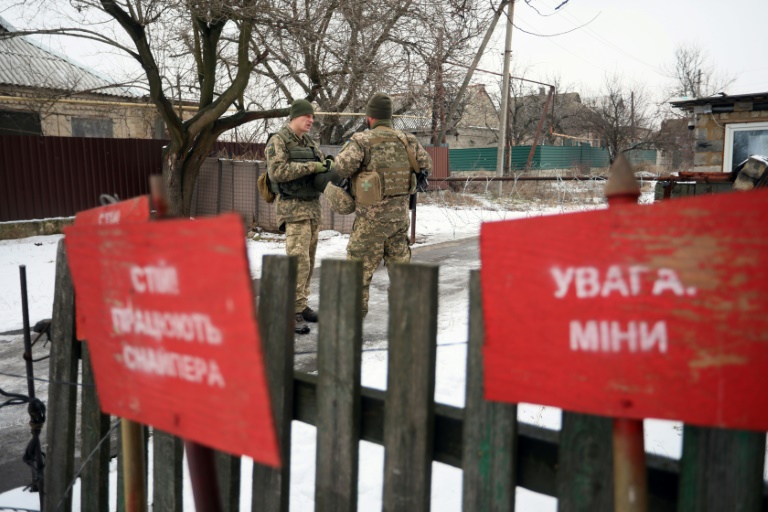
Russia’s use of newly-produced landmines in Ukraine poses the greatest challenge to a landmark global ban treaty forged 25 years ago, a monitor said Thursday.   

Moscow has developed new anti-personnel mines and used ones made as recently as 2021 in Ukraine, the Landmine Monitor said.

It said the use of landmines by Russia — and by Myanmar — marred the 25th anniversary of the Mine Ban Treaty, a pioneering accord struck in Ottawa in 1997.

The monitor’s annual report identified 277 civilian casualties of mines and explosives in Ukraine in the first nine months of 2022 — a near fivefold rise on the 58 in 2021.

“At least seven types of antipersonnel mines have been used by Russian forces in Ukraine since Russia invaded the country on February 24,” it said.

The monitor said it had confirmed evidence that Russian troops had planted “victim-activated booby-traps and improvised explosive devices in Ukraine… prior to retreating and abandoning their positions”.

“Scatterable mines” appear to have been used in several regions, many of which were under Russian control, it said.

“The greatest challenge to the emerging norm against these weapons can be seen in new use,” it said.

“Landmines continue to kill and injure civilians, destroy livelihoods, deny land use, and disrupt access to essential services in more than 60 countries and territories.”

A total of 164 countries are bound by the ban treaty and have jointly destroyed more than 55 million stockpiled anti-personnel mines.

Russia is not a signatory to the Mine Ban Treaty, while Ukraine is.

In 2021, at least 5,544 casualties were reported across 50 territories, of which 2,182 were fatal, it said.

The number of casualties was however down on the 7,073 recorded in 2020.

The all-time low of 3,456 was registered in 2013.

“Casualties from landmines and ERW (explosive remnants of war) have been disturbingly high for the past seven years,” the report said.

“This trend is largely the result of increased conflict and contamination by improvised mines observed since 2015.”

– Syria, Afghanistan worst-hit –

Syria witnessed the highest number of casualties in 2021 for the second straight year at 1,227. 

It was closely followed at 1,074 by Afghanistan, which has had more than 1,000 annual casualties for over a decade.

Colombia, Iraq, Mali, Nigeria and Yemen also recorded more than 100 casualties last year.

Where the age, combat status and gender of victims were known, 76 percent of casualties were civilians — of whom half were children. Males made up 81 percent of the victims.

Besides their use by the armed forces of Russia and Myanmar, landmines were deployed in 2021 by non-state armed groups in the Central African Republic, Colombia, the Democratic Republic of Congo, India and Myanmar.

The monitor said 11 countries were still producing anti-personnel mines: China, Cuba, India, Iran, Myanmar, North Korea, Pakistan, Russia, Singapore, South Korea and Vietnam.

This is one fewer than last year, following a US decision to prohibit their development, production, and acquisition.

There are approximately 45 million anti-personnel mines stockpiled worldwide.

Russia has the largest stockpile at 26.5 million, followed by fellow treaty non-signatories Pakistan with an estimated six million, India, China, and the United States, which has three million.

– 60 territories still mined –

Nearly 133 square kilometres (51 square miles) of land were cleared of landmines last year — more than half of which were in Cambodia and Croatia. 

Over 117,000 anti-personnel mines were destroyed, the report said.

But at least 60 territories are still riddled with anti-personnel mines, with only Sri Lanka and Zimbabwe currently seeming on target to meet clearance deadlines.

Assistance for victims was also inadequate, the report said.

“In 2021, healthcare and rehabilitation activities remained under-funded and faced increasing and numerous challenges,” it said, adding that global support for demining decreased by seven percent to $598.9 million in 2021.

The 24th annual report was produced by the Landmine and Cluster Munition Monitor, the research and monitoring arm of the International Campaign to Ban Landmines and the Cluster Munition Coalition NGOs.
M23 rebels advance in eastern DR Congo

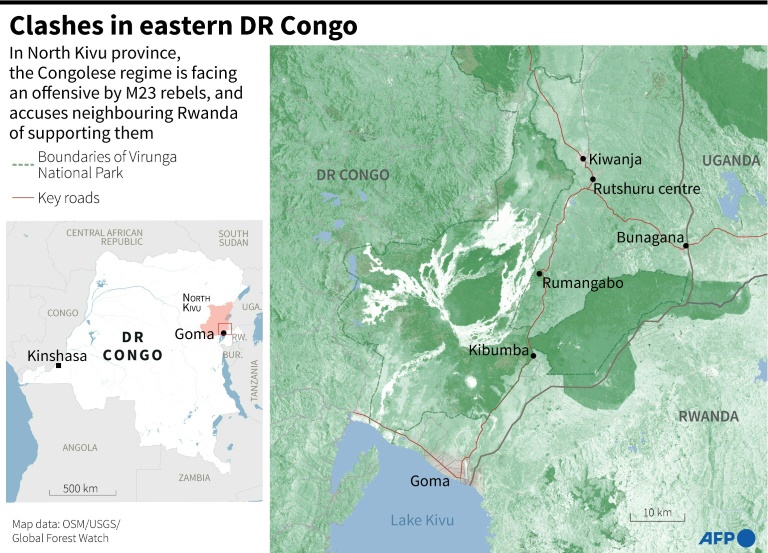
The M23 rebel group in eastern Democratic Republic of Congo has pushed into fresh territory, officials said, after a regional bloc issued a call to lay down arms. 

A resurgent group mostly drawn from Congolese Tutsis, the M23 has swept across North Kivu province, triggering a humanitarian crisis and a showdown between the DRC and Rwanda, which Kinshasa accuses of supporting the rebels.

In recent weeks, fighters have been edging closer towards Goma, an important commercial hub of one million people on the border with Rwanda.

But local residents and administrative officials told AFP that the armed group had also begun a push westwards into Masisi territory.

“The rebels are here,” a resident of Tongo, a town in wildlife haven Virunga National Park, which lies on the road leading to Masisi territory, said on Thursday. 

An official in the local administration, who requested anonymity, also told AFP late Wednesday that M23 fighters had entered his office. 

M23 fighters and Congolese troops were clashing this week in Kibumba, which is just 20 kilometres (12 miles) north of Goma. 

A security official, who declined to be named, said Thursday the M23 now controlled the settlement. 

The DRC’s army has yet to communicate officially about the rebel advance. 

On Wednesday, the head of the newly created East African Community (EAC) military force in eastern DR Congo, Jeff Nyagah, said that rebels that must pursue political negotiations and disarm. 

“Those who fail or refuse to voluntarily disarm, then we’ll go for them,” the Kenyan general warned.

Nyagah also vowed that the EAC force would protect Goma. 

Despite official denials from Kigali, an unpublished report for the United Nations seen by AFP in August pointed to Rwandan involvement with the M23.

The report also said the M23 plans to capture Goma in order to extract political concessions from the government in Kinshasa. 

The M23 first leapt to prominence in 2012 when it captured Goma, before being driven out and going to ground. 

But the rebel group re-emerged late last year, claiming that the DRC had failed to honour a pledge to integrate its fighters into the army, among other grievances. 

S.Africa's parliament probe into Ramaphosa farm heist to conclude December

South Africa’s parliament said Thursday it would discuss next month the findings of a special panel tasked with establishing whether President Cyril Ramaphosa should face impeachment for allegedly covering up a crime.

A three-person team was appointed in September to determine whether Ramaphosa has a case to answer, and had been scheduled to submit its findings on Thursday.

But parliament on Wednesday said the investigators had requested more time due to the “complexity” and “novelty” of the case, as well as the amount of work involved.

The report will now be turned in on November 30 and lawmakers will examine it on a one-day sitting on December 6, the assembly said.

The date is just 10 days before Ramaphosa faces an election for leadership of the ruling African National Congress (ANC) party.

“The deadline for the panel to submit its report has been postponed to November 30th so it has been decided that the National Assembly will consider the report on December 6,” parliamentary spokesman Moloto Mothapo spokesman told AFP.

Parliament was due to start its year-end recess on December 1, but this will now be delayed in order to address the matter.

The scandal erupted in June after South Africa’s former national spy boss filed a complaint with the police, alleging that in 2020 Ramaphosa had concealed a multi-million-dollar cash theft at his farm in the northeast of the country.

The controversy risks derailing Ramaphosa’s bid for a second term as ANC president, a post that as head of the ruling party also enshrines him as president of the nation.

The hotly-contested polls will take place at a conference running from December 16 to 20. The election typically takes place on the opening day.

The independent panel, which was appointed by the National Assembly speaker last month, comprises an ex-chief justice, a former prominent high court judge and a lawyer.

Impeaching a president — removing him or her from office — requires a two-thirds majority vote in the National Assembly, where the ANC commands more than two-thirds of the seats.

Ramaphosa came to power in 2018 on a promise of tackling graft. He succeeded Jacob Zuma, who was forced to resign by the ANC on the back of a string of corruption scandals.

The president, who denies any wrongdoing, reportedly faced questioning from party rivals and calls to step down at a closed-doors meeting on Sunday.

Presidential spokesman Vincent Magwenya told journalists that Ramaphosa “will gladly step aside” if he were to be criminally charged.

Language proposal stirs thorny debate in troubled Mali

Mali gained independence from France in 1960, yet even today French is the language of government business, used on road signs and in state TV broadcasts. 

But on Bamako’s streets, French is rarely heard, and out in the bush even less so.

Mali has scores of its own languages — which is why, for some, it rankles that the tongue of the former colonial ruler is the only official language.

A few lines in the country’s draft constitution are now fanning calls for change, albeit at the cost of reminding the West African nation of some of its many problems.

“It’s been 60 years since independence — is it normal that French is our only official language?” asked Ali Guindo, a resident of the capital Bamako.

“We have lots of languages here in Mali,” he said outside his home in Torokorobougou district. “It would be good to cement them in our official culture.”

The debate has been sparked by the unveiling last month of a draft constitution, billed by the ruling junta as crucial for saving Mali from jihadist insurgents.

As in the 1992 constitution it is designed to replace, the charter identifies French as the “language of official expression.”

But, in a change, it also says local languages are “intended to become official languages.”

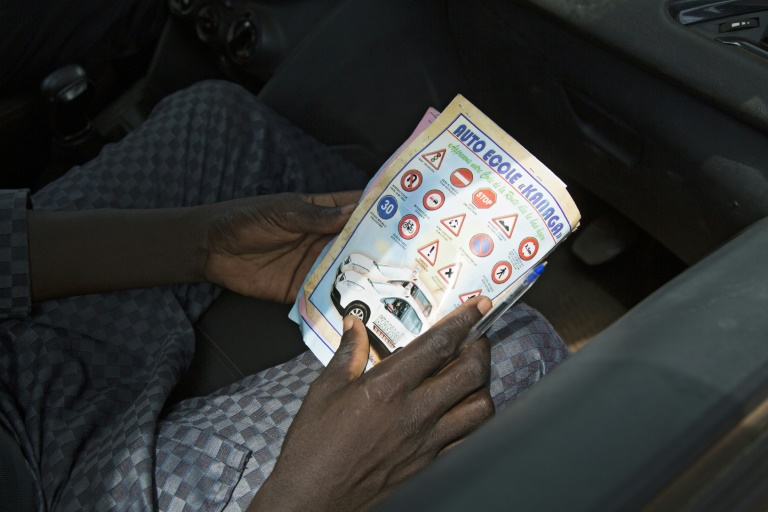
More than 70 languages are spoken in Mali, a deeply poor Sahel nation with a fast-growing population of some 21 million.

Of these 13 are recognised as “national” languages but French is the only official one, meaning that it is used for government and regulatory business, said Amadou Salifou Guindo, a specialist in sociolinguistics.

Among the major local languages, Songhay and Tamashek are widely spoken in the north; Fulfulde in central areas by the Fulani, an ethnic group also known as Peul; Bambara predominates in Bamako; and in the country’s far south, Senufo and Soninke prevail.

– Difficult debate –

The few words in the proposed Article 31 have now fired up discussion, from TV talk shows to chats over tea in informal get-togethers known as grins.

Among the questions: is it time to elevate vernacular languages to the status of official tongues? If so, which ones? And how can this be achieved?

But these questions also have swirling undercurrents.

One is Mali’s relationship with France, the country’s traditional ally, which has hit rock-bottom since the junta came to power in August 2020.

Some have used the bust-up to seize on Article 31 as a means to phase out French and make Bambara, the most-used language in Bamako, the official one instead.

But to do so touches on the sensitive question of national identity, potentially alienating speakers of other languages.

“Malians are afraid of an official language being imposed to the detriment of others,” said Guindo the linguist.

Another problem is rather more basic: teaching children to read and write in their local languages, which are rooted in oral traditions.

Under former president Moussa Traore who was ousted in 1991, experimental schools were set up that taught in vernacular languages.

The “revolutionary” idea foundered on a lack of state investment, and the schools came to be seen by parents and teachers as second class, writer and publisher Ismaila Samba Traore said.

– French dominates –

Local languages are still being taught, but on a small scale.

At the languages faculty at the University of Bamako, department head Mahamadou Kounta teaches Bambara to around 20 students.

The work, he says, is akin to sowing seed.

“When our students graduate, they will be able to read and write in the national languages and they in turn will be able to work to perpetuate them.”

Traore, who runs a publishing company called La Sahelienne, has been in business for 30 years.

He is one of the few publishers in Mali to bring out books in local languages — typically educational works ordered by international NGOs. 

Other than that, publishing remains overwhelmingly in French.

Changing the constitution will not by itself alter habits that have been entrenched for decades, Traore admitted.

“Certain processes cannot be achieved from one day to the other — you have to let things incubate,” he said.

'Nothing to eat': People starve in Burkina Faso town under jihadist blockade

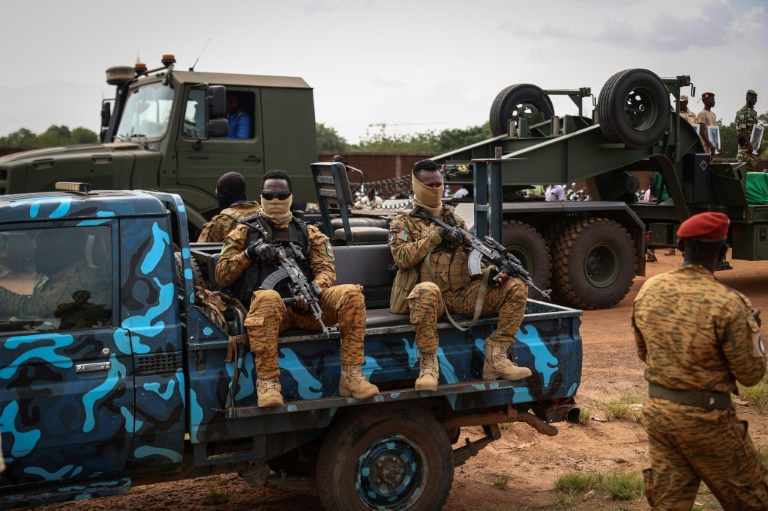
Jihadists have dynamited bridges and mounted deadly attacks against supply convoys, blockading Burkina Faso’s northern town of Djibo and leaving its people destitute.

“The situation is catastrophic in Djibo,” said Idrissa Badini, a spokesman for a group of civil society organisations in the wider Soum province.

“Hunger is at such a level that it is starting to kill children and the elderly.”

Last month alone, 15 people died of hunger in the town, he said. But there were “probably more victims”, as other cases had likely gone unreported.

According to the United Nations, dozens of places in Burkina Faso face conditions similar to those in Djibo.

Nearly a million people are living in besieged areas in the north and east of the country.

Burkina Faso has been struggling with a jihadist insurgency since 2015.

Over the last few years, Djibo has become a hub for the region’s internally displaced people, forced to flee violence involving groups linked to Al-Qaeda and the so-called Islamic State organisation.

The town’s population has tripled to an estimated 300,000.

But the blockade is now pushing some of those displaced to flee a second time, southwards to the capital Ouagadougou.

“Deprived of water, food, medicine and phone signal, many are leaving Djibo on foot, at night, in the hope of reaching areas they can still reach,” an aid worker told AFP on condition of anonymity.

– Eating leaves to survive –

On the road between Djibo and the town of Bourzanga, residents described seeing the wreckage of vehicles hit by landmines.

Several supply convoys have recently been attacked on the road.

In September, 35 people died when their truck was blown up by a mine. There were children among the dead.

Another attack on a convoy killed 11 soldiers.

The convoys are a lifeline — with farmers unable to tend to their fields amid the fighting, food production is almost non-existent in many parts of Burkina Faso.

“There’s nothing to eat, nothing to sell. Whether you’re poor or rich, you can’t buy anything,” said Souleymane Dicko, a Djibo resident who had escaped to the capital Ouagadougou.

“The worst thing is we’re in the dry season — the leaves and herbs we used to pull up and boil aren’t even available anymore.”

Disgruntled army officers have carried out two coups in Burkina Faso this year in a show of anger at failures to roll back the insurgency.

Earlier this month, Captain Ibrahim Traore, who seized power in a coup in September, went to Djibo on his first official visit.

“Go and see the children who have skin on their bones, the old people who are dying of hunger, the women who can no longer breastfeed because they have nothing left in their breasts,” Traore said.

“Let’s not pretend. There are people who eat leaves to survive.”

He described a “worrying situation”, saying “the territory is almost lost”.

– ‘Verge of a humanitarian disaster’ –

In Arbinda, a town to the east of Djibo, tens of thousands of people from surrounding areas have gathered fleeing attacks. 

“The regular land convoys that used to supply the population with food and subsistence products have stopped,” said Badini.

“For the past two months, nothing has reached Arbinda. The population, which has used up its reserves, is on the verge of a humanitarian disaster.”

In some cases, some supplies have been able to get through to areas in need despite the attacks.

At the end of last month, the army airlifted 70 tonnes of grain to Djibo, and trucks ferried in more than 300 tonnes of food to the town at the start of this month, the army general staff says. 

Seven mines were defused on the way.

“We have been able to supply some villages but not others yet,” Traore said.

The World Food Programme says around 3.5 million people in Burkina Faso will need emergency food aid in the coming months.

S.Africa's ghost hunters look for clues in hollow rooms

Shortly after nightfall, flashlight in hand, Rivas Bright knocks twice on the broken window of an abandoned building in Pretoria, South Africa.

“Still!” he tells his fellow ghost hunters. They hold their breath, waiting for a response from the shadows.

It’s been around two years since Bright, 39, set up “The Upsidedown” a group of paranormal enthusiasts hunting ghosts in a bid to prove they are real. 

It’s a daunting task, given spirits are proverbially evasive. 

“It’s a broken science,” Nigel Mullinder, 29, a member of the team who during the day works at a casino, says of the study of paranormal events, which has drawn the interest of researchers and parapsychologists but produced little hard evidence.

Bright and his team of “sceptical believers” — five men and two women — have turned to tech to solve the mystery. 

Armed with an arsenal of tools including infrared cameras, motion and heat detectors, radios, and a self-developed app to uncover paranormal activity, they scout haunted buildings looking for clues in cavernous hallways and rusting stairwells. 

“(We) need a set of evidence that would allow us to prove that it’s not just the wind (blowing) through the window or a door closing because of some sorts of vibrations,” says Mullinder.

Tonight they have come to an abandoned building within the campus of one of South Africa’s largest universities, which asked not to be named. 

Night guards here have been spooked by creepy noises. 

Lucy Tsoeu, 46, says slamming doors and the clacking of a typewriter at night have led her to believe a ghost is hanging about. 

Her colleague Mpho Mthombeni, 30, says he has heard toilets flush and felt a strange presence when there was no one about. 

“What can I do? Do I pray, or shall I speak louder to scare them away?” asks Tsoeu.  

“Maybe they’ll be able to cool them down,” she says of the ghost hunters, half worried and half excited.

– Shadows, whispers and gunshots –

Sporting a grey T-shirt over black trousers, a shaved head and pierced ears, Bright, a retail chain store employee, says he has heard strange sounds and seen sinister shadows since a very young age. 

“My mother would claim to speak to spirits” in her kitchen, he says. 

Since he founded “The Upsidedown”, the group has gathered a few thousand followers on social media, spent several thousand dollars on equipment and searched about a dozen premises, following tip-offs from anxious locals. 

At the university building the group checks every room, placing their detecting tools on a floor covered with dead leaves. 

“We are literally a bunch of guys that stand in the dark, ask questions… and follow red and green blinking lights,” quips Bright.

Bright rings a bell to signal to the ghosts that he wants to talk to them — but there is no reply.  

“We are not here to hurt anybody or remove you from that place. All we’re looking for is answers,” says Bright.

Gunshots echo in the distance. Pretoria is the capital of what is considered one of the world’s most dangerous countries. 

“Did you hear that? I could clearly hear someone call my name,” says a member of the team. It’s hard to corroborate. 

As the hunt goes on, others in turn sense a movement or hear a sigh. 

The group, made up of white, middle class South Africans, has been to this building once before a month ago. 

Then, its members say they communicated with the spirits of children in a room that was used as a makeshift morgue during violent riots in the 1980s. 

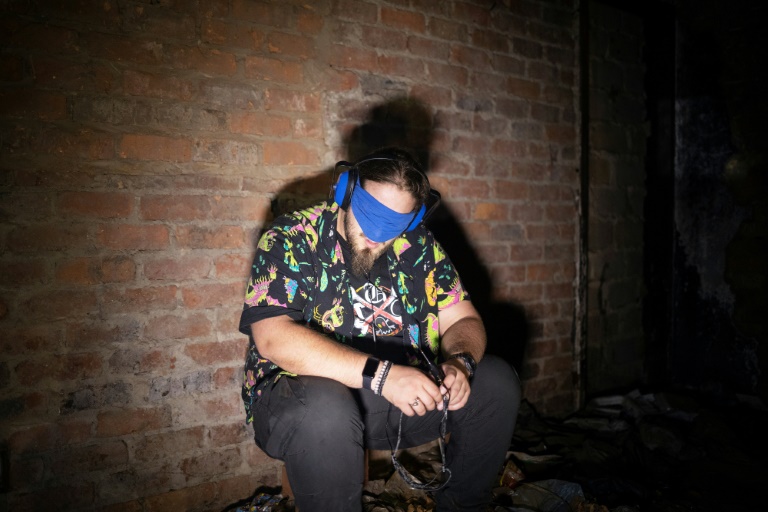
Mullinder tries to get in touch again, listening to a radio frequency meter while blindfolded. 

Everything is filmed to capture potential evidence. But the result is inconclusive. 

“I can understand why people would think we are crazy, but when we finally get that unsolvable massive piece of evidence… who’s the crazy one then?” says Bright. 

Brazil's Lula, world leaders bolster UN climate talks

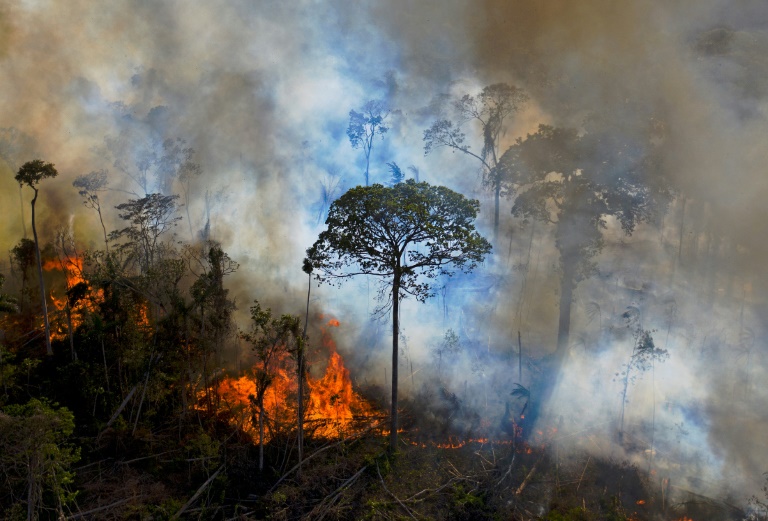
UN climate talks got a boost Wednesday after Brazilian president-elect Luiz Inacio Lula da Silva vowed to fight Amazon deforestation and global leaders reaffirmed key pledges.

While G20 leaders meeting in Indonesia issued a final communique committing to pursue the more ambitious limits on global heating, action on the sidelines of fraught COP27 negotiations in Egypt generated momentum at the UN climate conference.

Lula kicked off COP27 events Wednesday with a call to host the 2025 climate talks in the Amazon region, in his first international trip since defeating outgoing far-right President Jair Bolsonaro, who presided over years of rampant Amazon deforestation.

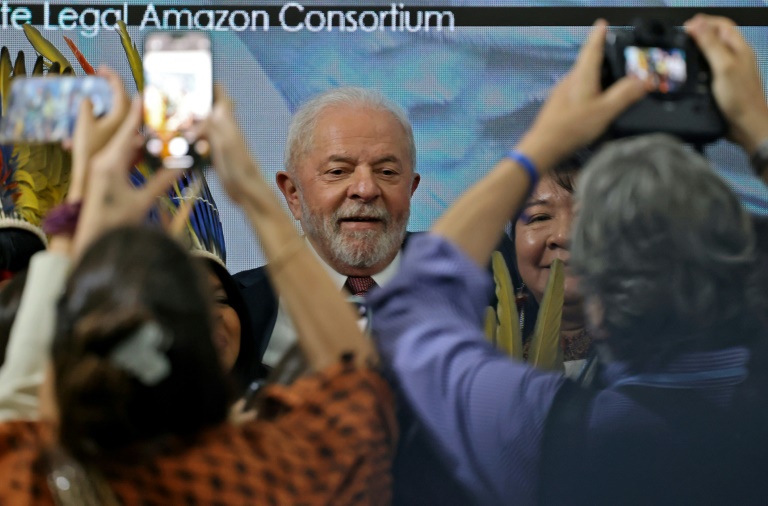
“I am here to say to all of you that Brazil is back in the world,” said Lula as he received a jubilant welcome from hundreds of people at an Amazon region pavilion in the Red Sea resort of Sharm el-Sheikh.

“We will put up a very strong fight against illegal deforestation,” he said, announcing the creation of an Indigenous people’s ministry to protect the vast region’s vulnerable communities.

“There is no climate security for the world without a protected Amazon,” Lula said later in a speech.

Lula arrived in Egypt on Tuesday and went straight into climate diplomacy, with meetings with US envoy John Kerry and China’s Xie Zhenhua.

– Kerry ‘pleased’ –

Kerry told a COP27 biodiversity panel on Wednesday that he was “really encouraged” by Lula’s pledge to protect the Amazon, and that the United States would work with other nations to help protect the rainforest.

Under Bolsonaro, a staunch ally of agribusiness, average annual deforestation increased 75 percent compared with the previous decade.

“We don’t need to cause deforestation of even one metre of the Amazon to continue being one of the biggest food producers in the world,” Lula said.

Speaking in Bangkok, where he is attending the Asia-Pacific Economic Cooperation forum, French President Emmanuel Macron threw his weight behind Lula’s proposal for the next UN climate summit to be held in the Amazon. 

“I ardently wish that we could have a COP in the Amazon, so I fully support this initiative of President Lula,” he said. 

In another boost to the UN climate process, the final communique from world leaders meeting at the Group of 20 talks in Bali, Indonesia, reaffirmed a promise to “pursue efforts” to curb global warming to 1.5 degrees Celsius above pre-industrial levels.

The G20 document also addresses the most contentious issue at COP27, as leaders urged “progress” on “loss and damage” — the costs of climate impacts already being felt — though without saying which approach they favoured.

Developing nations are demanding the creation of a loss and damage fund, through which rich polluters would compensate them for the destruction caused by climate-linked natural disasters.

But the United States and the European Union have suggested using existing channels for climate finance instead of creating a new one.

The G20 meeting was also the stage of a crucial meeting between US President Joe Biden and China’s Xi Jinping, where the two leaders agreed to resume their climate cooperation.

Ani Dasgupta, head of the World Resources Institute, said positive signals from leaders at the G20 “should put wind in the sails” of negotiators in Egypt.

In another COP27 announcement, the EU said it would dedicate more than $1 billion in climate funding to help countries in Africa boost their resilience in the face of the accelerating impact of global warming.

– Climate leadership –

In his speech, however, Lula took a dig at developed countries for failing to fulfil a pledge to provide $100 billion in aid annually from 2020 for developing nations to green their economies and adapt to future impacts.

“I’m also back to demand what was promised” at past climate talks, he said. 

The president-elect, who previously served from 2003 to 2010, threw his weight behind the idea of a climate impacts compensation fund.

“We very urgently need financial mechanisms to remedy losses and damages caused by climate change,” said Lula, who made a spectacular political comeback after serving jail time for corruption.

Latin America’s most populous country grew more isolated under Bolsonaro, analysts say, in part due to his permissive policies towards deforestation and exploitation of the Amazon, the preservation of which is seen as critical to fighting global warming.

Brazil is home to 60 percent of the Amazon, which spans eight countries and acts as a massive sink for carbon emissions.

The incoming Lula administration wants the United States to contribute to the Amazon Fund, considered one of the main tools to reduce deforestation in the planet’s biggest tropical forest.

Following Lula’s victory, the fund’s main contributors, Norway and Germany, announced they would participate again, after freezing aid in 2019 in the wake of Bolsonaro’s election.

Climate change fuelled rains behind deadly Nigeria floods: study

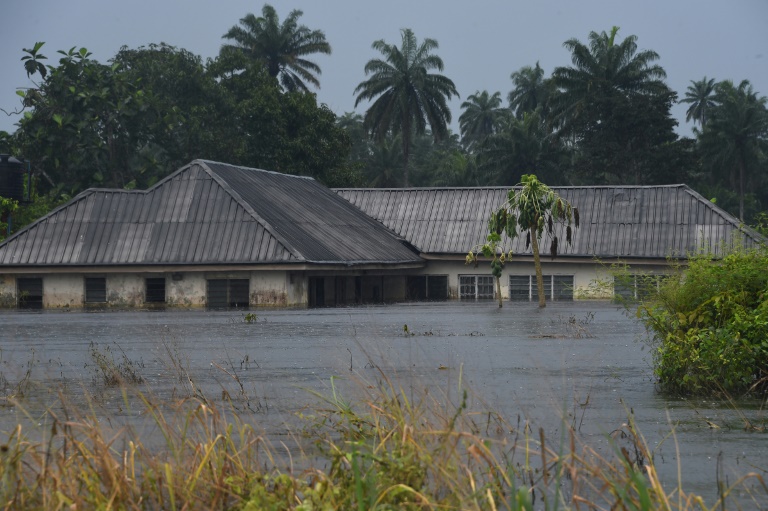
Heavy rains behind floods that killed over 600 people in Nigeria this year were about 80 times likelier because of human-induced climate change, scientists reported Wednesday.

The floods mainly struck Nigeria but also Niger, Chad and neighbouring countries, displacing over 1.4 million people and devastating homes and farmland in a region already vulnerable to food insecurity.

Researchers from the World Weather Attribution (WWA) consortium said in a study that the floods — among the deadliest on record in the region — were directly linked to human activity that is exacerbating climate change.

They matched long-term data on climate — which shows the planet has warmed by about 1.2 degrees Celsius (2.2 degrees Fahrenheit) since 1800 as carbon emissions have risen — against weather events.

The heavy rainfall that sparked the floods was 80 times likelier because of “human-caused climate change,” according to their findings. 

In addition, “this year’s rainy season was 20 percent wetter than it would have been without the influence of climate change,” they said. 

“The influence of climate change means the prolonged rain that led to the floods is no longer a rare event,” the study found. 

“The above-average rain over the wet season now has approximately a one in 10 chance of happening each year; without human activities it would have been an extremely rare event.” 

Over 600 people were killed in Nigeria alone because of the floods from June to October this year, and nearly 200 in Niger and 22 in Chad.

– ‘Real and present problem’ – 

The report comes as COP27 climate talks are underway in Egypt’s Sharm el-Sheikh, where developing nations are demanding rich polluters pay for climate-change linked calamities. 

Africa is home to some of the countries least responsible for carbon emissions but hardest hit by an onslaught of weather extremes, with the Horn of Africa currently in the grips of a severe drought.

“This is a real and present problem, and it’s particularly the poorest countries that are getting hit very hard. So it’s clear that solutions are needed,” Maarten van Aalst, director of the Red Cross Red Crescent Climate Centre, said at a WWA press conference. 

In a separate WWA study also released Wednesday, researchers examined a 2021 drought that reduced crop production in Mali, Burkina Faso, Niger, Nigeria and Chad that contributed to a food crisis this year. 

The study failed to find concrete climate change links, because of “a lack of reliable weather station data”, but showed “that even small shifts in rainfall can have major effects in the region”. 

It added that high global food prices deepened the crisis, along with the Russian invasion of Ukraine which disrupted deliveries of key fertilisers to Africa. 

The WWA publishes rapid-response reports following extreme climate events.

Their studies are not peer-reviewed, a process that can take months, but are widely backed by scientists. 

'Brazil is back': Lula draws crowds at UN climate talks

Showered with applause and chants of “Lula!”, Brazilian president-elect Luiz Inacio Lula da Silva made a splash at a UN climate conference in Egypt Wednesday, his first foreign trip since his election.

Despite a mixed record on the environment and jail time in his resume, the 77-year-old leftist politician drew crowds curious to hear his promises to protect the Amazon rainforest.

“Brazil is back,” Lula said repeatedly, words his supporters sang during his speech at the COP27 conference in the Red Sea resort of Sharm el-Sheikh.

Hundreds of people packed rooms at two separate events he attended, asking him for selfies and shouting his name.

UN security shut the doors when the room filled for his speech, leaving a disappointed crowd outside. 

Expectations are high for Lula to protect the Amazon after rampant deforestation seen under far-right President Jair Bolsonaro.

At COP27, Lula vowed to fight deforestation, offered to host UN climate talks in the Amazon region in 2025, and pledged to make Brazil a leader in the global battle against climate change again. 

“Lula represents a political change for Latin America,” said Adrian Martinez Blanco, who is attending the climate conference for Costa Rican NGO La Ruta del Clima.

“It is a shift towards the protection of the planet, the Amazon, human rights, the rights of Indigenous people,” he said.

– ‘Back into the fold’ –

Lula, who was president from 2003 to 2010, pulled off a huge political comeback to defeat Bolsonaro.

He left office as a blue-collar hero who presided over a commodity-fuelled economic boom that helped lift 30 million people out of poverty.

But he then became mired in a massive corruption scandal and served more than 18 months in prison from 2018. His conviction was later overturned.

“It’s very interesting to listen to him first hand and understand how he captures so much love from his people — while also not necessarily being the best for the country,” said Sofya Levitina, a student at the University of Connecticut, referring to the corruption scandal.

Melissa Yokoe Ashbaugh, who is studying at the same US university, said her “impression of the excitement is that he represents coming back around from a populous right-wing wave (that is) anti-environment”.

“It’s sort of the hope of people who are engaged in this sort of climate action space that globally, administrations like his will represent those interests,” she said.

Brazilian climate campaigner Mariana Paoli, who leads global advocacy at Christian Aid, said Brazil had become a “pariah state” under Bolsonaro when it came to climate policy.

“It’s so good to see Lula bringing Brazil back into the fold,” she said in a statement.

'No one will take Goma': E.Africa commander in DR Congo

The commander of the East African Community’s military force in the Democratic Republic of Congo vowed Wednesday to protect Goma, a key eastern city threatened by advancing M23 rebels.

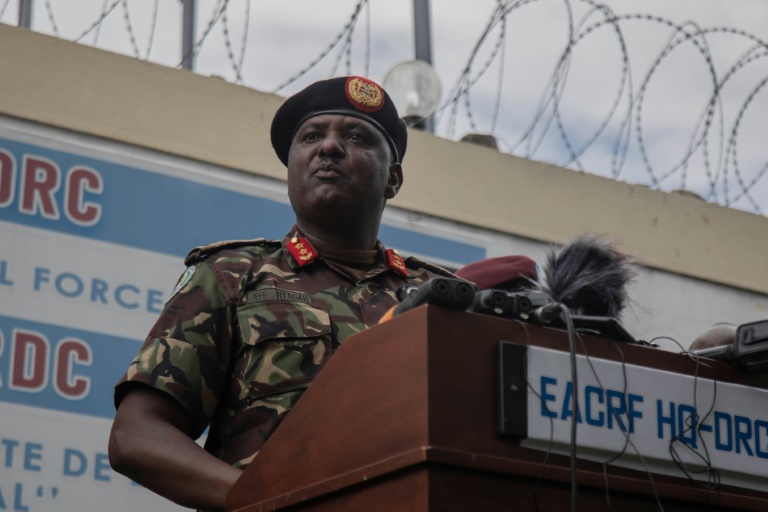
“No one will take Goma,” said Kenyan General Jeff Nyagah, the commander of the seven-nation bloc’s military force in the volatile east of the country.

“We are here to protect the city and the airport,” he added at a news conference in the commercial hub of about one million people.

About 100 Kenyan troops arrived in the city over the weekend, as part of a new East African Community (EAC) military operation aiming to stabilise eastern DRC.

Some 60 more Kenyan soldiers deployed on Wednesday, AFP journalists said, with M23 rebels just several dozen kilometres from the city.

East African leaders agreed to establish a military force for eastern DRC in April, but its intended size and scope remain unclear.

Nyagah told reporters that the EAC force was “an intervention force” rather than a peacekeeping force.

But he added that finding a political solution to the crisis and disarming rebels would take priority over fighting.

“Those who fail or refuse to voluntarily disarm, then we’ll go for them,” the general said. “We have no doubt about that in our mind.” 

The deployment of troops from the EAC bloc comes as M23 rebels have surged across the DRC’s North Kivu province, capturing swathes of territory in recent weeks.

On Wednesday, the rebel group announced that it had captured Kibumba, a settlement about 20 kilometres (12 miles) from Goma. 

The DRC’s army has not yet officially communicated on the rebel advance.

But an army official who spoke on condition of anonymity confirmed that soldiers had fled Kibumba.

“They have arms that rebels cannot have, this is a professional army we’re fighting,” the official told AFP. 

A mostly Congolese Tutsi group, the M23 first leapt to prominence in 2012 when it briefly captured Goma before being driven out and going to ground.

The group re-emerged late last year, taking up arms again on claims that the DRC had failed to honour a promise to integrate them into the army, among other grievances.

The crisis has cratered relations between the DRC and its smaller central African neighbour Rwanda, which Kinshasa accuses of backing the M23.

Despite official denials from Kigali, an unpublished report for the United Nations seen by AFP in August pointed to Rwandan involvement with the militia.

Rwanda, for its part, accuses Kinshasa of colluding with Hutu militants who fled across the border after the 1994 Rwandan genocide. The DRC denies this.

Close Bitnami banner
Bitnami