Africa Business

Irish edge world champions South Africa in Test thriller

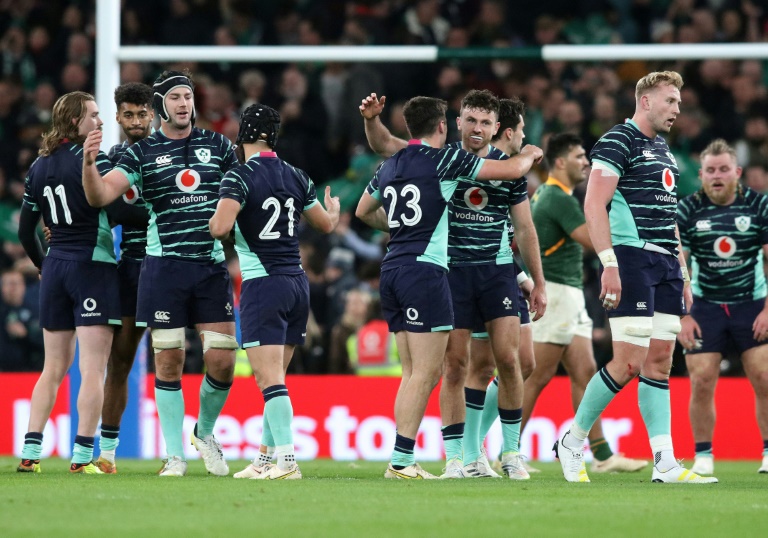
Ireland, the number one ranked team in the world, edged world champions South Africa 19-16 in a thrilling rugby Test at Lansdowne Road on Saturday for a 10th successive home win.

Both sides scored two tries apiece in the second-half as the game opened up after an attritional first period which saw the sides tied at 6-6 at the break.

The hosts tries came through Josh van der Flier and Mack Hansen whilst Franco Mostert and Kurt-Lee Arendse went over for the Springboks.

“That is the key word ‘Test’ match!” said Ireland captain Johnny Sexton.

“South Africa put you under so much pressure with their physicality but we dug in there and pulled it off and the pack did a brilliant job.

“We fronted up, we always do. We did not play our best but they did not let us.

“They are in our World Cup pool in a neutral venue. It will be a hell of a game.

“We will learn from this victory too, just as we would if we lost.”

Conor Murray’s traditional run on for his 100th cap was almost ruined as Sexton started to walk the team out from the tunnel.

However, Sexton realised the error, stopping and ushering his long-time half-back partner forward to take the cheers on his own.

The Irish made a storming start earning a penalty in the second minute — Sexton slotting it over for a 3-0 lead.

Damian Willemse, making just his third start for the Springboks as fly-half, levelled the scores in the ninth minute.

The hosts had been under the cosh and got a boost in the 17th minute as Georgian referee Nika Amashukeli flashed a yellow card at Cheslin Kolbe for a dangerous tackle on Mack Hansen.

The Irish tried to take immediate advantage but a crunching tackle on Hugo Keenan by Makazole Mapimpi won the Springboks a penalty allowing them to clear upfield. 

Willemse missed a chance to put the visitors ahead as his weakness in kicking at goal was painfully evident with his penalty drifting well wide of the posts.

– Murray disappointment –

However, it would have been the Springboks who were the happier come the return of Kolbe having kept the game all square.

Murray’s 100th Test ended disappointingly as, having made a run piercing the South African defence, he pulled up clutchng his groin.

The 33-year-old limped off with his hands covering his face in despair.

Sexton converted a penalty resulting from Murray’s run to give them a 6-3 lead. 

The Springboks levelled with the last kick of the half as Kolbe — replacing Willemse as the kicker — sent the ball between the posts.

The Irish came out fired up for the second-half despite losing another stalwart Tadhg Furlong to injury.

Sexton boldly went for touch instead of the posts — having been awarded a penalty — and van der Flier did brilliantly to touch down from the resulting line-out. 

Sexton’s conversion went wide leaving the Irish 11-6 up.

The hosts’ tails were up and they were back over the tryline within minutes.

A brilliant move by the Irish, having forced a turnover, resulted in Hansen going over in the corner — Sexton’s conversion once again went wide.

The Springboks were looking fatigued and became increasingly frustrated — Willie Le Roux received a telling off from the referee to ‘watch your language’ — but they struck back with 14 minutes remaining.

Franco Mostert went over but Kolbe’s conversion came back off the post for 16-11.

Willemse’s travails at fly-half did not let up as he sent a kick out on the full which allowed the Irish to come back for a line-out inside the visitors half.

They came away with three crucial points as Sexton — with his right thigh strapped — landed a penalty for 19-11 with less than eight minutes remaining.

However, South Africa showed their ‘world champion’ credentials by coming back once more, Eben Etzebeth’s brilliant lay-off setting up Arendse for a try in the corner.

Kolbe missed with the conversion and the Irish held on for the remaining two minutes to spark raucous celebrations.   
Pope holds Bahrain mass as death row families urge intervention

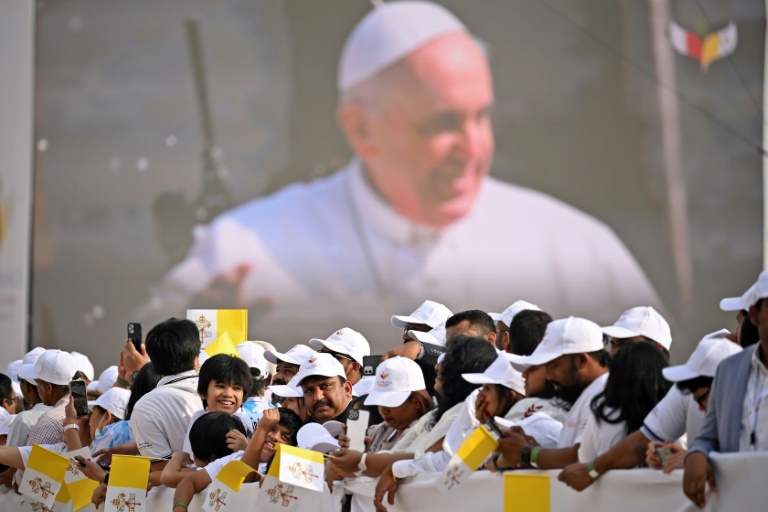
About 30,000 flag-waving worshippers attended an open-air mass held by Pope Francis in mainly Muslim Bahrain on Saturday, marked by a small protest by relatives of death row prisoners.

Police briefly detained around 10 people who had protested outside a school where he was due to speak and asked to meet with the pontiff, according to a London-based human rights group.

Hajer Mansoor, mother of jailed activist Sayed Nizar al-Wadaei, held a placard reading: “Tolerance does not exist for us here in Bahrain.”

The Bahrain Institute for Rights and Democracy (BIRD) said police had detained about 10 people and released them around an hour later.

A government spokesman said: “There have been no arrests or apprehensions related to the papal visit.

“A group of nine individuals were requested to disperse by uniformed police and acceded to the request,” the spokesman said, adding: “No further action is being taken in this regard”.

The pope, who did not stop to talk to the protesters, was met with dances and flowers inside the Sacred Heart school, where he urged children to “embrace the culture of care”.

The pontiff, leader of the world’s 1.3 billion Catholics, is on his second visit to the Muslim-ruled Gulf, home to millions of migrant workers including a sizeable Catholic community.

Matricia, a Filipina living in Dammam in neighbouring Saudi Arabia, said she felt “lucky” to be at Saturday morning’s mass.

“I am feeling blessed because we are really lucky to be at this holy event, where the pope will be giving the mass to all of us,” she said.

At the service, some congregants had tears in their eyes as they waited to see the 85-year-old at Bahrain National Stadium, the kingdom’s biggest venue.

Francis, who uses a wheelchair and walking stick due to knee problems, smiled and waved to the crowds and kissed children from his popemobile as it drove towards a white stage backdropped by a giant gold cross.

“This very land is a living image of coexistence in diversity and indeed an image of our world, increasingly marked by the constant migration of peoples and by a pluralism of ideas, customs and traditions,” he said in an address.

– ‘Right to life’ –

But while his trip has focused on dialogue with Islam, it has been marked by accusations of rights abuses in the Gulf nation.

Rights groups have long cited discrimination, repression and harassment by Bahrain’s Sunni Muslim rulers against Shiite opposition figures and activists.

Human Rights Watch has accused Bahraini courts of issuing death sentences based on “manifestly unfair trials”.

In a speech after his arrival on Thursday, the pontiff had spoken of the “right to life” and the “need to guarantee that right always, including for those being punished, whose lives should not be taken”.

A government spokesperson said Tuesday in a statement that Bahrain “does not tolerate discrimination” and “prides itself on its values of tolerance”.

The statement said that “no individual” is prosecuted “because of their religious or political beliefs”, but pointed to “a duty to investigate” people who “incite, promote or glorify violence or hatred”.

Pope Francis’s 39th international visit is largely aimed at building ties with Muslim officials. 

On Friday, he met the grand imam of Egypt’s Al-Azhar mosque, one of the leading authorities of Sunni Islam, and members of the Muslim Council of Elders.

He also attended a service at Our Lady of Arabia Cathedral, the biggest in the Arabian peninsula that seats more than 2,000. Hundreds of migrant workers were among the congregation welcoming him.

Pilot strike disrupts Kenya Airways flights

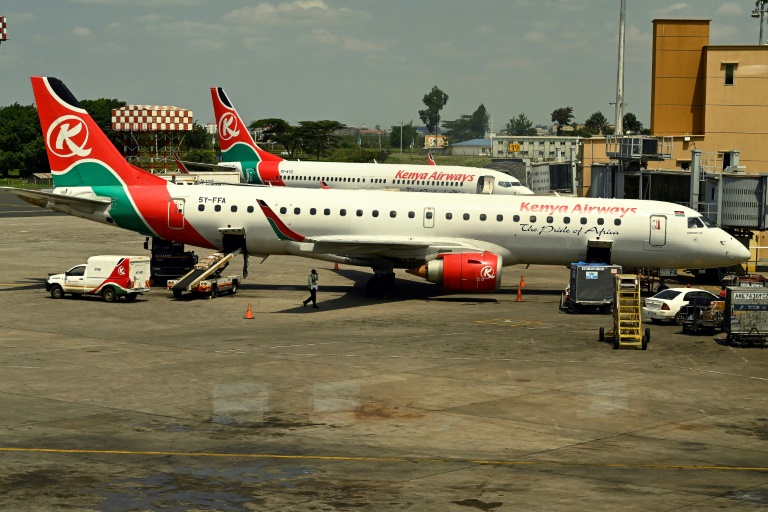
Kenya Airways pilots went on strike Saturday, grounding nearly two dozen flights and stranding thousands of passengers, exacerbating woes facing the beleaguered carrier.

The airline, part owned by the government and Air France-KLM, is one of the biggest in Africa, connecting multiple countries to Europe and Asia, but it is facing turbulent times, including years of losses.

The Kenya Airline Pilots Association (KALPA) said no Kenya Airways flight flown by its members had departed Nairobi’s Jomo Kenyatta International Airport from 6:00 am (0300 GMT) onwards on Saturday.

The pilots announced the strike in defiance of a court order against industrial action and gave no indication of how long it will last.

The airline’s managing director and CEO, Allan Kilavuka, said 23 flights had been cancelled as of 11:00 am due to “the unlawful strike”, affecting over 9,000 passengers.

He urged the protesting pilots, who make up 10 percent of the workforce, to return to work by 10:30 am on Sunday.

“Failure to do so will lead to immediate disciplinary action,” he warned.

The Kenya Aviation Workers Union (KAWU) subsequently announced that ground staff would also strike from 2:00 pm onwards in a separate, long-running dispute with the Kenya Airports Authority (KAA) over salary increases.

“The Union has no option but to commence the industrial action,” it said on Twitter, citing a court order supporting its members’ right to strike until negotiations with the KAA are concluded.

– ‘Negotiate in good faith’ –

But the KAA later said it had appealed the court order. “Our staff have reported on duty and operations at all our airports are normal,” it insisted.

Kenya’s newly appointed Transport Minister Kipchumba Murkomen told reporters that the pilots’ strike was unwarranted and “akin to economic sabotage”.

“I am not saying their concerns are not valid,” he said, appealing to the “goodwill of the pilots to terminate” what he described as drastic action.

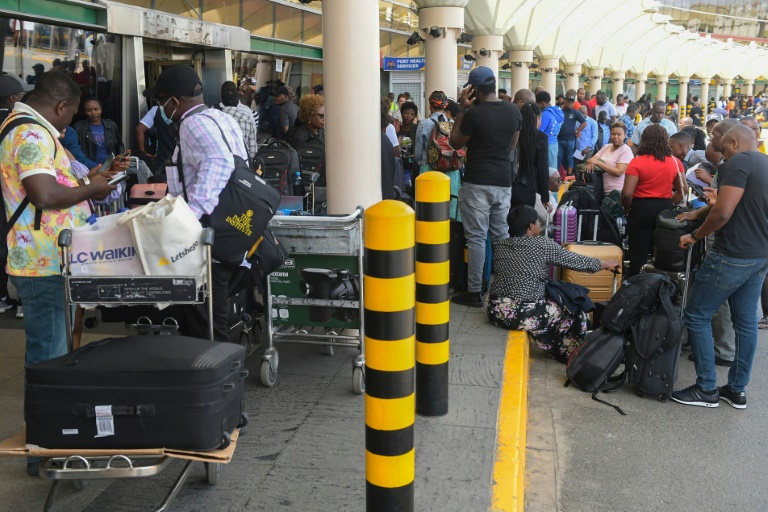
Frustrated passengers described huge queues at the airport, with many only learning their flights were cancelled when they arrived to check in.

“We have been told nothing,” US tourist Jill Lee told AFP as she waited in line after her flight to Tanzania’s financial capital Dar es Salaam was cancelled at the last minute.

The 65-year-old was booked to go on safari but said she had no idea where she would spend the night after her connecting flight from Nairobi was cancelled.

“Many people here have nowhere to go. It’s pretty horrible.”

On Saturday, KALPA blamed “the hardline stance adopted by” the airline’s management for throwing thousands of travellers’ plans into disarray.

It urged them to “come to the table and negotiate in good faith, if they truly sympathise with the plight of Kenya Airways passengers.”

– Injunction – 

The pilots are pressing for the reinstatement of contributions to a provident fund and payment of all salaries stopped during the Covid-19 pandemic.

On Monday, the airline won a court injunction stopping the strike, but an official at KALPA, which has 400 members, told AFP the pilots “were acting within the provisions of the law” and that they were yet to be served with a court order.

The carrier warned earlier this week that the strike would jeopardise its recovery, estimating losses at $2.5 million per day if the pilots went ahead with their plans.

The airline was founded in 1977 following the demise of East African Airways and flies more than four million passengers to 42 destinations annually.

But its slogan “The Pride of Africa” rings hollow as it operates thanks to state bailouts following years of losses.

The carrier saw its revenue nosedive after the pandemic grounded planes worldwide because of stringent travel restrictions, devastating the aerospace and tourism industries.

In August, the airline reported a $81.5 million half-year loss citing high fuel costs, despite the Kenyan government injecting some $520 million to keep it afloat.

On Wednesday, the airline’s management said it was on a path to recovery, flying at least 250,000 passengers each month, and aiming to cut its overall operating costs by 10 percent before the end of next year.

Pilot strike disrupts Kenya Airways flights

Kenya Airways pilots went on strike Saturday, grounding nearly two dozen flights and stranding thousands of passengers, as ground workers followed suit throwing the country’s aviation sector into chaos.

The airline, part owned by the government and Air France-KLM, is one of the biggest in Africa, connecting multiple countries to Europe and Asia, but it is facing turbulent times, including years of losses.

The Kenya Airline Pilots Association (KALPA) said no Kenya Airways flight flown by its members had departed Nairobi’s Jomo Kenyatta International Airport from 6:00 am (0300 GMT) onwards on Saturday.

The pilots announced the strike in defiance of a court order against industrial action and gave no indication of how long it will last.

The airline’s managing director and CEO, Allan Kilavuka, said 23 flights had been cancelled as of 11:00 am due to “the unlawful strike”, affecting over 9,000 passengers.

He urged the protesting pilots, who make up 10 percent of the workforce, to return to work by 10:30 am on Sunday.

“Failure to do so will lead to immediate disciplinary action,” he warned.

The Kenya Aviation Workers Union (KAWU) subsequently announced that ground staff would also strike from 2:00 pm onwards in a separate, long-running dispute with the Kenya Airports Authority (KAA) over salary increases.

– ‘Negotiate in good faith’ –

“The Union has no option but to commence the industrial action,” it said on Twitter, citing a court order supporting its members’ right to strike until negotiations with the KAA are concluded.

Kenya’s newly appointed Transport Minister Kipchumba Murkomen told reporters that the pilots’ strike was unwarranted and “akin to economic sabotage”.

“I am not saying their concerns are not valid,” he said, appealing to the “goodwill of the pilots to terminate” what he described as drastic action.

Frustrated passengers described huge queues at the airport, with many only learning their flights were cancelled when they arrived to check in.

“We have been told nothing,” US tourist Jill Lee told AFP as she waited in line after her flight to Tanzania’s financial capital Dar es Salaam was cancelled at the last minute.

The 65-year-old was booked to go on safari but said she had no idea where she would spend the night after her connecting flight from Nairobi was cancelled.

“Many people here have nowhere to go. It’s pretty horrible.”

On Saturday, KALPA blamed “the hardline stance adopted by” the airline’s management for throwing thousands of travellers’ plans into disarray.

It urged them to “come to the table and negotiate in good faith, if they truly sympathise with the plight of Kenya Airways passengers.”

– Injunction – 

The pilots are pressing for the reinstatement of contributions to a provident fund and payment of all salaries stopped during the Covid-19 pandemic.

On Monday, the airline won a court injunction stopping the strike, but an official at KALPA, which has 400 members, told AFP the pilots “were acting within the provisions of the law” and that they were yet to be served with a court order.

The carrier warned earlier this week that the strike would jeopardise its recovery, estimating losses at $2.5 million per day if the pilots went ahead with their plans.

The airline was founded in 1977 following the demise of East African Airways and flies more than four million passengers to 42 destinations annually.

But its slogan “The Pride of Africa” rings hollow as it operates thanks to state bailouts following years of losses.

Like other carriers around the world, Kenya Airways saw its revenue nosedive after the pandemic grounded planes worldwide because of stringent travel restrictions, devastating the aerospace and tourism industries.

In August, the airline reported a $81.5 million half-year loss citing high fuel costs, despite the Kenyan government injecting some $520 million to keep it afloat.

On Wednesday, the airline’s management said it was on a path to recovery, flying at least 250,000 passengers each month, and aiming to cut its overall operating costs by 10 percent before the end of next year.

Kenya Airways flights disrupted due to pilot strike

Kenya Airways flights were disrupted Saturday as a strike by its pilots demanding better working conditions grounded over a dozen planes, affecting thousands of passengers, the country’s transport minister said.

The airline, part owned by the government and Air France-KLM, is one of the biggest in Africa, connecting multiple countries to Europe and Asia, but it is facing turbulent times, including years of losses.

The Kenya Airlines Pilots Association (KALPA) said that no Kenya Airways flight flown by its members had departed Nairobi’s Jomo Kenyatta International Airport starting from 6:00 am (0300 GMT) on Saturday.

“The strike is fully in force,” KALPA union secretary general Murithi Nyagah said in a statement released on Saturday.

The pilots announced the strike in defiance of a court order against the industrial action and have given no indication of how long it will last.

Kenya’s newly appointed Transport Minister Kipchumba Murkomen told reporters at the airport on Saturday that the strike was unwarranted and “akin to economic sabotage”.

He said around 10,000 passengers had been affected by the strike, which had led to the grounding of 15 planes.

“I am not saying their concerns are not valid,” he said, but added that their actions were drastic as he appealed to the “goodwill of the pilots to terminate the strike.”

Frustrated passengers described huge queues at the airport, with many travellers only learning about their cancelled flights when they showed up to check in.

“We have been told nothing,” American tourist Jill Lee told AFP as she waited in line to figure out her next course of action after her flight to Dar es Salaam was cancelled at the last minute.

The 65-year-old had booked a safari in Tanzania but said she had no idea where she would spend the night after her connecting flight from Nairobi was cancelled.

“Many people here have nowhere to go. It’s pretty horrible.”

– ‘Soften its stance’ –

Kenya Airways on Saturday reported high call volumes at its service centre due to the “ongoing unlawful industrial action”, urging customers to only contact the airline if they were travelling in the next 48 hours.

The pilots, who have had a particularly fraught relationship with management, are pressing for the reinstatement of contributions to a provident fund.

They also want back payment of all salaries stopped during the Covid-19 pandemic.

KALPA representatives said Friday that a series of meetings with airline management had failed to resolve grievances.

“Kenya Airways management’s actions have left us with no other option,” Nyagah said, adding that a 14-day notice on the industrial action had ended without a solution.

“We had hoped that the management of the airline would soften its stance and engage in negotiation on the issues raised.”

On Monday, the airline won a court injunction stopping the strike, but an official at KALPA, which has 400 members, told AFP the pilots “were acting within the provisions of the law” and that they were yet to be served with a court order.

The carrier warned earlier this week that the strike would jeopardise its recovery, estimating losses at $2.5 million per day if the pilots went ahead with their plans.

The airline was founded in 1977 following the demise of East African Airways and flies more than four million passengers to 42 destinations annually.

But its slogan “The Pride of Africa” rings hollow as it operates thanks to state bailouts following years of losses.

Like other carriers around the world, Kenya Airways saw its revenue nosedive after the pandemic grounded planes worldwide because of stringent travel restrictions, devastating the aerospace and tourism industries.

Pope holds open-air mass for 30,000 in Bahrain

About 30,000 flag-waving worshippers joined an open-air mass held by Pope Francis in mainly Muslim Bahrain on Saturday, the highlight of his outreach mission to the Gulf.

Some of the congregation had tears in their eyes as they waited to see the 85-year-old at Bahrain National Stadium, the kingdom’s biggest venue.

Francis, who uses a wheelchair and walking stick due to knee problems, smiled and waved to the crowds from an open-sided popemobile where he was seated, flanked by more than a dozen suited security guards and attendants.

As a 100-strong, multinational choir sang in multiple languages, the Argentine stood to kiss children lifted up to greet him in the specially adapted vehicle, which drove slowly towards a white stage backdropped by a giant gold cross.

“This very land is a living image of coexistence in diversity and indeed an image of our world, increasingly marked by the constant migration of peoples and by a pluralism of ideas, customs and traditions,” he said in an address.

The pope, who has made outreach to Islam a pillar of his papacy, is on his second visit to the resource-rich Gulf, the cradle of Islam.

During his 2019 trip to the United Arab Emirates he led a mass for 170,000 people and signed a Christian-Muslim manifesto for peace.

He has spent much of his four-day Bahrain trip meeting top officials and religious figures, but for Catholics in the tiny island nation, including many migrant workers, Saturday’s mass was the high point.

– ‘We didn’t sleep’ –

“We’ve been here since one o’clock. We didn’t sleep,” said volunteer Philomina Abranches, 46, an Indian-born Bahrain resident.

“We are so excited. We all call him ‘Papa’. More than anything, he represents peace in the world. This is what we need now.”

Margerite Heida, 63, also a Bahrain resident, said: “Hosting Pope Francis is the best feeling. This is the greatest event of the year.”

Heida was waiting for her second look at the pontiff.

“I saw him yesterday in the church”, she said. “I consider myself lucky to be able to see him. I was also able to hold his hand yesterday and got his blessings.”

Many worshippers came to catch a glimpse of the pope from around the Gulf region, which has about two million Catholics, mainly foreign workers from South Asia and the Philippines.

Bahrain, like the United Arab Emirates, is considered a relatively tolerant Arab nation.

Still, NGOs continue to cite discrimination, repression and harassment in Bahrain by the Sunni elite against Shiites, crackdowns on opposition figures and activists, and other abuses. 

A government spokesperson said Tuesday in a statement that Bahrain “does not tolerate discrimination” and “prides itself on its values of tolerance”.

The statement said that “no individual” is prosecuted “because of their religious or political beliefs”, but pointed to “a duty to investigate” people who “incite, promote or glorify violence or hatred”.

Everyone at the stadium received a plastic bag containing a white baseball hat, a paper Vatican flag, a bottle of water, a booklet with details of the mass and some biscuits.

Pope Francis’s 39th international visit is largely aimed at building ties with Muslim officials. On Friday he met the grand imam of Egypt’s Al-Azhar mosque, one of the leading authorities of Sunni Islam, and members of the Muslim Council of Elders.

He also attended a service at Our Lady of Arabia Cathedral, the biggest in the Arabian peninsula that seats more than 2,000. Hundreds of migrant workers were among the congregation welcoming him.

Later on Saturday, Francis will meet children at the Sacred Heart School. 

On Sunday, he is to attend a prayer meeting at the 83-year-old Sacred Heart Church — the oldest in the region — before flying back to Rome.

Pope holds open-air mass for 30,000 worshippers in Bahrain

About 30,000 flag-waving worshippers joined an open-air mass held by Pope Francis in mainly Muslim Bahrain on Saturday, the highlight of his outreach mission to the Gulf.

Some of the congregation had tears in their eyes as they waited to see the 85-year-old at Bahrain National Stadium, the kingdom’s biggest venue.

Francis, who uses a wheelchair and walking stick due to knee problems, smiled and waved to the crowds from an open-sided popemobile where he was seated, flanked by more than a dozen suited security guards and attendants.

As a 100-strong, multinational choir sang in multiple languages, the Argentine stood to kiss children lifted up to greet him in the popemobile which drove slowly towards a white stage backdropped by a giant yellow cross.

The pope is on his second visit to the resource-rich Gulf — the cradle of Islam — after his 2019 trip to the United Arab Emirates, where he held a mass for 170,000.

“We’ve been here since one o’clock. We didn’t sleep,” said volunteer Philomina Abranches, 46, an Indian-born Bahrain resident.

“We are so excited. We all call him ‘Papa’. More than anything, he represents peace in the world. This is what we need now.”

Margerite Heida, 63, also a Bahrain resident, said: “Hosting Pope Francis is the best feeling. This is the greatest event of the year.”

Heida was waiting for her second look at the pontiff.

“I saw him yesterday in the church”, she said. “I consider myself lucky to be able to see him. I was also able to hold his hand yesterday and got his blessings.”

Many worshippers came to catch a glimpse of the pope from around the Gulf region, which has about two million Catholics, mainly foreign workers from South Asia and the Philippines.

Everyone at the stadium received a plastic bag containing a white baseball hat, a paper Vatican flag, a bottle of water, a booklet with details of the mass and some biscuits.

Pope Francis’s 39th international visit is largely aimed at building ties with Muslim officials. On Friday he met the grand imam of Egypt’s Al-Azhar mosque, one of the leading authorities of Sunni Islam, and members of the Muslim Council of Elders.

He also attended a service at Our Lady of Arabia Cathedral, the biggest in the Arabian peninsula that seats more than 2,000. Hundreds of migrant workers were among the congregation welcoming him.

Later on Saturday, Francis will meet children at the Sacred Heart School. 

On Sunday, he is to attend a prayer meeting at the 83-year-old Sacred Heart Church — the oldest in the region — before flying back to Rome.

Thousands protest in Mali over 'blasphemous' video

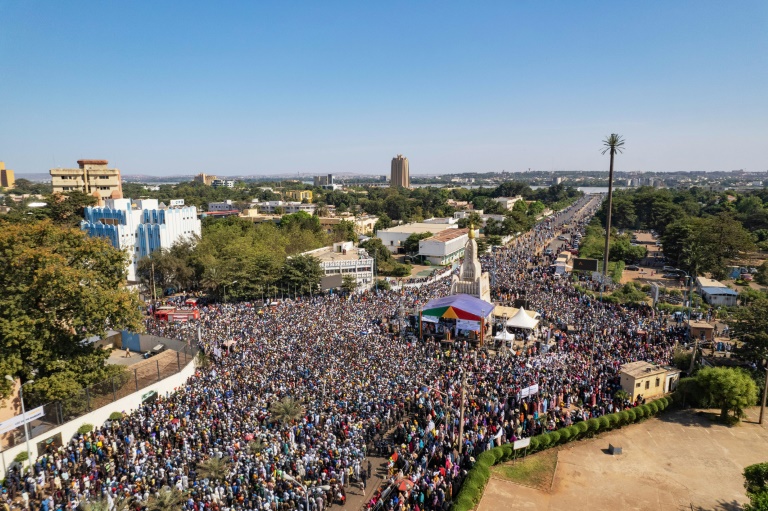
Thousands of demonstrators thronged Mali’s capital Bamako on Friday to protest the publication of a video on social media deemed blasphemous against Islam.

Six people were held on Thursday accused of complicity in circulating a “blasphemous” video showing a man making “derogatory comments” and “insulting acts” against Muslims, the Koran and the Prophet Mohammed, the Bamako prosecutor’s office said.

Police said the protest, called by the High Islamic Council of Mali (HCM), gathered thousands of people, although organisers estimated their numbers at more than one million.

Slogans including “No to blasphemous comments” and “no more attacks on Islam and the Prophet Mohammed” were visible on the protesters’ banners.

“What happened is unforgivable. The author of the blasphemous comments must be arrested and tried,” imam Abdoulaye Fadiga told AFP.

Haby Diallo, a teacher at a religious school in her 40s, said she wanted “inter-religious dialogue. Everyone should respect each other’s religion”.

The six people were put in pre-trial detention notably for refusing to tell authorities where the man — who is still on the run — was hiding, a source in the prosecutor’s office told AFP. 

The affair has caused uproar in Mali, where nearly 95 percent of the population is Muslim and the right to blaspheme does not exist.

The HCM — a grouping of religious leaders and associations and Mali’s highest Islamic body — has called for the man behind the video to be “killed”.

Kenya candidate files court case over presidential vote

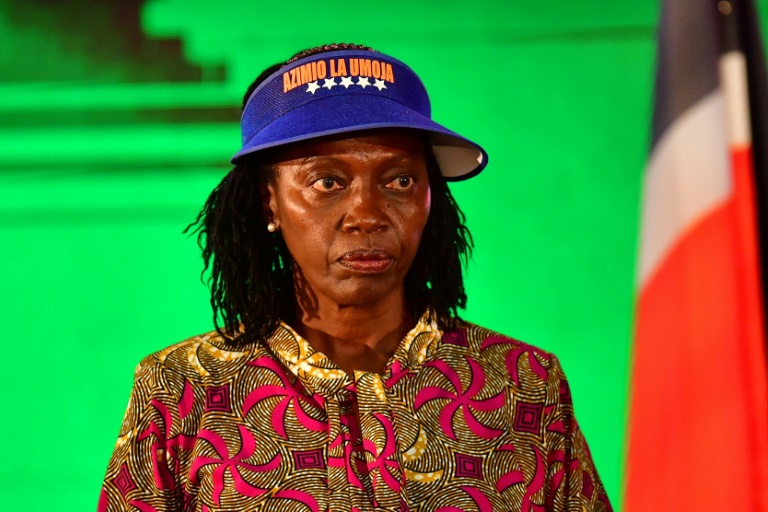
Kenya’s defeated deputy presidential candidate Martha Karua said Friday that she had filed a case challenging the Supreme Court’s decision in September which upheld the election victory of President William Ruto.

Ruto won a narrow victory in the bitterly fought August 9 poll against veteran politician Raila Odinga, who contested the results in an ultimately unsuccessful case lodged at Kenya’s top court.

On Friday, Odinga’s former running mate Karua said in a statement that she had filed a petition at the East African Court of Justice in Arusha, Tanzania, accusing the Kenyan court of undermining “the rule of law by violating the right to a fair trial”.

In the petition filed on Thursday, Karua, who is one of Kenya’s best-known lawyers, urged the regional court to order Kenyan authorities to conduct “transparent, independent, and professional investigations into all (the) violations” allegedly committed by the election commission and the country’s top court.

No Kenyan presidential election result has ever gone uncontested, with Odinga alleging fraud and hacking of the election commission’s servers.

But the Supreme Court delivered a unanimous verdict in favour of Ruto, saying there was no evidence to back Odinga’s claims.

Observers had feared that the disputed outcome could fuel violence in a country with a history of post-poll unrest, but voting day passed off peacefully.

The East African Court of Justice came into force in 2001 to ensure adherence to the laws establishing the seven-nation East African Community bloc, made up of Burundi, Kenya, Rwanda, South Sudan, Tanzania, the Democratic Republic of Congo and Uganda.

S.Africa to press rich nations for more money at COP27

South Africa needs much more money to green its economy than what rich nations have promised so far, President Cyril Ramaphosa said on Friday, ahead of a key global climate summit.

Ramaphosa is due to travel to Egypt in the coming days to attend the COP27 meeting, where funding for Africa’s green transition is likely to be a flashpoint.

Last year, South Africa, the continent’s most industrialised economy, secured $8.5 billion in loans and grants from a group of rich countries. 

But Ramaphosa said the money was not enough, with a just transition investment plan released on Friday suggesting Pretoria will need about 1.5 trillion rand ($83 billion) over the next five years.

His comments come after the World Bank earlier this week said South Africa would need around $500 billion by 2050 to achieve carbon neutrality.

“We need much greater funding than what has been put on the table,” Ramaphosa told an online sitting of the Presidential Climate Commission. 

“And in going to COP27, that’s precisely the message that we will be taking forward.” 

Ramaphosa said South Africa was working with international partners to find additional funding, adding that some already said they are willing to make new proposals. 

The president said he has stressed the need to increase the share of grants to avoid adding to the country’s already heavy debt burden in talks with other leaders. 

“The key challenge for South Africa and our sister countries on the continent is access to new, at scale and predictable funding that does not further exacerbate our debt crises,” he said. 

Key areas in need of investment included the electricity and the green hydrogen sectors, as well as initiatives to ensure a just transition, Ramaphosa said. 

– ‘Hold developed economies accountable’ –

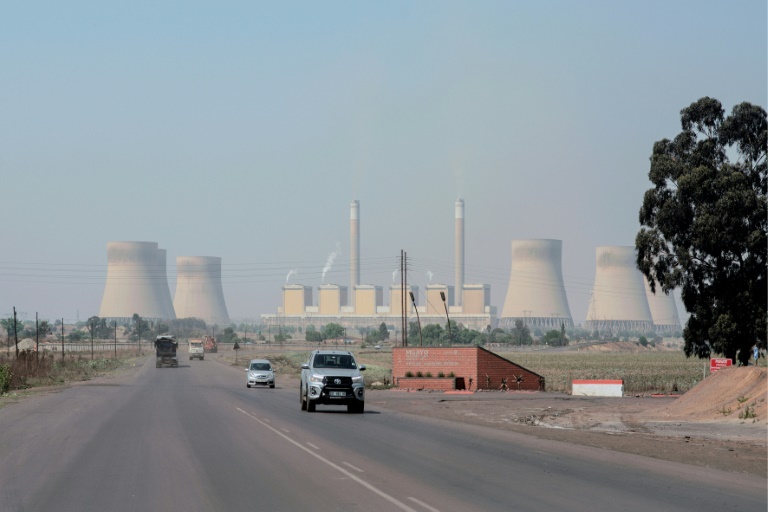
South Africa, one of the world’s top 12 largest polluters, generates about 80 percent of its electricity through coal.

The World Bank on Friday said the country has been granted financing of $497 million to decommission one of its largest coal-fired power plants and convert it to renewable energy.

Leaders of a divided world meet in the resort town of Sharm el-Sheikh this month tasked with taming the terrifying juggernaut of global warming as they face gale-force geopolitical crosswinds, including the war in Ukraine and economic turmoil.

UN chief Antonio Guterres said Thursday it was time for a “historic pact” between developed and emerging countries, with richer nations providing financial and technical assistance to help poorer ones speed up their renewable energy transitions. 

On Friday, Ramaphosa criticised Western nations, saying some were re-opening old coal-fired plants and tilting back towards fossil fuels in the wake of the conflict between Russia and Ukraine, having told the world to move away from such sources. 

Meanwhile, commitments to make $100 billion per year available to help developing countries decarbonise and adapt to climate change have not been fulfilled, Ramaphosa added. 

“We have an obligation to hold developed economies accountable by making sure that they do honour the financial commitments that they undertook,” he said. 

Close Bitnami banner
Bitnami