Africa Business

Ethiopia peace talks open in South Africa

Peace talks between the warring sides in the brutal two-year-old conflict in Ethiopia’s Tigray region opened in Pretoria on Tuesday, the South African presidency announced.

The negotiations, led by the African Union (AU), follow a fierce surge in fighting in recent weeks that has alarmed the international community and triggered fears for civilians caught in the crossfire.

“South Africa is hosting peace talks to end the conflict in the Tigray region,” Vincent Magwenya, spokesman for President Cyril Ramaphosa, told reporters.

The talks “have been convened to find a peaceful and sustainable solution to the devastating conflict,” he said, adding that they would run until October 30.

South Africa hopes “the talks will proceed constructively and result in a successful outcome that leads to peace for all the people of our dear sister country,” he said.

The talks between negotiators from the Ethiopian government of Prime Minister Abiy Ahmed and the regional authorities in war-stricken Tigray have been launched almost two months to the day since fighting resumed in August, shattering a five-month truce.

They are being facilitated by AU Horn of Africa envoy and Nigeria’s former president Olusegun Obasanjo, supported by Kenya’s former leader Uhuru Kenyatta and South Africa’s ex-vice president Phumzile Mlambo-Ngcuka, said Magwenya.

Diplomatic pressure has been mounting in recent weeks to silence the guns in a war which has left millions in need of humanitarian aid and, according to a US estimate, as many as half a million dead.

The talks come as federal government forces and their allies in the Eritrean army appear to be gaining the upper hand on the ground, seizing a string of towns in Tigray in offensives that have sent civilians fleeing.

An initial effort by the AU to bring the two sides to the negotiating table earlier this month failed, with diplomats suggesting logistical issues and a lack of preparedness were to blame.

The South Africa talks are the first public parley between the rivals, although a Western official has confirmed that previous secret contacts took place organised by the United States in the Seychelles and twice in Djibouti.

Abiy first sent troops into Tigray in November 2020, promising a quick victory over the northern region’s dissident leaders, the Tigray People’s Liberation Front (TPLF), after what he said were attacks by the group on federal army camps.

The move followed long-running tensions with the TPLF, which had dominated Ethiopia’s ruling coalition before Abiy came to power in 2018 and sidelined the party.

In a rare comment on the conflict last week, Abiy — who won the 2019 Nobel Peace Prize for his rapprochement with Eritrea — said the war “would end and peace will prevail”.

But on Monday, the head of the rebel region, Debretsion Gebremichael, issued a defiant statement saying: “The Tigray army has the capacity to defeat our enemies totally.”

The international community has been calling for an immediate cessation of hostilities, humanitarian access to Tigray and a withdrawal of Eritrean forces, whose return to the battlefield has raised fears of renewed atrocities against civilians. 
Sudan security forces tear-gas protesters on coup anniversary

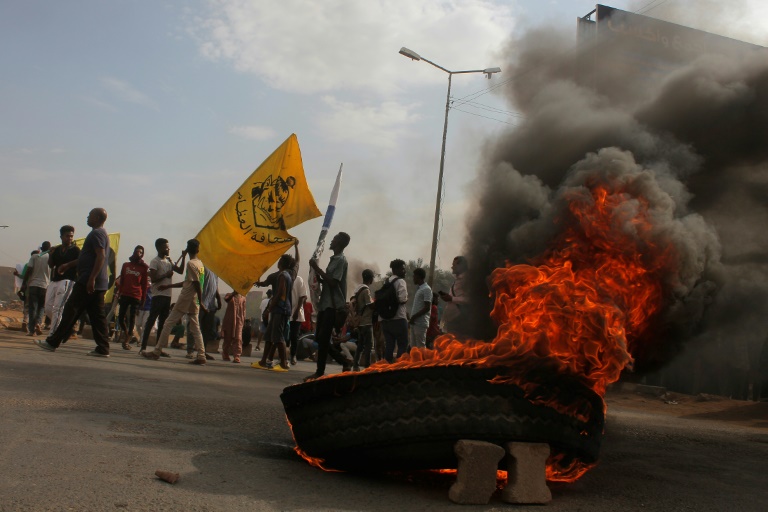
Sudanese security forces shot tear gas Tuesday as thousands of pro-democracy protesters marked the first anniversary of a coup that derailed a transition to civilian rule and sent hunger and inflation soaring.

Waving Sudanese flags, thousands of demonstrators in Khartoum and its suburbs defied security forces who have carried out deadly crackdowns on past rallies, demanding that “soldiers go back to the barracks”.

“No partnership, no negotiation with the putschists,” protesters chanted, calling out what has become a pro-democracy rallying cry.

A year ago to the day, army chief Abdel Fattah al-Burhan seized power and arrested the civilian leaders with whom he had agreed to share power in 2019, when mass protests compelled the army to depose one of its own, long-time autocrat Omar al-Bashir.

Protesters, calling out that the “revolution continues”, have demanded the creation of “a civil democratic Sudan”.

In Atbara, north of the capital Khartoum, “hundreds of students” also took to the streets, resident Adel Mohamed said.

In a bid to stem protests, authorities restricted internet access across the country, online monitor NetBlocks said.

– Security forces deployed –

The authorities in Khartoum ordered all public institutions, schools, and businesses shut Tuesday, as security forces blocked roads and bridges.

For a year, near weekly anti-coup protests have been met with force, most recently on Sunday when a protester was killed by a bullet fired by security forces, according to pro-democracy medics.

At least 118 people have been killed while demanding a return to civilian rule, a condition for Western governments to resume crucial aid they had halted in response to the coup.

Cut off from such aid, Sudan -– already one of the world’s poorest countries –- has plunged into a worsening economic crisis.

Between three-digit inflation and chronic food shortages, a third of Sudan’s 45 million inhabitants suffer from hunger, a 50 percent increase compared to 2021, according to the World Food Programme (WFP).

The cost of food staples has jumped 137 percent in one year, which the WFP says has forced Sudanese to spend “more than two-thirds of their income on food alone, leaving little money to cover other needs”.

Many worry that three years after the 2019 uprising that toppled Bashir, signs point to a reversal of their revolution.

Since the coup, several Bashir-era loyalists have been appointed to official positions, including in the judiciary, which is currently trying the former dictator.

Burhan’s pledge of elections next year is seen as far-fetched, no civilian leaders have taken up the mantle of the army chief’s promised civilian government and international mediation efforts are stalled.

“Sudan doesn’t have the luxury of zero-sum games and political manoeuvres,” UN envoy to Sudan Volker Perthes said Saturday. “All political actors need to put aside differences and focus on the best interest of the Sudanese people.”

– Deadly clashes –

On Friday, 31 protesters were injured, including three who were hit in the eye by tear gas canisters, according to pro-democracy medics.

Western embassies on Monday urged security forces “to refrain from using violence against protesters and to fulfil their obligation to protect freedoms of expression and peaceful assembly”.

A broader security breakdown nationwide has also left nearly 600 dead and more than 210,000 displaced as a result of ethnic violence this year, according to the United Nations.

Sudan is the world’s fifth most vulnerable country to the impacts of climate change, according to a 2020 ranking in the Global Adaptation Index, compiled by the Notre Dame University in the United States.

More than two-fifths of people depend on farming for a living in Sudan, and conflicts regularly erupt as pressure mounts around access to land, water and livestock grazing.

In the southern Blue Nile state, an area awash with automatic weapons after decades of civil war, some 250 people were killed in intense clashes between rival groups over land last week, the UN said.

Children among 11 killed in fire at Uganda blind school

Eleven people, mostly children, have perished in a blaze that tore through a dormitory at a school for the blind in Uganda in the early hours of Tuesday as pupils were sleeping.

“The cause of the fire is currently unknown but so far 11 deaths as a result of the fire have been confirmed while six are in critical conditions and admitted (to hospital),” the Uganda Police Force said on Twitter.

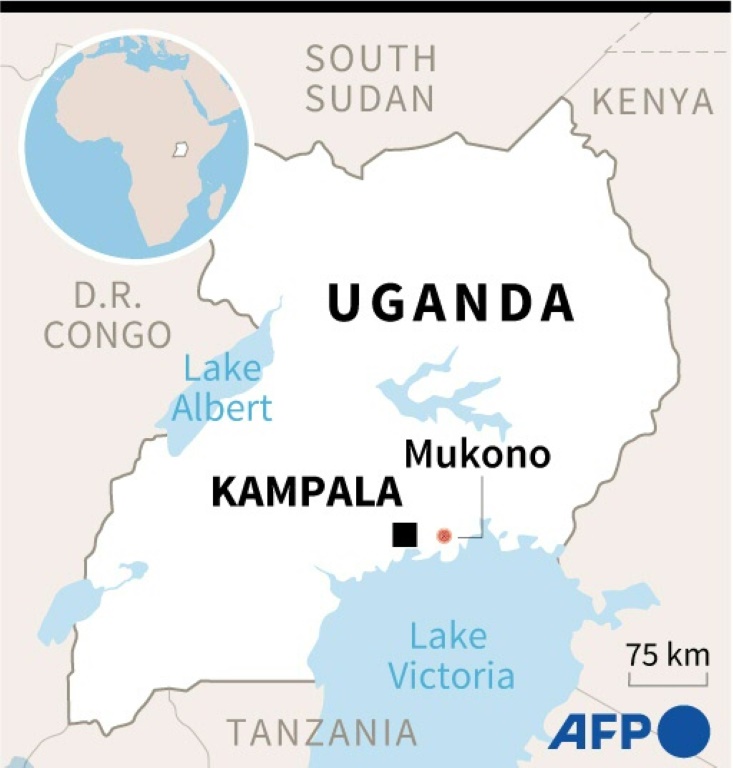
The disaster occurred at about 1 am (2200 GMT Monday) at the Salama School for the Blind in the Mukono district, east of the capital Kampala.

Police said an investigation had been launched into the cause of the inferno and more details would be released later.

“Most of the dead are children at the school and our sympathies go to the parents,” Internal Affairs Minister General Kahinda Otafiire told AFP. 

He said the school has been cordoned off as a “crime scene” and vowed that there would be a full investigation.

“As government we shall go to the root cause of the fire and if there are any culprits they will be apprehended and the law will take its course,” he added.

The school’s headmaster Francis Kirube, who is also blind, told AFP the flames swept through the dormitory as the pupils slept.

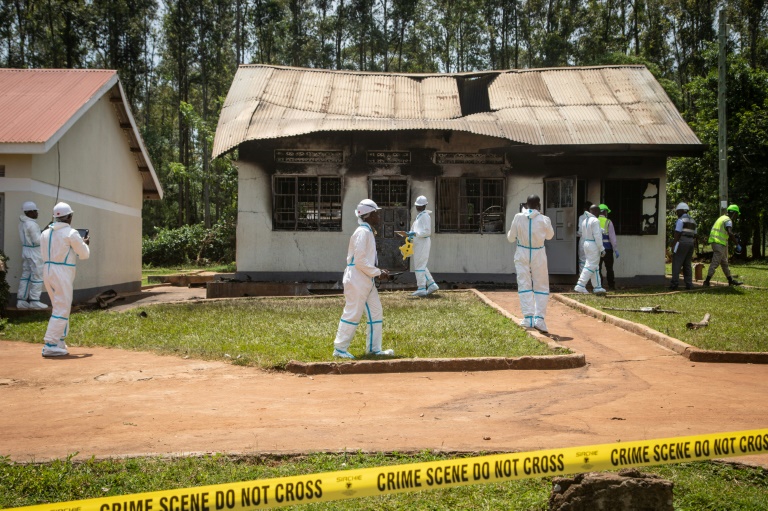
AFP images showed a charred but still largely intact building where the fire broke out, its window frames and door blackened and the corrugated roof damaged.  

Forensic teams were seen in white protective gear at the school, while grieving parents gathered nearby.

– ‘He is gone’ –

Richard Muhimba, the distraught father of one of the dead children, told AFP: “No words can explain the pain I am going through. 

“I visited my child on Saturday, he was in good health and in less than three days he is gone… Please give me time to go through this pain,” said Muhimba, before hanging up.

A friend told AFP that the child was aged 15 and that Muhimba was a father of five. 

Salama was built in April 1999 by the local government in Mukono and caters for children and young adults between the ages of six to 25.

Princess Anne, the sister of King Charles III, had been due to visit the school during her trip this week to Uganda, which marked its 60th anniversary of independence from Britain earlier this month.

The East African nation has suffered a string of deadly school fires in recent years.

In November 2018, 11 boys perished and another 20 suffered severe burns in a suspected arson attack at a boarding school in southern Uganda.

In April 2008, 18 schoolgirls burned to death along with one adult when a fire engulfed their dormitory at a junior school near the Ugandan capital. 

In March 2006, at least 13 children were killed and several hurt when fire razed an Islamic school in western Uganda. In July the same year, six children died in a similar fire in the east.

Jihadist raids spark new exodus in Mozambique

Even the exhaustion from walking 40 kilometres, fleeing jihadists who had attacked her village, could not mask the trauma on Maria Lourenco’s face.

An indelible image was imprinted on her mind.

“They beheaded two men and put their heads in a basin,” she told AFP.

“Then they handed over the heads to the wife of one of the victims to present to the authorities,” she said.

“I saw their heads.”

Her village in the Katapua area in Cabo Delgado province, the epicentre of a five-year-old jihadist insurgency in northern Mozambique, came under attack last weekend.

The 60-year-old grandmother fled on foot to the town of Chiure, 25 miles away, with her eight daughters and grandchildren.

Wearing blue flip-flops and clutching an improvised walking stick, she was standing in the town square waiting for her daughter-in-law to take her to the provincial capital Pemba.

The family’s terrifying experience underscores how Mozambique’s jihadist nightmare remains very far from over, despite military gains last year.

The insurgency erupted in October 2017 when fighters — since proclaimed to be affiliated to the Islamic State group — attacked coastal areas in northern Cabo Delgado, close to the Tanzanian border.

Bloody assaults on villages were followed in 2020 with the capture of the port of Mocimboa da Praia — a key part of a huge scheme to develop liquefied natural gas in the region.

In 2021, as Mozambique’s military floundered, Rwanda and the country’s neighbours deployed more than 3,000 troops, helping to push the militants out of their strongholds.

But the jihadists are now making incursions into the previously untouched south of Cabo Delgado and spilling over into neighbouring Nampula and Niassa provinces.

The insurgency has so far claimed more than 4,300 lives, and around a million people have fled their homes.

– ‘Evildoers’ –

An AFP correspondent in Chiure, a town with a population of around 100,000, saw around 500 people who had been uprooted from Katapua since the weekend.

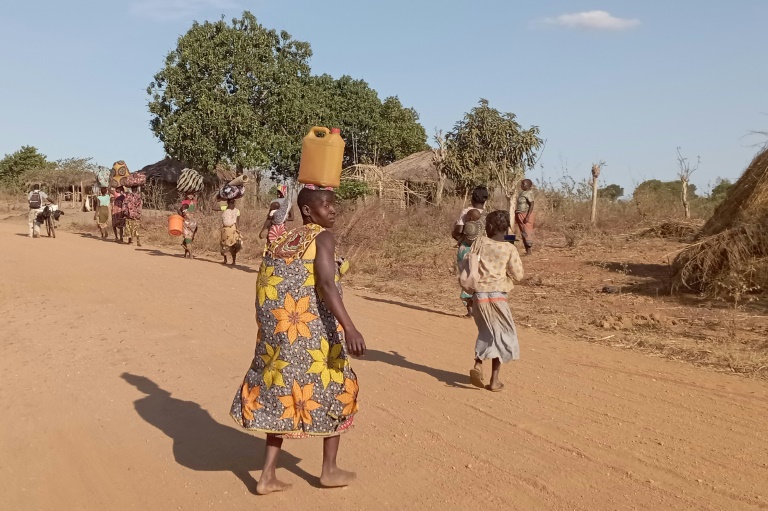
They congregated in front of the town’s main square. Many had slept rough in the open. Others sheltered on shop verandahs watching over a few belongings tied in large sheets, and foam mattresses that they had managed to carry.

Along the dusty road connecting Chiure to Katapua, several women, men and children trekked on foot, their belongings balanced on heads, or on bicycles.

“Many arrived during the early hours exhausted and complaining of pain,” said Consolta Paulo, a nurse in Chiure. 

Villagers reported new raids in Katapua on Monday.

“The evildoers went on the rampage in the village and burned a chapel,” Katapua’s administrative head, Xavier Jamal, told AFP by phone. 

He said it appeared the attackers were the same group which last week had raided on ruby mine near Montepuez.

London-listed ruby mining giant Gemfields halted operations at its Montepuez mine following the attack at a neighbouring site.

Jamal appealed to villagers not to flee, insisting the military “are on the ground, controlling the situation”.

But locals have little trust in Mozambique’s ill-trained and under-equipped forces.

Elias Mario, 36, a peasant farmer, fled Katapua with his wife and two children. He stood next to his bicycle, his shoulders slumped despondently.

“I brought my family here, but we still don’t know where we’re going,” he said.

Children among 11 killed in fire at Uganda blind school

Eleven people, mostly children, have perished in a blaze that tore through a dormitory at a school for the blind in Uganda in the early hours of Tuesday as pupils were sleeping.

“The cause of the fire is currently unknown but so far 11 deaths as a result of the fire have been confirmed while six are in critical conditions and admitted (to hospital),” the Uganda Police Force said on Twitter.

The disaster occurred at about 1 am (2200 GMT Monday) at the Salama School for the Blind in the Mukono district, east of the capital Kampala.

Police said an investigation had been launched into the cause of the inferno and more details would be released later.

“Most of the dead are children at the school and our sympathies go to the parents,” Internal Affairs Minister General Kahinda Otafiire told AFP. 

He said the school has been cordoned off as a “crime scene” and vowed that there would be a full investigation.

“As government we shall go to the root cause of the fire and if there are any culprits they will be apprehended and the law will take its course,” he added.

The school’s headmaster Francis Kirube, who is also blind, told AFP the flames swept through the dormitory as the pupils slept.

Images broadcast on Ugandan television showed a charred but still largely intact building where the fire broke out, its window frames and door blackened and the corrugated roof damaged.  

Forensic teams were seen in white protective gear at the school, while grieving parents gathered nearby.

– ‘He is gone’ –

Richard Muhimba, the distraught father of one of the dead children, told AFP: “No words can explain the pain I am going through. 

“I visited my child on Saturday, he was in good health and in less than three days he is gone… Please give me time to go through this pain,” said Muhimba, before hanging up.

A friend told AFP that the child was aged 15 and that Muhimba was a father of five. 

Salama was built in April 1999 by the local government in Mukono and caters for children and young adults between the ages of six to 25.

Princess Anne, the sister of King Charles III, had been due to visit the school during her trip this week to Uganda, which marked its 60th anniversary of independence from Britain earlier this month.

The East African nation has suffered a string of deadly school fires in recent years.

In November 2018, 11 boys perished and another 20 suffered severe burns in a suspected arson attack at a boarding school in southern Uganda.

In April 2008, 18 schoolgirls burned to death along with one adult when a fire engulfed their dormitory at a junior school near the Ugandan capital. 

In March 2006, at least 13 children were killed and several hurt when fire razed an Islamic school in western Uganda. In July the same year, six children died in a similar fire in the east.

Sudan protesters defy crackdown to mark coup anniversary

Sudan on Tuesday blocked internet access nationwide as pro-democracy activists marked the first anniversary of a coup that derailed the transition to civilian rule, with hunger and inflation throttling the country.

Waving Sudanese flags, protesters defied authorities who have launched repeated deadly crackdowns on past rallies, chanting “power to the people” and demanding that “soldiers go back to the barracks”.

A year ago to the day, army chief Abdel Fattah al-Burhan seized power and arrested the civilian leaders with whom he had agreed to share power in 2019, when mass protests compelled the army to depose one of its own, long-time autocrat Omar al-Bashir.

As demonstrations gathered across the northeast African country on Tuesday, authorities launched an “nation-scale internet disruption,” online monitor NetBlocks said, a regular tactic when mass protests are planned.

In Atbara, north of the capital Khartoum, hundreds of students on Tuesday took to the streets, resident Adel Mohamed said.

Ahead of planned rallies on Tuesday, protesters insisted that “the revolution continues”, and called for the creation of “a politically and economically-free Sudan, a civil democratic Sudan.”

– Security forces deployed –

The authorities in Khartoum ordered all public institutions, schools, and businesses shut Tuesday, as security forces deployed heavily throughout the city, blocking roads and bridges.

For a year, near weekly anti-coup protests have been met with force, most recently on Sunday when a protester was killed by a bullet fired by security forces, according to pro-democracy medics. 

At least 118 people have been killed while demanding a return to civilian rule, a condition for Western governments to resume crucial aid they had halted in response to the coup.

Cut off from such aid, Sudan -– already one of the world’s poorest countries –- has plunged into a worsening economic crisis.

Between three-digit inflation and chronic food shortages, a third of Sudan’s 45 million inhabitants suffer from hunger, a 50 percent increase compared to 2021, according to the World Food Programme (WFP).

The cost of food staples has jumped 137 percent in one year, which WFP says has forced Sudanese to spend “more than two-thirds of their income on food alone, leaving little money to cover other needs”.

Many worry that three years after the 2019 uprising that toppled Bashir, signs point to a reversal of their revolution.

Since the coup, several Bashir-era loyalists have been appointed to official positions, including in the judiciary, which is currently trying the former dictator.

Sudan is mired in uncertainty. Burhan’s pledge of elections next year is seen as far-fetched. 

No civilian leaders have taken up the mantle of the army chief’s promised civilian government and international mediation efforts remain stalled.

“Sudan doesn’t have the luxury of zero-sum games and political manoeuvres,” UN envoy to Sudan Volker Perthes said Saturday. “All political actors need to put aside differences and focus on the best interest of the Sudanese people.”

– Deadly clashes –

On Friday, 31 protesters were injured, including three who were hit in the eye by tear gas canisters, according to pro-democracy medics.

Western embassies on Monday urged security forces “to refrain from using violence against protesters and to fulfil their obligation to protect freedoms of expression and peaceful assembly”.

Even as security forces are mobilised to counter protests, a broader security breakdown nationwide has left nearly 600 dead and more than 210,000 displaced as a result of ethnic violence, according to the United Nations.

In the southern Blue Nile state, some 250 people were killed in intense clashes between rival groups over land last week, the UN said, the latest bout of ethnic violence in the state.

Sudan has enjoyed only brief spells of democratic rule over the decades.

Hunger forces hard choices in Nigeria's conflict-hit northeast

Ten years ago the threat of jihadist violence forced Falmata Mustapha to abandon the fertile land that her family had cultivated for generations outside the village of Gonglugong, in northeastern Nigeria’s Borno state. 

Her only option was to work a plot of land that was far less fertile but at least was relatively safe, for it lay within the village’s secure perimeter.

Nigeria’s jihadist insurgency has shifted and evolved since it began in 2009, with Boko Haram militants losing ground to military offensives and forced to battle rivals linked to the Islamic State group.

But for farmers like Mustapha, the grinding war remains a constant menace that keeps her from her land, like many of the more than two million people displaced due to the conflict.

“This plot does not give much, but where we are here, at least Boko Haram will not come and kill you,” said the 60-year-old farmer.

Past the military checkpoints that surround and protect Gongulong, the fields have become tantalisingly lush from the rainy season, but remain off limits.

Much of the northeast’s food-producing land remains at the mercy of jihadist insurgents.

The battle to create an Islamic caliphate in the region has left more than 40,000 dead and created one of the worst humanitarian crises of the 21st century.

“Again this morning, Boko Haram attacked several farmers. Thank God they didn’t kill them and just took their money,” Mustapha said, raising her hands to the sky. 

– Impossible dilemma –

Two years have passed, but the grandmother has not forgotten the day in December 2020 when jihadists slaughtered 43 farmers on a rice field in the neighbouring village of Koshebe.

Since that massacre, only a few people go beyond the army’s barricades and protective trenches to work the land “with fear in (their) stomach,” she said.

Doing so also means taking the risk of being accused by the army of collaborating with jihadist fighters and of being arrested.

“It’s a dilemma for the farmers, who have to choose between struggling to feed their children or putting themselves in danger to bring back food by going to the other side of the trenches,” said the head of the UN Office for the Coordination of Humanitarian Affairs (OCHA) in Nigeria, Trond Jensen. 

Mustapha can’t remember the last time she had enough money to eat meat, or when her children could still eat three full meals a day.

But, she said, she’s “lucky” because at least she has access to some land. 

That is not the case for millions of people in the region who have abandoned farming altogether, taking refuge in so-called garrison towns that are meant to provide more security.

Around 1.74 million children under the age of five face severe malnutrition in northeast Nigeria, according to the UN.

Medical centres that care for the most critical patients are overflowing with children in need of urgent assistance, their hunger visible by their protruding ribs and swollen bellies.

“It’s all because of the war,” said Amina Abdulahi, 42, who hugs her granddaughter on a metal bed at a medical centre for severely malnourished children in Damaturu, capital of Yobe State.

– Child hunger –

Rahama has the build of an infant just a few days old. But her deep gaze and her wide-open black eyes do not deceive: the little one was born six months ago already.

She looked even more frail next to the huge elephant painted on the wall of the centre supported by the humanitarian organisation Plan International. 

Doctors have been trying to get the child to gain weight for three days, along with about 40 other children whose bodies are deformed by hunger. 

“In our village, we have lost dozens of children in recent years,” said grandmother Abdulahi, her face surrounded by a plum-coloured veil. 

Some evenings, she said she puts her eight grandchildren to bed with their stomachs empty, and waits for them to fall asleep, exhausted from their incessant cries.

“Each year is worse than the previous one because of the dragging conflict,” said Dr. Hauwal Larai Goni, Yobe state public health officer.

The 13-year-old insurgency is primarily responsible for the region’s food crisis. 

But recent floods which destroyed thousands of farms in the region, double-digit inflation caused by the coronavirus pandemic and then the Russian offensive in Ukraine are additional factors, worsening an “already catastrophic” situation, she said.

According to the UN, some 370,000 children under the age of five face a high risk of mortality, and 5,000 children are at risk of dying without immediate funding to respond to the crisis. 

Will Africa's metals boom suffer the same curse as oil?

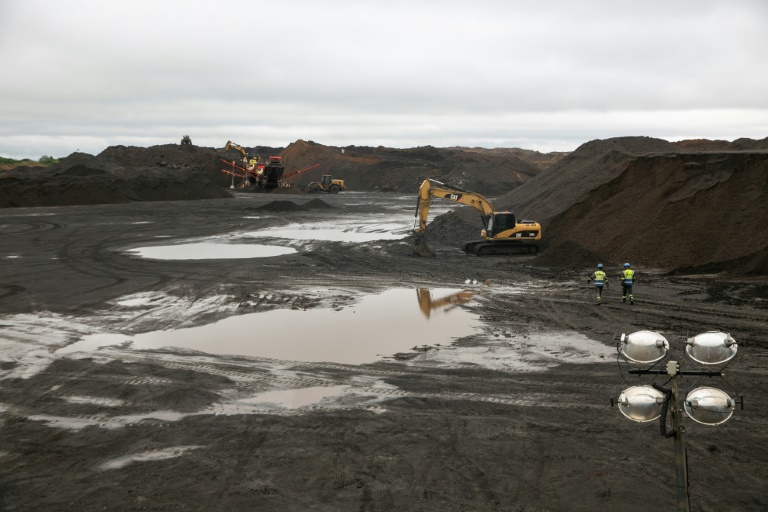
Mechanical diggers are hard at work in the bleak landscape of the Moanda open-cast mine in Gabon, using giant jaws to rip out manganese and then dump the ore into trucks with a crash.

“We’re lucky here in Moanda. We find it about five to six metres (about 18 feet) below the surface,” said manager Olivier Kassibi, whose mine yields 36 tonnes of manganese each day.

Element number 25 on the periodic table, manganese has traditionally been perceived as a useful if humdrum material widely employed in steel and alloys.

More recently, though, the silvery metal has gained star status thanks to its emerging role in rechargeable car batteries, helping to wean the world off carbon-spewing fossil fuels.

Decarbonisation of the world economy will take centre stage at the UN’s COP27 climate talks in Egypt next month.

And as the great transition goes into higher gear, eyes are turning to Africa.

Its soil is rich in manganese, cobalt, nickel and lithium — crucial ingredients in cleaner technology for generating or storing power.

The Moanda region alone contains as much as a quarter of known global reserves of manganese, according to the Compagnie Miniere de l’Ogooue (Comilog), a subsidiary of the French group Eramet which operates the site.

– Curse of oil –

But hopes that the mineral boom will translate into a new dawn of prosperity in the world’s poorest continent are clouded by memories of what happened with oil.

In Africa’s oil-producing countries, black gold meant a gush of wealth for a well-connected few — but only drops for the needy majority.

Corruption sucked the dollars out of plans for roads, hospitals and schools, and environmental damage was often all that remained.

Africa’s potential in new-age minerals is “huge”, said the former chief economist of the African Development Bank, Rabah Arezki, who pointed out that reserves are not even known because so little exploration has been done.

But, he said, “there is very little reason to think that this windfall will benefit the people of Africa, particularly because of governance concerns.”

New metals deposits are following one another at a giddying pace.

In one example, Firefinch Ltd of Australia was looking for gold at Goulamina in southern Mali when it came across lithium, said Seydou Semega, geologist and local director of the firm.

Firefinch then created a local offshoot, Leo Lithium, and inaugurated the mine in early 2022 — a facility that it says could create 1,200 jobs and generate more than $100 million a year for Mali in taxes and dividends.

“Could Africa be the main source of lithium in the world?” asked Simon Hay, director of Leo Lithium. “Absolutely.” 

Comilog, which has operated the Moanda mine since 1960, claims the creation of 3,400 direct and 6,000 indirect jobs, a contribution of around $345 million per year to the national economy in various forms, plus millions of dollars in health and education provisions for the population.

“You need to have a social policy that is as committed as possible to share this wealth,” said its CEO, Leod Paul Batolo.

Comilog is keen to list its green principles, which include rehabilitating and replanting extraction sites, decarbonising the energy mix of its factories and “setting limits” on encroaching on wildlife areas.

But more generally, innumerable studies say the exploitation of resources in Africa has a long and dark history of unequal distribution of wealth, corruption, environmental damage and rights violations.

– ‘Value chain’ –

A big problem is that Africa is typically used as a source of raw materials, and rarely for processing them into goods of higher value, said Gilles Lepesant, a geographer at the French National Centre for Scientific Research (CNRS).

“If activity is limited to mining and extracting ore, Africa will reap no benefit from the energy transition in Europe. It’s absolutely necessary to invest in the value chain,” he said.

He pointed to the Democratic Republic Congo, whose soil is estimated to contain half of the world’s reserves of cobalt, as an example of something that is “both an opportunity and a curse.”

Poorly regulated mining leads to environmental damage and encourages child labour, a phenomenon that is hard to resolve when a family’s livelihood depends on it.

In the sector of tropical forestry, many rich countries have demanded traceability of wood and labour in order to reassure concerned consumers. 

But this is far harder to achieve in the metals used in car batteries and other gadgets, said Lepesant.

“In a lot of cases, the mined metal is exported for refining to other countries, for example China, and then combined with other metals, so it’s hard to know if the cobalt you have on your production line actually comes from such and such a mine in the Democratic Republic of Congo,” he said.

Analyst Hugo Brennan of British firm Verisk Maplecroft said African nations had to strike “a tricky balancing act” — providing incentives for investment while enforcing social and environmental standards — to ensure their mining boom does not go the same way as oil.

Black South Africans break into once white-only wine industry

Winemaking was a profession most South African parents could never have envisioned for their children. 

But Black South Africans are today managing to break through multiple barriers into the renowned industry, transforming a landscape that was historically white. 

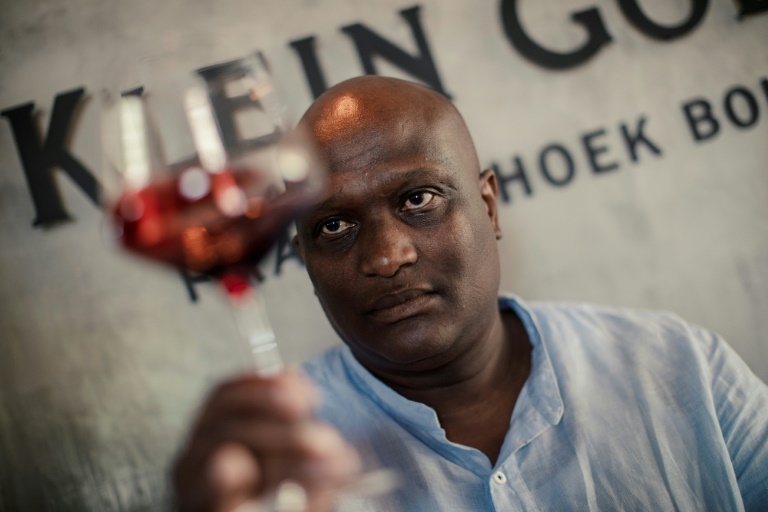
Paul Siguqa, 41, bought Klein Goederust farm (Afrikaans for “a little good rest”) after saving up for 15 years.

His mother had for 37 years worked at a farm in South Africa’s Cape winelands under the white minority apartheid regime.  

“If you grow up on a farm as children of farm labourers — black farm labourers — you are raised to be the next crop of labour for that farmer,” said Siguqa.

He finally purchased the “rundown” farm in 2019, renovated it and opened last year.

“If we want to see change in an industry, we need to be the change,” he told AFP after inspecting his flowering grape crop at the farm in Franschhoek (French corner), a region dotted with centuries-old vineyards.

The rise of entrepreneurs of colour has been slow and still faces serious obstacles, including lack of access to land and capital. As a result an industry push is underway to try to accelerate the pace of change.

“Nobody’s getting nowhere slowly,” said Wendy Petersen, manager at SA Wine Industry Transformation Unit which organises grants and internships for startups. Often the resources are not enough and have to be spread thinly among the candidates.

To help them grow, the organisation has launched the Wine Arc tasting room, in South Africa’s wine producing hub Stellenbosch, to promote budding producers.

Among the brands featured there is Carmen Stevens Wines, which became South Africa’s first fully black-owned winery when launched in 2011 and released its first vintage in 2014.

– ‘Land, biggest barrier’ –

“The difficult part of winemaking is selling this product, is getting this product to somebody’s table and somebody coming back and saying ‘I want more’,” Stevens said.

The 51-year-old is an unlikely winemaker, having grown up in the Cape Flats — an area marred by poverty and gangsters. 

Her mother, a factory worker, would buy her Mills & Boon fiction novels, many set in vineyards and involving wine.

South Africa was still under the racially segregated apartheid regime when Stevens made her first attempt to study winemaking in 1991. After being repeatedly refused, she was accepted at a college in 1993.

Her perseverance has paid off. This year she took home three gold medals at a South African wine and spirits award event for her sauvignon blanc and newly-released rose named after her mother Julie.

But like many black-owned brands, she procures her grapes from farmers in the region, not yet having her own land to cultivate.

Land access is “the biggest barrier for black people participating in the wine industry,” Siguqa says.

“That’s very political,” because historically the majority of black people, who make up about 80 percent of the population, don’t have access to land.

Black people “are competing, with old inter-generational, white rands” as well as with foreign buyers that are purchasing prime land… You are competing with the US dollars, with the pound and the euro,” said Siguqa.

The first vineyards were established in the 1600s by French Huguenots.

Since then, land has passed down through generations and when sales do occur, it has often been to neighbours, leaving little opportunity for newcomers to enter the market, said Maryna Calow, of the Wines of South Africa industry group.

But for those non-white operators who have broken the barriers into the industry, it’s been a bittersweet journey so far — having taken so long to achieve and, once in, the pressure to not fail.

“We’ve been free for 28 years and one would have wanted to see a lot more black people participating in the industry,” said Siguqa, wine bottles lined up on a table next to him.

Originally established in 1905  his farm this month scooped an award in Cape Town for offering an authentic South African experience.

Out of the hundreds of winemakers in the country, Africa’s top wine producer, only just over 80 brands are black-owned, according to Petersen.

Pro-democracy protests set to mark Sudan coup anniversary despite crackdown

On the first anniversary of a coup that derailed Sudan’s transition to civilian rule, pro-democracy activists are urging yet more protests Tuesday against military rule, as hunger and inflation throttle the country.

A year ago to the day, army chief Abdel Fattah al-Burhan seized power, arresting the civilian leaders with whom he had agreed to share power in 2019, when mass protests compelled the army to depose one of its own, long-time autocrat Omar al-Bashir.

Near weekly anti-coup protests have been met with force, most recently on Sunday when a protester was killed by a bullet fired by security forces, according to pro-democracy medics. 

At least 118 people have been killed while demanding a return to civilian rule, a condition for Western governments to resume crucial aid they had halted in response to the coup.

Cut off from such aid, Sudan – already one of the world’s poorest countries – has plunged into a worsening economic crisis.

– ‘Revolution continues’ –

Between three-digit inflation and chronic food shortages, a third of Sudan’s 45 million inhabitants suffer from hunger, a 50 percent increase compared to 2021, according to the World Food Programme (WFP).

The cost of food staples has jumped 137 percent in one year, which the WFP says has forced Sudanese to spend “more than two-thirds of their income on food alone, leaving little money to cover other needs”.

Even as they struggle with ever-declining purchasing power, many in the country worry that three years after the 2019 uprising that toppled Bashir, signs point to a reversal of their revolution.

Since the coup, several Bashir-era loyalists have been appointed to official positions, including in the judiciary, which is currently trying the former dictator.

The country is mired in uncertainty. Burhan’s pledge of elections next year is seen as far-fetched. No civilian leaders have taken up the mantle of the army chief’s promised civilian government and international mediation efforts remain stalled.

“Sudan doesn’t have the luxury of zero-sum games and political manoeuvres,” UN envoy to Sudan Volker Perthes tweeted Saturday. “All political actors need to put aside differences and focus on the best interest of the Sudanese people.”

Thousands had taken to the streets Friday to demand “the fall of the regime”, also marking the 58th anniversary of the first uprising that toppled a military dictatorship in a country with a coup-riddled history.

Sudan has enjoyed only brief spells of democratic rule over the decades.

Calls for protest on Tuesday insist “the revolution continues”.

“The demonstrations on October 25 will herald the irrevocable end of the putschist era,” read a call for protest shared by pro-democracy activists online. 

“It will be the foundation of a new Sudan we build together, a politically and economically free Sudan, a civil democratic Sudan.”

– Deadly clashes –

On Friday, 31 protesters were injured, including three who were hit in the eye by tear gas canisters, according to pro-democracy medics who have kept a tally of those wounded and killed in protests since the coup.

Western embassies on Monday urged security forces “to refrain from using violence against protesters and to fulfil their obligation to protect freedoms of expression and peaceful assembly”, in a statement condemning “the loss of another protester’s life” on Sunday.

Even as security forces are mobilised to counter protests, a broader security breakdown nationwide has left nearly 600 dead and more than 210,000 displaced as a result of ethnic violence, according to the UN.

Thousands in Sudan’s southern Blue Nile state, which borders South Sudan and Ethiopia, took to the streets on Monday, accusing local government of failing to protect them. 

According to the UN, “unconfirmed reports indicate that some 250 people were killed” in the span of two days last week, in the latest bout of ethnic violence in the state.

Close Bitnami banner
Bitnami