Africa Business

Moroccan rapper ElGrande Toto in custody after cannabis controversy

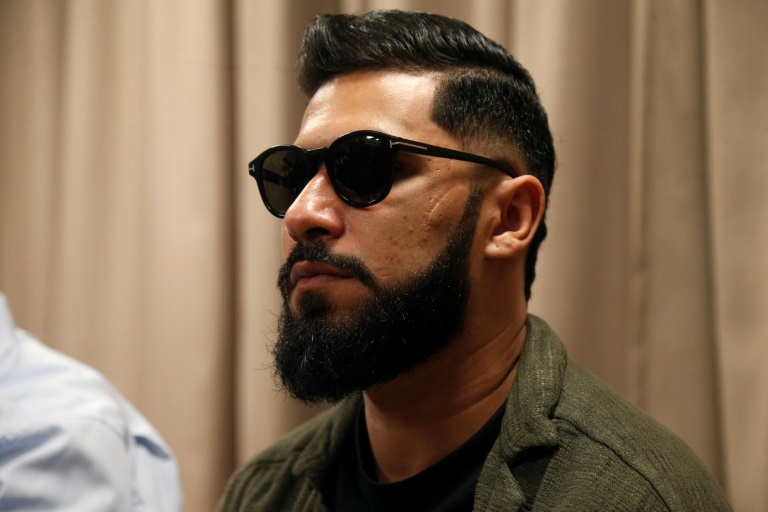
Moroccan rapper ElGrande Toto was taken into custody on Monday evening, following several complaints filed against him for public statements he made about using cannabis, a judicial source said.

The Casablanca-born rapper, who is a massive star in the Arabic-speaking music world, had in late September told reporters who gathered after one of his concerts, “I smoke hash — so what?… It does not mean I set a bad example.”

His comments sparked an outcry in Morocco, and the 26-year-old was on Thursday forbidden from leaving the territory by authorities and was also summoned by the police in Casablanca.

A prosecutor of a Casablanca court on late Monday decided to place Taha Fahssi — ElGrande Toto’s real name — in custody after complaints were filed by “three artists, a journalist, and a policeman”, a judicial source told AFP on condition of anonymity.

According to daily newspaper Le Matin, the rapper is the subject of a preliminary investigation that would focus on all his publications, digital content and statements “likely to contain elements punishable by law”. 

He was taken into custody a day after he made a public apology for his off-the-cuff comments. 

“I offer my apologies to anyone offended by my words, starting with the authorities and my public,” ElGrande Toto told a packed press conference Sunday in Rabat. 

“This controversy was not planned — it just got too big, and it’s a good lesson for me.”

After ElGrande Toto made his comments on September 23, a Belgium-based journalist lodged a complaint accusing him of “incitement to consume drugs”, said the journalist’s lawyer, Mohamed Karrout.

The rapper was the most in demand Arab artist in the Maghreb in 2021 on Spotify, with more than 50 million downloads. His YouTube channel meanwhile maintains 2.7 million subscribers, with popular videos drawing tens of millions of views.

Pakistan journalist shot dead by police in Kenya

A top Pakistani news anchor was shot dead by police in Kenya after he fled his home country to avoid sedition charges, investigators said Monday, prompting calls for a full probe into what one media rights group branded an “utterly disturbing murder”.

Arshad Sharif, 49, was a frequent critic of Pakistan’s powerful military establishment and supporter of former prime minister Imran Khan, who was ousted in a parliamentary no-confidence vote in April.

In a phone call with Kenyan President William Ruto, Pakistan’s Prime Minister Shehbaz Sharif called for a transparent investigation into the late-night shooting on Sunday.

Kenyan national police spokesman Bruno Shioso said the journalist was fatally wounded by an officer after his car drove through a police barrier in the Magadi area, 40 kilometres (25 miles) from the capital Nairobi.

“It is then that they were shot at, fatally injuring late Arshad Mohammed Sharif,” he said in a statement, adding that the journalist was travelling with a man described as his “brother” Khurram Ahmed.

“National Police Service regrets this unfortunate incident,” he said.

The killing triggered concern among media groups and a protest in the Pakistani city of Karachi.

According to a police report seen by AFP, the car carrying the two men was struck by around nine bullets, but continued on to the home of another Pakistani national.

There, Sharif was found to be dead “with a gunshot wound on the head which had penetrated from the back”.

The report said police at the time had been on the lookout for a stolen car and an abducted person and had set up a makeshift roadblock. 

In a post on Twitter, Pakistan PM Sharif said he had asked Ruto to “ensure fair & transparent investigation into shocking incident. He promised all-out help including fast-tracking the process of return of the body to Pakistan.”

In August, the journalist had interviewed senior opposition politician Shahbaz Gill, who said junior officers in Pakistan’s armed forces should not follow orders that went against “the will of the majority”.

The comment led to the news channel being briefly taken off air and an arrest warrant issued for Sharif, who fled the country. 

The channel ARY later said it had “cut ties” with him.

Gill was detained following the interview, and Khan’s criticism of the judiciary over the detention led to his own appearance in court. 

– ‘Harassment and arrest’ –

Pakistan has been ruled by the military for several decades of its 75-year history and criticism of the security establishment has long been seen as a red line.

“I lost friend, husband and my favourite journalist today, as per police he was shot in Kenya,” Sharif’s wife Javeria Siddique tweeted.

The United States, to which Sharif was reportedly seeking a visa, voiced sadness over his death.

“We encourage a full investigation by the government of Kenya into his death,” State Department spokesman Ned Price said.

Pakistan is ranked 157 out of 180 countries in a press freedom index compiled by Reporters without Borders, with journalists facing censorship and intimidation. 

Media rights group Reporters Without Borders (known by its French acronym RSF) said Sharif had been shot dead with two bullets in “unclear circumstances” and urged an international investigation into “this gruesome and utterly disturbing murder”.

The killing was “all the more baffling since he had just left his home country to Kenya in order to escape harassment and arrest”, it added on Twitter.

RSF’s call was echoed by the Kenya Editors’ Guild which said those responsible should be brought to book.

“This would not only demonstrate Kenya’s and the government’s ability to protect its citizens and visitors but also assure Kenyans and the international community that Kenya is safe for everyone, including journalists whose rights it should protect.”

Earlier this month, Ruto had vowed to overhaul Kenya’s security forces and disbanded a police unit accused of extrajudicial killings.

According to Missing Voices, a campaign group focused on extrajudicial killings in Kenya, there have been 1,264 deaths at the hands of police since it began collecting data in 2017.

jaf-ecl-ho-txw-sct/

I.Coast 'street general' Ble Goude to return home after acquittal

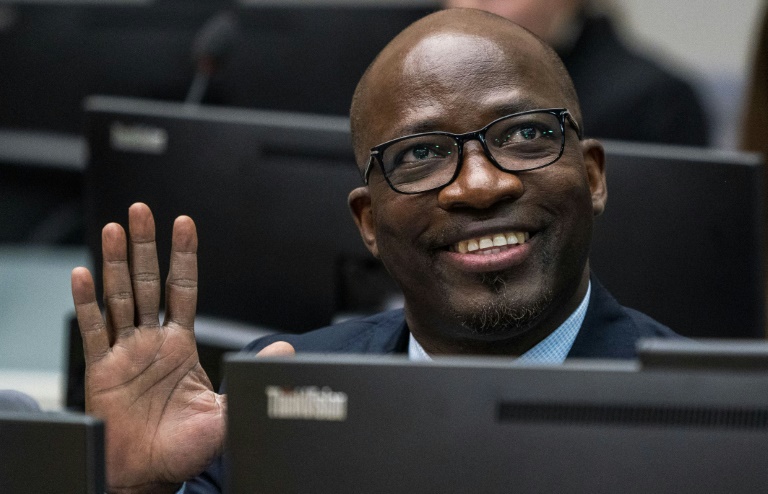
The former right-hand man of Ivory Coast’s ex-president Laurent Gbagbo told AFP on Monday that he will return home next month and join the reconciliation process after both were acquitted of crimes against humanity.

“I am going back to my country on November 26 and will take part in the  reconciliation that is so dear to my compatriots,” Charles Ble Goude told AFP.

President Alassane Ouattara’s office had approved the return date, he added.

Gbagbo returned to Abidjan in June 2021 but Ble Goude had to wait until the presidency gave the greenlight.

The West African state remains deeply scarred by the 2010-11 conflict, which erupted after Gbagbo refused to concede electoral defeat to Ouattara.

Some 3,000 people were killed and the country was divided on north-south lines. 

Both Ble Goude and Gbagbo were finally acquitted by the International Criminal Court in March 2021.

Ble Goude had been arrested in Ghana in 2013 and transferred to The Hague the following year.

Nicknamed the “street general” for his ability to organise a crowd, he led the pro-Gbagbo movement of Young Patriots.

Ble Goude, aged 50, has not joined the new political party PPA-CI that Gbagbo launched a year ago.

“I do not want to be a clan chief. I ask those with whom I fell out and do not have the same political ideas  for forgiveness,” Ble Goude told France RFI radio station in April last year.

Both Ble Goude and  Gbagbo were sentenced in their absence to 20 years in jail in Ivory Coast over the post-electoral violence.

Gbagbo, 77, was granted a presidential pardon in August.

Ethiopia rivals gear up for South Africa peace talks

The warring sides in Ethiopia were readying Monday for peace talks in South Africa aimed at finding a peaceful solution to the brutal two-year conflict.

The African Union-led negotiations had been flagged to start Monday, after a surge in fighting that has triggered alarm in the international community and fears for civilians caught in the crossfire.

But as evening fell, there was no word from any of those involved about whether the talks had started or exactly where they would be held.

Diplomatic pressure has been mounting to bring a halt to the war in Africa’s second most populous country that has left millions in need of humanitarian aid, and according to the United States, as many as half a million dead.

Kindeya Gebrehiwot, a spokesman for the rebel authorities in Tigray, announced their delegation’s arrival in South Africa in a tweet late Sunday.  

“Pressing: immediate cessation of hostilities, unfettered humanitarian access & withdrawal of Eritrean forces. There can’t be a military solution!” he added.

Addis Ababa said in a statement its delegation had left for South Africa on Monday morning, adding: “The government of Ethiopia views the talks as an opportunity to peacefully resolve the conflict and consolidate the improvement of the situation on the ground.”

But it also said its forces “have continued taking control of major urban centres in the past few days”, without identifying them.

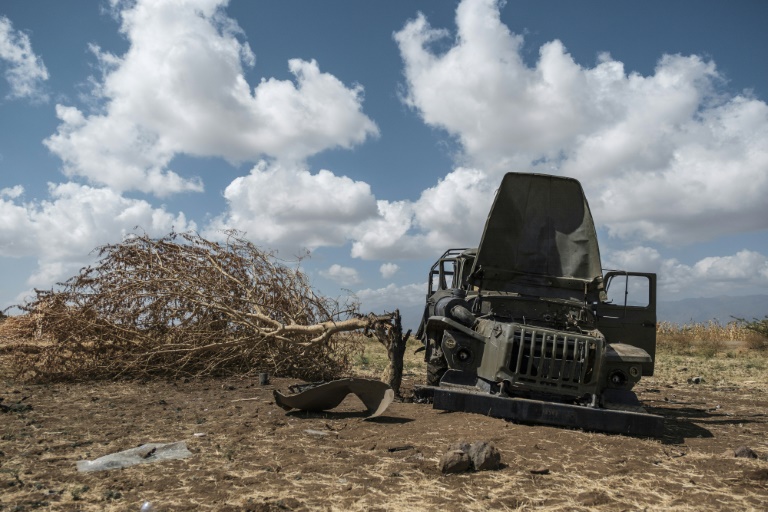
Last week, the government vowed to take control of airports and other federal sites in Tigray from the rebels as Ethiopian and Eritrean troops seized towns in the region including the strategic city of Shire, sending civilians fleeing.

Fighting resumed in August, shattering a five-month truce, and has seen the return of the Eritrean army in support of Ethiopian forces and their regional allies.

– ‘Peace will prevail’ –

Abiy first sent troops into Tigray in November 2020, promising a quick victory over the northern region’s dissident leaders, the Tigray People’s Liberation Front (TPLF), after what he said were attacks by the group on federal army camps.

The move followed long-running tensions with the TPLF, which had dominated Ethiopia’s ruling coalition before Abiy came to power in 2018 and sidelined the party.

In a rare comment on the conflict last week, Abiy — who won the 2019 Nobel Peace Prize for his rapprochement with Eritrea — said the war “would end and peace will prevail”.

But on Monday head of the rebel region Debretsion Gebremichael issued a defiant statement saying: “The Tigray army has the capacity to defeat our enemies totally.

“Those joint enemy forces that entered Tigray will be buried,” he warned. “Our enemies know they can’t battle with our troops.”

International calls for a ceasefire and a withdrawal of Eritrean troops have grown since the AU failed earlier this month to bring the warring sides to the negotiating table.

A Western official has confirmed that previous secret talks took place organised by the United States in the Seychelles and twice in Djibouti, but gave no further information.

The August return to the battlefield halted desperately-needed aid for Tigray’s six million people who lack food, medicine and basic services.

Tigray has also been under a communications blackout for over a year, and independent reporting from the region heavily curtailed.

– ‘End human suffering’ – 

The UN Security Council held a closed-doors meeting Friday to discuss the spiralling conflict, which has raised concerns about the stability of the volatile Horn of Africa region.

The US envoy to the United Nations, Linda Thomas-Greenfield, said after the talks that the scale of fighting and deaths “rival what we’re seeing in Ukraine”.

“Over two years of conflict, as many as half a million — half a million -– people have died, and the United States is deeply concerned about the potential for further mass atrocities.” 

The International Crisis Group (ICG) think tank said while reliable data was scarce, it believed the fighting since August alone may have involved more than half a million combatants and killed tens of thousands of people.

The IGC’s Ethiopia senior analyst William Davison said the first objective for mediators was “to try and get the federal and Tigray delegations to agree to a truce despite the momentum towards continued military confrontation”.

The AU’s mediation team for the South Africa talks was to include Horn of Africa envoy Olusegun Obasanjo, South Africa’s former deputy president Phumzile Mlambo-Ngcuka and former Kenyan president Uhuru Kenyatta.

“We count on all parties’ political leadership and sense of responsibility to work together to transform commitments into action — to end human suffering and put Ethiopia on path of reconciliation & reconstruction,” EU foreign policy chief Josep Borrell said on Twitter.

Pope Francis admitted he viewed the conflict in the predominantly Christian country with “trepidation”.

“May the efforts of the parties for dialogue lead to a genuine path of reconciliation,” he tweeted Sunday.

Chad protest witnesses recall 'terrible, terrible day' of death

Witnesses have come forward to tell AFP of the “absolutely terrible, terrible day” of violence that left 50 dead during widespread protests last week against the decision by Chad’s military ruler to extend his junta’s grip on power.

The unprecedented clashes between security forces and young demonstrators in the capital N’Djamena and elsewhere also left more than 300 injured.

There had been calls for several days for peaceful protests last Thursday — to mark the date when the military had promised to hand over power in the unstable Sahel country.

Junta head Mahamat Idriss Deby, a 38-year-old five-star general, has been in power since his iron-fisted father — was killed in an operation against rebels in April 2021.

He has since angered many at home and embarrassed backers abroad by hanging on to power for a further two years.

The evening before Thursday’s bloodshed, 75-year-old retired teacher Djim Toide said he “saw security forces vehicles parked on a roundabout near my house”.

“I thought they were conducting routine checks. Then at about four in the morning I started to hear gunshots.”

The building where he lives in the southern Moursal district of N’Djamena “filled with smoke”.

– ‘Live bullets’ –

“Things calmed down for a bit. And then the shooting started again,” he told AFP.

“So I went out into the street to see what was happening. I saw youths running all over the place chased by the security forces.”

He said the road was blocked with hastily erected barricades. Protesters were throwing stones and the police were firing tear gas.

Remadji Allataroum, a student at N’Djamena university, said she was woken at 2:00 am by protesters blowing whistles.

“The protesters came out of nowhere. They filled the streets, chanting ‘justice! equality!’,” she said.

Allataroum, who lives in the capital’s southern Abena district, said the atmosphere became palpably tense at around 6:00 am, when police intervened and “scuffles” broke out with protesters.

The security forces retreated briefly at around 7:00 am.

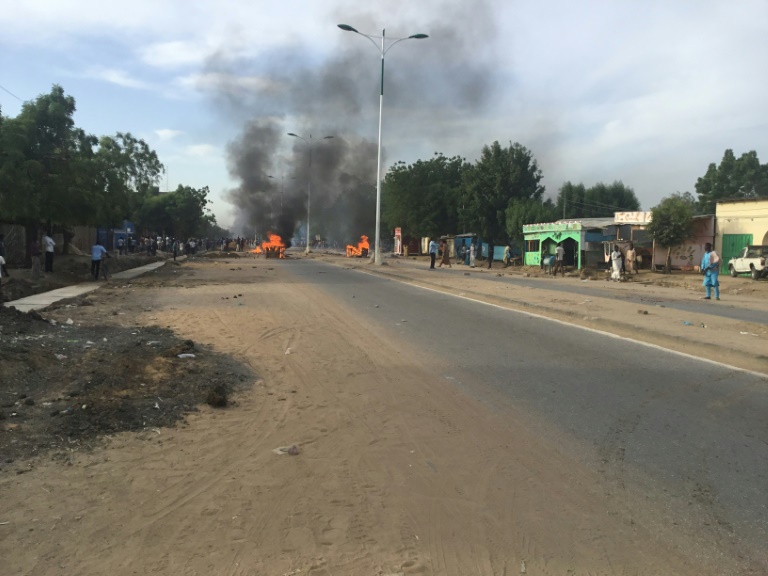
“The protesters seized the opportunity to put up roadblocks. They started burning tyres and kept chanting,” she said. 

Then the police returned. 

“They started firing live bullets and two protesters were hit in the head. They fell down dead right in front of me. 

“It was an absolutely terrible, terrible day. 

“Things only started to calm down a bit at the end of the afternoon,” she recalled.

– Crying out for help –

As on every workday morning, journalist Bertrand Teyane had been due on Thursday to go into the office. 

“But everywhere was shut off by the demonstrators’ roadblocks,” he told AFP.

He said he saw “clashes between police and young protesters”.

Teyane, who has three children of his own, said he heard “two women crying out for help in the street” near his house. 

“I decided to go outside to see what was happening and I’d only got a few metres (yards) when I saw two lifeless bodies stretched out on the ground.

“One was covered in the national blue, yellow and red flag. The other was just lying there covered in blood. He’d been hit in the stomach.”

Teyane said that by mid-afternoon there was an air of desolation about the capital — burnt-out wrecks of motorbikes and a car near the American embassy, police driving around in convoys “toting semi-automatic rifles”. 

“Around 5:00 pm, I heard gunshot and I thought to myself, ‘It’s starting up again’,” he said. 

“I didn’t dare go home until the firing stopped.”

Residents on edge as Uganda reports Ebola cases in Kampala

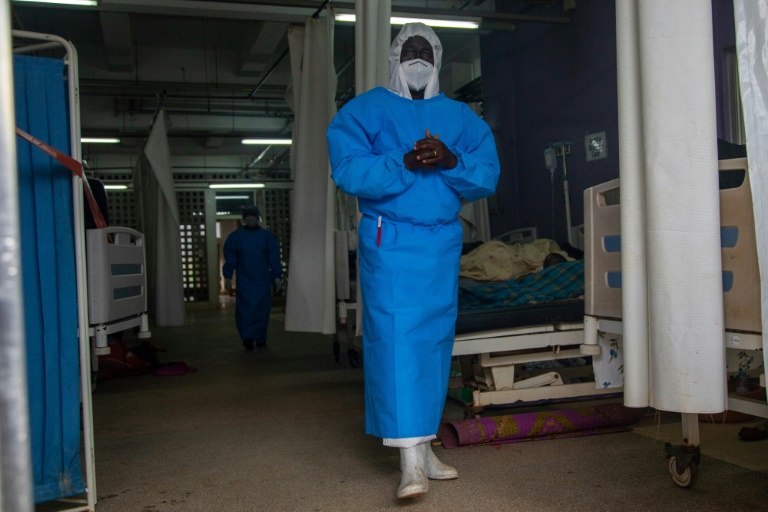
Uganda has reported 14 confirmed cases of Ebola in the greater Kampala region, the country’s health minister said Monday, but sought to assure anxious residents that the situation in the capital was under control.

So far, the death toll across the country from the Ebola epidemic declared in late September has climbed to 44, according to World Health Organisation figures issued last week.

Uganda’s health ministry meanwhile says there have been 90 confirmed cases overall, and 28 deaths.

Health Minister Ruth Jane Aceng told AFP there had been 14 confirmed cases in the Kampala area the past 48 hours, including nine who were contacts of a fatality from Kassanda, one of two central districts at the heart of the outbreak.

Of the nine, she said those infected included seven family members from Masanafu, a densely populated slum area in Kampala which lies near the Kasubi royal tombs, a UNESCO World Heritage Site, and not far from two of Uganda’s two main private universities.

President Yoweri Museveni earlier this month ordered Kassanda and Mubende, the epicentre of the outbreak, to be put under lockdown, imposing a travel ban, a curfew and the closure of public places.

But Aceng told AFP Monday: “The situation in Kampala is still under control and (there is) no need to restrict people’s movements.”

– ‘Disease is in our midst’ –

Residents of the capital, a city of about 1.5 million people bordering Lake Victoria, said they were anxious.

“It is getting scarier now that Kampala is recording Ebola cases,” said Rebecca Nanyonga, a 27-year-old mother of two.

“The government has not done much to sensitise Kampala residents on Ebola,” she said. “Parties and music concerts are still held yet the disease is in our midst.”

Ebola is spread through bodily fluids, with common symptoms being fever, vomiting, bleeding and diarrhoea, and combatted through time-honoured ways of tracing, containing and quarantining. Outbreaks are difficult to contain, especially in urban environments.

Uganda’s last recorded fatality from a previous Ebola outbreak was in 2019.

The particular strain now circulating in Uganda is known as the Sudan Ebola virus, for which there is currently no vaccine.

WHO has said that clinical trials could start within weeks on drugs to combat the Sudan strain.

The Ebola crisis follows the Covid-19 pandemic, which knocked the landlocked country’s economy hard.

“I had relaxed when Covid-19 cases went down. I am now putting back restrictions including visitors to my home,” said Ronald Kibwika, a 45-year-old Kampala businessman.

According to WHO figures, Uganda had more than 169,200 Covid cases and 3,630 deaths.

“We are at (the) mercy of God if Ebola cases rise in Kampala, because most people don’t take health precautions, and health services are still poor,” said Kampala businesswoman Anita Kwikiriza, 31.

Nigeria calls for calm after US, UK warn of 'terror' threat

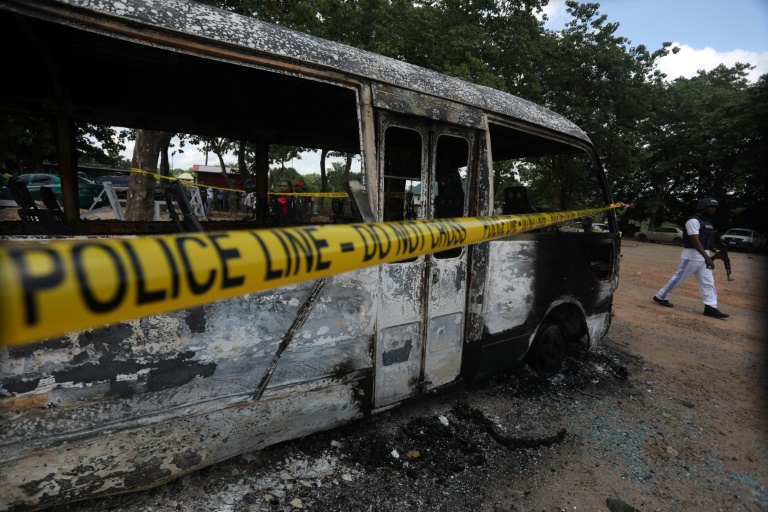
Western embassies in Nigeria’s capital Abuja on Monday advised their citizens in the country to limit their movements due to what they called a higher threat of a “terror” attack, despite appeals for calm from the authorities. 

It was unclear if the assessment from the US, UK and other countries was based on a new threat or because of incidents that had already occurred. 

Insurgents linked to the Islamic State group have claimed several attacks in states surrounding the Federal Capital Territory (FCT) in the past six months, putting many on edge in the city of six million.

On Sunday, the United States embassy in Nigeria issued an advisory warning its citizens of an “elevated risk of terror attacks in Nigeria, specifically in Abuja,” without giving further details. 

“Avoid all non-essential travel or movement,” the statement said, adding that it was “reducing services until further notice.”

Britain, Canada and Australia issued similar warnings over the weekend, recommending citizens in Nigeria and in Abuja in particular avoid public spaces where crowds gather.

The statements also reminded that schools have been targets for Nigerian insurgents in the past.

In response, Nigeria’s domestic security agency known as the Department of State Services (DSS) advised “that necessary precautions are taken by all.”

DSS spokesperson Peter Afunanya however said that there had been similar warnings in the past. 

“The service calls for calm as it works with other law enforcement agencies and stakeholders to maintain peace and order in and beyond Abuja,” he said.

In a bid to “de-escalate threats gathered from various intelligence… U.S advisory inclusive,” Nigeria’s police said it was launching a counter-terrorism exercise in Abuja on Tuesday and Wednesday. 

“The exercise will involve diversion of traffic, use of blank ammunition, and other operational manpower and assets,” police spokesperson Olumuyiwa Adejobi said in a statement on Monday. 

The operation was designed to improve coordination between different units “in response to terrorist incidents and other violent crimes,” Adejobi said.

Nigerian police said the public should not “panic at the sounds of explosives and gunshots during the exercise.”

– Mass jailbreak –

Residents in the FCT, including Western diplomats, have been increasingly worried about insecurity after a mass jailbreak from Kuje in July, a prison on the outskirts of the city. 

The incident, in which more than 400 inmates including dozens of suspected jihadists escaped, prompted President Muhammadu Buhari to say he was “disappointed” with his intelligence services.

The police and military said they had beefed up security in and around the city, which is surrounded by mountainous and forested areas and difficult to patrol.

Jihadists in Nigeria generally operate in the northeast of the country, far away from the capital, though they have small cells in other parts of the country. 

The last time one of the groups — Boko Haram — attacked the city centre was in 2014.

One of former army general Buhari’s main election promises in 2015 was to end insecurity but violence has continued and spread under his watch. 

On October 12, a man was killed during a kidnap attempt by criminals in the wealthy neighbourhood of Maitama in Abuja, where many Western embassies are located. 

In addition to the terrorism threat, the capital is also surrounded by states with high levels of banditry — gangs of heavily armed criminals who kidnap and kill. 

Analysts have warned that insecurity could worsen with the start of political campaigning to replace Buhari next year.

Pakistan journalist shot dead by police in Kenya

A top Pakistani news anchor was shot dead by police in Kenya  after he fled his home country to avoid sedition charges, investigators said Monday, prompting calls for a full probe into what one media rights group branded an “utterly disturbing murder”.

Arshad Sharif, 49, was a frequent critic of Pakistan’s powerful military establishment and supporter of former prime minister Imran Khan, who was ousted in a parliamentary no-confidence vote in April.

In a phone call with Kenyan President William Ruto, Pakistan’s Prime Minister Shehbaz Sharif called for a transparent investigation into the late-night shooting on Sunday.

Kenyan national police spokesman Bruno Shioso said the journalist was fatally wounded by an officer after his car drove through a police barrier in the Magadi area, 40 kilometres (25 miles) from the capital Nairobi.

“It is then that they were shot at, fatally injuring late Arshad Mohammed Sharif,” he said in a statement, adding that the journalist was travelling with a man described as his “brother” Khurram Ahmed.

“National Police Service regrets this unfortunate incident,” he said.

The killing triggered concern among media groups and a protest in the Pakistani city of Karachi.

According to a police report seen by AFP, the car carrying the two men was struck by around nine bullets, but continued on to the home of another Pakistani national.

There, Sharif was found to be dead “with a gunshot wound on the head which had penetrated from the back”.

The report said police at the time had been on the lookout for a stolen car and an abducted person and had set up a makeshift roadblock. 

In a post on Twitter, Pakistan PM Sharif said he had asked Ruto to “ensure fair & transparent investigation into shocking incident. He promised all-out help including fast-tracking the process of return of the body to Pakistan.”

In August, the journalist had interviewed senior opposition politician Shahbaz Gill, who said junior officers in Pakistan’s armed forces should not follow orders that went against “the will of the majority”.

The comment led to the news channel being briefly taken off air and an arrest warrant issued for Sharif, who fled the country. 

The channel ARY later said it had “cut ties” with him.

Gill was detained following the interview, and Khan’s criticism of the judiciary over the detention led to his own appearance in court. 

– ‘Harassment and arrest’ –

Pakistan has been ruled by the military for several decades of its 75-year history and criticism of the security establishment has long been seen as a red line.

“I lost friend, husband and my favourite journalist today, as per police he was shot in Kenya,” Sharif’s wife Javeria Siddique tweeted.

Pakistan is ranked 157 out of 180 countries in a press freedom index compiled by Reporters without Borders, with journalists facing censorship and intimidation. 

Media rights group Reporters Without Borders (known by its French acronym RSF) said Sharif had been shot dead with two bullets in “unclear circumstances” and urged an international investigation into “this gruesome and utterly disturbing murder”.

The killing was “all the more baffling since he had just left his home country to Kenya in order to escape harassment and arrest”, it added on Twitter.

RSF’s call was echoed by the Kenya Editors’ Guild which said those responsible should be brought to book.

“This would not only demonstrate Kenya’s and the government’s ability to protect its citizens and visitors but also assure Kenyans and the international community that Kenya is safe for everyone, including journalists whose rights it should protect.”

Earlier this month, Ruto had vowed to overhaul Kenya’s security forces and disbanded a police unit accused of extrajudicial killings.

According to Missing Voices, a campaign group focused on extrajudicial killings in Kenya, there have been 1,264 deaths at the hands of police since it began collecting data in 2017.

jaf-ecl-ho-txw/bp

Sudan names new military chief for conflict-hit Blue Nile

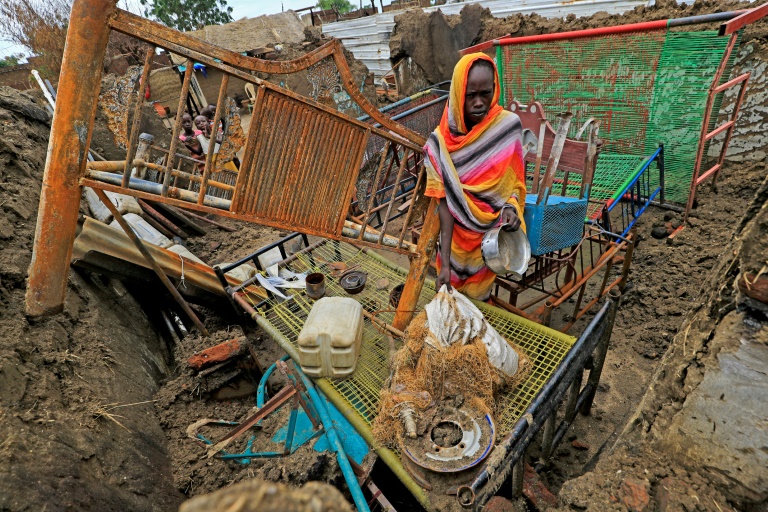
Sudan on Monday named a new military commander for troubled Blue Nile state, where recent bitter ethnic clashes over land have left at least 200 people dead and sparked angry demonstrations.

The new chief comes a day after eyewitnesses reported that crowds of thousands protested in front of army headquarters in the state capital Damazin, accusing the government of failing to protect them, with the local university suspending work.

Army spokesman Nabil Abdallah, announcing Monday a new commander for the southern Blue Nile state, said the military had ordered a committee to “evaluate the security situation”.

Blue Nile, which borders South Sudan and Ethiopia, is awash with guns and is still struggling to rebuild after decades of civil war, with over 300 people killed in recent months.

Sudan has been grappling with deepening political unrest and a spiralling economic crisis since last year’s military coup led by army chief Abdel Fattah al-Burhan.

A surge in ethnic violence in recent months has highlighted the security breakdown since the coup.

On Sunday, thousands of protesters demanded the resignation of state governor Ahmed al-Omda Badi, with eyewitnesses reporting the crowd “tried to enter the army headquarters” before “setting fire to the state government building.”

Badi declared a state of emergency on Friday to quell some of the worst fighting in recent months.

On Monday, Blue Nile University in Damazin announced “the suspension of classes and exams” due to “the unfortunate events.”

At least two hundred people were killed in two days of fighting last week, official media said Saturday, after clashes broke out over reported land disputes between members of the Hausa people and rival groups.

The violence follows clashes earlier this year between the same groups in Blue Nile, leaving at least 149 people killed and 65,000 displaced from July to early October, according to the United Nations.

The Hausa have mobilised across Sudan, claiming they were discriminated from owning land in Blue Nile because they were the last group to arrive there.

Access to land is highly sensitive in the impoverished country, where agriculture and livestock account for 43 percent of employment and 30 percent of GDP, according to UN and World Bank statistics.

Nearly 600 people have been killed and at least 211,000 forced to flee their homes in inter-communal conflicts across the country since January, according to the UN.

Nigeria calls for calm after US, UK warn of 'terror' threat

Western embassies in Nigeria’s capital Abuja on Monday advised their citizens in the country to limit their movements due to what they called a higher threat of a “terror” attack, despite appeals for calm from the authorities. 

It was unclear if the assessment from the US, UK and other countries was based on a new threat or because of incidents that had already occurred. 

Insurgents linked to the Islamic State group have claimed several attacks in states surrounding the Federal Capital Territory (FCT) in the past six months, putting many on edge in the city of six million.

On Sunday, the United States embassy in Nigeria issued an advisory warning its citizens of an “elevated risk of terror attacks in Nigeria, specifically in Abuja,” without giving further details. 

“Avoid all non-essential travel or movement,” the statement said, adding that it was “reducing services until further notice.”

Britain, Canada and Australia issued similar warnings over the weekend, recommending citizens in Nigeria and in Abuja in particular avoid public spaces where crowds gather.

The statements also reminded that schools have been targets for Nigerian insurgents in the past.

In response, Nigeria’s domestic security agency known as the Department of State Services (DSS) advised “that necessary precautions are taken by all.”

DSS spokesperson Peter Afunanya however said that there had been similar warnings in the past. 

“The service calls for calm as it works with other law enforcement agencies and stakeholders to maintain peace and order in and beyond Abuja,” he said.

Residents in the FCT, including Western diplomats, have been increasingly worried about insecurity after a mass jailbreak from Kuje in July, a prison on the outskirts of the city. 

The incident, in which more than 400 inmates including dozens of suspected jihadists escaped, prompted President Muhammadu Buhari to say he was “disappointed” with his intelligence services.

The police and military said they had beefed up security in and around the city, which is surrounded by mountainous and forested areas and difficult to patrol.

Jihadists in Nigeria generally operate in the northeast of the country, far away from the capital, though they have small cells in other parts of the country. 

The last time one of the groups — Boko Haram — attacked the city centre was in 2014.

One of former army general Buhari’s main election promises in 2015 was to end insecurity but violence has continued and spread under his watch. 

On October 12, a man was killed during a kidnap attempt by criminals in the wealthy neighbourhood of Maitama in Abuja, where many Western embassies are located. 

In addition to the terrorism threat, the capital is also surrounded by states with high levels of banditry — gangs of heavily armed criminals who kidnap and kill. 

Analysts have warned that insecurity could worsen with the start of political campaigning to replace Buhari next year.

Close Bitnami banner
Bitnami