Africa Business

Chad's leader visits part of capital hit by violent protests

Chad’s military ruler Mahamat Idriss Deby on Friday visited a hospital and a protest-hit district of N’Djamena, his office said, after a day of unprecedented violence that left around 50 people dead in the capital and elsewhere.

Tensions eased on Friday after Chad’s ruling junta announced an overnight curfew on Thursday, following fatal clashes eariler in the day between police and demonstrators protesting against the military’s grip on power.

The violence came on the heels of a national forum organised by Deby that extended his military government’s grip on power beyond Thursday’s deadline.

Deby, a 38-year-old five-star general, has been in power since his father — longtime military president Idriss Deby Itno — was killed in an operation against rebels in April 2021. He took no journalists with him on his city tour on Friday.

Escorted by a dozen vehicles, Mahamat Deby visited the capital’s southern seventh district, where there were violent clashes on Thursday, according to photos posted on the presidential palace’s Facebook page.

Some photos showed him at the hospital bedside of people hurt in the clashes.

Prime Minister Saleh Kebzabo put the official toll from the violence at around 50 dead and more than 300 injured. He said most fatalities had occurred in N’Djamena and the cities of Moundou and Koumra.

Kebzabo also announced the suspension of “all public activity” by major opposition groups, including the Transformers party and civil society coalition Wakit Tamma.

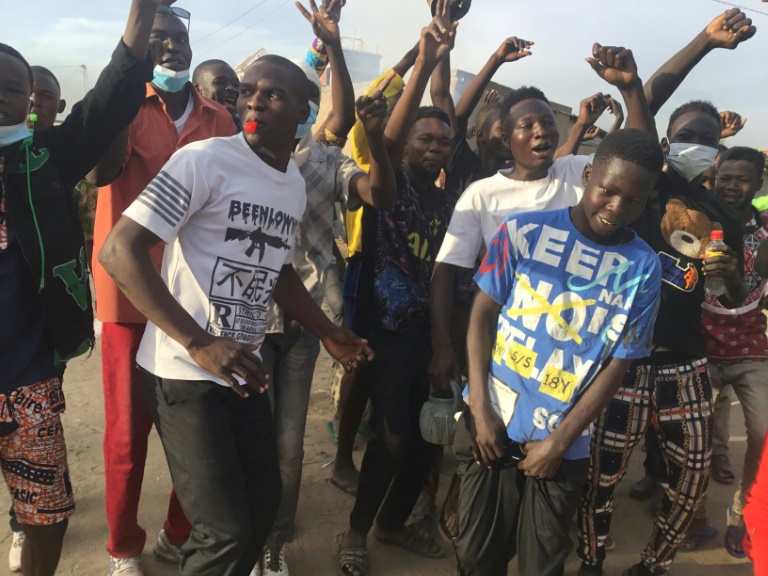
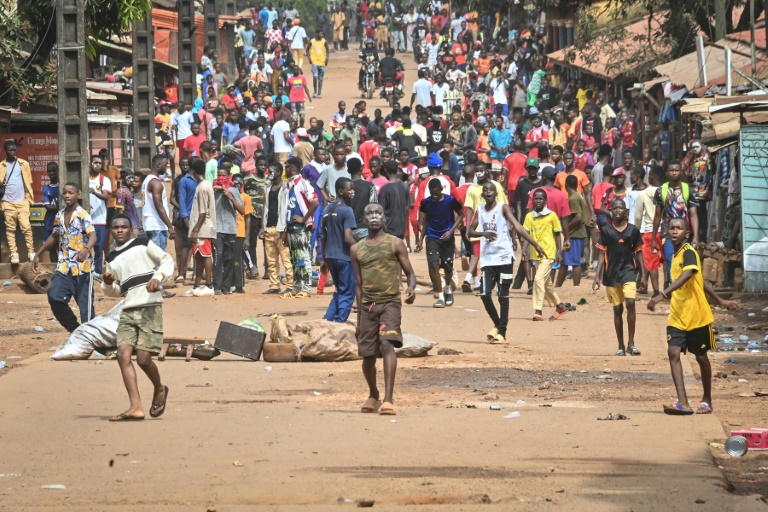
In southern districts of the capital, where most of the clashes took place, there was relative calm on Friday morning, although debris from burnt tyres and the remains of makeshift street barricades littered the streets.

Law enforcement officers, some of them hooded, were seen sitting in vehicles to deter further protests.

– ‘Killing our people’ –

In the southern Chagoua district of the capital, women wearing high-viz jackets and carrying brooms and pickaxes cleaned the streets, while bus services gradually resumed. 

Local resident Suzanne Chamnone, 50, who lives next to the headquarters of Kebzabo’s party, the National Union for Development and Renewal (UNDR), said she saw people gathered outside the party building on Thursday.

“They threw stones and set fire to the premises,” she said. “I went home out of fear, with my children.” 

The violence came on the heels of a national forum organised by Deby that extended his stay in power.

Deby took over in April 2021 after his iron-fisted father, in power for three decades, was killed during an operation against rebels.

The younger Deby has since angered many at home and embarrassed backers abroad by staying in power beyond his initially promised deadline, which would have expired on Thursday.

“They’re firing on us. They are killing our people,” Succes Masra, whose Transformers party was among groups that had called the protest, said on Twitter on Thursday.

The United Nations said it “deplored the lethal use of force” and called for an investigation into reports of human rights violations.

The African Union and the European Union have also condemned the repression of the protests.

“This was a declaration of war against our party. A group of about 100 people came with tyres and petrol. We were in the minority,” argued UNDR activist Nestor Nahor, 40, who witnessed the looting at the party HQ. 

Access to the internet was disrupted in the south of the city on Friday.

Deby’s junta had originally declared it would restore civilian rule after 18 months in power and he initially promised not to take part in elections that would follow.

But as the 18-month deadline neared, the nationwide forum staged by Deby reset the clock. On October 1, it approved a new 24-month timeframe for holding elections.

It named Deby “transitional president” and declared he could be a candidate in the poll.
Displaced by flooding, Nigerians in desperate need of help

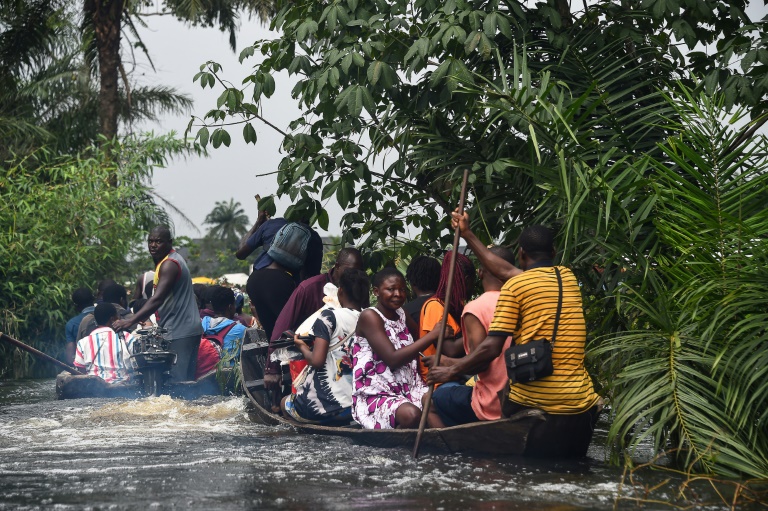
It was pitch black when the waters came, forcing mother Fortune Lawrence and her eight children to jump on a makeshift boat and flee their house.

For the past two weeks, they have been living in dire conditions near Ahoada, in Rivers state, in a school now crowded with more than a thousand people displaced by Nigeria’s worst floods in a decade.

“I was afraid to die in the water,” said Lawrence, surrounded by other families. “Here, we have nothing. Not enough food, no diapers, no mosquito nets.”

Flooding is frequent during Nigeria’s rainy season but this year, more than 600 people have died and 1.3 million others were forced to leave their homes, according to the latest government figures. 

In southern Rivers state, one of the worst affected, informal camps have popped up for those who managed to escape.

Some people are still stuck in flooded towns and villages, according to resident Obed Onyekachi.

There was “no way they could cross and come here,” said the 32-year-old, with anger in his voice. “How many of our brothers have been swallowed by the water, have gone missing?”

“Crops have been destroyed. We have no hope anymore. We will have to face starvation.”

– Contaminated water – 

Travelling across the state is a challenging task and makes it difficult to deliver aid.

On the main road, a tank truck has tipped over in the floods, and residents said several people had died in the area, where there are strong currents.

Others have managed to cross, wading through waist-deep water.

Alamin Mohamed, 25, was trying to travel on his motorbike, but said he had been stuck on the road for seven days.

“We don’t know how much time it will last,” he said.

The roof of a church could be seen poking out from the murky waters, between high voltage power lines. Wooden rafts have been ferrying large groups of people around.

The UN’s Food and Agriculture Organization representative in Nigeria, Fred Kafeero, warned this week that the floods had increased the risk of disease outbreaks such as cholera.

At a primary school in Ihuike, a community in Ahoada, displaced people are lying on the floor, squeezed against one another. There are around 50 people in each classroom.

A group of local volunteers are cleaning and dividing the meagre food supplies received from local authorities.

“We need a clean environment. We are really careful but we are exhausted. Even the water from the well is contaminated,” said one volunteer, who asked to remain anonymous. 

– Health risks –

Ten days ago, the governor of Rivers state, Ezenwo Nyesom Wike, approved one billion naira (about $2.3 million) for emergency relief measures for flood victims.

Still, the needs are immense. In one of the informal camps, women told AFP they did not have anything for menstrual hygiene. “We have no tissue for that,” one woman said.

At the entrance to the camp, children stood in line, waiting to be seen by women wearing surgical gloves. 

They were getting an oral HIV test, explained nurse Bukky Chika Emeyi. In case of a positive result, they will need a blood test in hospital.  

“Their living conditions are bad. The risk of transmission is high,” said the 27-year-old, who works with the local charity IHVN.

“Women are giving birth, helped by other women who are not trained, not educated, and using unsterilised tools.”

Guinea junta agrees return to civilian rule in 2 years

Guinea’s ruling junta has agreed to restore civilian rule in two years, after facing sanctions over its original plan for a three-year transfer of power, the West African bloc ECOWAS said Friday.

West African leaders had last month suspended Guinea from the bloc and imposed sanctions on a number of individuals following a military coup.

“In a dynamic compromise, experts from ECOWAS and Guinea have jointly developed a consolidated chronogram (timetable) for a transition spread over 24 months,” ECOWAS said in a report following a technical mission to the country published on social media by the junta.

The country’s military leader, Colonel Mamady Doumbouya, said in an address broadcast on state television that the timetable would take effect from January 1, 2023.

Leaders from the Economic Community of West African States must approve the timetable before it is officially implemented, with the bloc due to hold a summit before the end of the year.

The bloc had given the junta one month to present a “reasonable and acceptable” timetable for the return to civilian rule, an ultimatum that theoretically expires this weekend.

Diplomatic links between the two sides have remained and Guinean authorities have reiterated their readiness to cooperate with ECOWAS, which had dispatched its mission to Conakry to work out a compromise schedule.

– Acceptable –

The poor but mineral-rich West African state has been under a military government since a September 2021 coup that ousted president Alpha Conde after more than 10 years in power.

Colonel Doumbouya has since appointed himself president and vowed to restore civilian rule within three years.

Several West African officials have indicated that a two-year transition period would be acceptable.

A similar timeframe was agreed between ECOWAS and the junta in neighbouring Mali after months of wrangling.

Under the terms of that agreement, reached in July, the Malian military was to hand over power in March 2024. By that time, they would have been in power for more than three-and-a-half years since overthrowing the elected civilian president in August 2020.

In recent years, ECOWAS has witnessed a succession of military coups in West Africa, in 2020 and 2021 in Mali, in 2021 in Guinea and twice this year in Burkina Faso.

In the face of military authorities, the bloc has duly increased its summits and country missions while ramping up pressure to shorten the transitional periods back to civilian rule.

– Four dead in clashes –

The transition compromise was reached after demonstrations broke out Thursday in the capital Conakry, with young protesters clashing with security forces and opposition group the National Front for the Defence of the Constitution claiming four civilians had been killed.

The FNDC — outlawed by the junta — had called for the protests to demand a quick return to a civilian-led government and the release of all prisoners detained for political reasons.

In response, Guinea’s top prosecutor on Friday called for a crackdown on the organisers and participants of a giant anti-government protest in which he said six security personnel had been wounded while the opposition said four civilians had been killed.

The FNDC identified three of the people killed as Thierno Bella Diallo, Boubacar Diallo and Thierno Moussa Barry. It said 20 people suffered gunshot wounds while many others were arrested.

Justice Minister Alphonse Charles Wright confirmed their deaths in a statement on Friday, but said the causes “remain to be clarified by autopsy”. 

He ordered prosecutions, without commenting on the alleged perpetrators. 

Burkina coup leader says country in 'danger' as he takes office

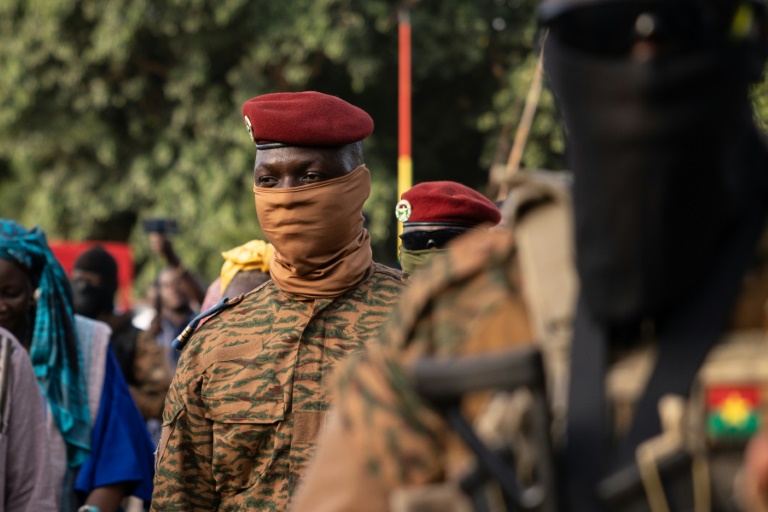
Ibrahim Traore, the young army captain who led the latest coup in Burkina Faso, became interim president on Friday, vowing to win back territory from jihadists.

Traore pledged support for a transition leading to elections in July 2024 as he took the oath of office in the capital Ouagadougou under tight security.

Traore, 34, led disgruntled junior officers last month in the second coup in eight months to hit the west African country.

Junta members had already announced that he would take over the role of transitional president, but Friday was the official investiture.

After taking the oath of office, Traore, dressed in military fatigues and a scarf with the country’s national colours, said: “We are confronted with a security and humanitarian crisis without precedent.

“Our aims are none other than the reconquest of territory occupied by these hordes of terrorists,” he added. “Burkina’s existence is in danger.”

The swearing in was outlined in the transition charter adopted last week.

The charter’s article four stipulates “that the term of the transition president ends with the investiture of the president resulting from the presidential election” planned for July 2024.

“I swear on my honour before the Burkina people that I will preserve, respect, ensure respect for and defend the constitution, the transition charter and (Burkina’s) laws,” Traore said, reading his oath of office.

Last month Traore toppled Lieutenant-Colonel Paul-Henri Sandaogo Damiba.

Damiba himself had seized power only in January, forcing out Burkina’s last elected president, Roch Marc Christian Kabore.

The motive for both coups was anger at failures to stem a seven-year jihadist insurgency that has claimed thousands of lives and driven nearly two million people from their homes.

Fresh evidence of that threat emerged on Friday when the army’s command said it had killed 15 jihadists, including the leader of a group active in the southwest of the country, and freed a hostage earlier in the week.

Foreign dignitaries were absent from the inauguration, which took place in a well-guarded room of the constitutional council in Ouagadougou.

Traore’s takeover comes during a struggle for influence between France and Russia in French-speaking Africa, where former French colonies are increasingly turning to Moscow.

Tigray's rebels agree to peace talks as Ethiopia PM vows 'end' to war

Tigray’s rebel authorities said Friday they would attend talks next week aimed at ending war in Ethiopia, as Prime Minister Abiy Ahmed vowed fighting “will end and peace will prevail”.

The government has also said it will participate in the negotiations in South Africa on Monday, being organised by the African Union, as diplomatic pressure mounts for a settlement to almost two years of bloodshed.

“Our delegation will attend,” Kindeya Gebrehiwot, a spokesman for the rebel authorities in Tigray, told AFP in a text message when asked if they would come to the table on October 24.

The news came ahead of a closed-door meeting of the United Nations Security Council on Friday to discuss the spiralling conflict in Africa’s second-most populous country, and growing fears for civilians caught in the crossfire.

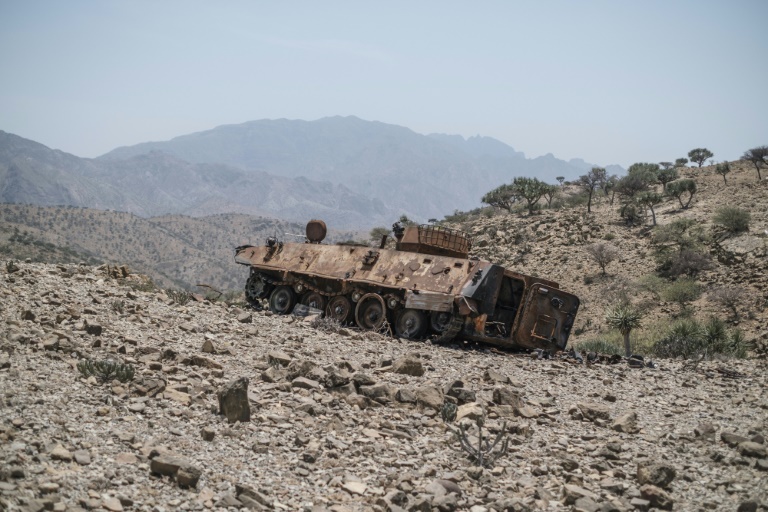
Ethiopia’s government this week vowed to seize airports and other federal sites in Tigray from rebel control as its army and their Eritrean allies seized towns in the war-torn region, sending civilians fleeing.

Abiy, who sent troops into Tigray in November 2020 promising a quick victory over the northern region’s dissident leaders, said the war “would end and peace will prevail.”

“Ethiopia will be peaceful, we will not continue fighting indefinitely,” the Nobel Peace Prize winner said Thursday at a project launch outside Addis Ababa.

“I hope the day when we will stand with our Tigrayan brothers to work together for development is near.”

– ‘Dramatic’ violence –

International calls for a ceasefire have grown since the AU failed earlier this month to bring the warring sides to the negotiating table, and fighting intensified in embattled Tigray.

The AU’s Peace and Security Council, its foremost conflict resolution body, met for the first time Friday since fighting resumed in August, shattering a five-month-long truce.

In a communique, the 15-member council welcomed “the mutual commitments to genuinely participate in the peace process” and hoped for a “fruitful outcome”.

The return to the battlefield in August halted desperately-needed aid into Tigray, a region of six million that lacks food, medicine and other life-saving essentials.

A humanitarian source told AFP on Friday that heavy fighting was underway between the cities of Shire and Axum in northern Tigray, where combat has intensified in recent weeks.

EU foreign policy chief Josep Borrell warned of a “dramatic escalation of violence”.

“The number of casualties and the level of human suffering is staggering”, he posted on Twitter on Friday.

Tigray has been under a communications blackout for over a year, and independent reporting from the region has heavily curtailed.

The International Crisis Group said that, while reliable data was scarce, it believed the fighting since August “may have involved more than half a million combatants and killed tens of thousands of people”.

“According to most estimates, it is among the world’s deadliest conflicts,” the Brussels-based think tank said in a report published Friday.

– ‘Great concern’ –

US State Department spokesman Ned Price said the UNSC and AU meetings “demonstrate the international community’s great concern about the situation” and the need for the violence to stop.

Speaking to reporters on Thursday, he also renewed calls for a resumption of humanitarian aid to Tigray, and the withdrawal of Eritrean troops from Ethiopia.

Price said US special envoy Mike Hammer was in Addis Ababa and in “constant touch” with the participants in the peace talks, including Kenya and South Africa.

The AU’s mediation team was to include Horn of Africa envoy Olusegun Obasanjo — who briefed the peace council on Friday –South Africa’s former deputy president Phumzile Mlambo-Ngcuka, and former Kenyan president Uhuru Kenyatta.

Logistical problems were blamed for peace talks scheduled earlier this month never eventuating.

The AU was “widely perceived as responding inadequately to this situation” but had been trying to ensure talks got started next week as planned, the AU-focused Amani Africa think tank said Friday in a briefing note.

The conflict began nearly two years ago when Abiy accused the Tigray People’s Liberation Front (TPLF), the region’s ruling party which resisted central authority, of attacking army camps.

The TPLF dominated Ethiopia’s ruling political alliance for decades before Abiy took power in 2018 and sidelined the party.

Chad's leader visits part of capital hit by violent protests

Chad’s military ruler Mahamat Idriss Deby on Friday visited a hospital and a protest-hit district of N’Djamena, his office said, after a day of unprecedented violence that left around 50 people dead in the capital and elsewhere.

Tensions eased on Friday after Chad’s ruling junta announced an overnight curfew on Thursday, following fatal clashes eariler in the day between police and demonstrators protesting against the military’s grip on power.

The violence came on the heels of a national forum organised by Deby that extended his military government’s grip on power beyond Thursday’s deadline.

Deby, a 38-year-old five-star general, has been in power since his father — longtime military president Idriss Deby Itno — was killed in an operation against rebels in April 2021. He took no journalists with him on his city tour on Friday.

Escorted by a dozen vehicles, Mahamat Deby visited the capital’s southern seventh district, where there were violent clashes on Thursday, according to photos posted on the presidential palace’s Facebook page.

Some photos showed him at the hospital bedside of people hurt in the clashes.

Prime Minister Saleh Kebzabo put the official toll from the violence at around 50 dead and more than 300 injured. He said most fatalities had occurred in N’Djamena and the cities of Moundou and Koumra.

Kebzabo also announced the suspension of “all public activity” by major opposition groups, including the Transformers party and civil society coalition Wakit Tamma.

In southern districts of the capital, where most of the clashes took place, there was relative calm on Friday morning, although debris from burnt tyres and the remains of makeshift street barricades littered the streets.

Law enforcement officers, some of them hooded, were seen sitting in vehicles to deter further protests.

– ‘Killing our people’ –

In the southern Chagoua district of the capital, women wearing high-viz jackets and carrying brooms and pickaxes cleaned the streets, while bus services gradually resumed. 

Local resident Suzanne Chamnone, 50, who lives next to the headquarters of Kebzabo’s party, the National Union for Development and Renewal (UNDR), said she saw people gathered outside the party building on Thursday.

“They threw stones and set fire to the premises,” she said. “I went home out of fear, with my children.” 

The violence came on the heels of a national forum organised by Deby that extended his stay in power.

Deby took over in April 2021 after his iron-fisted father, in power for three decades, was killed during an operation against rebels.

The younger Deby has since angered many at home and embarrassed backers abroad by staying in power beyond his initially promised deadline, which would have expired on Thursday.

“They’re firing on us. They are killing our people,” Succes Masra, whose Transformers party was among groups that had called the protest, said on Twitter on Thursday.

The United Nations said it “deplored the lethal use of force” and called for an investigation into reports of human rights violations.

The African Union and the European Union have also condemned the repression of the protests.

“This was a declaration of war against our party. A group of about 100 people came with tyres and petrol. We were in the minority,” argued UNDR activist Nestor Nahor, 40, who witnessed the looting at the party HQ. 

Access to the internet was disrupted in the south of the city on Friday.

Deby’s junta had originally declared it would restore civilian rule after 18 months in power and he initially promised not to take part in elections that would follow.

But as the 18-month deadline neared, the nationwide forum staged by Deby reset the clock. On October 1, it approved a new 24-month timeframe for holding elections.

It named Deby “transitional president” and declared he could be a candidate in the poll.
Ethiopia PM vows 'end' to war as Tigray's rebels agree to peace talks

Tigray’s rebel authorities said Friday they would attend talks next week aimed at ending war in Ethiopia, as Prime Minister Abiy Ahmed vowed fighting “will end and peace will prevail”.

The government has also said it would participate in negotiations in South Africa being organised by the African Union on Monday, as diplomatic pressure mounts for a settlement to nearly two years of bloodshed.

“Our delegation will attend,” Kindeya Gebrehiwot, a spokesman for the rebel authorities in Tigray, told AFP in a text message when asked if they would join the table on October 24.

It comes ahead of a closed-door meeting of the United Nations Security Council on Friday to discuss the spiralling crisis in Africa’s second-most populous country.

The AU’s Peace and Security Council also convened Friday and was briefed by its Horn of Africa envoy Olusegun Obasanjo, who is expected to mediate the talks.

International pressure for a ceasefire has grown since the AU failed earlier this month to bring the warring sides to the negotiating table, and fighting has intensified in embattled Tigray.

The government this week vowed to seize airports and other federal sites from rebel control as Ethiopian forces and their Eritrean allies seized a string of towns in Tigray, sending civilians fleeing.

Abiy, a Nobel Peace Prize winner who sent the army into Tigray in November 2020 to oust the region’s dissident authorities, said the war “would end and peace will prevail.”

“Ethiopia will be peaceful, we will not continue fighting indefinitely,” he told an audience on Thursday at the opening of a civil project outside Addis Ababa.

“Ethiopia will be peaceful, we will not continue fighting indefinitely. I hope the day when we will stand with our Tigrayan brothers to work together for development is near.” 

– ‘Great concern’ –

Fighting resumed in August, shattering a truce and halting aid into Tigray, a region of six million that lacks food, medicine and other life-saving essentials.

In recent weeks combat has intensified, spurring alarm for civilians and aid workers trapped in the warzone, and global calls for a ceasefire.

A humanitarian source told AFP on Friday that heavy fighting was underway between the cities of Shire and Axum in northern Tigray.

US State Department spokesman Ned Price said the UNSC and AU meetings “demonstrate the international community’s great concern about the situation” and the need for violence to stop.

Speaking to reporters on Thursday, he also renewed calls for a resumption of humanitarian aid to Tigray, and the withdrawal of Eritrean troops from Ethiopia.

The closed-door meeting of the AU’s 15-member Peace and Security Council was the first since violence exploded again in August.

The continent-wide bloc was “widely perceived as responding inadequately to this situation” but had been trying to ensure talks got underway next week as planned, the AU-focused Amani Africa think tank said Friday in a briefing note.

The aborted talks earlier this month were to be mediated by Obasanjo and supported by South Africa’s former deputy president Phumzile Mlambo-Ngcuka and former Kenyan president Uhuru Kenyatta.

Logistical problems were blamed for that meeting never taking place.

The conflict began nearly two years ago when Abiy accused the Tigray People’s Liberation Front (TPLF), the region’s ruling party which resisted central authority, of attacking army camps.

The TPLF dominated Ethiopia’s ruling political alliance for decades before Abiy took power in 2018 and sidelined the party.

Three died in Guinea anti-junta protests

Guinea’s top prosecutor is calling for a crackdown on the organisers and participants of anti-junta protests while the opposition and justice minister said Friday three civilians were killed in the unrest.

Young protesters clashed on Thursday with security forces in the capital Conakry in demonstrations called by an outlawed group against the country’s ruling junta.

Conakry’s Prosecutor General Yamoussa Conte said six security forces personnel were wounded, five of whom were in serious condition, adding that two civilians were injured.

He called for action “against the organisers and all the participants of the said banned demonstration,” according to a statement read on state television.

He named seven opposition leaders who allegedly called for the demonstration or supported it.

The National Front for the Defence of the Constitution (FNDC) had called for the protest to demand a quick return to a civilian led government and the release of all prisoners detained for political reasons.

In a statement released overnight Thursday to Friday, the FNDC called the ruling junta “dictatorial.”

The group identified the three people killed as Thierno Bella Diallo, Boubacar Diallo and Thierno Moussa Barry. It said 20 people suffered gunshot wounds while many others were arrested.

Justice Minister Alphonse Charles Wright confirmed their deaths in a statement on Friday, but said the causes “remain to be clarified by autopsy”. 

He ordered prosecutions, without commenting on the alleged perpetrators. 

Wright also stressed the authorities’ determination to combat impunity.

– ‘More severe sanctions’ –

Rights activists regularly accuse Guinean police and gendarmes of using excessive force, and the authorities of turning a blind eye in a country with a history of political violence.

The justice minister ordered the identification “without delay” of a member of the security forces whose image has gone viral on social networks. A video shows him firing a pistol at a target who is not visible in the footage.

The poor but mineral-rich West African state has been under military government since a September 2021 coup that ousted president Alpha Conde after more than 10 years in power.

An alliance of political parties, trade unions and civil groups, the FNDC spearheaded protests against Conde before his ouster.

It was officially dissolved in August by the junta-appointed government.

The coalition had called for peaceful demonstrations to take place in Conakry on Thursday, followed by nationwide protests on October 26.

West African leaders suspended Guinea from the Economic Community of West African States (ECOWAS), and imposed sanctions last month on a number of individuals.

It gave the ruling junta one month to present a “reasonable and acceptable” timetable for the return of civilian rule, an ultimatum that theoretically expires this weekend. 

If they fail to do so, ECOWAS has warned that it will adopt “more severe sanctions”.

Tensions ease in Chad after day of violent protests

Tensions eased in Chad on Friday following a day of unprecedented violence at protests that left around 50 people dead across the country.

Chad’s government had on Thursday announced an overnight curfew after the deadly clashes between police and demonstrators protesting the military’s grip on power.

Chadian Prime Minister Saleh Kebzabo put the official toll at around 50 dead, saying most fatalities occurred in N’Djamena and the cities of Moundou and Koumra, while more than 300 people were injured in the violence.

Kebzabo also announced the suspension of “all public activity” of major opposition groups, including the Transformers party and civil society coalition Wakit Tamma.

In the southern districts of the capital, where most of the clashes took place, there was a relative calm on Friday morning, though debris from burnt tyres and the remains of makeshift street barricades littered the streets.

Law enforcement officers, some of them hooded, were seen sitting in vehicles to deter further protests.

In Chagoua, south of the capital, women wearing yellow waistcoats and carrying brooms and pickaxes cleaned the streets, while bus services gradually resumed. 

Local resident Suzanne Chamnone, 50, whose home is next to the headquarters of Kebzabo’s party, the National Union for Development and Renewal (UNDR), said that on Thursday she “saw the people gathered and I went home out of fear with my children. They threw stones and set fire to the (party) premises”.

– ‘Killing our people’ –

The violence came on the heels of a national forum organised by military strongman Mahamat Idriss Deby Itno that extended his stay in power.

The 38-year-old five-star general took over in April 2021 after his iron-fisted father, Idriss Deby Itno, in power for three decades, was killed during an operation against rebels.

The younger Deby has since angered many at home and embarrassed backers abroad by staying in power beyond his initially promised deadline, which would have expired on Thursday.

“They’re firing on us. They are killing our people,” Succes Masra, whose Transformers party was among groups that had called the protest, said on Twitter Thursday.

The United Nations said it “deplored the lethal use of force” and called for an investigation into reported human rights violations.

The African Union and the European Union have also condemned the repression of the protests.

“This was a declaration of war against our party. A group of about 100 people came with tyres and petrol. We were in the minority,” said UNDR activist Nestor Nahor, 40, who witnessed the looting at the party’s headquarters in the 7th district of N’Djamena. 

Access to the internet was disrupted in the south of the city on Friday.

Burkina coup leader says country in 'danger' as he takes office

Ibrahim Traore, the young army captain who led the latest coup in Burkina Faso, became interim president on Friday, vowing to win back territory from jihadists.

Traore pledged support for a transition leading to elections in July 2024 as he took the oath of office in the capital Ouagadougou under tight security.

Traore, 34, led disgruntled junior officers last month in the second coup in eight months to hit the west African country.

The motive — as in January — was anger at failures to stem a seven-year jihadist insurgency that has claimed thousands of lives and driven nearly two million people from their homes.

Junta members had already announced that he would take over the role of transitional president, but Friday was the official investiture.

After taking the oath of office, Traore, dressed in military fatigues and a scarf with the country’s national colours, said: “We are confronted with a security and humanitarian crisis without precedent.

“Our aims are none other than the reconquest of territory occupied by these hordes of terrorists,” he added. “Burkina’s existence is in danger”.

The swearing in was outlined in the transition charter adopted last week.

The charter’s article four stipulates “that the term of the transition president ends with the investiture of the president resulting from the presidential election” planned for July 2024.

“I swear on my honour before the Burkina people that I will preserve, respect, ensure respect for and defend the constitution, the transition charter and (Burkina’s) laws,” Traore said, reading his oath of office.

Last month Traore toppled Lieutenant-Colonel Paul-Henri Sandaogo Damiba.

Damiba himself had seized power only in January, forcing out Burkina’s last elected president, Roch Marc Christian Kabore.

Foreign dignitaries were absent from the inauguration at a well-guarded room of the constitutional council in Ouagadougou.

Traore’s takeover comes during a struggle for influence between France and Russia in French-speaking Africa, where former French colonies are increasingly turning to Moscow.

Traore seems — for now — to bring hope to many in a country sinking steadily in the quagmire. 

Close Bitnami banner
Bitnami