Africa Business

Five migrants die in mass attempt to enter Spain's Melilla

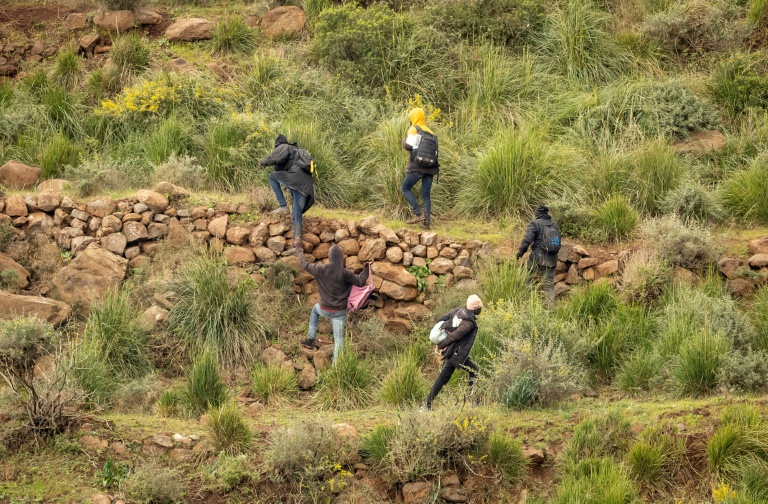
Five migrant were killed and dozens were injured when a huge crowd tried to cross from Morocco into Spain’s Melilla enclave on Friday, the latest migrant tragedy at the doors of Europe.

Some 2,000 migrants approached Melilla at dawn and over 500 managed to enter a border control area after cutting a fence with shears, the Spanish government’s local delegation said in a statement.

Of these 130 sub-Saharan African migrants, “all of them men and apparently adults”, managed to enter Melilla, it added.

A Moroccan official from the nearby border town of Nador said “five deaths were recorded after they stormed the border and some fell from the top of the barrier” separating the two sides.

He said 140 security personnel and 76 migrants were injured during the attempt to cross, the first such mass incursion since Spain and Morocco mended diplomatic relations last month.

The Spanish government’s local delegation said only that 49 Spanish police officers were lightly injured while 57 migrants suffered injuries of varying degrees, including three who were hospitalised.

Morocco had deployed a “large” number of forces to try to repel the assault on the border, who “cooperated actively” with Spain’s security forces, it said earlier in a statement.

Images on Spanish media showed exhausted migrants laying on the sidewalk in Melilla, some with bloodied hands and torn clothes.

Speaking in Brussels, Spanish Prime Minister Pedro Sanchez condemned the “violent assault” which he blamed on “mafias who traffic in human beings”.

– Migrant magnet –

Melilla and Ceuta, Spain’s other tiny North African enclave, have the European Union’s only land borders with Africa, making them a magnet for migrants. 

On Thursday night migrants and security forces “clashed” on the Moroccan side of the border, Omar Naji of Moroccan rights group AMDH told AFP. 

Several of them were hospitalised in Nador, he added.

In March this year, Spain ended a year-long diplomatic crisis by backing Morocco’s autonomy plan for Western Sahara going back on its decades-long stance of neutrality. 

Spanish Prime Minister Pedro Sanchez then visited Rabat, and the two governments hailed a “new stage” in relations.

The row began when Madrid allowed Brahim Ghali, leader of Western Sahara’s pro-independence Polisario Front, to be treated for Covid-19 in a Spanish hospital in April 2021.

A month later, some 10,000 migrants surged across the Moroccan border into Spain’s Ceuta enclave as border guards looked the other way, in what was widely seen as a punitive gesture by Rabat.

Rabat calls for the Western Sahara to have an autonomous status under Moroccan sovereignty but the Polisario wants a UN-supervised referendum on self-determination as agreed in a 1991 ceasefire agreement.

In the days just before Morocco and Spain patched up their ties, there were several attempted mass crossings of migrants into Melilla, including one involving 2,500 people, the largest such attempt on record. Nearly 500 made it across.

– ‘Means of pressure’ –

Patching up relationship with Morocco, the departure point for many migrants, has meant a drop in arrivals, notably in Spain’s Atlantic Canary Islands. 

The number of migrants who reached the Canary Islands in April was 70 percent lower than in February, government figures show. 

Sanchez earlier this month warned that “Spain will not tolerate any use of the tragedy of illegal immigration as a means of pressure.”

Spain will seek to have “irregular migration” listed as one of the security threats on the NATO’s southern flank when the alliance gathers for a summit in Madrid on June 29-30.

Over the years, thousands of migrants have attempted to cross the 12-kilometre (7.5-mile) border between Melilla and Morocco, or Ceuta’s eight-kilometre border, by climbing the fences, swimming along the coast or hiding in vehicles.

The two territories are protected by fences fortified with barbed wire, video cameras and watchtowers.

Migrants sometimes use hooks and sticks to try to climb the border fence, and throw stones at police.
Lumumba's coffin visits Kisangani, where Congo's first premier found his way

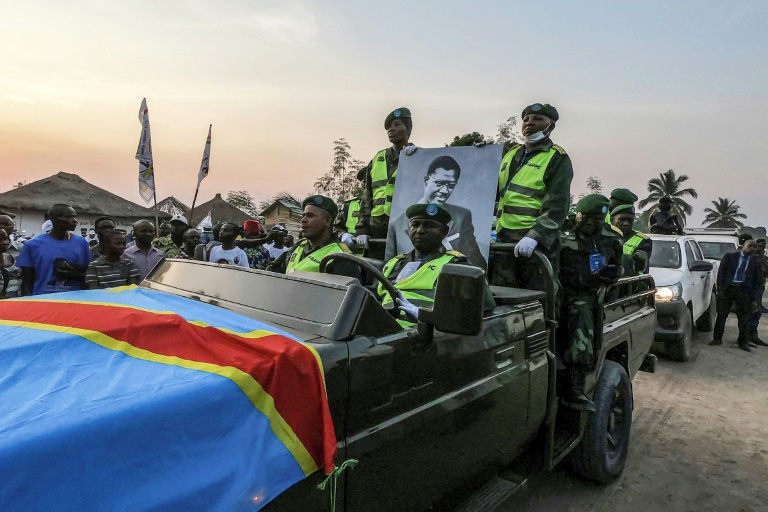
After resting in his native village, the coffin of the former Belgian Congo’s first post-independence prime minister on Friday pursued its memorial pilgrimage to the northeastern city of Kisangani.

As in Onalua village in the centre of today’s Democratic Republic of Congo, where Patrice Lumumba was born in 1925, officials, dancers and tam-tams in Kisangani awaited the remains of the independence hero, executed in January 1961, four months after the end of his brief term in office.

A single tooth is all that remains of the young scholar and nationalist politician whose life and career were cut short in a dark struggle for leadership and control of resources in the central African country.

His body was dissolved in acid after he was killed, but a Belgian police officer kept the tooth as a trophy. Belgian authorities in 2016 seized the relic from his daughter.

Belgium finally returned it on Monday to Lumumba’s family members during a ceremony in Brussels.

It was then placed inside a coffin for the funeral tour, 61 years late.

– ‘I protect Lumumba’s chair’ –

In a small room inside a brick building known as “1925” in Kisangani, the shelves are stacked with records and works of the colonial administration in Stanleyville, as Kisangani used to be called.

Titles ranged from “Congo Codes and Laws, 1954” and “Legal Review of the Belgian Congo” to “Palm groves in relation to ethnology”.

Lumumba worked here as a librarian for the Indigenous Labour Administration. He was also in charge of mail at the Post Office.

Joseph Lifaefi, head of an office that watches over the property, says he has heard talk of “a tourist site, but nothing concrete”.

“I protect Lubumba’s table and chair, the writings with his signature, his demands,” he told AFP, showing the wooden chair and old grey table.

He voiced concern for precious documents, some of which date back to the 19th century, that he said should be digitised.

“This makes me feel ashamed,” Lifaefi said. “There should be a museum here.”

Lumumba was just 20 when he arrived in Stanleyville, a junior civil servant appointed to handle postal cheques. He went on to become the commercial director of a large brewery.

“My father was the first to welcome him,” said Pauline Kimbulu, daughter of Paul Kimbulu, one of the few qualified nurses from colonial days.

“He came to eat here,” Kimbulu added in front of a small home with cement walls and a tin roof.

“Let someone restore this house.”

– ‘Extreme ambition’ –

As years passed, Lumumba gained confidence and “strength of conviction” matched with eloquence and easy charm, according to Belgian cultural historian and journalist David Van Reybrouck in his prize-winning work “Congo, the Epic History of a People”.

He lived until the late 1950s in Commercial District Five, where little tarmac remains on his street and the electricity supply died two years ago.

He held meetings at the mythical “Circle of State of Mangobo”, a hall that is now a ramshackle depot for furniture and coffins for sale.

Leader of a trade union branch, head of a local association of “evolved” minds, author of political analyses and newspaper columns, Lumumba also possessed what Van Reybrouck described as “extreme ambition”.

In 1958 he launched a political party, the Congolese National Movement (MNC), which won national elections in May 1960, a month before independence.

– ‘Fixing the road’ –

Blaise Tresor Badjoko, a neighbour, says that his father came to live in Lumumba’s home after his execution, and died under the same roof. Badjoko believes that Lumumba’s remains should rest in Kisangani, rather than in the capital Kinshasa.

After speeches on Friday in front of the coffin, four activists from the Lucha rights group burst out of the crowd holding up cardboard signs.

“Honouring Lumumba” meant setting up a “mausoleum in Kisangani”, but also “fixing the road” leading to his former home and “ensuring the territorial integrity of Congo as it is threatened by Rwanda”, they read.

The anti-colonial icon’s return home comes as the DRC has accused neighbouring Rwanda of backing rebels in the country’s east, a charge Kigali has denied.

From Kisangani, the coffin will be taken on Sunday to Katanga in the southeast, where a secessionist movement raged after independence and where Lumumba and his aides were tortured.

The burial ceremony in Kinshasa is planned for June 30, which is Independence Day.

Prince Charles says Commonwealth nations free to chart own course

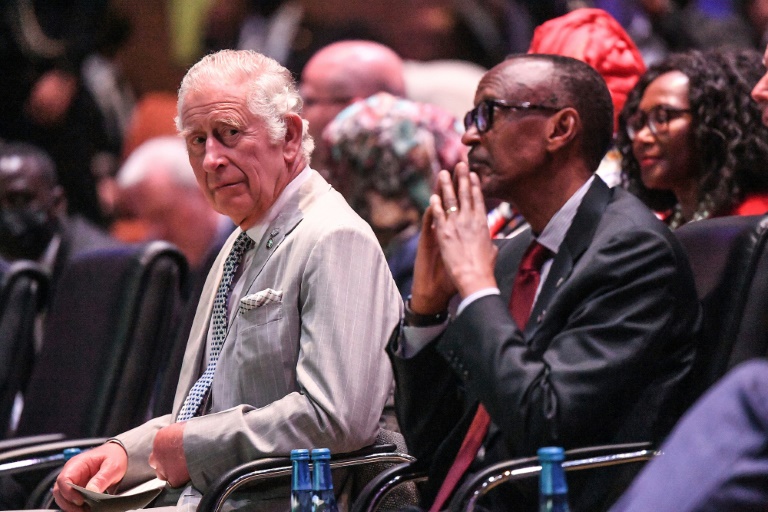
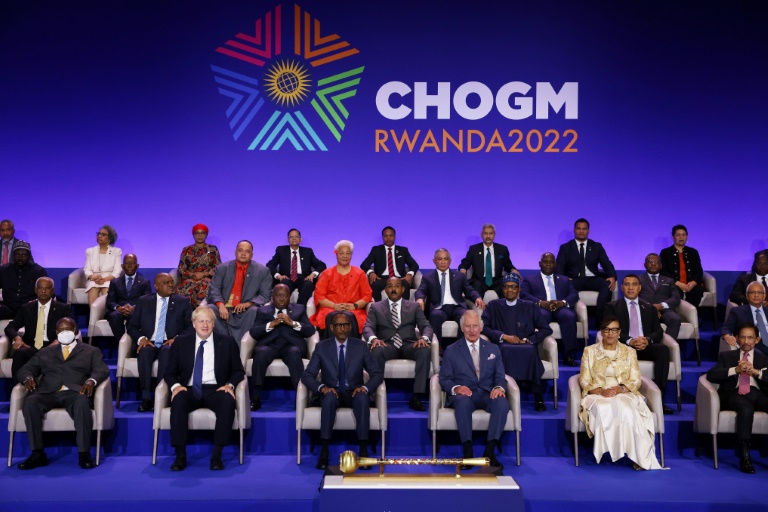
Prince Charles told Commonwealth leaders Friday that the choice to become a republic or abandon the queen as head of state was theirs alone, and expressed “personal sorrow” at Britain’s legacy of slavery.

The British heir to the throne addressed the opening of a Commonwealth Heads of Government Meeting (CHOGM) in Rwanda as the host nation faced scrutiny over its rights record and a much-criticised migrant deal with the UK.

Charles is representing Queen Elizabeth II as the 54-nation club of mostly former British colonies grapples with questions over its future relevance and modern profile.

Republican movements are taking root in a number of Commonwealth nations and some are seeking reparations for colonial-era injustices like slavery.

Charles acknowledged the change underfoot and said the Commonwealth — which represents one-third of humanity — would always be “a free association of independent, self-governing nations”.

“I want to say clearly, as I have said before, that each member’s constitutional arrangement, as republic or monarchy, is purely a matter for each member country to decide,” he told an audience of presidents and prime ministers.

He also acknowledged that the roots of the Commonwealth — which includes as members nations from Europe to Africa, Asia and the Americas — “run deep into the most painful period of our history”.

“I cannot describe the depths of my personal sorrow at the suffering of so many, as I continue to deepen my own understanding of slavery’s enduring impact,” he said.

– Migrant row –

Charles earlier Friday met British Prime Minister Boris Johnson, who has been defending his controversial deal to expel migrants from the UK thousands of miles away to Rwanda.

The scheme, which has stalled in the face of legal challenges, has been fiercely opposed by the UN, church leaders, rights groups and — reportedly — Charles himself.

“I’m confident that the migration aspect will work very well,” Johnson told British media in Kigali.

“We’re going to continue with the policy and… the Rwanda partnership offers a good way forward.”

He earlier heaped praise on President Paul Kagame for the “leaps and bounds” achieved in Rwanda, despite widespread concerns over a lack of political freedom and civil liberties in the tiny African nation.

Rights groups have openly questioned the suitability of Rwanda hosting the Commonwealth, which has a charter that enshrines respect for democracy and human rights as core shared values.

More than 20 rights groups and civil society organisations issued a letter before the summit saying a “climate of fear” exists under Kagame, whose party came to power after the horrors of the 1994 genocide.

The Democratic Republic of Congo has also called on Britain to condemn Rwanda over its alleged “aggression” in the mineral-rich eastern Congo, where Kigali has been accused of stoking a rebellion.

Johnson himself is facing a political crisis back home after his Conservatives suffered a crushing defeat in parliamentary by-elections.

– Leadership battle –

The Commonwealth’s closed-door summit meetings are missing some heavyweights, including Narendra Modi of India, South Africa’s Cyril Ramaphosa and Australia’s Anthony Albanese who sent envoys in their place.

The body has come under scrutiny over its relevance but supporters say the expansion of membership to nations with no historic ties to Britain underscores its value and prestige.

The two newest members are Mozambique and host Rwanda, while west African states Togo and Gabon are expected to join the club at the summit.

“The fact of holding this meeting in Rwanda, the new member with no historical connection to the British empire, expresses our choice to continue re-imagining the Commonwealth for a changing world,” Kagame said.

The secretary-general of the Commonwealth, Patricia Scotland, was narrowly re-elected Friday for another two years at the helm after a bruising campaign.

She defeated challenger Kamina Johnson Smith of Jamaica, who had the backing of the UK, which had expressed dissatisfaction with Scotland’s stewardship of the organisation.

Thousands of migrants storm border fence in Spain's Melilla

Around 2,000 migrants tried to storm the border separating Spain’s Melilla enclave from Morocco on Friday, the first such attempted mass crossing into the territory since the two nations mended diplomatic ties in March.

Some 2,000 migrants made their way to the border at dawn and over 500 managed to enter the border control area after cutting a fence with shears, the Spanish government’s local delegation said in a statement.

Of these 130 sub-Saharan African migrants, “all of them men and apparently adults”, managed to enter Melilla, it added.

Morocco deployed a “large” amount of forces to try to repel the assault on the border, who “cooperated actively” with Spain’s security forces, the delegation said earlier in a separate statement.

Images on Spanish media showed exhausted migrants laying on the sidewalk in Melilla, some with bloodied hands and torn clothes.

On Thursday night migrants and security forces “clashed” on the Moroccan side of the border, Omar Naji of Moroccan rights group AMDH told AFP.

He said “several” police officers and migrants were admitted to the Hassani Hospital in Nador near Melilla for treatment.

– ‘New stage’ –

In March this year, Spain ended a year-long diplomatic crisis by backing Morocco’s autonomy plan for Western Sahara going back on its decades-long stance of neutrality. 

Spanish Prime Minister Pedro Sanchez then visited Rabat, and the two governments hailed a “new stage” in relations.

The row began when Madrid allowed Brahim Ghali, leader of Western Sahara’s pro-independence Polisario Front, to be treated for Covid-19 in a Spanish hospital in April 2021.

A month later, some 10,000 migrants surged across the Moroccan border into Spain’s Ceuta enclave as border guards looked the other way, in what was widely seen as a punitive gesture by Rabat.

Rabat calls for the Western Sahara to have an autonomous status under Moroccan sovereignty but the Polisario wants a UN-supervised referendum on self-determination as agreed in a 1991 ceasefire agreement.

In the days just before Morocco and Spain patched up their ties, there were several attempted mass crossings of migrants into Melilla, including one involving 2,500 people, the largest such attempt on record. Nearly 500 made it across

– ‘Means of pressure’ –

Patching up relationship with Morocco, the departure point for many migrants, has meant a drop in arrivals, notably in Spain’s Atlantic Canary Islands. 

The number of migrants who reached the Canary Islands in April was 70 percent lower than in February, government figures show. 

Sanchez earlier this month warned that “Spain will not tolerate any use of the tragedy of illegal immigration as a means of pressure.”

Spain will seek to have “irregular migration” listed as one of the security threats on the NATO’s southern flank when the alliance gathers for a summit in Madrid on June 29-30.

Over the years, thousands of migrants have attempted to cross the 12-kilometre (7.5-mile) border between Melilla and Morocco, or Ceuta’s eight-kilometre border, by climbing the fences, swimming along the coast or hiding in vehicles.

The two territories are protected by fences fortified with barbed wire, video cameras and watchtowers.

The attempts include violent clashes between those crossing and the agents charged to stop them. 

Migrants sometimes use hooks and sticks to try to climb the border fence, and throw stones at police.
Claimed by Morocco, the two cities have long been a flashpoint in diplomatic relations between Rabat and Madrid, which insists both are integral parts of Spain.

Prince Charles says Commonwealth nations free to chart own course

Prince Charles told Commonwealth leaders Friday that the choice to become a republic or abandon the queen as head of state was theirs alone, and expressed “personal sorrow” at Britain’s legacy of slavery.

The British heir to the throne addressed the opening of a Commonwealth Heads of Government Meeting (CHOGM) in Rwanda as the host nation faced scrutiny over its rights record and a much-criticised migrant deal with the UK.

Charles is representing Queen Elizabeth II as the 54-nation club of mostly former British colonies grapples with questions over its future relevance and modern profile.

Republican movements are taking root in a number of Commonwealth nations and some are seeking reparations for colonial-era injustices like slavery.

Charles acknowledged the change underfoot and said the Commonwealth — which represents one-third of humanity — would always be “a free association of independent, self-governing nations”.

“The Commonwealth contains within it countries that have had constitutional relationships with my family, some that continue to do so, and increasingly those that have had none,” he told an audience of presidents and prime ministers.

“I want to say clearly, as I have said before, that each member’s constitutional arrangement, as republic or monarchy, is purely a matter for each member country to decide.”

He also acknowledged that the roots of the Commonwealth — which includes as members nations from Europe to Africa, Asia and the Americas — “run deep into the most painful period of our history”.

“I cannot describe the depths of my personal sorrow at the suffering of so many, as I continue to deepen my own understanding of slavery’s enduring impact,” he said.

– Migrant row –

Charles earlier Friday met British Prime Minister Boris Johnson, who has been defending his controversial deal to expel migrants from the UK thousands of miles away to Rwanda.

The scheme, which has stalled in the face of legal challenges, has been fiercely opposed by the UN, church leaders, rights groups and — reportedly — Charles himself.

“A lot of prejudices about Rwanda need to be blown away,” Johnson told British media in Kigali.

He has also heaped praise on President Paul Kagame for the “leaps and bounds” achieved in Rwanda, despite widespread concerns over a lack of political freedom and civil liberties in the tiny African nation.

Rights groups have openly questioned the suitability of Rwanda hosting the Commonwealth, which has a charter that enshrines respect for democracy and human rights as core shared values.

More than 20 rights groups and civil society organisations issued an open letter before the summit saying a “climate of fear” exists under Kagame, whose party came to power after the horrors of the 1994 genocide.

The Democratic Republic of Congo has also called on Britain to condemn Rwanda over its alleged “aggression” in the mineral-rich eastern Congo, where Kigali has been accused of stoking a rebellion.

Johnson himself is facing a political crisis back home after his Conservatives suffered a crushing defeat in parliamentary by-elections.

– Leadership battle –

The Commonwealth’s closed-door summit meetings are missing some heavyweights, including Narendra Modi of India, South Africa’s Cyril Ramaphosa and Australia’s Anthony Albanese who sent envoys in their place.

The body has come under scrutiny over its relevance but supporters say the expansion of membership to nations with no historic ties to Britain underscores its value and prestige.

The two newest members are Mozambique and host Rwanda, while west African states Togo and Gabon are expected to join the club at the summit.

“The fact of holding this meeting in Rwanda, the new member with no historical connection to the British empire, expresses our choice to continue re-imagining the Commonwealth for a changing world,” Kagame said.

The secretary-general of the Commonwealth, Patricia Scotland, was narrowly re-elected Friday for another two years at the helm after a bruising campaign.

She defeated challenger Kamina Johnson Smith of Jamaica, who had the backing of the UK, which had expressed dissatisfaction with Scotland’s stewardship of the organisation.

Loeb retires as Rovanpera takes early Safari Rally lead

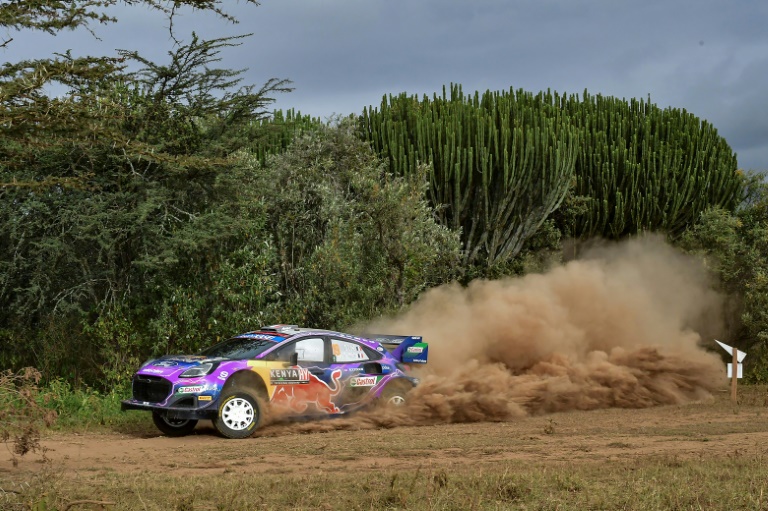
Former world motor rally champion Sebastian Loeb retired from the Safari Rally in Kenya with engine trouble on Friday, making a second successive early exit to his selective WRC campaign.

World rally championship series leader Kalle Rovanpera of Finland took advantage to move into the overnight lead going into Saturday’s third day.

Loeb, the nine-time world champion, was making a return to the Safari after 20 years when his M-Sport Ford gave in with fire engine damage at the end of the Friday morning’s fourth stage in Naivasha.

“I finished the stage without any problem. After the stop control, I drove a few metres and stopped for the helmet, and the engine dropped off immediately,” said Loeb. “There was burning a little bit behind the engine.”

Loeb was lying fifth and within a stretching distance on the road behind a dominant Toyota quartet led by Britain’s Elfyn Evans.

“I am happy enough,” said Evans, who hit a rock around the challenging Kedong region last year to end his Safari hopes. “It’s just really difficult to pitch your speech on the tough and rough roads.” 

The Welshman led world champion Sebastian Ogier through the four stages, before Rovanpera, who was lying third on the road in another Toyota, took advantage of his team-mates’s mishaps to grab the overnight lead.

“We did a good run today. The plan was be fast and safe,” said Rovanpera, who won three successive rallies in Sweden, Croatia and Portugal before retiring in the Rally of Sardinia. 

Evans wound up second 22.4 seconds behind Rovanpera with Hyundai’s Ott Tanak third.

Defending champion Ogier fell back after leading, dropping into sixth position with tyre punctures forcing him to stop several times.

Standings:

1. Kalle Rovanperä – Jonne Halttunen (FIN/Toyota) 1hr 20min 58.1sec, 2. Elfyn Evans – Scott Martin (GBR/Toyota) at 22.4sec, 3. Ott Tänak – Martin Järveoja (EST/Hyundai) 25.3, 4. Takamoto Katsuta – Aaron Johnston (JPN-IRL/Toyota) 26.6, 5. Thierry Neuville – Martijn Wydaeghe (BEL/Hyundai) 57.5, 6. Sébastien Ogier – Benjamin Veillas (FRA/Toyota) 2min 08.2sec, 7. Oliver Solberg – Elliot Edmondson (SWE-GBR/Hyundai) 4:27.1, 8. Kajetan Kajetanowicz – Maciej Szczepaniak (POL/Skoda) 9:51.1, 9. Craig Breen – Paul Nagle (IRL/M-Sport Ford) 10:24.6, 10. Sean Johnston – Alex Kihurani (USA/Citroën WRC2) +11:04.6

Special stage winners: Ogier (SS1, SS5, SS7); Rovanperä (SS3, SS4, SS7), Loeb (SS1) 

Retired: Sébastien Loeb (Ford)

Lumumba's coffin visits Kisangani, where Congo's first premier found his way

After a rest in his native village, the coffin of the former Belgian Congo’s first post-independence prime minister Friday pursued its memorial pilgrimage to the northeastern city of Kisangani.

As in Onalua village in the centre of today’s Democratic Republic of Congo, where Lumumba was born in 1925, officials, dancers and tam-tams in Kisangani awaited the remains of the independence hero, executed in January 1961, four months after the end of his brief term in office.

A single tooth is all that remains of the young scholar and nationalist politician whose life and career were cut short in a dark struggle for leadership and control of resources in the central African country.

His body was dissolved in acid after he was killed, but a Belgian police officer kept the tooth as a trophy. Belgian authorities in 2016 seized the relic from his daughter.

Belgium finally returned it on Monday to Lumumba’s family members during a ceremony in Brussels.

It was then placed inside a coffin for the funeral tour, 61 years late.

— ‘I protect Lumumba’s chair’ —

In a small room inside a brick building known as “1925” in Kisangani, the shelves are stacked with records and works of the colonial administration in Stanleyville, as Kisangani used to be called.

Titles ranged from “Congo Codes and Laws, 1954” and “Legal Review of the Belgian Congo” to “Palm groves in relation to ethnology”.

Patrice Emery Lumumba worked here as a librarian for the Indigenous Labour Administration. He was also in charge of mail at the Post Office.

Joseph Lifaefi, head of an office that watches over the property, says he has heard talk of “a tourist site, but nothing concrete”.

“I protect Lubumba’s table and chair, the writings with his signature, his demands,” he told AFP, showing the wooden chair and old grey table.

He voiced concern for precious documents, some of which date back to the 19th century, that he said should be digitised.

“This makes me feel ashamed,” Lifaefi said. “There should be a museum here.”

Lumumba was just 20 when he arrived in Stanleyville, a junior civil servant appointed to handle postal cheques. He went on to become the commercial director of a large brewery.

“My father was the first to welcome him,” said Pauline Kimbulu, daughter of Paul Kimbulu, one of the few qualified nurses from colonial days.

“He came to eat here,” Kimbulu added in front of a small home with cement walls and a tin roof.

“Let someone restore this house.”

— ‘Extreme ambition’ —

As years passed, Lumumba gained confidence and “strength of conviction” matched with eloquence and easy charm, according to Belgian cultural historian and journalist David Van Reybrouck in his prize-winning work “Congo, the Epic History of a People”.

He lived until the late 1950s in Commercial District Five, where little tarmac remains on his street and the electricity supply died two years ago.

He held meetings at the mythical “Circle of State of Mangobo”, a hall that is now a ramshackle depot for furniture and coffins for sale.

Leader of a trade union branch, head of a local association of “evolved” minds, author of political analyses and newspaper columns, Lumumba also possessed what Van Reybrouck described as “extreme ambition”.

In 1958 he launched a political party, the Congolese National Movement (MNC), which won national elections in May 1960, a month before independence.

Blaise Tresor Badjoko, a neighbour, says that his father came to live in Lumumba’s home after his assassination, and died under the same roof. Badjoko believes that Lumumba’s remains should rest in Kisangani, rather than in the capital Kinshasa.

From Kisangani, the coffin will be taken on Sunday to Katanga in the southeast, where a secessionist movement raged after independence and where Lumumba and his aides were tortured to death.

The burial ceremony in Kinshasa is planned for June 30, which is Independence Day.

Somalia president tests positive for Covid

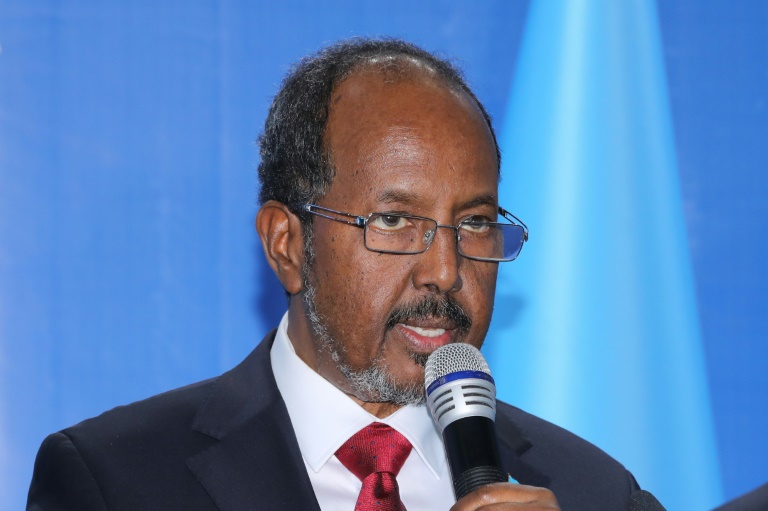
Somalia’s new President Hassan Sheikh Mohamud said on Friday he is isolating after testing positive for Covid-19, shortly after returning from a trip to the United Arab Emirates.

“So far, I have no symptoms but I will continue to self-isolate and serve the people of Somalia from home,” he said on Twitter.

“I ask we all keep each other safe by following public health advice and guidelines.”

The 66-year-old president returned Friday from the United Arab Emirates where he had made his first official trip abroad since his election on May 15. 

Mohamud is a former academic and peace activist who was previously president from 2012 to 2017 but whose first administration was dogged by claims of corruption and infighting.

The troubled Horn of Africa nation has recorded 26,748 coronavirus cases of which 1,361 have been fatal, according to the World Health Organization.

Prince Charles says Commonwealth nations free to chart own course

Prince Charles told Commonwealth leaders Friday that the choice to become a republic or abandon the queen as head of state was theirs alone, and expressed “personal sorrow” at Britain’s legacy of slavery.

The British heir to the throne addressed the opening of a Commonwealth Heads of Government Meeting (CHOGM) in Rwanda as the host nation faced scrutiny over its rights record and a much-criticised migrant deal with the UK.

Charles is representing Queen Elizabeth II as the 54-nation grouping of mostly former British colonies grapples with questions over its future relevance and modern profile.

Republican movements are taking root in a number of Commonwealth nations and some are seeking reparations for colonial-era injustices like slavery.

Charles acknowledged the change underfoot and said the Commonwealth — which represents one-third of humanity — would always be “a free association of independent, self-governing nations”.

“The Commonwealth contains within it countries that have had constitutional relationships with my family, some that continue to do so, and increasingly those that have had none,” he told an audience of presidents and prime ministers.

“I want to say clearly, as I have said before, that each member’s constitutional arrangement, as republic or monarchy, is purely a matter for each member country to decide.”

He also acknowledged that the roots of the Commonwealth — which includes as members nations from Europe to Africa, Asia and the Americas — “run deep into the most painful period of our history”.

“I cannot describe the depths of my personal sorrow at the suffering of so many, as I continue to deepen my own understanding of slavery’s enduring impact,” he said.

– Migrant row –

Charles earlier Friday met British Prime Minister Boris Johnson, who has been defending his controversial deal to expel migrants from the UK thousands of miles away to Rwanda.

The scheme, which has stalled in the face of legal challenges, has been fiercely opposed by the UN, church leaders, rights groups and — reportedly — Charles himself.

“What I will say is as people come to Rwanda, like you have today, there are a lot of prejudices about Rwanda need to be blown away,” Johnson told British media in Kigali.

He has also heaped praise on President Paul Kagame for the “leaps and bounds” achieved in Rwanda, despite widespread concerns over a lack of political freedom and civil liberties in the tiny African nation.

Rights groups have openly questioned the suitability of Rwanda hosting the Commonwealth, which has a charter that enshrines respect for democracy and human rights as core shared values.

More than 20 rights groups and civil society organisations issued an open letter before the summit saying a “climate of fear” exists under Kagame, whose party came to power after the horrors of the 1994 genocide.

The Democratic Republic of Congo has also called on Britain to condemn Rwanda over its alleged “aggression” in the mineral-rich eastern Congo, where Kigali has been accused of stoking a rebellion.

Johnson himself is facing a political crisis back home after his Conservatives suffered a crushing defeat in parliamentary by-elections.

– Direction and purpose –

The Commonwealth’s closed-door summit meetings are missing some heavyweights, including Narendra Modi of India, South Africa’s Cyril Ramaphosa and Australia’s Anthony Albanese who sent envoys in their place.

The body has come under scrutiny over its relevance but supporters say the expansion of membership to nations with no historic ties to Britain underscores its value and prestige.

The two newest members are Mozambique and host Rwanda. West African states Togo and Gabon are expected to join the club at this summit.

“More nations are seeking to join, which shows you everything you need to know about the health and vitality of our Commonwealth,” said Johnson.

Friday will also bring to a head a tussle for the leadership of the Commonwealth that has turned ugly at times.

Jamaica’s Foreign Minister Kamina Johnson Smith is challenging Patricia Scotland for the post as secretary-general, despite Commonwealth convention dictating the incumbent should stand unopposed for a second term.

Johnson Smith has the backing of the UK, which has publicly expressed dissatisfaction with Scotland’s stewardship of the organisation.

Commonwealth nations free to chart own course: Prince Charles

Prince Charles told Commonwealth leaders Friday that the choice to become a republic or abandon the queen as head of state was “a matter for each member country to decide”.

Speaking at the opening of a Commonwealth summit in Rwanda, the British heir to the throne said the 54-member club of mainly former British colonies would always be “a free association of independent, self-governing nations”.

The Prince of Wales is representing Queen Elizabeth II as the head of the Commonwealth in Rwanda at a time of renewed discussion over its purpose and profile in a modern world.

Republican movements are taking root in a number of Commonwealth nations and some are seeking reparations for colonial-era injustices like slavery.

Charles acknowledged the change underfoot and said the Commonwealth was a diverse and evolving family.

“The Commonwealth contains within it countries that have had constitutional relationships with my family, some that continue to do so, and increasingly those that have had none,” Charles told an audience of presidents and prime ministers.

“I want to say clearly, as I have said before, that each member’s constitutional arrangement, as republic or monarchy, is purely a matter for each member country to decide.

“The benefit of long life brings me the experience that arrangements such as these can change, calmly and without rancour.”

Queen Elizabeth has championed the Commonwealth since she took the throne in 1952, but in the decades since some member states have cast off the monarch as head of state.

Republican movements in some of the 14 Commonwealth countries outside the UK where the queen is head of state are gathering pace.

Member state Barbados became the world’s newest republic last year, and other Caribbean nations are pushing to follow suit.

Another member, Australia, has also appointed a minister for the republic, in a sign of constitutional change on the horizon.

There have also been questions about the future role of the royal family at the helm of a group representing one-third of humanity in rich and poor countries across the globe.

At its last meeting in 2018, the Commonwealth designated Charles the queen’s successor as head of the organisation and delegates in Rwanda praised the royal family for its dedication to the cause.

The Commonwealth has come under scrutiny over its relevance but supporters say the expansion of membership from nations with no historic ties to Britain underscores its health.

The two newest members are Mozambique and host Rwanda, and west African states Togo and Gabon are expected to join the club at this summit.

Close Bitnami banner
Bitnami