Asia Business

EU vows investment in push to boost SE Asia ties

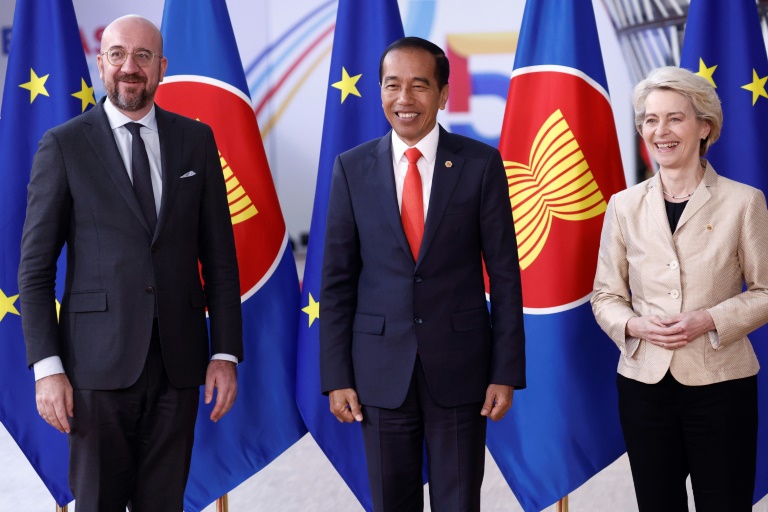
The EU vowed billions of dollars of investment in southeast Asia Wednesday, as leaders looked to bolster ties at a summit in the face of the Ukraine war and challenges from China. 

The European Union billed its first full summit with the Association of Southeast Asian Nations (ASEAN) in Brussels as a chance to push trade relations with the region’s fast-growing economies. 

“There might be many, many miles that divide us, but there are much more values that unite us,” European Commission President Ursula von der Leyen told the gathered leaders.

But different opinions over Russia’s war in Ukraine and concerns about tensions with China over a key shipping route for global trade loomed over the meeting. 

The EU has been on a diplomatic push to galvanise a global front against Moscow as its invasion has sent economic and political shock waves around the world. 

ASEAN’s 10 nations — nine of which were represented, after Myanmar’s junta was not invited — have been divided in their response to the Kremlin’s war on Ukraine.

Singapore has gone along with Western sanctions on Russia, while Vietnam and Laos, which have close military ties to Moscow, have remained more neutral. 

Along with Thailand, they abstained from a United Nations vote in October condemning Russia’s attempted annexation of regions of Ukraine seized since February.    

The diverging views led to intense wrangling over a declaration from the summit as the EU pushed for stronger language to condemn Moscow.

The final statement said “most members” decried Russia’s war, but conceded there were also “other views and different assessments”. 


– China looms –

While Europe pressed for a tougher response to Russia, another global giant figured prominently at the summit. 

Chinese claims over the South China Sea have set it against some neighbours and sparked fears in Europe over trade flows through the key global thoroughfare. 

But China remains the biggest trade partner for ASEAN and many in the region are wary of distancing themselves from their giant neighbour.

The EU is keen to pitch itself as a reliable partner for southeast Asia’s dynamic economies amid the growing rivalry between Beijing and Washington. 

The EU and ASEAN are each other’s third-largest trading partner and Europe sees the region as a key source for raw materials and wants to increase access to its booming markets.

EU nations are pushing to diversify key supply chains away from China as the war in Ukraine has highlighted Europe’s vulnerabilities. 

Von der Leyen offered an investment package over the next five years worth 10 billion euros ($10.6 billion) under the EU’s Global Gateway strategy designed as a counterweight to China’s largesse.

But ASEAN leaders insisted they would not be forced to make a choice between the global players competing for influence.  

“We absolutely refuse to go back to the situation of the Cold War where we have to pick sides in terms of who the superpower is that we are aligned with,” said Filipino President Ferdinand Marcos Jr.

– Sex law furore –

ASEAN and the EU suspended their push for a joint trade deal over a decade ago — but the bloc’s top officials said they hoped to relaunch efforts for a broad agreement. 

So far deals with Vietnam and Singapore are in place, and the EU is looking now to make progress with ASEAN’s largest economy Indonesia and to resume talks with Malaysia, Philippines and Thailand.

One issue that had risked clouding discussions was a new law in Indonesia criminalising sex outside marriage that has sparked fears for foreign visitors to the country.

But Indonesia’s President Joko Widodo pointedly insisted that the EU-ASEAN relationship needed to be based more on “equality”. 

“There must be no imposition of views,” he said. “There must not be one who dictates over the other and thinks that my standard is better than yours.”

Markets muted before expected US rate hike

Caution reigned on stock markets on Wednesday ahead of an expected interest rate hike from the Federal Reserve as inflation remains at decade-high levels despite moderate slowdowns. 

Wall Street’s main indices posted modest gains in morning trading, with the Dow adding 0.7 percent.

European stocks finished moderately lower, with London losses cushioned by news that UK inflation nudged lower in November.

Meanwhile, Frankfurt and Paris also fell despite the Ifo research institute’s forecast that Germany’s recession could be milder than previously predicted.

Asian stocks rose following Tuesday’s rebound on Wall Street.

The dollar drifted lower against its main rival currencies.

The Fed is forecast to increase borrowing costs 50 basis points Wednesday after four 75-point rises in a row.

The US central bank has embarked on an all-out campaign to cool demand in the world’s biggest economy, raising rates six times this year with interest-sensitive sectors like housing already reeling from tightening policy.

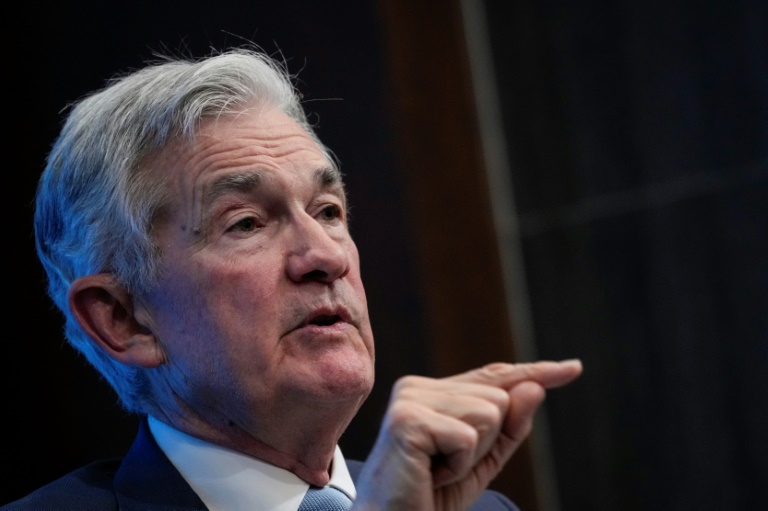
The US central bank’s post-meeting statement and boss Jerome Powell’s comments are the main focus for traders, along with the Fed’s infamous “dot plot” chart of the rate outlook.

“At the end of the day, it’s Jerome Powell, and the Fed, who will either give a green light for a modest Santa rally (for equities), or tell investors that Santa is stuck in a snow storm this year,” noted SwissQuote analyst Ipek Ozkardeskaya.

Investors will be looking for indications on the pace of future rate hikes, as well as what could be the “terminal rate”, or the highest interest rate before the Fed begins lowering rates again.

Briefing.com analyst Patrick O’Hare said the “tone and cadence from Fed Chair Powell will have an outsized impact today” on markets as official forecasts are subject to revision.

Later, the impact of higher interest rates on consumers and the wider economy will feed into investors’ calculations.

“That reality will be an inevitable drag on economic activity and it will be incorporated in the market’s concerns about the long and variable lags of monetary policy on economic activity,” he added.

It’s the turn of Europe on Thursday, with the Bank of England and European Central Bank expected to announce less aggressive rate hikes compared with their recent monetary policy decisions.

Wall Street rebounded Tuesday in reaction to data showing US consumer prices rose 7.1 percent last month, less than forecast and the slowest pace since December 2021.

The reading followed an October slowdown and fuelled hopes that inflation in the world’s biggest economy has finally peaked, after several months of Fed rate hikes.

Markets are also eyeing developments in China, which is continuing to roll back its strict zero-Covid strategy that has battered the world’s number two economy, though fears of a sharp surge in infections are causing some unease among dealers.

Oil prices pushed higher.

“Crude oil prices have continued their recent rise after the IEA warned that prices were likely to rise next year as sanctions further squeeze Russian supply, and demand starts to pick up as China starts to reopen properly,” said market analyst Michael Hewson at CMC Markets.

– Key figures around 1630 GMT –

New York – Dow: UP 0.7 percent at 34,350.80 points

EURO STOXX 50: DOWN 0.3 percent at 3,975.26

London – FTSE 100: DOWN less than 0.1 percent at 7,495.93 (close)

Frankfurt – DAX: DOWN 0.3 percent at 14,460.20 (close)

Paris – CAC 40: DOWN 0.2 percent at 6,730.79 (close)

Tokyo – Nikkei 225: UP 0.7 percent at 28,156.21 (close)

Hong Kong – Hang Seng Index: UP 0.4 percent at 19,673.45 (close)

Shanghai – Composite: FLAT at 3,176.53 (close)

Euro/dollar: UP at $1.0660 from $1.0635 on Tuesday

Dollar/yen: DOWN at 134.76 yen from 135.59 yen

Pound/dollar: UP at $1.2421 from $1.2366

Euro/pound: DOWN at 85.83 pence from 85.96 pence

Brent North Sea crude: UP 2.5 percent at $82.72 per barrel

West Texas Intermediate: UP 2.6 percent at $77.36 per barrel

burs-rl/lc

Markets muted before expected US rate hike

Caution reigned on stock markets on Wednesday ahead of an expected interest rate hike from the Federal Reserve as inflation remains at decade-high levels despite moderate slowdowns. 

Wall Street opened mixed, with the Dow adding 0.2 percent.

European stocks were moderately lower in afternoon trade, with London losses cushioned by news that UK inflation nudged lower in November.

Meanwhile, Frankfurt and Paris also fell despite the Ifo research institute’s forecast that Germany’s recession could be milder than previously predicted.

Asian stocks rose following Tuesday’s rebound on Wall Street.

The dollar drifted lower against its main rival currencies.

The Fed is forecast to increase borrowing costs 50 basis points Wednesday after four 75-point rises in a row.

The US central bank’s post-meeting statement and boss Jerome Powell’s comments are the main focus for traders, along with the Fed’s infamous “dot plot” chart of the rate outlook.

“At the end of the day, it’s Jerome Powell, and the Fed, who will either give a green light for a modest Santa rally (for equities), or tell investors that Santa is stuck in a snow storm this year,” noted SwissQuote analyst Ipek Ozkardeskaya.

Investors will be looking for indications on the pace of future rate hikes, as well as what could be the “terminal rate”, or the highest interest rate before the Fed begins lowering rates again.

Briefing.com analyst Patrick O’Hare said the “tone and cadence from Fed Chair Powell will have an outsized impact today” on markets as official forecasts are subject to revision.

Later, the impact of higher interest rates on consumers and the wider economy will feed into investors’ calculations.

“That reality will be an inevitable drag on economic activity and it will be incorporated in the market’s concerns about the long and variable lags of monetary policy on economic activity,” he added.

It’s the turn of Europe on Thursday, with the Bank of England and European Central Bank expected to announce less aggressive rate hikes compared with their recent monetary policy decisions.

Wall Street rebounded Tuesday in reaction to data showing US consumer prices rose 7.1 percent last month, less than forecast and the slowest pace since December 2021.

The reading followed an October slowdown and fuelled hopes that inflation in the world’s biggest economy has finally peaked, after several months of Fed rate hikes.

Markets are also eyeing developments in China, which is continuing to roll back its strict zero-Covid strategy that has battered the world’s number two economy, though fears of a sharp surge in infections are causing some unease among dealers.

Oil extended recent gains as traders awaited the weekly US inventories report for clues on demand in the world’s top crude consuming nation.

– Key figures around 1430 GMT –

London – FTSE 100: DOWN less than 0.1 percent at 7,498.46 points

Frankfurt – DAX: DOWN 0.5 percent at 14,424.85

Paris – CAC 40: DOWN 0.3 percent at 6,723.43

EURO STOXX 50: DOWN 0.4 percent at 3,972.18

New York – Dow: UP 0.2 percent at 34,165.75

Tokyo – Nikkei 225: UP 0.7 percent at 28,156.21 (close)

Hong Kong – Hang Seng Index: UP 0.4 percent at 19,673.45 (close)

Shanghai – Composite: FLAT at 3,176.53 (close)

Euro/dollar: UP at $1.0641 from $1.0635 on Tuesday

Dollar/yen: DOWN at 134.98 yen from 135.59 yen

Pound/dollar: UP at $1.2367 from $1.2366

Euro/pound: UP at 86.03 pence from 85.96 pence

Brent North Sea crude: UP 1.6 percent at $81.98 per barrel

West Texas Intermediate: UP 1.8 percent at $76.78 per barrel

burs-rl/lc

EU vows investment in push to boost SE Asia ties

The EU vowed billions of dollars of investment in southeast Asia Wednesday, as leaders looked to bolster ties at a summit in the face of the Ukraine war and challenges from China. 

The European Union billed its first full summit with the Association of Southeast Asian Nations (ASEAN) in Brussels as a chance to push trade relations with the region’s fast-growing economies. 

“There might be many, many miles that divide us, but there are much more values that unite us,” European Commission President Ursula von der Leyen told the gathered leaders.

But different opinions over Russia’s war in Ukraine and concerns about tensions with China over a key shipping route for global trade loomed over the meeting. 

The EU has been on a diplomatic push to galvanise a global front against Moscow as its invasion has sent economic and political shock waves around the world. 

ASEAN’s 10 nations — nine of which were represented, after Myanmar’s junta was not invited — have been divided in their response to the Kremlin’s war on Ukraine.

Singapore has gone along with Western sanctions on Russia, while Vietnam and Laos, which have close military ties to Moscow, have remained more neutral. 

Along with Thailand, they abstained from a United Nations vote in October condemning Russia’s attempted annexation of regions of Ukraine seized since February.    

The diverging views led to intense wrangling over a final declaration from the summit as the EU pushed for stronger language to condemn Moscow.

A draft of the final statement said “most members” decried Russia’s war, but conceded there were also “other views and different assessments”. 

– China looms –

While Europe pressed for a tougher response to Russia, another global giant figured prominently at the summit. 

Chinese claims over the South China Sea have set it against some neighbours and sparked fears in Europe over trade flows through the key global thoroughfare. 

But China remains the biggest trade partner for ASEAN and many in the region are wary of distancing themselves from their giant neighbour.

The EU is keen to pitch itself as a reliable partner for southeast Asia’s dynamic economies amid the growing rivalry between Beijing and Washington. 

The EU and ASEAN are each other’s third-largest trading partner and Europe sees the region as a key source for raw materials and wants to increase access to its booming markets.

EU nations are pushing to diversify key supply chains away from China as the war in Ukraine has highlighted Europe’s vulnerabilities. 

Von der Leyen offered an investment package over the next five years worth 10 billion euros ($10.6 billion) under the EU’s Global Gateway strategy designed as a counterweight to China’s largesse.

“There is a battle of offers today in the geopolitical arena, not only a battle of narrative,” said EU foreign policy chief Josep Borrell. “We have to offer more.”

– Sex law furore –

ASEAN and the EU suspended their push for a joint trade deal over a decade ago — but the bloc’s top officials said they hoped to relaunch efforts for a broad agreement. 

So far deals with Vietnam and Singapore are in place, and the EU is looking now to make progress with ASEAN’s largest economy Indonesia and to resume talks with Malaysia, Philippines and Thailand.

One issue that risked clouding discussions was a new law in Indonesia criminalising sex outside marriage that has sparked fears for foreign visitors to country.

Indonesia’s President Joko Widodo insisted though that the EU-ASEAN relationship needed to be based more on “equality”. 

“There must be no imposition of views,” he said.  

“There must not be one who dictates over the other and thinks that my standard is better than yours.”

Stocks diverge before expected US rate hike

Global stock markets diverged Wednesday, with Asia rising and Europe falling before an expected interest rate hike from the Federal Reserve, with inflation around the highest levels in decades despite moderate slowdowns.

London losses nearing the half-way mark were cushioned by news that UK inflation nudged lower in November.

Frankfurt and Paris also fell despite the Ifo research institute’s forecast that Germany’s recession could be milder than previously predicted.

Asian indices closed higher following Tuesday’s softer-than-expected US inflation data that could allow the Federal Reserve to slow its pace of interest rate hikes.

The Fed is forecast to increase borrowing costs 50 basis points Wednesday after four 75-point rises in a row.

The US central bank’s post-meeting statement and boss Jerome Powell’s comments are the main focus for traders, along with the Fed’s infamous “dot plot” chart of the rate outlook.

“At the end of the day, it’s Jerome Powell, and the Fed, who will either give a green light for a modest Santa rally (for equities), or tell investors that Santa is stuck in a snow storm this year,” noted SwissQuote analyst Ipek Ozkardeskaya.

It’s the turn of Europe on Thursday, with the Bank of England and European Central Bank expected to announce less aggressive rate hikes compared with their recent monetary policy decisions.

Wall Street rebounded Tuesday in reaction to data showing US consumer prices rose 7.1 percent last month, less than forecast and the slowest pace since December 2021.

The reading followed an October slowdown and fuelled hopes that inflation in the world’s biggest economy has finally peaked, after several months of Fed rate hikes.

Markets are also eyeing developments in China, which is continuing to roll back its strict zero-Covid strategy that has battered the world’s number two economy, though fears of a sharp surge in infections are causing some unease among dealers.

Oil extended recent gains as traders awaited the weekly US inventories report for clues on demand in the world’s top crude consuming nation.

– Key figures around 1200 GMT –

London – FTSE 100: DOWN 0.3 percent at 7,479.69 points

Frankfurt – DAX: DOWN 0.7 percent at 14,391.94

Paris – CAC 40: DOWN 0.6 percent at 6,702.55

EURO STOXX 50: DOWN 0.8 percent at 3,956.14

Tokyo – Nikkei 225: UP 0.7 percent at 28,156.21 (close)

Hong Kong – Hang Seng Index: UP 0.4 percent at 19,673.45 (close)

Shanghai – Composite: FLAT at 3,176.53 (close)

New York – Dow: UP 0.3 percent at 34,108.64 (close)

Euro/dollar: UP at $1.0653 from $1.0635 on Tuesday

Dollar/yen: DOWN at 134.96 yen from 135.59 yen

Pound/dollar: UP at $1.2377 from $1.2366

Euro/pound: UP at 86.04 pence from 85.96 pence

Brent North Sea crude: UP 0.9 percent at $81.40 per barrel

West Texas Intermediate: UP 1.0 percent at $76.15 per barrel

Asian markets extend US rally after inflation boost, eyes on Fed

Asian markets rose Wednesday and the dollar struggled to recover as investors welcomed softer-than-expected US inflation data that could allow the Federal Reserve to slow down its pace of interest rate hikes.

The reading provided some much-needed Christmas cheer on trading floors and came the day before the US central bank’s last policy decision of the year, which will be pored over for clues about its plans for 2023.

There is also some focus on China as it continues to roll back its strict zero-Covid strategy that has battered the world’s number two economy, though fears of a sharp surge in infections are causing some unease among dealers.

All three main indexes on Wall Street ended in positive territory Tuesday in reaction to data showing consumer prices rose 7.1 percent last month, less than forecast and the slowest pace since December 2021.

The reading followed an October slowdown and fuelled hopes that inflation has finally peaked, after several months of Fed rate hikes.

It “came with the caveat that it was ‘just one month of data’ but the November numbers add further weight to the interpretation that the long-awaited goods disinflation is showing up in the data,” said National Australia Bank’s Taylor Nugent.

Asian markets tracked Wall Street higher, though the gains were limited ahead of the Fed meeting with traders accepting that seven percent inflation was still very high.

Hong Kong, Tokyo, Sydney, Seoul, Singapore, Mumbai, Taipei, Manila and Bangkok all rose, while Shanghai was flat though Wellington and Jakarta dipped.

And the dollar moved only slightly after Tuesday’s retreat that came in reaction to the inflation report, with the yen, euro and pound the main beneficiaries.

London dipped as data showed UK inflation had also slowed in November, though it still remained elevated at 10.7 percent.

Paris and Frankfurt also fell.

While the Fed is widely expected to increase borrowing costs by 50 basis points Wednesday — after four successive 75-point hikes — its post-meeting statement and boss Jerome Powell’s comments are the main focus for traders.

And while the slower inflation print was welcomed, there is still concern that the US economy will tip into recession next year as rates will remain elevated until prices are brought under control and within the bank’s target of around two percent.

Silvia Dall’Angelo, at Federated Hermes, said policymakers would slow the pace of hikes so they could “assess the impact on the real economy from the large cumulative tightening that has taken place since March.

“However, the Fed will stress that it is still far from mission accomplished with respect to its fight (against) high inflation, and more hikes will follow in coming months,” she added.

“Our expectation is that while inflation will decline over 2023, it will remain above target, which will prevent the Fed from easing next year.”

Oil prices edged down slightly after rallying on the back of the weaker dollar, though Brent held above $80.

– Key figures around 0820 GMT –

Tokyo – Nikkei 225: UP 0.7 percent at 28,156.21 (close)

Hong Kong – Hang Seng Index: UP 0.4 percent at 19,673.45 (close)

Shanghai – Composite: FLAT at 3,176.53 (close)

London – FTSE 100: DOWN 0.3 percent at 7,481.69

Euro/dollar: DOWN at $1.0630 from $1.0635 on Tuesday

Dollar/yen: DOWN at 135.53 yen from 135.59 yen

Pound/dollar: DOWN at $1.2361 from $1.2366

Euro/pound: UP at 86.00 pence from 85.96 pence

West Texas Intermediate: DOWN 0.1 percent at $75.33 per barrel

Brent North Sea crude: DOWN 0.1 percent at $80.60 per barrel

New York – Dow: UP 0.3 percent at 34,108.64 (close)

Asian markets extend US rally after inflation boost, eyes on Fed

Asian markets rose Wednesday and the dollar struggled to recover as investors welcomed softer-than-expected US inflation data that could allow the Federal Reserve to slow down its pace of interest rate hikes.

The reading provided some much-needed Christmas cheer on trading floors and came the day before the US central bank’s last policy decision of the year, which will be pored over for clues about its plans for 2023.

There is also some focus on China as it continues to roll back its strict zero-Covid strategy that has battered the world’s number two economy, though fears of a sharp surge in infections is causing some unease among dealers.

All three main indexes on Wall Street ended in positive territory Tuesday in reaction to data showing consumer prices rose 7.1 percent last month, less than forecast and the slowest pace since December 2021.

The reading followed an October slowdown and fuelled hopes that inflation has finally peaked, after several months of Fed rate hikes.

“Last month’s positive surprise came with the caveat that it was ‘just one month of data’ but the November numbers add further weight to the interpretation that the long-awaited goods disinflation is showing up in the data,” said National Australia Bank’s Taylor Nugent.

Asian markets tracked Wall Street higher, though the gains were limited ahead of the Fed meeting.

Hong Kong, Tokyo, Shanghai, Sydney, Seoul, Singapore, Taipei, Manila and Jakarta all rose.

And the dollar held the losses suffered Tuesday in reaction to the inflation report, with the yen, euro and pound the main beneficiaries.

While the Fed is widely expected to increase borrowing costs 50 basis points Wednesday — after four successive 75-point rises — its post-meeting statement and boss Jerome Powell’s comments are the main focus for traders.

And while the slower inflation print was welcomed, there is still a growing concern among investors that the US economy will tip into recession next year as rates will remain elevated until prices are brought under control and within the bank’s target around two percent.

Silvia Dall’Angelo, at Federated Hermes, said monetary policymakers would slow the pace of hikes so they could “assess the impact on the real economy from the large cumulative tightening that has taken place since March.

“However, the Fed will stress that it is still far from mission accomplished with respect to its fight (against) high inflation, and more hikes will follow in coming months,” she added.

“Our expectation is that while inflation will decline over 2023, it will remain above target, which will prevent the Fed from easing next year.”

Oil prices edged down slightly after rallying on the back of the weaker dollar, though Brent held above $80.

– Key figures around 0230 GMT –

Tokyo – Nikkei 225: UP 0.7 percent at 28,141.41 (break)

Hong Kong – Hang Seng Index: UP 0.3 percent at 19,662.40

Shanghai – Composite: UP 0.1 percent at 3,178.01

Euro/dollar: DOWN at $1.0633 from $1.0635 on Tuesday

Dollar/yen: DOWN at 135.44 yen from 135.59 yen

Pound/dollar: DOWN at $1.2353 from $1.2366

Euro/pound: UP at 86.08 pence from 85.96 pence

West Texas Intermediate: DOWN 0.5 percent at $75.00 per barrel

Brent North Sea crude: DOWN 0.6 percent at $80.18 per barrel

New York – Dow: UP 0.3 percent at 34,108.64 (close)

London – FTSE 100: UP 0.8 percent at 7,502.89 (close)

Vietnam factory workers laid off as West cuts imports

Phan Thi Nhieu has spent a decade assembling shoes for worldwide brands such as Timberland and K-Swiss, but she is now among tens of thousands of Vietnamese factory workers laid off as Western consumers cut spending.

Almost half a million others have been forced to work fewer hours as orders fall in the Southeast Asian country, one of the world’s largest exporters of clothing, footwear and furniture.

The cost-of-living crisis in Europe and the United States — major markets for Vietnamese-produced goods — has seen the buying power of Western shoppers plunge.

Women factory workers, who make up 80 percent of the labour force in Vietnam’s garment industry, have been hit the hardest by the knock-on effect.

Early last month, 31-year-old Nhieu — who lives in a nine-square-metre (100 square feet) room in Ho Chi Minh City with her two young sons and husband — was told she was no longer needed at Ty Hung Company, a Taiwanese shoemaker that supplies big Western labels.

“They told us they did not have enough orders,” she said of Ty Hung’s announcement that it would fire 1,200 of its 1,800 staff. 

“I was so, so shocked and so scared, I cried, but I can do nothing, I have to accept it.”

The job earned Nhieu just $220 a month in an expensive city where the average monthly income is $370, but the money was regular and a step up from the mushroom picking she did as a teenager in the heat of the Mekong Delta.

– ‘Worse than Covid’ –

Now, with just two months’ severance pay to survive on, Nhieu must feed her family on a few dollars a day, and her kids are struggling to get enough to eat.

“We have no one to help us. I will have to get us through this on my own.”

Since September, more than 1,200 companies — mostly foreign businesses in the garment, footwear and furniture sectors — have been forced to sack staff or cut working hours, according to the Vietnam General Confederation of Labour. 

Compared with last year, orders are down 30-40 percent from the United States and 60 percent from Europe, where inflation and energy bills have soared because of the war in Ukraine.

More than 470,000 workers have had their hours slashed in the last four months of the year while about 40,000 people have lost their jobs — 30,000 of them women aged 35 or older, the confederation said.

Taiwanese giant Pouyuen, a Nike shoe producer, has put 20,000 of its workers on paid leave in rotation, while reports said Vietnam’s largest foreign investor, Samsung Electronics, has started reducing its smartphone production at factories in the north.

The situation is bleaker than during the Covid-19 pandemic, say workers, who were helped out with food donations when strict quarantine measures forced them to stay home — and were quickly in demand again once restrictions lifted at the end of 2021.

“It’s not easy to find a new job like before (following the pandemic),” said Nguyen Thi Thom, 35, who was laid off from a South Korean garment firm that makes clothes for US retail giant Walmart.

– No dream –

Since her factory work finished, Thom, who has three young children, spends her days on the streets of a shiny new suburban district of Ho Chi Minh City, selling dried noodles, shrimp sauce and oranges to passers-by.

The slowdown has come as a shock because export businesses in Vietnam were running at “their fullest capacity” for the first half of 2022, according to Tran Viet Anh, deputy head of Ho Chi Minh City’s Business Association. 

“At the start of the third quarter, due to global inflation, consumption demands have shrunk, leading to the suspension of orders… and huge stock surplus,” he told AFP.

But the downturn in Vietnam will likely only be temporary, Viet Anh added. 

A cut in production during the pandemic led to a shortage of goods in the first six months of 2022, and the situation will likely repeat a year on.

Viet Anh said that “2023 will be a period where we increase production to compensate”.

Until then, women like Nhieu and Thom, who form the backbone of a low-paid workforce that has helped Vietnam become a key manufacturing hub seen as an alternative to China, must find another way to keep their families afloat.

“I have never had the luxury of dreaming what I want from life. I have only one wish, of earning enough to survive,” Nhieu said.

Confidence falls among Japan's major manufacturers

Business confidence fell slightly among Japan’s largest manufacturers for the fourth straight quarter, a closely watched Bank of Japan survey showed Wednesday.

Optimism grew among non-manufacturers, however, and both readings beat market expectations.

The BoJ’s quarterly Tankan survey — considered the broadest indicator of how Japanese businesses are faring — showed that major manufacturers still feel much more upbeat than during the depths of the Covid-19 pandemic.

Confidence among large manufacturers stood at plus seven, down slightly from plus eight three months earlier.

A positive figure means more manufacturers see business conditions as favourable than those that consider them unfavourable.

Economists had forecast plus six for Wednesday’s reading.

“Weak demand in overseas markets including China, which was hit by its zero-Covid policy, was a headwind for manufacturers,” chief economist Saisuke Sakai of Mizuho Research & Technologies, told AFP.

The reading has been falling since April after nearly two years of improving sentiment, which had plunged to minus 34 in June 2020 as Covid-19 restrictions pummelled the economy.

Among large non-manufacturers, business confidence improved to 19 from a previous reading of 14, the Tankan showed. Market economists had forecast plus 16.

For non-manufacturers, “the government’s tourism campaign subsidies as well as loosening of border controls prompted recovery in demand,” Sakai said, noting that recent indicators showed a solid recovery in consumption.

“On the whole, the economy is not in bad shape, but looking ahead, the prospect of a global economic slowdown is a risk,” said Shinke Yoshiki, chief economist of Dai-ichi Life Research Institute.

Sakai agreed and said that inflation, fuelled by high energy costs and the weak yen, would also continue to weigh on Japan’s economy.

Inflation hit a four-decade high of 3.6 percent in October, ramping up pressure on Japan’s central bank to move away from its ultra-loose monetary policies.

The government in October pledged to spend $260 billion on a stimulus package to cushion the economy from the impact of inflation and the lower yen.

Growth downgrade for China 'very likely' on Covid surge: IMF chief

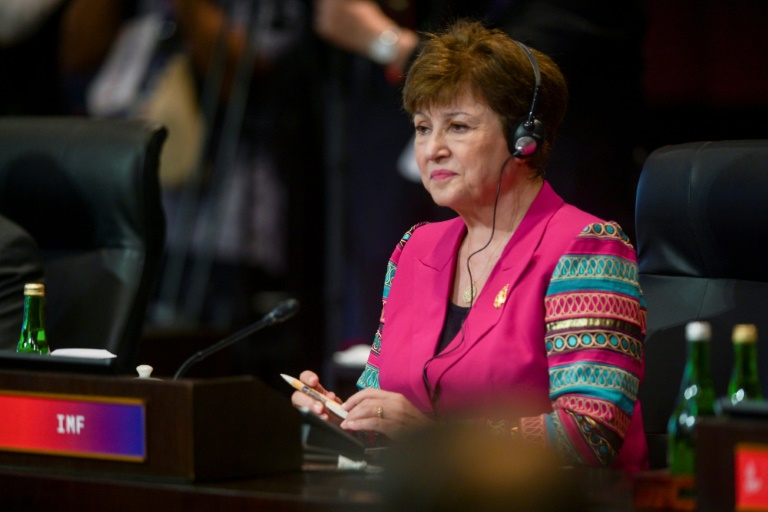
A lower growth forecast is “very likely” for China this year and next, with easing Covid-19 restrictions expected to bring a surge in infections and temporary difficulties, IMF chief Kristalina Georgieva told AFP Tuesday.

Her comments on the sidelines of a panel about a newly-created IMF fund come as the world’s second biggest economy grapples with soaring coronavirus cases, as it loosens virus controls after nearly three years.

While China’s zero-Covid policy has battered its economy, “the easing of restrictions is going to create some difficulties over the next months” as well, Georgieva said.

This is because a spike in infections will be inevitable, with more people temporarily unable to participate in the labor force.

“But it is likely that as China overcomes this in the second half of the year, there could be some improvement in growth prospects,” she said.

The zero-Covid policy, characterized by snap lockdowns, international travel restrictions and mass testing, took a heavy toll on consumers and businesses, with demonstrations against the measures eventually erupting in major Chinese cities.

The IMF earlier warned that tough virus restrictions have been especially hard on China’s residents.

Chinese officials said Monday that Covid cases are surging in Beijing, with a sharp spike in people visiting hospitals across the capital city. Rising infections in smaller cities were also discussed on social media.

The fund cut its growth projection for China in October to 3.2 percent this year — the lowest in decades — while expecting growth to rise to 4.4 percent next year.

But “very likely, we will be downgrading our growth projections for China, both for 2022 and for 2023,” Georgieva said.

– Adjusting policy –

For now, the country has to adjust its Covid policy, such as by being more targeted with restrictions and boosting vaccinations, especially to elderly populations. There is also a need to use more antiviral treatments, Georgieva added.

“In other words, retool the health system towards treating people rather than isolating, which has been the case for the last years,” she said.

Global economic leaders last week hailed China’s move away from its hardline virus strategy, with hopes that relaxation would also help to shore up a world economy struggling with fallout from the pandemic and Russia’s invasion of Ukraine.

With 2023 set to be a “very difficult year” as well, Georgieva reiterated that the likelihood of further downgrades in IMF growth projections will be “high.”

Apart from challenges in China, the US and European Union are also expected to slow simultaneously, with projections for half of the European Union to be in recession next year, she said.

While Washington-based fund earlier said there was a one-in-four chance global growth would fall below two percent next year, Georgieva added Tuesday that this probability has gone up.

Close Bitnami banner
Bitnami