US Business

China cities under heavy policing after protests

China’s major cities of Beijing and Shanghai were blanketed with security on Tuesday in the wake of nationwide rallies calling for political freedoms and an end to Covid lockdowns.

The country’s leadership is facing a wave of protest not seen in decades, fuelled by anger over the unrelenting lockdowns as well as deep-rooted frustrations over China’s political direction.

A deadly fire last week in Urumqi, the capital of northwest China’s Xinjiang region, was the catalyst for public outrage, with protesters taking to the streets of cities around the country over the weekend.

The demonstrators said Covid restrictions were to blame for hampering rescue efforts — claims the government denied as it accused “forces with ulterior motives” of linking the fire to the strict virus measures.

– ‘So many police’ –

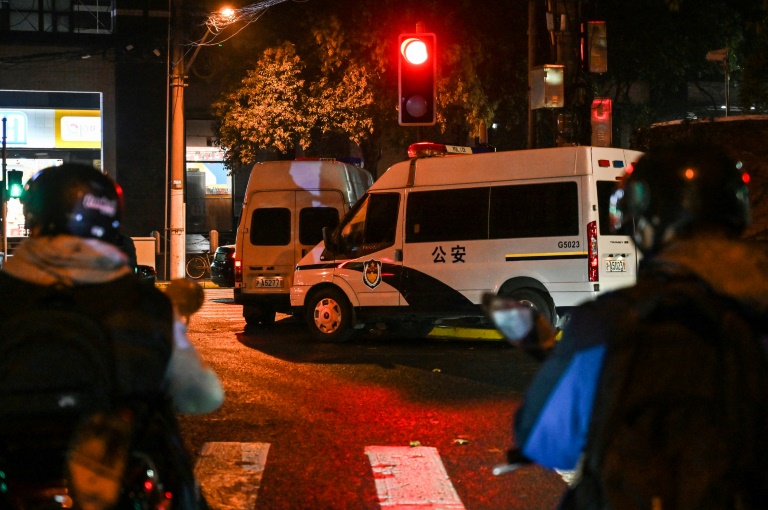
Several protests were planned for Monday night but did not materialise, with AFP journalists in Beijing and Shanghai noting a heavy police presence of hundreds of vehicles and officers on the streets.

People who had attended rallies over the weekend told AFP Monday they had received phone calls from law enforcement demanding information about their movements.

In Shanghai, near a site where weekend protests saw bold calls for the resignation of President Xi Jinping, bar staff told AFP they had been ordered to close at 10:00 pm (1400 GMT) for “disease control”. 

Small clusters of officers stood outside each metro exit.

Throughout the day AFP journalists saw officers detaining four people, later releasing one, with a reporter counting 12 police cars within 100 metres along Wulumuqi street in Shanghai, the focal point of Sunday’s rally.

“The atmosphere tonight is nervy. There are so many police around,” a man in his early 30s told AFP as evening fell.

And with police cars, foot patrols, a network of surveillance cameras, and aided by the icy wind, Beijing authorities also appeared Monday to have deterred fresh gatherings.

Elsewhere, some rallies did go ahead. In semi-autonomous Hong Kong, where mass democracy protests erupted in 2019, dozens gathered at the Chinese University to mourn the victims of the Urumqi fire.

“Don’t look away. Don’t forget,” protesters shouted.

And in Hangzhou, just over 170 kilometres (106 miles) southwest of Shanghai, there was strict security and sporadic protests in the city’s downtown, footage circulating on social media and partly geolocated by AFP showed.

– ‘Many died in vain’ –

China’s strict control of information and continued travel curbs has made verifying the numbers of protesters across the vast country challenging.

But such widespread rallies are exceptionally rare, with authorities harshly clamping down on all opposition to the central government.

US President Joe Biden is monitoring the unrest, the White House said Monday.

Around the world, solidarity protests have also mushroomed.

In the United States, Chinese-speaking and Uyghur communities came together in vigils.

“Officials are borrowing the pretext of Covid, but using excessively strict lockdowns to control China’s population,” one 21-year-old Chinese attendant who gave only his surname, Chen, told AFP.

“They disregarded human lives and caused many to die in vain,” he said.

– ‘No longer afraid’ –

China’s leaders have remained steadfast in their commitment to zero-Covid, which compels local authorities to impose snap lockdowns, quarantine orders, and limit freedom of movement in response to minor outbreaks.

But there are signs that some local authorities are taking steps to relax some of the rules and dampen the unrest.

In Urumqi, an official said Tuesday the city would give a one-off payment of 300 yuan ($42) to each person with “low income or no income”, and announced a five-month rent exemption for some households. 

People in the city of four million, some of whom have been confined to their homes for weeks on end, can also travel around on buses to run errands within their home districts starting Tuesday, officials said.

In Beijing, state media reported authorities had apologised for delayed deliveries to residents as online shopping demand surges due to repeated lockdowns.

The city has also banned “the practice of barring building gates in closed-off residential compounds”, Xinhua said on Sunday.

The practice has fuelled public anger as people found themselves locked in their homes during minor outbreaks. 

And an influential state media commentator suggested that Covid controls could be further relaxed — while insisting the public “will soon calm down”.

“I can give an absolute prediction: China will not become chaotic or out of control,” Hu Xijian, a columnist with the state-run tabloid Global Times said on Twitter, which is banned in China.

“China may walk out of the shadow of Covid-19 sooner than expected.”

World's largest volcano erupts in Hawaii

The world’s largest active volcano burst into life for the first time in 40 years, spewing lava and hot ash Monday in a spectacular display of nature’s fury by Mauna Loa in Hawaii.

Rivers of molten rock could be seen high up on the volcano, venting huge clouds of steam and smoke at the summit on Big Island, and sparking warnings the situation could change rapidly.

Pressure has been building at Mauna Loa for years, according to the United States Geological Survey, which reported the eruption could be seen from 45 miles (72 kilometers) away, in the town of Kona the west coast of Hawaii’s main island.

The eruption, which began shortly before midnight Sunday, was initially contained within the caldera — the concave area at the top of the volcano — but vulcanologists said Monday lava was now escaping from cracks in its side.

“The eruption of Mauna Loa has migrated from the summit to the Northeast Rift Zone where fissures are feeding several lava flows,” the USGS said on its website.

The agency said there was currently no threat to people living below the eruption zone, but warned that the volcano was volatile.

“Based on past events, the early stages of a Mauna Loa rift zone eruption can be very dynamic, and the location and advance of lava flows can change rapidly.”

Experts also cautioned that winds could carry volcanic gas and fine ash downslope, as well as Pele’s Hair — the name given to fine strands of volcanic glass formed when lava skeins cool quickly in the air.

Named after Pele, the Hawaiian goddess of volcanoes, the strands can be very sharp and pose potential danger to skin and eyes.

– ‘Long Mountain’ –

Authorities in Hawaii have not issued any evacuation orders, although the summit area and several roads in the region were closed, and two shelters have been opened as a precaution.

An ashfall advisory has been issued downwind of the volcano, with a light accumulation of ash expected on ships in ocean waters along the Big Island’s southeast.

Vulcanologist Robin George Andrews said the eruption had originally been contained, but was now spreading.

“Oof. Lava is now erupting from fresh vents on the slopes along Mauna Loa’s Northeast Rift Zone, or NERZ. That brings a new hazardous dimension to the eruption,” he wrote on Twitter.

“The fact that it is a hazardous mountain that hasn’t erupted since 1984 — the longest eruptive pause in its recorded history — is why we should all keep an eye on it.” 

But Andrews predicted that unless the lava flow rate picks up dramatically, the city of Hilo to the northeast, home to about 44,000 people, “will be okay.”

The largest volcano on Earth by volume, Mauna Loa, whose name means “Long Mountain,” covers half of the Big Island and is larger than the rest of the Hawaiian islands combined.

The volcano’s submarine flanks stretch for miles to an ocean floor that is in turn depressed by Mauna Loa’s great mass — making its summit some 17 kilometers (10.5 miles) above its base, according to the USGS. 

One of six active volcanoes on the Hawaiian islands, Mauna Loa has erupted 33 times since 1843.

Its most recent eruption, in 1984, lasted 22 days and produced lava flows which reached to within about seven kilometers (four miles) of Hilo.

Kilauea, a volcano on the southeastern flank of Mauna Loa, erupted almost continuously between 1983 and 2019, and a minor eruption there has been ongoing for months.

Asian markets mostly rise after calm night in China

Asian equities rose and the dollar weakened Tuesday as China avoided another night of protests after a weekend of unrest across the country fuelled uncertainty in the world’s number two economy.

The gains were led by a rally in Hong Kong and Shanghai, with property firms enjoying a much-needed surge on the back of moves to ease funding restrictions on troubled developers.

However, sentiment was tempered by warnings from top Federal Reserve policymakers that US interest rates would rise further and could go higher than initially thought to fight inflation.

The remarks were partly to blame for big losses of more than one percent in Wall Street’s three main indexes.

China was rocked by demonstrations at the weekend calling for more political freedoms and an end to the country’s long-running and economically painful zero-Covid strategy that has seen millions thrown into lockdown for months.

Several arrests were made and security forces were out in force Monday to prevent a repeat of the protests, which were the most widespread since pro-democracy demonstrations were crushed in 1989.

The return of some calm helped Hong Kong stocks rally more than three percent and Shanghai more than one percent, with some commentators suggesting the unrest could actually help push leaders to ease some of the strict containment measures. 

Property firms were among the best performers after China said it would end a ban on firms raising cash by selling stocks, marking the latest measure to ease pressure on the sector, which has seen several companies collapse and threatens the wider economy.

Sydney, Seoul, Singapore, Wellington, Taipei and Jakarta were also in positive territory, though Tokyo dipped with Manila.

Attention is turning to the United States this week with a number of Fed officials due to speak, including boss Jerome Powell, while Friday sees the release of key jobs data, which could provide an idea about the bank’s plans for monetary policy.

Bets on a slowdown in its pace of rate hikes have boosted markets for the past weeks, but some high-ranking members on Monday looked to play down the chances of a more dovish pivot.

St. Louis Fed chief James Bullard warned “markets are underpricing a little bit the risk that the (policy board) will have to be more aggressive rather than less aggressive in order to contain the very substantial inflation that we have in the US”.

And Richmond Fed president Thomas Barkin added: “I’m very supportive of a path that is slower, probably longer and potentially higher than where we were before.”

The officials indicated borrowing costs would not likely come down until the end of next year or in 2024.

– Key figures around 0230 GMT –

Tokyo – Nikkei 225: DOWN 0.6 percent at 27,999.82 (break)

Hong Kong – Hang Seng Index: UP 3.6 percent at 17,920.01

Shanghai – Composite: UP 1.6 percent at 3,128.24

Euro/dollar: UP at $1.0357 from $1.0347 on Monday

Dollar/yen: DOWN at 138.85 yen from 138.87 yen

Pound/dollar: UP at $1.1992 from $1.1952

Euro/pound: DOWN at 86.40 pence from 86.50 pence

West Texas Intermediate: FLAT at $77.24 per barrel

Brent North Sea crude: UP 0.2 percent at $83.34 per barrel

New York – Dow: DOWN 1.5 percent at 33,849.46 (close)

London – FTSE 100: DOWN 0.2 percent at 7,474.02 (close)

Macron heads to US for wide-ranging state visit

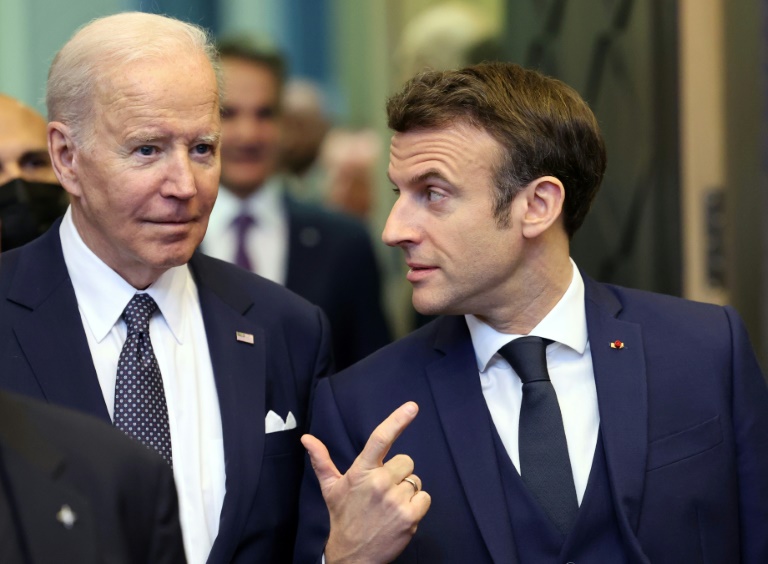
French President Emmanuel Macron heads to Washington Tuesday to discuss a slew of issues with US counterpart Joe Biden, ranging from aligning policy on Russia’s invasion of Ukraine to easing trade spats.

Macron, in a rare honour the first French leader to be invited for two US state visits, can look forward to another 21-gun salute and ostentatious White House dinner that ex-president Donald Trump provided in 2018.

His travelling entourage of foreign, defence and finance ministers, as well as business leaders and astronauts, illustrates the range of transatlantic cooperation Paris hopes to push forward.

But one senior American official told AFP that while there might be concrete “progress” in some fields, “this visit is about the personal relationship, the alliance relationship” with France.

“There are enormous opportunities to cooperate between the Biden administration and the Macron government,” said Martin Quencez, deputy director of the Paris office of think-tank GMF.

“But for various reasons, cooperation and coordination haven’t gone as far as one might imagine”.

The tone between Paris and Washington has calmed since a year ago, when the United States snatched a lucrative contract to supply Australia with submarines from under French noses — and launched a new US-UK-Australia alliance in the Pacific, dubbed AUKUS, that excluded France.

This week’s visit could be seen as the capstone of US efforts to placate a NATO ally which is one of the strongest voices calling for European “strategic autonomy”, said Celia Belin, a researcher at the Brookings Institution.

“The French aren’t always easy to manage, but when the French and the Americans agree, that moves things forward a great deal.”

– ‘Not on the same page’ –

As things stand, however, “we are not allies on the same page,” one adviser to Macron told AFP, promising “challenging” talks with Biden.

Despite his support for Kyiv, Macron’s insistence on continuing to talk with Moscow throughout Russia’s invasion of Ukraine has raised American hackles.

Another adviser told reporters last week that Macron would speak to Russian President Vladimir Putin soon — but not until after his US visit.

The conversation comes just as some US officials including Pentagon chief Mark Milley have raised the possibility of a negotiated peace.

Putin’s war has also set France and the United States at odds on the economy, intensifying existing disagreements over issues like the green transition and competing with China.

Massive US weapons deliveries to Ukraine — far outstripping the combined efforts of the European Union — have highlighted the country’s pre-eminence as an arms producer, while Franco-German joint efforts flounder.

That could be highlighted still further if a divided US Congress refuses to authorise the same level of aid to Kyiv from next year.

And as the United States plans massive investments and subsidies under its Inflation Reduction Act (IRA), Europeans fear distorting effects on competition with their own firms in sectors like electric cars, batteries and clean energy.

Macron will tell Biden “there’s a contradiction between an administration that constantly talks of alliances… and at the same time takes a decision like the IRA that will impact allies’ economies and industry,” researcher Quencez said.

A senior Biden administration official, speaking on condition of anonymity, stressed that even with the disagreements, the transatlantic partnership remains strong.

On divergences over the more hawkish US policy towards China, the official said European views are “not identical, but I think there is a strong view that we should be speaking from a common script in response to China.”

As for US subsidies for domestic green technology companies, the official said they do not shut out EU competitors and that a “very constructive set of conversations” was underway on how to work together.

– EU subsidies to come? –

Nevertheless, “We won’t stand idly by” while the United States engages in alleged protectionism, Macron’s Prime Minister Elisabeth Borne has said.

A joint statement last week from finance ministers in Berlin and Paris underscored the “urgent need for investments in Europe” to reduce energy dependencies and tackle climate and digital transitions.

The communique was read by some observers as potentially heralding a wave of EU subsidies.

“China favours its own products: America favours its own products. It might be time for Europe to favour its own products,” French Finance Minister Bruno Le Maire told France 3 radio on Sunday.

In the immediate term, Europeans are angered by the swingeing prices they must now pay for US exports of ship-borne liquefied natural gas — replacing cheaper Russian pipeline gas cut off during the invasion of Ukraine.

France in particular has suffered a double energy blow as much of its fleet of nuclear power plants is offline for maintenance or due to flaws uncovered in their cooling systems.

With Luc Remont, the newly installed head of state-controlled energy firm EDF, on Macron’s plane to Washington, some support for the civil nuclear industry could be on the cards.

Macron is also expected to announce a fund to support French language teaching on a later leg of his visit that will take him to New Orleans.

burs/tgb/sjw/imm/st/jh

Twitter owner Musk signals new 'war' against Apple

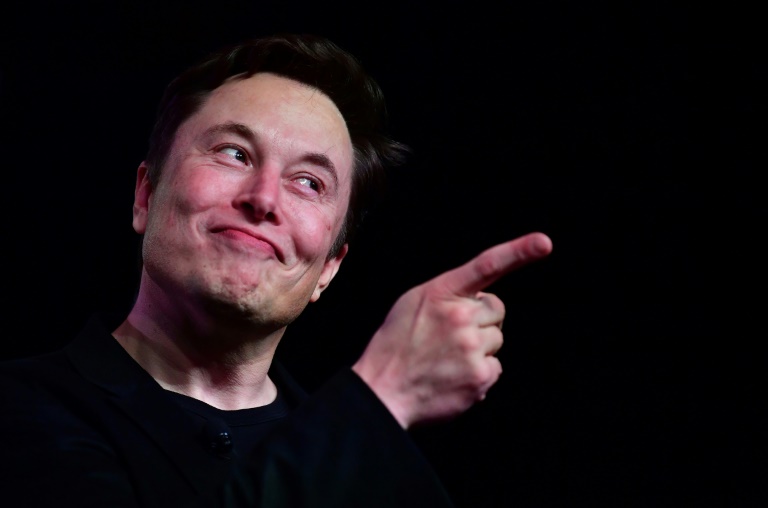
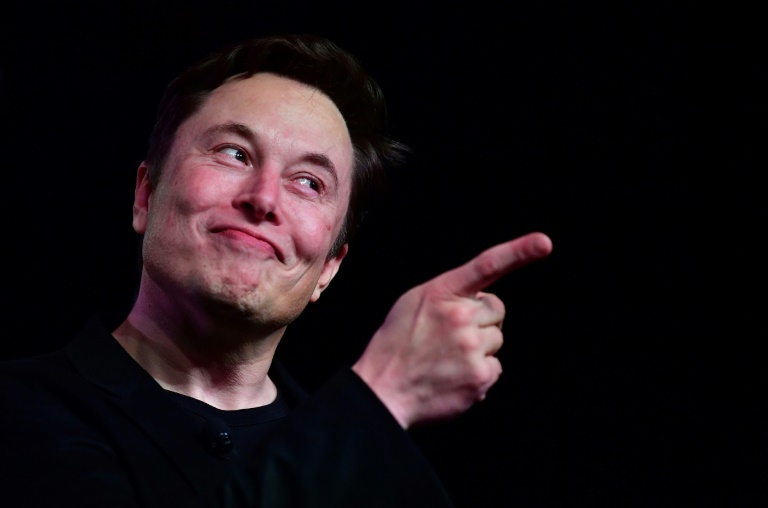
Twitter owner Elon Musk on Monday opened fire against Apple over its tight control of what is allowed on the App Store, saying the iPhone maker has threatened to oust his recently acquired social media platform.

Musk also joined the chorus crying foul over a 30 percent fee Apple collects on transactions via its App Store — the sole gateway for applications to get onto its billion plus mobile devices.

A series of tweets fired off by Musk included a meme of a car with his first name on it veering onto a highway off-ramp labeled “Go to War,” instead of continuing onwards towards “Pay 30%.”

The billionaire CEO also tweeted that Apple has “threatened to withhold Twitter from its App Store, but won’t tell us why.”

Apple did not immediately reply to an AFP request for comment.

Both Apple and Google require social networking services on their app stores to have effective systems for moderating harmful or abusive content.

But since taking over Twitter last month, Musk has cut around half of Twitter’s workforce, including many employees tasked with fighting disinformation, while an unknown number of others have voluntarily quit.

He has also reinstated previously banned accounts, including that of former president Donald Trump.

Yoel Roth, the former head of trust and safety at Twitter who left after Musk took over, wrote in a New York Times op-ed that “failure to adhere to Apple’s and Google’s guidelines would be catastrophic,” and risk “expulsion from their app stores.”

Describing himself as a “free speech absolutist,” Musk believes that all content permitted by law should be allowed on Twitter, and on Monday described his actions as a “revolution against online censorship in America.”

He also tweeted that he planned to publish “Twitter Files on free speech suppression,” but without clarifying what data he had in mind to share with the public.

Though Musk says Twitter is seeing record high engagement with him at the helm, his approach has startled the company’s major moneymaker — advertisers.

In recent weeks, half of Twitter’s top 100 advertisers have announced they are suspending or have otherwise “seemingly stopped advertising on Twitter,” an analysis conducted by nonprofit watchdog group Media Matters found.

Musk on Monday accused Apple of also having “mostly stopped advertising on Twitter.”

“Do they hate free speech in America?” he asked, before replying with a tweet tagging Apple CEO Tim Cook.

In the first three months of 2022, Apple was the top advertiser on Twitter, spending some $48 million on ads which accounted for more than 4 percent of the social media platform’s revenue, according to a Washington Post report citing an internal Twitter document.

Sarah Roberts, an information studies expert at University of California, Los Angeles, told AFP that “Musk didn’t understand that Twitter itself was a brand, had cachet.”

“Now companies don’t even want to be associated with it. It’s not even that they worry about the content. Twitter is a tainted brand, a brand non grata companies don’t want to be associated with,” she added.

– Tarnishing Tesla? –

Musk on Monday also called Apple’s fee on transactions through its App Store a “secret 30% tax.”

He shared a video released last year by Fortnite maker Epic Games that portrayed Apple as an oppressor in a mocking spin on a famous “1984” ad for Macintosh computers.

Apple has clashed in court with Epic, which has sought to break Apple’s grip on the App Store, accusing the iPhone maker of operating a monopoly in its shop for digital goods or services.

A federal judge last year ordered Apple to loosen control of its App Store payment options, but said Epic had failed to prove that antitrust violations had taken place.

Musk’s controversial moves at Twitter, along with the possibility he will need to sell more Tesla shares to keep the social media platform afloat, has taken shine off of the electric car company and its stock, according to Wedbush analyst Dan Ives.

“The Musk vs Apple new battle is not what investors want to see,” Ives said in a tweet.

“(Wall) Street wants less drama, not more as this Twitter situation remains the gift that keeps on giving for the Tesla bears with every day a new chapter.”

Twitter owner Musk signals new 'war' against Apple

Twitter owner Elon Musk on Monday opened fire against Apple over its tight control of what is allowed on the App Store, saying the iPhone maker has threatened to oust his recently acquired social media platform.

Musk also joined the chorus crying foul over a 30 percent fee Apple collects on transactions via its App Store — the sole gateway for applications to get onto its billion plus mobile devices.

A series of tweets fired off by Musk included a meme of a car with his first name on it veering onto a highway off-ramp labeled “Go to War,” instead of continuing onwards towards “Pay 30%.”

The billionaire CEO also tweeted that Apple has “threatened to withhold Twitter from its App Store, but won’t tell us why.”

Apple did not immediately reply to an AFP request for comment.

Both Apple and Google require social networking services on their app stores to have effective systems for moderating harmful or abusive content.

But since taking over Twitter last month, Musk has cut around half of Twitter’s workforce, including many employees tasked with fighting disinformation, while an unknown number of others have voluntarily quit.

He has also reinstated previously banned accounts, including that of former president Donald Trump.

Yoel Roth, the former head of trust and safety at Twitter who left after Musk took over, wrote in a New York Times op-ed that “failure to adhere to Apple’s and Google’s guidelines would be catastrophic,” and risk “expulsion from their app stores.”

Describing himself as a “free speech absolutist,” Musk believes that all content permitted by law should be allowed on Twitter, and on Monday described his actions as a “revolution against online censorship in America.”

He also tweeted that he planned to publish “Twitter Files on free speech suppression,” but without clarifying what data he had in mind to share with the public.

Though Musk says Twitter is seeing record high engagement with him at the helm, his approach has startled the company’s major moneymaker — advertisers.

In recent weeks, half of Twitter’s top 100 advertisers have announced they are suspending or have otherwise “seemingly stopped advertising on Twitter,” an analysis conducted by nonprofit watchdog group Media Matters found.

Musk on Monday accused Apple of also having “mostly stopped advertising on Twitter.”

“Do they hate free speech in America?” he asked, before replying with a tweet tagging Apple CEO Tim Cook.

In the first three months of 2022, Apple was the top advertiser on Twitter, spending some $48 million on ads which accounted for more than 4 percent of the social media platform’s revenue, according to a Washington Post report citing an internal Twitter document.

Sarah Roberts, an information studies expert at University of California, Los Angeles, told AFP that “Musk didn’t understand that Twitter itself was a brand, had cachet.”

“Now companies don’t even want to be associated with it. It’s not even that they worry about the content. Twitter is a tainted brand, a brand non grata companies don’t want to be associated with,” she added.

– Tarnishing Tesla? –

Musk on Monday also called Apple’s fee on transactions through its App Store a “secret 30% tax.”

He shared a video released last year by Fortnite maker Epic Games that portrayed Apple as an oppressor in a mocking spin on a famous “1984” ad for Macintosh computers.

Apple has clashed in court with Epic, which has sought to break Apple’s grip on the App Store, accusing the iPhone maker of operating a monopoly in its shop for digital goods or services.

A federal judge last year ordered Apple to loosen control of its App Store payment options, but said Epic had failed to prove that antitrust violations had taken place.

Musk’s controversial moves at Twitter, along with the possibility he will need to sell more Tesla shares to keep the social media platform afloat, has taken shine off of the electric car company and its stock, according to Wedbush analyst Dan Ives.

“The Musk vs Apple new battle is not what investors want to see,” Ives said in a tweet.

“(Wall) Street wants less drama, not more as this Twitter situation remains the gift that keeps on giving for the Tesla bears with every day a new chapter.”

Biden's ambitious climate plan stokes tension with EU allies

Certain provisions in US President Joe Biden’s landmark climate action plan, the Inflation Reduction Act (IRA), have provoked strong responses from the European Union, which fears it could hurt its industry.

With the IRA set to be one of the main topics discussed during French President Emmanuel Macron’s state visit to Washington this week, AFP answers some key questions about the spat.

– What are the measures in the IRA? –

The IRA, a behemoth piece of legislation that largely focuses on climate and social spending, provides more than $430 billion in US investments.

Of that sum, $370 billion will go toward reducing greenhouse gas emissions 40 percent by 2030, making it the largest-ever US program to combat climate change.

Some of the investments are in the form of tax cuts for companies that invest in clean energy, but there are also significant subsidies for electric vehicles, batteries and renewable energy projects — if they are manufactured in the United States. 

One is a $7,500 subsidy for households buying US-made electric vehicles, while another gives benefits to manufacturers of wind turbines and solar panels who use US steel.

– Why is the IRA ruffling European feathers? –

The IRA has caused a stir at EU headquarters in Brussels as well as in other European capitals, which see the various subsidies as “discriminatory,” in particular against the bloc’s auto manufacturers.

“This is unacceptable for the EU. As it stands, this text is extremely protectionist, to the detriment of European exports” said Czech industry minister Jozef Sikela, whose country currently holds the rotating EU presidency.

He did, however, stress the “goodwill on both sides” after a meeting of EU ministers with US Trade Ambassador Katherine Tai.

In early November, EU Internal Market Commissioner Thierry Breton threatened to “go before the WTO” and consider “retaliatory measures” if the United States did not reverse its subsidies. 

“In some cases, the subsidies that the Biden administration offers are four to 10 times the maximum amount authorized by the European Commission,” said French Finance Minister Bruno Le Maire, who called on the Commission to create “European preferential measures or to accelerate the use of reciprocity instruments.” 

According to a French official briefing reporters ahead of Macron’s state visit, the hot button issue will be on the table. 

“We fully understand the US desire to be more independent,” said the official Monday, “but the problems come from the fact that in Europe we do not have this type of discriminatory instrument, we respect the rules of the WTO in this area.”

The official said that France wanted “Europe too, not just the United States, to emerge stronger” from the period of multiple crises that the continent is going through.

– Is there leeway to amend the IRA? –

Even if Biden wanted to walk back certain measures, or to broaden the number of beneficiaries, his legislative options are quite limited.

Any action will be more complicated when his Democratic Party loses their House of Representatives majority in January, after their loss in the November midterms.

It’s also not clear that Biden is even thinking about touching a key plank of his presidential legacy, which he salvaged only after protracted negotiations in the Senate. 

Biden’s initial proposal, the Build Back Better Act, was even more ambitious, providing $1.7 trillion dollars of investment. That plan cleared the House at the end of 2021 but was blocked in the Senate. 

The subsidies in question are also very popular, especially in states such as Ohio and Michigan, where the automotive industry remains powerful and their “swing state” status gives them considerable political clout. 

However, the United States is hoping to smooth things over with its European partners.

After a virtual exchange with France’s Le Maire, US Trade Representative Tai on Monday said that the countries are “working together to strengthen common understanding of legislation.”

For his part, Macron hopes to go further and obtain from his US counterpart “exemptions for a certain number of European industries, perhaps on the model of what it already agrees for Mexico and Canada,” according to an adviser.

The two US neighbors, who share a free trade pact with the United States, received carve-outs in the IRA for electric vehicle subsidies.

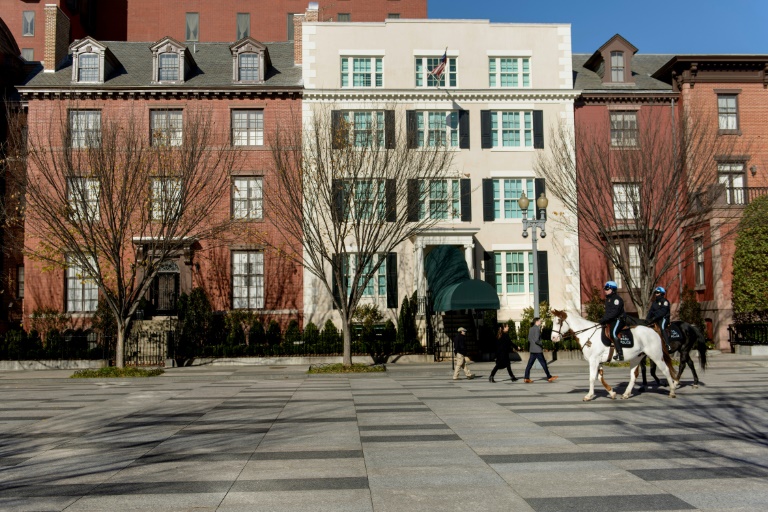
Blair House, US president's guest home, to welcome the Macrons

Blair House, the historic Washington residence where select foreign visitors are sumptuously housed, and where one US president escaped an assassination attempt, is gearing up for a state visit by France’s Emmanuel Macron.

The French president and his wife Brigitte Macron, who arrive Tuesday, will be following in the footsteps of Charles de Gaulle, Queen Elizabeth II and the emperor of Japan when they move into the venerable brick structure across Pennsylvania Avenue from the White House, in the heart of the federal capital.

Behind its rather austere three-story facade, Blair House actually comprises four contiguous buildings, forming a complex of 70,000 square feet (6,500 square meters) — larger than the White House itself — including 119 opulently decorated rooms dedicated to welcoming foreign leaders or providing a venue for high-stakes diplomatic talks.

In the back, a quiet garden with a fountain, park benches and ivy-covered walls allows visitors a chance to enjoy fresh air far from the tourists who swarm Pennsylvania Avenue.

The president’s guest house, as it is often described, has been the scene of marathon negotiating sessions over the Israeli-Palestinian conflict, and yearly meetings of G7 finance ministers.

It also played host to a colorful visit in the 1990s by heavy-drinking Russian president Boris Yeltsin who, according to Bill Clinton, was seen one day in 1995 hailing a taxi out front in his underwear and, a day later, mistaken for a drunken intruder wandering in the building’s basement.

And in 1998, British Prime Minister Tony Blair played on the similarity in names, quipping that he felt “kind of at home” when he stayed at Blair House.

– Guns and cigar smoke –

In addition to welcoming foreign dignitaries, it is in Blair House where a US president-elect traditionally spends the last few days before his inauguration.

That gave rise to a minor kerfuffle in 2009. Democratic president-elect Barack Obama arrived from Chicago with his family and hoped to move into Blair House early while preparing for the mammoth celebration around his historic January 20 inauguration. 

But the Republican administration of George W. Bush said he could not move in before the 15th, offering the excuse that a former Australian prime minister, in town to receive an award, was still there — an excuse that met with skepticism from some commentators.

Despite a lack of extensive security surrounding Blair House at the time, President Harry Truman and his family spent years there (1948-1952) while the White House was undergoing a major renovation.

That minimal protective layer made it possible on November 1, 1950 for two armed Puerto Rican independence activists to break in in a vain attempt to assassinate Truman. One assailant and a policeman were killed.

Inadequate security was also blamed when, in September 2000, an intruder managed to reach the room where the Indian prime minister, Atal Behari Vajpayee, was staying. Vajpayee was not present at the time.

Built in 1824, Blair House was soon purchased by Francis Preston Blair, editor in chief of the Washington Globe newspaper and a close advisor of President Andrew Jackson, who used the building as a venue for a sort of salon for the city’s elite.

In 1942, the US government purchased Blair House at the urging of president Franklin D. Roosevelt, whose patience had been tried by White House visitor Winston Churchill, who would fill the mansion’s hallways with acrid cigar smoke and once tried to rouse FDR at three in the morning for a chat.

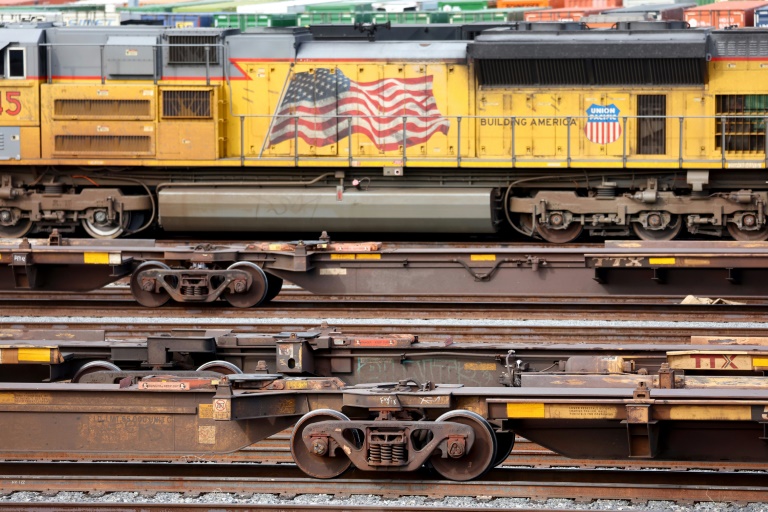
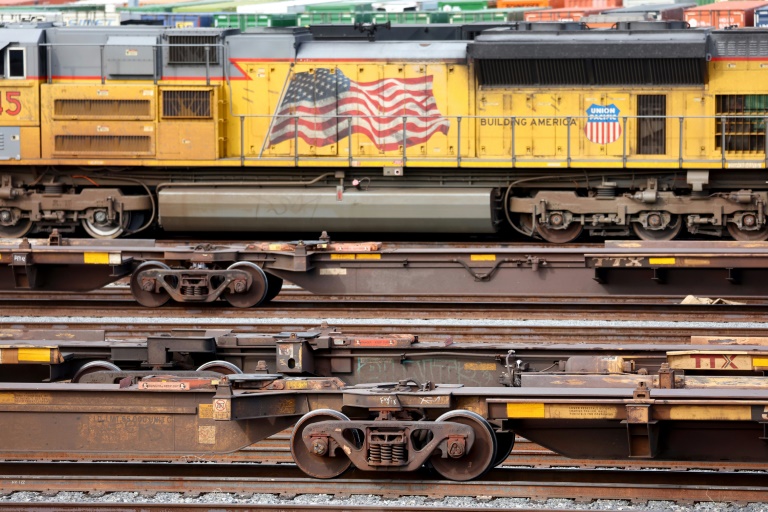
Congress must step in to prevent 'devastating' US rail strike: Biden

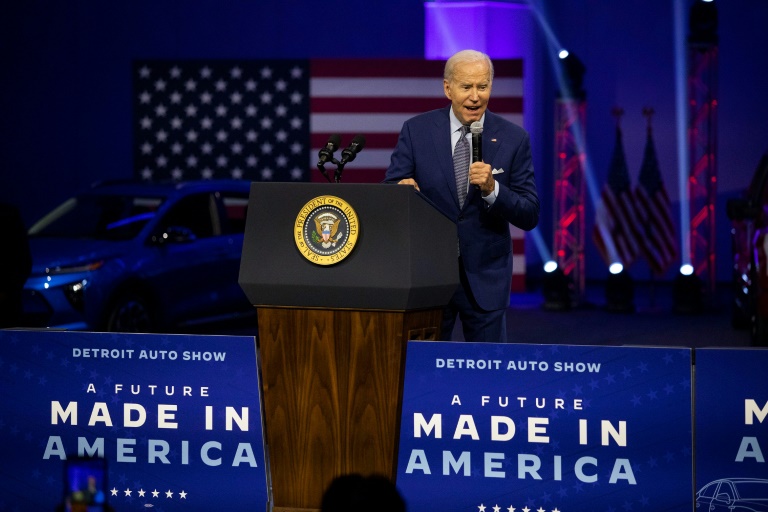
US President Joe Biden on Monday called on Congress to intervene urgently to prevent a strike by railroad workers that he warned would “devastate our economy.”

Biden asked Congress to deploy rarely used legislative powers to force adoption of a preliminary deal which freight rail companies and workers had struck in September before some of the trade unions backed off, returning to their threat to go on strike.

While noting his pro-union credentials, the Democratic party leader said there was no alternative to forcing through the contested deal, which covers wage increases and working conditions.

“Let me be clear: a rail shutdown would devastate our economy. Without freight rail, many US industries would shut down. My economic advisors report that as many as 765,000 Americans — many union workers themselves — could be put out of work in the first two weeks alone,” Biden said in a statement.

If an agreement is not reached by December 9, the world’s largest economy could see nearly 7,000 freight trains grind to a halt, at a cost of more than $2 billion a day, according to the American Association of Railroads.

Alluding to the crucial role played by trains in serving the continent-spanning country, Biden said a strike would mean that “communities could lose access to chemicals necessary to ensure clean drinking water. Farms and ranches across the country could be unable to feed their livestock.”

– December 9 deadline –

A dispute between workers and freight companies has been simmering for months. A strike was narrowly averted in September after Biden and his top aides intervened in marathon negotiations.

However four of the 12 unions involved later failed to ratify the deal, sparking the new crisis.

“As a proud pro-labor president, I am reluctant to override the ratification procedures and the views of those who voted against the agreement,” Biden said. “But in this case — where the economic impact of a shutdown would hurt millions of other working people and families — I believe Congress must use its powers to adopt this deal.”

Biden acknowledged union concerns over lack of sick leave in the deal but said now was not the time to try and fix an issue plaguing workplaces across the economy.

“I share workers’ concern,” he said, “but at this critical moment for our economy, in the holiday season, we cannot let our strongly held conviction for better outcomes for workers deny workers the benefits of the bargain they reached, and hurl this nation into a devastating rail freight shutdown.”

Biden urged Congress to pass the legislation “well in advance of December 9th so we can avoid disruption.”

Nancy Pelosi, the Democratic speaker of the House until January, when Republicans take over, said the bill would be put to a vote “this week.”

It will then go to the Senate, where the Democrats hold a narrow majority.

Congress must step in to prevent 'devastating' US rail strike: Biden

US President Joe Biden on Monday called on Congress to intervene urgently to prevent a strike by railroad workers that he warned would “devastate our economy.”

Biden asked Congress to deploy rarely used legislative powers to force adoption of a preliminary deal which freight rail companies and workers had struck in September before some of the trade unions backed off, returning to their threat to go on strike.

While noting his pro-union credentials, the Democratic party leader said there was no alternative to forcing through the contested deal, which covers wage increases and working conditions.

“Let me be clear: a rail shutdown would devastate our economy. Without freight rail, many US industries would shut down. My economic advisors report that as many as 765,000 Americans — many union workers themselves — could be put out of work in the first two weeks alone,” Biden said in a statement.

If an agreement is not reached by December 9, the world’s largest economy could see nearly 7,000 freight trains grind to a halt, at a cost of more than $2 billion a day, according to the American Association of Railroads.

Alluding to the crucial role played by trains in serving the continent-spanning country, Biden said a strike would mean that “communities could lose access to chemicals necessary to ensure clean drinking water. Farms and ranches across the country could be unable to feed their livestock.”

– December 9 deadline –

A dispute between workers and freight companies has been simmering for months. A strike was narrowly averted in September after Biden and his top aides intervened in marathon negotiations.

However four of the 12 unions involved later failed to ratify the deal, sparking the new crisis.

“As a proud pro-labor president, I am reluctant to override the ratification procedures and the views of those who voted against the agreement,” Biden said. “But in this case — where the economic impact of a shutdown would hurt millions of other working people and families — I believe Congress must use its powers to adopt this deal.”

Biden acknowledged union concerns over lack of sick leave in the deal but said now was not the time to try and fix an issue plaguing workplaces across the economy.

“I share workers’ concern,” he said, “but at this critical moment for our economy, in the holiday season, we cannot let our strongly held conviction for better outcomes for workers deny workers the benefits of the bargain they reached, and hurl this nation into a devastating rail freight shutdown.”

Biden urged Congress to pass the legislation “well in advance of December 9th so we can avoid disruption.”

Nancy Pelosi, the Democratic speaker of the House until January, when Republicans take over, said the bill would be put to a vote “this week.”

It will then go to the Senate, where the Democrats hold a narrow majority.

Close Bitnami banner
Bitnami