
US Business

Colorado mass shooter stopped by 'heroic' people inside club: police

The gunman who opened fire inside an LGBTQ Colorado nightclub, killing at least five people, was stopped by two “heroic” people inside the club, police told a press conference Sunday.

They identified the suspect as 22-year-old Anderson Lee Aldrich, and said he had used a rifle at the club, where partygoers were apparently marking Transgender Day of Remembrance, which pays tribute to trans people targeted in violent attacks.

Eighteen people were wounded in the incident shortly before midnight, police said, adding that an unspecified number of the wounded remained in critical condition.

The shooting was the latest in a long history of attacks on LGBTQ venues in the United States, the deadliest of which claimed 49 lives at a nightclub in Orlando, Florida, in 2016.

The suspect in Colorado Springs entered Club Q and immediately began shooting at people inside, police chief Adrian Vasquez told a press conference. 

He added, “At least two heroic people inside the club confronted and fought with the suspect and were able to stop the suspect from continuing to kill and harm others.”

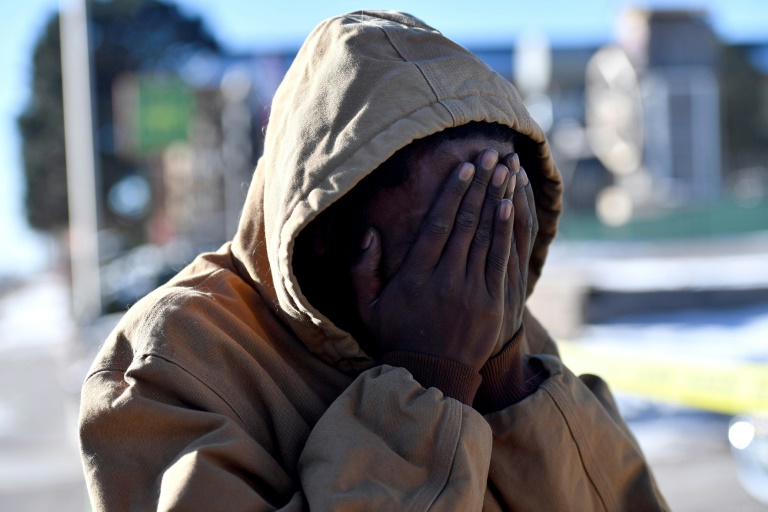
Joshua Thurman of Colorado Springs was in the club at the time.

“It was so scary,” he told reporters Sunday.

“There were bodies on the floor. There was shattered glass, broken cups, people crying.

“It was supposed to be our safe space… Where are we supposed to go?”

US President Joe Biden released a statement condemning the attack and, while he noted that the motive was not yet clear, slammed violence against the LGBTQ community, particularly transgender women of color.

“We must drive out the inequities that contribute to violence against LGBTQI+ people. We cannot and must not tolerate hate,” he said.

– Earlier bomb threat –

The authorities said the suspect was being treated at a local hospital but they released no other information about him, noting that officials including the FBI are investigating.

A man with the same name was arrested on June 18, 2021, aged 21 after his mother said he had threatened to hurt her with a homemade bomb or “multiple weapons,” according to a news release at the time from the El Paso County Sheriff’s Office. 

Police spokeswoman Pamela Castro said Sunday that police received an initial call about an active shooting in the club at 11:56 pm. She said a first officer arrived within four minutes, and that the suspect had been subdued just two minutes later.

“Club Q is a safe haven for our LGBTQ citizens,” Chief Vasquez said. “I’m so terribly saddened and heartbroken.”

Club Q said on Facebook that it was “devastated by the senseless attack on our community,” adding, “We thank the quick reactions of heroic customers that subdued the gunman and ended this hate attack.”

Authorities said Sunday that the shooting had not yet been officially classified as a hate crime but that first-degree murder charges were certain to be filed.

Governor Jared Polis, who in 2018 became the first openly gay man elected as a US governor, called the shooting “horrific, sickening and devastating,” adding that “Colorado stands with our LGTBQ Community and everyone impacted by this tragedy.”

Messages of support poured in by the hundreds to the club’s Facebook page, some from as far away as Sweden, Britain, New Zealand, Germany and Australia.

– ‘Events we train for’ –

Authorities could not immediately say how many people were in the popular club at the time.

Dozens of police and firefighters rushed to the scene. 

“Unfortunately,” Colorado Springs Fire Department spokesperson Mike Smaldino said, “these are events we do train for.”

Bartender Michael Anderson was working at the club.

“What I can’t stop thinking about is the visuals of the evening, of the bodies, of the blood, of the broken glass, of the carnage and the wreckage, and seeing a safe place turned into a war zone,” he told CBS. 

“I always hoped that I would never be somewhere where this would happen.”

Transgender Day of Remembrance has been marked each year since 1999, when it began as a vigil to honor the memory of Rita Hester, who had been killed the year before.

Transgender rights were a hot-button issue in the United States leading up to midterm elections earlier this month, with Republicans putting forward a slew of legislative proposals to restrict them.

– 600 mass shootings in 2022 –

On June 12, 2016, a gunman opened fire inside the Pulse nightclub in Orlando, killing 49 people and wounding more than 50 in what was then the deadliest mass shooting in modern US history.  

Gun violence is a huge problem in the United States, where more than 600 mass shootings have occurred so far in 2022, according to the Gun Violence Archive website.

Mass shootings have repeatedly reignited debate on gun control, a hot-button issue in the country, though little headway has been made in Congress on calls for reform.
Colorado mass shooter stopped by 'heroic' people inside club: police

The gunman who opened fire inside an LGBTQ Colorado nightclub, killing at least five people, was stopped by two “heroic” people inside the club, police told a press conference Sunday.

They identified the suspect as 22-year-old Anderson Lee Aldrich, and said he had used a long rifle at the club, where partygoers were apparently marking Transgender Day of Remembrance, which pays tribute to trans people targeted in violent attacks.

Eighteen people were wounded in the shooting shortly before midnight, police said, adding that an unspecified number of the wounded remained in critical condition. They said at least one other firearm was found at the club.

The shooting is the latest in a long history of attacks on LGBTQ venues in the United States, the deadliest of which claimed 49 lives at a nightclub in Orlando, Florida, in 2016.

The suspect in Colorado Springs entered Club Q and “immediately began shooting at people inside,” police chief Adrian Vasquez told a press conference. 

He added, “At least two heroic people inside the club confronted and fought with the suspect and were able to stop the suspect from continuing to kill and harm others.”

Joshua Thurman of Colorado Springs was in the club at the time.

“It was so scary,” he said in a video a local reporter posted to social media. “I heard shots — broken glass — bodies — it was, ‘How?’ … ‘Why?”

“It was supposed to be our safe space.”

US President Joe Biden released a statement condemning the attack and, while he noted that the motive was not yet clear, slammed violence against the LGBTQ community, particularly transgender women of color.

“We must drive out the inequities that contribute to violence against LGBTQI+ people. We cannot and must not tolerate hate,” he said.

– Earlier bomb threat –

The authorities said the suspect was being treated at a local hospital but they released no other information about him, noting that officials including the FBI are investigating.

A man with the same name was arrested on June 18, 2021, aged 21 after his mother said he had threatened to hurt her with a homemade bomb or “multiple weapons,” according to a news release at the time from the El Paso County Sheriff’s Office. 

Police spokeswoman Pamela Castro said Sunday that police received an initial call about an active shooting in the club at 11:56 pm. She said a first officer arrived within four minutes, and that the suspect had been subdued just two minutes later.

“Club Q is a safe haven for our LGBTQ citizens,” Chief Vasquez said. “I’m so terribly saddened and heartbroken.”

Club Q said on Facebook that it was “devastated by the senseless attack on our community,” adding, “We thank the quick reactions of heroic customers that subdued the gunman and ended this hate attack.”

Authorities said Sunday that the shooting had not yet been officially classified as a hate crime but that first-degree murder charges were certain to be filed.

Governor Jared Polis, who in 2018 became the first openly gay man elected as a US governor, called the shooting “horrific, sickening and devastating,” adding that “Colorado stands with our LGTBQ Community and everyone impacted by this tragedy.”

Messages of support poured in by the hundreds to the club’s Facebook page, some from as far away as Sweden, Britain, New Zealand, Germany and Australia.

– ‘Events we train for’ –

Authorities could not immediately say how many people were in the popular club at the time.

They said 39 police officers and 34 firefighters were dispatched to the scene. 

“Unfortunately,” Colorado Springs Fire Department spokesperson Mike Smaldino said, “these are events we do train for.”

Castro said that some of the wounded were hurt not by gunfire but were injured while fleeing.

Transgender Day of Remembrance has been marked each year since 1999, when it began as a vigil to honor the memory of Rita Hester, who had been killed the year before.

Transgender rights were a hot-button issue in the United States leading up to midterm elections earlier this month, with Republicans putting forward a slew of legislative proposals to restrict them.

On Sunday, US Secretary of State Antony Blinken released a statement marking Transgender Day of Remembrance and lamenting violent attacks against the community, though he did not mention the Colorado shooting specifically.

“Transgender, non-binary, and gender non-conforming persons have always been a part of our families, cultures, and nations,” he said.

– 600 mass shootings in 2022 –

On June 12, 2016, a gunman opened fire inside the Pulse nightclub in Orlando, killing 49 people and wounding more than 50 in what was then the deadliest mass shooting in modern US history.  

Gun violence is a major problem in the United States, where more than 600 mass shootings have occurred so far in 2022, according to the Gun Violence Archive website.

Mass shootings have repeatedly reignited debate on gun control, a hot-button issue in the country, though little headway has been made in Congress on calls for reform.

Turkey launches air raids against Kurdish militants in Syria, Iraq

Turkey announced on Sunday it had carried out air strikes against the bases of outlawed Kurdish militants across northern Syria and Iraq, which it said were being used to launch “terrorist” attacks on Turkish soil.

The overnight raids in northern and northeastern Syria killed at least 31 people, said the British-based monitoring group the Syrian Observatory for Human Rights. They were mainly against positions held by Syrian Kurdish forces. 

The offensive, codenamed Operation Claw-Sword, comes a week after a blast in central Istanbul killed six people and wounded 81, an attack Turkey has blamed on the Kurdistan Workers’ Party (PKK).

The PKK has waged a bloody insurgency there for decades and is designated a terror group by Ankara and its Western allies. But it has denied involvement in the Istanbul explosion.

“Air Operation Claw-Sword was successfully carried out, within the scope of our strategy to eradicate terrorism at its source and eliminate terror attacks against our people and security forces from northern Iraq and Syria,” said a defence ministry statement.

The strikes targeted PKK bases in northern Iraq’s mountainous regions of Kandil, Asos and Hakurk, and bases of the Kurdish People’s Protection Units (YPG), in Ayn al-Arab (called Kobane in Kurdish), Tal Rifaat, Jazira and Derik regions in Syria, the ministry said.

Ankara considers the YPG to be a PKK-affiliated terror group.

In all, 89 targets including shelters, bunkers, caves, tunnels, ammunition depots, so-called headquarters and training camps belonging to the militants “were destroyed”, the ministry said, adding “many terrorists were neutralised”. 

“All our planes safely returned to their bases after the operation,” it added. 

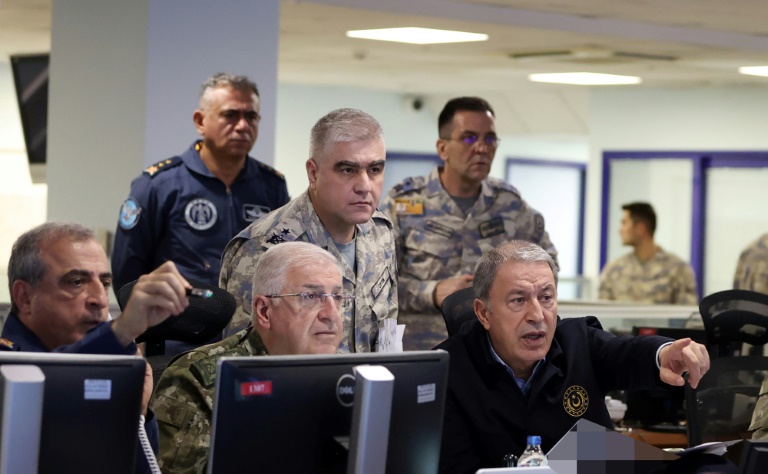
Defence Minister Hulusi Akar was seen in a video image briefing President Recep Tayyip Erdogan, who gave the order for the latest operation.

Syria’s government meanwhile said the raids had killed a number of its soldiers.

Last Sunday’s Istanbul bombing was the deadliest in five years, reviving bitter memories of a wave of nationwide attacks between 2015 and 2017.

Those attacks were attributed mostly to Kurdish militants or Islamic State (IS) group jihadists — but no one has claimed responsibility for the Istanbul attack.

– Rocket attack –

A rocket fired by Kurdish forces in Syria’s Tal Rifaat region wounded eight security personnel on the Turkish border, the official Anadolu news agency reported.

Two Turkish soldiers and six police officers were hurt after the rocket fell on the Oncupinar crossing in southern Turkey near the Syrian border, said the agency.

After the Istanbul explosion, Turkish authorities arrested more than a dozen people, including chief suspect Alham Albashir — a Syrian woman said to have been working for Kurdish militants.  

Bulgaria has also detained five people accused of having helped one of the suspects. 

“The hour of reckoning has come,” the Turkish defence ministry tweeted early Sunday, with a photo of a plane taking off for a night operation.

Nearly 25 air strikes hit the provinces of Raqa, Hassakeh and Aleppo, killing 18 members of the Kurdish-led Syrian Democratic Forces (SDF), 12 members of Syria’s military and one journalist, according to the Syrian Observatory for Human Rights. 

Kurdish authorities in northeastern Syria gave a toll of 29 dead: 11 civilians, 15 fighters aligned with Syria’s military, two silo guards and one Kurdish fighter.

Turkey’s military has in the past denied claims its strikes target civilians.

In its first comment on the Turkish strikes, the Syrian defence ministry said “a number of soldiers” had been killed due to “Turkish aggressions in northern Aleppo and Hassakeh provinces at dawn”. 

– Complex ties with US –

Turkey’s latest military push could create problems for its complex relations with its Western allies — particularly the United States, which has relied mostly on Syrian Kurdish militia forces in its fight against IS jihadists.

Turkey has often accused Washington of supplying Kurdish forces with weapons.

Interior Minister Suleyman Soylu rejected the United States’ message of condolences after the Istanbul attack, even though Erdogan accepted them during a meeting on Tuesday with President Joe Biden on the margins of the G20 summit in Indonesia.  

Soylu has said Ankara believes the order for the Istanbul attack was given from Kobane, controlled by Syrian Kurdish militia forces, who have also denied any role. 

Kobane, a Kurdish-majority town near the Turkish border, was captured by IS in late 2014 before Syrian Kurdish forces drove them out early the following year.

The US-backed SDF said in a statement that the Turkish attacks would “not go unanswered”.

Turkey has launched waves of attacks on Syria since 2016 targeting Kurdish militias as well as IS jihadists, and Ankara and forces backed by it have seized territory along the Syrian border.

Since May, Erdogan has been threatening to launch a new operation in northern Syria.

burs-fo/jj

COP27 agrees to fund climate damages, no progress on emission cuts

A fraught UN summit wrapped up Sunday with a landmark deal on funding to help vulnerable countries cope with devastating climate impacts — but also anger over a failure to be more ambitious on cutting emissions.

The two-week talks in Egypt’s Red Sea resort of Sharm el-Sheikh, which at times appeared to teeter on the brink of collapse, delivered a major breakthrough on a fund for climate “loss and damage”.

Pakistani climate minister Sherry Rehman said COP27 “responded to the voices of the vulnerable”.

“We have struggled for 30 years on this path, and today in Sharm el-Sheikh this journey has achieved its first positive milestone,” she told the summit.

Tired delegates applauded when the fund was adopted as the sun came up Sunday following almost two extra days of round-the-clock negotiations.

But jubilation over that achievement was countered by stern warnings.

UN chief Antonio Guterres said the talks had “taken an important step towards justice” with the loss and damage fund, but fell short in pushing for the urgent carbon-cutting needed to tackle global warming.

“Our planet is still in the emergency room,” Guterres said. “We need to drastically reduce emissions now and this is an issue this COP did not address.”

British Prime Minister Rishi Sunak also warned that “more must be done”, while French President Emmanuel Macron proposed another summit in Paris ahead of COP28 in Dubai to agree “a new financial pact” for vulnerable nations. 

– ‘Stonewalled by emitters’ –

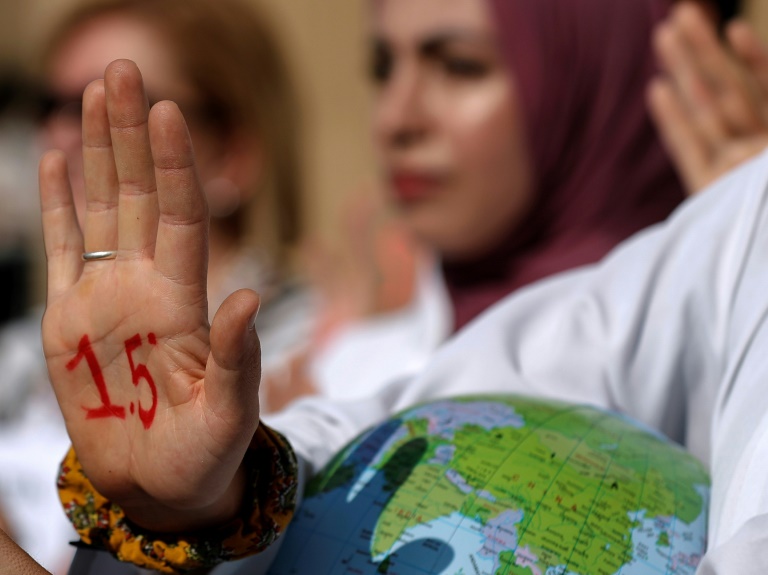
A final COP27 statement covering the broad efforts to grapple with a warming planet held the line on the aspirational goal of limiting global warming to 1.5 degrees Celsius from pre-industrial levels.

It also included language on renewable energy for the first time, while reiterating previous calls to accelerate “efforts towards the phasedown of unabated coal power and phase-out of inefficient fossil fuel subsidies”.

But that failed to go much further than a similar decision from last year’s COP26 meeting in Glasgow on key issues around cutting planet-heating pollution.

European Commission Vice President Frans Timmermans said the EU was “disappointed”, adding that more than 80 nations had backed a stronger emissions pledge.

“What we have in front of us… doesn’t bring enough added efforts from major emitters to increase and accelerate their emission cuts,” said Timmermans, who 24 hours earlier threatened to walk out of the talks.

Britain’s Alok Sharma, who chaired COP26 in Glasgow, said a passage on energy had been “weakened, in the final minutes”.

German Foreign Minister Annalena Baerbock said she was frustrated that the emissions cuts and fossil fuel phase-out were “stonewalled by a number of large emitters and oil producers”.

Criticised by some delegations for a lack of transparency during negotiations, Egyptian Foreign Minister Sameh Shoukry, the COP27 chair, said any missteps were “certainly not intentional”, and that he worked to avoid any “backslide” by parties.

– ‘Loss and damage’ –

The deal on loss and damage gathered critical momentum during the talks.

Developing nations relentlessly pushed for the fund, finally succeeding in getting the backing of wealthy polluters long fearful of open-ended liability.

A statement from the Alliance of Small Island States, comprised of islands whose very existence is threatened by sea levels rising, said the loss and damage deal was “historic”.

“The agreements made at COP27 are a win for our entire world,” said Molwyn Joseph, of Antigua and Barbuda and chair of AOSIS.

“We have shown those who have felt neglected that we hear you, we see you, and we are giving you the respect and care you deserve.”

With around 1.2C of warming so far, the world has seen a cascade of climate-driven extremes, shining a spotlight on the plight of developing countries faced with escalating disasters, as well as an energy and food price crisis and ballooning debt.

The fund will be geared towards developing nations “that are particularly vulnerable to the adverse effects of climate change” — language that had been requested by the EU.

– ‘On the brink’ –

The Europeans had also wanted to broaden the funder base to cough up cash — code for China and other better-off emerging countries. 

The final loss and damage text left many of the thornier questions to be dealt with by a transitional committee, which will report to next year’s climate meeting in Dubai to get the funding operational.

The fund will focus on what can be done now to support loss and damage resources but the agreement does not provide for liability or compensation, said a US State Department spokesperson.

Scientists say limiting warming to 1.5C is a far safer guardrail against catastrophic climate impacts, with the world currently way off track and heading for around 2.5C under current commitments and plans.

“The historic outcome on loss and damage at COP27 shows international cooperation is possible,” said Mary Robinson, former president of Ireland and Chair of The Elders.

“Equally, the renewed commitment on the 1.5C global warming limit was a source of relief. However, none of this changes the fact that the world remains on the brink of climate catastrophe.”  

All eyes on Trump's Twitter account after Musk reinstates him

Donald Trump has seemingly rejected returning to Twitter, but as he embarks on a new presidential campaign, will he be able to resist? All eyes were on his account Sunday for any activity, after it was reinstated by the platform’s new owner Elon Musk.

Twitter had issued a “permanent” ban on Trump in the wake of the January 6, 2021 attack by his supporters on the US Capitol, as he sought to overturn his election loss to Democrat Joe Biden.

But Musk, who describes himself as a “free speech absolutist,” posted a Twitter poll Saturday that saw a majority support the former president’s reinstatement, and the platform’s new owner wasted no time in acting on it.

As of 11:30 am EST (1630 GMT) Sunday, the revived account of the “45th President of the United States of America,” with its blue “verified” checkmark, had not posted any new messages.

The last message dates from January 8, 2021, when the billionaire said he would not attend Biden’s inauguration ceremony.  

On the same day, Twitter banned the account, which was being followed by some 88.8 million people, citing the risk of further incitement to violence.

– Campaign links –

Trump’s followers numbered 86.6 million as of Sunday — though it was unclear how many of those were real and how many were bots — while the number of accounts followed by him went from zero to 49.  

The account also linked to a campaign website seeking donations for Trump’s 2024 presidential run.

It was not clear who linked the website to the account or what any changes in the number of followers means — mass layoffs in recent weeks under Musk have seen Twitter’s communications team decimated.

Trump reveled in using Twitter as a mouthpiece during his presidency, posting policy announcements, attacking political rivals and communicating with supporters.

More than 15 million votes were cast in Musk’s poll — Twitter has 237 million daily users — with 51.8 percent in favor of reinstating Trump’s controversial profile and 48.2 percent against.

Musk asked for a simple “yes” or “no” response to the statement, “Reinstate former President Trump.”

On Saturday, while the poll was still underway, Trump posted a link to it on Truth Social, the Twitter alternative he founded, urging his 4.6 million followers there to vote for him.

But he also wrote: “don’t worry, we aren’t going anywhere. Truth Social is special!” 

And, appearing via video at a gathering of the Republican Jewish Coalition in Las Vegas, Trump said he welcomed the poll and was a fan of Musk, but appeared to reject any return to the platform.

“I don’t see it, because I don’t see any reason for it,” he said.

– ‘Better choices’ –

Trump posts often on Truth Social, sometimes dozens of times a day, and in recent months has engaged more brazenly than ever with extremist content, including dozens of posts from promoters of the QAnon conspiracy theory.

Although his reach there is relatively small, experts say the misinformation he spreads reverberates across the internet.

His reinstatement to the much larger and more mainstream platform of Twitter comes as his announcement that he will run for president again in 2024 is not being met with the kind of enthusiasm that marked his earlier bids.

He announced his candidacy just after the midterm elections, in which he had endorsed hundreds of candidates.

But Democrats did unexpectedly well and a predicted Republican “red wave” did not materialize, prompting a backlash against Trump and extremism in the Republican Party.

Trump’s former vice president Mike Pence, himself a potential contender for the 2024 Republican nomination, told CBS on Sunday that there would be “better choices” than his old boss. 

Turkey launches air raids against Kurdish militants in Syria, Iraq

Turkey announced on Sunday it had carried out air strikes against the bases of outlawed Kurdish militants across northern Syria and Iraq, which it said were being used to launch “terrorist” attacks on Turkish soil.

The raids in northern and northeastern Syria overnight, primarily against positions held by Syrian Kurdish forces, killed at least 31 people, British-based war monitoring group the Syrian Observatory for Human Rights said. 

The offensive, codenamed Operation Claw-Sword, comes a week after a blast in central Istanbul killed six people and wounded 81.

Turkey blamed the attack on the Kurdistan Workers’ Party (PKK), which has waged a bloody insurgency there for decades and is designated a terror group by Ankara and its Western allies. The PKK has denied involvement in the Istanbul explosion.

“Air Operation Claw-Sword was successfully carried out, within the scope of our strategy to eradicate terrorism at its source and eliminate terror attacks against our people and security forces from northern Iraq and Syria,” the defence ministry said in a statement. 

The strikes targeted PKK bases in northern Iraq’s mountainous regions of Kandil, Asos and Hakurk, as well as bases of the Kurdish People’s Protection Units (YPG), in Ayn al-Arab (called Kobane in Kurdish), Tal Rifaat, Jazira and Derik regions in Syria, the ministry said. 

Ankara considers the YPG as a PKK-affiliated terror group.

Of all, 89 targets including shelters, bunkers, caves, tunnels, ammunition depots, so-called headquarters and training camps belonging to the militants “were destroyed”, the ministry said, adding “many terrorists were neutralised”, including their leaders. 

“All our planes safely returned to their bases after the operation,” it added. 

Defence Minister Hulusi Akar was seen in a video image briefing President Recep Tayyip Erdogan, who gave the order for the latest operation, which the Syrian government said killed a number of its soldiers. 

The Istanbul bombing was the deadliest in five years and evoked bitter memories of a wave of nationwide attacks from 2015 to 2017 that were attributed mostly to Kurdish militants or Islamic State (IS) group jihadists.

No individual or group has claimed responsibility.

– Rocket attack –

A rocket fired from Syria left three people wounded on the Turkish border, the official Anadolu news agency reported.

One Turkish soldier and two special forces police officers were injured after the rocket fired by Kurdish militia forces fell on the Oncupinar border gate area near the Syrian border, said the agency. 

After the Istanbul explosion, Turkish authorities arrested more than a dozen people, including chief suspect Alham Albashir — a Syrian woman who is said to have been working for Kurdish militants.  

Bulgaria has also detained five people accused of having helped one of the suspects. 

“The hour of reckoning has come,” the Turkish defence ministry tweeted early on Sunday, along with a photo of a plane taking off for a night operation.

Nearly 25 air strikes hit the provinces of Raqa, Hassakeh and Aleppo, killing 18 members of the Kurdish-led Syrian Democratic Forces (SDF), 12 members of Syria’s military and one journalist, according to the Syrian Observatory for Human Rights. 

Kurdish authorities in northeastern Syria meanwhile gave a toll of 29 dead — including 11 civilians, 15 fighters aligned with Syria’s military, two silo guards and one Kurdish fighter.

Turkey’s military has in the past denied claims that its strikes target civilians.

In its first comment on the Turkish strikes, the Syrian defence ministry said “a number of soldiers” were killed due to “Turkish aggressions in northern Aleppo and Hassakeh provinces at dawn”. 

– Complex ties with US –

Turkey’s latest military push could create problems for Ankara’s complex relations with its Western allies — particularly the United States, which has relied mostly on Syrian Kurdish militia forces in its fight against IS jihadists.

Turkey has often accused Washington of supplying Kurdish forces with weapons. 

Interior Minister Suleyman Soylu rejected the United States’ message of condolences after the Istanbul attack, even though Erdogan accepted them during a meeting on Tuesday with President Joe Biden on the margins of the G20 summit in Indonesia.  

Soylu has said Ankara believes the order for the Istanbul attack was given from Kobane, controlled by Syrian Kurdish militia forces, which have also denied any role. 

Kobane, a Kurdish-majority town near the Turkish border, was captured by IS in late 2014 before Syrian Kurdish forces drove them out early the following year.

The US-backed SDF said the Turkish attacks would “not go unanswered”, in a statement. 

Turkey has launched waves of attacks on Syria since 2016 targeting Kurdish militias as well as IS jihadists, and Ankara and forces backed by it have seized territory along the Syrian border.

Since May, Erdogan has threatened to launch a new operation in northern Syria.

burs-fo/raz

COP27 agrees to fund climate damages, no progress on emission cuts

A fraught UN climate summit wrapped up Sunday with a landmark deal on funding to help vulnerable countries cope with devastating impacts of global warming — but also anger over a failure to push further ambition on cutting emissions.

The two-week talks in Egypt’s Red Sea resort of Sharm el-Sheikh, which at times appeared to teeter on the brink of collapse, delivered a major breakthrough on a fund for climate “loss and damage”.

Pakistani climate minister Sherry Rehman said COP27 “responded to the voices of the vulnerable, the damaged and the lost of the whole world”.

“We have struggled for 30 years on this path, and today in Sharm el-Sheikh this journey has achieved its first positive milestone,” she told the summit.

Tired delegates applauded when the loss and damage fund was adopted as the sun came up Sunday following almost two extra days of negotiations that went round-the-clock.

But jubilation over that achievement was countered by stern warnings.

UN chief Antonio Guterres said the UN climate talks had “taken an important step towards justice” with the loss and damage fund, but fell short in pushing for the urgent carbon-cutting needed to tackle global warming.

“Our planet is still in the emergency room,” Guterres said. “We need to drastically reduce emissions now and this is an issue this COP did not address.”

British Prime Minister Rishi Sunak also warned that “more must be done” while France regretted the “lack of ambition” and said there was no progress on efforts to reduce greenhouse gas emissions and abandon fossil fuels.

– ‘Stonewalled by emitters’ –

A final COP27 statement covering the broad array of efforts to grapple with a warming planet held the line on the aspirational goal of limiting global warming to 1.5 degrees Celsius from pre-industrial levels.

It also included language on renewable energy for the first time, while reiterating previous calls to accelerate “efforts towards the phasedown of unabated coal power and phase-out of inefficient fossil fuel subsidies”.

But that failed to go much further than a similar decision from last year’s COP26 meeting in Glasgow on key issues around cutting planet-heating pollution.

European Commission Vice President Frans Timmermans said the EU was “disappointed”, adding that more than 80 nations had backed a stronger emissions pledge.

“What we have in front of us is not enough of a step forward for people and planet,” he said.

“It doesn’t bring enough added efforts from major emitters to increase and accelerate their emission cuts,” said Timmermans, who 24 hours earlier had threatened to walk out of the talks rather than getting a “bad result”.

Britain’s Alok Sharma, who chaired COP26 in Glasgow, said a passage on energy had been “weakened, in the final minutes”.

German Foreign Minister Annalena Baerbock said she was frustrated that the emissions cut and fossil fuel phase-out were “stonewalled by a number of large emitters and oil producers”.

Criticised by some delegations for a lack of transparency during negotiations, Egyptian Foreign Minister Sameh Shoukry, the COP27 chair, said any missteps were “certainly not intentional”.

“I believe I succeeded in avoiding that any of the parties were to backslide,” he said.

– ‘Loss and damage’ –

The deal on loss and damage — which had only barely made it onto the negotiation agenda — gathered critical momentum during the talks.

Developing nations relentlessly pushed for the fund, finally succeeding in getting the backing of wealthy polluters long fearful of open-ended liability.

A statement from the Alliance of Small Island States, comprised of islands whose very existence is threatened by sea level rise, said the loss and damage deal was “historic”.

“The agreements made at COP27 are a win for our entire world,” said Molwyn Joseph, of Antigua and Barbuda and chair of AOSIS.

“We have shown those who have felt neglected that we hear you, we see you, and we are giving you the respect and care you deserve.”

With around 1.2C of warming so far, the world has seen a cascade of climate-driven extremes, shining a spotlight on the plight of developing countries faced with escalating disasters, as well as an energy and food price crisis and ballooning debt.

The fund will be geared towards developing nations “that are particularly vulnerable to the adverse effects of climate change” — language that had been requested by the EU.

– ‘On the brink’ –

The Europeans had also wanted to broaden the funder base to cough up cash — code for China and other better-off emerging countries. 

The final loss and damage text left many of the thornier questions to be dealt with by a transitional committee, which will report to next year’s climate meeting in Dubai to get the funding operational.

The fund will focus on what can be done now to support loss and damage resources but the agreement does not provide for liability or compensation, said a US State Department spokesperson.

Scientists say limiting warming to 1.5C is a far safer guardrail against catastrophic climate impacts, with the world currently way off track and heading for around 2.5C under current commitments and plans.

“The historic outcome on loss and damage at COP27 shows international cooperation is possible,” said Mary Robinson, former president of Ireland and Chair of The Elders.

“Equally, the renewed commitment on the 1.5C global warming limit was a source of relief. However, none of this changes the fact that the world remains on the brink of climate catastrophe.”  

Five killed, 18 wounded in Colorado LGBTQ nightclub shooting

At least five people were killed and 18 wounded in a mass shooting at an LGBTQ nightclub in the US city of Colorado Springs, police said Sunday.

Partygoers who were apparently marking the Transgender Day of Remembrance subdued the gunman, according to a Facebook post by the venue, Club Q, and police said they have the suspect in custody.

The shooting is the latest in a long history of attacks on LGBTQ venues in the United States, the deadliest of which took place at a nightclub in Orlando, Florida, in 2016.

“It’s with a heavy heart I have to tell you that we had a shooting at a local club this evening,” said Colorado Springs Police Department spokesperson Pamela Castro.

“We have 18 injured and five deceased. That number is subject to change as the investigation continues,” she said. “The FBI is already on the scene and assisting.”

Castro said police in the Colorado city received an emergency call just before midnight on Saturday (0657 GMT Sunday) saying that there was an active shooting at Club Q. 

She said medical teams and officers responded and “they did locate one individual who we believe to be the suspect inside,” adding that the suspect was in custody and being treated at a local hospital. 

Club Q responded by saying it “is devastated by the senseless attack on our community.”  

“We thank the quick reactions of heroic customers that subdued the gunman and ended this hate attack,” it posted on Facebook Sunday.

Messages of support were pouring in by the hundreds beneath the post, some from as far away as Sweden, Britain, New Zealand, Germany and Australia.

The club had posted earlier on Saturday about an LGBTQ event starting at 8:00 pm. 

“We’re celebrating Transgender Day of Remembrance with a variety of gender identities and performance styles,” the post read.

The Transgender Day of Remembrance is held annually on November 20 to honor the memory of trans people who were killed in acts of transphobic violence.

An emergency medical team including 34 firefighters and 11 ambulances was dispatched to the scene of the shooting, according to Colorado Springs Fire Department spokesperson Mike Smaldino. 

“Unfortunately, these are events we do train for, as far as what we call a ‘mass casualty,’ so that is why we had such a big response,” Smaldino said.

He added that some ambulances had to carry two or three victims to nearby hospitals.

The Colorado Springs Police Department said there would be an 8:00 am (1500 GMT) news conference on the shooting.

– 600 mass shootings in 2022 –

On June 12, 2016, a gunman opened fire inside the Pulse nightclub in Orlando, killing 49 people and wounding more than 50 in what was then the deadliest mass shooting in modern US history.  

US President Joe Biden marked the fifth anniversary of the Orlando shooting last year, taking the rare step of saying he would designate the club as a national memorial.

Gun violence is a major problem in the United States, where more than 600 mass shootings have occurred so far in 2022, according to the Gun Violence Archive website.

The archive defines a mass shooting as a single incident in which at least four people are wounded or killed.

Mass shootings have repeatedly reignited debate on gun control, a hot-button issue in the country, though little headway has been made in Congress on calls for reform.

Turkey launches air raids against Kurdish militants in Syria, Iraq

Turkey announced on Sunday it had carried out air strikes against the bases of outlawed Kurdish militants across northern Syria and Iraq, which it said were being used to launch “terrorist” attacks on Turkish soil.

The offensive, codenamed Operation Claw-Sword, comes a week after a blast in central Istanbul that killed six people and wounded 81.

Turkey blamed the attack on the Kurdistan Workers’ Party (PKK), which has waged a bloody insurgency there for decades and is designated a terror group by Ankara and its Western allies. The PKK has denied involvement in the Istanbul explosion.

“Air Operation Claw-Sword was successfully carried out, within the scope of our strategy to eradicate terrorism at its source and eliminate terror attacks against our people and security forces from northern Iraq and Syria,” the defence ministry said in a statement. 

The raids targeted PKK bases in northern Iraq’s mountainous regions of Kandil, Asos and Hakurk, as well as bases of the Kurdish People’s Protection Units (YPG), in Ayn al-Arab (called Kobane in Kurdish), Tal Rifaat, Jazira and Derik regions in Syria, the ministry said. Ankara considers the YPG an extension of the PKK. 

Of all, 89 targets including shelters, bunkers, caves, tunnels, ammunition depots, so-called headquarters and training camps belonging to the militants “were destroyed”, the ministry said, adding “many terrorists were neutralised”, including the militant groups’ leaders. 

“All our planes safely returned to their bases after the operation,” it added. 

Defence Minister Hulusi Akar was seen in a video image briefing President Recep Tayyip Erdogan, who gave the order for the latest operation, which the Syrian defence ministry said killed a number of its soldiers. 

The Istanbul bombing was the deadliest in five years and evoked bitter memories of a wave of nationwide attacks from 2015 to 2017 that were attributed mostly to Kurdish militants or Islamic State (IS) group jihadists.

No individual or group has claimed responsibility.

– ‘Hour of reckoning’ –

After the explosion, Turkish authorities arrested more than a dozen people, including chief suspect Alham Albashir — a Syrian woman who is said to have been working for Kurdish militants.  

Bulgaria has also detained five people accused of having helped one of the suspects. 

“The hour of reckoning has come,” the Turkish defence ministry tweeted early on Sunday, along with a photo of a plane taking off for a night operation.

“Terrorist hotbeds razed by precision strikes,” the ministry said in another post, which was accompanied by a video showing a target being selected from the air followed by an explosion.

In its first comment on the Turkish strikes, the Syrian defence ministry said “a number of soldiers” were killed due to “Turkish aggressions in northern Aleppo and Hassakeh provinces at dawn”. 

The raids killed at least 11 members of the Kurdish-led Syrian Democratic Forces (SDF) and 10 Syrian regime soldiers, said the Syrian Observatory for Human Rights (SOHR), a Britain-based monitoring group that has an extensive network of contacts across the country.

The SOHR said the strikes killed only fighters while the SDF said that 11 civilians died. 

Turkey’s military has in the past denied claims that its strikes target civilians.

– ‘Bombing threatens whole region’ –

Turkey’s latest military push could create problems for Ankara’s complex relations with its Western allies — particularly the United States, which has relied mostly on Syrian Kurdish militia forces in its fight against IS jihadists.

But Turkey considers the YPG a terror group linked to the PKK and has often accused Washington of supplying arms to the Kurdish militias in Syria. 

Interior Minister Suleyman Soylu rejected the United States’ message of condolences after the Istanbul attack, even though Erdogan accepted them during a meeting on Tuesday with President Joe Biden on the margins of the G20 summit in Indonesia.  

Soylu has said Ankara believes the order for the Istanbul attack was given from Kobane, controlled by Syrian Kurdish militia forces, which have also denied any role. 

Kobane, a Kurdish-majority town near the Turkish border, was captured by IS in late 2014 before Syrian Kurdish forces drove them out early the following year.

“Turkish bombing of our safe areas threatens the whole region,” Mazloum Abdi, the chief commander of the US-allied SDF, tweeted.

Turkey has launched waves of attacks on Syria since 2016 targeting Kurdish militias as well as IS jihadists, and Ankara and forces backed by it have seized territory along the Syrian border.

Since May, Erdogan has threatened to launch a new operation in northern Syria.

burs-fo/gil

COP27 summit strikes historic deal to fund climate damages

A fraught UN climate summit wrapped up Sunday with a landmark deal on funding to help vulnerable countries cope with devastating impacts of global warming — but also anger over a failure to push further ambition on cutting emissions.

The two-week talks in Egypt’s Red Sea resort of Sharm el-Sheikh, which at times appeared to teeter on the brink of collapse, delivered a major breakthrough on a fund for climate “loss and damage”.

Pakistani climate minister Sherry Rehman said COP27 “responded to the voices of the vulnerable, the damaged and the lost of the whole world”.

“We have struggled for 30 years on this path, and today in Sharm el-Sheikh this journey has achieved its first positive milestone,” she told the summit.

Tired delegates applauded when the loss and damage fund was adopted as the sun came up Sunday following almost two extra days of negotiations that went round-the-clock.

But jubilation over that achievement was countered by stern warnings.

UN chief Antonio Guterres said the UN climate talks had “taken an important step towards justice” with the loss and damage fund, but fell short in pushing for the urgent carbon-cutting needed to tackle global warming.

“Our planet is still in the emergency room,” Guterres said. “We need to drastically reduce emissions now and this is an issue this COP did not address.”

– ‘Stonewalled by emitters’ –

A final COP27 statement covering the broad array of the world’s efforts to grapple with a warming planet held the line on the aspirational goal of limiting global warming to 1.5 degrees Celsius from pre-industrial levels.

It also included language on renewable energy for the first time, while reiterating previous calls to accelerate “efforts towards the phasedown of unabated coal power and phase-out of inefficient fossil fuel subsidies”.

But that failed to go much further than a similar decision from last year’s COP26 meeting in Glasgow on key issues around cutting planet-heating pollution.

European Commission Vice President Frans Timmermans said the EU was “disappointed”, adding that more than 80 nations had backed a stronger emissions pledge.

“What we have in front of us is not enough of a step forward for people and planet,” he said.

“It doesn’t bring enough added efforts from major emitters to increase and accelerate their emission cuts,” said Timmermans, who 24 hours earlier had threatened to walk out of the talks rather than getting a “bad result”.

Britain’s Alok Sharma, who chaired COP26 in Glasgow, said a passage on energy had been “weakened, in the final minutes”.

Germany Foreign Minister Annalena Baerbock said she was frustrated that the emissions cut and fossil fuel phase-out were “stonewalled by a number of large emitters and oil producers”.

Criticised by some delegations for a lack of transparency during negotiations, Egyptian Foreign Minister Sameh Shoukry, the COP27 chair, said any missteps were “certainly not intentional”.

“I believe I succeeded in avoiding that any of the parties were to backslide,” he said.

– ‘Loss and damage’ –

The deal on loss and damage — which had only barely made it onto the negotiation agenda — gathered critical momentum during the talks.

Developing nations relentlessly pushed for the fund, finally succeeding in getting the backing of wealthy polluters long fearful of open-ended liability.

A statement from the Alliance of Small Island States, comprised of islands whose very existence is threatened by sea level rise, said the loss and damage deal was “historic”.

“The agreements made at COP27 are a win for our entire world,” said Molwyn Joseph, of Antigua and Barbuda and chair of AOSIS.

“We have shown those who have felt neglected that we hear you, we see you, and we are giving you the respect and care you deserve.”

With around 1.2C of warming so far, the world has seen a cascade of climate-driven extremes, shining a spotlight on the plight of developing countries faced with escalating disasters, as well as an energy and food price crisis and ballooning debt.

The World Bank estimated that devastating floods in Pakistan this year caused $30 billion in damage and economic loss.

The fund will be geared towards developing nations “that are particularly vulnerable to the adverse effects of climate change” — language that had been requested by the EU.

– ‘On the brink’ –

The Europeans had also wanted to broaden the funder base to cough up cash — code for China and other better-off emerging countries. 

The final loss and damage text left many of the thornier questions to be dealt with by a transitional committee, which will report to next year’s climate meeting in Dubai to get the funding operational.

Scientists say limiting warming to 1.5C is a far safer guardrail against catastrophic climate impacts, with the world currently way off track and heading for around 2.5C under current commitments and plans.

“The historic outcome on loss and damage at COP27 shows international cooperation is possible,” said Mary Robinson, former president of Ireland and Chair of The Elders.

“Equally, the renewed commitment on the 1.5C global warming limit was a source of relief. However, none of this changes the fact that the world remains on the brink of climate catastrophe.”  

Close Bitnami banner
Bitnami

