
US Business

US Democrats maintain Senate majority

President Joe Biden’s Democrats retained control of the US Senate on Saturday, a remarkable midterm election result that defied predictions of a Republican win over both houses of Congress.

Midterms traditionally deliver a rejection of the party in power, and with inflation surging and Biden’s popularity in the doldrums, Republicans had been expecting to ride a mighty “red wave” and capture the Senate and the House of Representatives.

But the wave never got much beyond a ripple, and on Saturday US networks called the key Senate race in Nevada for Democrat incumbent Catherine Cortez Masto, giving the party the 50 seats it needs for an effective majority. 

The win clinches Democratic control in the Senate as Vice President Kamala Harris can cast the tie-breaking vote if the upper chamber is evenly split 50-50.

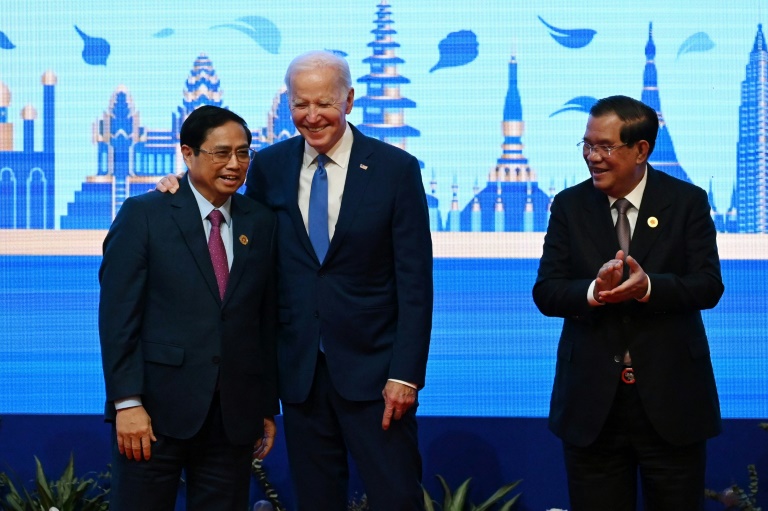
“I feel good and I’m looking forward to the next couple years,” Biden said of the result, speaking at a meeting of Southeast Asian leaders in Phnom Penh on Sunday.

Biden, due to meet Chinese President Xi Jinping on the sidelines of the G20 summit on Monday, said control of the Senate would bolster his position in the talks.

“I know I’m coming in stronger,” he said of the midterms’ impact.

One Senate race remains up in the air — a runoff in Georgia set for December 6, in which the Democrats could add to their majority.

The result in the House of Representatives still hangs in the balance, and while Republicans are slightly favored to take control, it would be with a far smaller majority than they had envisaged going into Tuesday’s election.

Senate Majority Leader Chuck Schumer was quick to ring in his party’s win, tweeting the result was a “vindication” of Democrats’ achievements. 

– Call to ‘come together’ –

Speaking minutes after the projections were announced, Schumer said the result showed Americans “soundly rejected the anti-democratic, authoritarian, nasty and divisive direction the MAGA Republicans wanted to take our country,” referring to former president Donald Trump’s “Make America Great Again” movement. 

Trump was omnipresent on the campaign trail, putting his thumb on key Republican primaries and holding rallies nationwide, during which he repeated his baseless claims of fraud in the 2020 race.

While more than 100 Republican candidates who challenged the 2020 presidential election results won their races, according to US media projections, some of Trump’s hand-picked candidates underperformed and the Republicans’ poor showing overall was a damaging political blow.

Trump is set to declare his 2024 White House bid on Tuesday — an announcement he had planned as a triumphant follow-on to an expected crushing election victory by the party he still dominates.

Maintaining control of the Senate means Biden and the Democrats will retain key leverage in legislative debates, particularly in domestic and foreign spending policy. 

Schumer underscored that the Democrats’ win would ensure a “firewall” against moves by Republicans in Congress to further curtail abortion rights — a key issue in the midterms.

But the Senator for New York also urged the two parties to “try to come together” to end “divisive negativity.”

The two parties had been neck-and-neck at 49 seats each after Democrat Mark Kelly was projected to win a tight Senate race in Arizona on Friday evening.

The former astronaut beat out challenger Blake Masters, who has not yet conceded defeat and was backed by Trump.

Trump’s response to the Arizona result was to double down on unfounded claims of ballot rigging, posting on his Truth Social platform that the Democrat’s victory was a “scam” and the result of “voter fraud.”

The underwhelming outcome for Republicans has prompted a bout of internal finger-pointing, with targets including Trump, party leaders and campaign messaging.

US media on Saturday cited a letter circulated by three Republican senators calling for the postponement of party leadership elections currently scheduled for the middle of next week.

“We are all disappointed that a Red Wave failed to materialize, and there are multiple reasons it did not,” the letter said.

“We need to have serious discussions within our conference as to why and what we can do to improve our chances in 2024,” it added.

After the Senate result was projected, Republican Senator from Missouri Josh Hawley called in a tweet for the party to “build something new.” 

“The old party is dead. Time to bury it.”
Biden to seek red lines in talks with Xi

US President Joe Biden said Sunday he will seek to establish “red lines” in America’s fraught relations with Beijing when he holds high-stakes talks with Chinese counterpart Xi Jinping.

Biden said he goes into Monday’s encounter on the sidelines of a G20 summit in Indonesia stronger after his Democratic Party’s unexpected success in midterm elections they were forecast to lose heavily.

Washington and Beijing are at loggerheads over issues ranging from trade to human rights in China’s Xinjiang region and the status of the self-ruled island of Taiwan. Biden said he expected candid talks with Xi.

“I know Xi Jinping, he knows me,” he added, saying they have always had “straightforward discussions”.

The two men have known each for more than a decade, since Biden’s time as vice-president, but Monday will see them meet face-to-face for the first time in their current roles.

“We have very little misunderstanding. We just gotta figure out what the red lines are,” Biden said.

White House officials say Biden will push China to use its influence to rein in North Korea after a record-breaking spate of missile tests sent fears soaring that the reclusive regime will soon carry out its seventh nuclear test.

Biden had a fillip overnight with the news that the Democrats retained their effective majority in the US Senate thanks to Catherine Cortez Masto winning in Nevada.

“I know I’m coming in stronger,” he said of the midterms’ impact on his talks with Xi.

– Japan, S. Korea talks –

Biden will meet his South Korean counterpart Yoon Suk-yeol and Japanese Prime Minister Fumio Kishida on Sunday to discuss ways to address the threat posed by the North’s missile programme.

China is Pyongyang’s main ally and US officials say that, while Biden will not make demands, he will warn Xi that further missile and nuclear build-up would mean the United States boosting its military presence in the region — something Beijing bitterly opposes.

“North Korea represents a threat not just to the United States, not just to (South Korea) and Japan but to peace and stability across the entire region,” US National Security Advisor Jake Sullivan told reporters.

Kim Jong Un’s regime ramped up missile launches in response to large-scale US-South Korean air exercises, which the North described as “aggressive and provocative”.

The tests included an intercontinental ballistic missile and another shorter-range projectile that crossed the de facto maritime border and landed near the South’s territorial waters for the first time since a ceasefire ended hostilities in the Korean War in 1953.

– Diplomatic blitz –

Biden flew to Phnom Penh from the COP27 climate conference as part of US efforts to boost its influence in Southeast Asia as a counter to China.

China has been flexing its muscles — through trade, diplomacy and military clout — in recent years in a region it sees as its strategic backyard.

Biden took a veiled swipe at Beijing in talks with leaders from the Association of Southeast Asian Nations (ASEAN) regional bloc.

He said the United States would work with ASEAN to “defend against the significant threats to rules-based order and threats to the rule of law”.

While the president did not refer to China by name, Washington has long criticised what it says are Beijing’s efforts to undermine international norms on everything from intellectual property to human rights.

Biden and Chinese Premier Li Keqiang were seated on either side of host, Cambodian leader Hun Sen, at a gala dinner to mark the ASEAN summit on Saturday night.

While Biden goes into the meeting with Xi buoyed by the Democrats seeing off a predicted Republican “red wave”, Xi was anointed last month for a historic third term as paramount leader by the Chinese Communist Party congress.

Li met International Monetary Fund chief Kristalina Georgieva at the ASEAN gathering on Saturday, when he also addressed participants.

Biden and Li took part Sunday in an East Asia Summit that rounds off the first leg of a trilogy of top gatherings in the region, with the G20 on the holiday island of Bali and an APEC gathering in Bangkok to follow.

The consequences of the war in Ukraine are set to dominate the upcoming talks, although Russian President Vladimir Putin will be notably absent.

'We are Ukraine': Locals joyful over Russian retreat from Kherson

Ukrainians on Saturday celebrated Russia’s retreat from Kherson, as Kyiv said it was working to de-mine the strategic southern city, record Russian crimes and restore power across the region.

Kherson was one of four regions in Ukraine that Russian President Vladimir Putin claimed to have annexed in September. 

Weeks later, the Russian retreat from the city of Kherson has boosted Ukrainian resistance after nearly nine months of fighting and hardship.

In the formerly occupied village of Pravdyne, outside Kherson, returning locals embraced their neighbours, with some unable to hold back tears.

“Victory, finally!” said Svitlana Galak, who lost her eldest daughter in the war. 

“Thank god we’ve been liberated and everything will now fall into place,” the 43-year-old told AFP.

“We are Ukraine,” added her husband, Viktor, 44.

Several disabled anti-tank mines and grenades could be seen in the settlement, which is home to a Polish Roman Catholic church, with a number of damaged buildings also visible.

Speaking from Kherson city centre, Yaroslav Yanushevych, head of the regional state administration, said everything was being done to “return normal life” to the area. 

While de-mining is carried out, a curfew has been put in place and movement in and out of the city has been limited, Yanushevych explained in a video posted to social media, in which people could be seen celebrating in the background.

Images distributed by the Ukrainian military showed Kherson residents dancing around a bonfire singing “Chervona Kalyna”, a patriotic song.

“Today, we all feel elation,” Ukrainian President Volodymyr Zelensky said on Saturday after declaring the day before that the Black Sea city was back in Kyiv’s hands.

– Evacuation orders – 

Kherson city — which serves as a gateway to the Black Sea — was the first major urban hub to fall after Russia invaded in February.

“Before fleeing Kherson, the occupiers destroyed all critical infrastructure — communication, water supply, heat, electricity,” Zelensky said, adding that nearly 2,000 explosives had been removed. 

He said that Ukraine’s forces had established control over more than 60 settlements in the Kherson region. 

After an eight-month Russian occupation, Ukrainian television resumed broadcasting in the city and the region’s energy provider said it was working to restore power supplies.

Ukraine’s police chief Igor Klymenko said around 200 officers were erecting roadblocks and recording “crimes of the Russian occupiers”.

He urged Kherson residents to watch out for possible landmines laid by the Russian troops, saying one policeman had been wounded while de-mining an administrative building.

A woman and two children were taken to hospital with injuries after an explosive device went off near their car in the village of Mylove, police said.

In Berislav district of the Kherson region, Ukrainian police said Russian shelling left “dead and wounded”, without providing further details.

Across the Dnipro River in the east, local pro-Moscow authorities in Kakhovka district issued an evacuation order to its employees to head to the Russian region of Krasnodar.

“Today, the administration is the number one terrorist attack target for Ukraine’s Armed Forces,” according to a post on an official Telegram channel. 

“This is why by order of the Kherson region government… we are moving to a more secure territory, from where we will be governing the area,” it said, referring to the Russia-installed body.

Ukraine’s Armed Forces said Saturday evening that Russian forces were currently “strengthening fortification equipment of the defensive lines on the left bank of the Dnipro”.

Kherson’s full recapture would open a gateway for Ukraine to the entire Kherson region, with access to both the Black Sea in the west and the Sea of Azov in the east.

– Nuclear hint –

On Saturday, an increasingly isolated Putin spoke by phone with Iranian President Ebrahim Raisi, pledging to intensify political and trade cooperation, the Kremlin said.

Russia’s former president Dmitry Medvedev hinted again that Moscow could use nuclear weapons.

“For reasons that are obvious to all reasonable people, Russia has not yet used its entire arsenal of possible means of destruction,” Medvedev said on messaging app Telegram.

“There is a time for everything.”

Blinken hailed the “remarkable courage” of Ukraine’s military and people and vowed US support “will continue for as long as it takes” to defeat Russia.

In London, British Defence Secretary Ben Wallace said Russia’s “strategic failure” in Kherson could prompt ordinary Russians to question the war. 

“Ordinary people of Russia must surely ask themselves: ‘What was it all for?'”

Despite the Kherson victory, Ukraine’s Foreign Minister Dmytro Kuleba warned that Russia is still “mobilising more conscripts and bringing more weapons to Ukraine” and called for the Western world’s continued support. 

The Kremlin has insisted that Kherson remains part of Russia.

“This is a subject of the Russian Federation. There are no changes in this and there cannot be changes,” spokesman Dmitry Peskov told reporters.

A Ukrainian recapture of the whole Kherson region would disrupt a land bridge for Russia between its mainland and the Crimean peninsula, which Moscow annexed in 2014.

bur-video-as/bfm/dhc/aha

Biden seeks N. Korea strategy in talks with Japan, S. Korea

US President Joe Biden will seek ways to rein in Pyongyang after its barrage of missile tests in talks with South Korean and Japanese leaders Sunday, a day before a high-stakes encounter with China’s Xi Jinping.

A record-breaking spate of launches by the North in recent weeks has sent fears soaring that the reclusive regime will soon carry out its seventh nuclear test.

The White House says Biden will press China to curb Pyongyang’s activities when he holds his first face-to-face meeting with Xi on Monday on the sidelines of a G20 summit in Indonesia.

Biden will meet his South Korean counterpart Yoon Suk-yeol and Japanese Prime Minister Fumio Kishida on Sunday to discuss ways to address the threat posed by the North’s “unlawful weapons of mass destruction and ballistic missile programs”, the White House said.

The three-way meeting on the sidelines of an East Asia Summit in Phnom Penh comes after flurry of tests by the North earlier this month, including an intercontinental ballistic missile.

Pyongyang ramped up its launches in response to large-scale US-South Korean air exercises, which the North described as “aggressive and provocative”.

Biden will use his closely watched talks with Xi on Monday to urge China to use its influence as North Korea’s main ally to press Kim Jong Un’s regime to cool down.

US National Security Advisor Jake Sullivan said the president would not make demands but would warn Xi that further missile and nuclear build-up would mean the United States boosting its military presence in the region — something Beijing bitterly opposes.

“North Korea represents a threat not just to the United States, not just to (South Korea) and Japan but to peace and stability across the entire region,” Sullivan told reporters.

– Diplomatic blitz –

Biden flew to Phnom Penh from the COP27 climate conference as part of US efforts to boost its influence in Southeast Asia as a counter to China.

China has been flexing its muscles — through trade, diplomacy and military clout — in recent years in a region it sees as its strategic backyard.

Biden took a veiled swipe at Beijing in talks with leaders from the Association of Southeast Asian Nations (ASEAN) regional bloc.

He said the United States would work with ASEAN to “defend against the significant threats to rules-based order and threats to the rule of law”.

While the president did not refer to China by name, Washington has long criticised what it says are Beijing’s efforts to undermine international norms on everything from intellectual property to human rights.

Biden and Chinese Premier Li Keqiang were seated on either side of host, Cambodian leader Hun Sen, at a gala dinner to mark the ASEAN summit on Saturday night.

Biden goes into the meeting with Xi buoyed by unexpectedly successful midterm elections at home, where his Democratic Party retained control of the US Senate and saw off predictions of a Republican “red wave”.

For his part, Xi was anointed last month for a historic third term as paramount leader by the Chinese Communist Party congress.

Li met International Monetary Fund chief Kristalina Georgieva at the ASEAN gathering on Saturday, when he also addressed participants.

Sunday’s East Asia Summit rounds off the first leg of a trilogy of summits, with the G20 on the holiday island of Bali and an APEC gathering in Bangkok to follow.

The consequences of the war in Ukraine are set to dominate the upcoming talks, although Russian President Vladimir Putin will be notably absent.

Shunned by the West over his invasion of Ukraine, Putin has despatched his veteran Foreign Minister Sergey Lavrov in his stead.

Observers will be watching for any repeat of the tit-for-tat walkouts staged by Lavrov and Western officials at meetings earlier this year.

Ukrainian President Volodymyr Zelensky is expected to attend the G20 virtually, after his request to address the ASEAN gathering was turned down.

Two WWII planes collide at Dallas air show: US aviation agency

Two World-War-II-era airplanes collided Saturday at an air show in Dallas, US authorities said, with social media footage showing the aircraft crashing into each other and hitting the ground with a fiery explosion.

It was not immediately clear how many people were in the two craft, a Boeing B-17 Flying Fortress and a smaller Bell P-63 Kingcobra, the Federal Aviation Administration said. 

Nor was it clear whether anyone survived the early afternoon crash, which occurred during the Wings Over Dallas Airshow at Dallas Executive Airport.

While the number of casualties was not immediately known, “no spectators or others on the ground were reported injured,” Dallas Mayor Eric Johnson tweeted.

Multiple videos posted on social media showed dramatic scenes of the smaller plane descending towards the lower-flying B-17, crashing into it. 

After the collision, the planes appeared to break up into several large pieces before crashing into the ground and exploding in a ball of fire, creating a huge plume of black smoke.

The crash scattered debris across the airport grounds as well as on a nearby highway and strip mall, Johnson said.

The FAA said its agents and the National Transportation Safety Board would investigate the incident.

“As many of you have now seen, we have had a terrible tragedy in our city today during an airshow. Many details remain unknown or unconfirmed at this time,” Johnson said.

The B-17, a four-engined bomber, played a major role in winning the air war against Germany in World War II. With a workhorse reputation, it became one of the most produced bombers ever.

The P-63 Kingcobra was a fighter aircraft developed during the same war by Bell Aircraft but it was used in combat only by the Soviet Air Force. 

One of the last major crashes of a B-17 was on October 2, 2019, when seven people died in an accident at an airport in Windsor Locks, Connecticut.

US Democrats maintain Senate majority

President Joe Biden’s Democrats retained control of the US Senate on Saturday, a remarkable midterms election result that defied predictions of a Republican win over both houses of Congress.

Midterms traditionally deliver a rejection of the party in power, and with inflation surging and Biden’s popularity in the doldrums, Republicans had been expecting to ride a mighty “red wave” and capture the Senate and the House of Representatives.

But the wave never got much beyond a ripple and on Saturday US networks called the key Senate race in Nevada for Democrat incumbent Catherine Cortez Masto, giving the party the 50 seats it needs for an effective majority. 

The win clinches Democratic control in the Senate as Vice President Kamala Harris can cast the tie-breaking vote if the upper chamber is evenly split 50-50.

One Senate race remains up in the air — a runoff in Georgia set for December.

The two parties had been neck-and-neck at 49 seats each after Democrat Mark Kelly was projected to win a tight Senate race in Arizona on Friday evening. 

The result in the House of Representatives is also hanging in the balance, and while Republicans are slightly favored to take control, it would be with a far smaller majority than they had envisaged going into Tuesday’s election.

– Call for unity –

In Arizona, Kelly called for unity in a victory speech on Saturday.

“After a long election, it can be tempting to remain focused on the things that divide us,” he said.

“But we’ve seen the consequences that come when leaders refuse to accept the truth and focus more on conspiracies of the past than solving the challenges that we face today.” 

The former astronaut beat out challenger Blake Masters, who has not yet conceded defeat and was backed by Donald Trump. 

The former president was omnipresent on the campaign trail and the Republicans’ poor national performance was a damaging political blow. 

Trump’s response to the Arizona result was to double down on unfounded claims of ballot rigging, posting on his Truth Social platform that the Democrat’s victory was a “scam” and the result of “voter fraud.”

Trump is set to declare his 2024 White House bid on Tuesday — an announcement he had planned as a triumphant follow-on to an expected crushing election victory by the party he still dominates.

The underwhelming outcome has prompted a bout of internal finger-pointing, with targets including Trump, the party leaders, and the campaign messaging.

US media on Saturday cited a letter circulated by three Republican senators calling for the postponement of party leadership elections currently scheduled for the middle of next week.

“We are all disappointed that a Red Wave failed to materialize, and there are multiple reasons it did not,” the letter said.

“We need to have serious discussions within our conference as to why and what we can do to improve our chances in 2024,” it added.

Some suggest Trump’s early entry into the presidential race is designed to fend off possible criminal charges arising from multiple investigations into the final weeks of his presidency as well as his business affairs.

On Friday, Trump’s lawyers challenged a subpoena from the Congressional committee investigating the January 6 attack on the US Capitol by his supporters.

The subpoena sought to have Trump questioned under oath next week but the lawyers filed a lawsuit arguing he enjoyed “absolute immunity” as a former president from being compelled to testify before Congress.

The subpoena is “invalid, unlawful, and unenforceable,” the lawsuit said.

FTX working to secure assets after 'unauthorized' transactions

The new CEO of troubled cryptocurrency platform FTX said Saturday the company was making “every effort to secure all assets” following unauthorized transactions potentially worth hundreds of thousands of dollars.

“Unauthorized access to certain assets has occurred,” CEO John Ray said in a statement posted to Twitter by FTX’s general counsel, Ryne Miller.

FTX officials did not detail the quantity of unauthorized transactions made, but cryptocurrency analysis firm Elliptic said in a report published Saturday that “$477 million is suspected to have been stolen.”

More than “$663 million in various tokens” had been drained from FTX’s wallets only 24 hours after it filed for bankruptcy, Elliptic said, with the difference “believed to have been moved into secure storage by FTX themselves.”

FTX US and FTX.com “continue to make every effort to secure all assets, wherever located,” Ray, who specializes in corporate turnarounds, said in the statement.

The announcement comes a day after FTX filed for bankruptcy, part of a stunning collapse that has reverberated through the relatively young sector, sending other cryptocurrencies plummeting and drawing scrutiny from government regulators.

Additionally, the platform’s chief executive, 30-year-old Sam Bankman-Fried, once considered a star in the freewheeling cryptocurrency world, resigned.

As recently as 10 days ago, FTX was considered the world’s second-largest cryptocurrency platform, at one point valued at $32 billion.

But the company is now left trying to reassure a skeptical public.

– Fall from grace –

“Among other things, we are in the process of removing trading and withdrawal functionality and moving as many digital assets as can be identified to a new cold wallet custodian,” Ray said in the statement.

“Cold storage” refers to moving cryptocurrency assets to a hardware “wallet” unconnected to the Internet — to assure its security. 

Ray added that “an active fact review and mitigation exercise was initiated immediately in response” to the unauthorized transactions.

Overnight, Miller had tweeted about an investigation into anomalies and other unclear movements, and by Saturday morning indicated that “unauthorized transactions” had occurred.

FTX’s troubles first surfaced amid press reports that its Alameda Research trading house was involved in a risky financial arrangement with FTX.com that appeared to involve grave conflicts of interest. 

Financial media reported that FTX executives knew the platform was using billions in customer funds to prop up Alameda.

Adding to the drama, Binance, the world’s largest crypto exchange, agreed to buy FTX.com on Tuesday — before scrapping the takeover just a day later. 

FTX is being investigated by both the US Securities and Exchange Commission (SEC) and the New York state Justice Department, according to the New York Times, which cited sources close to those probes.

The fall from grace even stretched to the world of sports, where the Miami Heat announced its FTX Arena is set for a rename and the Mercedes Formula One team said it had suspended a sponsorship deal with FTX and removed the company’s logos from its cars ahead of this weekend’s Sao Paulo Grand Prix.

FTX working to secure assets after 'unauthorized' transactions

The new CEO of troubled cryptocurrency platform FTX said Saturday the company was making “every effort to secure all assets” following unauthorized transactions potentially worth hundreds of thousands of dollars.

“Unauthorized access to certain assets has occurred,” CEO John Ray said in a statement posted to Twitter by FTX’s general counsel, Ryne Miller.

FTX officials did not detail the quantity of unauthorized transactions made, but cryptocurrency analysis firm Elliptic said in a report published Saturday that “$477 million is suspected to have been stolen.”

More than “$663 million in various tokens” had been drained from FTX’s wallets only 24 hours after it filed for bankruptcy, Elliptic said, with the difference “believed to have been moved into secure storage by FTX themselves.”

FTX US and FTX.com “continue to make every effort to secure all assets, wherever located,” Ray, who specializes in corporate turnarounds, said in the statement.

The announcement comes a day after FTX filed for bankruptcy, part of a stunning collapse that has reverberated through the relatively young sector, sending other cryptocurrencies plummeting and drawing scrutiny from government regulators.

Additionally, the platform’s chief executive, 30-year-old Sam Bankman-Fried, once considered a star in the freewheeling cryptocurrency world, resigned.

As recently as 10 days ago, FTX was considered the world’s second-largest cryptocurrency platform, at one point valued at $32 billion.

But the company is now left trying to reassure a skeptical public.

– Fall from grace –

“Among other things, we are in the process of removing trading and withdrawal functionality and moving as many digital assets as can be identified to a new cold wallet custodian,” Ray said in the statement.

“Cold storage” refers to moving cryptocurrency assets to a hardware “wallet” unconnected to the Internet — to assure its security. 

Ray added that “an active fact review and mitigation exercise was initiated immediately in response” to the unauthorized transactions.

Overnight, Miller had tweeted about an investigation into anomalies and other unclear movements, and by Saturday morning indicated that “unauthorized transactions” had occurred.

FTX’s troubles first surfaced amid press reports that its Alameda Research trading house was involved in a risky financial arrangement with FTX.com that appeared to involve grave conflicts of interest. 

Financial media reported that FTX executives knew the platform was using billions in customer funds to prop up Alameda.

Adding to the drama, Binance, the world’s largest crypto exchange, agreed to buy FTX.com on Tuesday — before scrapping the takeover just a day later. 

FTX is being investigated by both the US Securities and Exchange Commission (SEC) and the New York state Justice Department, according to the New York Times, which cited sources close to those probes.

The fall from grace even stretched to the world of sports, where the Miami Heat announced its FTX Arena is set for a rename and the Mercedes Formula One team said it had suspended a sponsorship deal with FTX and removed the company’s logos from its cars ahead of this weekend’s Sao Paulo Grand Prix.

Making New York – new play tells tale of ruthless powerbroker

Was he a visionary or a corrupt racist with a god complex? The troubled legacy of Robert Moses, the master builder who shaped New York, comes under scrutiny this fall in a new play starring Ralph Fiennes.

Robert Moses was an urban planner who, despite never holding elected office, launched building projects in the early 20th century which transformed New York and inspired cities across the United States. 

While his vision lives on in New York’s vast network of parks, roads and bridges, Moses’ name became synonymous with the racist undertones of “urban renewal.” 

The city’s ambivalence about Moses gets a fresh airing in “Straight Line Crazy,” a two-act dramatization of Moses’ decades-long tenure atop the New York power jungle.

Fiennes depicts a Moses who cajoles politicians, outmaneuvers opponents, and shrugs off doubters in his insatiable quest to fulfill his ambitious vision for the city. 

“Our job is to lead, not to follow,” Moses tells an underling who worries about pleasing the public. “People don’t know what they want until they have it.”

– Corruption of power? –

Written by the British playwright David Hare, “Straight Line Crazy” was originally presented in London.

It marks the latest effort to reckon with Moses, who amassed unparalleled authority from holding posts on as many as a dozen municipal bodies simultaneously in a career that spanned four decades.

Moses was celebrated for much of his professional life for his building projects and the leading role he played in bringing the United Nations to New York and in developing the Lincoln Center.

But in 1974, the journalist Robert Caro lifted the veil on the underside of Moses’ imperial-like reign in a book that won the Pulitzer Prize.

He depicted him as a ruthless and corrupt dictator who held grudges, smeared opponents and hoodwinked allies while running a municipal machine of monumental proportions.  

Caro exposed how Moses marshaled massive public funds to favor suburban elites.

Poorer, non-white communities were displaced from condemned neighborhoods and suffered from Moses’ lack of support for public transit as he promoted mammoth highway projects that championed the car.

Hare has called Caro the authoritative expert on Moses, but views his subject differently.

“Caro believes that… what corrupted Moses was power and that he became sort of crazed with power,” Hare said at a panel discussion at The Shed theater, where the show runs through December 18. 

However, Hare believes his life “was about pursuit of an idea that was too rigid.”

Compared with Caro’s monster-like figure, the play humanizes Moses, while still zeroing in on significant character flaws.

Dan Doctoroff, a former deputy mayor for economic development and rebuilding and a board member of the Shed, said Moses’ story offers some clues for policy makers on how to tackle ambitious projects, such as the need to back up a vision with detailed plans.

“He did magnificent things. He did terrible things, and the reality is you’re never going to get everything right,” Doctoroff said during the panel conversation. “But at the end of the day, his disdain for the common person tarnishes the legacy forever.” 

– What ‘democracy couldn’t deliver’ –

The play, based on real events but with invented dialogue and some fictionalized characters, spotlights two moments in Moses’ career, riffing on a rise-and-fall narrative arc.

In the first act, he casually flouts governance norms as he outwits Long Island gentry to push through the construction of the Jones Beach State Park in 1926.

However, Moses meets his match in the second act, when grassroots opponents mobilize in 1955 to ultimately derail his plan for an expressway in lower Manhattan.

A longtime aide warns of waning patience with Moses’ autocratic style and calls out his favoritism of “clean people… well-off people… white people.”

But Moses says he knows that “people may not like me, but they need me.”

“Now, of course, it’s suddenly fashionable to dislike me, because I’m the dirty bastard who pushed through the things democracy needed but which democracy couldn’t deliver.” 

GMO skeptics still distrust big agriculture's climate pitch

As a changing climate intensifies extreme weather, agricultural multinationals are hyping the ability of genetically modified crops to boost yields when facing drought, heat or even heavy rainfall.

But skeptics of engineered foods, or genetically modified organisms (GMOs), still aren’t buying it.

“I don’t see why we should evolve our views when they’re still doing the same things,” said Bill Freese, science director at the non-profit Center for Food Safety, criticizing the “dramatically increased toxic herbicide use” following the proliferation of GMOs.

Seeds designed to thrive in specific local conditions have been developed for centuries through conventional breeding, by crossing together plants with relevant characteristics and selecting the desired offspring.

But as more severe weather creates hostile growing conditions for conventional seeds, companies such as Bayer/Monsanto, Corteva and Syngenta are promoting GMOs as more efficient.

And newer technologies can reduce development times for these heartier varieties “by many years” compared with traditional crop modification techniques, according to a spokesperson for Germany’s Bayer.

“Drought tolerance is a complex trait involving many genes,” the spokesperson said. “Therefore, the ability to develop drought-tolerant traits through classic breeding methods such as crossbreeding is limited.”

Longtime GMO critics say they are open to new approaches but are not sold on the latest industry pitch, viewing conventional seed products as safer and with fewer environmental drawbacks.

“How many times have we read that we won’t be able to feed the world by 2050 unless we have GMOs?” said Freese, referring to the argument of GMO proponents that genetically modified crops will be necessary to produce enough food for a growing population on a warming planet. 

But for Freese, that  claim is “just a really effective smoke screen put on by the pesticide and seeds conglomerates to put a good face on this new technology.”

US company Corteva said it, too, is focused on “new breeding technologies such as gene editing” to “take advantage of the genetic diversity that already exists within the plant’s DNA” when it comes to creating new seed types. 

Such GMO products can help normalize a crop’s performance, even if extreme moisture from rain or flooding promotes the spread of fungus or pests, companies say.

In July, the World Economic Forum highlighted the potential for GMOs to help reduce greenhouse gas emissions by creating breeds that remove more carbon dioxide than conventionally grown crops.

– Safety, environmental concerns –

Many American growers favor GMO options because, while more costly, they require less human labor, Freese said.

More than 90 percent of the corn, cotton and soybeans grown in the United States is currently genetically modified to withstand herbicides and/or insects, according to US government figures.

Farmers have been growing corn meant to tolerate drought since 2011. Whether or not this trait is acheived with traditional breeding or with GMO seeds, the resulting plants are then usually combined with GMOs that can withstand herbicides.

“They told us in the ’70s and ’80s that GMOs were going to be more nutritious, fix the nitrogen level, withstand everything,” said Michael Hansen, a senior scientist at Consumer Reports. “What did we see? Mainly herbicide-tolerant crops.” 

Dana Perls, senior food and agricultural program manager at environmental network Friends of the Earth, said GMOs “go hand in hand with harsh chemicals that perpetuate pesticide pollution,” harming insect populations, soil health and water quality.

Perls acknowledged “incredible advances” in mapping and manipulating genetic material, but said scientists “are still quite limited in our understanding of the functioning of the incredible complexity of life, both within a single organism and within ecosystems.” 

For now, she advocates for regulatory oversight of new GMO technology “rooted in a precautionary approach.”

Andrew Smith of Rodale Institute said using GMOs to help crops withstand droughts and other extreme conditions is “nearsighted” unless the health of the soil is ensured.

Smith favors agricultural practices such as rotating crops, limiting chemical inputs and reducing soil tillage. Such techniques, known as regenerative agriculture, leads to healthier soil able to retain more water. 

“It’s a strategy to mitigate climate change,” said Smith.

Close Bitnami banner
Bitnami