US Business

'Make my voice heard' — voters line up across US

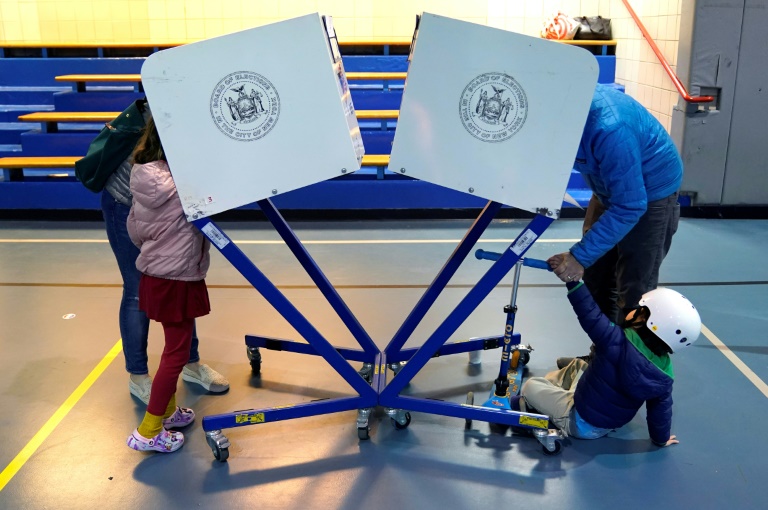
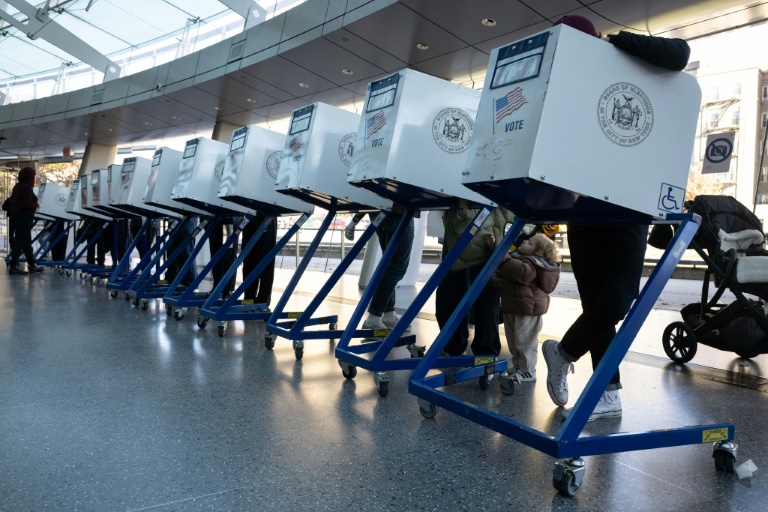
At polling stations across the United States on Tuesday — in schools, town halls and libraries — lines formed quietly from before dawn.

Voters said a range of concerns motivated them to cast a ballot in the midterm elections, from key campaign issues such as abortion to broad disdain for the political climate.

Their choices, along with those of millions who already voted by mail or early in-person, will decide the control of US Congress, as well as many governorships, state legislatures and local offices.

Here’s what voters said drew them to the polls.

– Democratic duty –

“I’ve tried to come first, make sure that I do my part, and then I can get to work,” said Robin Ghirdar, coffee in hand at a voting site in Pittsburgh, Pennsylvania.

“There’s so much polarization and misinformation that I’d like to make sure that my voice is heard.”

In Union City, a majority Black suburb of Atlanta, Georgia, 26-year-old attorney Kuanna Harris said history pulled her to the voting booth.

“A bunch of my ancestors, whether they were Black or women, were not able to vote, so I think God put me here at this particular time to carry on that torch for them.”

At a polling site in Brooklyn, New York, retired police officer Kevin Flynn voted because of “the situation that happened on January 6th” 2021, when Donald Trump supporters stormed the US Capitol.

“Once an officer, always an officer… officers got injured,” in the assault, said the 60-year-old. “It needs to be rectified…bottom line.”

Voter Donald Newton, 82, told AFP in Arizona’s capital Phoenix, that he believes Trump’s claims of massive election fraud are the “truth.”

“There’s a movie out there called 2000 mules,” said Newton, referencing a documentary alleging a conspiracy of hacked voting machines in 2020.

“It explains it all. And if you go and watch that, you’ll be convinced this is the truth of what happened there: it was stolen, the election.”

In contrast, 30-year-old lawyer Alexandra Ashley, in Pittsburgh, said that “some people are trying to undermine democracy. And it’s something that we can’t lose.”

And Susan Kwushue, a 50-year-old healthcare provider in Georgia, said having now voted, she knew she “contributed in my own little way by voting to make sure that things get better.”

– Abortion rights –

Reproductive rights are a banner issue for many voters, after the US Supreme Court overturned the right to abortion.

In Brooklyn, sustainability consultant Helen Rubenstein said that her motivation for voting was “first and foremost, my female reproductive rights, which are a healthcare issue.”

Phoenix voter Mona Sablan, 56, said that for abortion, “it’s the decision for the woman.”

“I don’t think the state — I don’t think the local, (or) federal (government) should have anything to say about this.”

– Political change –

With growing political fissures in the United States, some voters said they are fed up of the hostility.

In Brooklyn, 39-year-old software engineer Quonn Bernard says “some candidates that have been up for office recently are into mud slinging and negative campaigning.”

“I just don’t want those people representing me at the highest levels.”

Analysts have also warned of the threat of violence around the elections.

One 64-year-old voter in McAllen, a city in Texas along the US border with Mexico, said he hopes that there will not be a repeat of 2020.

“My expectation is that everybody act civilized, that… all the parties accept their winnings or defeats and that we all act as a country,” said Enrique Ayala.

Court orders striking Kenya Airways pilots back to work

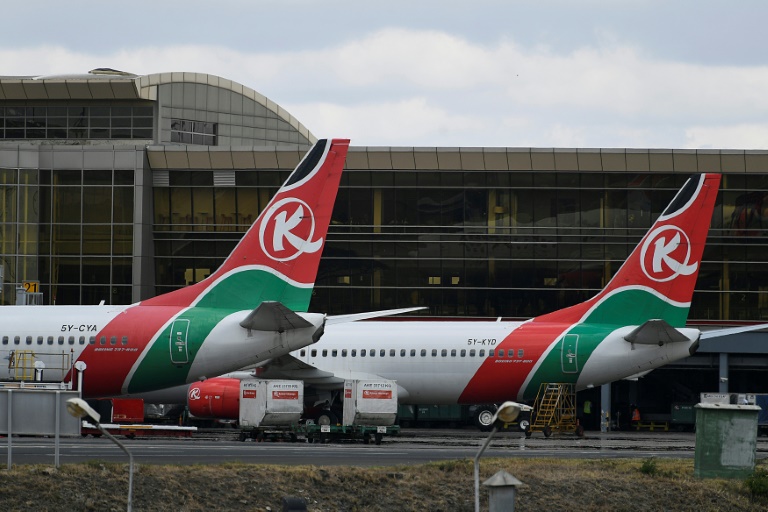
A Nairobi court has ordered striking Kenya Airways pilots to return to work by Wednesday morning, a breakthrough for the beleaguered carrier after the days-long walkout forced flight cancellations and left thousands of passengers stranded.

The Kenya Airline Pilots Association (KALPA) launched the strike at Nairobi’s Jomo Kenyatta International Airport on Saturday, defying a court order issued last week against the industrial action.

Justice Anna Mwaure on Tuesday ordered “the Kenya Airways pilots to resume their duties as pilots by 6:00 am on 9th November 2022 unconditionally”.

The walkout has exacerbated the woes facing the troubled national carrier, which has been running losses for years, despite the government pumping in millions of dollars to keep it afloat.

There was no immediate response from KALPA to the court order, which was welcomed by the airline’s management who vowed to intensify efforts to “recover the time, money and reputation lost”.

The carrier on Monday announced that it was ending its recognition of the union and withdrawing from their collective bargaining deal, accusing KALPA of “exposing the airline to irreparable damage”.

Mwaure said the court would now consider the issue and ordered the airline’s management to allow the pilots “to perform their duties without harassing them or intimidating them and especially by not taking any disciplinary action against any of them”.

In a statement released Tuesday evening, the airline’s CEO Allan Kilavuka said: “We commit to complying with the Court’s directions.”

The carrier had earlier said that the strike had forced it to cancel most of its flights but Kilavuka vowed that the airline would “do everything possible to return to normalcy in the shortest time”.

Kenya Airways, which is part owned by the government as well as Air France-KLM, is one of the biggest in Africa, connecting multiple countries to Europe and Asia. 

The dispute has added to the challenges facing Kenya’s recently elected government, with Transport Minister Kipchumba Murkomen on Sunday threatening the pilots with disciplinary action unless they returned to work.

Mwaure had summoned KALPA officials to appear in court on Tuesday for disobeying last week’s injunction against the strike.

– ‘Economic sabotage’ –

The airline and the government have accused the union of engaging in “economic sabotage”, with Kenya Airways warning that the strike would lead to losses estimated at $2.5 million per day.

“Due to this unlawful action by KALPA, the customers of KQ both locally and globally have suffered and continue to suffer immeasurable inconvenience and losses,” Kenya Airways said in a statement Monday using the shorthand airline code.

On Sunday, the airline said 56 flights had been cancelled due to the strike, disrupting 12,000 passengers’ plans.

The pilots in turn have accused the airline’s management of making “no concessions” to end the stalemate.

The protesting pilots, who make up 10 percent of the workforce, are pressing for the reinstatement of contributions to a provident fund and payment of all salaries stopped during the Covid-19 pandemic.

It was founded in 1977 following the demise of East African Airways, and flies more than four million passengers to 42 destinations annually.

It has been operating in large part thanks to state bailouts following years of losses.

Powerball jackpot grows to record $2.3 bn in US

The US Powerball jackpot grew to a mind-boggling $2.3 billion Tuesday -– the largest prize in world history -– leaving countless Americans clinging to hope of winning big.

There were no winners in Monday’s drawing, Powerball USA announced on Twitter Tuesday morning, soon after a delayed drawing took place.

The drawing was postponed after a participating lottery needed more time to complete security protocols due to high demand for tickets.

Powerball tickets are sold in nearly all states — 45 of 50 — as well as Washington DC, the US Virgin Islands and Puerto Rico.

The last time someone claimed the Powerball jackpot was August 3, when a lucky ticket holder in Pennsylvania raked in an estimated $206.9 million. 

Since then, 40 consecutive draws have produced no winner, and the Powerball jackpot has grown and grown.

The latest winnerless drawing for a prize of $1.9 billion actually came out to a final figure of $2.04 billion following massive ticket demand.

Tickets cost $2 and a winner can choose either a lump sum payment, calculated for the next drawing at $1.124 billion, or opt to be paid in installments over 29 years.

Most winners choose the lump sum payout.

The next drawing will occur Wednesday evening.

Smart farming tech offers sprout of hope in Greece

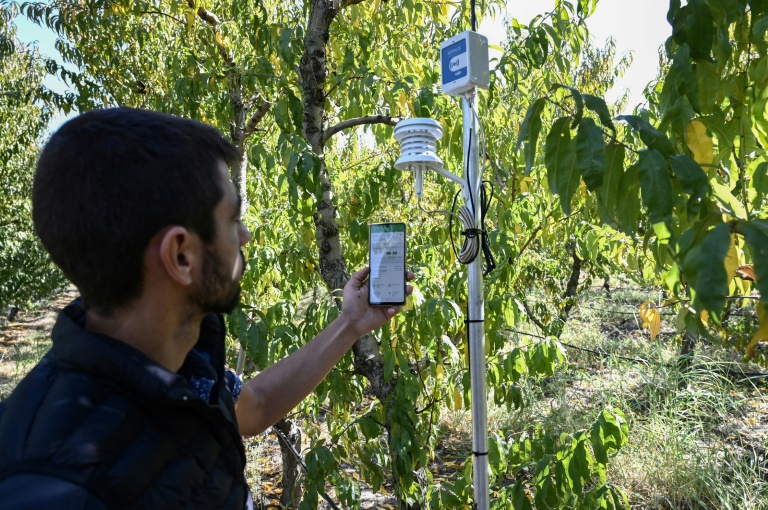
Eyes glued to his mobile phone, farmer Sotiris Mournos pores over the latest microclimate and humidity data about his fields on the plain of Imathia in northern Greece.

The high-tech farming techniques he uses are making slow progress in Greece’s tradition-bound and struggling agricultural sector, but growers like him see them as key to their future. 

Mournos, 25, employs a Greek smart-farming app to boost production of his family’s cotton fields and fruit trees.

Using real-time data recorded by a weather station, he can analyse and correlate the impact of weather conditions on his 10-hectare (nearly 25-acre) cotton plantation.

“We’ve managed to reduce the use of fertiliser and irrigation… (and thereby to) increase the financial return” of the farm, said Mournos, who gave up studying computer science at university to devote himself to the family holding in the town of Platy. 

Measuring the humidity or the nitrogen level in the soil helps to curb the excessive use of fertilisers and saves water, he notes.

As in many other southern European countries, Greece’s agricultural sector is chronically short of water and smart farming could help deal with that problem.

– Boosting yields –

The sector has also lost a major share of its available labour in recent decades, as young people snub farm work for better-paid jobs in services such as tourism.

Agriculture now represents just five percent of Greece’s GDP, half what it was 20 years ago. 

The government has budgeted 230 million euros ($231 million) over the next three years to revive the country’s farming industry.

Most of that derives from the European Union’s Common Agricultural Policy innovation fund. 

“Most young people in my village prefer other jobs and have given up working in the fields,” Mournos told AFP. 

But he is making a go at farming, aiming to work smart by using the farming app for several years now.

It means he uses 40 percent less fertiliser on his cotton field and can avoid using two pesticide sprays — altogether saving 9,000 euros (about $9,000) — without affecting production rates. 

Analysts say the farming app is not widely used in Greece although interest is gradually picking up.

But persuading farmers who may be less technologically minded than Mournos to embrace it faces myriad challenges.

A key hurdle is the small size of Greek farms — less than 10 hectares on average — and the country’s largely mountainous terrain.

Greek farms are often family businesses or involve rented fields, making investment in tools and practices less appealing.

– Convincing farmers –

Meanwhile, an “endemic” lack of cooperation among farmers prevents them sharing costs, says Aikaterini Kasimati, an agricultural engineer at the University of Agronomy in Athens.

As a result, Greece lags far behind other European states in the use of smart farming, says Vassilis Protonotarios, marketing manager of Neuropublic, a company specialising in digital agriculture.

He said farmers could benefit from new technology without having to invest in expensive equipment or have “specialised digital skills”.

Then, there is the difficulty of convincing farmers to try something new.

Organic farmer Thodoris Arvanitis says his colleagues are not interested in new technologies because they don’t know enough about them and prefer long-used conventional methods. 

“Farmers won’t go after technology when they don’t have enough money for fuel,” he added, at his farm in the small town of Kiourka, some 30 kilometres (nearly 20 miles) north of Athens.

Attitudes may change in time as climate change puts additional pressure on farm costs, says Machi Symeonidou, an agronomist and creator of the agricultural IT startup Agroapps. 

The war in Ukraine and its impact on global food supplies also shows that it is increasingly necessary to produce food at a local level, said agricultural engineer Kasimati. 

“We see a constant degradation of fields and a fall in yield,” she said, adding that water was also becoming expensive.

“But as the technology becomes simpler and cheaper, these tools will see more use,” she added.

Biden agenda at stake — and Trump in the wings — as Americans vote

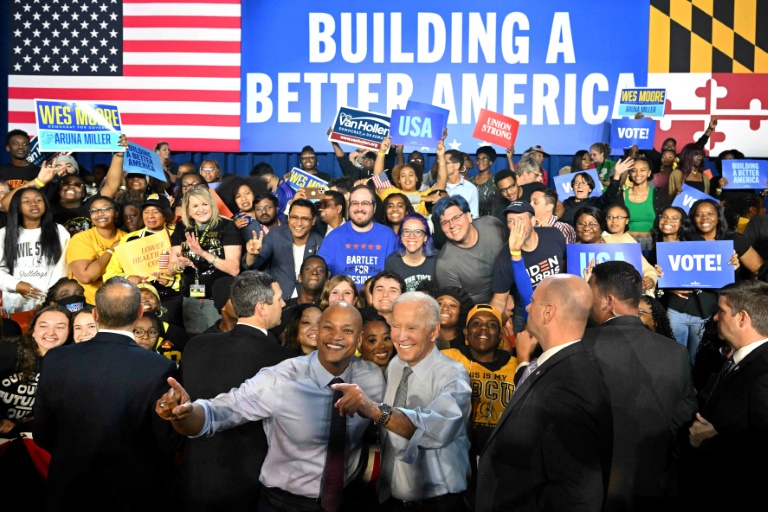
Americans headed to the polls on Tuesday in midterm elections in which Republicans are chasing a congressional majority that would paralyze President Joe Biden’s agenda and serve as a springboard for another White House run by Donald Trump.

Biden’s Democrats are facing a gargantuan struggle to hang on to Congress, after a race the president has cast as a “defining” moment for US democracy — while Trump’s Republicans campaigned hard on kitchen-table issues like inflation and crime.

“It’s Election Day, America,” the 79-year-old Biden tweeted as polling stations opened on the East Coast. “Make your voice heard today. Vote.”

At stake are all 435 seats in the House of Representatives, one-third of the Senate and a slew of state and local positions. Five states are holding referendums on abortion — California, Vermont, Kentucky, Montana and Michigan.

First results will begin trickling in after 7:00 pm (0000 GMT) but with razor-thin margins in some key congressional races a full picture may not be available for days or even weeks, setting the stage for likely acrimonious challenges.

The bitter political divide in the country was on the minds of many voters as they cast their ballots.

“I hope that we’ll get a better mix of candidates and that both sides can actually work together to solve our issues instead of fighting against one another,” said Sarah Hunt, a 41-year-old teacher as she cast her ballot in New York.

“There’s so much polarization and misinformation that I’d like to make sure that my voice is heard,” said Robin Girdhar, a 61-year-old doctor at a polling station in Pittsburgh, Pennsylvania.

Trump — who has all but announced he will seek the White House again in 2024 — grabbed the election eve spotlight to flag “a big announcement” on November 15, while Biden made a final appeal to Democrats to turn out en masse.

“The power’s in your hands,” Biden told a rally near the capital. “We know in our bones that our democracy is at risk and we know that this is your moment to defend it.”

Polls show Republicans in line to seize the House, which would allow them to snarl the rest of Biden’s first term in aggressive investigations and opposition to spending plans.

– ‘Giant red wave’ –

Returning to the White House Monday night, Biden told reporters he believed Democrats would hold on to the Senate but it would be “tough” to retain the House and his life in Washington may become “more difficult.”

If both the House and Senate flip, Biden would be left as little more than a lame duck and his legislative agenda would be frozen. 

That would raise questions over everything from climate crisis policies, which the president will be laying out at the COP27 conference in Egypt this week, to Ukraine, where Republicans are reluctant to maintain the current rate of US financial and military support.

An influx of far-right Trump backers in Congress would also accelerate the shift that has been taking place inside the Republican Party since the former real estate tycoon stunned the world by defeating Hillary Clinton for the presidency in 2016.

Despite facing criminal probes over taking top secret documents from the White House and trying to overturn the 2020 election, Trump has been using the midterms to cement his status as the de facto Republican leader and presumptive presidential nominee.

In a typically dark, rambling speech to supporters in Dayton, Ohio, the 76-year-old Trump said, “if you support the decline and fall of America, then you must, you absolutely must vote for the radical left, crazy people.”

“If you want to stop the destruction of our country, then tomorrow you must vote Republican in a giant red wave,” he said — before teasing his 2024 announcement.

Across the country voters called on their fellow citizens to cast their ballot in the midterms, which historically have low turnout.

“Vote, vote, vote,” Luke Osuagwu, a 24-year-old student, told AFP in Atlanta, Georgia.

“Abortion is probably the biggest issue for me,” said Alexandra Ashley, a 30-year-old lawyer as she cast her vote in Pittsburgh. “I want to make sure it’s available for everybody and safe.”

– 44 million early votes –

More than 44 million ballots were cast through early voting options, meaning the outcome had already begun to take shape before election day.

Senate races in Pennsylvania, Nevada, Arizona, Georgia, Wisconsin, New Hampshire and Ohio are expected to be close and any one of them could swing the balance of power in the chamber.

Trump has already claimed — baselessly — that swing state Pennsylvania “rigged” the midterms — reprising his playbook from the 2020 election which he falsely asserted was stolen by Biden.

Citing growing support for voter conspiracy theories among Trump and his Republicans, as well as their push to curb abortion access, Biden has warned that democracy and basic rights are at stake on Tuesday.

Republicans have countered that a vote for Democrats means more soaring inflation and rising violent crime, seeking to make the midterms a referendum on the president.

The outcome will likely determine whether Biden, who turns 80 this month and is the oldest president ever, will seek a second term in 2024 — or step aside.

S.Africa slams 'out of reach' climate aid for poorer nations

South Africa’s president, whose coal-dependent country is among the world’s top polluters, Tuesday criticised international funders for making it difficult for poorer nations to access aid to fight climate change.

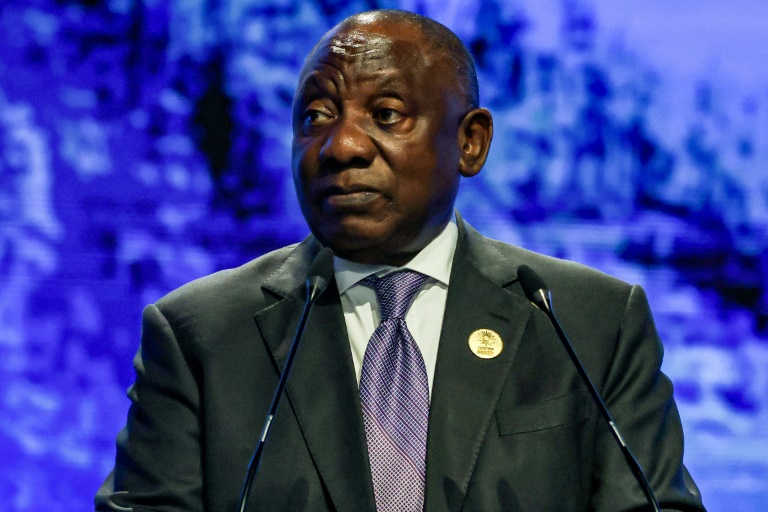
Support from multilateral organisations “is out of reach of the majority of the world’s population due to lending policies that are risk-averse and carry onerous costs as well as conditionalities,” Cyril Ramaphosa told the UN COP27 climate summit.

Addressing the meeting in Egypt’s Sharm el-Sheikh, he said “funding institutions need to transform … the way in which they fund projects that will enable us to develop with regard to climate change”.

According to a UN-backed report released Tuesday, developing countries and emerging economies need investments well beyond $2 trillion annually by 2030 if the world is to stop the global warming juggernaut.

South Africa, one of the world’s top 12 polluters, last week revealed that it will require about $98 billion over the next five years to transition to net zero.

Last year, at the COP26 in Glasgow, Pretoria secured $8.5 billion in loans and grants from a group of rich countries towards its green transition — very little of which is grant funding.

“We found in the end that only 2.7 percent was grant money, other portions were concessional loans …offered by development funding institutions as well as normal commercial institutions,” Ramaphosa told a news conference after his address.

He called on rich nations to honour their commitments “because failing to honour these commitments breaks trust and confidence in the process”.

“More industrialised countries need to live up to the commitments they have made, knowing fully well that they have, through the development of their own economies, contributed a great deal more to the damage that many countries on our continent now labour under,” he told reporters.

The head of state assured the summit that South Africa, which generates about 80 percent of its electricity through coal, was on course to retire several of its ageing coal-fired power plants in the next eight years.

The World Bank last week granted South Africa $497 million to decommission one of its largest coal-fired power plants and promote renewable energy.

“Because South Africa already carries a fairly sizeable loan burden that it has to service … we require more grant funding” Ramaphosa said.

South Africa will require at least $500 billion dollars to achieve carbon neutrality by 2050, according to the bank.

burs-zam/sn/fz

Renault unveils sweeping overhaul for electric future

French automaker Renault unveiled a sweeping overhaul on Tuesday in a bid to attract investors as it expands its electric vehicle business amid an accelerating market.

Under the green revamp, Renault is to split its operations in two, with a new electric vehicle unit and a subsidiary for petrol, diesel and hybrid cars that will pair up with China’s Geely. 

The carmaker’s flagship division following the reorganisation will be Ampere, which aims to produce a million electric vehicles by 2031, the group said ahead of an investor day in Paris.

The new division will employ around 10,000 staff in France.

Renault is the latest automaker seeking to finance a shift towards electric.

The market for the greener vehicles is expected to grow rapidly in response to consumers’ worries about climate change, putting pressure on manufacturers to develop less polluting products.

The European Union last month agreed to phase out new CO2-emitting vehicles by 2035, a move set to turbo-charge the production of electric prototypes on the continent.

Renault follows the likes of US automaker Ford and Germany’s Volkswagen.

The latter launched its premium sports brand Porsche on the stock market in September to finance its investment in electric, connected and autonomous cars.

Ampere will produce the new Renault 5 and Renault 4 among other models in northern France and will target more than 30-percent growth annually over the next eight years and to break even by 2025.

Renault said it would list Ampere on the Euronext Paris stock exchange in the latter half of 2023 and invite investment but will retain “a strong majority”.

The group — in which the French state and carmaker Nissan each own 15 percent — has still to outline the part that its Japanese partner will play in the new electric division.

– Financing electric drive – 

For hybrid and internal-combustion vehicles, Renault plans to combine its technological, manufacturing and research and development activities with Chinese automaker Geely.

The 50-50 partnership with the Chinese group — owner of Volvo — will develop and produce engines, gear boxes and other components for hybrid and petrol and diesel vehicles.

Volvo Cars said separately it will cede its stake in its internal combustion engine partnership with Geely, which will be folded into the partnership with Renault that will be called “Horse”.

It will employ 19,000 people across Europe, China and South America, and have 17 factories and five research and development centres.

Turnover for the division is expected to grow by four percent by 2027, the group said.

“We are designing an agile and innovative organisation to manage the volatility and accelerated technological evolution of our time,” said Renault chief executive Luca de Meo.

The group aims to see an operating margin — a key profitability yardstick — of above eight percent in 2025.

Shares in Renault were down 2.6 percent in afternoon trading on the Paris stock exchange. 

The group’s financial targets are “more ambitious than expected” but “raise questions”, analyst Tom Narayan of RBC said.

The company suffered a historic loss in 2020 due to the Covid-19 pandemic and its recovery was destabilised by its withdrawal from Russia following Moscow’s invasion of Ukraine.

In late July, Renault said that its decision to quit the Russian market had pushed it deep into the red in the first half of 2022.

Two months earlier, it had sold its 100-percent stake in Renault Russia and its 68-percent stake in AVTOVAZ. 

But with its new revamp, Renault said it planned to resume paying shareholders a dividend next year for the first time since 2019. 

The value of traditional car manufacturers pales in comparison to new players on the market specialising in electric vehicles such as Elon Musk’s Tesla or Chinese firm BYD.

US giant Ford has taken similar steps, announcing the creation of the “Model E” electric subsidiary earlier this year.

Renault’s sales of traditional internal-combustion vehicles are falling. 

In the first nine months of 2022, hybrid and electric vehicles represented 38 percent of the brand’s registrations in Europe, a year-on-year increase of 12 percent.

The separation of Renault’s electric and conventional production has concerned trade unions after several waves of job cuts.

Global stocks move higher as US voters cast ballots

Global stock markets mostly moved higher on Tuesday as Americans headed to the polls in critical midterm elections.

The dollar clawed back some of its recent losses versus the euro, while Chinese demand expectations were keeping oil prices in check.

Europe’s main markets were showing modest gains some two hours from the close save for a tiny London dip. 

On Wall Street the Dow was up 0.4 percent shortly after the opening bell, while the broader S&P 500 and tech-heavy Nasdaq wobbled around before also moving higher.

“Those US midterm elections today might keep investors on the sidelines a bit before they make any major decisions,” noted Markets.com analyst Neil Wilson.

Polls opened Tuesday in crucial US elections that could decide the political future of both President Joe Biden and his predecessor Donald Trump — who has all but announced he will seek the White House again in 2024.

Biden’s Democrats are facing a gargantuan struggle to hang on to Congress, after a race the president has cast as a “defining” moment for US democracy — while Trump’s Republicans have campaigned hard on kitchen-table issues like inflation and crime.

Polls show Republicans are likely to win at least one house of Congress — and some see the prospect of further Washington gridlock as a scenario that lessens the risk of policy uncertainty.

“Consensus is that investors prefer political deadlock as it prevents any significant shifts in policy,” added Scope Markets analyst James Hughes.

“With that looking like a real possibility, the real market turbulence may appear later in the week.”

Politics aside, investors are also waiting on US inflation data due on Thursday for a pointer on the interest path ahead.

In Asia, the Hong Kong and Shanghai stock markets sank as speculation about a rollback of China’s strict zero-Covid policies fuelled market volatility, but Tokyo ended 1.3 percent ahead.

– Crypto crunch –

Elsewhere, in the world of crypto finance, the native token of the FTX crypto derivatives exchange platform slumped after the CEO of rival platform Binance said his firm was liquidating its holdings amid concerns about FTX’s finances.

Bitcoin was down 5.3 percent to $19,583, ending a relatively bullish October run. and FTX’s FTT token slumped 25.4 percent to 16.63 dollars, its lowest since early 2021.

The crypto industry is still licking its wounds since so-called stablecoin TerraUSD and a linked token, Luna, collapsed in May this year, knocking tens of billions of nominative value off the market.

“Given the current conditions and state of the crypto community, which is still under the horrors of Terra Luna, another shock of FTX’s exchange could draw some serious blood out of the crypto industry, and this means that Bitcoin price could actually revisit the price level of $10K, which will be complete chaos for the crypto market,” said Naeem Aslam. chief market analyst with Avatrade.

– Key figures around 1330 GMT –

New York – Dow: UP 0.4 percent at 32,956.33 points

London – FTSE 100: DOWN 0.1 percent at 7,304.89

Paris – CAC 40: UP 0.1 percent at 6,420.68

Frankfurt – DAX: UP 0.6 percent at 13,607.42

EURO STOXX 50: UP 0.5 percent at 3,725.97

Tokyo – Nikkei 225: UP 1.3 percent at 27,872.11 (close)

Hong Kong – Hang Seng Index: DOWN 0.2 percent at 16,557.31 (close)

Shanghai – Composite: DOWN 0.4 percent at 3,064.49 (close)

Pound/dollar: DOWN at $1.1454 from $1.1514 on Monday

Euro/dollar: DOWN at $1.0002 from $1.0020

Dollar/yen: DOWN at 146.35 from 146.93 yen

Euro/pound: UP at 87.33 pence from 87.03 pence

West Texas Intermediate: DOWN 0.3 percent at $91.47 per barrel

Brent North Sea crude: DOWN 0.1 percent at $97.86 per barrel

Court orders striking Kenya Airways pilots back to work

A Nairobi court has ordered striking Kenya Airways pilots to return to work by Wednesday morning after the days-long walkout forced dozens of flight cancellations and left thousands of passengers stranded.

The Kenya Airline Pilots Association (KALPA) launched the strike at Nairobi’s Jomo Kenyatta International Airport on Saturday, defying a court order issued last week against the industrial action.

Justice Anna Mwaure on Tuesday ordered “the Kenya Airways pilots to resume their duties as pilots by 6:00 am on 9th November 2022 unconditionally”.

The walkout has exacerbated the woes facing the troubled national carrier, which has been running losses for years, despite the government pumping in millions of dollars to keep it afloat.

There was no immediate response from KALPA to the court order, which came as the airline announced that most of its flights had been cancelled due to the strike.

The carrier on Monday announced that it was ending its recognition of the union and withdrawing from their collective bargaining deal, accusing KALPA of “exposing the airline to irreparable damage”.

Mwaure said the court would now consider the issue and ordered the airline’s management to allow the pilots “to perform their duties without harassing them or intimidating them and especially by not taking any disciplinary action against any of them”.

The airline, which is part owned by the government as well as Air France-KLM, is one of the biggest in Africa, connecting multiple countries to Europe and Asia. 

The dispute has added to the challenges facing Kenya’s recently elected government, with Transport Minister Kipchumba Murkomen on Sunday threatening the pilots with disciplinary action unless they returned to work.

Mwaure had summoned KALPA officials to appear in court on Tuesday for disobeying last week’s injunction against the strike.

The airline and the government have accused the union of engaging in “economic sabotage”, with Kenya Airways warning that the strike would lead to losses estimated at $2.5 million per day.

– ‘Immeasurable losses’ –

“Due to this unlawful action by KALPA, the customers of KQ both locally and globally have suffered and continue to suffer immeasurable inconvenience and losses,” Kenya Airways said in a statement Monday using the shorthand airline code.

On Sunday, the airline said 56 flights had been cancelled due to the strike, disrupting 12,000 passengers’ plans.

The pilots in turn have accused the airline’s management of making “no concessions” to end the stalemate.

The protesting pilots, who make up 10 percent of the workforce, are pressing for the reinstatement of contributions to a provident fund and payment of all salaries stopped during the Covid-19 pandemic.

It was founded in 1977 following the demise of East African Airways, and flies more than four million passengers to 42 destinations annually.

It has been operating in large part thanks to state bailouts following years of losses.

'Toxic cover-up': UN draws red line around net zero greenwashing

The UN’s chief called Tuesday for an end to a “toxic cover-up” by companies as a sweeping report said they cannot claim to be net zero if they invest in new fossil fuels, cause deforestation or offset emissions instead of reducing them.

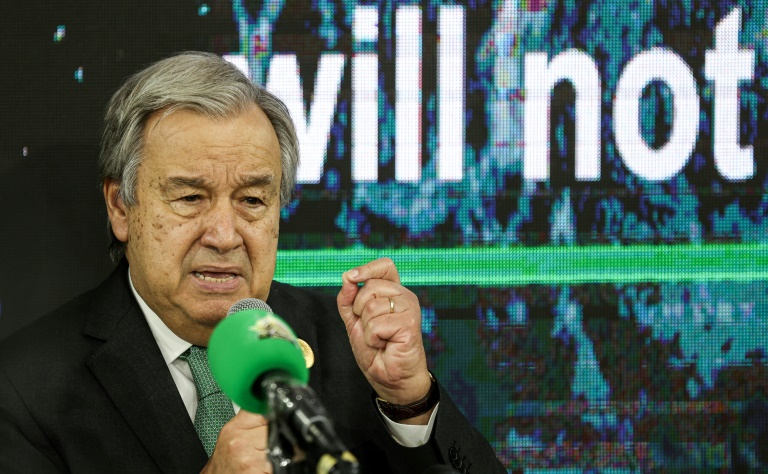
Antonio Guterres said businesses as well as cities and regions should update their voluntary net zero pledges within a year to comply with the recommendations by UN experts, as he trained his sights on fossil fuel firms and “their financial enablers”.

“Using bogus ‘net-zero’ pledges to cover up massive fossil fuel expansion is reprehensible. It is rank deception,” he said at the launch of the report at the COP27 conference in Egypt.  

“This toxic cover-up could push our world over the climate cliff. The sham must end.”

The UN expert panel, convened by Guterres after UN climate talks in Glasgow last year, set its sights on drawing a “red line” around greenwashing in net zero targets from companies, cities and regions.

A huge surge in decarbonisation pledges in recent months means that around 90 percent of the global economy is now covered by some sort of promise of carbon neutrality, according to Net Zero Tracker.      

“It’s very easy to make an announcement that you are going to be net zero by 2050. But you have to walk the talk and what we’ve seen is that there is not enough action,” said Catherine McKenna, Canada’s former environment and climate change minister, who led the panel.

“We have to do two things to reach net zero — we need to drastically reduce emissions, and we need to invest in clean (energy),” she told AFP.

She added it was currently “extremely hard” to properly evaluate whether firms were cutting emissions and called for greater transparency. 

The report lists a slew of recommendations, including calling on governments to begin putting in place binding regulations.  

– ‘Do the work’ –

A central recommendation from the panel is that net zero plans must be in line with the Paris Agreement’s most ambitious aim of limiting global warming to 1.5 degrees Celsius above pre-industrial temperatures. 

But to do that UN scientists say that global emissions must be slashed virtually in half by 2030, and after that they should be reduced to net zero by 2050. 

There have been growing concerns that some firms have not aligned their efforts with the latest climate science — by failing to account for emissions from key activities, or by saying they can make up for increasing pollution today with “carbon credits” from activities like tree planting.    

The report recommends that credits should not be used to “offset” emissions, until after a firm has done everything possible to cut emissions in line with the 1.5C target and that if they are used at all they should be from a reliable and verified source. 

“The reality is you can’t offset your way to net zero,” McKenna told AFP. 

“You don’t get an A for showing up in class. You get an A for doing the work and you can’t pay someone else to do it, you have got to do it yourself.”

The report added that net zero pledges should include short term targets every five years, beginning in 2025.

It stressed that these should cover all greenhouse gas emissions from all activities — including supply chains for businesses and investments for financial institutions. 

– ‘Watershed moment’ –

Net zero is “entirely incompatible” with any new fossil fuel investment, the report said, although McKenna said oil and gas companies could still have these pledges if they swiftly transition to renewables.

Firms would also not be able to continue activities that result in deforestation and still claim they are decarbonising.

“We find that too often too many businesses continue to rely on business models that result in the destruction of natural ecosystems,” said panel member Arunabha Ghosh, of the Council on Energy Environment and Water, a think tank.

“We want to show that any company doing this is working against net zero.”

The report also said businesses with net zero plans should not lobby against climate action.

“Today’s announcement is a watershed moment when it comes to corporate lobbying on climate policy, which has long stymied action from governments,” said Will Aitchison of the think tank InfluenceMap.

In September, an analysis by CDP, a non-profit that runs a global disclosure system for companies to manage their environmental impacts, found that the decarbonisation plans of major corporations from G7 nations put Earth on course to heat a potentially catastrophic 2.7C.

Close Bitnami banner
Bitnami