US Business

Ukraine slams Russia's 'dirty bomb' claims as 'dangerous' lies

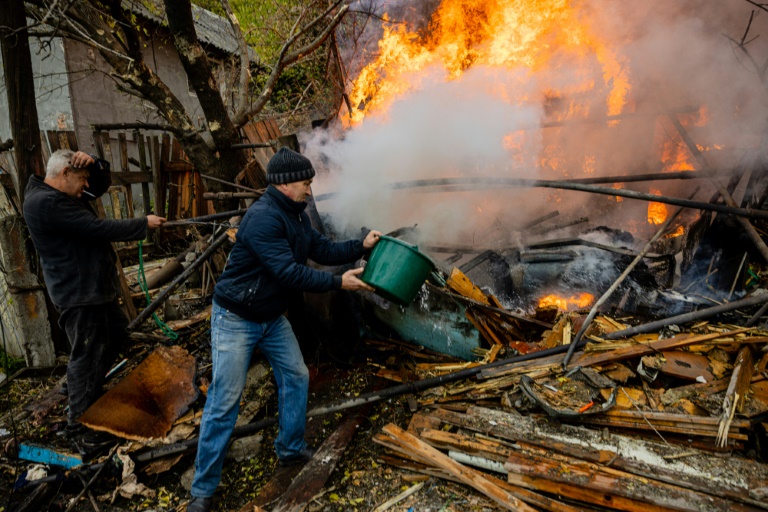
Ukraine slammed Russia on Sunday for alleging Kyiv was planning to use a radioactive bomb in its own territory, calling the claims “dangerous” lies and prompting Western allies to warn Moscow against using any pretext for escalating the conflict.

Russia’s Defence Minister Sergei Shoigu spoke with his British, French and Turkish counterparts to convey “concerns about possible provocations by Ukraine with the use of a ‘dirty bomb’,” Moscow said, referring to a weapon that uses traditional explosives to scatter radioactive material.

But Ukraine and its Western allies swiftly dismissed Moscow’s allegations, with the United States, Britain and France issuing a joint statement on Sunday rejecting Russia’s “transparently false” claims.

Moscow said Shoigu had also spoken to US Defense Secretary Lloyd Austin, but the Pentagon said Austin had “rejected any pretext for Russian escalation” in the phone call.

US Secretary of State Antony Blinken tweeted on Sunday that he spoke to Ukraine’s Foreign Minister Dmytro Kuleba to “reject Russia’s false allegations that Ukraine is preparing to use a dirty bomb on its own territory”.

Ukrainian President Volodymyr Zelensky called for a united international response.

“If Russia calls and says that Ukraine is allegedly preparing something, it means one thing: Russia has already prepared all this,” Zelensky said in a video address on social media.

“I believe that now the world should react as harshly as possible.”

Earlier on Sunday, Kuleba had denounced Moscow’s claims as “absurd” and “dangerous”.

“Russians often accuse others of what they plan themselves,” he added. 

A British defence ministry statement said Defence Secretary Ben Wallace had “refuted these claims and cautioned that such allegations should not be used as a pretext for greater escalation”.

And in Washington, National Security Council spokeswoman Adrienne Watson said President Joe Biden’s administration dismissed Moscow’s “transparently false allegations”.

– ‘Vile strikes’ –

Russia announced Sunday it had destroyed a depot in central Ukraine that was storing over 100,000 tonnes of aviation fuel.

Kyiv’s energy operator said scheduled power cuts had been introduced in the capital due to Russia’s repeated strikes on Ukraine’s power network, and urged residents to use electricity sparingly.

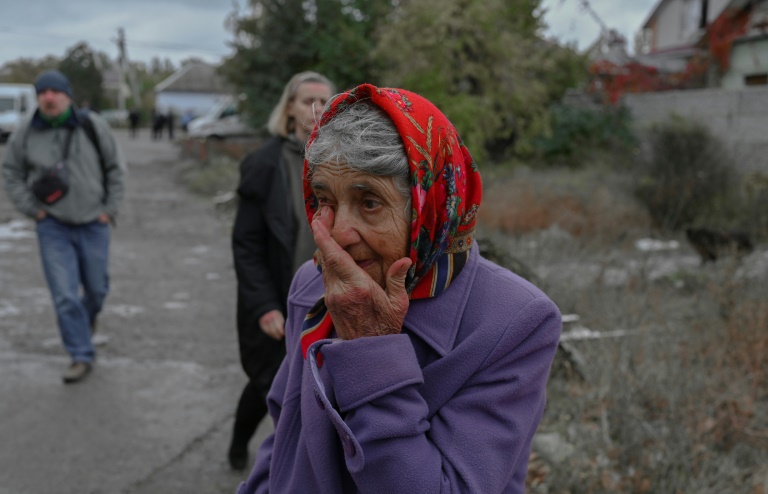
More than one million Ukrainian households have lost electricity following recent Russian strikes and at least a third of the country’s power stations have been destroyed ahead of winter, according to officials in Kyiv.

Zelensky condemned the strikes as “vile”.

– ‘Save your strength’ –

In the southern Ukrainian city of Kryvyi Rig, deputy mayor Sergiy Miliutin has been dealing with emergencies and outages from his underground bunker, used as a venue for a children’s martial arts competition.

“I’ve reached a point where I just survive on my drive. You have to stay level-headed and save your strength. No one knows how long this will all last,” he told AFP.

The intensification of Russian strikes on Ukraine, particularly on energy facilities, came after the bridge linking the annexed Crimea peninsula to mainland Russia was partially destroyed by an explosion this month.

It was another major setback for Moscow’s forces, battling to contain a Ukrainian counteroffensive in the south and east of the country.

Speaking in Rome on Sunday at the start of a peace conference, French President Emmanuel Macron said that it was for Ukrainians to decide when “peace is possible”.

Ukraine reported three deaths in an overnight Russian artillery strike in the Toretsk area, a governor of the eastern Donetsk region said.

Inside Russia, two lines of defence have been built in the border region of Kursk to deal with any possible attack, a local governor said Sunday.

And defence structures are also being built in the neighbouring Russian border region of Belgorod after two civilians were killed there in strikes Saturday and thousands were left without electricity, according to governor Vyacheslav Gladkov.

– Kherson evacuations –

Ukraine’s SBU intelligence service said it had detained two officials of Ukrainian aircraft engine maker Motor Sich on suspicion of working with Russia.

The SBU said management at the company’s plant in Ukraine’s southern Zaporizhzhia region — partly controlled by Russian forces — had colluded with Russian state-owned defence conglomerate Rostec.

The suspects had supplied Russia with Ukrainian aircraft engines that were used to make and repair attack helicopters, the SBU said.

In the southern Ukrainian region of Kherson, which Russia claims to have annexed, pro-Moscow officials have urged residents to leave amid Ukraine’s counteroffensive.

Kherson, the region’s main city, was the first to fall to Moscow’s troops in the invasion’s early days and retaking it would be a major prize for Kyiv.

Around 25,000 people have already left Kherson city to the left bank of the Dnipro River, according to Kremlin-installed officials.

Ukraine has denounced the removal of residents from Kherson, describing them as “deportations”.

ECB again eyes jumbo rate hike to 'tame inflation beast'

The European Central Bank is expected to set aside recession worries and deliver another jumbo interest rate hike this week to cool inflation, as Russia’s war on Ukraine sends energy prices soaring.

Inflation in the 19-nation eurozone climbed to an all-time high of nearly 10 percent in September, five times the ECB’s target of two percent.

The ECB’s governing council last month raised its key interest rates by an unprecedented 75 basis points, and many observers expect it to repeat the move at Thursday’s meeting.

Households and businesses are bracing for a grim winter as Russia continues to squeeze gas supplies to Europe, raising fears of energy shortages and eye-wateringly high electricity and heating bills.

The war has also pushed up food costs, while pandemic-era supply chain snarls combined with higher manufacturing costs have added to price pressures on a range of goods.

“Those who thought inflation was dead now know better,” said Joachim Nagel, the head of Germany’s Bundesbank central bank.

“Now the beast has woken up from its slumber… it’s up to monetary policymakers to tame it again,” he recently told students at Harvard University.

Like other central banks, the ECB is using a series of rate hikes to bring inflation under control — at the risk of slowing economic activity to such an extent that it triggers a downturn.

“The 75 basis point rate hike looks like a done deal,” said ING economist Carsten Brzeski.

“The ECB has turned a blind eye on recession risks,” he added.

Analysts from Capital Economics said they saw the ECB going even bigger, predicting a 100 basis-point jump followed by smaller hikes over the coming months.

– ‘Not painless’ –

In the United States, where inflation is running at a 40-year high, the Federal Reserve recently said there was no “painless” way to combat runaway prices.

A slowdown of economic growth and the US job market will be “required” to bring down inflation, said the Fed, which has hiked rates faster and more aggressively than the ECB.

ECB president Christine Lagarde has warned that the euro area was also facing “a significant slowdown”.

If Russia completely cuts off gas flows to Europe, the eurozone economy could shrink by nearly one percent in 2023, ECB vice-president Luis de Guindos added.

It’s a scenario that has become more likely after Russia in late August halted gas flows through the crucial Nord Stream 1 pipeline to Europe’s biggest economy, Germany.

– Government spending –

The German economy, whose energy-hungry industries relied heavily on Russian gas before the war, is now forecast to shrink by 0.4 percent in 2023.

Chancellor Olaf Scholz has unveiled a 200-billion-euro ($197 billion) energy fund to help citizens cope with price shocks, irking European neighbours who can’t afford the same fiscal largesse.

With other eurozone countries such as France and Spain also rolling out support measures, the ECB has warned governments not to fall into the trap of spending so much that they boost inflation.

Germany’s hawkish Finance Minister Christian Lindner agreed, saying last week that fiscal policy “must not counter the measures of central banks” by strengthening demand.

The ECB is also expected to use this week’s meeting to discuss bringing other monetary policy levers in line with its inflation-busting efforts.

Policymakers are likely to consider changes to the super cheap, long-term loans (TLTROs) offered to banks in recent years to help the eurozone through several crises — sometimes at negative rates.

As a consequence of the ECB’s rapid rate hikes since July, lenders can now make a profit by parking their excess TLTRO cash at the central bank and pocketing the new, higher deposit rate — leaving the ECB looking for ways to incentivise early repayment of the loans.

The ECB may also ponder how best to shrink its multi-trillion-euro balance sheet, after years of hoovering up government and corporate bonds to drive up stubbornly low inflation.

But given the uncertain outlook and the risk of rattling financial markets, analysts say the start of any “quantitative tightening” is some way off.

Most Asian markets up on rate hopes but China fear casts shadow

Most Asian markets rose Monday after a surge on Wall Street fuelled by hopes the Federal Reserve could begin to slow its pace of interest rate hikes.

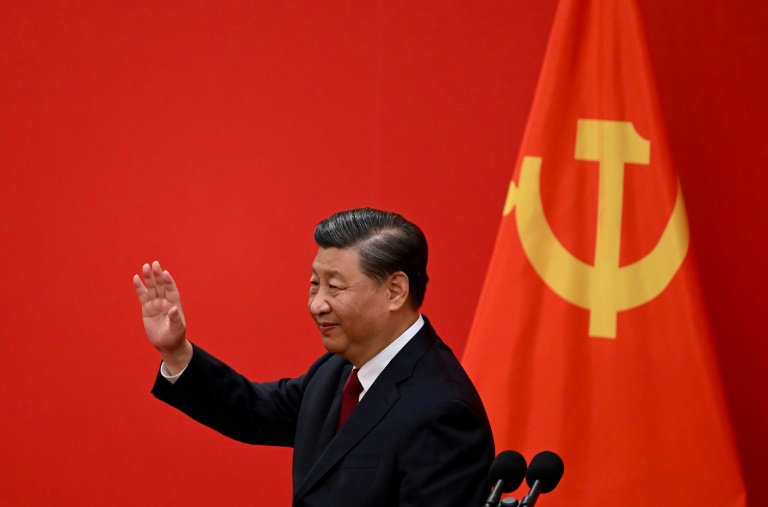
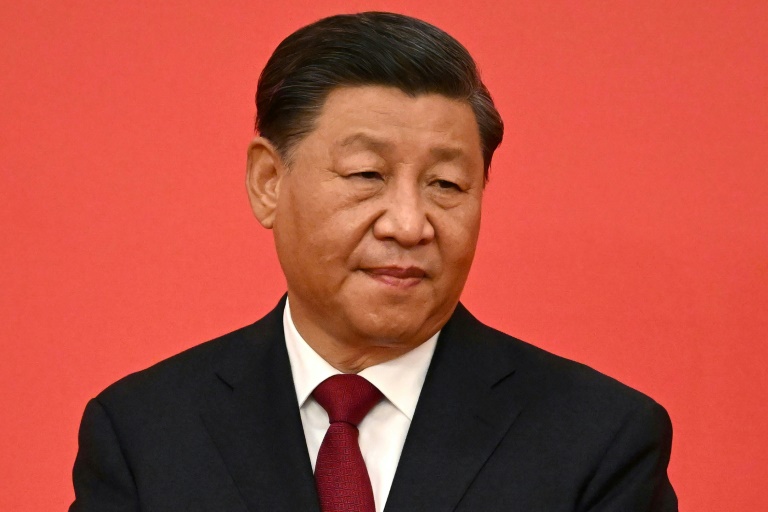
However, the bright start to the week was overshadowed by a plunge in Hong Kong and Shanghai after Xi Jinping was handed a third term as leader and put in place a team who back his economically damaging zero-Covid strategy.

The yen fluctuated against the dollar as speculation swirled that Japanese authorities had stepped into forex markets again to support their currency for a second time in as many sessions.

Tokyo, Sydney, Seoul and Taipei led gains after a strong performance in New York that was sparked by a report the Fed could begin to take its foot off the pedal in its rate hike campaign.

The Wall Street Journal article said some officials were keen to discuss a slowdown when they meet next month.

Markets have been hammered this year by fears that moves by the Fed and other central banks to fight decades-high inflation will spark a recession.

Officials had been expected to lift rates 75 basis points for a fourth successive time next month, while bets were increasing on another such move in December.

“The mere suggestion of the Fed stepping down from 75 basis points to a 50 basis point incremental rate hike in December produced a fierce rally in US equities, partial reversal of the recent surge in US Treasury yields and smart about-turn in the US dollar,” said National Australia Bank’s Ray Attrill.

However, while most equity markets across the region were well up, Chinese markets were being hammered by the reshuffle at the top of government. Hong Kong shed more than four percent and Shanghai almost one percent.

-Zero-Covid worries-

Xi, who was at the weekend given a third five-year term as leader, handed key positions to loyalists who back his strategy of fighting Covid outbreaks with lockdowns and other strict measures.

The policy has been blamed for the sharp drop in growth in the world’s number two economy, and while data showed Monday that it expanded more than forecast in the third quarter, traders remain on edge.

On currency markets, the yen was hovering around 149 to the dollar, having strengthened to 145.65 earlier amid talk that authorities had intervened to support the unit for a second time in as many sessions.

Observers said officials likely stepped in on Friday after the dollar soared to a fresh 32-year high of 151.93 yen. That came after warnings from the finance ministry that it was keeping tabs on movements, and follows a similar move last month.

“Whilst the (finance ministry) has since declined to comment on whether they intervened, such action has not come without multiple warnings from officials,” said Matt Simpson at City Index.

“The MoF last week said they will deal with speculators ‘severely’ and the strong price reaction on Friday suggests they did just that.

“Price action has also been erratic in Monday’s Asian session, which points to another probable intervention.”

The pound rose after former UK prime minister Boris Johnson said he would not stand for the Conservative leadership again, after the resignation of Liz Truss last week.

His decision leaves his former finance minister Rishi Sunak the favourite to take the reins and become the country’s third premier this year.

The choice of the less-controversial Sunak could provide a little stability in Westminster after weeks of turmoil sparked by Truss’s debt-fuelled mini-budget that hammered the pound and sent shivers through markets.

– Key figures around 0230 GMT –

Tokyo – Nikkei 225: UP 1.0 percent at 27,156.95 (break)

Hong Kong – Hang Seng Index: DOWN 4.4 percent at 15,497.13

Shanghai – Composite: DOWN 0.9 percent at 3,010.37

Pound/dollar: UP at $1.1318 from $1.1258 on Friday

Dollar/yen: UP at 148.92 yen from 147.65 yen

Euro/dollar: DOWN at $0.9840 from $0.9863

Euro/pound: DOWN at 86.93 pence from 87.26 pence

West Texas Intermediate: FLAT at $85.05 per barrel

Brent North Sea crude: FLAT at $93.47 per barrel

New York – Dow: UP 2.5 percent at 31,082.56 (close)

London – FTSE 100: UP 0.4 percent at 6,969.73 (close)

China economy grows 3.9 percent year-on-year in third quarter

China’s economy grew 3.9 percent year-on-year in the third quarter, according to official data released Monday, beating forecasts a day after President Xi Jinping was re-elected to a historic third term as leader.

Beijing last week delayed the release of the third-quarter growth figures — along with a host of other economic indicators — as the country’s leaders gathered in Beijing for the five-yearly Communist Party Congress. 

China had been expected to announce some of its weakest quarterly growth figures since 2020, with its economy hobbled by Covid-19 restrictions and a real estate crisis.

In the previous quarter, growth in the world’s second-largest economy collapsed to 0.4 percent compared with the previous year, the worst performance since 2020. The country posted 4.8 percent growth in the first quarter of 2022.

But Monday’s data, published six days later than scheduled, showed a slight rebound, with China posting growth higher than the 2.5 percent predicted by a panel of experts surveyed by AFP.

It did, however, show a marked rise in unemployment from last month, a figure officials blamed on the pandemic. 

Many economists continue to think China will struggle to attain its 2022 growth target of around 5.5 percent, and the International Monetary Fund (IMF) has lowered its GDP growth forecast to 3.2 percent for 2022 and 4.4 percent for next year.  

AFP’s panel of experts predicted average growth of three percent in 2022, far below the 8.1 percent seen in 2021. 

That would equal China’s weakest growth rate in four decades, excluding 2020, when the global economy was hammered by the emergence of the coronavirus.

“The big policy challenge is accepting that the economy has reached a state of maturity that means growth numbers are likely permanently reset to the zero-to-4.5 percent range for the coming decade,” Clifford Bennett, chief economist at ACY Securities, told AFP. 

– Zero-Covid –

Beijing’s zero-Covid policy, which continues to weigh heavily on the economy, appears no closer to loosening than before the weekend’s Party Congress. 

China is the last of the world’s major economies to continue following the strategy, which imposes tight travel restrictions, mass PCR testing and obligatory quarantines.  

It involves sudden and strict lockdowns — including of businesses and factories — which has disrupted production and weighed heavily on household consumption.

But despite the impact on the economy, “there is no clear sign of a significant easing of the zero-Covid strategy”, Nomura’s Ting Lu said, noting that, if anything, the opposite had happened. 

In the week leading up to the Congress, state media published multiple editorials warning the policy should not be relaxed, and officials have pounced on recent outbreaks across the country with increased curbs.

Meanwhile, China is also battling an unprecedented crisis in its real estate sector — historically a driver of growth and representative of more than a quarter of the country’s GDP when combined with construction. 

Following years of explosive growth fuelled by easy access to loans, Chinese authorities launched a crackdown on excessive debt in 2020.

Property sales are now falling across the country, leaving many developers struggling and some owners refusing to pay their mortgages for unfinished homes.

Despite the problems, “many economic indicators have actually recovered reasonably well from the mass lockdowns of March and April”, according to analyst Thomas Gatley of Gavekal Dragonomics.

Car sales held strong in September, driven by strong demand for electric clean vehicles.

August exports increased by 7.1 percent compared with the previous year, and Beijing has invested in infrastructure to support activity.

However, “those pillars of growth are becoming more fragile”, Gatley said. 

Latina Republicans deploy anti-immigrant rhetoric in chase for Texas seats

When Mayra Flores made history this June as the first Mexican-born member of the US Congress, the Republican seized her south Texas seat from the Democrats by courting Latinos with strident calls to close the border.

That apparent paradox has made the 36-year-old — whose campaign slogan is “God, family, country” — one of the faces of the Republican Party’s new push in the border region for the November midterm elections.

She is bidding to repeat her victory next month, when fellow Latina Republicans Monica de la Cruz, Cassy Garcia and Carmen Maria Montiel will also vie for nearby congressional seats that for decades have remained Democratic.

The group hope to appeal directly to a community made up largely of immigrants and children of immigrants, who are increasingly calling to expand the wall that separates their adopted home country from Latin America.

Sara Rodriguez, a resident of Edinburg, 20 miles (32 kilometers) from the Mexico border, plans to vote for Flores because she “represents our views as far as immigration goes.”

“There’s an influx of a lot of people coming through the valley, especially here at the south border… I feel like it’s very unsafe right now.”

Flores won her seat in a special poll this summer after the Democratic incumbent resigned.

Campaigning for re-election in the border city of McAllen, she won raucous applause from a crowd wearing boots and wide-brimmed hats during a speech peppered with fierce anti-immigrant rhetoric.

“Red wave! Red wave!” supporters chanted, referencing the Republican Party’s color, as a mariachi band played traditional Mexican music.

“The Democratic Party has walked away from the Hispanic community. They just take us for granted every election year,” she told AFP after her rally.

– ‘My hard work’ –

Democrats in various US states have for years benefited from the traditional support of Latino voters, which in the 1990s played a key role in transforming California into a solidly blue state.

But in south Texas, where Hispanics or Latinos (40.2 percent) outnumbered non-Latino or Hispanic whites (39.4 percent) for the first time this year, the Democrats’ lead has gradually shrunk.

In 2020, Donald Trump’s hardline immigration stance was widely credited with helping to slash the Democratic lead over Republican voters along the Texas border to 17 percent, from 33 percent four years earlier.

While they rarely mention the former president by name in speeches, local Republican candidates have adopted his nationalist and pro-wall rhetoric, while highlighting their community roots.

“It’s so important that you have people who live on the border, who understand the border, representing the border,” said de la Cruz, who hopes to win a seat held by Democrats for more than a century. 

Jesus Contreras, a Mexican who became a naturalized US citizen in the 1990s, plans to vote for her after decades of supporting the Democrats.

“My parents, everybody, taught me, ‘Oh the Republicans are bad,'” he said, switching between English and Spanish. “But they’re not.”

Contreras blames the Democrats for the border situation, and for the rising cost of living. 

“The folks that are coming across are helping the economy in which way? Do they pay taxes?” he asked.

“As far as I know, I’ve been paying taxes all my life. But yeah, they come over here and… get to reap the benefits of my hard work.

“I don’t think so.”

– ‘Unacceptable’ –

Between last October and this August, US authorities reported more than two million “border encounters” — a record.

The figure does not directly translate into the number of migrants, as many people try several times to cross.

Many are seeking asylum, claiming to be fleeing dangerous situations in countries such as Guatemala, Cuba, and Nicaragua.

Venezuela has seen an explosion in cases, with more than 180,000 of its citizens intercepted at the US southern border in one year.

For Montiel, an ex-beauty queen who is running in Houston to become the first Venezuelan in US Congress, the situation is “unacceptable.”

“My constituents want the border to be closed, for there to be legal migration,” she told AFP.

“Even if they are Venezuelans, I do not agree with someone entering this country breaking the law,” she added, although her former country has no diplomatic relations with Washington and no functioning US embassy.

– ‘Coming from poverty’ –

Still, in the border city of Laredo, multiple Latino voters told AFP they defined themselves as Democrats because of the party’s humanitarian position on immigration.

“It is not dangerous here — migrants come to work,” says Gustavo Hernandez, a taxi driver who arrived 25 years ago from Mexico.

“They are just coming from poverty,” he added.

Sandra Ibarra, who spoke to AFP on her way to attend noon Mass at Laredo’s cathedral, said it was “necessary for everyone to get out and vote.”

“I think (President Joe) Biden has done a lot of good things and he is trying to do everything he can to help immigrants, but the governor [Republican Greg Abbott] puts a lot of restrictions on us,” she said.

“We are at a crossroads.”

Tax fraud trial of Trump family business set to begin in New York

The family business of former US president Donald Trump is facing potential fines of over $1.5 million if found guilty of fraud and tax evasion during a New York trial set to begin Monday.

Manhattan prosecutors have charged the Trump Organization, currently run by Trump’s two adult sons, Donald Jr and Eric Trump, with hiding compensation it paid to some of its top executives between 2005 and 2021.

One of those executives, longtime CFO Allen Weisselberg, has already pleaded guilty to 15 counts of tax fraud, and is expected to testify against his former company as part of a plea bargain.

A close friend of the Trump family, the 75-year-old Weisselberg admitted he schemed with the company to receive undeclared benefits such as a rent-free apartment in a posh Manhattan neighborhood, luxury cars for him and his wife and private school tuition for his grandchildren.

According to his plea deal, Weisselberg has agreed to pay nearly $2 million in fines and penalties and complete a five month prison sentence in exchange for testimony during the trial, for which jury selection begins Monday.

“This plea agreement directly implicates the Trump Organization in a wide range of criminal activity and requires Weisselberg to provide invaluable testimony in the upcoming trial against the corporation,” Manhattan District Attorney Alvin Bragg said earlier in August.

Weisselberg has so far refused to give testimony directly implicating the former president in the scheme.

– Loads of lawsuits –

Two subsidiaries of the Trump family’s sprawling real estate, golf and hospitality business are targeted by the suits.

While Donald Trump is not named in this case, he is facing charges along with three of his eldest children in another civil investigation led by New York’s attorney general, Leticia James.

James, a Democrat, has accused the family of purposefully inflating and deflating the value of their properties to avoid tax liabilities and to get more favorable loan and insurance deals.

Her office is seeking $250 million in fines against the former president, and that his family be barred from conducting business in the state.

The suit also calls for three of Trump’s children — Donald Jr, Eric and Ivanka — to be barred from purchasing real estate in New York for five years.

The 76-year-old Trump, who has heavily hinted but not yet announced a 2024 White House run, is also facing legal action on several other fronts, which he has decried as “witch hunts.”

He is at the center of a Justice Department investigation into the handling of highly classified documents, which the FBI seized from his Florida home in a raid, as well as multiple state and federal probes into his involvement in the January 6, 2021 attack on the US Capitol.

The congressional committee investigating the Capitol riot has issued a subpoena requiring the former president to submit documents by November 4 and give sworn testimony by mid-November.

Without confirming that Trump had received the subpoena, his lawyer David Warrington has said his team would “review and analyze” the document and “respond as appropriate to this unprecedented action.”

Trump’s compliance would mean testifying under oath and could result in him being charged with perjury were he to lie.

If he refuses to comply, the House of Representatives can hold him in criminal contempt in a vote recommending him for prosecution. 

In a Florida 'food desert,' a gnawing sense of being left behind

Sitting outside her modest home in Jacksonville, Florida, on a street lined with nondescript buildings in faded shades of blue, a weary Brenda Jenkins expresses a simple wish: to be able to buy fresh fruit and produce in her own neighborhood.

It sounds simple enough. But for people like her, one of the 39 million Americans living in “food deserts” — most of them low-income urban dwellers, and predominantly people of color — fresh food is practically inaccessible.

In a country with often poor mass transit and persistent pockets of poverty, getting to grocery stores that sell fresh food can be daunting.

“It’s very tiring,” said the 26-year-old Jenkins, a mother of three.

The phrase “food desert” is misleading. The problem is not so much that fresh food is unavailable, as that it can be hard to get to, in a country where the car is king — but also expensive.

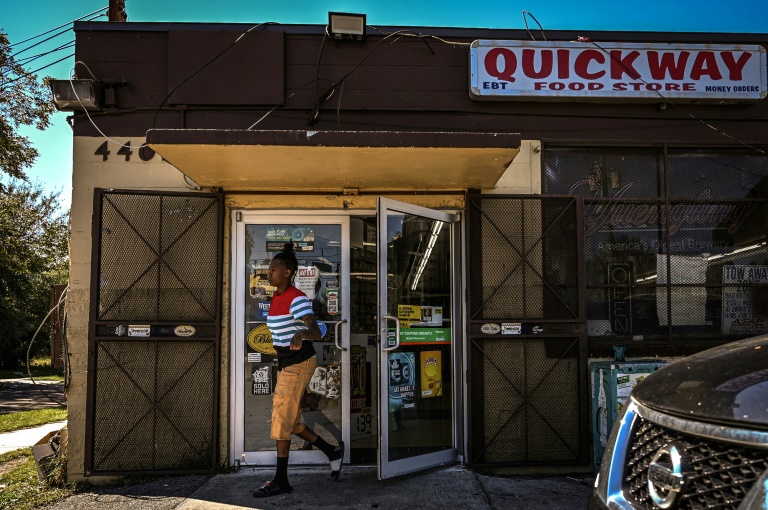
There are no supermarkets in Jenkins’ nearly all-Black neighborhood in the large city of Jacksonville on Florida’s northern Atlantic coast.

Service stations, fast food restaurants and mom-and-pop groceries provide the only nearby food options. 

Their shelves bulge with candy, chips, soda and cookies. But the only fresh products are likely to be a few wan-looking apples or bruised bananas near the cash register.

Yet the poorest residents have no other option. The city’s mass transit system is skeletal. And the nearest supermarket is nearly an hour’s walk away.

Jenkins has a car, and she often takes neighbors with her when she goes shopping. 

But “what if I decided to move or what if I had something to do?” she asked. “How can they get groceries?”

And when her car breaks down — a not-infrequent occurrence — she has had no choice but to buy “processed foods” from a corner grocery — “and it’s just not healthy, especially with children.”

With US midterm elections just weeks away — and the prospect of major change in the Congress — Jenkins complained that she has seen no candidates in her neighborhood, and received no campaign leaflets.

She thinks politicians ignore her area “because we’re considered low-income.”

If the authorities really cared, she said, “something would have been done” to address the food desert problem.

– ‘A human right’ –

The once-prosperous neighborhood has progressively fallen on hard times over the decades, making it less and less profitable for the big supermarket chains.

When the last one closed, “people lost access to healthy food,” said Mika Hardison-Carr, a Black woman who manages a collective garden called White Harvest Farms. 

Over time, local residents simply got used to living in a food desert and getting by on “processed food, canned food (and) noodles,” said Hardison-Carr, holding a freshly picked kumquat.

“It is absolutely hard to change people’s way of life,” she said.

So the challenge now, Hardison-Carr added, is not just to give people access to fresh foods but to teach them to again make those foods a part of their daily diet. 

Limited food options and poor eating habits are “contributing to all of these health issues that’s causing us to die earlier, to be sicker, to be fatter,” she said.

And she is adamant about this: “Access to fresh, healthy food should be a human right.”

Her urban farm, created by the Clara White Mission with the help of public funds, provides free produce to the volunteers who help with the garden, and a low-price option to others in the neighborhood, who can pay with the federal food stamps that so many rely on.

On this autumn day, with Florida’s normally stifling heat beginning to turn balmy, people are at work in the garden, a rare patch of green in the neighborhood’s gritty urban landscape. 

To attract buyers, the farm’s crops include vegetables — like collard greens — that are essential to Southern and African-American cooking.

“They’ve already been in here asking us when the greens are ready,” 43-year-old volunteer Nicole Boone noted with a laugh, adding, “we just seeded them!”

She has been with the program since it began last year.

Nearby, Sarah Salvatore, another garden manager, is planting flowers to attract insects that will help avoid the need for pesticides.

“Food deserts are very easy to eliminate,” she said, hunched over her plants.

“We have to elect people that are putting their energy towards solving these issues,” Salvatore said, “because they’re solvable — they’re just underfunded.”

'Black Adam' rocks to top of N.America box office

Warner Bros.’ new film “Black Adam” blew away all competition this weekend, leading the North American box office with an estimated take of $67 million, industry watcher Exhibitor Relations reported Sunday.

A superhero origin story spun off from 2019’s “Shazam,” “Black Adam” stars Dwayne “The Rock” Johnson as the titular villain, a former slave endowed with miraculous powers by ancient Egyptian gods. 

“As a spinoff, this is a strong opening,” David A. Gross of Franchise Entertainment Research said, adding that it was a “positive and steady step forward for DC Comics,” the generator of many superhero films.

In a distant second was another new release, Universal’s “Ticket to Paradise,” at $16.3 million for the Friday-through-Sunday period. Released earlier abroad, it has already taken in $80 million outside North America.

“This is a very good domestic opening for a romantic comedy,” Gross said. 

It stars two of Hollywood’s biggest stars, George Clooney and Julia Roberts, as a bickering, divorced couple who fly to Hawaii to try to sabotage their daughter’s wedding. 

With Halloween approaching, the next two films were both horror specials.

Paramount’s “Smile” dropped one spot from last weekend to third, taking in $8.4 million. Sosie Bacon plays a therapist whose grasp on reality is shaken by a horrifying event.

Next was Universal’s blood-soaked “Halloween Ends,” which dropped sharply from last weekend’s box-office-topping $41.3 million to just $8 million. Jamie Lee Curtis stars.

And in fifth was Sony’s family-friendly “Lyle Lyle Crocodile,” at $4.2 million.

Overall, it was a good weekend for Hollywood, with combined revenue surpassing $100 million.

Rounding out the top 10 were: 

“The Woman King” ($1.9 million)

“Terrifier 2” ($1.9 million)

“Don’t Worry Darling” ($880,000)

“Amsterdam” ($818,000)

“Triangle of Sadness” ($600,000)

Rushdie lost sight in eye, use of hand in attack: agent

Author Salman Rushdie lost vision in one eye and was left “incapacitated” in a hand after he was stabbed in the United States in August, his agent said in an interview published this weekend.

The 75-year-old writer, who had received several death threats after the publication of his “The Satanic Verses”, was stabbed several times in the neck and abdomen before he was due to give a talk in the state of New York.

Rushdie was then air-lifted to a nearby hospital for emergency surgery but his condition had improved in the weeks after.

“He’s lost the sight of one eye… He had three serious wounds in his neck. One hand is incapacitated because the nerves in his arm were cut. And he has about 15 more wounds in his chest and torso,” Andrew Wylie told Spanish daily El Pais, providing an update on Rushdie’s health.

The injuries “were profound… it was a brutal attack”, Wylie added.

He would not give any information about the writer’s whereabouts, or whether he was still in hospital, but said: “He’s going to live.”

The British author had lived in hiding for years after Iran’s first supreme leader Ayatollah Ruhollah Khomeini ordered his killing for what he deemed the blasphemous nature of “The Satanic Verses”.

The main suspect, Hadi Matar, a 24-year-old from New Jersey with roots in Lebanon, was arrested immediately after the attack on Rushdie and he then pleaded not guilty during a hearing in New York state in mid-August.

The attack sparked outrage in the West but was praised by extremists in Muslim countries like Iran and Pakistan.

Power cuts hit Kyiv as Russia pummels energy grid

Kyiv’s energy operator on Sunday said scheduled power cuts have been introduced in the Ukrainian capital as Russia has repeatedly targeted the nation’s power network.

More than one million Ukrainian households have lost electricity following recent Russian strikes, according to the Ukrainian presidency, with at least a third of the country’s power stations destroyed ahead of winter.

Moscow announced a new incursion on Sunday, saying it had destroyed a depot in central Ukraine that was storing over 100,000 tonnes of aviation fuel.

Ukrainian President Volodymyr Zelensky on Saturday evening denounced “vile strikes on critical objects” by Russia after fresh attacks on energy facilities and power outages were reported nationwide including in western Ukraine — far from the frontline.

National energy operator Ukrenergo introduced “stabilisation shutdowns” in Kyiv on Sunday to “avoid accidents”, energy company DTEK said in a statement on its website.

The blackouts started from 11:13 am (0813 GMT) with consumers in Kyiv divided into three groups that will be “disconnected for a certain period of time”, DTEK said.

It added that the blackouts should last “no more than four hours” but may be longer “due to the scale of damage to the power supply system”.

DTEK reiterated calls for residents to use electricity “sparingly” and for businesses to limit their use of external lighting.

– ‘Save your strength’ –

In the southern Ukrainian city of Kryvyi Rig, deputy mayor Sergiy Miliutin was dealing with emergencies and power outages from his underground bunker used as a venue for a children’s martial arts competition.

“I’ve reached a point where I just survive on my drive. You have to stay level-headed and save your strength. No one knows how long this will all last,” he told AFP.

The intensification of Russian strikes on Ukraine, particularly energy facilities, came after the bridge linking the annexed Crimea peninsula to mainland Russia was partially destroyed by an explosion earlier this month.

The incident was seen as another major setback for Moscow’s forces, which are battling to contain a Ukrainian counter-offensive in the south and east of the country.

Russian Defence Minister Sergei Shoigu held telephone calls with his French, Turkish and British counterparts to discuss Ukraine.

Shoigu conveyed “concerns about possible provocations by Ukraine with the use of a ‘dirty bomb'” in all three calls, the Russian defence ministry said.

Ukraine reported three deaths in an overnight Russian artillery strike in the Toretsk area, said a governor of the eastern Donetsk region.

In Russia itself, two lines of defence have been built in the region of Kursk near the border with Ukraine to deal with a possible attack, a local governor said Sunday.

The move came a day after the governor in the neighbouring region of Belgorod, which also borders Ukraine, said the construction of defence structures began in parts of the region.

The governor, Vyacheslav Gladkov, also reported the death of two civilians in strikes on his region on Saturday, adding that 15,000 people were left without electricity.

– Kherson evacuations –

Ukraine’s SBU intelligence service offered a new accusation of alleged collaboration, saying it had detained two officials of Ukrainian aircraft engine maker Motor Sich on suspicion of working with Russia.

The SBU said the management of the company’s plant in Ukraine’s southern Zaporizhzhia region — part of which is controlled by Russian forces — “acted in collusion” with Russian state-owned defence conglomerate Rostec.

“The suspects established transnational channel for the illegal supply of wholesale batches of Ukrainian aircraft engines to the aggressor country,” the SBU said, specifying that Russia used them to produce and repair attack helicopters. 

The power cuts and deadly strikes came as pro-Moscow officials in the southern Ukrainian region of Kherson that Russia claims to have annexed urged residents on Saturday to leave “immediately” amid a “tense situation” at the front.

Kherson, the region’s main city, was the first to fall to Moscow’s troops and retaking it would be a major prize in Ukraine’s counter-offensive.

A Moscow-installed official in Kherson, Kirill Stremousov, told Russian news agency Interfax on Saturday that around 25,000 people had left Kherson city to the left bank of the Dnipro River.

Ukraine has denounced the removal of residents from Kherson as “deportations”.

Close Bitnami banner
Bitnami