US Business

Trump ally Bannon sentenced to prison for contempt of Congress

Donald Trump’s former aide Steve Bannon was sentenced Friday to four months in prison for refusing to testify in the congressional probe of the January 6, 2021 attack on the Capitol.

One of the masterminds behind Trump’s 2016 presidential campaign and victory, Bannon was found guilty on two counts of contempt of Congress for defying a subpoena to testify over the riot by the former president’s supporters.

Bannon, who was also fined $6,500, was permitted by the judge to remain free while he fights what his lawyer vowed would be a “bulletproof” appeal.

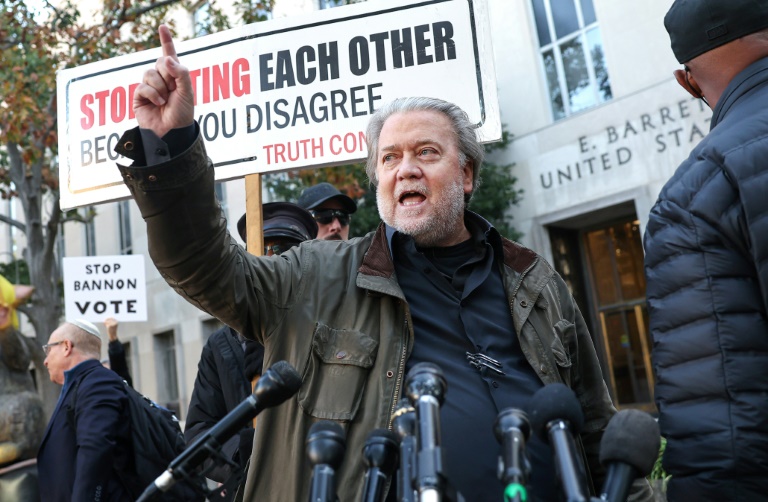
The longtime Trump strategist struck a defiant tone upon leaving the federal court in Washington — lashing out at President Joe Biden and the Democratic leaders of the House of Representatives.

“Today was my judgment day by the judge,” Bannon told reporters outside. “On November 8th there’s going to have judgment on the illegitimate Biden regime,” he vowed — in reference to the upcoming midterm elections. 

“And we know which way that is going,” he said. “The Biden administration ends on the evening of the 8th of November.”

Bannon was greeted earlier on arrival at the courthouse by protesters yelling “Traitor” Fascist!”

His prison sentence was less than the six months requested by the Justice Department, but more than the probation Bannon’s attorneys had sought.

Bannon had argued that he declined to appear before the Capitol riot probe panel upon advice from his lawyer that doing so would violate Trump’s executive privilege.

But he also said he felt that the investigation was politically driven.

Federal Judge Carl Nichols rejected those arguments, saying Trump had never asserted executive privilege in Bannon’s case and that the events at the Capitol needed investigating.

“The events of January 6th were undeniably serious,” Nichols said before pronouncing the sentence.

“The January 6 committee thus has every reason to investigate what happened that day.”

In addition, he said, Bannon failed to cooperate with the committee on issues not touched by claims of executive privilege.

Bannon has “not produced a single document… and has not provided any testimony on any topic,” he said.

– ‘Assaulted the rule of law’ –

Despite the prison sentence, Bannon, who currently runs a streaming political commentary website, could remain out of jail well into next year while fighting his appeal.

The investigation by a special House committee has depicted Bannon as knowing in advance of the plan by hardline Trump supporters to attack the Capitol to prevent Biden from being confirmed as the next president.

It also showed him advocating for Congress to block Biden — who defeated Trump in the November 2020 election — from becoming president.

“The rioters who overran the Capitol on January 6 did not just attack a building — they assaulted the rule of law upon which this country was built and through which it endures,” the Justice Department told the court in its sentencing memo.

“By flouting the Select Committee’s subpoena and its authority, the defendant exacerbated that assault.”

Bannon served in the White House for the first seven months of Trump’s term as chief strategist, leaving reportedly due to conflicts with other top staffers.

In 2020, Bannon was charged with wire fraud and money laundering for taking millions of dollars for personal use that donors had contributed for the construction of a wall on the border with Mexico.

While others were found guilty in the scheme, Trump issued a blanket pardon for Bannon before leaving office in January 2021, leading to the dismissal of the charges against him.
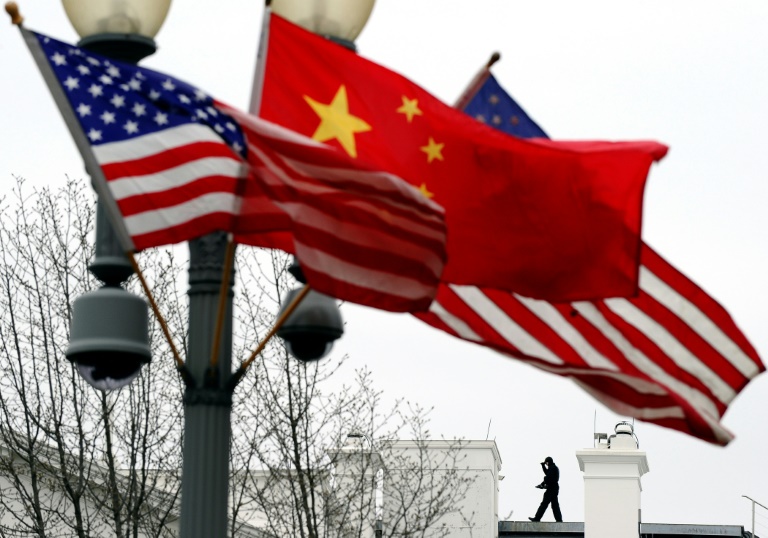

US charges seven Chinese nationals over forced repatriation campaign

The United States has charged seven Chinese nationals for participating in an alleged campaign to force a US resident back to China, drawing a rebuke Friday from Beijing.

The Justice Department said the defendants were engaged in Beijing’s Operation Fox Hunt, which US authorities have said involves extra-judicial repatriation squads that clandestinely attempt to force expatriates to return to China.

Beijing defended the operation as part of an anti-corruption campaign and said its law enforcement agencies follow international laws when abroad.

The seven people charged on Thursday allegedly surveilled and harassed the family of an “elite” overseas Chinese national they called John Doe-1 as part of a forced repatriation campaign against him. 

“The defendants engaged in a unilateral and uncoordinated law enforcement action on US soil on behalf of the government of the People’s Republic of China, in an effort to cause the forced repatriation of a US resident to China,” Justice Department attorney Breon Peace said in a statement. 

“The United States will firmly counter such outrageous violations of national sovereignty and prosecute individuals who act as illegal agents of foreign states.”

Chinese Foreign Ministry spokesman Wang Wenbin condemned the indictment, saying Beijing was engaged in “fighting crimes, repatriating fugitives and recovering illegal proceeds” and this is supported by the international community.

“By making those allegations, the US is denying basic facts and discrediting China’s law enforcement efforts,” Wang said Friday. “We firmly oppose it.”

Two of those charged — lead defendant, Quanzhong An, 55, and his daughter Guangyang An, 34, — were arrested Thursday, while the other five accused remain at large. 

The Justice Department said Quanzhong An, described as a New York businessman, was Beijing’s key US-based liaison.

“Quanzhong An admitted that he was acting as an agent of the Provincial Commission to increase his standing in the PRC,” the Justice Department said, adding that he met with the targeted expatriate’s son several times to “cause the return of John Doe-1.”

The campaign also saw one of John Doe-1’s relatives sent from China to the US in 2018 to convey threats to his son “that were intended to coerce” his return.  

Spanish-based rights group Safeguard Defenders released a report in January citing government data to estimate that almost 10,000 Chinese nationals had been forcibly returned since 2014.

Through two programs, Operation Fox Hunt and Operation Sky Net, those targeted were pressured to return to China against their will using a combination of non-judicial methods — including kidnappings, harassment and intimidation, according to the report.

In July, the US charged nine people with acting as and conspiring to act as unregistered agents of China under Operation Fox Hunt. 

In October, five people were arrested for targeting an unnamed Chinese person living in the US.

Mordaunt enters Tory race as Johnson eyes comeback for PM

Britain’s divisive former leader Boris Johnson on Friday received heavyweight Conservative backing to stage a sensational comeback following the resignation of Prime Minister Liz Truss.

Cabinet member Penny Mordaunt became the first to formally declare her candidacy, after the UK’s ruling party was forced into its second leadership contest in weeks.

Mordaunt, who just missed out on making the final runoff after Johnson quit, said she was running for “a fresh start, a united party and leadership in the national interest”.

Truss announced Thursday she was quitting after just 44 tempestuous days in office.

A poll by YouGov found 79 percent of British people thought she was right to resign, with 64 percent calling her a “terrible” prime minister.

The pollster also found that three in five voters want an early general election, in line with the angry clamour coming from opposition parties as Britons struggle with a worsening cost-of-living crisis.

Labour and other parties argue only an election can end the months of political chaos, sparked when Johnson was himself forced out in July after non-stop personal and political scandal.

In the resultant contest, Truss won the support of just over 80,000 Tory party members, defeating Rishi Sunak, who correctly warned that her hard-right programme of debt-fuelled tax cuts would crash the economy.

Now with a new vacancy suddenly opening up in 10 Downing Street, the former finance minister has emerged as favourite in media straw polls of Conservative MPs. 

But Johnson was reportedly cutting short a Caribbean holiday to take part in the accelerated contest, which will see Tory MPs hold a vote on Monday before a possible online ballot for the members next week.

– Serious times –

Business Secretary Jacob Rees-Mogg, an arch Johnson loyalist, became the first minister to publicly back him, tweeting: “Only Boris can win the next election.”

Cabinet colleague Simon Clarke also endorsed Johnson.

Defence Secretary Ben Wallace, a favourite of the Tory grassroots, told reporters he was not standing himself and said: “At the moment, I’m leaning towards Boris Johnson.”

Wallace noted that Johnson was the only potential leader with UK-wide electoral legitimacy, having won a thumping victory for the Tories over Labour in 2019.

But the minister added that Johnson still had “some questions to answer” over the multiple scandals, which resulted in a yet-to-launch investigation in the House of Commons.

If found guilty of lying to the Commons over the “Partygate” scandal — lockdown-breaching revels held in Downing Street — Johnson could be suspended or even expelled from parliament.

The investigating committee is sitting on “damning new evidence” that would doom any new Johnson premiership, ITV News reported.

Thanks to such controversies, Johnson left Number 10 with dismal poll ratings. One poll found that the word most commonly associated with him for voters was “liar”.

Other Tories were aghast at the prospect of his comeback. Veteran backbencher Roger Gale warned that Johnson could face a wave of resignations from MPs refusing to serve under him as leader.

Crispin Blunt MP told the BBC that Johnson was a “fantastic communicator” but Sunak was “a much more serious personality” who could impart a “serious message” to the country.

Jesse Norman, a minister in the Foreign Office, said choosing Johnson again would be “an absolutely catastrophic decision”.

– ‘Soap opera’ –

While Sunak and Johnson are yet to formally declare, the contest is widely expected to be a three-way race between them and Mordaunt, who is the cabinet minister in charge of the House of Commons. 

Contenders have until 2:00 pm (1300 GMT) on Monday to produce a minimum 100 nominations from their fellow Tory MPs.

That means a maximum of three candidates will emerge from among the 357 Conservatives in the Commons.

If necessary, they will vote to leave two candidates standing, and hold another “indicative” vote to tell the party membership their preferred option.

If no single candidate emerges, the rank-and-file will then have their say in an online ballot and the result will be announced next Friday.

Political website Guido Fawkes, which is running a rolling spreadsheet of Tory MPs’ declared support, had Sunak on 73, Johnson on 61 and Mordaunt on 21 by Friday afternoon.

The leader of the main opposition Labour party, Keir Starmer, said Britain “cannot have another experiment” after Truss’s disastrous tenure.

“This is not just a soap opera at the top of the Tory party — it’s doing huge damage to the reputation of our country,” he said.

Mordaunt enters Tory race as Johnson eyes comeback for PM

Britain’s divisive former leader Boris Johnson on Friday received heavyweight Conservative backing to stage a sensational comeback following the resignation of Prime Minister Liz Truss.

Cabinet member Penny Mordaunt became the first to formally declare her candidacy, after the UK’s ruling party was forced into its second leadership contest in weeks.

Mordaunt, who just missed out on making the final runoff after Johnson quit, said she was running for “a fresh start, a united party and leadership in the national interest”.

Truss announced Thursday she was quitting after just 44 tempestuous days in office.

A poll by YouGov found 79 percent of British people thought she was right to resign, with 64 percent calling her a “terrible” prime minister.

The pollster also found that three in five voters want an early general election, in line with the angry clamour coming from opposition parties as Britons struggle with a worsening cost-of-living crisis.

Labour and other parties argue only an election can end the months of political chaos, sparked when Johnson was himself forced out in July after non-stop personal and political scandal.

In the resultant contest, Truss won the support of just over 80,000 Tory party members, defeating Rishi Sunak, who correctly warned that her hard-right programme of debt-fuelled tax cuts would crash the economy.

Now with a new vacancy suddenly opening up in 10 Downing Street, the former finance minister has emerged as favourite in media straw polls of Conservative MPs. 

But Johnson was reportedly cutting short a Caribbean holiday to take part in the accelerated contest, which will see Tory MPs hold a vote on Monday before a possible online ballot for the members next week.

– Serious times –

Business Secretary Jacob Rees-Mogg, an arch Johnson loyalist, became the first minister to publicly back him, tweeting: “Only Boris can win the next election.”

Cabinet colleague Simon Clarke also endorsed Johnson.

Defence Secretary Ben Wallace, a favourite of the Tory grassroots, told reporters he was not standing himself and said: “At the moment, I’m leaning towards Boris Johnson.”

Wallace noted that Johnson was the only potential leader with UK-wide electoral legitimacy, having won a thumping victory for the Tories over Labour in 2019.

But the minister added that Johnson still had “some questions to answer” over the multiple scandals, which resulted in a yet-to-launch investigation in the House of Commons.

If found guilty of lying to the Commons over the “Partygate” scandal — lockdown-breaching revels held in Downing Street — Johnson could be suspended or even expelled from parliament.

The investigating committee is sitting on “damning new evidence” that would doom any new Johnson premiership, ITV News reported.

Thanks to such controversies, Johnson left Number 10 with dismal poll ratings. One poll found that the word most commonly associated with him for voters was “liar”.

Other Tories were aghast at the prospect of his comeback. Veteran backbencher Roger Gale warned that Johnson could face a wave of resignations from MPs refusing to serve under him as leader.

Crispin Blunt MP told the BBC that Johnson was a “fantastic communicator” but Sunak was “a much more serious personality” who could impart a “serious message” to the country.

Jesse Norman, a minister in the Foreign Office, said choosing Johnson again would be “an absolutely catastrophic decision”.

– ‘Soap opera’ –

While Sunak and Johnson are yet to formally declare, the contest is widely expected to be a three-way race between them and Mordaunt, who is the cabinet minister in charge of the House of Commons. 

Contenders have until 2:00 pm (1300 GMT) on Monday to produce a minimum 100 nominations from their fellow Tory MPs.

That means a maximum of three candidates will emerge from among the 357 Conservatives in the Commons.

If necessary, they will vote to leave two candidates standing, and hold another “indicative” vote to tell the party membership their preferred option.

If no single candidate emerges, the rank-and-file will then have their say in an online ballot and the result will be announced next Friday.

Political website Guido Fawkes, which is running a rolling spreadsheet of Tory MPs’ declared support, had Sunak on 73, Johnson on 61 and Mordaunt on 21 by Friday afternoon.

The leader of the main opposition Labour party, Keir Starmer, said Britain “cannot have another experiment” after Truss’s disastrous tenure.

“This is not just a soap opera at the top of the Tory party — it’s doing huge damage to the reputation of our country,” he said.

Twitter shares fall as Musk takeover faces fresh questions

Twitter shares fell about five percent early Friday as the proposed takeover by Elon Musk faced new questions and weak Snap results weighed on social media shares.

Bloomberg reported that the Biden administration was weighing a national security review of Musk’s $44 billion takeover of Twitter, in part because of Musk’s investment consortium, which includes Prince Alwaleed bin Talal of Saudi Arabia and Qatar’s sovereign wealth fund.

Biden administration officials are also concerned about Musk’s favorable public posture towards Russian President Vladimir Putin, Bloomberg reported.

Also, the Washington Post reported that Musk plans deep staff cuts at Twitter if his purchase goes through.

While pitching the acquisition to investors, Musk said he planned to get rid of nearly three-quarters of Twitter’s workers, lopping its ranks to just over 2,000 employees from 7,500, the Post reported.

The on-again, off-again deal to merge Twitter into Musk’s empire could close as soon as next week. 

Twitter had filed a lawsuit to hold Musk to the terms of the takeover deal he inked in April, even though Musk tried to get out of it.

A US judge recently suspended litigation in the saga after Musk expressed a change of heart, giving the parties until October 28 to finalize the megadeal.

Wedbush analyst Dan Ives described the reported 75 percent Twitter staff cut as “way too aggressive,” adding that “Musk cannot cut his way to growth with Twitter.”

While acknowledging lingering questions about financing, Ives predicted the Twitter deal “gets done next week.”

A third factor weighing on Twitter shares Friday was a dismal earnings report from Snapchat parent Snap, which reported a quarterly loss of $360 million on weakening online advertising revenue.

Near 1430 GMT, Twitter shares were down 4.7 percent at $49.97.

Snap shares were off about 30 percent Friday, while other online advertisers including Facebook parent Meta and Google parent Alphabet were also lower.

Hong Kong to let Covid-hit participants of banking summit leave on own flights: official

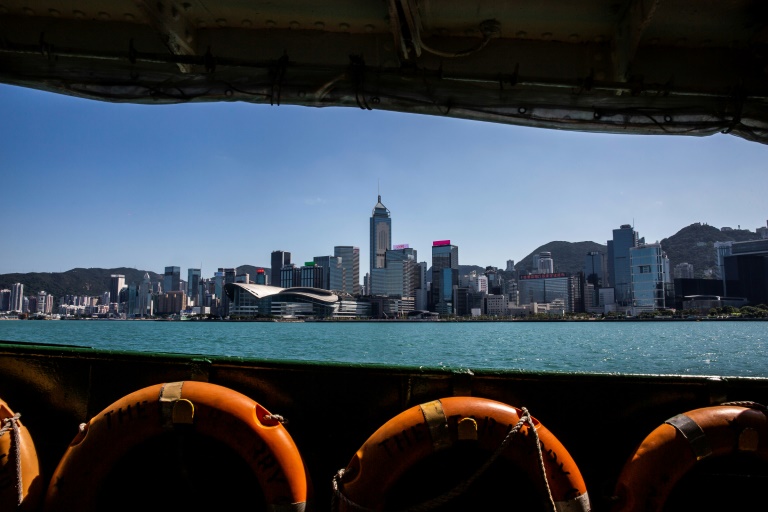
Foreign participants at a high-profile financial summit in Hong Kong next month would be able to skip isolation and leave via “appropriate flight arrangements” if they catch Covid, a top health official said Friday.

The comments followed media reports that attendees — expected to include top executives from some of the world’s most powerful financial institutions — would be allowed to leave on private jets if they test positive for the coronavirus.

Hong Kong is aiming to reassert its position as a global financial hub with the summit, organised by the city’s central bank, after being effectively cut off because of its strict Covid policies — especially for international travellers.

If a summit participant tests positive for the coronavirus, “we will adopt the same isolation arrangements as with other inbound visitors,” Permanent Secretary for Health Thomas Chan told a press conference when asked if any rules would be relaxed for the event.

“But at the same time we will also provide facilitation should there be appropriate flight arrangements for leaving Hong Kong.”

Commercial airlines are restricted from transporting virus-positive passengers to and from Hong Kong.

Bloomberg News had reported Thursday that the Hong Kong government was considering allowing participants at the two-day summit to leave by private jet if they test positive.

Hong Kong has had a difficult three years, with a sweeping crackdown on political freedoms and the imposition of some of the world’s strictest coronavirus pandemic controls, which kept it isolated even as competitors such as Singapore reopened.

It scrapped mandatory hotel quarantine for travellers last month, as warnings grew that the financial hub was suffering brain drain and loss of business.

The Hong Kong Monetary Authority expects to draw 200 participants to the event, including the heads of 30 major financial institutions including Goldman Sachs and Morgan Stanley.

Some Covid restrictions, such as face masks, remain in Hong Kong.

Chief Executive John Lee has not yet outlined a roadmap for full reopening, and has said that the city must remain cautious while relaxing virus curbs.

French climate activists target store lights in Paris night raids

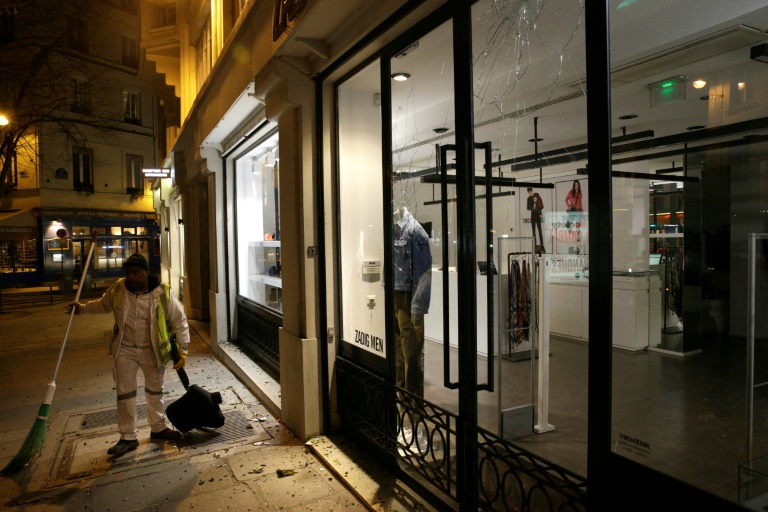
Paris climate activists have found a new way to get across their message against energy waste in the City of Light — switching off store signs and advertising screens that are kept on all night even though the government has urged people to cut back electricity use.

At 9:00 pm on a recent evening, around 20 Extinction Rebellion members gathered for a tactical briefing before spreading out on another night-time raid.

If the police spot them “we absolutely don’t run”, says “Joad,” a 32-year-old veteran of the movement, detailing out the legal risks and advice for those who might be arrested.

“There are 12 million people going cold in France because they can’t heat their homes, and on the other hand we’re wasting this energy on advertising signs that are completely useless consumption,” he tells AFP.

After distributing posters and equipment, including telescopic poles to reach switches for outdoor lights, Joad’s team heads for the lively Marais district, a magnet for both Parisians and tourists, where dozens of retailers have outlets.

Click, and off goes a Levi’s sign. On other storefronts, the group tapes up posters saying “This isn’t Versailles!” — the scolding heard by generations of French children when they leave lights on needlessly.

The team targets opticians, jewellers, perfume boutiques and mattress stores as well as the numerous luminous billboards, prising open the frames to switch them off and replace ads with their own posters.

– ‘Political courage’ –

The government, under pressure as Russia crimps gas exports to Europe, has urged people to show energy “restraint” as winter approaches, notably by lowering home heating thermostats to 19 degrees Celsius (66 degrees Fahrenheit).

It has also issued a decree that illuminated signs and publicity must be turned off from 1:00 am to 6:00 am, starting in June 2023.

The city authorities in Paris have gone further, ordering lights out for signs and advertising from 11:45 pm to 6:00 am from December.

For the climate activists, that’s not soon enough.

“We know this is very symbolic because electricity used by illuminated signs is only a tiny fraction of the energy the country uses,” said “Pikou,” a 36-year-old who also used a pseudonym.

The bigger problem, for Pikou, is the government’s “double-speak”.

“What makes me angry, and that’s why I’m here tonight, is that the government asks ordinary people for restraint, with little gestures like turning their heating down or turning off Wi-Fi, but it doesn’t have the political courage to ask for the same restraint from businesses,” he said.

As the activists progress along the winding Marais streets, their actions often garner applause from passers-by.

“I completely agree with them,” says Federica, a tourist from Milan. Anna, who also stops to watch, call the illuminated signs “a disgrace”.

One store in particular draws the activists’ ire. It is a clothing boutique vaunting its environmental credentials with the slogan “Because there is no Planet B” — alongside three large advertising screens.

The screens are quickly covered with posters.

“This is phase one. It’s about raising awareness and prevention,” says Joad, adding that some store owners respond with messages of support and promises to turn the lights off.

“For those who keep the lights on and continue this wastage, we’ll advance to phase two, which will be a bit bolder, starting in December.”

Google fined $162 mn by Indian watchdog over market dominance

Google has been fined more than $160 million by India’s anti-trust watchdog after a probe found the tech behemoth was abusing its commanding position in the local smartphone market. 

The California-based company’s Android mobile operating system is by far the dominant player in India and is run on 95 percent of all the country’s smartphones, according to research agency Counterpoint.

But the Competition Commission of India (CCI) said the operating system was configured to unlawfully crowd out rivals to YouTube, web browser Chrome and other popular Google apps.

Android had a suite of Google apps pre-installed on its phones, including the company’s own search engine, “which accorded significant competitive edge to Google’s search services over its competitors”, a CCI statement said late Thursday. 

“Markets should be allowed to compete on merits and the onus is on (Google) that its conduct does not impinge this competition on merits,” it added. 

The commission levied a fine of 13.4 billion rupees ($162 million) and instructed the company to allow Android users to remove pre-installed Google apps. 

It also told Google not to enter into any agreement with smartphone makers that would encourage them to only sell Android-based devices or exclusively use its software.

The company said it would review the decision and weigh its next moves.

“The CCI’s decision is a major setback for Indian consumers and businesses, opening serious security risks for Indians… and raising the cost of mobile devices,” a spokesperson told AFP. 

Google faced a similar anti-trust ruling in the European Union that found the company had imposed “unlawful restrictions” on smartphone makers to benefit its search engine. 

Last month the EU’s second-highest court upheld a $4.1 billion fine against the company. 

Global regulators have followed suit, with Google facing a barrage of cases in the United States and Asia based on similar accusations.

India is home to the second-highest number of smartphone users in the world, after China.

Its smartphone market grew 27 percent year on year in 2021, according to Counterpoint, with annual sales exceeding 169 million units.

More than 60 percent of phones sold in the country come from leading Chinese manufacturers including Xiaomi and Oppo.  

Apple remains a minor player in the budget-conscious market but has seen some inroads in recent years, and the company last month announced plans to locally manufacture its flagship iPhone 14. 

As Ukrainians advance, Russians risk losing prized Kherson city

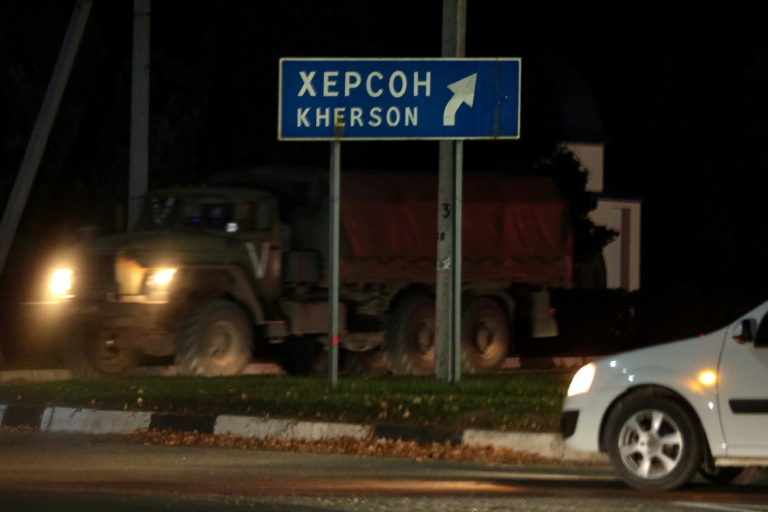
Advancing Ukrainians have vowed to wrest back the southern city of Kherson from the Russians but analysts say Moscow may be reluctant to give up one of its biggest trophies since the February invasion.

On March 3, barely a week into the cross-border assault, Russian troops captured Kherson, the regional centre of the southern Ukrainian province of the same name.

It was the first major city to fall to Moscow’s forces, providing them with a bridgehead on the western banks of the Dnipro river from which Russian troops could launch attacks for more territory further west.

“It’s a strategic point. It’s a connexion point between the Dnipro and the rest of the country,” said Olga Chiriac, a researcher at the Middle East Institute.

But today a Ukrainian counteroffensive is creeping closer to the city, threatening to deprive Moscow of the only provincial capital it has occupied in the invasion.

Pro-Russian authorities in the city have ordered residents to evacuate. And on Friday they accused Kyiv’s forces of killing four people when they shelled a bridge linking both sides of the river, though a Ukrainian military spokeswoman denied that they had killed any civilians.

Ukrainian President Volodymyr Zelensky has in turn accused Russia of planning to destroy a hydroelectric dam upstream from the city, in what would amount to a “catastrophe on a grand scale”.

He said hundreds of thousands of people around the Dnipro would be in danger of flash flooding.

And cutting water supplies could also impact the cooling systems of the Zaporizhzhia nuclear power plant, Europe’s largest.

– Russians ‘at a dead end’ –

It is not yet clear whether the Russians will hold on to Kherson or retreat eastwards across the river.

For the moment, Russia controls a strip around 140 kilometres (90 miles) long along the western bank of the Dnipro river.

It has bolstered its presence with a huge number of seasoned soldiers, who would have the advantage and be able to inflict terrible losses if the Ukrainians decided to attack the city.

But with a river within Ukrainian artillery range separating the Russians from their fall-back positions, they also risk being encircled.

In short, said former Romanian military intelligence officer Valentin Mateiu, Russia had troops that were competent “but at a dead end”. 

Its forces were at a “strategic disadvantage”, after Ukrainian soldiers managed to seize their own foothold beyond a Dnipro tributary to the north of the city, from which they might cut off Russian-held territory.

Ukrainians earlier in the war “systematically prepared the battlefield”, destroying bridges and command centres for example, he said, and could likely do the same again.

He and Chiriac nevertheless thought the Russians would do their best to hold on to the city.

“The Russians will try to avoid being encircled and turn Kherson into a centre of resistance,” Mateiu said.

– ‘Risk a new Mariupol’? –

Ukrainian analyst Mykhailo Samus said Moscow’s troops should have been evacuated “a long time ago”.

But he thought it was unlikely that the Ukrainians would want to attack the Russian-held city, where tens of thousands of residents remain.

“The Ukrainians won’t conduct any battle for Kherson. They don’t attack and destroy cities like Russia, like Mariupol,” he said, referring to the city pounded to rubble by the Russians earlier in the war.

Retired US general Ben Hodges agreed the Ukrainians were likely to avoid a “giant fight inside the city”.

Instead, they are “keeping these Russian troops fixed there so that they cannot escape, and at some point… they’ll be ready to bypass the Russians inside Kherson”, he said.

Pierre Grasser, a researcher tied to Paris’ Sorbonne University, said the Ukrainians were having to carefully weigh up their movements outside the city.

Any closer and “they will be entering the Kherson suburbs, and that could be dangerous”, he said.

“Urban warfare always leads to many deaths on the attacker’s side” and “it would risk a new Mariupol” in terms of damage.

Mateiu said the commander-in-chief of Ukraine’s armed forces, Valeriy Zaluzhnyi, was facing a dilemma.

“The president wants this strategic victory”, especially since it would pave the way towards retaking Ukraine’s Crimea peninsula annexed by Russia in 2014, he said. 

That leaves the army chief with what retired French general Michel Yakovleff described as a terrible choice — “besiege (the city) for as long as it takes or annihilate it and reduce it to rubble”.

Russia says 'fortress' Kherson readying for Ukraine attack

Kremlin proxy officials said Friday they were building up defences and turning Ukraine’s southern city of Kherson into a “fortress” as Kyiv’s forces advance and Russia pulls residents from the region.

The claim came as Ukraine’s President Volodymyr Zelensky said Moscow’s troops were preparing to destroy a hydroelectric dam in the southern Kherson region, in what would amount to a “catastrophe on a grand scale”.

Ukrainian forces in recent weeks — aided by Western weapons — have been advancing along the west bank of the Dnieper river towards the region’s main city, also called Kherson.

Kherson was the first major city to fall to Moscow’s troops since the February invasion began and retaking it would be a crucial prize in Ukraine’s counter-offensive.

Moscow-installed authorities in Kherson accused Kyiv’s forces of killing people by shelling a bridge.

“Four people were killed,” pro-Moscow official Kirill Stremousov said on Telegram. “The city of Kherson, like a fortress, is preparing for its defence.”

A Ukrainian military spokeswoman Nataliya Gumenyuk denied Kyiv’s forces were responsible, saying they do not target local populations.

Russian state-run media in recent days had aired footage showing civilians with bags taking ferries across the river from Kherson.

– Risks of disasters –

Kyiv has branded the organised movement of Kherson residents to Russia and other Moscow-controlled regions as “deportations” of Ukrainian citizens.

Zelensky said late Thursday that Russian forces had mined the Kakhovka hydroelectric power plant with the intent of blowing it up.

Hundreds of thousands of people around the lower Dnipro River would be in danger of flash flooding if the dam was destroyed, Zelensky warned in a speech Thursday to European leaders.

He said cutting water supplies to the south could also impact the cooling systems of the Zaporizhzhia nuclear power plant, Europe’s largest.

The nuclear facility is a key concern of Russia’s eight-month invasion with both sides regularly accusing the other of shelling near it and endangering operations.

Ukraine’s push in the south comes after a sweeping counter-offensive in the northeast Kharkiv region that has badly impaired Russia’s supply routes and logistics corridors in the eastern Donbas region.

But Russian forces have continued shelling the region’s largest city, Kharkiv, and the presidency said Friday that “industrial infrastructure” was hit in the city, wounding six.

The attack is the latest in a weeks-long barrage that has targeted infrastructure and particularly energy facilities.

Energy-saving measures were put in place across the country after Russian missile and drone strikes destroyed what Zelensky said was more than 30 percent of the country’s power stations in a week.

– Resilient Ukraine –

A 64-year-old Ukrainian, Vyacheslav, told AFP in Kyiv that the nation would make do, despite the restrictions.

“There are books to read. There battery-powered lights. I think we can hold out for a few hours. There are gas stoves so it will still be possible to cook,” he said, but declined to give his full name.

Kyrylo, a 27-year-old shop salesman, said that there had been a rush on power banks after Russian attacks began on the energy facilities in the capital.

“We don’t sell flashlights but regarding power banks, I can say that on the 10th, when the attack on Kyiv began, almost all available power banks were sold, and in general, the demand for power banks increased by 70 or 80 percent,” he added.

The Ukraine presidency said Friday that Russian forces were continuing to shell sections along the entire frontline of Donbas in east Ukraine and that two people were killed in the Donetsk region.

Close Bitnami banner
Bitnami