US Business

Supreme Court ponders the fate of pigs, high cost of bacon

A California law aimed at reducing animal suffering on pig farms led to some unusual exchanges Tuesday in the US Supreme Court.

Following a grassroots referendum, California passed an animal welfare measure in 2018 that bans the sale of pork from pigs that were raised in overly confined spaces.

The pork industry had gone to court accusing California — which produces little of the pork it consumes — of restricting interstate commerce and trying to impose its values on other US states.

The sector fears that California will effectively set national standards for conditions in which farm animals, including cows and chickens, are kept, thus raising ham and bacon prices for consumers.

Pork producers, after being rejected by state courts, turned to the Supreme Court, which seemed baffled by the case.

For nearly two hours, the nine justices pondered the criteria that would allow comparable cases to be resolved in the future.

The result was a series of highly political hypothetical scenarios.

Progressive Justice Elena Kagan wondered what would happen if Democratic states banned the sale of goods made by non-unionized workers.

Her conservative colleague Amy Coney Barrett imagined that they would ban goods from companies that did not fund medical care for their transgender employees.

Judge Brett Kavanaugh, meanwhile, speculated that Republican states might ban products created by undocumented immigrants.

Perplexity peaked when Justice Sonia Sotomayor noted that the pork market was already regulated. 

“We have marketed already pork marked as organic, crate-free, antibiotic-free and beta-agonist free,” she said. “I have no idea what that means, but I know it’s there. I’ve seen it in supermarkets.”

The high court will return a decision before June 30. 

Equities, oil prices slide on recession fears

Stock markets mostly slid and oil prices tumbled Tuesday as markets contend with growing recession worries with the Federal Reserve and other central banks moving aggressively to counter inflation.

A downcast IMF report highlighted the risks of elevated inflation and other fallout from Russia’s invasion of Ukraine.

The mood darkened also on new China Covid-19 crackdowns and continued upheaval in British financial markets.

With the focus on inflation, analysts said US consumer price index data released later this week will be crucial to the direction of risk assets. 

Another big reading could spark a fresh equity selloff and a surge in the dollar.

“There is growing pessimism in the markets now and with some big data points to come from the US this week, not to mention the start of earnings season,” noted Craig Erlam, analyst at OANDA trading group.

“Investors should probably brace for more volatility.”

Traders had hoped that bumper rate increases by the US Federal Reserve this year would begin to drag on the economy and slow runaway prices, allowing policymakers to reduce the pace of monetary tightening.

But a forecast-beating US jobs report on Friday highlighted the tough work the country’s central bank has slowing inflation from four-decade highs, and many observers warn recession is virtually inevitable.

World Bank chief David Malpass said Monday there was a “real danger” of a global contraction next year, adding that the surge in the dollar was weakening the developing nations’ currencies and pushing their debt to “burdensome” levels.

In its latest forecasts released on Tuesday, the IMF trimmed its 2023 global growth forecast to 2.7 percent. It left its world growth forecast for this year unchanged at 3.2 percent.

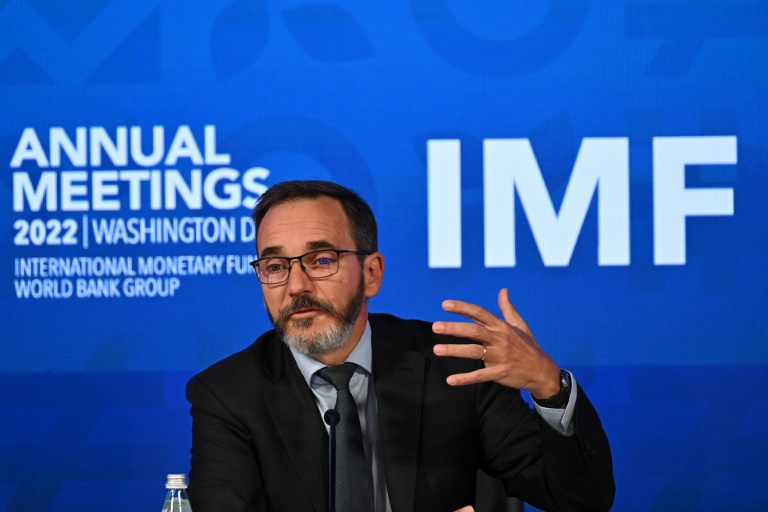
But the IMF’s economic counsellor Pierre-Olivier Gourinchas also warned that more than a third of the global economy is headed for contraction this year or next, and the three biggest economies –- the United States, European Union and China –- will continue to stall.

“The worst is yet to come and, for many people 2023 will feel like a recession,” said Gourinchas.

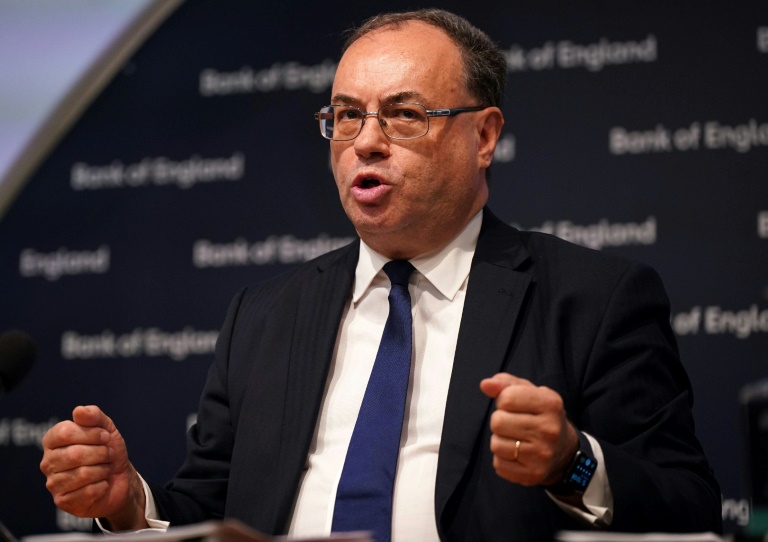
Europe’s main equity markets closed lower, while the S&P 500 fell for the fifth straight day, sagging after comments by Bank of England Governor Andrew Bailey that the central bank would end emergency bond-buying efforts on Friday, rebuffing calls for a longer program to allow markets to stabilize.

“We think the rebalancing must be done and my message to the funds involved and all the firms involved managing those funds: you’ve got three days left now,” Bailey said.

“You’ve got to get this done,” he said at an appearance at the Institute of International Finance, a Washington trade group. 

Bailey’s statement also weighed on the pound, which retreated after earlier posting gains on the dollar following the BoE’s interventions announced earlier Tuesday.

Oil prices also fell, with concerns about Chinese demand front and center.

“Covid cases are picking up in the country, and the Chinese Communist Party’s newspaper, the People’s Daily, ran a commentary saying the Covid Zero policy is ‘sustainable’, indicating that the country is likely to keep following it if not double down,” said Stephen Innes at SPI Asset Management. 

– Key figures around 2050 GMT –

New York – Dow: UP 0.1 percent at 29,239.19 (close)

New York – S&P 500: DOWN 0.7 percent at 3,588.84 (close)

New York – Nasdaq: DOWN 1.1 percent at 10,426.19 (close)

London – FTSE 100: DOWN 1.1 percent at 6,885.23 (close)

Frankfurt – DAX: DOWN 0.4 percent at 12,220.25 (close)

Paris – CAC 40: DOWN 0.1 percent at 5,833.20 (close)

EURO STOXX 50: DOWN 0.5 percent at 3,340.35 (close)

Tokyo – Nikkei 225: DOWN 2.6 percent at 26,401.25 (close)

Hong Kong – Hang Seng Index: DOWN 2.2 percent at 16,832.36 (close)

Shanghai – Composite: UP 0.2 percent at 2,979.79 (close)

Euro/dollar: UP at $0.9709 from $0.9702 on Monday

Pound/dollar: DOWN at $1.0972 from $1.1055

Euro/pound: UP at 88.46 pence from 87.76 pence

Dollar/yen: UP at 145.83 yen from 145.72 yen

West Texas Intermediate: DOWN 2.0 percent at $89.35 per barrel

Brent North Sea crude: DOWN 2.0 percent at $94.29 per barrel

burs-jmb

Death penalty 'appropriate sentence' for Parkland shooter: prosecutor

Nikolas Cruz, who shot and killed 17 people at a Florida high school on Valentine’s Day in 2018, planned and carried out a “systematic massacre,” a prosecutor arguing for the death penalty said Tuesday.

“What he wanted to do, what his plan was, and what he did, was to murder children at school and their caretakers,” assistant state attorney Michael Satz said in closing arguments at the sentencing trial of the 24-year-old Cruz.

“It was calculated. It was purposeful. And it was a systematic massacre,” Satz said.

“And he picked Valentine’s Day to do it,” he told a hushed courtroom packed with family members of those gunned down at Marjory Stoneman Douglas High School in Parkland, a town north of Miami.

Satz recounted the day of the massacre in harrowing detail as Cruz stared down at the table in front of him with his head in his hand.

The 80-year-old Satz, who came out of retirement to try the case, ended his closing arguments by reciting the names of the 17 people who died.

“The appropriate sentence for Nikolas Cruz is the death penalty,” he said.

Cruz pleaded guilty to the shooting and it is up to the jury to decide whether he receives the death penalty or life in prison.

If the jury of seven men and five women does not vote unanimously for capital punishment, Cruz will be sentenced to life in prison with no possibility of parole.

The jury is to begin deliberations on Wednesday and will be sequestered until they reach a decision.

– ‘Doomed from the womb’ –

Melisa McNeill, a lawyer for Cruz, urged the jurors to show compassion for a troubled young man who was born with fetal alcohol stress disorder and put up for adoption by a mother who was homeless, alcoholic and drug-addicted.

“He was doomed from the womb and in a civilized, humane society, do we kill brain-damaged, mentally ill, broken people?” McNeill asked. “Do we? I hope not.”

“The state of Florida wants to put you in a place of hate and anger and vengeance,” she said.

Quoting the late South African bishop Desmond Tutu, McNeill said: “To take a life when a life has been lost is revenge, not justice.”

“This is your individual moral decision,” she added.

On February 14, 2018, the then 19-year-old Cruz walked into school carrying a high-powered AR-15 rifle. He had been expelled a year earlier for disciplinary reasons.

In a matter of nine minutes, he killed 14 students and three staff members, then fled by mixing in with people frantically escaping the gory scene.

Police arrested Cruz shortly thereafter as he walked along the street.

The shooting stunned the nation and reignited debate on gun control since Cruz had legally purchased the gun he used despite his history of mental issues.

On March 24, 2018, nationwide marches inspired by school shooting survivors and parents of victims brought together 1.5 million people — the largest public turnout ever in defense of stricter gun control laws in America.

But the Parkland shooting prompted no significant reform and gun sales have continued to rise.

There have been more mass shootings, including one in May that left 19 young children and two adults dead at an elementary school in Uvalde, Texas.

After the latest shootings, Congress did pass legislation to increase funding for school security and mental health care.

BoE chief says '3 days left' on bond intervention

Bank of England chief Andrew Bailey said Tuesday bond investors have “three days left” until the British central bank phases out emergency bond-buying efforts.

“We think the rebalancing must be done and my message to the funds involved and all the firms involved managing those funds: you’ve got three days left now,” Bailey said.

“You’ve got to get this done,” he said at an appearance at the Institute of International Finance, a Washington trade group. 

The comments, which rebuffed calls from some investor groups for a longer program to allow markets to stabilize, sent the pound sharply lower.

The statement was a reiteration of the timetable on the emergency program, which was expanded earlier Tuesday by the central bank in the latest in a series of responses to upheaval in financial markers.

“We’ve been up all nights in recent days working how to solve the problem,” Bailey said. “That’s a financial stability intervention.”

This week’s actions are a fresh bid to soothe the bond markets in particular, as state borrowing — and its costs — soar following finance minister Kwasi Kwarteng’s debt-fueled mini-budget last month.

The poor market response to it saw UK bond yields spike and the pound tumble to a record low against the dollar, prompting the BoE to step in over recent weeks vowing to protect the nation’s financial stability.

The Bank of England on Monday revealed it was launching a temporary facility aimed at easing liquidity pressures, and followed that up Tuesday by announcing plans to expand the program to include index-linked securities.

The Pensions and Lifetime Savings Association praised the BoE’s latest manuevers but said in a statement Tuesday that the “purchasing should not be ended too soon,” adding that “many” have called for the program to be prolonged to “31 October and possibly beyond.”

Near 2000 GMT, the pound was at $1.0987, down 0.6 percent from the prior day.

France threatens to break refinery blockades in strike standoff

The French government warned Tuesday striking workers could soon be forced to return to their jobs to break blockades of paralysed oil refineries and fuel depots.

Motorists again besieged petrol stations that are either low on fuel or completely dry as the labour protest at energy giant TotalEnergies and Esso-ExxonMobil entered its third week.

Government ministers have urged a negotiated resolution to the crisis, but have been threatening direct intervention to get supplies flowing again if agreements are not reached soon.

On Tuesday evening TotalEnergies offered to consult unions whose workers were not on strike.

And France’s oil giant renewed an offer to the hard-left CGT union leading the strike to negotiate if its members returned to work.

“If the CGT removes the blockades of the sites before midday (1000 GMT) tomorrow, it will be welcome at this dialogue meeting,” a Total statement said.

Earlier in the day, Prime Minister Elisabeth Borne told parliament workers would be requisitioned in particular at two depots owned by Esso-ExxonMobil, and face fines or jail time if they refuse.

Unions representing overall staff at the company accepted a pay deal Monday, but the CGT and FO unions at the depots rejected it and voted to extend their stoppage.

“Social dialogue means moving forward as soon as a majority agrees,” Borne told lawmakers. “I have asked officials to begin, as allowed by law, requisitions of essential staff for operating this company’s depots.”

Government spokesman Olivier Veran had already warned Tuesday that strikers at TotalEnergies could also be forced back, calling the strike “excessive and out of line”.

The company has said it is willing to advance annual pay negotiations to this month.

But Eric Sellini, CGT coordinator at the oil major, said: “We are still waiting for details from management on what they want to negotiate on.”

His union wants a 10-percent pay hike for all of 2022, pointing to the company’s profit of $5.7 billion in the second quarter of the year, more than double the year-earlier figure.

– ‘They don’t respect us’ –

The stoppages have hit several key refineries, including France’s biggest near Le Havre in the north.

The company runs a network of around 3,500 filling stations in France, nearly a third of the total.

At Fos-sur-Mer, in southern France, home to refineries run by TotalEnergies and Esso, strikers said their working conditions had been getting worse for years.

“For the past 10 years we have not been getting the slightest recognition for our work,” said one man who joined Esso 24 years ago.

“Not only don’t they pay us enough, they also don’t respect us,” agreed CGT spokesman Fabien Cros at the neighbouring Total installation.

Franck Tinel, FO secretary for Esso at the site, said the threat of forcing workers back to work would have only a limited impact.

“They’re going to unblock internal depots for these refineries, but we’re not storage sites, so in fact these volumes will be used up quickly,” he said after Borne’s intervention.

Other workers acknowledged that tensions could rise further if the government began ordering refinery workers back.

– ‘We can’t work’ –

Long queues formed outside petrol stations from dawn Tuesday, with many people using social media to exchange tips on the best places to go.

One post in a Facebook group Monday said a local BP service station would be resupplied “at 2:30 pm”. Another replied: “It’s now 2:37 pm and they’re out of diesel.”

Jefferson Saint-Louis, a taxi driver, said “without fuel we can’t work. I’m just going to go home”.

The crisis comes at a time of high energy prices and inflation that are sapping French households’ purchasing power.

The frustrations could add impetus to a “march against the high cost of living” in Paris and elsewhere on Sunday, called by the left-wing opposition coalition Nupes.

At the weekend, several prominent French people came out in support of the initiative, including this year’s winner of the Nobel Prize for Literature, Annie Ernaux.

“With this government, when dialogue stalls, it’s threats for the wage earners and caresses for the bosses,” tweeted Manuel Bompard, a deputy for the left-wing LFI party.

burs-jh/js/bp/imm

NASA spaceship deflected asteroid in test to save Earth

NASA on Tuesday said it had succeeded in deflecting an asteroid in a historic test of humanity’s ability to stop an incoming cosmic object from devastating life on Earth.

The fridge-sized Double Asteroid Redirection Test (DART) impactor deliberately smashed into the moonlet asteroid Dimorphos on September 26, pushing it into a smaller, faster orbit around its big brother Didymos, said NASA chief Bill Nelson.

“DART shortened the 11 hour 55 minute orbit to 11 hours and 23 minutes,” he said. Speeding up Dimorphos’ orbital period by 32 minutes exceeded NASA’s own expectation of 10 minutes.

“We showed the world that NASA is serious as a defender of this planet,” added Nelson.

The asteroid pair loop together around our Sun every 2.1 years, and pose no threat to our planet.

But they are ideal for studying the “kinetic impact” method of planetary defense, in case an actual approaching object is ever detected.

DART’s success as a proof-of-concept has made a reality of science fiction — notably in films such as “Armageddon” and “Don’t Look Up.” 

Astronomers rejoiced in stunning images of matter spreading out thousands of miles in the wake of the impact — pictures collected by Earth and space telescopes, as well as a mini satellite that had traveled to the zone with DART.

– Pseudo-comet –

Thanks to its temporary new tail, Dimorphos, which is 530-foot (160-meter) in diameter or roughly the size of a big Egyptian pyramid, has turned into a manmade comet.

But quantifying just how well the test worked required an analysis of light patterns from ground telescopes, which took a few weeks to become apparent.

The binary asteroid system, which was around 6.8 million miles (11 million kilometers) from Earth at impact, is visible only as a single dot from the ground.

Ahead of the test, NASA scientists said the results of the experiment would reveal whether the asteroid is a solid rock, or more like a “rubbish pile” of boulders bound by mutual gravity.

If an asteroid is more solid, the momentum imparted by a spaceship will be limited. But if it is “fluffy” and significant mass is pushed at high velocity in the opposite direction to impact, there will be an additional boost.

Never actually photographed before, Dimorphos appeared as a speck of light around an hour before impact.

Its egg-like shape and craggy, boulder-dotted surface finally came into clear view in the last few moments, as DART raced toward it at roughly 14,500 miles (23,500 kilometers) per hour.

– Mass extinction –

Very few of the billions of asteroids and comets in our solar system are considered potentially hazardous to our planet, and none are expected in the next hundred years or so. 

But wait long enough, and it will happen.

The geological record shows, for example, that a six-mile wide asteroid struck Earth 66 million years ago, plunging the world into a long winter that led to the mass extinction of the dinosaurs along with 75 percent of all species.

An asteroid the size of Dimorphos, by contrast, would only cause a regional impact, such as devastating a city.

Kinetic impact with a spaceship is just one way to defend the planet, albeit the only method possible with current technology.

Should an approaching object be detected early, a spaceship could be sent to fly alongside it for long enough to divert its path via using the ship’s gravitational pull, creating a so-called gravity tractor.

Another option would be launching nuclear explosives to redirect or destroy an asteroid.

NASA believes the best way to deploy such weapons would be at a distance, to impart force without blowing the asteroid to smithereens, which could further imperil Earth.

BoE struggles to calm markets after latest intervention

The Bank of England struggled Tuesday to reassure investors after unveiling yet more measures to calm markets rocked by the British government’s tax-cutting mini-budget, as the International Monetary Fund renewed warnings about their divergent policies.

The day after it launched a temporary facility aimed at easing liquidity pressures, the central bank said it was now widening the scope of its daily purchases of UK government bonds, or gilts, until Friday to include index-linked securities.

Comprising around a third of such bonds, they see their value and interest rates fluctuate with UK inflation and can have an outsized impact on pension funds which invest heavily in government bonds. 

This week’s actions are a fresh bid to soothe the bond markets in particular, as state borrowing — and its costs — soar following finance minister Kwasi Kwarteng’s debt-fuelled mini-budget last month.

The poor market response to it saw UK bond yields spike and the pound tumble to a record low against the dollar, prompting the BoE to step in over recent weeks vowing to protect the nation’s financial stability.

In a surprise September 28 move, it announced it was temporarily buying up tens of billions of pounds of long-dated UK government bonds “to restore orderly market conditions”.

Its latest action Tuesday would “act as a further backstop to restore orderly market conditions”, the central bank said.

– ‘Dysfunction’ –

It noted that “the beginning of this week has seen a further significant repricing of UK government debt, particularly index-linked gilts”, which it will now buy under its wider operation of bond purchases.

“Dysfunction in this market, and the prospect of self-reinforcing ‘fire sale’ dynamics pose a material risk to UK financial stability,” it added.

But in a sign that investors remained wary of the UK’s ability to repay long-term debts, the 30-year government borrowing rates have risen again in recent weeks and reached 4.73 percent early Tuesday afternoon.

AJ Bell investment director Russ Mould noted a key problem was that “the support measures are only scheduled to last until Friday”. 

“Extending it could go one of two ways — the market either applauds the move and breathes a sigh of relief or it gets even more worried, thinking the extra time suggests the crisis is more severe than originally thought.”

In some positive news, official data Tuesday revealed British unemployment fell to a near 50-year low at 3.5 percent.

Wages, however, continue to be eroded by decades-high inflation that threatens to send Britain into recession.

The British government on Monday brought forward key growth and inflation forecasts to Halloween, hoping not to spook markets further.

Finance minister Kwarteng will unveil debt-reduction plans and UK economic predictions on October 31 rather than in late November.

It comes after he was already forced to axe a tax cut for the richest earners, in the face of outrage as millions of Britons face a cost-of-living crisis with UK inflation around 10 percent.

– ‘Different direction’ –

However, in Washington, IMF economic counsellor Pierre-Olivier Gourinchas said the divergence between BoE monetary policy and the UK government’s tax-slashing fiscal plans was “a little bit difficult”.

“It’s like having a car with two people in the front, and each of them is steering the wheel, and trying to steer the car in a different direction,” he told reporters. “That’s not going to work very well.”

The IMF, among others, has previously criticised the mini-budget over fears that government debt would balloon to pay for the tax cuts.

It added to the gloom Tuesday with a new forecast that UK economic growth would slow sharply to just 0.3 percent in 2023 — and warned the budget would “complicate” efforts to fight inflation.

Fitch last week lowered the outlook on its credit rating for British government debt to negative from stable.

The BoE has piled on further pressure by ramping up its main interest rate to a 14-year high of 2.25 percent in a bid to cool inflation — and is expected to hike even further next month.

This in turn has seen retail banks ramp up interest rates on mortgages, with analysts predicting heavy price falls for property.

Britain meanwhile faces “painful” cuts in public spending to fix state finances should it decide against more U-turns over tax cuts, a leading think tank warned.

“With a weaker economy, getting government finances on a sustainable path without cancelling tax cuts could force… big and painful spending cuts,” the Institute for Fiscal Studies said in a study.

France threatens to break refinery blockades in strike standoff

The French government warned Tuesday that it could move to break blockades of refineries and fuel depots paralysed by strikes, saying it would soon force some of the workers to return to their jobs.

Motorists again besieged petrol stations that are either low on fuel or completely dry as the labour protest at energy giant TotalEnergies and Esso-ExxonMobil entered its third week.

Government ministers have urged a negotiated resolution to the crisis, but have been threatening direct intervention to get supplies flowing again if agreements are not reached soon.

On Tuesday, Prime Minister Elisabeth Borne told parliament that workers would be requisitioned in particular at two depots owned by Esso-ExxonMobil, and face fines or jail time if they refuse.

Unions representing overall staff at the company accepted a pay deal Monday, but the hard-left CGT and FO unions at the depots rejected it and voted to extend their strike.

“Social dialogue means moving forward as soon as a majority agrees,” Borne told lawmakers. “I have asked officials to begin, as allowed by law, requisitions of essential staff for operating this company’s depots.”

Earlier, government spokesman Olivier Veran said striking workers at TotalEnergies could also be forced back, calling the strike “excessive and out of line”.

The company has said it is willing to advance annual pay negotiations to this month.

But Eric Sellini, coordinator for the CGT union at the oil major, said: “We are still waiting for details from management on what they want to negotiate on.”

His union demands a 10 percent pay hike for all of 2022, pointing to the company’s profit of $5.7 billion in the second quarter of the year, more than double the year-earlier figure.

– ‘They don’t respect us’ –

The stoppages have hit several key refineries, including France’s biggest near Le Havre in the north of the country, after strikers at TotalEnergies voted to extend their action.

The company runs a network of around 3,500 filling stations in France, nearly a third of the total.

At Fos-sur-Mer, in southern France, home to refineries run by TotalEnergies and Esso, strikers said their working conditions had been getting worse for years.

“For the past 10 years we have not been getting the slightest recognition for our work,” said one worker who joined Esso 24 years ago.

“Not only don’t they pay us enough, they also don’t respect us,” agreed CGT spokesman Fabien Cros at the neighbouring TotalEnergies installation.

Franck Tinel, the FO secretary for Esso at the site, said the threat of forcing workers back to work would have only a limited impact.

“They’re going to unblock internal depots for these refineries, but we’re not storage sites, so in fact these volumes will be used up quickly,” he said after Borne’s announcement.

But other workers acknowledged that tensions could rise further if the government began ordering refinery workers back.

– ‘We can’t work’ –

Motorists formed long queues outside petrol stations from dawn Tuesday, hoping to be served before the pumps closed.

Many used social media to exchange tips. One post in a Facebook group Monday said a local BP service station would be resupplied “at 2:30 pm”. Another replied: “It’s now 2:37 pm and they’re out of diesel.”

Jefferson Saint-Louis, a taxi driver, said “without fuel we can’t work. I’m just going to go home”.

The petrol crisis comes at a time of high energy prices and inflation that are sapping French households’ purchasing power.

The frustrations could add impetus to a “march against the high cost of living” in Paris and elsewhere on Sunday, called by the leftwing opposition coalition Nupes.

At the weekend, several prominent French people came out in support of the initiative, including this year’s winner of the Nobel Prize for Literature, Annie Ernaux.

“With this government, when dialogue stalls, it’s threats for the wage earners and caresses for the bosses,” tweeted Manuel Bompard, a deputy for the leftwing LFI party.

burs-jh/js/raz

Murder charges dropped in 'Serial' podcast case

Prosecutors in the US city of Baltimore dropped charges on Tuesday against a man who served over two decades in prison for his ex-girlfriend’s murder — a case that drew worldwide attention thanks to the hit podcast “Serial.”

The Maryland public defender’s office said the state’s attorney had dropped murder charges facing Adnan Syed, 41, who had been serving a life sentence since 2000 for the 1999 murder of Hae Min Lee.

“We can confirm that the charges were dropped,” Tammy Jarnagin of the public defender’s office said in an email to AFP.

Baltimore City Circuit Court Judge Melissa Phinn tossed out Syed’s conviction last month at the request of the Baltimore City state’s attorney, Marilyn Mosby, and ordered his immediate release.

Mosby had asked the court to vacate Syed’s conviction while a further investigation into Lee’s murder was carried out.

“The state has lost confidence in the integrity of his conviction,” assistant state’s attorney Becky Feldman said. “We need to make sure we hold the correct person accountable.”

Feldman told the judge the decision was prompted by the discovery of new information regarding two alternative suspects and the unreliability of cell phone data used to convict Syed.

The state had also been awaiting the results of new DNA tests on Lee’s clothing before deciding whether to drop all charges or organize a new trial.

Prosecutors had 30 days to either bring new charges against Syed or dismiss the case.

– Honor students –

Lee’s body was found buried in February 1999 in a shallow grave in the woods of Baltimore, Maryland. The 18-year-old had been strangled.

Syed has steadfastly maintained his innocence but his multiple appeals had been denied, including by the US Supreme Court which declined in 2019 to hear his case.

Syed’s case earned global attention when it was taken up in 2014 by “Serial,” a weekly podcast that saw a journalist revisit his conviction and cast doubt on his guilt.

It has also been the subject of a four-part documentary on the HBO channel called “The Case Against Adnan Syed.”

The “Serial” podcast — a mix of investigative journalism, first-person narrative and dramatic storytelling — focused its first season on Syed’s story in 12 nail-biting episodes.

Both Syed and Lee were high school honor students and children from immigrant families — he Pakistani, she South Korean — who had concealed their relationship from their conservative parents.

Prosecutors said during the trial that Syed was a scorned lover who felt humiliated after Lee broke up with him.

IMF cuts 2023 global growth, warns major economies to stall

Global growth is expected to slow further next year, the IMF said Tuesday, downgrading its forecasts as countries grapple with the fallout from Russia’s invasion of Ukraine, spiraling cost-of-living and economic downturns.

The world economy has been dealt multiple blows, with the war in Ukraine driving up food and energy prices following the coronavirus outbreak, while soaring costs and rising interest rates threaten to reverberate around the globe.

“This year’s shocks will re-open economic wounds that were only partially healed post-pandemic,” said International Monetary Fund economic counsellor Pierre-Olivier Gourinchas in a blog post accompanying the fund’s latest World Economic Outlook.

More than a third of the global economy is headed for contraction this year or next, and the three biggest economies –- the United States, European Union and China –- will continue to stall, he warned.

“The worst is yet to come and, for many people 2023 will feel like a recession,” said Gourinchas.

In its report, the IMF trimmed its 2023 global GDP growth forecast to 2.7 percent, 0.2 point down from July expectations.

Its world growth forecast for this year remains unchanged at 3.2 percent.

The global growth profile is its weakest since 2001, apart from during the global financial crisis and the worst of the pandemic, the IMF said.

This reflects slowdowns for the biggest economies, including a US GDP contraction in the first half of 2022 and continued lockdowns in China as it faces a property market crisis.

– Laser focus –

A key factor behind the slowdown is a shift in policy as central banks try to bring down soaring inflation, with higher interest rates starting to take the heat out of domestic demand.

Growing price pressures are the most immediate threat to prosperity, said Gourinchas in the report, adding that central banks are now “laser-focused on restoring price stability”.

Global inflation is expected to peak at 9.5 percent this year before dropping to 4.1 percent by 2024.

Misjudging the persistence of inflation could prove detrimental to future macroeconomic stability, he warned, “by gravely undermining the hard-won credibility of central banks.”

Asked about the Federal Reserve’s rate hikes, Gourinchas told a press briefing on Tuesday that the IMF is not calling for an acceleration, but this “doesn’t mean that they should pause on the path… that we’ve seen” either. 

This is because banks were starting from a point where rates were historically low as countries emerged from the pandemic, he said.

Current challenges do not mean a large downturn is inevitable, but the fund also warned many low-income countries are either in, or close to debt distress.

While the G20 has agreed on a “common framework” for debt restructuring for the poorest countries, only three have qualified and “more progress is needed,” Gourinchas told reporters.

“Time may soon be running out,” he said.

– Slowdown in major economies –

The IMF has also cut forecasts for the world’s two biggest economies, the United States and China.

US economic growth for this year is now pegged at 1.6 percent, 0.7 point below the fund’s July forecast, due to an “unexpected real GDP contraction in the second quarter,” the IMF said.

“Declining real disposable income continues to eat into consumer demand, and higher interest rates are taking an important toll on spending,” the report added.

The Federal Reserve has been raising interest rates aggressively to tamp down surging inflation, which is slowing economic activity. And the central bank has said more increases are likely to come.

China’s economy is expected to grow at 3.2 percent this year — its lowest rate in decades, apart from the initial coronavirus outbreak.

The fund cautioned that a worsening of China’s property sector slump could spill over to the domestic banking sector and weigh heavily on growth.

A slowdown in the Euro area is also expected to deepen next year, the IMF projected, with the German and Italian economies tumbling into recession due to their exposure to Russian gas cuts.

The energy crisis provoked by Russia’s invasion of Ukraine “is not a transitory shock,” the IMF said, describing the global shift in energy trade as “broad and permanent.”

It warned that winter this year will be “challenging for Europe,” while “winter 2023 will likely be worse.”

Close Bitnami banner
Bitnami