US Business

W.House blasts 'catastrophic' Arizona abortion ban ruling

The White House on Saturday blasted a court ruling in Arizona that imposes a near-complete ban on abortions in the southwestern US state as “catastrophic, dangerous and unacceptable.”

On Friday, a judge in Arizona’s Pima County had ruled that the stricter ban — imposed in 1864 and expanded by a 1901 law, years before Arizona became a state — must be enforced.

“If this decision stands, health care providers would face imprisonment of up to five years for fulfilling their duty of care; survivors of rape and incest would be forced to bear the children of their assaulters; and women with medical conditions would face dire health risks,” spokeswoman Karine Jean-Pierre said in a statement.

The Arizona decision sparked outrage from abortion providers and seemed sure to plunge the thorny issue deeper into the national debate ahead of midterm elections in November.

The ruling “has the practical and deplorable result of sending Arizonans back nearly 150 years,” said Brittany Fonteno, president of the Arizona branch of Planned Parenthood, the country’s largest provider of reproductive services.

“No archaic law should dictate our reproductive freedom,” she said in a statement.

The ruling from Judge Kellie Johnson came in a case filed in Arizona seeking clarification after the US Supreme Court in June overturned the constitutional right to abortion but left it to the states to set new parameters.

The 1864 ban in Arizona, which permits abortions only when a woman’s life is in danger, had been blocked by injunction since 1973, when the US high court first found there was a constitutional right to abortion.

The Pima County ruling came a day before a ban on abortions after the 15th week of pregnancy, passed earlier by the Arizona legislature, was to take effect. That law was supported by Governor Doug Ducey, a Republican.

But with Republican-led states across the country imposing even more rigid rules since the Supreme Court decision, some in Arizona wanted to go further.

Arizona Attorney General Mark Brnovich, a Republican, asked the court to “harmonize” conflicting state laws, and he welcomed the Pima County ruling.

“We applaud the court for upholding the will of the legislature and providing clarity and uniformity on this important issue,” he said in a statement, the AZCentral.com news website reported.

Planned Parenthood had argued before Johnson that a number of abortion-related laws passed in Arizona since 1973 effectively created a right to abortion, but the judge was unswayed.

AZCentral reported that in the many years the 1864 law was in effect, numerous doctors and amateur abortion providers received jail terms for violating it. 

This year’s decision by the conservative-dominated Supreme Court has been seized on by Democrats, who expect it to anger and mobilize women to vote against Republicans in the fall. 

Several special elections held since that ruling have shown significantly higher female participation, and some Republican politicians, once absolutists, have begun to tiptoe around the subject.

In Arizona, a Donald Trump-backed candidate for the US Senate, Blake Masters, once described abortion as “genocide” and called for a federal “personhood” law for fetuses.

But as he slips in the polls, Masters has softened his tone and removed some of the toughest anti-abortion language on his website. 

He now voices opposition only to “very late-term and partial birth abortion,” two rare procedures. 
NASA scraps Tuesday Moon launch due to storm

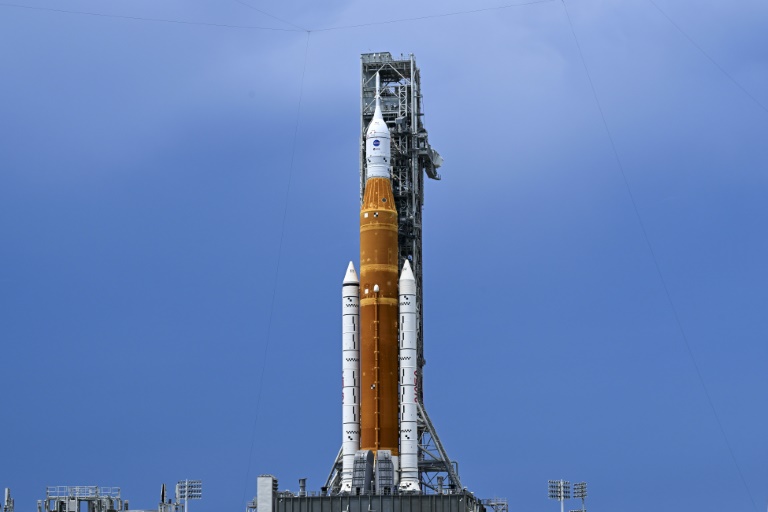
NASA has called off the scheduled Tuesday launch of its historic uncrewed mission to the Moon due to a tropical storm that is forecast to strengthen as it approaches Florida.

After two previously canceled launch attempts, NASA is weighing returning the Artemis 1 mission rocket to its assembly site under the threat of extreme weather.

“NASA is forgoing a launch opportunity… and preparing for rollback (from the launchpad), while continuing to watch the weather forecast associated with Tropical Storm Ian,” it said on Saturday.

The US National Hurricane Center (NHC) said Ian is due to “rapidly intensify” over the weekend as it moves toward Florida, home to the Kennedy Space Center, from which the rocket is set to launch.

Currently south of Jamaica, the storm is expected to approach Florida’s west coast “at or near major hurricane strength” early next week, threatening storm surge, flooding and hurricane-force winds across much of the state, the NHC said.

On the launchpad, the giant orange and white Space Launch System (SLS) rocket can withstand wind gusts of up to 137 kilometers (85 miles) per hour. But if it has to be sheltered, the current launch window, which runs until October 4, will be missed.

A decision on whether to roll back the rocket to the Vehicle Assembly Building is due to be taken by the Artemis 1 team on Sunday, “to allow for additional data gathering and analysis,” with the operation, if necessary, starting late Sunday or Monday morning, NASA said.

Jim Free, associate administrator for the agency’s exploration systems development directorate, said on Twitter that a “step-wise approach” to the decision to roll back preserves “a launch opportunity if conditions improve,” indicating a launch date before October 5 was still on the table.

If not, the next launch window will run from October 17 to 31, with one possibility of take-off per day, except from October 24-26 and 28.

The Artemis 1 space mission hopes to test the SLS as well as the unmanned Orion capsule that sits atop it, in preparation for future Moon-bound journeys with humans aboard.

Artemis is named after the twin sister of the Greek god Apollo, after whom the first Moon missions were named.

Unlike the Apollo missions, which sent only white men to the Moon between 1969 and 1972, Artemis missions will see the first person of color and the first woman step foot on the lunar surface.

A successful Artemis 1 mission would come as a huge relief to the US space agency, after years of delays and cost overruns. 

But another setback would be a blow to NASA, after two previous launch attempts were scrapped when the rocket experienced technical glitches including a fuel leak.

The cost of the Artemis program is estimated to reach $93 billion by 2025, with its first four missions clocking in at a whopping $4.1 billion each, according to a government audit.

Russia stiffens penalty for surrender, replaces top general

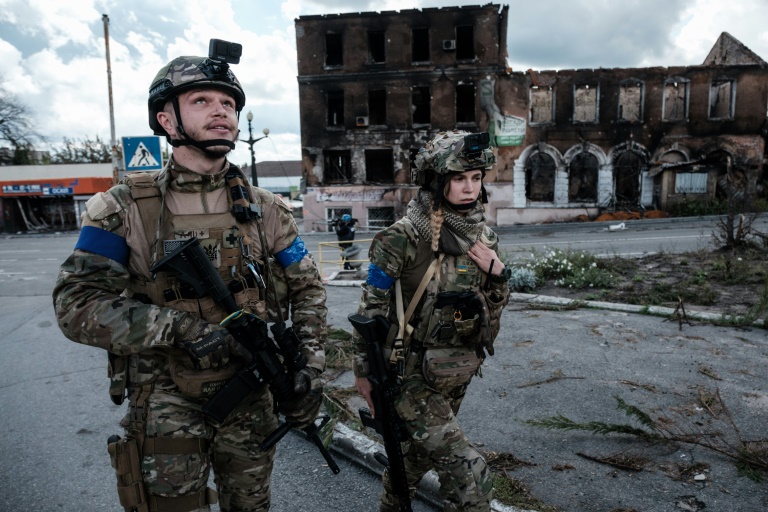
Russia on Saturday toughened penalties for voluntary surrender and refusal to fight with up to 10 years imprisonment and replaced its top logistics general after a series of setbacks to its seven-month war in Ukraine. 

The tough new amendments and personnel change come days after Russia instigated partial mobilisation with Kyiv taking back more and more territory in a counter-offensive.

It also comes as Kremlin-held regions of eastern and southern Ukraine voted for a second day on becoming part of Russia, dramatically raising the stakes. 

Integrating the four regions into Russia would mean that Moscow would consider any military move there as an attack on its own territory.

Russia’s invasion, launched on February 24, and Ukraine’s recent gains have laid bare flaws with some analysts seeing logistics as the weak link in Moscow’s army.

“Army General Dmitry Bulgakov has been relieved of the post of deputy minister of defence” and will be replaced by Colonel General Mikhail Mizintsev, aged 60, the defence ministry said.

Russia’s partial mobilisation announced on Wednesday will likely be one of his first big logistical challenges with the hundreds of thousands of reservists being called up needing to be equipped and trained before deployment.

Military-age men have sought to leave, with flights full and neighbouring countries receiving an influx of Russians, including Georgia where 2,300 private vehicles were waiting to enter at one crossing, regional Russian authorities said.

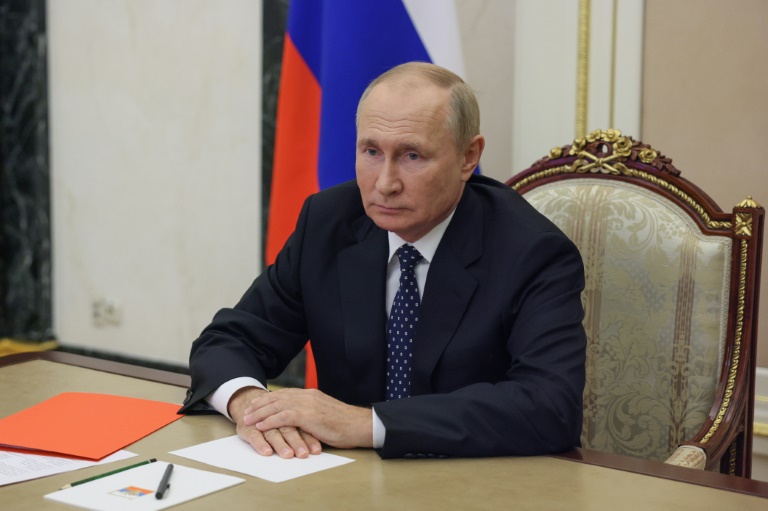
Now that President Vladimir Putin has signed the legislation, servicemen who desert, surrender “without authorisation”, refuse to fight or disobey orders can face up to 10 years imprisonment.

– ‘Sham’ –

Looting will be punishable by 15 years imprisonment. 

A separate law, also signed on Saturday, facilitates Russian citizenship for foreigners who enlist in the Russian army as the Kremlin seeks to bolster the ranks.

On Friday, US President Joe Biden has dismissed as a “sham” the voting on whether Russia should annex four regions of Ukraine, which ends next Tuesday.

Even Beijing, Moscow’s closest ally since the war began, called for the respect of “sovereignty and territorial integrity”.

The voting is being held in Russian-controlled areas of Donetsk and Lugansk in the east, and Kherson and Zaporizhzhia in the south.

For four days, authorities are going door-to-door to collect votes. Polling stations then open Tuesday for residents to cast ballots on the final day. Results are expected as early as late Tuesday or Wednesday.

“Ultimately, things are moving towards the restoration of the Soviet Union. The referendum is one step towards this,” Leonid, a 59-year-old military official, told AFP.

The snap referendums were announced just this week after the Ukrainian counter-offensive seized most of the northeast Kharkiv region — bringing hundreds of settlements back under Kyiv’s control after months of Russian occupation.

Irpin, close to the capital, was recaptured after weeks of fighting and residents have rallied to start rebuilding before winter sets in.

Over 100 apartment blocks in Irpin — dubbed a “hero city” by President Volodymyr Zelensky for holding back Russian invaders — were badly damaged by shelling.

– Evidence of ‘war crimes’ –

Head of his building’s residents’ association Mykhailo Kyrylenko looked proudly at the new roof taking shape.

“People don’t have much money, but they agreed” to donate funds to gradually restore the shattered homes, he told AFP.

Putin this week warned that Moscow would use “all means” to protect its territory — which former Russian leader Dmitry Medvedev said on social media could include the use of “strategic nuclear weapons”.

Zelensky has denounced the polls, on Friday calling them “crimes against international law and the law of Ukraine”.

G7 nations declared the polls will “never” be recognised and have “no legal effect or legitimacy”.

UN investigators on Friday accused Russia of committing war crimes on a “massive scale” in Ukraine — listing bombings, executions, torture and horrific sexual violence.

In the eastern Kharkiv region, Ukrainian officials said they had exhumed 447 bodies from a site near the city of Izyum, which was recaptured from Russian forces.

“Most of them have signs of violent death, and 30 have signs of torture,” said Kharkiv regional governor Oleg Synegubov.

“There are bodies with rope around their necks, with their hands tied, with broken limbs and gunshot wounds.” 

The Kremlin has accused Kyiv of fabricating evidence of the alleged war crimes.

France's TotalEnergies injects further $1.5 bn into Qatar gas

France’s TotalEnergies on Saturday signed a new $1.5 billion deal to help expand Qatar’s natural gas production as Europe scrambles to find new energy sources to replace Russian supplies.

But TotalEnergies chairman Patrick Pouyanne and Qatar Energy Minister Saad Sherida Al-Kaabi expressed surprise at reports that Germany was resisting 20-year contracts — insisting that Europe must agree longer contracts to guarantee supplies.

The French energy giant will have a 9.3 percent stake in Qatar’s North Field South project, part of the world’s biggest natural gas reserves, Kaabi said at a signing ceremony.

Pouyanne said TotalEnergies would invest $1.5 billion in the new field.

It had already agreed in June to put more than $2 billion into Qatar’s North Field East and Kaabi said: “With this agreement, we see an enhanced position for TotalEnergies as a long term strategic partner”.

Twenty five percent of the field is to be reserved for foreign firms and more deals will be announced in coming weeks, Kaabi said.

Britain’s Shell, Italy’s ENI and US giants ConocoPhillips and ExxonMobil have already signed up to be part of North Field East.

– Security will cost –

Qatar has embarked on a massive expansion of the whole North Field, aiming to increase its liquefied natural gas (LNG) production by more than 60 percent by 2027.

The boost comes as Europe struggles to replace supplies of Russian oil and natural gas that have fallen victim to the Ukraine war.

Kaabi, who is to host talks with German Chancellor Olaf Scholz in Doha on Sunday, refused to discuss negotiations with Germany but expressed surprise at media reports that Qatar was insisting on a 20 year supply deal.

Russia’s invasion of Ukraine in February came as Europe was already facing an energy crisis and the Gulf state has hosted muliple visits by European leaders seeking gas supplies.

Europe had rejected the long-term deals that Qatar seeks, but a change in attitude has been forced as it faces a looming winter of energy shortages.

“We are in active discussions with the majority of buyers around the world and some are advancing more than others,” Kaabi told a news conference after the ceremony.

“For us, 15 years plus constitutes a long term deal,” the minister added.

Pouyanne said Europe had to accept longer deals to guarantee supplies. Producer countries and energy majors have insisted on the need for certainty in contracts to justify the huge investments needed in the gas industry.

“Most of the leaders of the world have discovered the words LNG,” said Pouyanne.

“The question is simple — the longer it (the contract) is, the better the price will be for the buyer.

“If you want a cheap price for a short duration, the answer will be ‘no’.”

Qatar is one of the world’s top LNG producers, alongside the United States, Australia and Russia. 

State-owned Qatar Energy estimates the North Field holds about 10 percent of the world’s known natural gas reserves.

LNG from the North Field is expected to start coming on line in 2026.

The offshore reserves extend over the maritime border with Iran, whose efforts to exploit its adjacent South Pars field have been hindered by US sanctions.

South Korea, Japan and China have traditionally been the main markets for Qatari LNG.

Qatar’s gas is among the cheapest to produce and has fuelled an economic boom in the tiny Gulf emirate, which is now one of the world’s wealthiest countries.

Pharoah Sanders, cosmic jazz saxophonist, dead at 81

Pharoah Sanders, one of the most wildly inventive figures in jazz who wrestled his saxophone to its limits and felt equally at home in Indian and African music, died Saturday. He was 81.

His record label, Luaka Bop, said he died peacefully around friends and family in Los Angeles.

“Always and forever the most beautiful human being, may he rest in peace,” a label statement said.

Taking the open-mindedness of the free jazz movement to new heights, Sanders would virtually attack his saxophone by heavily overblowing on the mouthpiece — of which he collected hundreds — as well as biting the reed and even shouting into the bell of the instrument.

Sanders, a disciple of John Coltrane, who played aggressive solos on the jazz master’s classic late-career “Live in Japan” album, was often seen as a sort of successor to the global-minded legend after Coltrane’s sudden death in 1967.

Ornette Coleman — arguably the most important pioneer of free jazz — called Sanders “probably the best tenor player in the world.” 

But Sanders, who to a lesser extent played soprano and alto sax as well, also divided audiences and never reached quite the same commercial success as Coltrane, Coleman or other historic jazz innovators.

With solos that built from screeching and squawking to silky and melodic, Sanders was described as a godfather of spiritual or even cosmic jazz, although the reticent musician brushed aside labels.

His best-known works included “The Creator Has a Master Plan,” a nearly 33-minute track off his “Karma” album on which Sanders sounds as if he is exorcising demons, before reaching back to a heavenly state.

Leon Thomas sings on the track, released in 1969 at the apex of counterculture, with the lines, “The creator has a master plan / Peace and happiness for every man.”

“Upper Egypt and Lower Egypt,” off Sanders’ influential 1967 “Tauhid” album, builds off guitar twangs and a gentle xylophone paying tribute to African tradition as Sanders storms in with a saxophone that sounds like tortured howls.

– Seeing saxophone as self –

“I don’t really see the horn anymore. I’m trying to see myself,” he said in the liner notes to “Tauhid,” his first album on the Impulse! label that put out Coltrane.

“And similarly, as to the sounds I get, it’s not that I’m trying to scream on my horn, I’m just trying to put all my feelings into the horn,” he said.

Farrell Sanders — he changed his first name’s spelling at the encouragement of futuristic jazz composer Sun Ra — was born and raised in segregated Little Rock, Arkansas, where he played clarinet in a school band and explored jazz from touring artists.

He moved after high school to Oakland, California, where for the first time he enjoyed the freedom to attend racially mixed clubs and had a fateful first meeting with Coltrane as they shopped for mouthpieces.

He later headed to New York where he at times fell into homelessness, working as a cook and even selling his blood to survive.

He met Sun Ra while cooking at a Greenwich Village club. Discovering his musical talent, Sun Ra and Coltrane enlisted Sanders as a band member, with Sanders coming into his own as a band leader after Coltrane’s death.

Describing his style in a 1996 interview with the San Francisco Chronicle, Sanders said: “I have a dark sound; a lot of the younger guys have a bright sound, but I like a dark sound with more roundness, more depth and feeling in it,” he said.

“I want my sound to be like a fragrance that people will like — something fresh, like the smell of your grandmother’s cake cooking,” he said.

– Spiritual explorations –

Sanders — distinctive in his later years for his long white beard and fez cap — dabbled in pop music, starting with 1971’s “Thembi,” named after his wife.

But his mainstream direction was brief and he often found more musical kinship outside the United States. On 1969’s “Jewels of Thought,” Sanders explored mysticism from across Africa, opening with a Sufi meditation for peace.

Decades later on “The Trance of Seven Colors,” Sanders collaborated with Mahmoud Guinia, the Moroccan master of the spiritual gnawa music and of the guembri lute.

Sanders’ 1996 album “Message from Home” delved into the influences of sub-Saharan Africa including highlife, the pop mix of Western and traditional music that originated in Ghana.

He also explored Indian form with his collaborations with Alice Coltrane, the jazz master’s second wife, who became a yogi.

Sanders voiced the most admiration for Indian musicians, including Bismillah Khan, who brought a wider audience to the shehnai, a type of oboe played frequently at processions on the subcontinent, and Ravi Shankar, who made the sitar international.

Sanders, accustomed to the sharing of energy within jazz bands, described Indian musicians as achieving “pure music.”

“Nobody is trying to cut each other’s throat. There’s no ego,” he told the San Francisco Chronicle.

Describing his own music, he said: “I want to take the audience on a spiritual journey; I want to stir them up, excite them. Then I bring them back with a calming feeling.”

'Marlowe' closes San Sebastian film festival

Spain’s prestigious San Sebastian film festival wrapped up on Saturday with the international premiere of “Marlowe” starring Northern Irish actor Liam Neeson.

Based on John Banville’s novel “The Black Eyed Blonde”, the movie is set in 1930s Los Angeles.

Private eye Philip Marlowe — played by Neeson — is tasked with finding the missing ex-lover of Clare Cavendish, a beautiful heiress played by German-born actress Diane Kruger.

The character Marlowe has been played before by the likes of Humphrey Bogart and Elliott Gould, but Neeson said this pedigree didn’t phase him from taking part in the neo-noir thriller.

“Even though these wonderful actors have played it before, that didn’t intimidate me,” Neeson told a press conference in San Sebastian.

The film by Oscar-winning director Neil Jordan was screened out of competition at the 70th edition of the festival, which opened in San Sebastian in northern Spain on September 16.

“We don’t get to play those kind of characters very often anymore or those kind of films are not being made that often anymore,” said Kruger, known for films such as “Inglourious Basterds” and “Troy”.

“I knew Neil would give it a certain quirky twist and that he would cast it superbly,” said Neeson.

A total of 17 films are competing for the best award in the official selection, with the festival’s prizes to be announced at a ceremony late Saturday.

The festival is the fourth major European film gala of the year, following Cannes, Venice and Berlin.

It was originally intended to honour Spanish-language films but has established itself as a top showcase for new films.

The festival hosted the world premiere of Alfred Hitchcock’s spy thriller “North by Northwest” in 1959 and Woody Allen’s “Melinda and Melinda” in 2004.

Blinken urges calm on Taiwan in talks with China

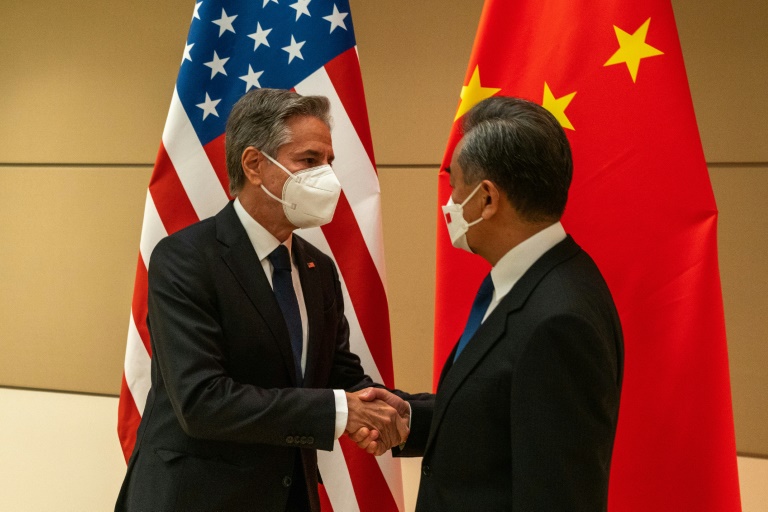
US Secretary of State Antony Blinken called Friday for calm over Taiwan as he met his Chinese counterpart, as soaring tensions showed signs of easing a notch.

Blinken met for 90 minutes with Chinese Foreign Minister Wang Yi in New York on the sidelines of the United Nations General Assembly, in talks a US official described as “extremely candid” and focused largely on Taiwan.

Blinken “stressed that preserving peace and stability across the Taiwan Strait is critical to regional and global security and prosperity,” a State Department statement said.

He “discussed the need to maintain open lines of communication and responsibly manage the US-PRC relationship, especially during times of tension,” it added, using the acronym for the People’s Republic of China.

A State Department official described the exchange on Taiwan as “direct and honest.” 

The official said Blinken also renewed US warnings not to support Russia’s invasion of Ukraine, amid guarded US hopes that Beijing is taking a distance from Moscow, nominally its ally.

Wang met in New York with Ukraine’s foreign minister for the first time since the war and, in a Security Council session Thursday, emphasized the need for a ceasefire rather than support for Russia.

Blinken, who went ahead with the talks despite the death of his father the previous day, met Wang for the first time since a sit-down in July in Bali, where both sides appeared optimistic for more stability.

One month later, House Speaker Nancy Pelosi visited Taiwan, infuriating Beijing, which staged exercises seen as a trial run for an invasion of the self-governing democracy, which it claims as its territory.

And in an interview aired Sunday, President Joe Biden said he was ready to intervene militarily if China uses force in Taiwan, once again deviating from decades of US ambiguity.

In the meeting with Blinken, Wang accused the US of “sending very wrong and dangerous signals” encouraging Taiwan independence, the Chinese foreign ministry said in a readout.

Wang told Blinken that China wished for “peaceful reunification” with Taiwan and warned that “the more rampant ‘Taiwan independence’ activities are, the less likely a peaceful solution would be,” according to the foreign ministry.

The US official said Blinken insisted to Wang that “there has been no change” to the US policy of only recognizing Beijing and voiced opposition to “unilateral changes to the status quo” by either side.

– Taiwan the ‘biggest risk’ –

In a sign that tensions have eased, Wang also met in New York with US climate envoy John Kerry, despite China’s announcement after Pelosi’s visit that it was curbing cooperation on the issue, a key priority for Biden.

But in a speech before his talks with Blinken, Wang called Taiwan “the biggest risk in China-US relations” and accused the United States of stoking pro-independence forces.

“Taiwan independence is like a highly disruptive great rhinoceros charging toward us. It must be stopped resolutely,” he said at the Asia Society think tank.

“Just as the US will not allow Hawaii to be stripped away, China has the right to uphold the unification of the country,” he said.

He denounced the US decision to “allow” the Taiwan visit by Pelosi, who is second in line to the presidency after the vice president. The Biden administration, while privately concerned about her trip, noted that Congress is a separate branch of government.

But Wang was conciliatory toward Biden. The New York talks are expected to lay the groundwork for a first meeting between Biden and President Xi Jinping since they became their two countries’ leaders, likely in Bali in November on the sidelines of a summit of the Group of 20 economic powers.

Wang said that both Biden and Xi seek to “make the China-US relationship work” and to “steer clear of conflict and confrontation.”

The US Congress is a stronghold of support for Taiwan, a vibrant democracy and major technological power.

Last week, a Senate committee took a first step to providing billions of dollars in weapons directly to Taiwan to deter China, a ramp-up from decades of only selling weapons requested by Taipei.

Tensions have also risen over human rights, with the United States accusing the communist state of carrying out genocide against the mostly Muslim Uyghur people.

Indigenous activists raise climate awareness on sidelines of UNGA

Uyukar Domingo Peas, an Ecuadorian Indigenous activist, says if there are still “reservoirs of natural resources” in the world, it is “because we have protected them for thousands of years.” 

Peas has been fighting against the destruction of forests for three decades and regrets that states and companies continue to destroy the Amazon despite the urgency of the climate crisis.

“The Amazon must remain intact for the youth and the rest of humanity,” the 58-year-old from the Achuar nation told AFP, lamenting that governments and corporations have not sought the ancestral knowledge of Indigenous peoples to save the planet.

Peas was speaking at Environment Week, a series of independent events involving Indigenous peoples from around the world that is being held in New York on the sidelines of the United Nations General Assembly.

An estimated 80 percent of the world’s tropical forests — about 800 million hectares — are in Indigenous territories, according to organizations that defend them. 

Many Indigenous people blame capitalism for the destruction of their forests. 

“We want companies and banks to stop investing for money and invest for the common good” because “climate change harms every human being,” he said. 

He is calling for funds to implement the Amazon Sacred Headwaters Initiative, which aims to protect 35 million hectares in the Amazon rainforest of Peru and Ecuador, and is home to 30 Indigenous communities with around 600,000 people.

He hopes that the nine countries that share the Amazon — often referred to as the lungs of the planet, spread over nearly 300 million hectares with three million inhabitants from more than 500 peoples — will also join this initiative.

– ‘Bioeconomy’ – 

Peas advocates for a new “bioeconomy,” with new sources of energy, tourism programs and other initiatives to ensure that Indigenous youth do not migrate away from their homelands. 

“We want to take care of the jungle and live off the jungle,” he said. 

Compared to the large sums needed for the oil and mining projects that pollute their lands and rivers, Peas’ initiative requires just $19 million over 10 years. 

“Mother Earth does not expect us to save her, she expects us to respect her,” said Nemonte Nenquimo, the Ecuadorian chief of the Waorani nation. 

– ‘Where does the money go?’- 

The Covid pandemic and “the collective hysteria of oil-dependent countries” following the conflict in Ukraine have dealt a severe blow to the Indigenous climate struggle, said Levi Sucre, of the Bribri community, an Indigenous people living between Costa Rica and Panama. 

With priorities set on economic recovery, Indigenous rights “have regressed alarmingly in the last two, three years,” he told AFP. 

He said that the most alarming case is that of Brazil, where the government “deliberately ignores the Indigenous peoples.” 

Indigenous peoples’ representatives complain that the resources agreed upon at climate meetings barely ever reached them. 

Monica Kristiani Ndoen, a young Indonesian Indigenous leader, said that “the challenge is to access climate funds directly.” 

“The question is where does the money go?” 

For the Venezuelan Gregorio Diaz Mirabal, general coordinator of the Indigenous Organizations of the Amazon Basin (COICA), the problem is that “we are not present in the meetings where the decisions are taken.”

“If you want us to continue to provide oxygen, rivers, forests, drinking water, respect our house,” he said. 

Elton John, a Trump favorite, sings at Biden White House

Elton John on Friday sang at the White House at the invitation of President Joe Biden, after declining invitations from his predecessor Donald Trump. 

Dressed in a glittering black suit and wearing orange glasses, the 75-year-old pop icon sat down at the piano on the South Lawn of the White House, with the US presidential residence lit up in the background.

“I don’t know what to say, what a dump,” John joked as he took the stage to perform his 1970 hit “Your Song.” 

“I’ve played in some beautiful places before, but this is probably the icing on the cake.” 

About 2,000 guests were invited to the event, including activists, LGBTQ campaigners, nurses, teachers and others. Also in attendance were Nobel Peace Prize winner Malala Yousafzai and former tennis champion and activist Billie Jean King, the White House said in a statement.

“It’s clear Elton John’s music has changed our lives,” Biden said.

The singer spoke of the importance of fighting HIV/AIDS and thanked the United States for its role in battling the virus.

According to the White House, Friday’s event was meant to celebrate the unifying power of music.

But as John performed his hits “Tiny Dancer” and “Rocket Man,” which were often played at Trump rallies, they were a reminder of the deep divisions in US politics. 

John, who was on a marathon global farewell tour, thanked Biden for the invitation and also praised former US President George W. Bush.

“I just wish America could be more bipartisan on everything,” John said.

At the end of the night, Biden surprised John by presenting him with the National Humanities Medal for empowering people to fight for justice.

“I’m never flabbergasted,” said a visibly emotional John. “But I’m flabbergasted.”

What could happen if Putin used nuclear weapons in Ukraine?

President Vladimir Putin’s threat to use a nuclear weapon in Ukraine if Russian “territorial integrity” is threatened has sparked deep discussion in the West as to how it would respond.

“Those who are trying to blackmail us with nuclear weapons should know that the wind can also turn in their direction,” Putin said, adding: “This is not a bluff.”

However analysts aren’t convinced the Russian president is willing to be the first to unleash nuclear weapons since the US bombed Japan in 1945.

AFP spoke with several experts and officials about the possible scenarios that could arise should Russia carry out a nuclear attack.

What would a Russian nuclear attack look like?

Analysts say Moscow would likely deploy one or more “tactical” or battlefield nuclear bombs.

These are small weapons, ranging from 0.3 kilotons to 100 kilotons of explosive power, compared to the 1.2 megatons of the largest US strategic warhead or the 58 megaton bomb Russia tested in 1961.

Tactical bombs are designed to have a limited impact on the battlefield, compared to strategic nuclear weapons which are designed to fight and win all-out wars.

But “small” and “limited” are relative: The atom bomb the US dropped on Hiroshima in 1945 to devastating effect was just 15 kilotons.

What would Moscow target?

Analysts say Russia’s goal in using a tactical nuclear bomb in Ukraine would be to frighten it into surrender or submission to negotiations, and to divide the country’s Western backers.

Mark Cancian, a military expert with the CSIS International Security Program in Washington, said Russia would not likely use nuclear weapons on the front lines. 

Capturing 20 miles (32 kilometers) of territory could require 20 small nuclear bombs — small gains for the huge risks of introducing nuclear weapons and nuclear fallout.

“Just using one will not be enough,” Cancian said.

Moscow could instead send a strong message and avoid significant casualties by detonating a nuclear bomb over water, or exploding one high over Ukraine to generate an electromagnetic pulse that would knock out electronic equipment.

Or Putin could opt for greater destruction and death: attacking a Ukraine military base, or hitting an urban center like Kyiv, generating mass casualties and possibly killing the country’s political leadership.

Such scenarios “would likely be designed to split the NATO alliance and global consensus against Putin,” Jon Wolfsthal, a former white House nuclear policy expert, wrote Friday on Substack.

But “it is unclear if it would succeed, and could just as easily be seen as desperation as resolve,” he said.

Should the West respond with nukes?

The West has remained ambiguous on how it would respond to a tactical nuclear strike, and the choices are complicated.

The United States and NATO do not want to appear weak in front of an implicit nuclear threat.

But they also would want to avoid the possibility that the war in Ukraine — not a NATO member — could escalate into a much broader, devastating global nuclear war.

Experts say the West would have no option but to respond, and that a response should come from NATO as a group, rather than the United States alone.

Any response should “ensure both that Putin’s military situation did not improve from such a strike, and that his political, economic and personal position suffered as a result,” said Wolfsthal.

The United States has positioned about 100 of its own tactical nuclear weapons in NATO countries and could respond in kind against Russian forces.

That would demonstrate resolve and remind Moscow of the danger of its actions, according to Matthew Kroenig of the Atlantic Council.

However, he said, “it might also provoke a Russian nuclear reprisal, raising the risk of a larger nuclear exchange and further humanitarian disaster.”

Another risk is that some NATO members might reject a nuclear response, serving Putin’s aims of weakening the alliance.

Give Ukraine the ability to attack Russia?

Answering a Russian nuclear attack in a more conventional military or diplomatic way, and supplying Ukraine with more lethal arms to attack Russia, could be more effective, experts say.

“Russian nuclear use might provide an opening to convince countries that have so far been reluctant — such as India and possibly even China — to participate in escalating sanctions,” said Kroenig.

In addition, the United States could offer Ukraine NATO aircraft, Patriot and THAAD anti-missile batteries, and ATACMS long-range missiles that could be used by Ukraine forces to strike deep inside Russia.

“Whatever restrictions we have on Ukraine forces — and I think we have some restrictions — I think we take all of those off,” said Cancian.

Close Bitnami banner
Bitnami