US Business

World markets plunge on growing recession fears

Stock markets tumbled, the pound crashed against the dollar and oil prices slumped Friday on growing recession fears after central banks this week ramped up interest rates to fight decades-high inflation.

With price rises showing no solid sign of letting up, monetary policymakers have gone on the offensive, warning that short-term hits to economies are less painful than the long-term effects of not acting.

The Federal Reserve’s decision Wednesday to lift borrowing costs by 0.75 percentage points for a third successive meeting was followed by a warning that more big rises were in the pipeline and that rates would likely come down only in 2024.

There were similar moves by central banks in other countries including Britain, Sweden, Norway, Switzerland, the Philippines and Indonesia — all pointing to a dark outlook for markets.

Wall Street extended losses Friday while European equities sank in afternoon deals and Asia finished lower.

“A negative end to the week in Asia, and Europe has quickly followed as the prospect of much more tightening and a recession weighs on sentiment,” said Craig Erlam, analyst at trading platform OANDA.

In a sign that recession expectations are rising, the 10-year US Treasury yield jumped to its highest level in a decade.

The UK 10-year yield struck an 11-year high on Friday.

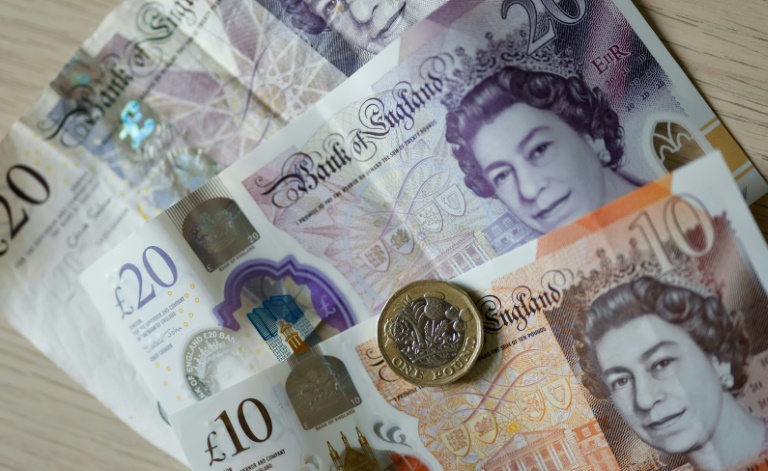
The British pound tumbled to a 37-year low under $1.10 as a tax-cutting budget sparked public finance concerns while recession fears mounted.

“Equity markets are also plunging on concerns that this (UK) package could further push inflation even higher, and thus make it more difficult to bring back down,” said Michael Hewson, chief market analyst at CMC Markets UK.

“Sterling is in the firing line as traders are turning their backs on all things British. There is a creeping feeling the extra government borrowing that is in the pipeline will severely weigh on the UK economy,” added David Madden, market analyst at Equiti Capital.

In the eurozone, recession fears deepened as data showed its economic activity fell once again in September.

The S&P eurozone PMI dropped to 48.2 in September — with a score under 50 representing economic contraction.

The euro hit a new two-decade low at $0.9751.

“A eurozone recession is on the cards as companies report worsening business conditions and intensifying price pressures linked to soaring energy costs,” said Chris Williamson, chief business economist at S&P Global Market Intelligence.

He added that falling UK business activity this month indicates that the British economy is likely already in recession.

Recession fears also caused oil prices to fall, with the main US contract, WTI, falling below $80 for the first time since January.

Traders were keeping a close eye as well on developments following the Japanese finance ministry’s intervention to support the yen, after it hit a new 24-year low of 146 against the dollar.

The first such intervention since 1998 helped strengthen the yen but it remained above 140.

Analysts warned the move was unlikely to have much long-term impact and the yen remained vulnerable owing to the Bank of Japan’s refusal to tighten policy — citing a need to boost the economy.

– Key figures at around 1530 GMT –

New York – Dow: DOWN 1.52 percent at 29,618.21 points

London – FTSE 100: DOWN 1.97 percent at 7,018.60 (close) 

Frankfurt – DAX: DOWN 1.97 percent at 12,284.19 (close)

Paris – CAC 40: DOWN 2.28 percent at 5,783.14 (close) 

EURO STOXX 50: DOWN 2.3  percent at 3,355.97  

Hong Kong – Hang Seng Index: DOWN 1.2 percent at 17,933.27 (close)

Shanghai – Composite: DOWN 0.7 percent at 3,088.77 (close)

Tokyo – Nikkei 225: Closed for a holiday

Pound/dollar: DOWN at 1.0926 from $1.1252 Thursday

Euro/dollar: DOWN at $ 0.9727 from $0.9839

Euro/pound: UP at 89.00 pence from 87.40 pence 

Dollar/yen: UP at 143.17 yen from 142.35 yen

West Texas Intermediate: DOWN 4.49 percent at $79.00 per barrel

Brent North Sea crude: DOWN 4.14 percent at $86.32 per barrel

burs-ach/cdw
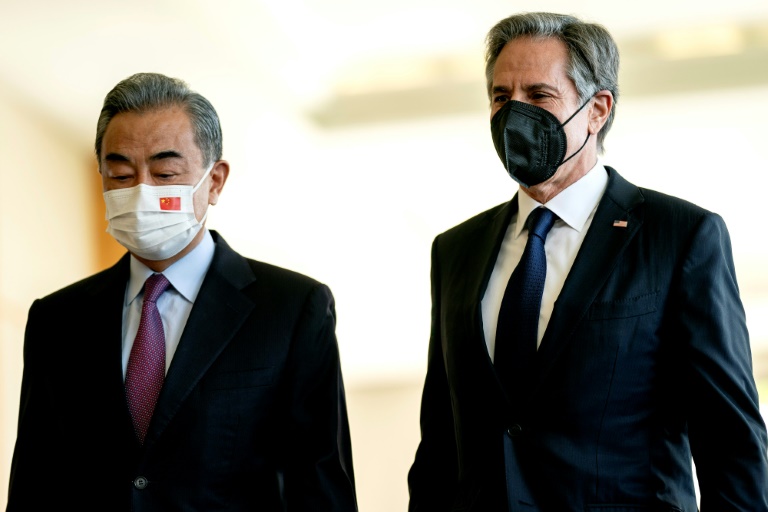
US, China top diplomats meet to contain high tensions on Taiwan

The top US and Chinese diplomats met Friday in New York as soaring tensions show signs of easing, but Beijing issued a new warning against support for Taiwan.

Secretary of State Antony Blinken and Chinese Foreign Minister Wang Yi shook hands but only exchanged pleasantries before the cameras before sitting down with aides on the sidelines of the annual United Nations summit.

It was their first encounter since extensive talks in July in Bali where both sides appeared optimistic for more stability.

One month later, House Speaker Nancy Pelosi visited Taiwan, infuriating Beijing which staged exercises seen as a trial run for an invasion of the self-governing democracy.

In a sign of smoother ties, Wang also met in New York with US climate envoy John Kerry despite China’s announcement after Pelosi’s visit that it was curbing cooperation on the issue, a key priority for Biden.

Blinken went ahead with the talks despite paring down his schedule following the death of his father on Thursday. Immediately before seeing Wang, he met with his counterparts from Australia, Japan and India, the so-called “Quad” which Beijing has denounced as an attempt to isolate it.

“Our four countries know very well the significant challenges that we face, as well as the opportunities that are before us, demand more than ever that we work together,” Blinken said as the ministers signed an agreement on cooperation in disaster relief.

– Taiwan the ‘biggest risk’ –

President Joe Biden in an interview aired Sunday said he was ready to intervene militarily if China uses force in Taiwan, once again deviating from decades of US ambiguity.

In a speech before his talks with Blinken, Wang reiterated anger over US support for Taiwan, which China considers part of its territory.

“The Taiwan question is growing into the biggest risk in China-US relations. Should it be mishandled it is most likely to devastate bilateral ties,” he said at the Asia Society think tank.

“Just as the US will not allow Hawaii to be stripped away, China has the right to uphold the unification of the country,” he said.

He denounced the US decision to “allow” the Taiwan visit by Pelosi, who is second in line to the presidency after the vice president. The Biden administration, while privately concerned about her trip, noted that Congress is a separate branch of government.

But Wang was conciliatory toward Biden. The New York talks are expected to lay the groundwork for a first meeting between Biden and President Xi Jinping since they became their two countries’ leaders, likely in Bali in November on the sidelines of a summit of the Group of 20 economic powers.

Wang said that both Biden and Xi seek to “make the China-US relationship work” and to “steer clear of conflict and confrontation.”

The US Congress is a stronghold of support for Taiwan, a vibrant democracy and major technological power.

Last week a Senate committee took a first step to providing billions of dollars in weapons directly to Taiwan to deter China, a ramp-up from decades of only selling weapons requested by Taipei.

Tensions have also risen over human rights with the United States accusing the communist state of carrying out genocide against the mostly Muslim Uyghur people.

Biden, like his predecessor Donald Trump, has viewed a rising China as the chief global competitor to the United States and vowed to reorient US foreign policy around the challenge.

Russia’s invasion in February of Ukraine quickly diverted the US focus to Europe but also heightened fears that Beijing could make good on years of threats to use force against Taiwan.

Yet US officials have also been heartened that China has shown some distance from Russia, nominally its close ally.

Wang met in New York with Ukraine’s foreign minister for the first time since the war and in a Security Council session Thursday emphasized the need for a ceasefire rather than support for Russia.

Germany's Scholz to visit Gulf states on energy hunt

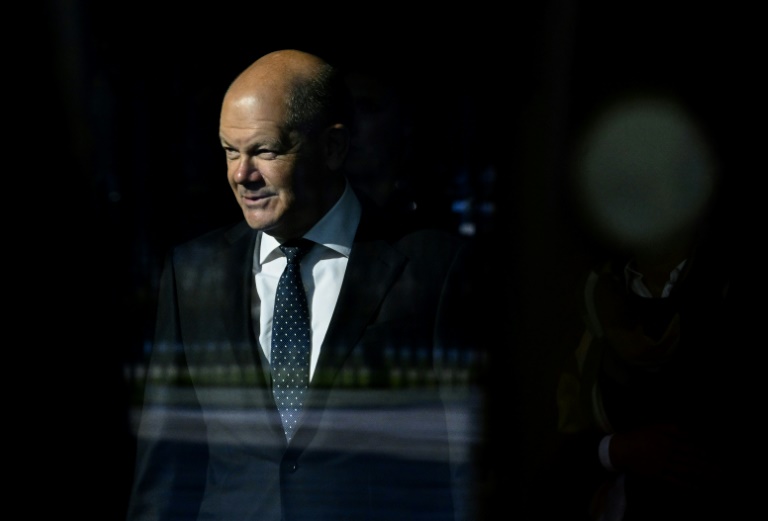
German Chancellor Olaf Scholz will on Saturday begin a two-day tour of Gulf states, including Saudi Arabia, in the hope of sealing new energy deals with the fossil fuel exporters.

Scholz, accompanied by a sizeable industry delegation, will first head to Saudi Arabia before visiting the United Arab Emirates and Qatar on Sunday.

The chancellor hopes to agree new energy partnerships with the oil- and gas-rich Gulf states, with the loss of Russian supplies in the wake of the invasion of Ukraine.

Scholz however is faced with a diplomatic balancing act, as he will have to navigate significant differences with his hosts over human rights.

“We are meeting with difficult partners there,” a government source said, but Germany “cannot rule out working together” with them.

Scholz’s planned meeting with the Saudi Crown Prince Mohammed bin Salman on Saturday is seen as particularly sensitive.

Bin Salman was until recently regarded as a pariah in the West due to his suspected role in the murder of Washington Post journalist Jamal Khashoggi in 2018.

The German government strongly condemned the journalist’s murder and would not be “editing” its position, the government sources indicated.

– ‘Have to work with Saudis’ –

Saudi Arabia’s importance as a fossil fuels exporter and regional power meant a “solid working relationship” was needed with the crown prince, said a government source.

The 36-year-old was likely to steer the country through “the next 10, 20 or 30 years”, he added. 

Nor is the visit being considered as just an “energy shopping tour”.

Berlin also wants to extend cooperation on new technologies such as green hydrogen produced using renewable energy, which Germany could import in vast quantities from the Gulf states, said government sources.

The chancellor would also seek to strengthen political cooperation with the regional powers, courted on the other side by Russia and China. 

Scholz would seek to “build as broad a network as possible in this world and advocate for his positions”, the source said.

“We have to work with Saudi Arabia if we want to sort out, for example, the question of the war in Yemen or tackle the Iranian question,” the government source said.

On Saturday, Scholz is also set to meet Saudi King Salman, though the ageing monarch is said to play an ever smaller role in government affairs.

On Sunday, Scholz will head to the UAE and meet with President Sheikh Mohamed bin Zayed Al-Nahyan. 

In the afternoon, the chancellor will hold talks with Qatari Emir Sheikh Tamim bin Hamad Al-Thani.

US Republicans roll out 'Commitment to America' ahead of midterms

US House Republicans unveiled their “Commitment to America” on Friday, as they seek to unite around a message that will set them on the path back to power in the crucial midterm elections.

With just 45 days to go until the nationwide polls that decide who controls Congress, the party’s candidates have been keen to tout a concrete policy agenda beyond simply hammering President Joe Biden.

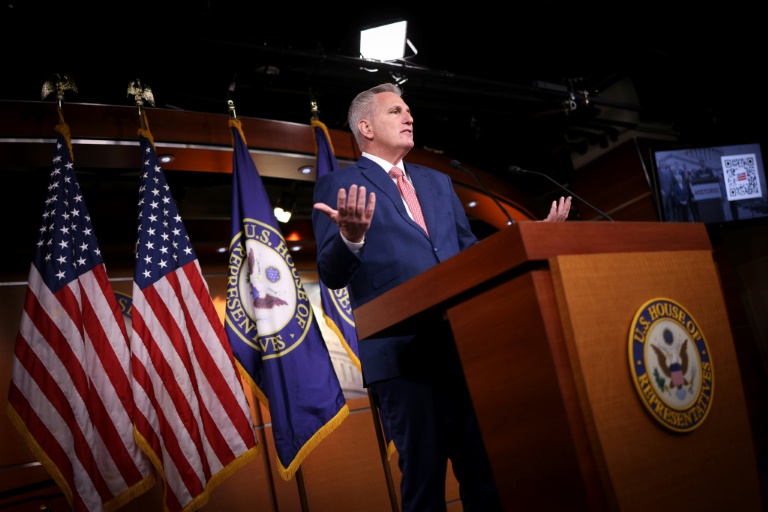
“We’ve spent the last year and a half — all the Republican members in conference — going throughout the country listening — listening to the challenges, fighting what Democrats have been doing,” House Minority Leader Kevin McCarthy said at an event outside Pittsburgh, Pennsylvania.

“And we want to roll it out to you, to the entire country, to know exactly what we will do.”

The agenda prioritizes the usual conservative staples of the economy, illegal immigration, the opioid crisis, combating crime and increased fossil fuel production — all identified weaknesses for Biden. 

It hits on hot-button issues that have polarized voters, such as transgender athletes in girls’ and women’s sports, in parts reflecting former president Donald Trump’s right-wing “Make America Great Again” (MAGA) agenda.

The Republicans are also focused on Democratic policies in schools, where bitter debates have played out on what many parents see as overzealous mask mandates and on the teaching of racism in America’s history. 

Beyond a brief pledge to “protect the lives of unborn children,” however, it notably steers clear of the Republican goal to more tightly regulate abortion, an issue McCarthy didn’t address in his speech.

It also avoids other issues seen by Democrats as electoral catnip, such as protecting democracy in the wake of the 2021 Capitol insurrection and the global climate crisis. 

– ‘Number one killer’ –

“We’ve watched what’s happened to our border, the millions of people who are just walking across, people on the terrorist watch list,” McCarthy said, leaning into Democrats’ perceived weakness on immigration.

“But now we’re watching it create every community to be a border community. Fentanyl, the number one killer of Americans between the ages of 18 and 45: the poison starts in China and comes across our border. You realize it’s killing 300 Americans every day?”

McCarthy said the Republicans’ “very first bill” would be to repeal Democratic legislation providing for 87,000 new internal revenue service agents, a move conservatives have characterized as an intrusion into people’s private lives.

The four-part blueprint — focusing on “An economy that’s strong,” “A nation that’s safe,” “A future that’s free” and “A government that’s accountable” — has broad support among Republicans.

Senate Minority Leader Mitch McConnell, who is not planning to unveil his agenda ahead of election day on November 8, took to Twitter to praise his House counterpart.

“Less inflation. More law and order. Parents’ rights. Border security. American energy,” he said, summarizing what he saw as the highlights.

The roll-out has drawn comparisons with the Republicans’ 1994 “Contract with America,” which ended decades of Democratic dominance in the House, although it is lighter on specifics. 

Democratic House Speaker Nancy Pelosi slammed the Republicans’ “whole-hearted commitment” to Trumpism, accusing them of seeking to criminalize women’s health care and threaten democracy.  

“These appalling proposals have long been advanced by right-wing politicians and are widely supported by the dark money special interests who call the shots in the (Republican Party),” she said in a statement.

“But this extreme MAGA agenda is way out of step with Americans’ priorities, who align with Democrats’ vision of putting people over politics: with lower costs, better-paying jobs and safer communities.”

World markets plunge on growing recession fears

Stock markets tumbled, the pound crashed against the dollar and oil prices slumped Friday on growing recession fears after central banks this week ramped up interest rates to fight decades-high inflation.

With price rises showing no solid sign of letting up, monetary policymakers have gone on the offensive, warning that short-term hits to economies are less painful than the long-term effects of not acting.

The Federal Reserve’s decision Wednesday to lift borrowing costs by 0.75 percentage points for a third successive meeting was followed by a warning that more big rises were in the pipeline and that rates would likely come down only in 2024.

There were similar moves by central banks in other countries including Britain, Sweden, Norway, Switzerland, the Philippines and Indonesia — all pointing to a dark outlook for markets.

Wall Street extended losses Friday while European equities sank in afternoon deals and Asia finished lower.

“A negative end to the week in Asia, and Europe has quickly followed as the prospect of much more tightening and a recession weighs on sentiment,” said Craig Erlam, analyst at trading platform OANDA.

In a sign that recession expectations are rising, the 10-year US Treasury yield jumped to its highest level in a decade.

“It’s a messy situation in the Treasury market to be sure and that is creating a messy situation for stocks. However, it’s not just a US situation. Things are messy elsewhere,” said Briefing.com analyst Patrick O’Hare.

The UK 10-year yield struck an 11-year high on Friday.

The British pound tumbled to a 37-year low under $1.10 as a tax-cutting budget sparked public finance concerns while recession fears mounted.

“Equity markets are also plunging on concerns that this (UK) package could further push inflation even higher, and thus make it more difficult to bring back down,” said Michael Hewson, chief market analyst at CMC Markets UK.

In the eurozone, recession fears deepened as data showed its economic activity fell once again in September.

The S&P eurozone PMI dropped to 48.2 in September — with a score under 50 representing economic contraction.

The euro hit a new two-decade low at $0.9751.

“A eurozone recession is on the cards as companies report worsening business conditions and intensifying price pressures linked to soaring energy costs,” said Chris Williamson, chief business economist at S&P Global Market Intelligence.

He added that falling UK business activity this month indicates that the British economy is likely already in recession.

Recession fears also caused oil prices to fall, with the main US contract, WTI, falling below $80 for the first time since January.

Traders were keeping a close eye as well on developments following the Japanese finance ministry’s intervention to support the yen, after it hit a new 24-year low of 146 against the dollar.

The first such intervention since 1998 helped strengthen the yen but it remained above 140.

Analysts warned the move was unlikely to have much long-term impact and the yen remained vulnerable owing to the Bank of Japan’s refusal to tighten policy — citing a need to boost the economy.

– Key figures at around 1435 GMT –

New York – Dow: DOWN 1.4 percent at 29,644.98 points

London – FTSE 100: DOWN 2.3 percent at 6,997.50 

Frankfurt – DAX: DOWN 1.9 percent at 12,294.22

Paris – CAC 40: DOWN 2.3 percent at 5,782.79

EURO STOXX 50: DOWN 2.3 percent at 3,349.75

Hong Kong – Hang Seng Index: DOWN 1.2 percent at 17,933.27 (close)

Shanghai – Composite: DOWN 0.7 percent at 3,088.77 (close)

Tokyo – Nikkei 225: Closed for a holiday

Pound/dollar: DOWN at $1.0972 from $1.1252 Thursday

Euro/dollar: DOWN at $0.9726 from $0.9839

Euro/pound: UP at 88.65 pence from 87.40 pence 

Dollar/yen: UP at 143.12 yen from 142.35 yen

West Texas Intermediate: DOWN 4.9 percent at $78.61 per barrel

Brent North Sea crude: DOWN 4.6 percent at $84.95 per barrel

burs-lth/ach  

Recession-bound UK fights inflation with tax cuts

The UK’s new government on Friday unveiled a multi-billion-pound package to support households and businesses hit by the highest inflation in decades, cutting taxes as the nation heads for recession.

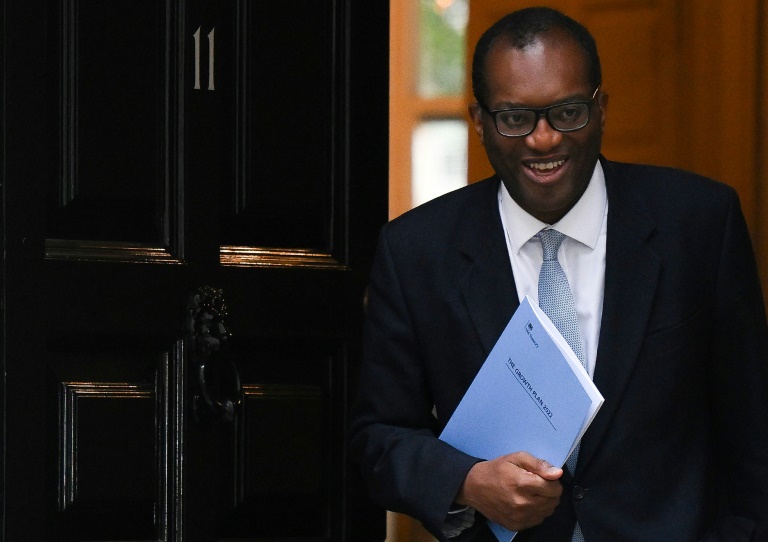
Finance minister Kwasi Kwarteng, fresh from being appointed by new Prime Minister Liz Truss, said caps on soaring energy bills would cost about £60 billion ($68 billion) in the first six months.

“The PM has acted with great speed to announce one of the most significant interventions the British state has ever made,” Kwarteng told parliament in a so-called mini budget.

“People need to know that help is coming.”

In a controversial move as millions of Britons face a cost-of-living crisis, Kwarteng axed an EU-inherited cap on bankers’ bonuses following Brexit to bolster the financial services sector.

Kwarteng brought forward a plan to cut the lowest rate of income tax, and reduced the highest to 40 percent from 45.

The chancellor of the exchequer also reversed a planned increase in tax on company profits signed off by Truss’s predecessor Boris Johnson.

He had announced on Thursday he would scrap a tax on salaries, reversing a 1.25-percentage-point rise in National Insurance implemented by his predecessor Rishi Sunak.

Opposition politicians slammed the budget as boosting the rich.

“We have had six so-called plans for growth from the Conservatives since 2010 — here they are, a litany of failure every single one of them,” said Rachel Reeves, finance spokeswoman for the main opposition Labour party.

“The prime minister and chancellor are like two desperate gamblers in a casino chasing a losing run,” Reeves said.

The announcement comes as economists warned that Britain was likely already in recession, as rocketing fuel and food prices take their toll.

– Pound collapse –

Adding to the pain, the pound Friday plunged two percent against the dollar on intensifying fears of a sharp downturn, while London’s stock market also sank.

Sterling hit a fresh 37-year low at $1.1021.

Kwarteng also lifted the point at which tax is levied on purchases of residential properties, as soaring interest rates put the brakes on the housing market.

Kwarteng released his plan a day after the Bank of England suggested the country was slipping into recession as it hiked interest rates again to tame red-hot inflation.

With prices soaring, Britain on Wednesday announced a six-month plan to pay about half of energy bills for businesses.

Truss had already launched a two-year household energy price freeze. The caps will not kick in, however, until Britons face another large hike in gas and electricity bills from October.

The average household will have their annual energy bill capped at £2,500 until 2024 but many are expected to spend above that to keep homes warm over the winter.

Wholesale electricity and gas prices for firms — as well as charities, hospitals and schools — will be capped at half the expected cost on the open market.

UK energy companies including BP and Shell will not get the cap, as their profits soared after Russia’s war in Ukraine sent oil and gas prices soaring.

The Labour party has demanded that the government extends a windfall tax on energy companies launched by Sunak earlier this year.

But Truss ruled it out, arguing that additional taxes hinder economic recovery and efforts by energy groups to transition into greener companies.

She took office on September 6, two days before the death of Queen Elizabeth II, after winning an election of Conservative party members on a tax-cutting platform.

– ‘Unacceptable strikes’ –

Kwarteng on Friday confirmed plans to shake up the welfare system.

Some 120,000 people in part-time work would face a benefit cut should they fail to take new steps to look for more work.

Kwarteng had described the policy as a “win-win”, pitching it as a way to fill 1.2 million UK job vacancies.

The cost-of-living crisis has triggered some of the biggest strike action in more than 30 years, involving sectors from the rail industry to postal services and even lawyers.

“At such a critical time for our economy, it is simply unacceptable that strike action is disrupting so many lives,” Kwarteng told MPs.

He said the government would legislate “to ensure strikes can only be called once negotiations have genuinely broken down”.

Russia proxies hold breakaway polls in Ukraine

Voting on whether Russia should annex Kremlin-controlled regions of Ukraine opened Friday as the West denounced the referendum that has dramatically raised the stakes of Moscow’s seven-month invasion.

As polling got underway, Ukrainian forces said they were clawing back territory from the Moscow-backed separatists, contesting territory the Kremlin seeks to control.

The votes in four regions are the latest shock development in a ferocious war that UN investigators said had seen violence — like executions and torture — that amounted to war crimes.

The referendums in the eastern Donetsk and Lugansk regions, as well as in the southern Kherson and Zaporizhzhia regions have been dismissed as a “sham” by Kyiv’s Western allies.

And even diplomats from Russia’s closest ally since the war began, Beijing, told Ukraine that the “sovereignty and territorial integrity of all countries must be respected”.

Authorities in the Russian-controlled regions are going door-to-door for four days to collect votes. Polling stations then open Tuesday for residents to cast ballots on the final day of voting. 

It was also possible to vote at the building in Moscow that represents the Donetsk breakaway region. 

Leonid, a 59-year-old military official, told AFP he was “feeling happy”. 

“Ultimately, things are moving towards the restoration of the Soviet Union. The referendum is one step towards this,” he said.

Earlier this month, Ukrainian forces seized back most of the north-eastern Kharkiv region in a huge counter-offensive that has seen Kyiv retake hundreds of settlements that had been under Russian control for months.

On Friday, Russian news agency TASS showed officials in Donetsk alerting residents to the polls by loudspeaker, surrounding one local as he voted.

– ‘Sham’ –

Denis Pushilin, a pro-Russian separatist leader in the Donetsk region — part of the industrial Donbas region — said on Telegram that “Donbas is Russia”.

Kyiv said Friday its forces had recaptured a village in the Donetsk region and taken back positions south of the war-scarred town of Bakhmut.

The four regions’ integration into Russia — which for most observers is a foregone conclusion — would represent a major escalation of the conflict.

“We cannot — we will not — allow (Russian President Vladimir) Putin to get away with it,” US Secretary of State Antony Blinken told the UN Security Council on Thursday, condemning the referendums as a “sham”.

The referendums are reminiscent of Russia’s annexation of Ukraine’s Crimea in 2014. Western capitals maintain that a similar vote then was fraudulent and hit Moscow with sanctions.

– Paper ballots –

In Donetsk and Lugansk — which Putin already recognised as independent before invading Ukraine in February — residents are answering if they support their “republic’s entry into Russia”, TASS reported.

Ballots in Kherson and Zaporizhzhia ask the question: “Are you in favour of secession from Ukraine, formation of an independent state by the region and its joining the Russian Federation as a subject of the Russian Federation?”

Russian news agencies reported voting began on Friday at 0500 GMT while TASS reported paper ballots would be used to save time.

Ukrainian President Volodymyr Zelensky denounced the referendums as a “farce”.

Chinese Foreign Minister Wang Yi meanwhile met his Ukrainian counterpart Dmytro Kuleba at the UN and told him the “sovereignty and territorial integrity of all countries must be respected,” the ministry in Beijing said in a statement. 

UN investigators said Friday that war crimes have been committed in the Ukraine conflict, listing Russian bombings of civilian areas, numerous executions, torture and horrific sexual violence.

Erik Mose, who has led a team of investigators set up in March, said they were “struck by the large number of executions”.

Putin said Moscow would use “all means” to protect its territory — which former Russian leader Dmitry Medvedev said on social media could include the use of “strategic nuclear weapons”. 

Moscow began its mandatory troop call-up on Thursday after Putin called for about 300,000 reservists to bolster the war effort.

– ‘Don’t want to die’ –

But men were leaving Russia in droves before they were made to join, with flights to neighbouring countries booked up for days to come.

Some have not been able to avoid the summons.

Mikhail Suetin, 29, was among those detained at an anti-mobilisation protest in Moscow this week and was handed a summons to appear at a recruitment office.

“To be told ‘tomorrow you will go to war’… that was a surprise,” 29-year-old Suetin, who regularly joins opposition protests in Moscow, told AFP.

burs/gw

UK axes EU-inherited cap on banker bonuses

Britain on Friday axed a cap on bankers’ bonuses aimed at boosting London’s finance sector after Brexit, raising anger amid a cost-of-living crisis.

Finance minister Kwasi Kwarteng removed an EU-inherited policy that limits bankers’ bonuses at twice the basic salary. 

But the move, along with the scrapping of the top income tax bracket, triggered stinging criticism from opposition parties and unions.

New British Prime Minister Liz Truss, whose finance chief also outlined a costly freeze on energy bills to help households and business, said removing the bonus cap would stimulate economic growth and jobs.

Kwarteng followed up by stating that Britain needed “global banks to… invest jobs here and pay taxes here in London — not in Paris, not in Frankfurt and not in New York”. 

“All the bonus cap did was to push up the basic salaries of bankers or drive activity outside Europe,” the chancellor of the exchequer told parliament in a mini budget on Friday.

“It never capped total remuneration… so as a consequence of this we are going to get rid of it.”

A strong UK economy “has always depended on a strong financial services sector”, Kwarteng insisted. 

Britain’s cap had been in place since 2014, a legacy of membership of the European Union that Britain exited last year.

Brussels introduced the cap across the bloc following the global financial crisis, when banks received enormous state bailouts.

In another boost to high-earners on Friday, Kwarteng removed the 45-percent top rate of income tax levied on earnings above £150,000 ($169,000).

A new top rate of 40 percent would be applied to all annual salaries above £50,000.

– ‘Already wealthy’ –

Opposition politicians slammed the budget as boosting the rich, although income tax was cut slightly for all earners.

“It is all based on an outdated ideology that says if we simply reward those who are already wealthy, the whole of society will benefit,” said Rachel Reeves, finance spokeswoman for the main opposition Labour party.

Conservative party MP Kwarteng said his measures would bolster growth, as economists warn that Britain was likely already in recession.

“High tax rates damage Britain’s competitiveness,” warned Kwarteng, adding they “reduce the incentive to work, invest, and start a business”.

He also scrapped a planned tax rise on company profits.

Britain had planned to ramp up corporation tax to 25 percent from 2023.

Instead, it will remain at 19 percent — the lowest in the G20.

– Firestorm –

Susannah Streeter, senior investment and markets analyst at Hargreaves Lansdown, said the chancellor had sparked a “firestorm” over the tax measures.

“Kwasi Kwarteng has set off fireworks with this budget, while sparking a firestorm of criticism about benefiting the wealthy much more than the poorer sections of society,” she noted.

“Scrapping the top rate of tax will return many thousands of pounds to high earners, while lifting the cap on bankers’ bonuses is likely to be hard to swallow for low paid workers.”

Why 'Monkey Island' creators returned to 1990s classic game

When Ron Gilbert and Dave Grossman first let loose their swords, voodoo and pirates epic “The Secret of Monkey Island”, it was sold on floppy disks and released for long-forgotten home PCs like the Amiga.

Three decades later, they are back at it with “Return to Monkey Island”, a sequel with flashier graphics and orchestral scores that is only available as a download.

“Back in 1990 we had an office and we were all in there all day long sharing space,” Grossman told AFP in a joint interview with Gilbert.

“Now we’re all remote — and not even just because of the pandemic, we’re going to be remote anyway.”

The two men worked together on the first two editions of the game, released in 1990 and 1991, before the group disbanded and went their separate ways.

The second edition ended on a cliffhanger that has never been resolved, with the hero, Guybrush Threepwood, facing off against his nemesis LeChuck.

And the secret alluded to in the title of the original was never divulged.

It has kept fans on tenterhooks ever since and gave Gilbert and Grossman a reason to come back to the franchise 30 years later.

“I think there’s unfinished business for Guybrush because he never found the secret, and I think there’s unfinished business for Dave and I as well,” said Gilbert.

– ‘Coloured by nostalgia’ –

The fan fervour around last Monday’s release showed just how strong the feelings still were for a game with blocky graphics and text prompts.

Although most of the reaction was positive, some took exception to the cartoon aesthetic of the new game and vented on social media — something 1990s creators did not have to contend with.

“Adventure game fans have always been very nice and I felt like they kind of turned a little bit,” said Gilbert. 

“It does affect you on some level but it’s not going to change how we think about the game at all.”

Slick graphics were never the appeal of “Monkey Island” — instead players solved puzzles and riddles and advanced through strange landscapes with surreal humour and pop-culture nods aplenty.

It largely set the template for adventure games that were to follow, but the “Monkey Island” franchise petered out with a few later entries published without the involvement of Gilbert.

Although the pair are polite about these subsequent editions — “we would never pooh-pooh the canon”, said Gilbert — their new game picks up the story where the 1991 game ended.

But before they could even start thinking of the story, they had to negotiate licensing the rights to the game from Disney.

“It was a long process, just because lawyers get involved and then everything takes a long time,” said Gilbert.

A core team of 25 people then spent two years beavering away on the game, dealing not only with the rigours of game design but also 30 years of expectation among fans.

“Their memories are unrealistically coloured by nostalgia,” said Grossman. “That makes a sort of an unreachable goal for us.”

Instead, they decided to make a game that they themselves would enjoy.

– ‘Golden age’ –

Despite beginning their careers when the gaming industry was still in its infancy, Gilbert and Grossman are still hugely inspired by the current landscape.

“Nearly anyone can just get three friends together and make a game in their garage, go on the internet and find an audience for it,” said Grossman, calling it “the golden age of video games”.

Their original 1990s games have already found a second life in this golden age through apps and online emulators.

And both creators are quietly confident that “Monkey Island” will continue in some form in the future.

“I think we should do one of these about every 10 or 15 years,” said Grossman.

“Yeah, see you in 2035,” replied Gilbert.

World markets plunge on growing recession fears

Stock markets tumbled, the pound crashed against the dollar and oil prices slumped Friday on growing recession fears after central banks this week ramped up interest rates to fight decades-high inflation.

With price rises showing no solid sign of letting up, monetary policymakers have been forced to go on the offensive, warning that short-term hits to economies are less painful than the long-term effects of not acting.

The Federal Reserve’s decision Wednesday to lift borrowing costs by 0.75 percentage points for a third successive meeting was followed by a warning that more big rises were in the pipeline and that rates would likely come down only in 2024.

That came along with similar moves by banks in several other countries including Britain, Sweden, Norway, Switzerland, the Philippines and Indonesia — all pointing to a dark outlook for markets.

“We see this new even-higher-for-longer rate path as associated with a substantially higher likelihood of a hard landing, and so not just unambiguously hawkish but unambiguously bad for risk,” said Krishna Guha, vice-chair of Evercore ISI.

In a sign that recession expectations are rising, the 10-year US Treasury yield jumped to 3.7 percent, its highest level in a decade, while on Wall Street the S&P 500 has sunk to its weakest level since June and just above its 2022 lows.

The UK 10-year yield struck at an 11-year high at 3.84 percent Friday.

The pound slumped to $1.1021, the lowest level since 1985, even as the UK government unveiled a tax-cutting budget aimed at driving growth.

In the eurozone, recession fears deepened as data showed its economic activity fell once again in September.

The S&P eurozone PMI dropped to 48.2 in September — with a score under 50 representing economic contraction.

“A eurozone recession is on the cards as companies report worsening business conditions and intensifying price pressures linked to soaring energy costs,” said Chris Williamson, chief business economist at S&P Global Market Intelligence. 

He added that falling UK business activity this month indicates that the British economy is likely already in recession.

Traders were keeping a close eye also on developments following the Japanese finance ministry’s intervention to support the yen, after it hit a new 24-year low of 146 against the dollar.

The first such intervention since 1998 helped strengthen the yen to just above 140.

But analysts warned the move was unlikely to have much long-term impact and the yen remained vulnerable owing to the Bank of Japan’s refusal to tighten policy — citing a need to boost the economy.

Recession fears also caused oil prices to fall by more than three percent.

– Key figures at around 1115 GMT –

London – FTSE 100: DOWN 2.4 percent at 6,984.85 points

Frankfurt – DAX: DOWN 2.6 percent at 12,201.91

Paris – CAC 40: DOWN 2.4 percent at 5,777.00

EURO STOXX 50: DOWN 2.6 percent at 3,337.10

Hong Kong – Hang Seng Index: DOWN 1.2 percent at 17,933.27 (close)

Shanghai – Composite: DOWN 0.7 percent at 3,088.77 (close)

Tokyo – Nikkei 225: Closed for a holiday

New York – Dow: DOWN 0.4 percent at 30,076.68 (close)

Pound/dollar: DOWN at $1.1059 from $1.1252 Thursday

Euro/dollar: DOWN at $0.9760 from $0.9839

Euro/pound: UP at 88.27 pence from 87.40 pence 

Dollar/yen: UP at 142.90 yen from 142.35 yen

West Texas Intermediate: DOWN 3.4 percent at $80.68 per barrel

Brent North Sea crude: DOWN 3.2 percent at $87.56 per barrel

burs-bcp/rfj/lth

Close Bitnami banner
Bitnami