US Business

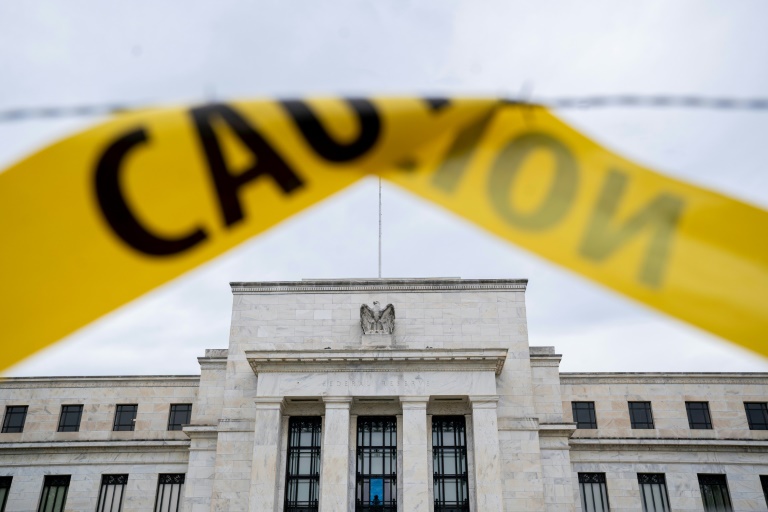
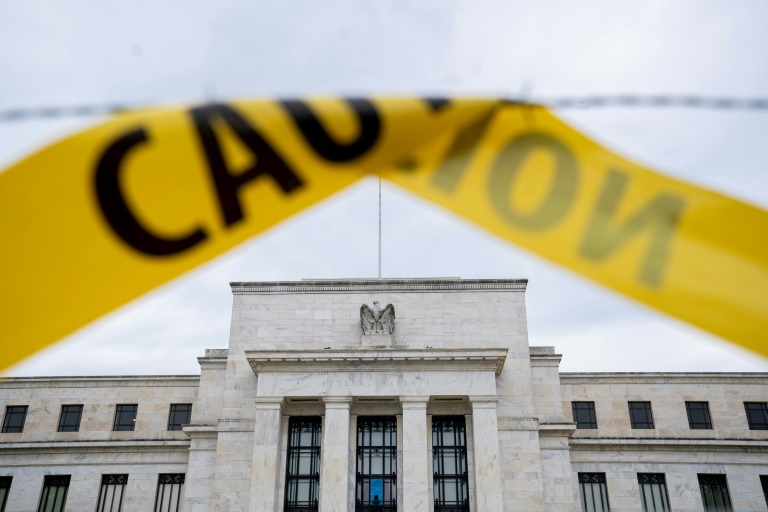
US Fed opens policy meeting with steep rate hike on the table

US central bankers opened their two-day policy meeting on Tuesday with another steep interest rate hike seen as a near certainty amid stubbornly high inflation.

American families have felt the squeeze of soaring prices, which have risen at the fastest pace since the early 1980s, and Federal Reserve Chair Jerome Powell has made it clear officials will continue to act aggressively to cool the economy.

Many economists are expecting a third straight three-quarter point rate hike when the meeting concludes Wednesday, an unprecedented action in recent decades.

Fed officials have been united in the message that the US central bank cannot risk letting inflation take hold due to the damaging impact on workers and businesses, but analysts warn that the risks of recession are rising.

“The inflation rate will continue to call the tune for the path of monetary policy, despite rising risks of a recession in 2023,” said Kathy Bostjancic of Oxford Economics, who projects a downturn early next year. 

“We see higher-for-longer inflation, more aggressive Fed monetary policy tightening, and negative spillover effects from a weakening global backdrop combining to push the US economy into a mild recession in H1 2023.”

The Fed’s policy-setting Federal Open Market Committee (FOMC) is scheduled to announce its decision at 1600 GMT Wednesday.

Markets have been roiled in recent days by the decidedly hawkish statements from central bankers, and closed lower again Tuesday after a brief bounce Monday.

Investors and analysts will pay close attention to Powell’s press conference after the meeting for information on what he thinks the next steps will be and how high rates could go.

– More hikes coming? –

Despite the welcome drop in gasoline prices at the pump in recent weeks, the disappointing consumer price report for August, released last week, showed housing, food and medical costs continued to rise. And when volatile food and energy prices are stripped out, so-called core inflation accelerated.

It is not just current high inflation that concerns policymakers, but the fear that consumers and businesses begin to expect rising prices will become a permanent feature, which could set off a dangerous spiral and a phenomenon called stagflation.

That fear has driven the Fed to front-load its rate hikes, rather than pursuing the more customary course of small, gradual steps over a longer period. 

The US central bank has cranked up the benchmark lending rate four times this year, including two straight three-quarter-point hikes in June and July.

The aim is to raise the cost of borrowing and cool demand — and it is having an impact: Home mortgage rates have now topped six percent for the first time since 2008.

And recent statements from Fed officials indicate more rate hikes are coming, and no cuts until inflation is under control — dousing hopes that had built up in markets following the July policy meeting.

The FOMC also will release the quarterly forecasts from members, which will show how they feel about the direction of the economy and the impact of the policy moves, and how soon inflation will come down.

UN tackles food prices as Ukraine crisis spells disaster

World powers met Tuesday at the United Nations on how to address rising food insecurity, with dire warnings of a devastating harvest next year due to the war in Ukraine.

The United States joined the European Union, African Union and Spain for a meeting at the ministerial level on food prices, seen as a key factor in conflicts and instability.

US Secretary of State Antony Blinken noted the effects of rising prices in some of the world’s most vulnerable places, including Yemen, which has been devastated by eight years of war from which it is seeing a respite.

“As we’ve seen over the last years as a result of Covid, before that climate change and, more recently, conflict — notably Russia’s aggression against Ukraine — profound food insecurity touches well over 200 million people on this planet, including, of course, in Yemen,” Blinken said.

The United States has increasingly highlighted Russia’s invasion of Ukraine — a major grain producer — as a factor in rising food prices.

Russia has cast blame on Western sanctions over its invasion, an assertion denounced by the United States, which says it is not targeting agricultural or humanitarian goods.

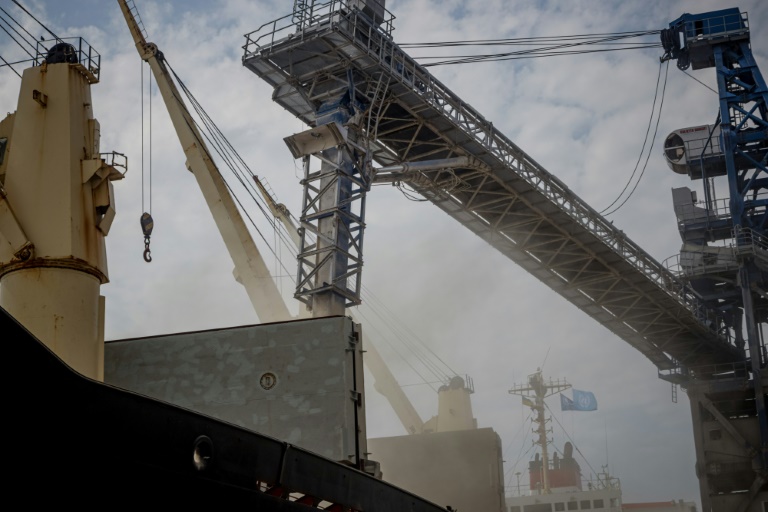
Blinken said it was “vital” to preserve an agreement brokered by the United Nations and Turkey through which ships with grain have been able to sail through the blockaded Black Sea.

But concerns are mounting on the long-term impacts. A recent report by the Ukraine Conflict Observatory, a non-governmental US group, found that around 15 percent of grain stocks in Ukraine have been lost since the invasion in February.

Experts warn that disruptions in fertilizer shipments could seriously impede future harvests around the world.

“It’s very clear that the current food supply disruption and the war in Ukraine is having an impact on the next harvest,” said Alvaro Lario, incoming president of the International Fund for Agricultural Development.

“There’s one or two harvests per year, and already we’re seeing that it’s going to be devastating for next year,” he told AFP, warning that the impact could be “much worse” than Covid.

He called for longer-term action, which would entail billions of dollars of investment, to ensure the stability of food supply chains and to adapt to a warming climate.

“We know the solutions and we have the institutions to make that happen. What is currently lacking is the political will, in terms of the investment,” he said.

In a joint report in July, UN agencies, including UNICEF and the Food and Agriculture Organization, said that between 702 and 828 million people were impacted by hunger in 2021, or 9.8 percent of the world population.

The figure was up by 46 million people from 2020 and by 150 million in 2019, showing the heavy impact of the Covid-19 pandemic on the world’s food economy.

UN Secretary-General Antonio Guterres said recently that the world had enough food in 2022 but that the problem was distribution.

If the situation does not stabilize in 2022, in 2023 “we risk to have a real lack of food,” he said.

Hertz to buy some 175,000 GM EVs through 2027

US rental car giant Hertz will buy up to 175,000 electric vehicles from General Motors by the end of 2027, the companies announced Tuesday, as the auto industry grapples with concerns over climate change and petroleum dependency.

First deliveries, which will consist of BOLT EVs and EUVs, should take place in the first quarter of 2023, according to the joint statement.

Subsequent purchases will depend on how fast General Motors (GM) ramps up production of electric vehicles. The automaker says it plans to manufacture one million a year in North America by 2025. 

Hertz will be able to select from GM’s Chevrolet, Buick, GMC, Cadillac and BrightDrop EV brands, according to the press release.

“With the vehicle choice, technology and driving range we’re delivering, I’m confident that each rental experience will further increase purchase consideration for our products and drive growth for our company,” GM CEO Mary Barra said.

Hertz, which is aiming for one-quarter of its fleet to be comprised of electric vehicles by 2024, has already signed agreements for 100,000 Teslas and 65,000 Polestars, an electric car firm controlled by Sweden’s Volvo and its Chinese owner Geely.

While gasoline-powered cars still dominate US roads, auto giants are unveiling more and more EVs as they pump billions of dollars in investment in a bid to wrest control of a growing market from Tesla and newer upstarts.

In addition to its agreement with Hertz, GM announced Tuesday it has entered into a partnership with the Environmental Defense Fund to ensure that at least 50 percent of its new vehicles sold by 2030 are zero emitting.

The end goal is to eliminate all tailpipe emissions from passenger vehicles sold by GM by 2035, Barra said.

Hertz to buy some 175,000 GM EVs through 2027

US rental car giant Hertz will buy up to 175,000 electric vehicles from General Motors by the end of 2027, the companies announced Tuesday, as the auto industry grapples with concerns over climate change and petroleum dependency.

First deliveries, which will consist of BOLT EVs and EUVs, should take place in the first quarter of 2023, according to the joint statement.

Subsequent purchases will depend on how fast General Motors (GM) ramps up production of electric vehicles. The automaker says it plans to manufacture one million a year in North America by 2025. 

Hertz will be able to select from GM’s Chevrolet, Buick, GMC, Cadillac and BrightDrop EV brands, according to the press release.

“With the vehicle choice, technology and driving range we’re delivering, I’m confident that each rental experience will further increase purchase consideration for our products and drive growth for our company,” GM CEO Mary Barra said.

Hertz, which is aiming for one-quarter of its fleet to be comprised of electric vehicles by 2024, has already signed agreements for 100,000 Teslas and 65,000 Polestars, an electric car firm controlled by Sweden’s Volvo and its Chinese owner Geely.

While gasoline-powered cars still dominate US roads, auto giants are unveiling more and more EVs as they pump billions of dollars in investment in a bid to wrest control of a growing market from Tesla and newer upstarts.

In addition to its agreement with Hertz, GM announced Tuesday it has entered into a partnership with the Environmental Defense Fund to ensure that at least 50 percent of its new vehicles sold by 2030 are zero emitting.

The end goal is to eliminate all tailpipe emissions from passenger vehicles sold by GM by 2035, Barra said.

47 charged in Minnesota in $240 mn Covid fraud scheme

Forty-seven people in the northern US state of Minnesota have been charged in connection with a $240 million Covid relief fraud scheme, officials said Tuesday.

“Today’s indictments describe an egregious plot to steal public funds meant to care for children in need in what amounts to the largest pandemic relief fraud scheme yet,” FBI Director Christopher Wray said.

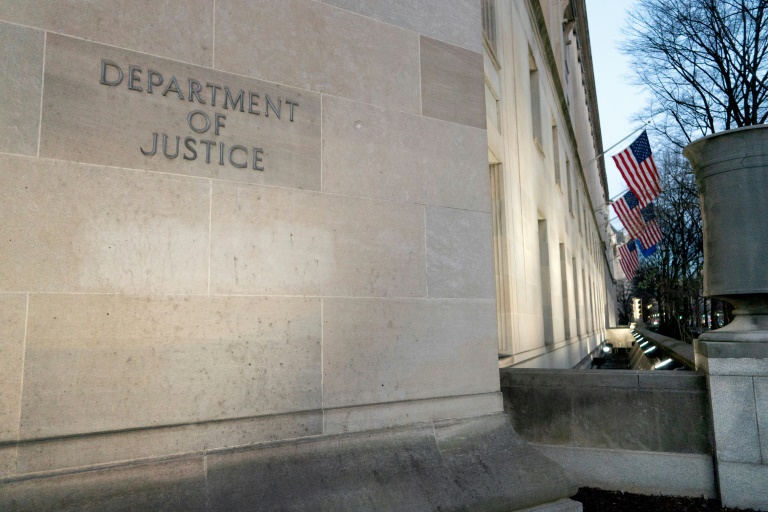
The Justice Department alleged that the defendants diverted tens of millions of dollars disbursed under the Federal Child Nutrition Program to feed needy children during the Covid pandemic.

Among those charged is Aimee Bock, 41, the founder and executive director of Feeding Our Future, a non-profit organization that was a sponsor of the Federal Child Nutrition Program.

“Feeding Our Future employees recruited individuals and entities to open Federal Child Nutrition Program sites throughout the state of Minnesota,” the Justice Department said in a statement.

“These sites, created and operated by the defendants and others, fraudulently claimed to be serving meals to thousands of children a day,” it said.

Instead, they submitted false invoices and fraudulent meal count sheets using fake names of children.

According to the Justice Department, Feeding Our Future claimed to have opened more than 250 sites throughout the state of Minnesota during the pandemic.

“The defendants used the proceeds of their fraudulent scheme to purchase luxury vehicles, residential and commercial real estate in Minnesota as well as property in Ohio and Kentucky, real estate in Kenya and Turkey, and to fund international travel,” the department said.

The defendants face an array of charges ranging from wire fraud to federal programs bribery to money laundering. 

Golden Globes to bring scandal-hit awards back to TV: organizers

The scandal-hit Golden Globes, one of Hollywood’s most important awards events, are to return to television next year, organizers said Tuesday, after being dumped by broadcasters and shunned by industry figures over ethics lapses.

The awards, voted for by members of the Hollywood Foreign Press Association (HFPA), have traditionally been seen as second only in importance to the Oscars.

But disquiet grew around the HFPA over accusations of racism, sexism, bullying and corruption, with television rights-holder NBC last year pulling the plug on its annual awards broadcast.

“We are thrilled to announce the return of the Golden Globe Awards on NBC and to hosting the ‘Party of the Year’ for audiences around the world who have been waiting for its return,” said Helen Hoehne, HFPA president.

“The HFPA remains committed to important changes and supporting programs which prioritize diversity, inclusion, and transparency.”

The organization found itself in the spotlight following a 2021 investigation by the Los Angeles Times that showed it did not have a single Black member at the time.

That opened the floodgates for criticism from across Hollywood to burst out into the open, including from A-list stars such as Tom Cruise.

As it sought to stave off attacks, the HFPA — made up of entertainment writers connected to foreign publications — rushed through reforms, including admitting its biggest ever annual intake of new members last year.

It also banned members from accepting lavish gifts and hotel stays from studios courting their votes — a near-constant source of criticism, including from acerbic British comic Ricky Gervais as he hosted the ceremony — and highlighted its philanthropic work.

In a press release on Tuesday, the HFPA said there were 103 new voting members, representing 62 countries.

“Combined with the current HFPA membership, the total Golden Globe Awards voting body is now 52 percent female (and) 51.5 percent racially and ethnically diverse,” the statement said.

– One-year deal –

The show has in the past been broadcast around the world and often featured big name presenters honoring stars from both film and television.

It will return to NBC in a one-year deal, which organizers said will allow them “to explore new opportunities for domestic and global distribution across a variety of platforms in the future.”

Frances Berwick of NBCUniversal Television and Streaming hailed the return to TV.

“We recognize the HFPA’s commitment to ongoing change and look forward to welcoming back the Golden Globes to NBC for its landmark 80th Anniversary in January 2023,” she said.

The Globes went ahead in January this year with neither audience nor media in attendance, dishing out prizes to “The Power of the Dog” and “West Side Story.”

None of the stars were present at the Beverly Hilton, with the ceremony held behind closed doors, and with no livestream, leaving the world to learn of the winners via tweet.

Studios and movie makers largely opted not to openly celebrate their wins, but “West Side Story” star Ariana DeBose acknowledged her award, while cautioning that reforms must continue at the HFPA.

“There is still work to be done, but when you’ve worked so hard on a project — infused with blood, sweat, tears and love — having the work seen and acknowledged is always going to be special,” she tweeted. 

US Fed opens policy meeting with steep rate hike on the table

US central bankers opened their two-day policy meeting on Tuesday with another steep interest rate hike seen as a near certainty amid stubbornly high inflation.

American families have felt the squeeze of soaring prices, which have risen at the fastest pace since the early 1980s, and Federal Reserve Chair Jerome Powell has made it clear officials will continue to act aggressively to cool the economy.

Many economists are expecting a third straight three-quarter point rate hike when the meeting concludes Wednesday, an unprecedented action.

Fed officials have been united in the message that the US central bank cannot risk letting inflation take hold due to the damaging impact on workers and businesses, but analysts warn that the risks of recession are rising.

“The inflation rate will continue to call the tune for the path of monetary policy, despite rising risks of a recession in 2023,” said Kathy Bostjancic of Oxford Economics, who projects a downturn early next year. 

“We see higher-for-longer inflation, more aggressive Fed monetary policy tightening, and negative spillover effects from a weakening global backdrop combining to push the US economy into a mild recession in H1 2023.”

The Fed’s policy-setting Federal Open Market Committee (FOMC) is scheduled to announce its decision at 1600 GMT Wednesday.

Markets have been roiled in recent days by the decidedly hawkish statements from central bankers, and Powell’s press conference after the meeting will be closely scrutinized for information on what he thinks the next steps will be.

– More hikes coming? –

Despite the welcome drop in gasoline prices at the pump in recent weeks, the disappointing consumer price report for August, released last week, showed housing, food and medical costs continued to rise. And when volatile food and energy prices are stripped out, so-called core inflation accelerated.

It is not just current high inflation that concerns policymakers, but the fear that consumers and businesses begin to expect rising prices will become a permanent feature, which could set off a dangerous spiral and a phenomenon called stagflation.

That fear has driven the Fed to front-load its rate hikes, rather than pursuing the more customary course of small, gradual steps over a longer period. 

The US central bank has cranked up the benchmark lending rate four times this year, including two straight three-quarter-point hikes in June and July.

The aim is to raise the cost of borrowing and cool demand — and it is having an impact: Home mortgage rates have now topped six percent for the first time since 2008.

And recent statements from Fed officials indicate more rate hikes are coming, and no cuts until inflation is under control — dousing hopes that had built up in markets following the July policy meeting.

The FOMC also will release the quarterly forecasts from members, which will show how they feel about the direction of the economy and the impact of the policy moves, and how soon inflation will come down.

US Fed opens policy meeting with steep rate hike on the table

US central bankers opened their two-day policy meeting on Tuesday with another steep interest rate hike seen as a near certainty amid stubbornly high inflation.

American families have felt the squeeze of soaring prices, which have risen at the fastest pace since the early 1980s, and Federal Reserve Chair Jerome Powell has made it clear officials will continue to act aggressively to cool the economy.

Many economists are expecting a third straight three-quarter point rate hike when the meeting concludes Wednesday, an unprecedented action.

Fed officials have been united in the message that the US central bank cannot risk letting inflation take hold due to the damaging impact on workers and businesses, but analysts warn that the risks of recession are rising.

“The inflation rate will continue to call the tune for the path of monetary policy, despite rising risks of a recession in 2023,” said Kathy Bostjancic of Oxford Economics, who projects a downturn early next year. 

“We see higher-for-longer inflation, more aggressive Fed monetary policy tightening, and negative spillover effects from a weakening global backdrop combining to push the US economy into a mild recession in H1 2023.”

The Fed’s policy-setting Federal Open Market Committee (FOMC) is scheduled to announce its decision at 1600 GMT Wednesday.

Markets have been roiled in recent days by the decidedly hawkish statements from central bankers, and Powell’s press conference after the meeting will be closely scrutinized for information on what he thinks the next steps will be.

– More hikes coming? –

Despite the welcome drop in gasoline prices at the pump in recent weeks, the disappointing consumer price report for August, released last week, showed housing, food and medical costs continued to rise. And when volatile food and energy prices are stripped out, so-called core inflation accelerated.

It is not just current high inflation that concerns policymakers, but the fear that consumers and businesses begin to expect rising prices will become a permanent feature, which could set off a dangerous spiral and a phenomenon called stagflation.

That fear has driven the Fed to front-load its rate hikes, rather than pursuing the more customary course of small, gradual steps over a longer period. 

The US central bank has cranked up the benchmark lending rate four times this year, including two straight three-quarter-point hikes in June and July.

The aim is to raise the cost of borrowing and cool demand — and it is having an impact: Home mortgage rates have now topped six percent for the first time since 2008.

And recent statements from Fed officials indicate more rate hikes are coming, and no cuts until inflation is under control — dousing hopes that had built up in markets following the July policy meeting.

The FOMC also will release the quarterly forecasts from members, which will show how they feel about the direction of the economy and the impact of the policy moves, and how soon inflation will come down.
Moscow-held Ukraine regions to vote on annexation by Russia

Moscow-held regions of Ukraine will urgently vote on annexation by Russia, separatist officials said Tuesday, as Kyiv’s troops wrest back territory captured by Moscow’s forces.

Separatist authorities in the eastern Donetsk and Lugansk regions, as well as in the southern Kherson and Zaporizhzhia regions, said they would hold the vote over five days beginning Friday this week.

The regions are on the frontlines of a sweeping Ukrainian counter-offensive that has seen Kyiv’s forces retake hundreds of towns and villages that had been controlled by Russia for months.

Their integration into Russia would represent a major escalation of the conflict as Moscow could try to say it was defending its own territory from Ukrainian forces.

Washington, Berlin and Paris denounced the ballots and said the international community would never recognise the results while NATO said the votes marked a “further escalation” of the war.

Kyiv said the “sham” referendums were meaningless and vowed to “eliminate” threats posed by Russia, saying its forces would keep retaking territory regardless of what Moscow or its proxies announced.

Denis Miroshnichenko, a separatist leader in the Lugansk region, said pro-Moscow lawmakers had voted to hold the vote from September 23 to 27.

Shortly afterwards, a news portal associated with separatist authorities in Donetsk said the region would hold a ballot over the same dates.

Large parts of the industrial Donbas area — made up of Donetsk and Lugansk — have been controlled by Moscow-backed separatists since 2014, after nationwide demonstrations ousted a Kremlin-friendly Ukrainian president.

– ‘Restore historical justice’ –

Russia at the time annexed the Crimean peninsula on the Black Sea from Ukraine with a vote that was criticised by Kyiv and the West, which imposed sanctions in response.

Ahead of the announcement by separatist and pro-Moscow leaders, Russia’s lower house of parliament drafted new legislation tightening prison time for soldiers who surrender, desert or loot.

Authorities in the southern Kherson region of Ukraine also announced on Tuesday they would hold a vote over the same dates.

“The incorporation of the Kherson region into the Russian Federation will secure our territory and restore historical justice,” said the Moscow-installed head of that region, Vladimir Saldo.

He echoed a phrase used earlier in the day by Russia’s former president and prime minister Dmitry Medvedev who invoked correcting historical wrongs, but also said the votes would bolster Russian forces.

“Encroachment into Russian territory is a crime and if it is committed, that allows you to use all possible force in self-defence,” Medvedev, now the deputy chairman of Russia’s security council, said on social media. 

Pro-Moscow authorities in Ukraine’s Zaporizhzhia region — home to Europe’s largest nuclear power plant — also announced they would hold a vote on the region’s “territorial allegiance”.

Ukrainian President Volodymyr Zelensky’s chief of staff, Andriy Yermak, vowed a decisive response from Kyiv.

– ‘Sham’ votes –

“Ukraine will solve the Russian issue. The threat can be eliminated only by force,” Yermak said.

German Chancellor Olaf Scholz denounced the “sham” votes and said they must be rejected by the international community. French President Emmanuel Macron called them a “travesty”.

White House National Security Advisor Jake Sullivan said the referendums were “an affront to the principles of sovereignty and territorial integrity”.

“If this does transpire, the United States will never recognize Russia’s claims to any purportedly annexed parts of Ukraine,” he said.

Ukraine Foreign Minister Dmytro Kuleba said the referendums would change nothing.

“Ukraine has every right to liberate its territories and will keep liberating them whatever Russia has to say,” he said in a statement online.

At the United Nations, Turkish President Recep Tayyip Erdogan called for a “dignified way out” of the seven-month crisis sparked by Russia’s invasion.

The votes come at a decisive moment.

Ukraine’s forces in the east are now pushing towards the village of Bilogorivka whose capture by Russia in May decimated Moscow’s forces as they crossed the Siverskyi Donets river nearby.

Political analyst Tatiana Stanovaya said the vote announcements were a direct result of the success of Ukraine’s counter-offensive in east Ukraine.

Putin, she said, wants to threaten the full use of Russia’s military, including nuclear weapons, in defending Russian territory, including newly annexed regions.

“Putin does not want to win this war on the battlefield. Putin wants to force Kyiv to surrender without a fight,” she said.

The head of Russian state-media group, RT, Margarita Simonyan said the announcements marked either “the eve of our imminent victory or the eve of nuclear war”.

Speaking with newly appointed foreign ambassadors in Moscow on Tuesday ahead of the opening of the UN General Assembly, Putin said that Russia would pursue its “sovereign course.” 

The Russian leader earlier Tuesday met with defence industry representatives and demanded the sector “resolve the problem of the prompt and full provision of defense industry factories with domestically-manufactured components”.

UN chief warns of 'winter of discontent' as war and climate worsen

The head of the United Nations warned Tuesday of an upcoming “winter of global discontent” from rising prices, a warming planet and deadly conflicts as world leaders sought ways forward on Ukraine and Iran.

The UN General Assembly, the annual gathering of world leaders that clogs Midtown Manhattan, returned in person after two years of pandemic restrictions with only one leader allowed to appear virtually — Ukrainian President Volodymyr Zelensky.

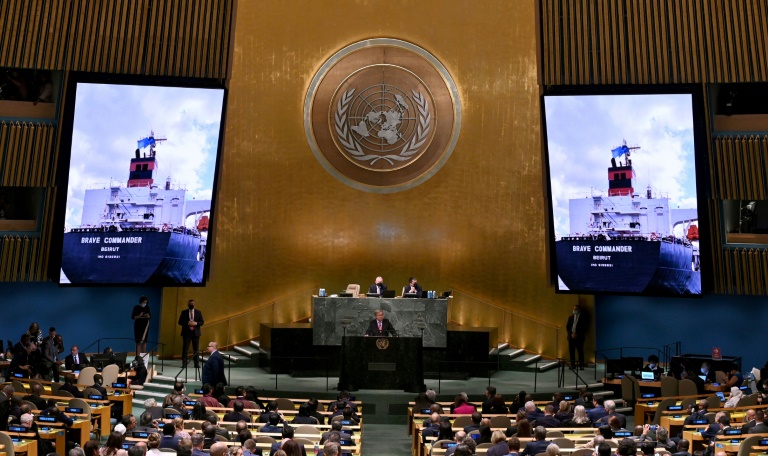
UN Secretary-General Antonio Guterres opened the summit with an image of a ship carrying grain out of Ukraine, a symbol of successful diplomacy, but he warned of a dire state of the planet. 

“A winter of global discontent is on the horizon,” Guterres said. 

“Trust is crumbling, inequalities are exploding, our planet is burning. People are hurting — with the most vulnerable suffering the most.”

With global temperatures rising and a chunk of Pakistan the size of the United Kingdom recently under water, Guterres lashed out at fossil fuel companies and the “suicidal war against nature.”

“Let’s tell it like it is — Our world is addicted to fossil fuels. It’s time for an intervention. We need to hold fossil fuel companies and their enablers to account,” Guterres said.

He called on all developed economies to tax profits from fossil fuels and dedicate the funds both to compensate for damage from climate change and to help people struggling with high prices.

“Polluters must pay,” Guterres said.

– Warnings on Ukraine –

The summit still saw disruption due to the death of Queen Elizabeth II, with President Joe Biden of the United States, by tradition the second speaker on the opening day, instead due to speak on Wednesday.

Just as leaders huddled at the United Nations about the war in Ukraine, Russian-backed forces announced they were going ahead with a move the West had long warned against — referendums on annexation by Moscow.

German Chancellor Olaf Scholz called the votes, to be conducted in the coming days in Russian-occupied Ukrainian territory, a “sham” that were part of “imperialist aggression” by Moscow.

The war in Ukraine, a major grain producer, has sent global food prices spiraling, hitting developing nations especially hard.

Senegalese President Macky Sall, the current chair of the African Union, urged a “negotiated solution” in Ukraine to “avoid the catastrophic risk of a potentially global conflict.”

Turkish President Recep Tayyip Erdogan, who has fashioned himself as a mediator and played a key role in arranging the grain shipments, called for an end to the war that recognizes Ukraine’s sovereignty and territorial integrity.

“Together, we need to find a reasonably practical diplomatic solution that will give both sides a dignified way out of the crisis,” Erdogan told the General Assembly.

Western leaders led by the United States have made clear they do not want the summit to focus exclusively on the Ukraine war itself, mindful of resentment in the developing world to the billions of dollars sent in weapons.

“The brutality of Russia’s war of aggression and its threat to the peace order in Europe have not blinded us to the fact that its dramatic effects are also clearly being felt in many other regions of the world,” German Foreign Minister Annalena Baerbock said.

US Secretary of State Antony Blinken will head a meeting on food security, and Guterres on Monday launched a bid to step up funding for education, badly affected by the pandemic.

– Criticism on Iran –

Among leaders who headed to New York was Iranian President Ebrahim Raisi, a hardliner who took office last year and faced noisy demonstrations on the streets of Manhattan.

While talks with Iran at the United Nations will once again focus on the fate of a 2015 nuclear accord, Raisi traveled as protests grip his country following the death of a young woman arrested by “morality police.”

Chilean President Gabriel Boric, a leftist former student leader, in his UN speech paid tribute to 22-year-old Mahsa Amini, who was arrested by the unit responsible for enforcing the Islamic republic’s strict dress code for women.

Boric called for “an end to abuses by the powerful everywhere,” including Russia’s “unjust war in Ukraine” and “violence against women” in Iran and elsewhere.

Iranian dissidents announced that they had filed a new lawsuit in US courts against Raisi over his role as a judge following the Islamic revolution in which thousands were sentenced to death.

Raisi went ahead with meetings including with French President Emmanuel Macron, who is seeking to revive the nuclear accord trashed by former US president Donald Trump.

Biden supports the accord, under which Iran drastically scaled back nuclear work in return for sanctions relief.

But Raisi has called for “guarantees” a future US leader will not ditch the deal, a promise the Biden administration considers impossible.

Close Bitnami banner
Bitnami