US Business

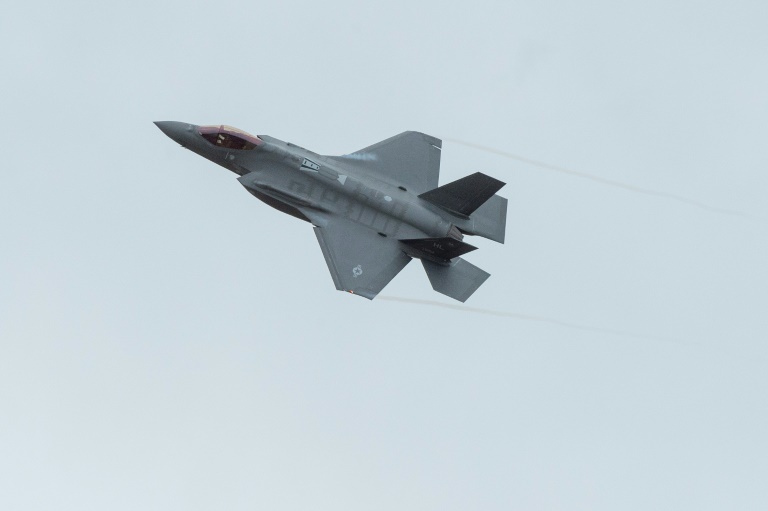
Switzerland signs contract for 36 US fighter jets

Switzerland signed a controversial contract on Monday to buy 36 US F-35 stealth fighter jets at a cost of more than six billion francs ($6.2 billion). 

“National Armaments Director Martin Sonderegger and the Swiss F-35A Program Manager Darko Savic signed the procurement contract on 19 September 2022 at armasuisse in Bern,” said armasuisse, the country’s arms procurement agency.

“With this, the procurement of 36 F-35A is contractually agreed,” it added.

The selection of the F-35 by the Swiss government in June 2021 sparked some controversy, particularly in light of the cost-overruns of the fighter programme in the United States.

But a Swiss parliamentary investigation did not call into question the selection of the fighter.

The Swiss government and parliament also short-circuited holding a referendum on the plane’s purchase despite enough signatures being collected to put the issue to voters, saying there was not enough time to do so before manufacturer Lockheed Martin’s offer expires.

But Swiss voters had already narrowly approved in September 2020 spending six billion Swiss francs to replace the country’s fleet of ageing F/A-18 Hornets and F-5 Tigers.

The F-35s will be delivered between 2027 and 2030.

Switzerland joins a growing number of European countries which have opted for the stealth multi-role combat aircraft, including Belgium, Britain, Denmark, Finland, Italy, Greece, Germany, the Netherlands, Norway, and Poland.

Kremlin dismisses mass burial discoveries as 'lies'

The Kremlin on Monday denied its forces were responsible for large-scale killings in east Ukraine and accused Kyiv of fabricating its discoveries of mass graves in recaptured territory.

In the latest incident spurring fears of an atomic emergency, Ukraine said that Russian rockets landed precariously close to a nuclear power station in southern Ukraine.

Ukraine recaptured Izyum and other towns in the east this month, crippling Kremlin supply routes and bringing fresh claims of Russian atrocities with the discovery of hundreds of graves — some containing multiple bodies.

“These are lies,” Kremlin spokesman Dmitry Peskov told reporters on Monday. Moscow, he said, “will stand up for the truth in this story.”

Fighting in the northeast has raged and AFP journalists heard artillery exchanges in frontline Kupiansk on Monday, as traumatised civilians headed out of the town now mainly in the hands of Ukrainian forces.

The streets were strewn with broken glass, spent cartridge casings and the discarded remains of ration packs issued by both forces. 

Most of the fire is outgoing, with Ukrainian tanks and artillery targeting Russian positions on the west side of the town, over a mess of broken bridges. A column of smoke rose in the distance. 

At the entrance to the town, cowering from the sounds of Ukrainian tank shells passing overhead towards Russian lines, civilians gathered to hitch rides or join buses to head out into safer Ukrainian territory. 

“There’s been no light, no electricity, for a week. No water,” said a 49-year-old former policeman who gave his name only as Ruslan.

– ‘Lost a lot of blood’ –

Russian-backed authorities in east Ukraine said a “punitive” strike by Kyiv’s forces had killed more than a dozen people and wounded more in the separatist stronghold of Donetsk.

The rebel head of the region claimed the strike was “deliberate” and said it would “not go unpunished.”

A court in the neighbouring rebel-region of Lugansk sentenced an employee of the Organization for Security and Cooperation in Europe to 13 years for leaking military secrets.

Ukrainian civilians in the recaptured northeast region of Kharkiv have recounted months of brutality under Russian occupation.

In Kupiansk, Mykhailo Chindey, told AFP he had been tortured on suspicion of supplying targeting coordinates to Ukrainian forces.

“One person was holding my hand and another one was beating my arm with a metal stick. They were beating me up two hours almost every day,” he told AFP. 

“I lost consciousness at some point. I lost a lot of blood. They hit my heels, back, legs and kidneys,” he said.

Ukraine’s nuclear energy agency, Energoatom, said Russia struck the Pivdennoukrainsk nuclear power plant overnight, with a “powerful explosion” just 300 metres (985 feet) from its reactors.

The strike damaged more than 100 windows at the station, but the reactors were not damaged, Energoatom said, publishing photos of glass shattered around blown-out frames.

It also released images of what it said was a two-metre-deep crater from where the missile landed. No staff were wounded, it said.

– ‘Russia endangers the whole world’ –

Attacks around nuclear facilities in Ukraine have spurred calls from Ukraine and its Western allies to de-militarise surrounding areas.

Europe’s largest atomic facility — the Zaporizhzhia nuclear plant in Russian-held territory in Ukraine — has become a hot spot for concerns after tit-for-tat claims of attacks.

The UN’s atomic agency deployed a monitoring team to the site in early September after new fighting.

Early in the February invasion, fighting erupted around Chernobyl in the north, where an explosion in 1986 left swathes of the surrounding territory contaminated.

“Russia endangers the whole world. We have to stop it before it’s too late,” President Volodymyr Zelensky said early Monday.

French President Emmanuel Macron this month urged Vladimir Putin to withdraw Russian heavy weapons from Zaporizhzhia. The Russian leader cautioned against potential “catastrophic” consequences of fighting there.

The Mykolaiv region in southern Ukraine, where the Pivdennoukrainsk plant is located, is close to the front line of of a Ukrainian counter-offensive in the south.

Kyiv’s forces have clawed back territory near Mykolaiv, nearing the strategically important hub of Kherson.

Russian forces have continued to shell Ukrainian-held towns near the front lines.

burs-jbr/jm

Markets struggle ahead of another Fed rate hike

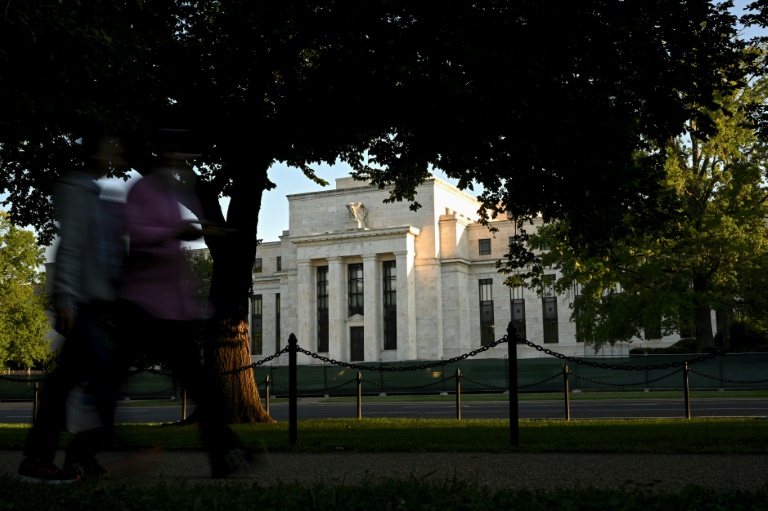
Stock markets dropped again Monday, extending last week’s rout as investors brace for another big rate hike by the US Federal Reserve that they fear could drag down the global economy.

Wall Street opened lower, with the Dow dropping 0.6 percent.

The Paris CAC 40 and Frankfurt DAX were down in afternoon trading while Asian indices mostly closed lower. London was closed for the funeral of Queen Elizabeth II. 

“Traders are worried that they are going to hear more hawkish stance from central banks this week” which would “cut economic activity further,” AvaTrade analyst Naeem Aslam told AFP.

The Fed will announce its latest monetary policy decision on Wednesday as it seeks to tame decades-high inflation.

With recent data showing US inflation rooted at four-decade highs, investors are increasingly pessimistic about the outlook for the global economy.

Central banks raise interest rates to cool inflation, but higher borrowing costs also slow down economic activity.

Disappointing US inflation figures last week unnerved traders and ramped up bets for a third successive 0.75-percentage-point rise, while some have predicted a whole percentage point move.

Policymakers, including Fed chairman Jerome Powell, have repeatedly said their ultimate aim is to bring inflation under control, even if that means sending the economy into recession.

“We’re expecting a sharp interest rate increase and therefore a clear signal against galloping inflation,” said Tim Emden, an independent market analyst.

Patrick O’Hare at Briefing.com said that a good question is why stock markets are still falling when they already took a wallop last week on the prospect of higher interest rates triggering an economic slump.

“The reason being is that the market doesn’t have a comforting sense where the end rate will be, how long the end rate will remain the end rate, and how low earnings estimates will go,” he said.

The Bank of England and its peer in Japan are also holding key meetings this week, with the pound and the yen feeling the pressure from a strong dollar.

– Yen under pressure –

Asian equity investors continued the selling on Monday.

Hong Kong closed down one percent, even after reports that the city’s government was considering ending mandatory hotel quarantine for incoming travellers.

Shanghai was also down despite news that megacity Chengdu was ending a two-week Covid-19 lockdown that saw 21 million people affected.

Tokyo was closed for a holiday.

The prospect of more big Fed rate hikes is also keeping the dollar at multi-decade highs against its major peers, with the yen feeling most of the pressure as the Bank of Japan refuses to tighten policy.

The Japanese unit last week hit a fresh 24-year low of 144.99 to the dollar, though it has bounced slightly after comments from BoJ officials that signalled they were ready to intervene to provide support.

Oil prices tumbled around three percent despite the news out of Chengdu as demand fears are fuelled by the growing fear of recession around the world.

“The market’s growth concerns, meanwhile, are being fed by the inverted yield curve and are manifesting themselves in the commodities market,” O’Hare said.

An inverted yield curve is the unusual situation where short-term interest rates are higher than long-term interest rates, and is often a signal of an impending recession.

– Key figures at around 1330 GMT –

New York – Dow: DOWN 0.6 percent at 30,722.56

EURO STOXX 50: DOWN 0.7 percent at 3,499.78

Frankfurt – DAX: DOWN 0.3 percent at 12,707.24

Paris – CAC 40: DOWN 1.0 percent at 6,015.85

London – FTSE 100: Closed for queen’s funeral

Hong Kong – Hang Seng Index: DOWN 1.0 percent at 18,565.97 (close)

Shanghai – Composite: DOWN 0.4 percent at 3,115.60 (close)

Tokyo – Nikkei 225: Closed for holiday

Pound/dollar: DOWN at $1.1369 from $1.1423 on Friday

Euro/pound: UP at 87.79 pence from 87.00 pence 

Euro/dollar: DOWN at $0.9983 from $1.0018

Dollar/yen: UP at 143.45 yen from 142.91 yen

West Texas Intermediate: DOWN 3.5 percent at $81.81 per barrel

Brent North Sea crude: DOWN 2.7 percent at $88.67 per barrel

Scholz to visit Saudi as Germany seeks energy supplies

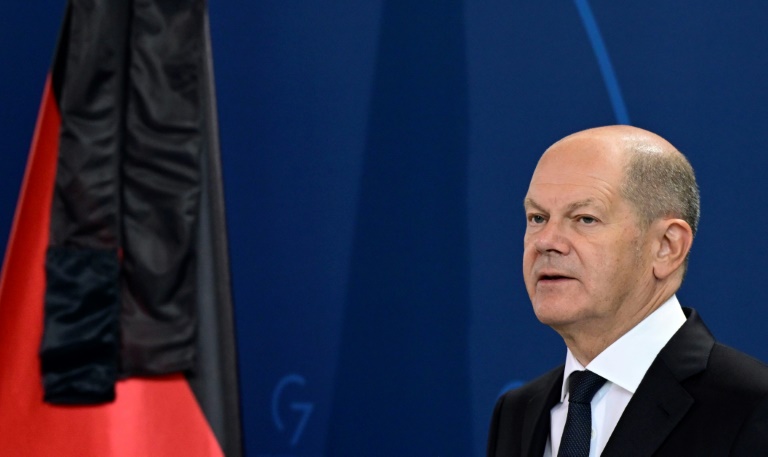
Chancellor Olaf Scholz will visit Saudi Arabia and meet Saudi Crown Prince Mohammed bin Salman as part of a Gulf trip, his spokesman said Monday, as Germany rushes to secure energy supplies.

Scholz, whose two-day trip next weekend will also take him to Qatar and the United Arab Emirates, becomes the latest Western leader to meet with the crown prince.

Bin Salman was until recently regarded as a pariah in the West due to his suspected role in the murder of Washington Post journalist Jamal Khashoggi in 2018. 

But he is being courted again as Europe and its allies urgently seek fresh sources of fossil fuels after Russia cut gas supplies amid soaring tensions over its invasion of Ukraine.

Scholz, accompanied by a business delegation, will visit Saudi Arabia on Saturday, where he will meet with the crown prince and — if his health permits it — King Salman, government spokesman Steffen Hebestreit said. 

He did not go into detail about the reasons for Scholz’s Gulf visit but said he would be “very surprised” if the topic of energy was not discussed. 

The spokesman also offered assurances that “the murder of Mr Khashoggi will certainly figure in discussions”.

It is the latest sign of bin Salman’s international rehabilitation — in July, French President Emmanuel Macron held talks with him in Paris, and US President Joe Biden visited the kingdom.

On Sunday, Scholz will head first to the UAE and meet with President Sheikh Mohamed bin Zayed Al-Nahyan. Economy Minister Robert Habeck said Scholz would sign contracts there related to liquified natural gas — seen as a key alternative to Russian energy supplies. 

In the afternoon, the chancellor will hold talks with Qatari Emir Sheikh Tamim bin Hamad Al-Thani. 

Habeck already visited Qatar and the UAE in March in an effort to find alternatives to Russian gas, which Germany has traditionally depended on heavily.

Russia’s decision to cut off supplies has triggered an energy crisis in Europe, with consumers and businesses facing soaring bills as winter approaches. 

Taliban say US national freed in exchange for key ally

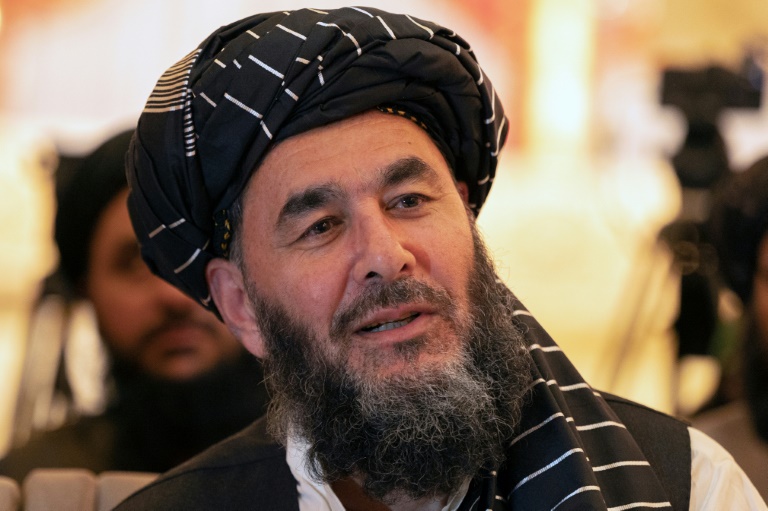
An American navy veteran detained in Afghanistan since 2020 was released by the Taliban on Monday in exchange for an ally who spent 17 years in a US jail for heroin smuggling, Afghanistan’s foreign minister said.

Mark Frerichs was working as a civil engineer on construction projects in Afghanistan when he was “taken hostage”, Washington previously said.

“After long negotiations, US citizen Mark Frerichs was handed over to an American delegation and that delegation handed over (Bashar Noorzai) to us today at Kabul airport,” Afghan Foreign Minister Amir Khan Muttaqi said at a press conference.

“We are happy that at Kabul International Airport, in the capital of Afghanistan, we witnessed the wonderful ceremony of one of our compatriots returning home.”

Noorzai was welcomed with a hero’s fanfare by the government of the newly-styled Islamic Emirate of Afghanistan (IEA). Photos show he was greeted by masked Taliban soldiers bearing floral garlands.

“If the IEA had not shown its strong determination, I would not have been here today,” Noorzai told reporters at the press conference.

“My release in exchange for an American will be a source of peace between Afghanistan and Americans.”

Noorzai is the second Afghan inmate released by the United States in recent months. In June, Assadullah Haroon was released after 15 years of detention in the United States’ notorious Guantanamo Bay prison.

Haroon was accused of links to Al-Qaeda but languished without charge for years at the US detention centre in Cuba, after his arrest in 2006 whilst working as a honey trader.

He was not released under the terms of a deal with the Taliban.

Afghan security analyst Hekmatullah Hekmat said Noorzai’s release was a “major achievement” for Kabul’s new rulers.

“The Taliban can tell their foot soldiers and Afghans that they are able to bring back their people held by opposition groups,” he told AFP.

Muttaqi said the homecoming of Noorzai marks the beginning of a “new chapter” in relations between Afghanistan and the United States.

– ‘Non-negotiable’ –

The Taliban seized power in Afghanistan a little over a year ago, as the United States and their NATO allies withdrew from the country after 20 years of military intervention. 

Since then, the nation has been further plunged into economic and humanitarian hardship, with billions in Afghan assets abroad frozen by Washington and international aid vastly reduced. 

No country has yet recognised the new government, with Washington repeatedly telling the Taliban that they will have to “earn” legitimacy.

The US State Department had previously described navy veteran Frerich’s release as one of the government’s “core, non-negotiable priorities”. 

“The Taliban must immediately release Mark before it can expect any consideration of its aspirations for legitimacy. This is not negotiable,” US President Joe Biden said in a statement in January.

Noorzai, a militia commander and Taliban associate, was sentenced to life imprisonment for heroin smuggling and had served 17 years.

He once fought with US-backed mujahideen forces against the Soviet occupation of Afghanistan and was a close associate of the Taliban’s late founder Mullah Omar.

At the time of his trial, US prosecutors said he ran a “worldwide narcotics network” and supported the Taliban’s first regime between 1996 and 2001.

While he held no official position, Noorzai had “provided strong support including weapons” for the Taliban in the 1990s, Taliban government spokesman Zabihullah Mujahid told AFP on Monday.

Markets struggle ahead of another Fed rate hike

Stock markets dropped again Monday, extending last week’s rout as investors brace for another big rate hike by the US Federal Reserve that they fear could drag down the global economy.

The Paris CAC 40 and Frankfurt DAX were down in early afternoon trading while Asian indices mostly closed lower. London was closed for the funeral of Queen Elizabeth II. 

“Traders are worried that they are going to hear more hawkish stance from central banks this week” which would “cut economic activity further,” AvaTrade analyst Naeem Aslam told AFP.

The Fed will announce its latest monetary policy decision on Wednesday as it seeks to tame decades-high inflation.

With recent data showing US inflation rooted at four-decade highs, investors are increasingly pessimistic about the outlook for the global economy.

Central banks raise interest rates to cool inflation, but higher borrowing costs also slow down economic activity.

Disappointing US inflation figures last week unnerved traders and ramped up bets for a third successive 0.75-percentage-point rise, while some have predicted a whole percentage point move.

Policymakers, including Fed chairman Jerome Powell, have repeatedly said their ultimate aim is to bring inflation under control, even if that means sending the economy into recession.

“We’re expecting a sharp interest rate increase and therefore a clear signal against galloping inflation,” said Tim Emden, an independent market analyst.

The Bank of England and its peer in Japan are also holding key meetings this week, with the pound and the yen feeling the pressure from a strong dollar.

– Yen under pressure –

Asian equity investors continued the selling on Monday.

Hong Kong closed down one percent, even after reports that the city’s government was considering ending mandatory hotel quarantine for incoming travellers.

Shanghai was also down despite news that megacity Chengdu was ending a two-week Covid-19 lockdown that saw 21 million people affected.

Tokyo was closed for a holiday.

The prospect of more big Fed rate hikes is also keeping the dollar at multi-decade highs against its major peers, with the yen feeling most of the pressure as the Bank of Japan refuses to tighten policy.

“Speculative selling of the yen is readily justified by the ongoing widening in US-Japan yield differentials,” said Ray Attrill, of National Australia Bank.

“Until or unless something happens to arrest or reverse this spread widening, the yen is susceptible to additional selling pressure.”

The Japanese unit last week hit a fresh 24-year low of 144.99 to the dollar, though it has bounced slightly after comments from BoJ officials that signalled they were ready to intervene to provide support.

Oil prices dipped despite the news out of Chengdu as demand fears are fuelled by the growing fear of recession around the world.

– Key figures at around 1100 GMT –

EURO STOXX 50: DOWN 1.1 percent at 3,462.97

Frankfurt – DAX: DOWN 0.7 percent at 12,654.03

Paris – CAC 40: DOWN 1.4 percent at 5,994.24

London – FTSE 100: Closed for queen’s funeral

Hong Kong – Hang Seng Index: DOWN 1.0 percent at 18,565.97 (close)

Shanghai – Composite: DOWN 0.4 percent at 3,115.60 (close)

Tokyo – Nikkei 225: Closed for holiday

New York – Dow: DOWN 0.5 percent at 30,822.42 (close)

Pound/dollar: DOWN at $1.1378 from $1.1423 on Friday

Euro/pound: UP at 87.81 pence from 87.00 pence 

Euro/dollar: DOWN at $0.9991 from $1.0018

Dollar/yen: UP at 143.45 yen from 142.91 yen

West Texas Intermediate: DOWN 1.8 percent at $83.61 per barrel

Brent North Sea crude: DOWN 0.6 percent at $89.91 per barrel

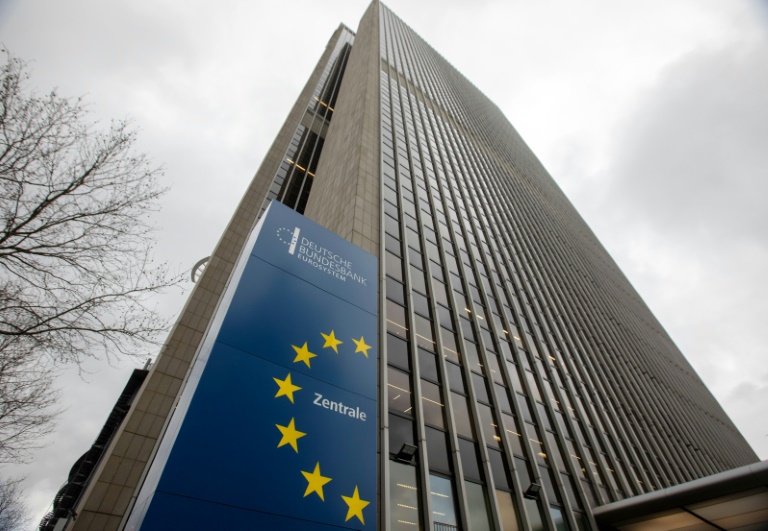
German central bank sees signs of recession 'multiplying'

The German central bank said Monday it was increasingly likely that Europe’s largest economy would shrink for a “prolonged” period as Russia throttled energy supplies to the continent.

“The signs of a recession for the German economy are multiplying,” the Bundesbank said in its monthly report, warning of a “broad-based and prolonged decline in economic output”.

The likely slump was above all down to “supply-side constraints”, namely reduced deliveries of energy in the wake of the Russian invasion of Ukraine. 

Moscow has dwindled supplies of gas to Europe and kept the Nord Stream pipeline shut since the end of August, heaping pressure on Germany’s economy.

Germany had been highly reliant on Russian energy imports to power its industry and heat its homes, with 55 percent of its gas coming from Russia before the outbreak of the war.

German GDP grew fractionally by 0.1 percent between April and June, but an increasing number of economic indicators, such as business and consumer confidence, have begun to flash red.

The economy would likely shrink “slightly” in the third quarter of the year, the Bundesbank said, before a “marked” drop over the last three months of 2022 and the beginning of 2023.

The Russian gas supply stop meant that the situation on gas markets was “very tense”, it said. 

Germany could “avoid formal rationing” of the fuel, but necessary reductions in consumption would lead companies to limit or pause production, the central bank predicted.

The impact was unlikely to be as bad as an “adverse scenario” sketched out by the Bundesbank in June, which foresaw the economy shrinking by 3.2 percent in 2023, it said.

“The outlook is however extremely uncertain,” the Bundesbank said.

The reduction in gas supplies has sent prices for the fuel and for electricity rocketing, spurring decades-high inflation rates. 

Consumer prices rose at a 7.9-percent rate in Germany in August, well above the two-percent target of the European Central Bank.

China says Biden's Taiwan remarks 'severely violate' US policy over island

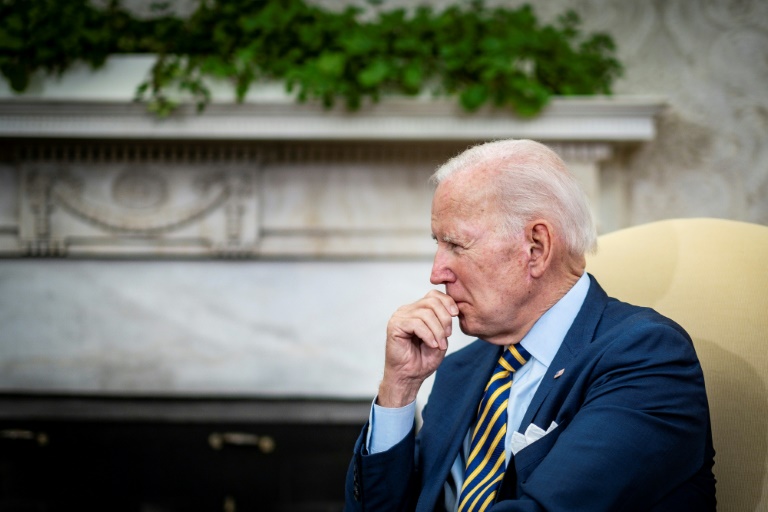
Beijing on Monday said President Joe Biden’s latest comments that the United States would defend Taiwan against a Chinese invasion “severely violate” Washington’s policy towards the island.

Washington cut formal diplomatic relations with Taiwan in 1979, switching recognition to Beijing as the sole representative of China — but it has maintained a decisive, if delicate, role in supporting the island since.

In an interview with US broadcaster CBS that was aired on Sunday, Biden was asked whether US troops would defend Taiwan, and replied “yes”, if it were “an unprecedented attack”.

He went on to say that Taiwan makes its “own judgements” about independence and the US was not “encouraging… their being independent”. 

“That’s their decision,” he said.

China reacted angrily on Monday, with foreign ministry spokesperson Mao Ning telling a regular press briefing: “The US remarks… severely violate the important commitment the US made not to support Taiwan independence, and send a seriously erroneous signal to Taiwanese separatist independence forces.”

“We are willing to make the biggest sincere efforts to strive for the prospect of peaceful reunification,” Mao said.

“At the same time, we will never tolerate any activities aimed at splitting the country, and reserve the choice to take all necessary measures.”

Tensions between China and the US are already higher than usual in the wake of a rare visit to Taiwan by Nancy Pelosi, a key Biden ally and speaker of the House of Representatives.

Last week, a US Senate committee took the first step towards directly providing billions of dollars in military aid to Taiwan and making ties more official.

The US approved a potential arms sale worth more than $1 billion to Taiwan in early September, including 60 anti-ship missiles and 100 air-to-air missiles, which provoked anger from China. 

“We urge the US side to fully recognise the extreme importance and high sensitivity of the Taiwan question… (and) earnestly implement the commitment made by US leaders not to support Taiwanese independence,” Mao added.

– ‘Strategic ambiguity’ –

Biden’s comments appeared to depart from decades of US policy towards Taiwan.

While Washington does arm Taiwan, it has long maintained a policy of “strategic ambiguity” on whether it would intervene militarily if Beijing were to invade. 

The policy is designed to dissuade both China from invading and Taiwan from formally declaring independence.

As on previous occasions where Biden has appeared to be changing US policy on the island, the White House insisted the remarks did not indicate a change.

In May, Biden again signalled he would use military force to defend Taiwan from a Chinese invasion, but did not offer any clarification. 

Biden’s new comments are “dangerous, even if not an official change in policy”, wrote Jessica Chen Weiss, professor of government at Cornell University, on Twitter.

“More explicit here than in previous gaffes is the suggestion that the US would send troops to fight for Taiwan, regardless of what Taiwan does,” she wrote, adding that it will “strengthen perceptions that the US is issuing Taiwan a blank check”.

Taiwan’s Ministry of Foreign Affairs, however, expressed its “sincere gratitude” for Biden’s support on Monday. 

Power out in Puerto Rico, 'catastrophic' damage in several areas from Fiona

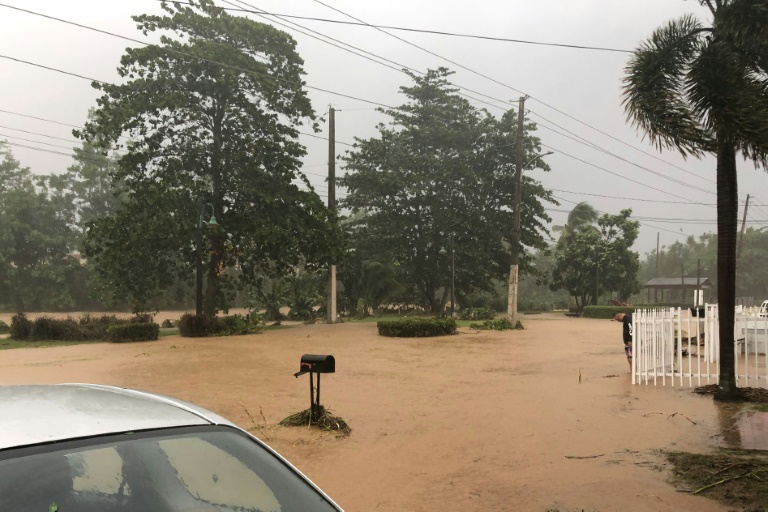
Hurricane Fiona smashed into Puerto Rico, knocking out the US island territory’s power while dumping torrential rain and wreaking catastrophic damage before making landfall in the Dominican Republic on Monday.

Landslides, blocked roads, fallen trees and power lines, as well as a collapsed bridge in the town of Utuado in the central mountainous region, were part of the destruction already caused by Fiona, Governor Pedro Pierluisi told an evening press conference.

The storm carried maximum sustained winds of 90 miles per hour (144 kilometers per hour) as it hit the Dominican Republic, the US National Hurricane Center (NHC) said on Twitter. 

“Life-threatening flash and urban flooding is likely for eastern portions of the Dominican Republic,” the NHC said in its latest advisory at 5:00 am local time (0900 GMT). 

Ahead of Fiona’s arrival in the Dominican Republic, President Luis Abinader suspended work on Monday and the island placed 13 of its 32 provinces, located to the north and east, on red alert ahead of the storm making landfall. 

In Puerto Rico, the entire territory of more than three million people was left without power as the hurricane neared, with Pierluisi saying the electrical system was out of service.

On Monday, the island’s power company said on its website that it had “reenergized some circuits” but did not have numbers on how many people were receiving electricity. 

The NHC downgraded Fiona to a tropical storm in Puerto Rico but warned that destructive rain and devastating flash floods could continue to hit the island.

Fiona will go down as a “catastrophic event due to the impacts of flooding” in Puerto Rico’s central, eastern and southern regions, Pierluisi tweeted, adding that 9-13 inches (23-33 centimeters) of rain had fallen in just five hours.

The hurricane has also left around 196,000 people without drinking water as a result of power outages and flooded rivers, officials said.

The storm made landfall in Puerto Rico on Sunday afternoon as a Category One hurricane, at the lowest end of the five-tier Saffir-Simpson scale.

Fiona is expected to grow stronger, turning into a “major hurricane” before it heads north into the open waters of the Atlantic Ocean, according to the NHC.

– ‘Extremely delicate’ –

In the town of Utuado, one family saw the zinc roof of their house — already replaced after 2017’s Hurricane Maria — torn off yet again, according to local media.

“This is an extremely delicate and sad situation. The damage we are seeing is catastrophic in several areas,” Pierluisi told reporters at the Sunday press conference.

The storm has caused one fatality — a man who was killed after his house was swept away by flooding in the French overseas department of Guadeloupe, when Fiona was still classified as a tropical storm.

Utuado resident Fernando Vera told US broadcaster NPR that his family has never fully recovered from Hurricane Maria. 

“We still struggle from the consequences of Maria and it’s kind of difficult knowing we’re going to probably have to start over again,” he said.

US President Joe Biden declared a state of emergency for Puerto Rico on Sunday, authorizing the Federal Emergency Management Agency to provide assistance.

The NHC also said tropical storm conditions are expected in the Turks and Caicos Islands and the southeastern Bahamas by late Monday or early Tuesday.

– ‘Stay in their homes’ –

Puerto Ricans have been advised “to stay in their homes or seek refuge if they need it,” Pierluisi told reporters.

The island — which has suffered from major infrastructure problems for years — was hit by hurricanes Irma and Maria in 2017, devastating its electrical grid.

The grid was privatized in June 2021 in an effort to resolve the problem of blackouts, but the issue has persisted, and the entire island lost power earlier this year.

The former Spanish colony became a US territory in the late 19th century before gaining the status of associated free state in 1950.

After years of financial woes and recession, the island in 2017 declared the largest bankruptcy ever by a local US administration. Later that year, two hurricanes added to the misery and sparked a feud between San Juan and then-president Donald Trump’s administration.

Markets drop again as traders brace for another big Fed hike

Markets fell Monday as traders extended last week’s rout across risk assets, with expectations high that the Federal Reserve will this week announce another outsized interest rate hike.

With recent data showing US inflation rooted at four-decade highs, investors are increasingly pessimistic about the outlook for the global economy.

Some observers have warned of a sharp recession in many countries caused by the huge rate increases, which are hitting families in the pocket.

And with uncertainty rife owing to a range of issues, including Russia’s war in Ukraine and China’s lockdown-induced slowdown, equities are in danger of revisiting the lows they hit in June.

Several central banks are due to make rate announcements this week, with Japan and Britain among the biggest, although the main event is Wednesday’s Fed decision.

There had been a hope that after two 75-basis-point increases in a row, and economic data showing weakness, officials would take their foot off the pedal this month.

But last Tuesday’s disappointing consumer price figures shocked traders and ramped up bets for a third successive 75-point rise, while some have predicted a whole percentage point move.

Policymakers, including Fed boss Jerome Powell, have repeatedly said their ultimate aim is to bring inflation under control, even if that means sending the economy into recession.

“It is clear that the Fed will project hawkish messaging, once again reiterating that it will bring down inflation unconditionally,” said Vasileios Gkionakis at Citigroup.

Wall Street’s worst week since June ended with more losses after FedEx reported Thursday that it shipped fewer packages than expected over the summer owing to weakness in the global economy.

That came as CEO Raj Subramaniam said he expects a global recession.

Asian equity investors continued the selling on Monday.

Hong Kong closed down one percent, even after reports that the city’s government was considering ending mandatory hotel quarantine for incoming travellers.

Shanghai was also down despite news that megacity Chengdu was ending a two-week Covid-19 lockdown that saw 21 million people affected.

Sydney, Seoul, Singapore, Taipei, Manila and Wellington were also in the red, though Mumbai and Bangkok inched up and Jakarta was flat. Tokyo was closed for a holiday.

Frankfurt and Paris both opened lower. London was closed for the funeral of Queen Elizabeth II.

The prospect of more big Fed rate hikes is also keeping the dollar at multi-decade highs against its major peers, with the yen feeling most of the pressure as the Bank of Japan refuses to tighten policy.

“Speculative selling of the yen is readily justified by the ongoing widening in US-Japan yield differentials,” said Ray Attrill, of National Australia Bank.

“Until or unless something happens to arrest or reverse this spread widening, the yen is susceptible to additional selling pressure.”

The Japanese unit last week hit a fresh 24-year low of 144.99 to the dollar, though it has bounced slightly after comments from BoJ officials that signalled they were ready to intervene to provide support.

Oil prices dipped despite the news out of Chengdu as demand fears are fuelled by the growing fear of recession around the world.

– Key figures at around 0830 GMT –

Hong Kong – Hang Seng Index: DOWN 1.0 percent at 18,565.97 (close)

Shanghai – Composite: DOWN 0.4 percent at 3,115.60 (close)

Tokyo – Nikkei 225: Closed for holiday

Pound/dollar: DOWN at $1.1390 from $1.1423 on Friday

Euro/pound: UP at 87.60 pence from 87.00 pence 

Euro/dollar: DOWN at $0.9979 from $1.0018

Dollar/yen: UP at 143.37 yen from 142.91 yen

West Texas Intermediate: DOWN 1.3 percent at $83.99 per barrel

Brent North Sea crude: DOWN 0.9 percent at $90.60 per barrel

New York – Dow: DOWN 0.5 percent at 30,822.42 (close)

London – FTSE 100: Closed for queen’s funeral

Close Bitnami banner
Bitnami