US Business

'Help wanted': businesses struggle to fill jobs

Germany has a shortage of plumbers. The United States needs more postal workers. Australia is lacking engineers. In Canada, hospitals are looking for more nurses. 

“The Great Resignation” that countries have experienced since Covid pandemic restrictions were eased is not over yet.

Michael Blume, chief executive of a software company in eastern Germany, said he had “a lot of difficulties finding workers”.

“Wherever we look, we are lacking qualified workers,” Blume, whose firm Currentsystem23 is based in eastern Germany, told AFP.

There were 887,000 job vacancies in Germany — Europe’s biggest economy — in August, some 108,000 openings more than last year.

“Help Wanted” signs are plastered in front of restaurants and other businesses in the United States, where there were more than 11 million job openings in late July, or two for every employment seeker.

“Vacancy rates are very high across the world. Surveys and firms are saying it is still very hard to fill positions,” said Ariane Curtis, a Toronto-based economist at research firm Capital Economics. 

Countries in Western Europe and North America are having a particularly tough time filling jobs, though the problem is also present in eastern Europe, Turkey and Latin America, Curtis said.

Vacancy-to-unemployed rates rose sharply in Australia, Canada and Britain in later 2021 compared to pre-pandemic levels, an OECD report said in July.

– Businesses closing early –

The shortages have persisted even as the world economy has begun to slow since Russia invaded Ukraine earlier this year.

It affects a broad range of sectors: from a lack of teachers in Texas to not enough staff in the hospitality industry in Italy or the Canadian health system.

The shortages have forced businesses to adapt.

Pharmacies in the US state of Wisconsin, services at hospitals in Canada’s province of Alberta and restaurants in Australia’s Sunshine Coast have had to close for parts of the day, according to local news reports.

White-collar workers are also in short supply.

Clement Verrier, who co-heads an executive recruiting firm in Paris, said it used to be difficult to find companies looking to hire. Now it’s the opposite. 

“We’re seeing an unprecedented number of candidates who disappear in the middle of the recruitment process, without calling back,” Verrier said.

– ‘Shift in mindset’ –

Aging populations were already starting to cause shortages before Covid, but the problem exploded with the pandemic.

There are multiple factors behind the phenomenon: some people have chosen to retire early, while others have struggled with long Covid symptoms. Others have simply had enough of poor working conditions or low salaries.

Other factors include a drastic drop in immigration due to lockdowns, people moving out of cities and workers seizing the moment to rethink their career choices.

“The pandemic drove a fundamental shift in mindset and priorities, and employers aren’t keeping pace with that change,” said Bonnie Dowling, expert associate partner at McKinsey, a global consultancy that conducted a study on the wave of resignations around the world.

To keep or woo workers, companies are offering higher salaries. Other benefits that have emerged include the option of working from home, “bonus” holidays and more personal days.

Some countries are easing their immigration rules to attract more workers.

Germany unveiled plans Wednesday to make it easier for people to hold multiple nationalities and make naturalisation of foreigners easier.

“The big question is if what we have seen in the last months will cool down or not,” said Mike Smith, CEO of Netherlands-based international recruiter Randstad Sourceright.

“From our position we don’t believe it is transitory,” he said.

“We think it is a structural change in the way employees are looking to interact with work. Trends continue to point to that. The shift in worker expectations is here to stay.”

'Help wanted': businesses struggle to fill jobs

Germany has a shortage of plumbers. The United States needs more postal workers. Australia is lacking engineers. In Canada, hospitals are looking for more nurses. 

“The Great Resignation” that countries have experienced since Covid pandemic restrictions were eased is not over yet.

Michael Blume, chief executive of a software company in eastern Germany, said he had “a lot of difficulties finding workers”.

“Wherever we look, we are lacking qualified workers,” Blume, whose firm Currentsystem23 is based in eastern Germany, told AFP.

There were 887,000 job vacancies in Germany — Europe’s biggest economy — in August, some 108,000 openings more than last year.

“Help Wanted” signs are plastered in front of restaurants and other businesses in the United States, where there were more than 11 million job openings in late July, or two for every employment seeker.

“Vacancy rates are very high across the world. Surveys and firms are saying it is still very hard to fill positions,” said Ariane Curtis, a Toronto-based economist at research firm Capital Economics. 

Countries in Western Europe and North America are having a particularly tough time filling jobs, though the problem is also present in eastern Europe, Turkey and Latin America, Curtis said.

Vacancy-to-unemployed rates rose sharply in Australia, Canada and Britain in later 2021 compared to pre-pandemic levels, an OECD report said in July.

– Businesses closing early –

The shortages have persisted even as the world economy has begun to slow since Russia invaded Ukraine earlier this year.

It affects a broad range of sectors: from a lack of teachers in Texas to not enough staff in the hospitality industry in Italy or the Canadian health system.

The shortages have forced businesses to adapt.

Pharmacies in the US state of Wisconsin, services at hospitals in Canada’s province of Alberta and restaurants in Australia’s Sunshine Coast have had to close for parts of the day, according to local news reports.

White-collar workers are also in short supply.

Clement Verrier, who co-heads an executive recruiting firm in Paris, said it used to be difficult to find companies looking to hire. Now it’s the opposite. 

“We’re seeing an unprecedented number of candidates who disappear in the middle of the recruitment process, without calling back,” Verrier said.

– ‘Shift in mindset’ –

Aging populations were already starting to cause shortages before Covid, but the problem exploded with the pandemic.

There are multiple factors behind the phenomenon: some people have chosen to retire early, while others have struggled with long Covid symptoms. Others have simply had enough of poor working conditions or low salaries.

Other factors include a drastic drop in immigration due to lockdowns, people moving out of cities and workers seizing the moment to rethink their career choices.

“The pandemic drove a fundamental shift in mindset and priorities, and employers aren’t keeping pace with that change,” said Bonnie Dowling, expert associate partner at McKinsey, a global consultancy that conducted a study on the wave of resignations around the world.

To keep or woo workers, companies are offering higher salaries. Other benefits that have emerged include the option of working from home, “bonus” holidays and more personal days.

Some countries are easing their immigration rules to attract more workers.

Germany unveiled plans Wednesday to make it easier for people to hold multiple nationalities and make naturalisation of foreigners easier.

“The big question is if what we have seen in the last months will cool down or not,” said Mike Smith, CEO of Netherlands-based international recruiter Randstad Sourceright.

“From our position we don’t believe it is transitory,” he said.

“We think it is a structural change in the way employees are looking to interact with work. Trends continue to point to that. The shift in worker expectations is here to stay.”

Indigenous community at center of stabbing no stranger to suffering

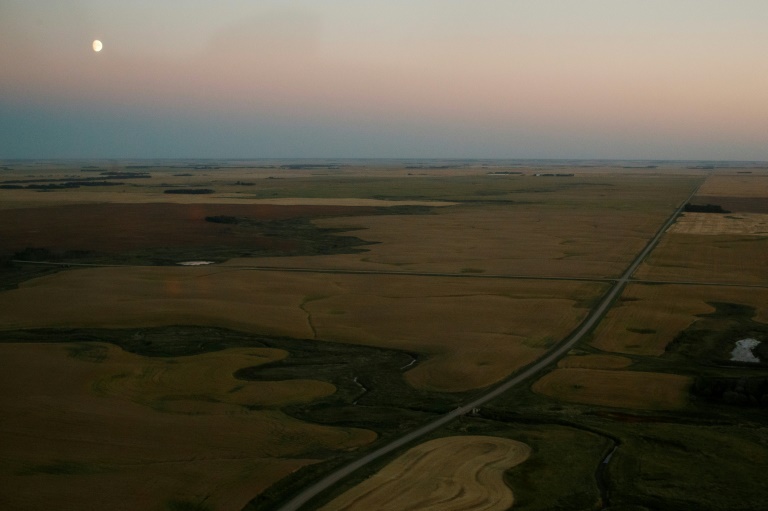
Isolated in the vast prairies of west-central Canada, the James Smith Cree Nation — epicenter of a deadly stabbing rampage — is a small Indigenous community that is no stranger to drama.

Like many other Indigenous communities in North America, it suffers from such problems as overcrowded housing, high unemployment, drug addiction and racial discrimination, researchers say.

– Small, isolated community

Located in a territory spanning more than 15,000 hectares (37,000 acres) the community’s central village is in a rural area where people live off farming and ranching. 

Some 3,400 members of the Cree tribe — one of Canada’s First Nations — live in this area including 2,000 in the village itself. 

On Sunday the community suffered inexplicable tragedy when nine people there were stabbed to death in an outburst of attacks whose motive remains unknown. Another person was killed in the nearby town of Weldon.

Two brothers were identified as the suspects. One was found dead Monday, and news reports said the second died of self inflicted wounds after being arrested on Wednesday, ending the manhunt.

Half of the Cree village’s population is less than 24 years of age and the jobless rate is 24 percent amid low living standards, according to figures from the 2016 census.

Housing is a huge problem: nearly two-thirds of the homes need major repairs and about a third are overcrowded.

– Violence, disasters – 

Almost a year ago to the day, the James Smith community was rocked by a shooting that left two people dead and one wounded.

Several times since 2012 hundreds of people have had to be evacuated from the reservation because of flooding.

In 2016, a leak from oil pipeline contaminated the river that provided the village’s water source. The people of the village sued the provincial and federation governments but nothing came of it.

– Trauma of residential schools- 

The village also included people who spent time at now-notorious schools for Indigenous children.

Between the late 19th century and the 1990s, some 150,000 Indigenous youths in Canada were forced to attend these schools, cut off from their families, languages and culture.

Many of them suffered physical or sexual abuse and thousands never came home from the schools, dying of sickness, malnutrition or negligence.

The Canadian government eventually labeled this cultural genocide and the scars from the tragedy still haunt many Indigenous Canadians.

In late April the archbishop of Canterbury, head of the Anglican Church, visited the James Smith Cree Nation to meet with people who survived their time at the schools. In the name of the church, the archbishop apologized for the abuse meted out at the schools.

Even today Indigenous people suffer from “overt, covert and systemic racism,” said Robert Henry, a professor of Indigenous studies at the University Saskatchewan. 

In 2020, the United Nations denounced what it called a broad range of abuse suffered by Indigenous people, such as problems accessing drinking water, discrimination against children living on reserves, disproportionate presence of Indigenous people in prison, and other woes.

– Drug problems – 

As in many Indigenous communities of Saskatchewan province, drug abuse is a problem, said Marie-Pierre Bousquet, director of the Indigenous studies program at the University of Montreal.

“These are rather big territories with not much of a presence by police who are often overwhelmed, and drugs flow pretty freely,” said Bousquet, adding that violence often comes hand in hand with drug trafficking.

The day after the stabbing attacks Bobby Cameron, the head of the Federation of Sovereign Indigenous Nations, blamed “harmful illegal drugs (that) invade our communities.”

US returns antiquities to Egypt

Authorities in New York announced Wednesday the return of 16 antiquities to Egypt, including five works that were seized from the Metropolitan Museum of Art as part of a probe into international art trafficking.

Manhattan District Attorney Alvin Bragg said the 16 works were worth more than $16 million. He spoke a day after announcing a similar return of 58 artworks to Italy.

“Today’s repatriation shows the breadth and prevalence of antiquities trafficking networks,” Bragg said in a statement.

Nine of the pieces had been in the possession of Michael Steinhardt, whom Bragg described as one of the world’s largest collectors of ancient art.

In 2021, Steinhardt was forced by US authorities to return 180 stolen ancient artworks worth a total of $70 million.

Under that deal he avoided going to jail but was banned for life from acquiring antiquities in the legal market.

Five other pieces were seized in May and June from the Met, worth $3.1 million, as part of a probe carried out by US and French authorities and under which former Louvre director Jean-Luc Martinez was charged in France.

Those five pieces had been looted from archeological sites in Egypt, smuggled through Germany or the Netherlands to France, and sold by the Paris-based Pierre Berge & Associes to the Met, Bragg said.

“The information developed and shared by the Manhattan DA’s office with law-enforcement agencies around the world related to this investigation has led to the indictment or arrest of nine individuals in France, including the former Louvre Director Jean-Luc Martinez,” Bragg said.

US law can't require coverage of HIV prevention drugs, judge rules

A US judge ruled Wednesday in favor of Christian employers who refuse, on religious grounds, to provide workers with health insurance that covers the cost of drugs that help prevent HIV/AIDS.

District Judge Reed O’Connor of a Texas federal court, known for making several rulings hostile to former president Barack Obama’s sweeping health care law, took aim at a new aspect of the legislation nicknamed Obamacare.

The law requires private insurers to reimburse certain preventive care as defined by health authorities. In 2020, they included PrEP — pills that act to prevent HIV transmission.

Two companies and several individuals went to court to challenge the coverage of the drugs, saying it violates their religious beliefs by making them “complicit in facilitating homosexual behavior,” O’Connor said in his decision.

One of the plaintiffs was facing fines of $100 per employee per day for failing to comply with the Obamacare law, said the judge, who ruled that the requirement to reimburse the cost of PrEP pills violates the federal Religious Freedom Restoration Act.

President Joe Biden’s Democratic administration will likely appeal the ruling.

“The administration is reviewing today’s decision by the Northern District of Texas,” White House Press Secretary Karine Jean-Pierre said on Twitter, noting that the Affordable Care Act “has been the law of the land for over 10 years.”

The Texas decision was strongly criticized by the Speaker of the House of Representatives, Nancy Pelosi.

“This disturbing decision amounts to open homophobia,” Pelosi, a Biden ally, said in a statement.

PrEP, short for pre-exposure prophylaxis, was approved by the US Food and Drug Administration in 2012 and is now routinely recommended for high-risk people who are HIV-negative to prevent them from becoming infected.

When taken daily, PrEP reduces the risk of infection by 99 percent, but only 23 percent of people who could benefit from it were using the medicine in 2019.

British cinema chain Cineworld files for US bankruptcy

Britain’s Cineworld, the world’s second biggest cinema chain, announced Wednesday that it has filed for bankruptcy protection in the United States as it seeks to restructure after facing low audience numbers.

The group, which operates hundreds of movie theatres in the United States, said in a statement that it filed for Chapter 11 at a bankruptcy court in Texas.

Chapter 11 of the US bankruptcy code is a court-supervised restructuring process that provides companies time to negotiate with its creditors to reach a settlement on the reduction of debts.

Cineworld said it “will seek to implement a de-leveraging transaction that will significantly reduce the Group’s debt, strengthen its balance sheet and provide the financial strength and flexibility to accelerate, and capitalise on, Cineworld’s strategy in the cinema industry.”

The statement said it hoped to emerge from bankruptcy proceedings in the first quarter of next year, and had $1.94 billion in financing from existing lenders to help it through that period.

The company also warned existing shareholders that their holdings would likely be considerably diluted as part of the bankruptcy process.

Eric Snyder, a bankruptcy expert at Wilk Auslander, said Cineworld’s creditors aren’t giving them “a lot of time to make the decision between reorganizing or selling it”. 

A big problem for the company is that “travelling to a movie theatre to watch a movie for two to three hours, and spending $20 to $25, is just not attractive anymore for a lot of people, especially young people,” Snyder added.

Cineworld’s shares had been sliding since the beginning of the year as the company’s position deteriorated when people didn’t return to cinemas in droves after Covid lockdowns were eased.

They plummeted last month when the company acknowledged it was considering filing for bankruptcy.

Cineworld shares rose 10 percent on Wednesday to 4.29 pence, but were still down 87 percent from the start of the year.

Analysts argue that Cineworld’s 2018 takeover of American peer Regal left it saddled with too much debt, putting it in a poor position to weather the pandemic.

British cinema chain Cineworld files for US bankruptcy

Britain’s Cineworld, the world’s second biggest cinema chain, announced Wednesday that it has filed for bankruptcy protection in the United States as it seeks to restructure after facing low audience numbers.

The group, which operates hundreds of movie theatres in the United States, said in a statement that it filed for Chapter 11 at a bankruptcy court in Texas.

Chapter 11 of the US bankruptcy code is a court-supervised restructuring process that provides companies time to negotiate with its creditors to reach a settlement on the reduction of debts.

Cineworld said it “will seek to implement a de-leveraging transaction that will significantly reduce the Group’s debt, strengthen its balance sheet and provide the financial strength and flexibility to accelerate, and capitalise on, Cineworld’s strategy in the cinema industry.”

The statement said it hoped to emerge from bankruptcy proceedings in the first quarter of next year, and had $1.94 billion in financing from existing lenders to help it through that period.

The company also warned existing shareholders that their holdings would likely be considerably diluted as part of the bankruptcy process.

Eric Snyder, a bankruptcy expert at Wilk Auslander, said Cineworld’s creditors aren’t giving them “a lot of time to make the decision between reorganizing or selling it”. 

A big problem for the company is that “travelling to a movie theatre to watch a movie for two to three hours, and spending $20 to $25, is just not attractive anymore for a lot of people, especially young people,” Snyder added.

Cineworld’s shares had been sliding since the beginning of the year as the company’s position deteriorated when people didn’t return to cinemas in droves after Covid lockdowns were eased.

They plummeted last month when the company acknowledged it was considering filing for bankruptcy.

Cineworld shares rose 10 percent on Wednesday to 4.29 pence, but were still down 87 percent from the start of the year.

Analysts argue that Cineworld’s 2018 takeover of American peer Regal left it saddled with too much debt, putting it in a poor position to weather the pandemic.

Countries growing 70% of world's food face 'extreme' heat risk by 2045

Blistering crop-withering temperatures that also risk the health of agricultural workers could threaten swathes of global food production by 2045 as the world warms, an industry analysis warned Thursday.

Climate change is already stoking heatwaves and other extreme weather events across the world, with hot spells from India to Europe this year expected to hit crop yields.

Temperature spikes are causing mounting concern for health, particularly for those working outside in sweltering conditions, which is especially dangerous when humidity levels are high. 

The latest assessment by risk company Verisk Maplecroft brings those two threats together to calculate that heat stress already poses an “extreme risk” to agriculture in 20 countries, including agricultural giant India.

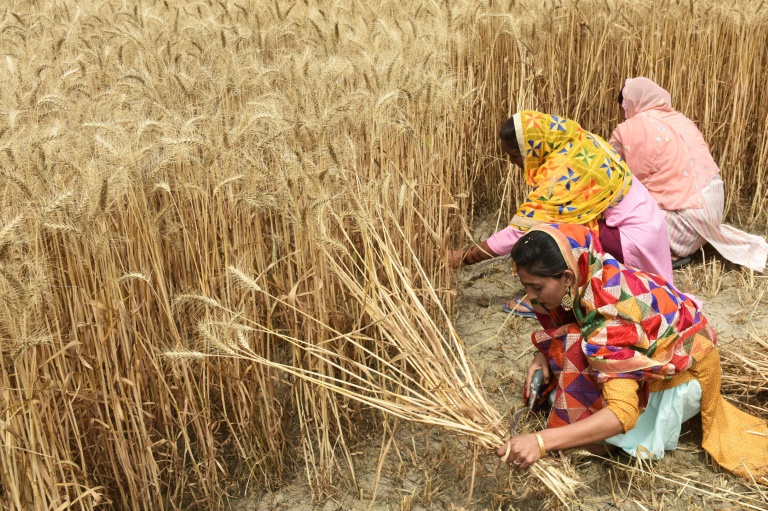
But the coming decades are expected to expand the threat to 64 nations by 2045 — representing 71 percent of current global food production — including major economies China, India, Brazil and the United States. 

“With the rise in global temperatures and rise in global heat stress, we’re going to see crops in more temperate countries as well start being affected by this,” said Will Nichols, head of climate and resilience at Verisk Maplecroft. 

Rice is particularly at risk, the assessment said, with other crops like cocoa and even tomatoes also singled out as of concern.

– Growing risk –

Maplecroft’s new heat stress dataset, using global temperature data from the UK Met Office, feeds into its wider risk assessments of countries around the world. 

It is based on a worst-case emissions scenario leading to around 2 degrees Celsius of warming above pre-industrial levels as soon as 2045. 

However, the authors stress that in projections to mid-century, even scenarios that assume higher levels of carbon-cutting action could still result in temperatures nearing 2C.

India — responsible for 12 percent of global food production in 2020 and heavily reliant on outdoor labour productivity — is already rated as at extreme risk, the only major agricultural nation in that category at current temperatures. 

“There’s a very real worry that people in rural areas, which are obviously highly dependent on agriculture, are going to be much more vulnerable to these kinds of heat events going forward,” Nichols told AFP. 

That could impact productivity and in turn exports — and have potentially “cascading” knock-on effects on issues such as the country’s credit rating and even political stability, he said.

By 2045, the list grows much longer.   

Nine of the top ten countries affected in 2045 are in Africa, with the world’s second largest cocoa producer Ghana, as well as Togo and Central African Republic receiving the worst possible risk score.

The top 20 at-risk countries in the coming decades include key Southeast Asian rice exporters Cambodia, Thailand and Vietnam, the authors said, noting that rice farmers in central Vietnam have already taken to working at night to avoid the high temperatures.

The assessment highlights that major economies like the US and China could also see extreme risk to agriculture in 2045, although in these large countries the impacts vary by region.  

Meanwhile, Europe accounts for seven of the 10 countries set to see the largest increase in risk by 2045. 

“I think what it reinforces is that, even though a lot of us are sort of sitting in sort of Western countries, where we might think we’re a bit more insulated from some of these threats, actually we are not necessarily,” Nichols said.  

“Both in terms of the sort of physical risks that we’re facing, but also in terms of the kind of knock on effects down the supply chain.” 

Energy majors exaggerating green performance: analysis

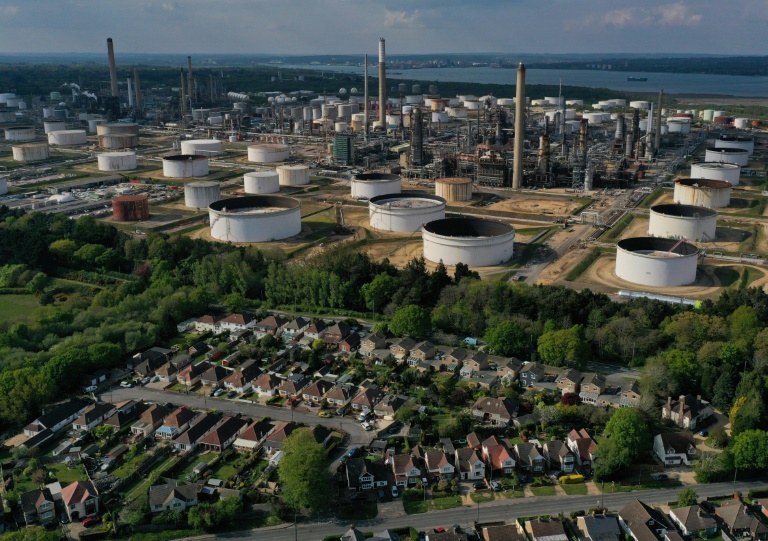
Energy majors are exaggerating their green credentials in public messaging while continuing to allocate the majority of new investment to oil and gas projects, according to an industry analysis released Thursday.

Campaigners say this “significant misalignment” between communication strategies and business plans could allow five of the biggest privately-owned energy firms to continue to delay the decarbonisation needed to avoid the worst impacts of climate change. 

Industry watchdog InfluenceMap analysed the content of more than 3,400 public communications from BP, Chevron, ExxonMobil, Shell and TotalEnergies in 2021, from press releases, speeches and company and CEO social media accounts. 

They found that 60 percent of all messages contained at least one “green” claim — such as emissions reduction targets, transitioning the energy mix, or promoting fossil gas as part of a clean energy solution.

These public communications were found to contrast with the five’s planned capital expenditure for 2022, with just 12 percent of new investments earmarked for low-carbon activities. 

“You can see this real difference between a high use of green claims in public communications versus this ongoing strategy to kind of undermine and block climate policy,” report co-author and program manager Faye Holder told AFP.

She said the gap between what the majors advertised and what they were investing in was misleading the public as to their role in battling climate change.  

“Based on the public communications, and particularly social media, it would be fair enough if you walked away with the impression that these companies are acting to solve climate change, because that’s what you’re hearing from them,” she said.

– ‘Climate disinformation’ –

The analysis found that Shell had the largest disparity between its green talk and actual low-carbon investment. 

InfluenceMap said that 70 percent of Shell’s communications last year contained at least one green claim, compared with just 10 percent of planned investment in low-carbon activities this year.

A spokesman for Shell told AFP the major was already investing “billions of dollars in low-carbon energy”.

“To help alter the mix of energy Shell sells, we need to grow these new businesses rapidly. That means letting our customers know through advertising or social media what lower-carbon solutions we offer now or are developing.”

The analysis found that 62 percent of TotalEnergies’ communications mentioned green activities, while it planned to allocate 25 percent of 2022 capital expenditure on low-carbon projects. 

A TotalEnergies spokeswoman countered that 30 percent of the firm’s investments are devoted to “decarbonised energy”.

“Our public announcements policy reflects the transformation of TotalEnergies in a multi-energy company,” she told AFP. 

An ExxonMobil spokesman said it “continues to mitigate emissions from its operations and achieved its 2025 emission-reduction plans four years earlier than planned”.

BP and Chevron did not respond to requests for comment. 

The analysis found that overall the five corporations had spent $750 million on climate-related messaging last year alone. 

Report co-author Ed Collins said that represented good business for the majors, as it was significantly cheaper than decarbonising their business models and would encourage governments to continue subsidising their products.

“The costs seem huge, but the investment is tiny in comparison to the potential reward in terms of favourable policy conditions and subsidisation of building assets,” he said. 

Some of the firms analysed plan to increase oil and gas production by 2026, something the analysts said would see their emissions “significantly overshoot” the International Energy Agency’s recommended net-zero pathway. 

Gwendoline Delbos-Corfield, a Greens member of the European Parliament, said Thursday’s analysis proved that the firms studied were engaged in “climate disinformation”.

“It shows the lengths oil and gas companies are willing to go to mislead citizens and protect their own interests.”

American woman killed by shark while snorkeling in Bahamas

An American mother was killed by a shark while snorkeling with her family in the Bahamas on a sideline excursion during their cruise, authorities said Wednesday.

The 58-year-old woman from the US state of Pennsylvania was attacked Tuesday afternoon in the waters of Green Cay, near the Bahamian capital Nassau, according to Bahamian police.

“Tour operators along with family members attempted to rescue the female,” police said in a statement.

“However, they were unsuccessful; which resulted in the female receiving serious injuries to the left side of her body.”

When she was brought to land, paramedics found she showed “no vital signs of life,” police added.

The family of five arrived early Tuesday in the Bahamas as part of a seven-night cruise aboard the Royal Caribbean International ship Harmony of the Seas.

The family was participating in what the cruise industry calls an “independent shore excursion,” not sponsored or organized by the cruise line.

Royal Caribbean, in confirming the death, said the company was “providing support and assistance” to the victim’s family.

In 2019, a young American woman died after being attacked by three sharks during a family dive in the same area of the Bahamas.

Close Bitnami banner
Bitnami