US Business

Elon Musk sells nearly $7 billion worth of Tesla shares: document

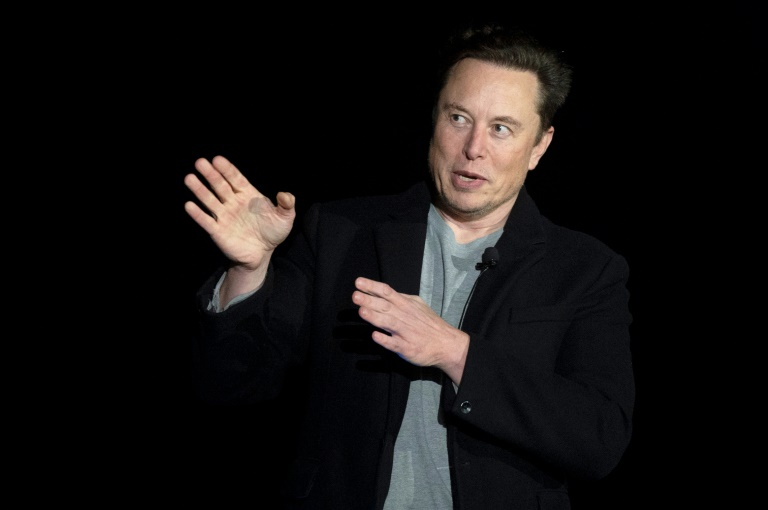
Elon Musk has sold nearly $7 billion worth of Tesla shares, according to legal filings published Tuesday, amid a high-stakes legal battle with Twitter over a $44 billion buyout deal.

The Tesla boss sold some 7.9 million shares between August 5 and 9, according to filings published on the Securities and Exchange Commission’s website.

“In the (hopefully unlikely) event that Twitter forces this deal to close and some equity partners don’t come through, it is important to avoid an emergency sale of Tesla stock,” Musk, the world’s richest man wrote on Twitter late Tuesday.

Twitter is locked in a legal battle with the mercurial Tesla boss over his effort to walk away from the April agreement to buy the company, and a judge has ordered that a trial will begin in October.

Musk has filed a countersuit, accusing Twitter of fraud and alleging the social media platform misled him about key aspects of its business before he agreed to a $44 billion buyout.

The move comes after Musk sold around $8.5 billion worth of shares in the electric carmaker in April as he was preparing to finance the Twitter deal. He tweeted at the time: “No further TSLA sales planned after today.”

Elon Musk sells nearly $7 billion worth of Tesla shares: document

Elon Musk has sold nearly $7 billion worth of Tesla shares, according to legal filings published Tuesday, amid a high-stakes legal battle with Twitter over a $44 billion buyout deal.

The Tesla boss sold some 7.9 million shares between August 5 and 9, according to filings published on the Securities and Exchange Commission’s website.

“In the (hopefully unlikely) event that Twitter forces this deal to close and some equity partners don’t come through, it is important to avoid an emergency sale of Tesla stock,” Musk, the world’s richest man wrote on Twitter late Tuesday.

Twitter is locked in a legal battle with the mercurial Tesla boss over his effort to walk away from the April agreement to buy the company, and a judge has ordered that a trial will begin in October.

Musk has filed a countersuit, accusing Twitter of fraud and alleging the social media platform misled him about key aspects of its business before he agreed to a $44 billion buyout.

The move comes after Musk sold around $8.5 billion worth of shares in the electric carmaker in April as he was preparing to finance the Twitter deal. He tweeted at the time: “No further TSLA sales planned after today.”

On the menu at a UK restaurant: carbon footprint

The menu at The Canteen in southwest England doesn’t just let diners know how much a dish costs. They can also check its carbon footprint.

The carrot and beetroot pakora with yoghurt sauce is responsible for just 16 grams of CO2 emissions. The aubergines with a miso and harissa sauce with tabbouleh and Zaatar toast caused 675 grams of carbon dioxide.

As customers weigh their options, the menu at the vegetarian restaurant in Bristol includes a comparison with a dish that it does not serve: the emissions from a UK-produced hamburger.

“Three kilos for a burger, wow! I can’t believe it,” exclaimed Enyioma Anomelechi, a 37-year-old diner sipping a beer outside in the sunshine.

The menu notes that a real beef burger’s emissions is “10 times the amount of its vegan alternative”.

The carbon footprints of businesses and consumers have come under growing scrutiny as countries scramble to limit global temperature increases to 1.5 degrees Celsius and to achieve net-zero emission by 2050.

The Canteen became in July the first restaurant to agree to put its carbon footprint on the menu under a campaign spearheaded by UK vegan campaigning charity Viva!

The restaurant’s manager, Liam Stock, called the move a way to “see what we are doing; to understand and improve ourselves”.

The average British person has an annual carbon footprint of more than 10 tonnes, according to UK government figures.

Britain has set the ambitious goal of reducing harmful emissions by 78 percent by 2035, compared with 1990 figures, in order to meet its international climate change commitments.

– ‘Climate emergency’ –

Switching to a plant-based diet is one of the most effective ways for an individual to reduce their carbon footprint, experts from the UN’s Intergovernmental Panel on Climate Change said in April.

The livestock industry replaces CO2-absorbing forests with land for grazing and soy crops for cattle feed. The animals also belch huge amounts of methane, a potent greenhouse gas.

Whether diners will let carbon footprints influence their order choices remains to be seen, but Stock said the menu innovation has stoked interest and support.

“In England if you’re a big chain restaurant, it’s the law that you have to have calories on (the menu),” he said. 

“But a lot of people are saying… they’re more interested in carbon.”

While Anomelechi noted the “huge” difference in emissions between a hamburger and other dishes, he said he did not necessarily want to be burdened with knowing his order’s calorie count or carbon footprint.

“When I go out to eat I just want to enjoy,” he added, noting he would be more inclined to change his ways when grocery shopping.

Laura Hellwig, campaigns manager at Viva!, said the carbon footprint figure should become compulsory.

“We are in a climate emergency and consumers have to be able to make informed choices,” said the activist. 

In her view, “most people would actually choose for the planet” if confronted with a comparison between the carbon footprint of a meat-based meal and a vegan dish.

– ‘Cradle to store’ –

Stock said he knew his restaurant’s dishes would score low carbon footprints, as most of his ingredients are sourced regionally.

“We didn’t have to change anything,” he said, while admitting some surprises, such as learning that imported spices drive up emissions.

To calculate the dishes’ footprints, The Canteen sent its recipes and the source of the ingredients to a specialised company called MyEmissions.

It is able to calculate the carbon impact from “cradle to store”, taking into account farming, processing, transport and packaging.

“If I was choosing between two dishes, maybe depending on how hungry I was, I might choose the one with a lower footprint,” said Nathan Johnson, a 43-year-old diner at the restaurant. 

That day, he opted for the chef’s salad, which racks up 162 grams of carbon.

Another diner, 29-year-old Emma Harvey, also backed the idea of increased awareness of carbon footprints “and the ethical effects of the food that we’re eating”. 

“We have to incorporate things (like) that into everyday life,” she said.

Space invaders: How video gamers are resisting a crypto onslaught

When video game designer Mark Venturelli was asked to speak at Brazil’s biggest gaming festival, he submitted a generic-sounding title for his presentation — “The Future of Game Design” — but that was not the talk he gave.

Instead, he launched into a 30-minute diatribe against the blockchain technology that underpins cryptocurrencies and the games it has spawned, mostly very basic smartphone apps that lure players with the promise of earning money.

“Everything that is done in this space right now is just bad — actually it’s terrible,” he told AFP.

He is genuinely worried for the industry he loves, particularly because big gaming studios are also sniffing around the technology.

To crypto enthusiasts, blockchain will allow players to grab back some of the money they spend on games and make for higher-stakes enjoyment.

Critics say the opposite is true — game makers will capture more profits while sidestepping laws on gambling and trading, and the profit motive will kill all enjoyment.

The battle lines are drawn for what could be a long confrontation over an industry worth some $300 billion a year, according to Accenture.

– ‘Ecologically mortifying’ –

Gamers like Venturelli might feel that they have triumphed in the early sorties.

Cryptocurrencies have crashed recently and dragged down the in-game tokens that had initially attracted players.

“Nobody is playing blockchain games right now,” Mihai Vicol of Newzoo told AFP, saying between 90 and 95 percent of games had been affected by the crash. 

Ubisoft, one of the world’s biggest gaming firms, last year tried to introduce a marketplace to one of its hit games for trading NFTs, the digital tokens that act as receipts for anything from art to video game avatars. 

But gamers’ forums, many already scattered with anti-crypto sentiment, lit up in opposition.

Even French trade union IT Solidarity got involved, labelling blockchain “useless, costly, ecologically mortifying tech” — a reference to the long-held criticism that blockchain networks are hugely power hungry.

Ubisoft quickly ditched the NFT marketplace in Tom Clancy Ghost Recon Breakpoint.

Last month, Minecraft, a world-building game hugely popular with children and teenagers, announced it would not allow blockchain technology. 

The firm criticised the “speculative pricing and investment mentality” around NFTs and said introducing them would be “inconsistent with the long-term joy and success of our players”.

The wider sector also has a serious image problem after a spectacular theft earlier this year of almost $600 million from Axie Infinity, a blockchain game popular in the Philippines. 

Analyst firm NonFungible last week revealed that the NFT gaming sector crashed in the second quarter of this year with the number of sales plunging 22 percent.

All of this points to a bleak time for crypto enthusiasts, but blockchain entrepreneurs are not giving up. 

– ‘Revolutionise’ gaming –

Sekip Can Gokalp, whose firms Infinite Arcade and Coda help developers introduce blockchain to their games, argues it is still “very early days”.

He told AFP some of the attention-grabbing play-to-earn games had been “misguided” and he was convinced the technology still had the potential to “revolutionise” gaming.

Reports of a culture clash between gamers and crypto fans, he said, were overplayed and his research suggested there was substantial overlap between the two communities.

Gokalp can take heart from recent announcements by gaming giants such as Sega and Roblox, a popular platform mostly used by children, indicating they are still exploring blockchain. 

And Ubisoft, despite abandoning its most high-profile blockchain effort, still has several crypto-related projects on the go. 

Among the many benefits trumpeted by crypto enthusiasts are that the blockchain allows players to take items from one game to another, gives them ownership of those items and stores their progress across platforms. 

Vicol, though, reckons blockchain gaming needs to find other selling points to succeed.

“It could be the future,” he said, “but it’s going to be different to how people envisage it today”. 

Brazilian Venturelli, whose games include the award-winning Relic Hunters, used his talk at the BIG Festival in Sao Paulo to dismiss all the benefits trumpeted by crypto fans as either unworkable, undesirable or already available. 

And he told AFP that play-to-earn games risked real-world damage in Latin America — a particular target for the industry — by enticing young people away from occupations that bring benefits to society.

He said many people he knows, including venture capitalists and the heads of billion-dollar corporations, shared his point of view.

“They came to congratulate me on my talk,” he said. 

But with new blockchain games emerging every day, he accepts that the battle is far from over.

Bollywood seeks boost with 'Forrest Gump' remake

One of India’s biggest stars is banking on a remake of Hollywood feelgood hit “Forrest Gump” to revive the fortunes of Hindi-language Bollywood, after a string of weak box-office showings.

Aamir Khan’s “Laal Singh Chaddha”, an adaptation of the 1994 US classic starring Tom Hanks, hits cinemas on Thursday ahead of India’s 75th independence celebrations.

Disappointing takings for other Bollywood A-listers have cast a pall over an industry still recovering from Covid-19 lockdown losses when many in movie-mad India turned to streaming giants like Netflix and Disney+ Hotstar.

The adaptation keeps several iconic scenes from the original — which netted six Oscars, including for Best Picture — such as a floating white feather, ping-pong playing and lots of running.

– Box of golgappas –

But there are several changes, with Gump’s “box of chocolates” line becoming “Life is just like a golgappa. Your tummy might feel full, but your heart always craves more.”

Golgappa is a popular Indian snack, while the second half of the saying — “you never know what you’re gonna get” in the original —  draws from a common Hindi phrase.

The film promises to take people through India’s history in the same way Gump stumbled through and influenced major US events like the Vietnam War.

This could irk Indian right-wing critics who have already called for a boycott of the film because of comments made by Khan in 2015 that were deemed to be unpatriotic.

Khan, the star of megahit “Dangal” (2016), and screenwriter Atul Kulkarni were coy in sharing what Indian historical settings would be featured.

Kulkarni would only say that his script was a “beautiful story about a beautiful country called India through a beautiful person called Laal Singh”.

– Remaking a ‘classic’ –

Khan, 57, admitted that he initially put off reading Kulkarni’s script, uncertain it would be possible to adapt such a “cult classic”.

“It’s like saying we are remaking ‘Mughal-e-Azam’ and ‘Mother India’. It’s not a wise thing to do,” he said, referring to two Indian classics.

“But when I heard the script, I understood he’s done it. It was a moving experience for me. I really loved it. The moment I heard it I wanted to do this.”

Bollywood star Kareena Kapoor, 41, who plays Singh’s lifelong friend Rupa, based on Robin Wright’s Jenny Curran, said the plot was “timeless” with a love story at its core.

“I wondered how they would play around with such an iconic film,” added Naga Chaitanya, a Telugu-language star from the southern film industry “Tollywood” who plays Bala, an adaptation of Gump’s shrimp-fishing Vietnam comrade Bubba.

“But the way they have conceived the film for Indian cinema is unique.”

– Competition –

Recent silver-screen hits have not come from Hindi-language Bollywood but are in other Indian languages, such as action flicks “Pushpa”, “KGF: Chapter 2” and “RRR”.

“RRR”, released in March, raked in $87 million domestically, while “KGF: Chapter 2”, which debuted a few weeks later, took in $106 million, media analyst Karan Taurani of Mumbai-based Elara Capital told AFP.

Action film “Shamshera”, released on July 22 and starring Bollywood actor Ranbir Kapoor, has so far only made $5.6 million, dashing hopes it would lure audiences back to Hindi cinema.

A rare Bollywood hit this year has been comedy horror “Bhool Bhulaiyaa 2” released on May 20 and featuring rising star Kartik Aryan, which has brought in $24 million so far.

Now, all eyes are on “Laal Singh Chaddha” and family dramedy “Raksha Bandhan” with Bollywood megastar Akshay Kumar — which also releases on Thursday.

Taurani estimates that “Laal Singh Chaddha” will make $19 million, falling short of Khan’s per-film average of $35 million.

Khan, who co-produced “Laal Singh Chaddha”, believes Bollywood hasn’t lost its mojo, blaming the early release of movies on streaming services for lower box-office takings.

“I feel that perhaps we — I’m including myself in this — as Hindi filmmakers, need to… also pick topics which are relevant to a larger audience, as opposed to picking topics which are relevant to a smaller audience,” he said.

Asian markets drop on rate worries ahead of inflation data

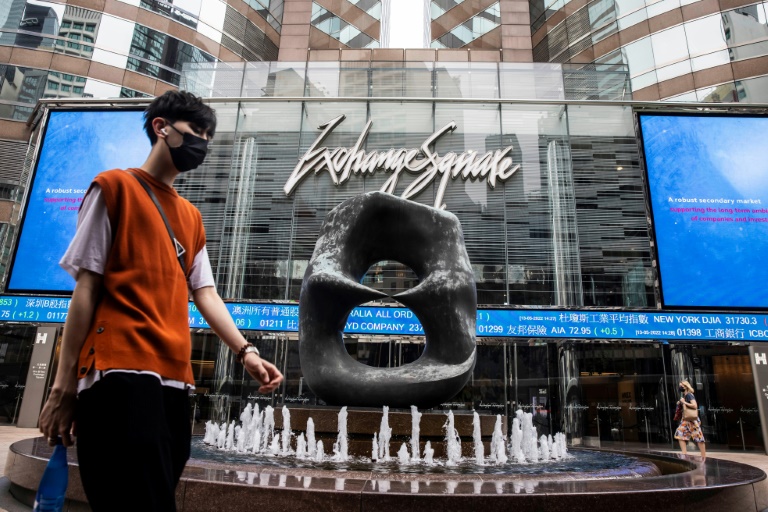
Asian equities fell Wednesday, tracking a drop on Wall Street ahead of a crucial US inflation report later in the day, which could have a huge bearing on the Federal Reserve’s plans for raising interest rates.

Investors are preparing for the consumer price figures with a sense of dread as analysts warn a forecast-beating reading would ramp up bets on another big Federal Reserve hike and reinforce recession expectations.

The US central bank has said its decision on when and by how much to tighten monetary policy will be driven by data as it struggles to walk a fine line between bringing inflation down from four-decade highs and trying not to damage the economy.

There had been hope that recent indicators showing activity slowing would give the Fed room to be less hawkish. But a bigger-than-predicted jump in jobs last month revived talk of a third straight three-quarter-point hike in September.

“The (Fed policy board) will need to make sure inflation moves back towards target sustainably before contemplating pausing its tightening cycle,” Carol Kong, of Commonwealth Bank of Australia, said.

“A strong inflation outcome today will likely reinforce the (board) is still some way away from that point yet, and see markets readjust higher their expectations for US interest rates.”

Wednesday’s figures come at a sensitive time for world markets, which have been buffeted by a range of other issues including the war in Ukraine, supply chain snarls and rising China-US tensions over Taiwan.

While the latest earning season has been less painful than feared, there are increasing signs that the economic slowdown is beginning to impact companies, with some major firms — including Apple and Amazon — providing downbeat outlooks.

Chip-maker Micron became the latest, saying revenue would likely come in at the low end of its forecasts in the fourth quarter owing to weak demand. That came a day after rival Nvidia unveiled disappointing results.

Tech firms led losses in New York, with the Nasdaq off more than one percent, and they did so in early Asian trade.

Hong Kong, Shanghai, Tokyo, Sydney, Seoul, Wellington, Taipei, Manila and Jakarta were all well down.

There was little initial  reaction to news that China’s consumer price index rose last month to a two-year high but came in below expectations.

Oil prices were flat but remained around six-month lows, even after news that supplies from Russia to three European countries through Ukraine had been halted as sanctions prohibited the processing of the transit payment.

The cost of the commodity has essentially wiped out all the gains seen since Russia’s invasion of its neighbour in February as expectations of a recession hit demand forecasts, while consumers are put off buying petrol owing to rising prices.

But OANDA’s Edward Moya said the market would not likely weaken further.

“Whatever crude demand destruction that occurs from a weakening global economy won’t be able to drag down oil prices much lower given how low the supply outlook remains,” he said in a note. 

– Key figures at around 0230 GMT –

Tokyo – Nikkei 225: DOWN 0.8 percent at 27,767.07 (break)

Hong Kong – Hang Seng Index: DOWN 1.6 percent at 19,687.72

Shanghai – Composite: DOWN 0.4 percent at 3,233.24

Euro/dollar: UP at $1.0215 from $1.0213 Tuesday

Pound/dollar: UP at $1.2081 from $1.2071

Euro/pound: DOWN at 84.55 pence from 84.57 pence

Dollar/yen: DOWN at 135.06 yen from 135.12 yen

West Texas Intermediate: DOWN 0.1 percent at $90.45 per barrel

Brent North Sea crude: UP 0.1 percent at $96.39 per barrel

New York – Dow: DOWN 0.2 percent at 32,774.41 (close)

London – FTSE 100: UP 0.1 percent at 7,488.15 (close)

China's consumer inflation pushes higher

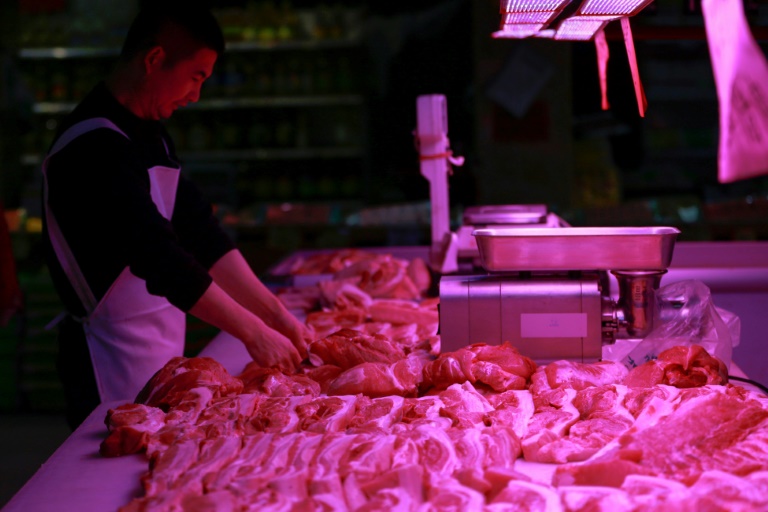
China’s consumer inflation rose in July to a two-year high, official data showed Wednesday, with a surge in pork prices pushing up the cost of food.

Compared with other countries, consumer costs in the world’s second-biggest economy have not skyrocketed, largely spared the impact of a global surge in food prices after the Russian invasion of Ukraine.

China’s consumer price index (CPI), a key gauge of retail inflation, grew less than expected at 2.7 percent from a year ago in July, National Bureau of Statistics (NBS) data showed.

CPI rose slightly on-year “due to an increase in prices of pork, fresh vegetables and other food, as well as seasonal factors”, NBS senior statistician Dong Lijuan said in a statement.

Food prices were up 6.3 percent on-year, with pork spiking 20.2 percent in July, she added.

Prices of the staple meat rose in part because of the reluctance of some farmers to sell — ostensibly to maximize profits — and a pick-up in consumer demand, according to the NBS.

While fuel prices were also higher than the same period last year, their growth rates have declined, Dong said.

“The headline rate has been lifted by fuel inflation and, more recently, a rebound in food inflation,” said Julian Evans-Pritchard, senior China economist at Capital Economics in a recent report.

He added that a weak labour market “may further sap price pressures”, and that he expects inflation to fall later this year.

The producer price index (PPI) — measuring the cost of goods at the factory gate — rose 4.2 percent in July, down from 6.1 percent in June, official data showed Wednesday.

This was lower than the expectation in a Bloomberg poll of analysts.

The NBS said this was influenced by a drop in international commodity prices such as crude oil and non-ferrous metals.

“The priority given to keeping factories open while restricting many consumer activities has meant that, domestically, lockdowns have been disinflationary,” Evans-Pritchard added in his earlier report.

“Unlike elsewhere, stimulus has targeted investment rather than household spending.”

Forever 16: America's teens succumbing to deadly fentanyl

Makayla Cox, a high school student in the US state of Virginia, thought she was taking medication that her friend had procured to treat pain and anxiety.

Instead, the pill she took two weeks after her sixteenth birthday was fentanyl, a synthetic opioid 50 times more potent than heroin. It killed her almost instantly.

After watching a movie — a prequel to “Harry Potter” — with her mother Shannon one evening in January, Makayla appeared fine as she headed to her bedroom with her husky dog that often slept on her bed.

But when Shannon entered Makayla’s room the next morning, she found her partially sitting up, perched against the headboard, orange fluid coming out of her nose and mouth.

“She was stiff. I shook her, I screamed her name, I called 911,” Shannon told AFP. “My neighbors came over and did CPR, but it was too late. After that, I just don’t remember much.”

America’s opioid crisis has reached catastrophic proportions, with over 80,000 people dying of opioid overdoses last year, most of them due to illicit synthetics such as fentanyl — more than seven times the number a decade ago.

“This is the most dangerous epidemic that we’ve seen,” said Ray Donovan, chief of operations at the US Drug Enforcement Agency (DEA). “Fentanyl is not like any other illicit narcotic, it’s that deadly instantaneously.”

And deaths are rising especially quickly among young people, who obtain counterfeit prescription drugs through social media. Unknown to them, the pills come either laced with or made of fentanyl.

In 2019, 493 American adolescents died of drug overdose, in 2021 that figure was 1,146.

– Dealers seek teens via apps –

Drug dealers reach adolescents on apps such as Snapchat, TikTok, Instagram and others, often using emojis as code. 

Oxycodone, an opioid, may be advertised as a half-peeled banana, Xanax, a benzodiazepine used to treat anxiety, as a chocolate bar, and Adderall, an amphetamine that acts as a stimulant, as a train.

Wilson Compton, deputy director of the National Institute on Drug Abuse, said the number of Americans doing drugs has largely stayed the same in recent years, but what changed is how deadly they’ve become.

One cup of heroin is equivalent to one teaspoon of fentanyl, and less than one gram can mean the difference between life and death.

“It takes very small quantities to be a poison that can stop somebody breathing,” Compton told AFP in an interview. 

Most of the illicit fentanyl in the United States is manufactured by Mexican drug cartels in clandestine labs from chemicals shipped over from China.

Because fentanyl is much more potent, it takes much less of it to fill a pill, resulting in more supply and more profit to the cartels.

One kilogram of pure fentanyl can be purchased for up to $12,000, pressed into half a million of pills that will sell for up to $30 each, raking in millions of dollars, Donovan said. And it’s also much easier to smuggle in pill form.

Last year, the DEA seized 15,000 pounds (nearly seven tons) of fentanyl — enough to kill every American. Four out of 10 seized pills contain lethal quantities of fentanyl.

– ‘One pill can kill’ –

At the agency’s headquarters, a collection of photographs titled “Faces of Fentanyl” hangs in the hallway. It features dozens of portraits of people who recently lost their lives to fentanyl. One of them reads “Makayla. Forever 16.”

An honor-roll student and a cheerleader, Makayla liked to paint, cuddle with her two huskies, Maize and Malenkai, and planned to go to university to study law, said her mother Shannon Doyle, 41, who works as a paralegal in a loan service firm.

Makayla had battled anxiety after her parents’ divorce, but things got worse during the pandemic.

Last summer she started a job at a water park, where she met a friend who introduced her to counterfeit prescription drugs.

The blue pills found in Makayla’s bed turned out to be 100 percent fentanyl. Police are investigating, but so far no arrests have been made.

“It used to be that when you were addicted to drugs you had five, 10, 15 years to try and get over your addiction and get the help and change your life,” Shannon said at her house in Virginia Beach, a town on the Atlantic coast some 240 miles (400 kilometers) south of the US capital.

“You don’t have that chance anymore.” 

Last year the DEA launched a campaign called “One pill can kill” to raise awareness of the dangers of fentanyl, and there are efforts across America to make naloxone, a medication that can reverse an opioid overdose, more easily available, including in schools.

Makayla’s ashes are in her bedroom and Shannon still peeks into the room every morning and evening, like she did when her daughter was alive.

She started a foundation in Makayla’s name to help prevent similar tragedies — a way, she says, helps her cope with her grief.

Makayla’s best friend Kaydence Blanchard, 16, is spending the summer without her, trying to make good on the dreams the girls had: to get a driver’s license and drive to the beach.

But for Makayla “the future will never happen,” Blanchard said. “She will never complete any of the plans that we had together.”

Forever 16: America's teens succumbing to deadly fentanyl

Makayla Cox, a high school student in the US state of Virginia, thought she was taking medication that her friend had procured to treat pain and anxiety.

Instead, the pill she took two weeks after her sixteenth birthday was fentanyl, a synthetic opioid 50 times more potent than heroin. It killed her almost instantly.

After watching a movie — a prequel to “Harry Potter” — with her mother Shannon one evening in January, Makayla appeared fine as she headed to her bedroom with her husky dog that often slept on her bed.

But when Shannon entered Makayla’s room the next morning, she found her partially sitting up, perched against the headboard, orange fluid coming out of her nose and mouth.

“She was stiff. I shook her, I screamed her name, I called 911,” Shannon told AFP. “My neighbors came over and did CPR, but it was too late. After that, I just don’t remember much.”

America’s opioid crisis has reached catastrophic proportions, with over 80,000 people dying of opioid overdoses last year, most of them due to illicit synthetics such as fentanyl — more than seven times the number a decade ago.

“This is the most dangerous epidemic that we’ve seen,” said Ray Donovan, chief of operations at the US Drug Enforcement Agency (DEA). “Fentanyl is not like any other illicit narcotic, it’s that deadly instantaneously.”

And deaths are rising especially quickly among young people, who obtain counterfeit prescription drugs through social media. Unknown to them, the pills come either laced with or made of fentanyl.

In 2019, 493 American adolescents died of drug overdose, in 2021 that figure was 1,146.

– Dealers seek teens via apps –

Drug dealers reach adolescents on apps such as Snapchat, TikTok, Instagram and others, often using emojis as code. 

Oxycodone, an opioid, may be advertised as a half-peeled banana, Xanax, a benzodiazepine used to treat anxiety, as a chocolate bar, and Adderall, an amphetamine that acts as a stimulant, as a train.

Wilson Compton, deputy director of the National Institute on Drug Abuse, said the number of Americans doing drugs has largely stayed the same in recent years, but what changed is how deadly they’ve become.

One cup of heroin is equivalent to one teaspoon of fentanyl, and less than one gram can mean the difference between life and death.

“It takes very small quantities to be a poison that can stop somebody breathing,” Compton told AFP in an interview. 

Most of the illicit fentanyl in the United States is manufactured by Mexican drug cartels in clandestine labs from chemicals shipped over from China.

Because fentanyl is much more potent, it takes much less of it to fill a pill, resulting in more supply and more profit to the cartels.

One kilogram of pure fentanyl can be purchased for up to $12,000, pressed into half a million of pills that will sell for up to $30 each, raking in millions of dollars, Donovan said. And it’s also much easier to smuggle in pill form.

Last year, the DEA seized 15,000 pounds (nearly seven tons) of fentanyl — enough to kill every American. Four out of 10 seized pills contain lethal quantities of fentanyl.

– ‘One pill can kill’ –

At the agency’s headquarters, a collection of photographs titled “Faces of Fentanyl” hangs in the hallway. It features dozens of portraits of people who recently lost their lives to fentanyl. One of them reads “Makayla. Forever 16.”

An honor-roll student and a cheerleader, Makayla liked to paint, cuddle with her two huskies, Maize and Malenkai, and planned to go to university to study law, said her mother Shannon Doyle, 41, who works as a paralegal in a loan service firm.

Makayla had battled anxiety after her parents’ divorce, but things got worse during the pandemic.

Last summer she started a job at a water park, where she met a friend who introduced her to counterfeit prescription drugs.

The blue pills found in Makayla’s bed turned out to be 100 percent fentanyl. Police are investigating, but so far no arrests have been made.

“It used to be that when you were addicted to drugs you had five, 10, 15 years to try and get over your addiction and get the help and change your life,” Shannon said at her house in Virginia Beach, a town on the Atlantic coast some 240 miles (400 kilometers) south of the US capital.

“You don’t have that chance anymore.” 

Last year the DEA launched a campaign called “One pill can kill” to raise awareness of the dangers of fentanyl, and there are efforts across America to make naloxone, a medication that can reverse an opioid overdose, more easily available, including in schools.

Makayla’s ashes are in her bedroom and Shannon still peeks into the room every morning and evening, like she did when her daughter was alive.

She started a foundation in Makayla’s name to help prevent similar tragedies — a way, she says, helps her cope with her grief.

Makayla’s best friend Kaydence Blanchard, 16, is spending the summer without her, trying to make good on the dreams the girls had: to get a driver’s license and drive to the beach.

But for Makayla “the future will never happen,” Blanchard said. “She will never complete any of the plans that we had together.”
Biden signs major semiconductors investment bill to compete against China

President Joe Biden signed into law Tuesday a multibillion dollar bill boosting domestic semiconductor and other high-tech manufacturing sectors that US leaders fear risk being dominated by rival China.

The Chips and Science Act includes around $52 billion to promote production of microchips, the tiny but powerful and relatively hard-to-make components at the heart of almost every modern piece of machinery.

Tens of billions of dollars more are allocated for scientific research and development.

The White House says the government commitment to bolstering high-tech industries is already drawing in large-scale private investors, with some $50 billion in new semiconductor investment alone. The lion’s share of that is a plan announced by US firm Micron to put $40 billion into domestic expansion by 2030.

Biden said at a White House speech that the cash injection from the Chips Act will help “win the economic competition in the 21st century.”

Entrepreneurs are “the reason why I’m so optimistic about the future of our country,” he said, and “the Chips and Science Act supercharges our efforts to make semiconductors here in America.”

One of the Democrat’s key themes since taking office has been the need to revamp US leadership in cutting-edge innovation and rebuild the homegrown industrial base in the face of China’s mammoth state-backed investments.

Semiconductors are of particular concern because they are vital to everything from washing machines to sophisticated weapons and nearly all are made abroad.

Although the semiconductor was invented in the United States, the country only produces around 10 percent of global supply, according to the White House, with some 75 percent of US supplies coming from east Asia.

“Today’s signing of the bipartisan Chips Act is a historic investment in America’s future. It will boost microchip production at home, strengthen our supply chains, increase domestic research and development, and bolster our national security,” said US Chamber of Commerce vice president Neil Bradley.

– Wider economic, political appeal –

Biden is also counting on the Chips Act to generate enthusiasm among voters, as his Democratic party tries to defend a thin congressional majority from a Republican takeover in this November’s midterm elections.

He told Americans that studies show the expansion of factories will create around a million construction jobs over the next six years — and these will be “union jobs” that pay “the prevailing wage.”

On Wednesday, Biden will sign another bill increasing funding for military veterans exposed to toxins. Like the Chips bill, this won bipartisan support in the usually bitterly divided Congress.

Shortly, Biden is also expected to be signing an enormous domestic investment bill — backed only by Democrats — aimed at fighting climate change and reducing health care costs.

Reflecting on the string of successes in Congress and the sudden momentum for his long stalled agenda, Biden predicted that “people will look back at this week and all we passed, and all we moved on, that we met the moment at this inflection point in history.”

“We bet on ourselves, believed in ourselves and recaptured the story, the spirit and the soul of this nation,” he said.

Close Bitnami banner
Bitnami