US Business

Stocks fall after US jobs growth surges

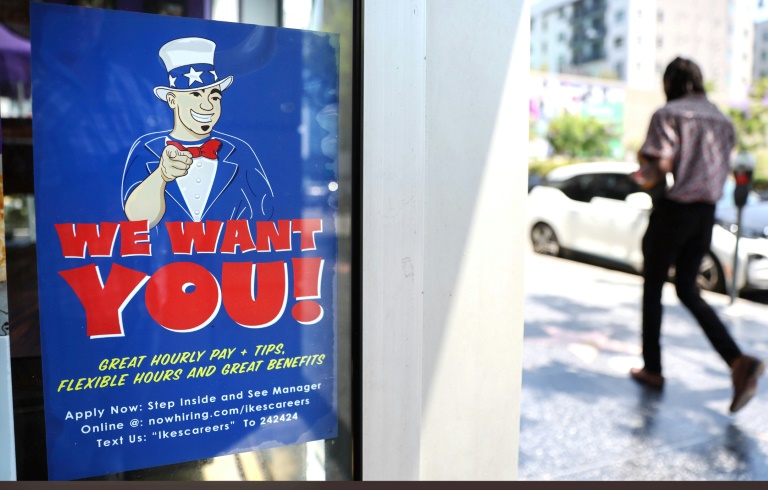
Stock markets slid Friday as a much stronger-than-expected US jobs report raised the prospect that the Federal Reserve will maintain its aggressive monetary policy to combat inflation.

Official data published Friday showed the US economy added 528,000 positions, defying all expectations of a slowdown.

Friday’s data also showed US wages jumped, which will add to inflation concerns and likely push the Fed to raise rates aggressively again next month.

The Fed has previously said its decision will be guided by data.

“The key takeaway from the report is that it squashes the friendly notion that the Fed can turn friendly with its monetary policy decisions sooner rather than later,” said Patrick O’Hare, analyst at Briefing.com.

Wall Street stocks opened lower with the Dow and S&P falling one percent and 0.7 percent respectively, while the tech-heavy Nasdaq Composite was down nearly 1.4 percent.

The dollar gained against other major currencies.

Officials have said the US economy remains healthy despite four-decade high inflation and a sharp lift in borrowing costs.

The jobs data “make a mockery of claims that the economy is on the brink of recession”, said Michael Pearce, senior US economist at Capital Economics, said.

“All the details appear to support continued aggressive rate hikes from the Fed,” he said in a note.

In Europe, London equities retreated 0.2 percent one day after the Bank of England unveiled a half-point interest rate hike and forecast UK inflation topping 13 percent on surging domestic energy bills.

The BoE’s rate increase followed more aggressive monetary policy from the European Central Bank and the Fed as authorities crack down on rampant inflation in the wake of Russia’s invasion of Ukraine.

Back in the eurozone, Frankfurt stocks slipped 0.4 percent and Paris sank 0.7 percent.

– ‘Stagflation awaits’ –

“The dire warnings from the BoE are impossible to ignore as other central banks desperately try to avoid a similar fate,” OANDA analyst Craig Erlam told AFP.

“It seems only a matter of time until others are forced to accept that a recession is the price to pay for getting inflation under control.”

He added: “A period of stagflation now awaits the UK — and others may not be far behind as the crushing impact of energy prices wreaks havoc on living standards and saps demand.”

Stagflation is a toxic mixture of stubbornly high consumer prices and low economic growth.

India’s central bank on Friday lifted borrowing costs for the third time in four months to the highest level since summer 2019.

Asian equities mostly rose Friday, with Taipei surging on easing concerns over a conflict with Beijing — even as China conducts its largest-ever military exercises around Taiwan in response to US House Speaker Nancy Pelosi’s visit earlier this week.

Oil prices fell further, one day after WTI crude fell to the level where it had stood before the Ukraine conflict sent the market soaring. 

– Key figures at around 1330 GMT –

London – FTSE 100: DOWN 0.2 percent at 7,430.67 points

Frankfurt – DAX: DOWN 0.4 percent at 13,599.79

Paris – CAC 40: DOWN 0.7 percent at 6,465.23

EURO STOXX 50: DOWN 0.5 percent at 3,640.03

New York – Dow: DOWN 0.7 percent at 32,498.29

Tokyo – Nikkei 225: UP 0.9 percent at 28,175.87 (close)

Hong Kong – Hang Seng Index: UP 0.1 percent at 20,201.94 (close)

Shanghai – Composite: UP 1.2 percent at 3,227.03 (close)

Euro/dollar: DOWN at $1.0153 from $1.0246 Thursday

Pound/dollar: DOWN at $1.2021 from $1.2160

Euro/pound: UP at 84.44 pence from 84.26 pence

Dollar/yen: UP at 134.78 yen from 132.89 yen

Brent North Sea crude: DOWN 1.0 percent at $93.14 per barrel

West Texas Intermediate: DOWN 1.2 percent at $87.41 per barrel

burs-raz/lth
Where's Boris? UK's PM on leave as economic crisis deepens

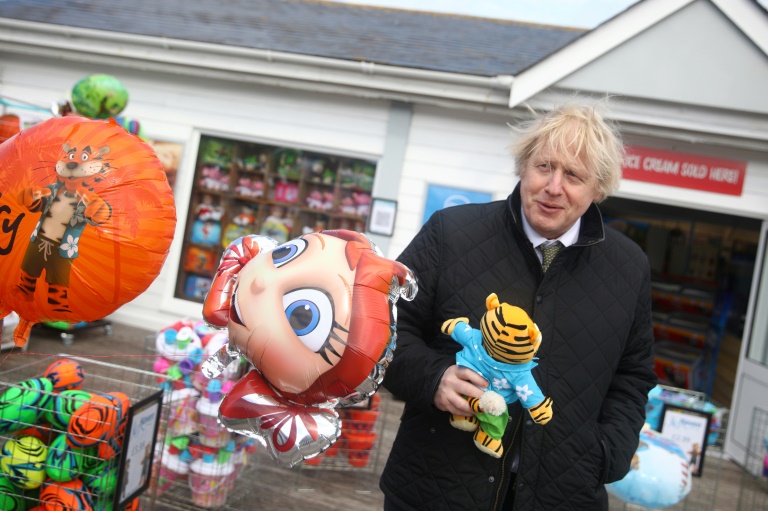
A British cabinet member admitted Friday “I don’t know where Boris is” as the prime minister checked out on holiday, in a week that saw the Bank of England warn a year-long recession is coming.

Boris Johnson has since Wednesday been on a belated honeymoon with wife Carrie, according to Downing Street.

Aides said he still remained at the helm, rather than handing over temporarily to Deputy Prime Minister Dominic Raab, but refused to confirm the honeymoon destination. 

The UK embassy in Ljubljana confirmed that Johnson was on a private visit to Slovenia.

Johnson will have a lot more time on his hands after September 6, when he is due to hand over to either Liz Truss or Rishi Sunak as Conservative leader, but decided to take a break sooner.

Chancellor of the Exchequer Nadhim Zahawi is also on holiday this week, and the opposition Labour party accused the government’s two senior-most members of being “missing in action”.

“I don’t know where Boris is, but I’m in constant contact with him,” Business Secretary and Truss supporter Kwasi Kwarteng told Times Radio. 

He said he exchanges WhatsApp messages with both Johnson and Zahawi “all the time”, and insisted that criticism the government was doing nothing about the economic crisis was “false”.

Zahawi said he had remained in touch with Bank of England governor Andrew Bailey on Thursday after the central bank hiked interest rates from 1.25 to 1.75 percent, the biggest rise in 27 years.

The bank is trying to rein in surging inflation, which it warned could peak at 13.3 percent, as it forecast the UK economy would enter a recession in the fourth quarter that will last until late 2023.

“For me, like I’m sure lots of others, there is no such thing as a holiday and not working. I never had that in the private sector, not in government,” Zahawi said in a statement.

– ‘Magical solutions’ –

Foreign Secretary Truss and Sunak, Zahawi’s predecessor as chancellor, clashed anew over how to address the crisis in a televised debate late Thursday.

“The reality is we’re facing a recession if we carry on with our business-as-usual policies,” Truss, who is leading in surveys of Tory members, told reporters on Friday.

She plans an emergency budget to lower taxes immediately to combat the cost-of-living crisis, and to review the independent Bank of England’s inflation-fighting mandate.

But Sunak said tax cuts financed with more borrowing would force the bank to increase interest rates even more, insisting on the need to maintain fiscal rigour and tame the price pressures first.

Former cabinet minister Liam Fox, who supports Sunak, warned against “magical solutions” via debt-financed tax cuts as proposed by Truss.

The two candidates were due later Friday to host another hustings event in front of Tory members, who have until September 2 to vote. 

At Thursday’s Sky News debate, Truss was forced on the back foot after the moderator highlighted her shifting stances over the years, including a major policy U-turn this week on pay for public-sector workers.

But Sunak also faced embarrassment after video emerged of him telling grassroots Tories in wealthy Kent last week that, as chancellor, he had diverted government funds away from “deprived urban areas”.

His campaign said that in the video, obtained Friday by the New Statesman magazine, Sunak had merely stressed the need to shift the focus of government help to other towns and rural areas.

But senior Labour MP Lisa Nandy said: “This leadership race is revealing the Conservatives’ true colours. 

“It’s scandalous that Rishi Sunak is openly boasting that he fixed the rules to funnel taxpayers’ money to prosperous Tory shires.”

'Climate criminal': Celebrities rapped over jet use

From a 14-minute flight by Drake’s private plane to Taylor Swift’s carbon footprint, celebrities are struggling to shake off a firestorm over their jet emissions amid the climate crisis.

Fury erupted in July when reality star Kylie Jenner shared a picture to her 364 million Instagram users of her and her partner, rapper Travis Scott, in front of two jets with the caption: “you wanna take mine or yours?”

Critics on social media swiftly attacked Jenner, calling her a “climate criminal”.

Then last week, British sustainability marketing firm Yard named and shamed the “worst private jet CO2 emission offenders” among celebrities.

Normally used to topping music charts, US pop star Taylor Swift headlined the unenviable list, prompting a torrent of social media outrage, memes and jokes that she was using her jet to pick up food.

Her jet has flown 170 times since January, with total flight emissions for the year reaching 8,293.54 tonnes, or 1,184.8 times more than the average person, Yard said.

In second place was boxer Floyd Mayweather followed by rapper Jay-Z.

Jenner’s half-sister, reality TV star Kim Kardashian, ranked seventh, having recently flaunted her jet’s cashmere-clad interior. Rapper Scott was 10th while Jenner herself was 19th.

Yard cautioned that its list was “not conclusive to the biggest offenders” as it is based on the “Celebrity Jets” Twitter account, which tracks the flights thanks to public data. It was also impossible to determine if the stars were on all the recorded flights.

“Taylor’s jet is loaned out regularly to other individuals,” Swift’s publicist told media. “To attribute most or all of these trips to her is blatantly incorrect.”

While Drake escaped the top 10 list, the Canadian rapper faced heat over a 14-minute flight between Toronto and Hamilton in July, especially after he said that the “Air Drake” plane was empty.

“This is just them moving planes to whatever airport they are being stored at for anyone who was interested in the logistics… nobody takes that flight,” he said on Instagram.

“It’s even worse if it flew empty,” said Beatrice Jarrige, long-distance mobility project manager at Shift Project, a non-profit focused on climate change.

– ‘Fly with climate bombs’ –

The aviation sector is responsible for two to three percent of carbon dioxide emissions.

But a report in May by Transport & Environment, a European non-government group, showed the carbon footprint of private jets is five to 14 times higher per passenger compared with commercial flights, and 50 times bigger than that of train riders.

“We are allowing people to fly with climate bombs,” said William Todts, executive director of the clean transport campaign group.

The usage of private jets has soared since the coronavirus pandemic, with wealthier customers seeking to avoid any cancellations.

Private jet flights increased by seven percent in 2021 compared to 2019, according to aviation data research firm WingX.

In Europe, celebrities using private jets could use the continent’s vast train network for the majority of their journeys instead, Todts said.

– Jets ‘like taxis’ –

The Celebrity Jets account was created by 19-year-old student Jack Sweeney in 2020 after he started following Elon Musk’s private plane.

He now has 30 accounts tracking sports stars, Meta boss Mark Zuckerberg and even Russian oligarchs.

Sweeney has inspired copycat accounts.

Sebastien, a 35-year-old aerospace engineer who refused to give his real name, created in April the “I Fly Bernard” account that follows flights by French billionaires including Bernard Arnault, the head of luxury giant LVMH.

“What I wish to condemn is their use of private jets like taxis,” he said, pointing to their multiple domestic and European flights.

Arnault has not yet responded to the online criticism. 

Jarrige hopes the anger on social media turns into political action.

“It is not a question of totally banning such flights, but the richest must make an effort to be more restrained,” she said, calling for more investment in railways.

Todts said celebrities can and should do more to encourage the development of biofuels rather than kerosene.

“If they actually use their power to buy clean fuels, it would encourage the industry to develop them,” he said.

The commercial aviation sector said last year that sustainable fuels are “key” to carbon neutrality objectives that it has set for 2050.

More grain leaves Ukraine ahead of high-stakes summit on Russian invasion

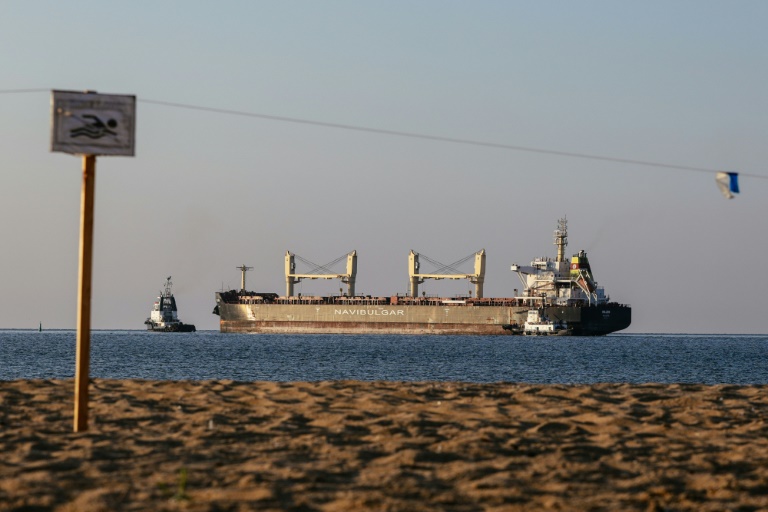
Three ships loaded with grain set sail from Ukraine on Friday under a landmark deal to free up shipments brokered by Turkey, as its leader prepared to meet his Russian counterpart for talks on Moscow’s invasion of its neighbour.

Months of efforts by President Recep Tayyip Erdogan saw Moscow and Kyiv agree in Istanbul last month to resume the shipments from Ukrainian ports in a bid to relieve a global food crisis caused by the assault launched in February.

The government in Kyiv said on social media that two ships carrying Ukrainian maize — the Maltese-flagged Rojen and the Turkish Polarnet — had set off from Chornomorsk while the Panama-flagged Navistar departed from Odessa. 

As the vessels left, Erdogan was preparing with most of his top ministers for his second talks with President Vladimir Putin in 17 days and a working lunch in the Russian resort city of Sochi.

“Russia’s war on Ukraine has restored Turkey’s self-image as a key geopolitical player and given Erdogan more visibility than at any time in the last few years,” European Council on Foreign Relations fellow Asli Aydintasbas wrote in a report last week.

The first ship from Ukraine crossed Istanbul on Wednesday, while the three latest deliveries were destined for Turkey and markets in Ireland and Britain.

Erdogan wants to translate the success into truce talks in Istanbul between Putin and Ukrainian President Volodymyr Zelensky.

“We discussed if the grain agreement could be an occasion for a sustainable ceasefire,” Turkish Foreign Minister Mevlut Cavusoglu said after talks with Russian counterpart Sergei Lavrov in Asia this week.

– Victim-blaming –

The rare diplomatic breakthrough has been overshadowed in Ukraine, however, by a mushrooming controversy over accusations that the war-torn country is violating international law and endangering civilians in its defence against Russia’s invasion.

Amnesty International released a report Thursday listing incidents in 19 cities and towns where Ukrainian forces appeared to have put civilians in harm’s way by establishing bases in residential areas.

Zelensky equated the accusations to victim-blaming in an evening address in which he said the rights group had sought to offer “amnesty (to) the terrorist state and shift the responsibility from the aggressor to the victim”.  

“There is no condition, even hypothetically, under which any Russian strike on Ukraine becomes justified. Aggression against our state is unprovoked, invasive and terrorist,” he added.  

“If someone makes a report in which the victim and the aggressor are supposedly equal in some way… then this cannot be tolerated.”  

After a four-month investigation, Amnesty said it had found that the Ukrainian military had established bases in schools and hospitals, and launched attacks from populated areas, asserting that the tactics violated international humanitarian law.  

The group noted, however, that the tactics “in no way justify Russia’s indiscriminate attacks”, which have battered civilian populations.  

On Friday, the Ukrainian presidency reported Russian bombardments overnight targeting the southern city of Mykolaiv with widely-banned cluster bombs and heavy artillery — prompting regional governor Vitaliy Kim to order a curfew from 11:00 pm (2000 GMT) on Friday, until 5:00 am (0200 GMT) on Monday. 

“I ask everyone to understand, plan the weekend and make purchases for these two days,” the governor said on social media platform Telegram.

“Honest people have nothing to worry about — just keep your documents with you.”

– Counter-offensive –

Several towns and villages in the east, including Nikopol and Kryvyi Rig, were also hit by shelling that damaged houses and a gas station.

Several missiles struck the central city of Zaporizhzhia overnight, where Moscow has been accused of storing heavy weapons at Europe’s largest nuclear power plant in occupied Ukrainian territory.

There was also heavy bombardment of Ukraine’s second city Kharkiv, in the northeast, where housing, shops, a market and an educational institution were damaged.

Ukrainian forces are conducting a counter-offensive in the country’s south, where they claim to have retaken more than 50 villages previously controlled by Moscow.

They also claimed to have liberated two villages in the eastern Donetsk region on Thursday and one near Kharkiv on Friday. 

The attacks have not affected the grain shipment deal, which provides for the establishment of secure corridors in the Black Sea to allow merchant ships to export between 20 and 25 million tonnes of Ukrainian grain held up in ports. 

A similar agreement signed at the same time allows Russia to export its agricultural products and fertiliser despite Western sanctions.

Where's Boris? UK's PM on leave as economic crisis deepens

A British cabinet member admitted Friday “I don’t know where Boris is” as the prime minister checked out on holiday, in a week that saw the Bank of England warn a year-long recession is coming.

Boris Johnson has since Wednesday been on a belated honeymoon with wife Carrie. Downing Street has refused to say where, but The Times newspaper said the couple were in Slovenia.

Johnson will have a lot more time on his hands after September 6, when he is due to hand over to either Liz Truss or Rishi Sunak as Conservative leader, but decided to take a break sooner.

The opposition Labour party accused the government’s two senior-most ministers of being “missing in action” — with Chancellor of the Exchequer Nadhim Zahawi also on holiday this week.

“I don’t know where Boris is, but I’m in constant contact with him,” Business Secretary and Truss supporter Kwasi Kwarteng told Times Radio. 

He said he exchanges WhatsApp messages with both Johnson and Zahawi “all the time”, and insisted that criticism the government was doing nothing about the economic crisis was “false”.

Zahawi said he had remained in touch with Bank of England governor Andrew Bailey on Thursday after the central bank hiked interest rates from 1.25 to 1.75 percent, the biggest rise in 27 years.

The bank is trying to rein in surging inflation, which it warned could peak at 13.3 percent, as it forecast the UK economy would enter a recession in the fourth quarter that will last until late 2023.

“For me, like I’m sure lots of others, there is no such thing as a holiday and not working. I never had that in the private sector, not in government,” Zahawi said in a statement.

– ‘Magical solutions’ –

Foreign Secretary Truss and Sunak, Zahawi’s predecessor as chancellor, clashed anew over how to address the crisis in a televised debate late Thursday.

“The reality is we’re facing a recession if we carry on with our business-as-usual policies,” Truss, who is leading in surveys of Tory members, told reporters on Friday.

She plans an emergency budget to lower taxes immediately to combat the cost-of-living crisis, and to review the independent Bank of England’s inflation-fighting mandate.

But Sunak said tax cuts financed with more borrowing would force the bank to increase interest rates even more, insisting on the need to maintain fiscal rigour and tame the price pressures first.

Former cabinet minister Liam Fox, who supports Sunak, warned against “magical solutions” via debt-financed tax cuts as proposed by Truss.

The two candidates were due later Friday to host another hustings event in front of Tory members, who have until September 2 to vote. 

At Thursday’s Sky News debate, Truss was forced on the back foot after the moderator highlighted her shifting stances over the years, including a major policy U-turn this week on pay for public-sector workers.

But Sunak also faced embarrassment after video emerged of him telling grassroots Tories in wealthy Kent last week that, as chancellor, he had diverted government funds away from “deprived urban areas”.

His campaign said that in the video, obtained Friday by the New Statesman magazine, Sunak had merely stressed the need to shift the focus of government help to other towns and rural areas.

But senior Labour MP Lisa Nandy said: “This leadership race is revealing the Conservatives’ true colours. 

“It’s scandalous that Rishi Sunak is openly boasting that he fixed the rules to funnel taxpayers’ money to prosperous Tory shires.”

China scraps cooperation with US over Taiwan spat

China said Friday it was ending cooperation with the United States on a litany of key issues including climate change, anti-drug efforts and military talks, as relations between the two superpowers nosedive over the island of Taiwan.

Beijing has reacted furiously to a visit by US House Speaker Nancy Pelosi to the island, which it claims as its territory and has vowed to retake, by force if necessary.

It has since Thursday encircled the self-ruled, democratic island with a series of huge military drills that have been roundly condemned by the United States and other Western allies.

And Friday saw its foreign ministry hit back further against the United States, suspending talks and cooperation on multiple agreements between the two — including on fighting climate change.

The world’s two largest polluters last year pledged to work together to accelerate climate action this decade, and vowed to meet regularly to “address the climate crisis”.

But that deal looks shaky as relations sink to some of their lowest levels in years, as do agreements on everything from talks on military matters to anti-drug cooperation.

Pelosi — who was also hit with sanctions by Beijing for the visit — has defended her trip to Taiwan, saying Friday that Washington would “not allow” China to isolate the island.

Taiwan has also condemned Beijing’s furious response to the visit, with premier Su Tseng-chang calling for allies to push for de-escalation.

“(We) didn’t expect that the evil neighbour next door would show off its power at our door and arbitrarily jeopardise the busiest waterways in the world with its military exercises,” he told reporters.

– ‘Our motherland is powerful’ –

Beijing has said its military exercises will continue until midday Sunday, and Taipei reported 68 Chinese planes and 13 warships crossed the “median line” that runs down the Taiwan Strait on Friday.

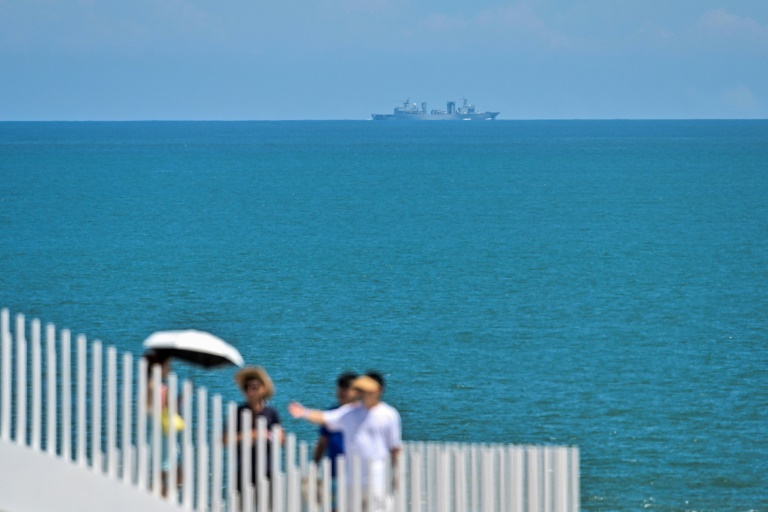
AFP journalists on the Chinese island of Pingtan saw a fighter jet flying overhead, prompting tourists to snap photos as it flew along the coast.

A Chinese military vessel was also visible sailing through the Taiwan Strait, they added.

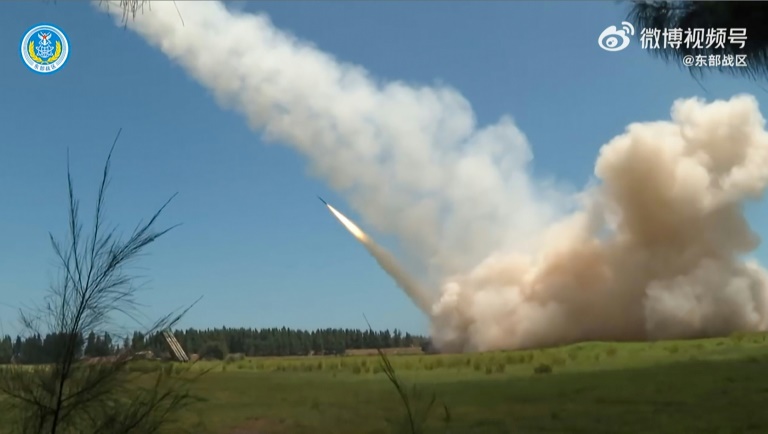
China’s drills involved a “conventional missile firepower assault” in waters to the east of Taiwan, the Chinese military said. 

And state broadcaster CCTV reported that Chinese missiles had flown directly over Taiwan — a major escalation if officially confirmed.

On the Chinese island of Pingtan, local tourists proudly extolled their country’s military might against its much smaller neighbour.

“Our motherland is powerful. We are not afraid of having war with Taiwan, the US or any country in the world,” Liu, a 40-year-old tourist from Zhejiang province, told AFP.

“We hope to unify Taiwan soon. We are not scared of anyone,” he added. 

“Our country is powerful. We don’t want to start a war, but we are not afraid of others.”

– ‘Significant escalation’ –

China’s ruling Communist Party views Taiwan as part of its territory and has vowed to one day take it, by force if necessary.

But the scale and intensity of the drills have triggered outrage in the United States and other democracies.

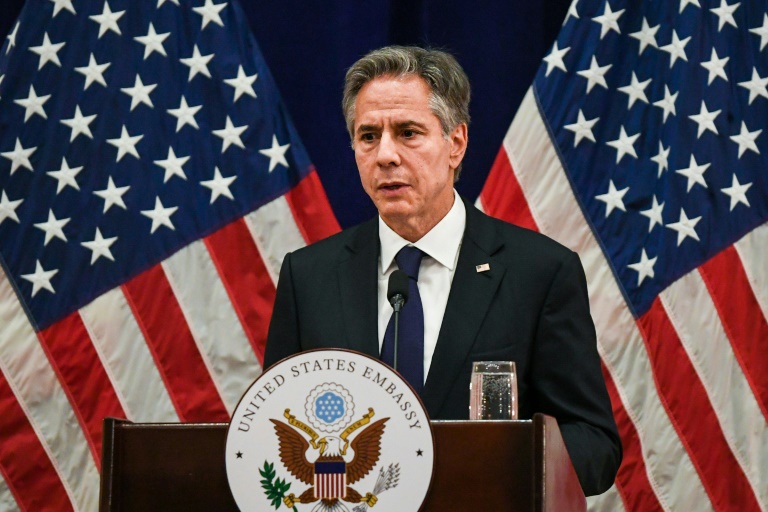
“These provocative actions are a significant escalation,” US Secretary of State Antony Blinken said after talks with Southeast Asian foreign ministers in Phnom Penh.

“The fact is, the speaker’s visit was peaceful. There is no justification for this extreme, disproportionate and escalatory military response,” he added.

Japan lodged a formal diplomatic complaint against Beijing, with five of China’s missiles believed to have landed in its exclusive economic zone.

And Australia — which has a troubled relationship with China, its largest trading partner — condemned the drills as “disproportionate and destabilising”.

The manoeuvres are taking place along some of the world’s busiest shipping routes, used to disseminate the global supply of vital semiconductors and electronic equipment produced in East Asia.

European stocks slip on stagflation fear, before US data

European stock markets slid Friday after the Bank of England’s gloomy recession warning raised the spectre of stagflation, and as investors awaited critical US payrolls data, dealers said.

London equities retreated 0.2 percent one day after the BoE unveiled a half-point interest rate hike and forecast UK inflation topping 13 percent on surging domestic energy bills.

The hike followed more aggressive monetary policy from the European Central Bank and US Federal Reserve as authorities crack down on rampant inflation in the wake of Russia’s invasion of Ukraine.

India on Friday lifted borrowing costs for the third time in four months to the highest level since summer 2019.

Back in the eurozone, Frankfurt stocks slipped 0.1 percent and Paris sank 0.5 percent, despite modest gains in Asia.

Oil prices held steady, one day after WTI crude fell to the level where it had stood before the Ukraine conflict sent the market soaring. 

– ‘Stagflation awaits’ –

“The dire warnings from the BoE are impossible to ignore as other central banks desperately try to avoid a similar fate,” OANDA analyst Craig Erlam told AFP.

“It seems only a matter of time until others are forced to accept that a recession is the price to pay for getting inflation under control.”

He added: “A period of stagflation now awaits the UK — and others may not be far behind as the crushing impact of energy prices wreaks havoc on living standards and saps demand.”

Stagflation is a toxic mixture of stubbornly high consumer prices and low economic growth.

Later on Friday, traders will focus on key US non-farm payrolls (NFP) data that could stoke fears of a prolonged downturn in the world’s number one economy.

“Market participants will closely scrutinize today’s NFP report for any signs that weakness in activity data in the US economy is starting to spill-over into the labour market with a lag which would heighten (US) recession fears,” said MUFG analyst Lee Hardman.

Asian equities mostly rose Friday, with Taipei surging on easing concerns over a conflict with Beijing — even as China conducts its largest-ever military exercises around Taiwan in response to US House Speaker Nancy Pelosi’s visit earlier this week.

And while many analysts are beating the drum of a global recession, traders are also hopeful of a reprieve from monetary tightening.

“The recent fall in oil prices, which are now trading below the levels immediately before Russia’s invasion of Ukraine, has contributed to the market’s perception that inflation is likely to peak soon, taking pressure off the Fed to raise rates as aggressively,” said National Australia Bank’s Rodrigo Catril. 

The Fed has said its rate decision will be guided by data, with signs of economic weakness seen as likely to mean any increases will be light.

Officials have said the US economy remains healthy despite four-decade high inflation and a sharp lift in borrowing costs.

– Key figures at around 1030 GMT –

London – FTSE 100: DOWN 0.2 percent at 7,434.14 points

Frankfurt – DAX: DOWN 0.1 percent at 13,648.93

Paris – CAC 40: DOWN 0.5 at 6,479.50

EURO STOXX 50: DOWN 0.4 percent at 3,740.74

Tokyo – Nikkei 225: UP 0.9 percent at 28,175.87 (close)

Hong Kong – Hang Seng Index: UP 0.1 percent at 20,201.94 (close)

Shanghai – Composite: UP 1.2 percent at 3,227.03 (close)

New York – Dow: DOWN 0.3 percent at 32,726.82 (close)

Euro/dollar: DOWN at $1.0225 from $1.0246 Thursday

Pound/dollar: DOWN at $1.2147 from $1.2160

Euro/pound: DOWN at 84.19 pence from 84.26 pence

Dollar/yen: UP at 133.00 yen from 132.89 yen

Brent North Sea crude: FLAT at $94.11 per barrel

West Texas Intermediate: FLAT at $88.52 per barrel

burs-rfj/lcm

Blinken meets Cambodian opposition leader

US Secretary of State Anthony Blinken met a Cambodian opposition leader facing treason charges during a visit to Phnom Penh Friday, expressing concern about the kingdom’s eroding democracy ahead of elections next year.

One of the world’s longest-serving leaders, Prime Minister Hun Sen has ruled Cambodia for more than 37 years. In 2018 his party won every seat in a national election.

And in June, a Phnom Penh court convicted about 60 opposition figures — including dual US-Cambodian citizen Theary Seng — in a mass treason trial that rights groups have condemned as politically motivated.

Blinken said he directly expressed concerns about the kingdom’s ailing democracy during talks with Hun Sen, while visiting the Cambodian capital for the Association of South East Nations (ASEAN) foreign ministers’ meeting.

Allowing broader participation in the political system would strengthen the country, the secretary of state told reporters Friday.

“One of the things that stands in the way of strengthening the relationship between our countries are our concerns about eroding respect for human rights and democratic institutions here in Cambodia,” he said.

Washington’s top diplomat said that earlier Friday he met Cambodian opposition leader Kem Sokha, who is on trial for treason in a case that has dragged on since January 2020 — and which could effectively rule him out of next year’s national election.

During talks with Hun Sen, Blinken also raised the case of Theary Seng. The outspoken lawyer and campaigner was hit with a six-year jail term in June’s treason case.

Hun Sen and his ruling party have publicly backed the prime minister’s eldest son — currently commander of the army — to eventually take the reins.

Ahead of local elections two months ago, the United Nations Human Rights Office said it was disturbed by reports of opposition obstruction in a “paralysing political environment”.

Hun Sen’s political party later announced a landslide win.

Who could be part of a US-Russia prisoner exchange?

The drug smuggling conviction in Russia of US basketball star Brittney Griner has again raised the question of a prisoner exchange between Moscow and Washington.

Russia said Friday it was “ready” for talks on a swap. Below are prisoners who could potentially be involved in a swap.  

– Brittney Griner –

Griner was on Thursday sentenced to nine years in a Russian penal colony and ordered to pay a fine of one million rubles ($16,590) for possessing and smuggling narcotics.

She was arrested at a Moscow airport in February for possessing vape cartridges with cannabis oil. The arrest came just days before Moscow launched its offensive in Ukraine on February 24.

She said it was prescribed by a US doctor to relieve pain for her many injuries.

The 31-year-old Phoenix Mercury player came to Russia to play basketball for a club in Russia’s Yekaterinburg during the off-season — a common path for American stars seeking additional income.

The two-time Olympic gold medallist and Women’s NBA champion pleaded guilty to the charges, but said she did not intend to break the law or use the banned substance in Russia.

– Paul Whelan –

Former US marine Paul Whelan, 52, was arrested in December 2018 and accused by Russian security services of spying. 

He was detained on a visit to Moscow to attend a wedding when he took a USB drive from an acquaintance, thinking it contained holiday photographs. He did not look at the contents of the drive, but his lawyer said it contained “state secrets”.

The former security official at a vehicle parts company — who also has British, Canadian and Irish passports — was sentenced to 16 years on espionage charges in June 2020. 

During his closed-door trial, Whelan insisted he was innocent.

– Marc Fogel – 

A teacher at an international school in Moscow, US citizen Marc Fogel was in June sentenced to 14 years in prison on charges of “large-scale” cannabis trafficking.

Russian customs officers said they found marijuana and hash oil in Fogel’s luggage when he arrived from New York at Moscow’s Sheremetyevo airport. 

Fogel said the marijuana was prescribed in the United States for medical purposes after a spinal operation.

Russia has not made the use of cannabis legal for medicinal purposes. 

Russian officials said Fogel was earlier employed by the US embassy in Moscow and benefited from diplomatic immunity until May 2021. 

– Victor Bout –

Russian arms trafficker Victor Bout was in 2012 sentenced to 25 years in a US jail after he was accused of arming rebels in some of the world’s bloodiest conflicts. 

The 55-year-old is considered the highest-profile Russian imprisoned in the United States.

The former Soviet air force officer and polyglot was arrested in Thailand in 2008 during a sting operation in which US agents posed as Colombia’s FARC rebels seeking weapons.

He inspired the 2005 arms smuggling movie “Lord of War” starring Nicolas Cage and was dubbed the “Merchant of Death” by former British minister Peter Hain for supplying weapons to war-torn Angola and Liberia.

Strategic ambiguity? The US, Taiwan and China — a guide

US House Speaker Nancy Pelosi’s visit to Taiwan has provoked Beijing’s ire — and brought into focus Washington’s deliberately ambiguous foreign policy stance toward the democratic, self-ruled island.

Pelosi’s pledge Friday that the United States will “not allow” China to isolate Taiwan comes just months after President Joe Biden repeatedly said US forces would defend the island militarily if China attempted to take control of it.

Biden’s team have nsisted that Washington’s decades-old approach remained unchanged. 

Here is a recap of that foreign policy stance and why relations between the United States, China and Taiwan are so delicate:

– Bitter history – 

The deep rift between Beijing and Taiwan dates back to China’s civil war, which erupted in 1927 and pitted forces aligned with the Communist Party of China against the Nationalist Kuomintang (KMT) army. 

Eventually defeated by Mao Zedong’s communists, KMT chief Chiang Kai-shek fled to Taiwan, which was still under his control. 

From there, Chiang continued to claim the entirety of China — just as the mainland claimed Taiwan as part of its territory to be re-taken one day, by force if necessary.  

For years, both sides still formally claimed to represent all of China, and Taiwan’s official name remains the Republic of China, while the mainland is the People’s Republic of China

Since the late 1990s, Taiwan has transformed from an autocracy into a vibrant democracy and a distinct Taiwanese identity has emerged. 

The current ruling party, led by President Tsai Ing-wen, has pledged to defend Taiwan’s sovereignty.

– Strategic ambiguity –

Washington cut formal diplomatic relations with Taiwan in 1979, switching recognition to Beijing as the sole representative of China, with the mainland becoming a major trading partner.

But at the same time, the United States maintained a decisive, if at times delicate, role in supporting Taiwan.

Under a law passed by Congress, the United States is required to sell Taiwan military supplies to ensure its self-defence against Beijing’s vastly larger armed forces.

But it has maintained “strategic ambiguity” on whether it would actually intervene militarily, a policy designed both to ward off a Chinese invasion and discourage Taiwan from ever formally declaring independence.

There is now growing bipartisan discussion in Washington over whether a switch to “strategic clarity” is preferable given Beijing’s increasingly bellicose approach to cross-strait relations. 

Beijing has become much more assertive towards Taiwan under President Xi Jinping and the last two years in particular have seen a surge in incursions into Taiwan’s air defence identification zone by Chinese military aircraft.

And Russia’s war on Ukraine has heightened fears that China might one day follow through on threats to annex its smaller neighbour. 

On Friday, China encircled the island with a series of huge military drills, prompting rebuke from Taipei, the United States and other democracies. 

Yet analysts broadly agree that despite all its aggressive posturing, Beijing does not want an active military conflict against the United States and its allies over Taiwan — just yet.

-‘One China’ policy –

US policy on Taiwan has always hinged on diplomatic nuance. 

In what is termed the “One China policy”, Washington recognises Beijing, but only acknowledges the Chinese position that Taiwan is part of China. 

It leaves it to the two sides to work out a solution, while opposing any use of force to change the status quo. 

In practice, Taiwan enjoys many of the trappings of a full diplomatic relations with the United States. 

While there is no US embassy in Taipei, Washington runs a centre called the American Institute in Taiwan. 

In the United States, the island’s diplomats enjoy the status of other nations’ personnel. 

Only 13 nations, all in the developing world, and the Vatican still recognise Taiwan.  

Beijing has tried hard to stop any international recognition of the island. 

It baulks at any use of the word Taiwan, such as when Lithuania allowed Taipei to open a de facto embassy under its own name last year, lest it might lend the island a sense of legitimacy on the global stage. 

The United States and a growing number of countries have pushed for Taiwan to be included in UN bodies, such as the World Health Organization. 

Close Bitnami banner
Bitnami