US Business

Seoul says Pelosi DMZ visit sends clear message to North

After her high-profile trip to Taiwan, US House Speaker Nancy Pelosi was in South Korea Thursday where her agenda included a visit to the heavily fortified Demilitarized Zone (DMZ) — but not a meeting with the country’s president.

Pelosi, who arrived in Seoul late Wednesday, met top parliamentary officials in the capital before her scheduled trip to the border with the nuclear-armed North, where the two neighbours’ forces stand face to face, a South Korean official said.

She will be the highest-ranking US official to visit the Joint Security Area (JSA) and inter-Korean truce village of Panmunjom since then president Donald Trump met North Korean leader Kim Jong Un there in 2019.

But those talks collapsed and North Korea has conducted a record-breaking blitz of weapons tests so far this year, including firing an intercontinental ballistic missile at full range for the first time since 2017.

Pelosi discussed the “grave situation” and growing threat posed by North Korea’s nuclear weapons programmes with her South Korean counterpart, National Assembly Speaker Kim Jin-pyo.

And her trip to the DMZ is seen by President Yoon Suk-yeol as “a sign of strong deterrence between South Korea and the US against North Korea,” an official from his office said Thursday.

– Pelosi snub? –

Yoon, who spoke to Pelosi by phone but did not meet her in person as he is officially on holiday this week, is facing growing domestic criticism over his perceived snub of the second in line to the US Presidency.

Local media and lawmakers from Yoon’s party have pointed to the fact that no official delegation was sent to greet Pelosi, even as Yoon was photographed attending a play in central Seoul the same night.

“What should we make of the fact that [Yoon] is watching a play and have a gathering [with the actors] but not meeting the US House Speaker?” a former lawmaker from Yoon’s People’s Power party, Yoo Seung-min, wrote on Facebook Thursday.

“Speaker Pelosi is visiting the JSA today. It is undesirable to think that the leader of our ally’s parliament visits the forefront of our security but there won’t be any meetings between our president and her.”

Yoon took office in May, vowing to boost ties with the United States, including ramping up the joint military drills that always infuriate North Korea, which views them as rehearsals for invasion.

He had also struck a hawkish, anti-China tone on the campaign trail, saying he wanted to buy an additional THAAD US missile system to counter the North, despite staunch opposition from Beijing.

But critical local media reports now speculate he may have avoided meeting Pelosi in a bid to placate China.

– Taiwan visit –

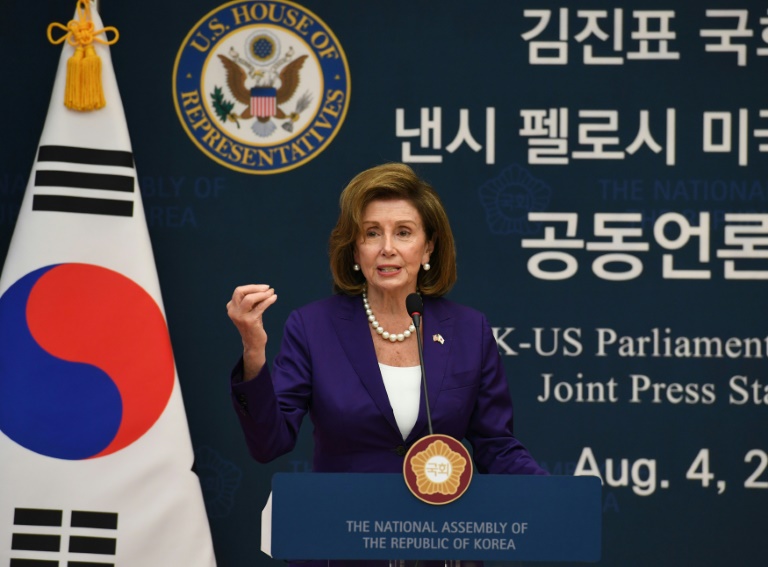
At a brief press conference in Seoul, during which she did not take any questions, Pelosi hailed the “special” relationship between South Korea and the United States — but made no mention of her visit to Taipei.

“The US-Republic of Korea relationship is special to us,” she said, adding that the bond which was forged during the Korean war “from urgency and security… has become the warmest of friendships.”

Pelosi had defied repeated Chinese warnings to visit Taiwan, which China considers its territory. Beijing had said any such trip would be viewed as a major provocation.

It has since launched massive military drills around the island.

China is North Korea’s key ally and trade partner.

Pyongyang on Wednesday echoed Beijing’s criticism of the Pelosi visit to Taiwan, describing it as “impudent interference” in China’s internal affairs and blaming Washington for raising regional tensions.

South Korea is the fourth stop in Pelosi’s Asia tour, following Singapore, Malaysia and Taiwan.

She is scheduled to fly to Japan later on Thursday for the final leg of her Asia trip.
European stocks mainly rise, London down as rate hike looms

European stocks mostly rose Thursday but London fell before an expected interest rate hike from the Bank of England, while traders tracked Chinese military drills around Taiwan.

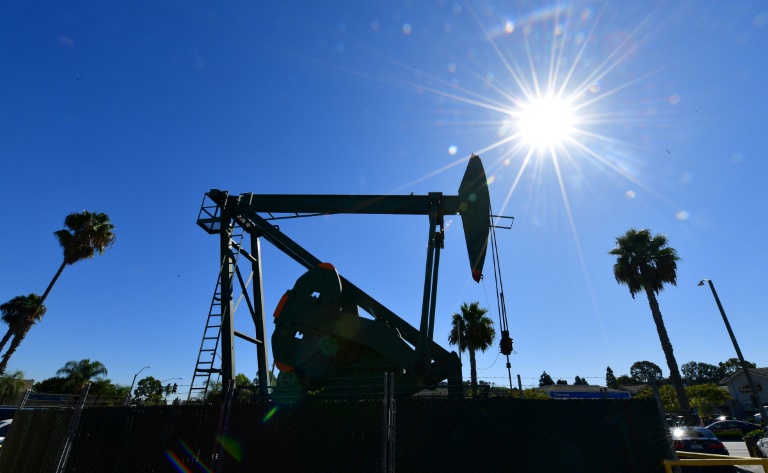
Oil prices edged higher, one day after sinking as major producers announced a small output increase.

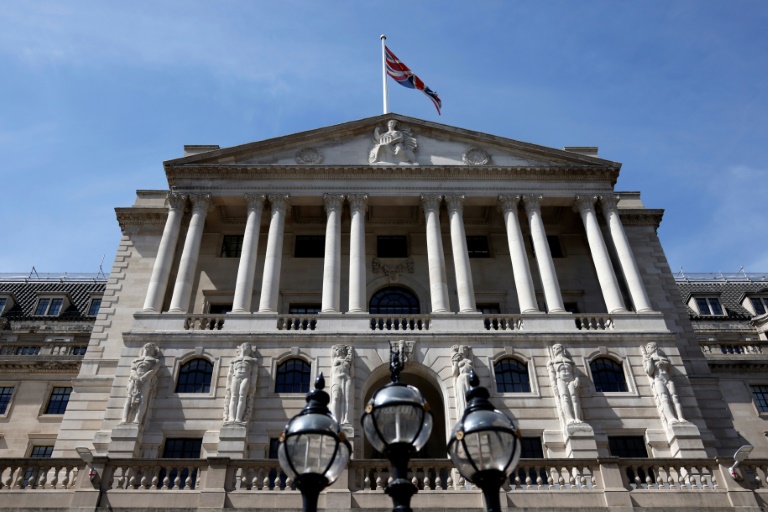
The London stock market declined ahead of the Bank of England’s latest rate decision at 1100 GMT.

The BoE is tipped by economists to ramp up interest rates by a half-point, the biggest hike in almost 30 years, mirroring aggressive monetary policy elsewhere as it seeks to cool decades-high inflation.

“All eyes (are) on (the) BoE to see if follows other central banks and delivers a larger hike,” said MUFG analyst Lee Hardman.

Rising interest rates tend to weigh on shares because they lift business loan repayments and eat further into consumers’ incomes.

In company news, Rolls-Royce shares sank 10 percent after the British engine maker revealed it tanked into a £1.6-billion ($1.9-billion) net loss in the first half on adverse currency movements, despite rebounding revenues.

Frankfurt and Paris stock markets meanwhile advanced.

Most Asian indices tracked a Wall Street rally fuelled by healthy economic and earnings data, despite lingering Taiwan concerns.

New York surged Wednesday after a report on the crucial US services sector showed surprise improvement, soothing recession fears in the world’s top economy.

That came as several companies — including Electronic Arts, Starbucks and Moderna — posted strong earnings, extending a broadly positive reporting season in the face of surging inflation and rising interest rates.

Markets have swung this week after a number of Federal Reserve officials lined up to suggest there were still some big US rate hikes likely and talk of cuts next year might be overdone.

– Pelosi visit –

The mood in Asia was also a lot more settled after the upheaval of this week’s visit to Taiwan by US House Speaker Nancy Pelosi, which sparked outrage in China with warnings of stern military and economic responses.

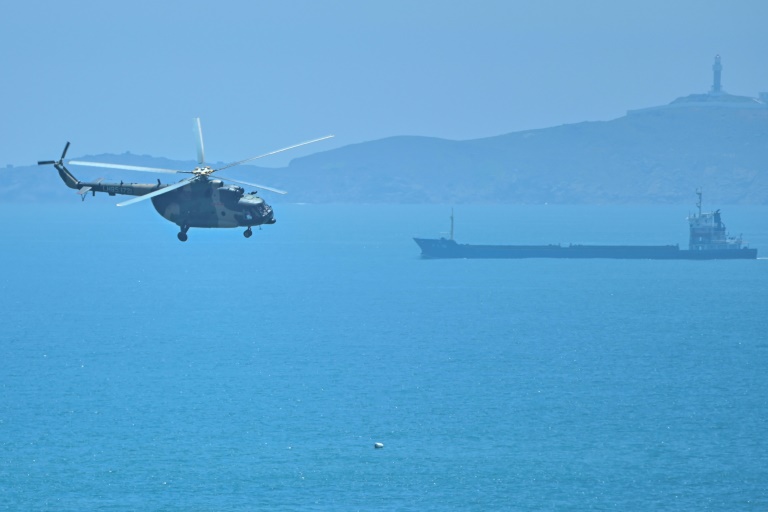
Beijing has suspended a limited amount of cross-strait imports and exports, and on Thursday began its largest-ever military exercises encircling Taiwan that are expected to last for days.

Soon after, Taiwan’s defence ministry said it was “preparing for war without seeking war”.

Taipei stocks fell again on worries that the Chinese manoeuvres would hit shipping lanes and flights into Taiwan.

– Key figures at around 0940 GMT –

London – FTSE 100: DOWN 0.2 percent at 7,431.05 points

Frankfurt – DAX: UP 0.9 percent at 13,706.27

Paris – CAC 40: UP 0.5 at 6,504.53

EURO STOXX 50: UP 0.6 percent at 3,755.04

Tokyo – Nikkei 225: UP 0.7 percent at 27,932.20 (close)

Hong Kong – Hang Seng Index: UP 2.1 percent at 20,174.04 (close)

Shanghai – Composite: UP 0.8 percent at 3,189.04 (close)

New York – Dow: UP 1.3 percent at 32,812.50 (close)

Euro/dollar: UP at $1.0188 from $1.0166 Wednesday

Pound/dollar: UP at $1.2166 from $1.2149

Euro/pound: UP at 83.73 pence from 83.63 pence

Dollar/yen: UP at 134.26 yen from 133.86 yen

Brent North Sea crude: UP 0.4 percent at $97.16 per barrel

West Texas Intermediate: UP 0.3 percent at $90.95 per barrel

burs/rfj/lth

Mexico races to rescue trapped coal miners

Rescuers raced Wednesday to free about 10 workers believed to be trapped in a coal mine in northern Mexico, while three others were found alive, authorities said.

Military personnel and rescue dogs were deployed to the scene of the accident in the state of Coahuila, President Andres Manuel Lopez Obrador said.

“At 1:35 pm (1835 GMT) a coal mine collapsed in the municipality of Sabinas, Coahuila, which caused a tunnel to flood” and trapped the workers, he tweeted.

“We hope to find them safe.”

Lopez Obrador had said nine miners were missing, but the security ministry said later that three had been rescued and taken to hospital while 10 were still believed to be inside.

“The work will not stop until they are found,” the ministry said in a statement.

“The Mexican government guarantees all the necessary resources to carry out the search and rescue operations,” it said.

Anxious relatives gathered to wait for news, with some crying and comforting each other at the site, about 1,130 kilometres (700 miles) north of Mexico City.

The mother of one of the workers wept inconsolably, unable to answer questions from the press.

Through tears, another woman at the scene said two of her children worked in the mine, though one of them had managed to escape after the accident.

As night fell hours later, the families gathered under tents outside the mine in silence as state police, the national guard, medical teams and other rescuers worked to find the trapped workers.

Coahuila’s state government said that the miners had been carrying out excavation work when they hit an adjoining area full of water, causing the shaft to collapse and flood.

“The mine began operating in January of this year and until now there have been no reports of any type of anomaly,” it said in a statement.

State governor Miguel Riquelme said he had asked labor authorities and the local prosecutor’s office to prioritize the rescue and investigation.

Coahuila, the country’s main coal-producing region, has seen a series of fatal mining accidents over the years.

The worst was an explosion that claimed 65 lives at the Pasta de Conchos mine in 2006.

Last year, seven miners died when they were trapped after another accident in Coahuila.

China's Taiwan war games threaten more global supply chain disruption

Chinese military exercises around Taiwan are set to disrupt one of the world’s busiest shipping zones, analysts told AFP, highlighting the island’s critical position in already stretched global supply chains.

The drills — China’s largest-ever around Taiwan — are a major show of strength after US House Speaker Nancy Pelosi infuriated Beijing by visiting the island.

The manoeuvres kicked off Thursday and will take place along some of the busiest shipping routes on the planet, used to supply vital semiconductors and electronic equipment produced in East Asian factory hubs to global markets.

The routes are also a key artery for natural gas.

Nearly half the world’s container ships passed through the narrow Taiwan Strait — which separates the island from the Chinese mainland — in the first seven months of this year, according to data compiled by Bloomberg. 

“Given that much of the world’s container fleet passes through that waterway, there will inevitably be disruptions to global supply chains due to the rerouting,” said James Char, an associate research fellow at Singapore’s S. Rajaratnam School of International Studies.

– ‘Incredibly busy waterway’ –

Even a small disruption in global supply chains, already battered by the Covid-19 pandemic and Russia’s invasion of Ukraine, could prove costly.

“China’s planned live-fire exercises are occurring in an incredibly busy waterway,” Nick Marro, the Economist Intelligence Unit’s lead analyst for global trade, wrote in a note.

“The shutting down of these transport routes — even temporarily — has consequences not only for Taiwan, but also trade flows tied to Japan and South Korea.”

The uncertainty dragged the Taiwan Taiex Shipping and Transportation Index, which tracks major shipping and airline stocks, down 1.05 percent on Thursday.

The index was down 4.6 percent since the beginning of the week.

Taiwan’s Maritime and Port Bureau has warned ships in northern, eastern and southern areas to avoid the areas being used for the drills.

But several shipping companies contacted by AFP said they were waiting to see the impact of the drills before rerouting.

The ongoing typhoon season made it riskier to divert ships around the eastern coast of Taiwan through the Philippine Sea, some added.

Others said they would stick to their schedules.

“We don’t see any impact during (this) period and we don’t have any plan on re-routing our vessels,” said Bonnie Huang, a spokesman for Maersk China.

The drills have also hit air routes.

Over the last two days, more than 400 flights were cancelled at major airports in Fujian, the Chinese province closest to Taiwan, signalling that the airspace could be used by the military.

Taiwan’s cabinet meanwhile, has said the exercises would disrupt 18 international routes passing through its flight information region (FIR).

– Aggressive posturing –

During the previous Taiwan Strait Crisis in the 1990s, China conducted military exercises for months, including lobbing missiles into waters off Taiwan and rehearsing amphibious assaults on the island.

“The Chinese undoubtedly wanted to demonstrate resolve in ways that went beyond what they did in 1996,” said Bonnie Glaser, director of the Asia programme at the US-based German Marshall Fund think tank.

China’s Global Times newspaper said Wednesday the drills were aimed at showing that China’s military is “capable of blockading the entire island”.

But China’s ongoing economic woes mean it is unlikely to risk a major disruption and would limit itself to aggressive posturing, analysts said.

“Closing off traffic through the Strait for any extended period of time will also hurt the Chinese economy,” Char said.

“It’s not in Beijing’s interest to interrupt civilian travel and trade in the region,” said Natasha Kassam of the Lowy Institute, an Australian think tank.

The extent to which China will escalate its response to the Pelosi visit — flexing its military muscle, cyber attacks and economic sanctions — remains to be seen.

Given its military advances, “China very likely has the ability to enforce an air and maritime blockade against Taiwan,” said Thomas Shugart, an expert at US think tank the Center for a New American Security.

“Whether China will choose to attempt such a blockade… is largely a matter of how much political and economic risk the Chinese Communist Party’s leaders are willing to incur.”

Mexico races to rescue trapped coal miners

Rescuers battled Wednesday to free about 10 workers believed to be trapped in a coal mine in northern Mexico, while three others were found alive, authorities said.

Military personnel and rescue dogs were deployed to the scene of the accident in the state of Coahuila, President Andres Manuel Lopez Obrador said.

“A coal mine collapsed in the municipality of Sabinas, Coahuila, which caused a tunnel to flood” and trapped the workers, he tweeted.

“We hope to find them safe,” he added.

Lopez Obrador had said nine miners were missing, but the security ministry said later that three had been rescued and taken to hospital while 10 were still believed to be inside.

“The work will not stop until they are found,” the ministry said in a statement.

“The Mexican government guarantees all the necessary resources to carry out the search and rescue operations,” it said.

Anxious relatives gathered at the site waiting for news, with some crying and comforting each other.

One woman at the scene said, through tears, that two of her children worked in the mine, though one of them had managed to escape after the accident.

Coahuila’s state government said that the miners had been carrying out excavation work when they hit an adjoining area full of water, causing the shaft to collapse and flood.

“The mine began operating in January of this year and until now there have been no reports of any type of anomaly,” it said in a statement.

Coahuila, the country’s main coal-producing region, has seen a series of fatal mining accidents over the years.

The worst was an explosion that claimed 65 lives at the Pasta de Conchos mine in 2006.

Last year seven miners died after they were trapped in another accident in Coahuila.

Directors 'shocked' by axing of $90m 'Batgirl' film

The directors of “Batgirl” said Wednesday they were “shocked” that the $90 million superhero film had been axed by the studio and will now not be released in any format.

Warner Bros. Discovery announced they were shelving the movie adaptation of the DC Comics character, which was to star Leslie Grace in the title role, alongside Michael Keaton as Batman, preventing it from being seen in either theaters or on streaming platform HBO Max.

“We are saddened and shocked by the news. We still can’t believe it,” directors Adil El Arbi and Bilall Fallah wrote on Instagram.

“As directors, it is critical that our work be shown to audiences, and while the film was far from finished, we wish that fans all over the world would have had the opportunity to see and embrace the final film themselves.”

The movie had completed principal photography and much of the post-production work — where special effects, sound and graphics are added — was also done.

Star Grace (“In the Heights”) released an upbeat statement on her Instagram account Wednesday night, saying she was “proud of the love, hard work and intention all of our incredible cast and tireless crew put into this film over 7 months in Scotland.

“I feel blessed to have worked among absolute greats and forged relationships for a lifetime in the process!”

Her efforts were applauded by El Arbi and Fallah, who described themselves as “huge fans of Batman since we were little kids.”

“It was a dream to work with such fantastic actors like Michael Keaton, J.K. Simmons, Brendan Fraser… and especially the great Leslie Grace, who portrayed Batgirl with so much passion, dedication and humanity,” the “Bad Boys for Life” directing duo added.

The move sent shockwaves through Hollywood, where industry veterans said it was unprecedented for a movie to be so close to completion — and with so much money already spent — and not be released.

– Streaming platforms’ belt-tightening –

“Batgirl” appears to have fallen victim to a change in corporate strategy after a merger between Warner Bros. and Discovery.

Warner Bros. had committed to making movies that could go straight to HBO Max as part of an effort to boost subscribers in the increasingly crowded streaming sector.

The decision, which was driven partially by a need to bypass Covid-hit theaters in 2021, was not popular among creatives and appears to have been rolled back after the tie-up with Discovery.

Trade title Variety quoted industry insiders as saying “Batgirl” had fallen between two stools — not big and glitzy enough for a theatrical release, with its expensive marketing requirements, but too big to make economic sense in the belt-tightening streaming landscape.

Variety said the $90 million hole this would leave in the studio’s balance sheet would probably be dealt with via a tax write-down — a process where companies reduce their exposure to tax by subtracting losses from their profits.

Asian markets rally on healthy US data, post-Pelosi relief

Asian markets on Thursday tracked a Wall Street rally fuelled by healthy economic and earnings data, while there was some relief that Nancy Pelosi’s Taiwan trip did not elicit a harsher response from China despite grave warnings from Beijing.

Oil managed to clock up some gains following another sell-off that came on the back of fresh signs of weakening demand in the United States, which came as major producers announced an increase in output, albeit a small one.

New York’s three main indexes surged after a report on the crucial US services sector showed surprise improvement, soothing worries about a possible recession in the world’s top economy.

That came as several companies — including Electronic Arts, Starbucks and Moderna — posted strong earnings, extending a broadly positive reporting season in the face of surging inflation and rising interest rates.

All eyes are now on the release of US jobs data Friday, which will provide the latest snapshot of the economy and could help guide the Federal Reserve in its debate on monetary policy.

Markets have swung this week after a number of Fed officials lined up to suggest there were still some big rate hikes likely and talk of cuts next year might be overdone. 

That came after comments last week from bank chief Jerome Powell indicated that the policy board could start easing up on its tightening campaign.

“Following last week’s Fed meeting that opened up the possibility of a slower hiking pace, markets are still running ‘risk-on’ despite the recent push back from Fed officials,” said SPI Asset Management’s Stephen Innes. 

“But for stock investors, lower oil prices are a pleasure to behold as not only did the US 10-year yields drop but sliding oil prices also downshifted inflation expectations, supporting that slower hiking pace thesis.”

Both main oil contracts edged up Thursday, a day after prices tumbled to a six-month low as a spike in US inventories showed demand waning, while figures showed Americans driving less than summer 2022 when travel was smashed by Covid-19.

Crude has now given up all the gains seen in the aftermath of Russia’s invasion of Ukraine, though the 100,000 barrel output increase by OPEC+ was brushed off by investors as too little to make an impact. 

The mood in Asia was also a lot more settled after the upheaval of this week’s visit to Taiwan by House Speaker Pelosi, which sparked outrage in China with warnings of stern military and economic responses.

While Beijing suspended a limited amount of cross-strait imports and exports and embarked on its largest-ever military exercises encircling Taiwan, Asian investors felt a sense of relief it did not go further.

Hong Kong led gains, adding more than two percent, while there were also advances in Shanghai, Tokyo, Sydney, Seoul, Jakarta and Wellington.

However, Taipei fell again on worries that the Chinese manoeuvres would hit shipping lanes and flights into Taiwan.

Singapore and Manila also dipped.

Pelosi’s trip managed to further strain already-fraught China-US relations, and markets strategist Louis Navellier said “it will be interesting if China retaliates against any US companies or restricts trade in any manner”.

– Key figures at around 0230 GMT –

Tokyo – Nikkei 225: UP 0.5 percent at 27,892.68 (break)

Hong Kong – Hang Seng Index: UP 2.1 percent at 20,182.31

Shanghai – Composite: UP 0.8 percent at 3,188.86

Dollar/yen: DOWN at 133.70 yen from 133.92 yen Wednesday

Euro/dollar: DOWN at $1.0166 from $1.0172

Pound/dollar: UP at $1.2151 from $1.2149

Euro/pound: DOWN at 83.67 pence from 83.71 pence

West Texas Intermediate: UP 0.6 percent at $91.19 per barrel

Brent North Sea crude: UP 0.5 percent at $97.29 per barrel

New York – Dow: UP 1.3 percent at 32,812.50 (close)

London – FTSE 100: UP 0.5 percent at 7,445.68 (close)

Mexico races to rescue nine trapped miners

Rescuers battled Wednesday to free around nine workers believed to be trapped in a coal mine in northern Mexico, President Andres Manuel Lopez Obrador said.

Military personnel and rescue dogs were deployed to the scene of the accident in the state of Coahuila, Lopez Obrador said.

“A coal mine collapsed in the municipality of Sabinas, Coahuila, which caused a tunnel to flood and apparently trapped nine miners,” he tweeted.

“We hope to find them safe,” he added.

Anxious relatives gathered at the site waiting for news, some crying and comforting each other.

One woman said through tears that two of her children worked in the mine, although one of them had managed to escape after the accident.

Coahuila’s state government said that the miners had been carrying out excavation work when they hit an adjoining area full of water, causing the shaft to collapse and flood.

“The mine began operating in January of this year and until now there have been no reports of any type of anomaly,” it said in a statement.

Coahuila, the country’s main coal-producing region, has seen a series of fatal mining accidents over the years.

The worst was an explosion that claimed 65 lives at the Pasta de Conchos mine in 2006.

Last year seven miners died after they were trapped in another accident in Coahuila.

Inflation-fighting BoE poised to unleash big rate hike

The Bank of England is expected Thursday to follow other major central banks with an aggressive interest rate hike to tackle surging inflation.

The BoE is tipped to lift its main rate by 0.50 percentage points — the biggest amount in more than a quarter of a century.

British inflation jumped to a four-decade high of 9.4 percent in June, worsening a cost-of-living crisis as workers’ wages fail to keep pace.

With inflation spiking globally following Russia’s invasion of Ukraine, the US Federal Reserve and the European Central Bank sprang large hikes last month of 0.75 and 0.50 percentage points respectively.

– ‘Up the ante’ –

“After the ECB and the Fed delivered oversized hikes at their July meetings, the Bank of England is likely to feel similar pressure to up the ante at its August meeting,” said BNP Paribas economist Amarjot Sidhu in a note to clients.

“We expect the Monetary Policy Committee… to deliver the first 50 basis point hike since its independence and to signal its determination to prevent inflation from becoming entrenched.”

The BoE, granted operational independence from the government over monetary policy in 1997, will reveal its latest rate decision at 1100 GMT on Thursday alongside its latest outlook.

Governor Andrew Bailey has already stated that a half-point hike — which would be the biggest since 1995 — will be “among the choices on the table” this time around.

That would take borrowing costs to 1.75 percent, a level last seen in December 2008.

Consumer prices have soared as energy costs spike on key gas and oil producer Russia’s invasion of Ukraine.

Inflation has also raced higher on supply-chain woes, including labour market shortages in the wake of Brexit, and strong demand for goods and services as the Covid pandemic recedes.

– Inflation ‘spooks’ central banks –

Yet the bank predicts UK inflation will spike to 11 percent later this year — and it was expected to lift this guidance on Thursday.

Added to the picture, state energy regulator Ofgem is due to ramp up domestic electricity and gas prices again in October.

That could take the average UK household energy bill above £3,000 ($3,600) per year.

“Surging energy prices… will force the BoE to revise up its inflation forecast yet again,” said Barclays analyst Fabrice Montagne.

“Higher inflation for even longer is the kind of scenario that spooks central banks.”

The BoE’s key task is to keep inflation close to a 2.0-percent target.

Economists meanwhile argue that a large rate hike damages the nation’s recovery from the coronavirus pandemic — and risks the prospect of recession.

Rising rates inflict more misery for businesses and consumers via rising loan repayments.

“The… anticipated hike would be harmful to the economy and pile on the pain for people across the country,” said Nigel Green, boss of financial consultants deVere.

The BoE has increased its key rate five times since December, lifting it to 1.25 percent from a record-low 0.1 percent.

Until now, the BoE has not hiked its rates by more than 0.25 percentage points each time.

The soaring cost of living has dominated the race to become Britain’s next prime minister.

Liz Truss is currently ahead in the polls against fellow Conservative and former finance minister Rishi Sunak.

Scholz opens door to extend nuclear as Russia squeezes gas supply

German Chancellor Olaf Scholz on Wednesday raised the possibility of keeping nuclear plants going as he accused Russia of blocking the delivery of a key turbine to throttle gas supplies to Europe.

The continent’s biggest economy has been scrambling for energy sources to fill a gap left by a reduction in gas supplies from Moscow. 

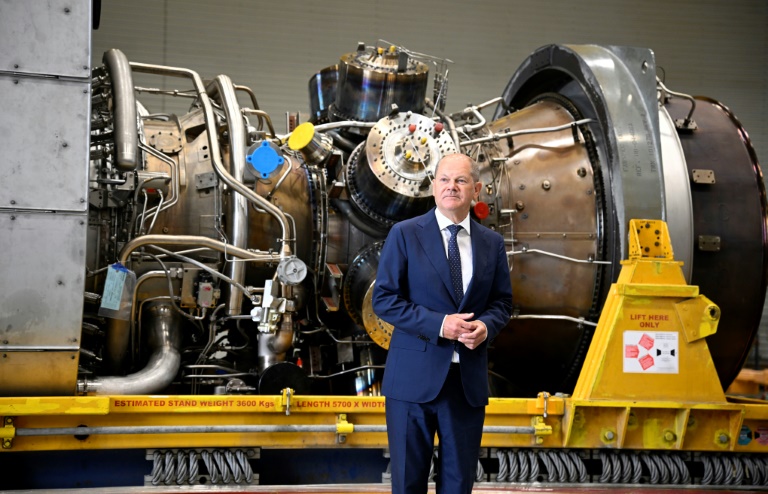
Standing next to the turbine, Scholz said that extending the lifetime of Germany’s three remaining nuclear power plants “can make sense”.

The power stations, which are set to be taken off the grid at the end of the year, were “relevant exclusively for electricity production, and only for a small part of it”, Scholz said.

In total, the nuclear fleet accounts for six percent of Germany’s electricity output.

The government has said it will await the outcome of a new “stress test” of the national electric grid before determining whether to stick with the long-planned phase-out.

– Nuclear switch –

Former chancellor Angela Merkel spectacularly decided to ditch atomic energy in 2011 following the Fukushima nuclear disaster in Japan.

Extending the lifetime of the plants has set off a heated debate in Germany, where nuclear power has been a source of controversy stretching back before Merkel’s decision.

Germany has already moved to restart mothballed coal power plants to guard against an energy shortfall. 

The squeeze comes as Russia dwindles supplies of gas, which Germany has long relied on to power industry and heat homes.

Russian energy giant Gazprom has chalked up limited supplies to technical issues.

The delayed return of a turbine from Canada, where the unit was being serviced, was behind the initial reduction in deliveries via the Nord Stream 1 gas pipeline in June, according to Gazprom.

Supplies via the energy link were further reduced to around 20 percent of capacity in late July, after Gazprom halted the operation of one of the last two operating turbines due to the “technical condition of the engine”.

– Turbine trouble –

Berlin has dismissed Gazprom’s justifications for the reduction to supply, seeing instead a “political” move in response to the West’s support for Ukraine.

The turbine which was transferred from Canada to Germany was “available and working”, Scholz said Wednesday.

“There is no reason why this delivery cannot happen,” he said, adding that it had received “all the approvals” needed for export from Germany to Russia.

Pipeline operators only had to say “they want to have the turbine and provide the necessary customs information for transport to Russia”, Scholz said.

Gazprom however insisted it was unable to take delivery of the turbine.

“Sanctions regimes in Canada, in the European Union and in Britain, as well as the inconsistencies in the current situation concerning the contractual obligations of (turbine maker) Siemens make the delivery impossible,” it said.

Kremlin spokesman Dmitry Peskov also said Gazprom was still waiting for documents confirming the unit was “not affected by sanctions”.

It was however “technologically possible” in the opinion of Russian President Vladimir Putin to continue deliveries via the Nord Stream 2 pipeline, Peskov said.

The second pipeline, which runs parallel to Nord Stream 1, stands completed but was blocked by the German government in the run-up to the invasion of Ukraine.

Former chancellor Gerhard Schroeder, who signed off on the pipeline while in office, told German magazine Stern it was “the easiest solution” to use Nord Stream 2 instead.

But Scholz has rejected the call, saying Nord Stream 1 provided sufficient capacity for gas flows. 

Moscow’s move to limit supplies sent a “difficult message” to the world by creating doubt over Russia’s commitment to its agreements, he added.

Close Bitnami banner
Bitnami