US Business

Airbnb reports soaring revenue as travel rebounds

Airbnb said Tuesday revenue in the recently ended quarter topped $2 billion as people shook off pandemic worries and took part in a banner travel season.

The home rental platform logged a net income of $379 million in what it touted as the most profitable second quarter in its history.

As a sign of confidence in its future, the San Francisco-based company announced it will devote $2 billion to buying back shares.

“During the height of the pandemic, we made many difficult choices to reduce our spending, making us a leaner and more focused company,” the company said in a letter to investors.

“Airbnb is well positioned for whatever lies ahead.”

More than 103 million nights and travel “experiences” arranged by Airbnb were booked during the quarter, setting a new high, despite inflation and other broad economic woes, the company reported.

The $2.1 billion in revenue taken in during the quarter was 58 percent higher than the same period a year earlier.

“We are in the midst of our strongest peak travel season yet,” Airbnb said in the letter.

“On July 4th, we recorded our highest single day revenue ever, signaling the strong summer season ahead.”

Airbnb expects to set a new revenue record in the current quarter, bringing in between $2.78 billion and $2.88 billion.

“We have nearly every type of space in nearly every location, so however travel changes, we are able to adapt,” Airbnb said.

“Regardless of the economic environment, our guests come to Airbnb because they can find great value, and our hosts can earn extra income.”

The optimism came despite Airbnb shutting down its business in China early this year as pandemic lockdowns show no sign of ending there.

Airbnb in July stopped booking stays or visitor “experiences” in China, focusing instead on helping people there with travel plans outside the country, the company said in an earnings report.

“We made this difficult decision based on the costly and complex challenges of operating in the country, exacerbated by the severe Covid lockdowns,” Airbnb said.

“We continue to expect Asia Pacific, including outbound travel from China, to represent a significant growth opportunity for Airbnb over the long term.”

Airbnb launched its business in China six years ago, and has booked stays there for some 25 million guests. Bookings at residences in China have accounted for only one percent of Airbnb reservations in recent years, the company has reported.

Airbnb faced strong competition in China.
Airbnb reports soaring revenue as travel rebounds

Airbnb said Tuesday revenue in the recently ended quarter topped $2 billion as people shook off pandemic worries and took part in a banner travel season.

The home rental platform logged a net income of $379 million in what it touted as the most profitable second quarter in its history.

As a sign of confidence in its future, the San Francisco-based company announced it will devote $2 billion to buying back shares.

“During the height of the pandemic, we made many difficult choices to reduce our spending, making us a leaner and more focused company,” the company said in a letter to investors.

“Airbnb is well positioned for whatever lies ahead.”

More than 103 million nights and travel “experiences” arranged by Airbnb were booked during the quarter, setting a new high, despite inflation and other broad economic woes, the company reported.

The $2.1 billion in revenue taken in during the quarter was 58 percent higher than the same period a year earlier.

“We are in the midst of our strongest peak travel season yet,” Airbnb said in the letter.

“On July 4th, we recorded our highest single day revenue ever, signaling the strong summer season ahead.”

Airbnb expects to set a new revenue record in the current quarter, bringing in between $2.78 billion and $2.88 billion.

“We have nearly every type of space in nearly every location, so however travel changes, we are able to adapt,” Airbnb said.

“Regardless of the economic environment, our guests come to Airbnb because they can find great value, and our hosts can earn extra income.”

The optimism came despite Airbnb shutting down its business in China early this year as pandemic lockdowns show no sign of ending there.

Airbnb in July stopped booking stays or visitor “experiences” in China, focusing instead on helping people there with travel plans outside the country, the company said in an earnings report.

“We made this difficult decision based on the costly and complex challenges of operating in the country, exacerbated by the severe Covid lockdowns,” Airbnb said.

“We continue to expect Asia Pacific, including outbound travel from China, to represent a significant growth opportunity for Airbnb over the long term.”

Airbnb launched its business in China six years ago, and has booked stays there for some 25 million guests. Bookings at residences in China have accounted for only one percent of Airbnb reservations in recent years, the company has reported.

Airbnb faced strong competition in China.
Oscars group elects Janet Yang as new president

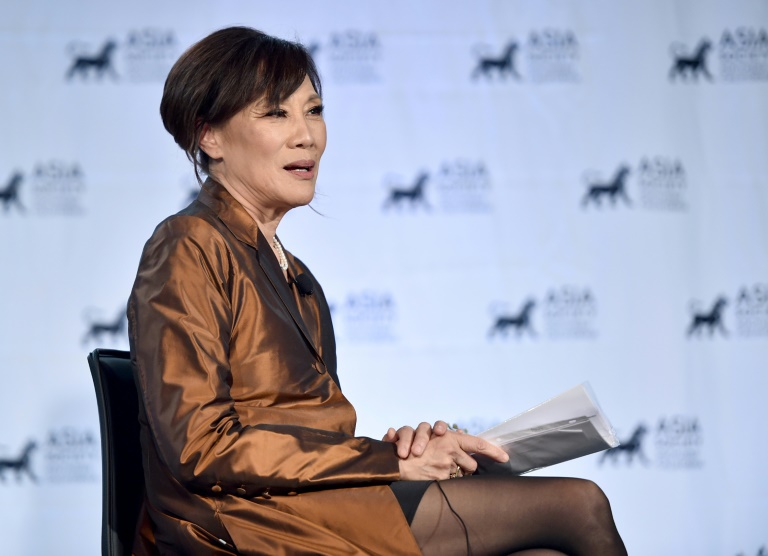
The Academy of Motion Picture Arts and Sciences elected film producer Janet Yang as its new president, the group behind the Oscars announced Tuesday.

Yang, best known for hits including “The Joy Luck Club” and “The People vs. Larry Flynt,” becomes the fourth woman elected to run Hollywood’s most elite group of filmmakers, and the first of Asian origin.

Academy members vote for the winners of the Oscars each year, while the group has recently launched a major new Los Angeles film museum which had been decades in the planning. 

In a statement, Academy CEO Bill Kramer praised in particular Yang’s work on “membership recruitment, governance, equity, diversity, and inclusion” among other areas.

“I am thrilled that she is taking on the esteemed role of Academy President and look forward to working closely with her on our shared vision to serve our membership, celebrate the collaborative arts and sciences of motion pictures, and inspire the next generation of filmmakers,” he wrote.

The Academy has had to navigate multiple controversies in recent years, including accusations of a lack of racial diversity.

Most notably, the group was pummeled with criticism for a dearth of Black Oscar nominees during the #OscarsSoWhite movement, which emerged in 2015. 

It has since fulfilled a pledge to double the number of women and minority members by 2020, significantly expanding overall membership from around 6,000 to nearly 10,000 in the process.

Around 19 percent of Academy members are now from underrepresented ethnic and racial communities.

Stock trading platform Robinhood axes staff

Robinhood on Tuesday said it is laying off nearly a quarter of its employees as inflation and a crypto market crash cripple activity on the stock trading platform.

Dismissal emails went out to 23 percent of workers, referred to internally as “Robinhoodies,” in a cost-cutting move that the Silicon Valley-based company said will leave it with about 2,600 employees.

Internet giants whose business boomed during the pandemic have taken a hit from inflation, the war in Ukraine, supply-line trouble and people returning to pre-Covid lifestyles.

Robinhood earlier this year cut nine percent of its staff, but that wasn’t enough, chief executive Vlad Tenev said in a blog post.

“Since that time, we have seen additional deterioration of the macro environment, with inflation at 40-year highs accompanied by a broad crypto market crash,” Tenev said.

“This has further reduced customer trading activity and assets under custody.”

Meanwhile, financial services regulators in the state of New York on Tuesday announced that Robinhood’s cryptocurrency unit will pay a $30 million penalty for failing to meet mandatory standards for cyber-security and fighting money laundering.

The failure “resulted in significant violations” of state regulations, said state superintendent of financial services Adrienne Harris.

Flaws at Robinhood Crypto meanwhile stemmed from “significant shortcomings” in management that included failure to foster “an adequate culture of compliance” with banking rules, regulators said.

Robinhood associate general counsel Cheryl Crumpton said the company is “pleased” the matter is resolved in a settlement.

“We have made significant progress building industry-leading legal, compliance, and cybersecurity programs, and will continue to prioritize this work to best serve our customers,” Crumpton said in response to an AFP inquiry.

Robinhood layoffs will be concentrated in operations, marketing, and program management, Tenev said.

“In the short seven years since Robinhood launched to the world, we have adapted to challenges and forced the financial industry to adapt to us,” Tenev said.

“We’ve overcome many obstacles and have emerged from each a stronger and more resilient company,” he said.

Stock trading platform Robinhood axes staff

Robinhood on Tuesday said it is laying off nearly a quarter of its employees as inflation and a crypto market crash cripple activity on the stock trading platform.

Dismissal emails went out to 23 percent of workers, referred to internally as “Robinhoodies,” in a cost-cutting move that the Silicon Valley-based company said will leave it with about 2,600 employees.

Internet giants whose business boomed during the pandemic have taken a hit from inflation, the war in Ukraine, supply-line trouble and people returning to pre-Covid lifestyles.

Robinhood earlier this year cut nine percent of its staff, but that wasn’t enough, chief executive Vlad Tenev said in a blog post.

“Since that time, we have seen additional deterioration of the macro environment, with inflation at 40-year highs accompanied by a broad crypto market crash,” Tenev said.

“This has further reduced customer trading activity and assets under custody.”

Meanwhile, financial services regulators in the state of New York on Tuesday announced that Robinhood’s cryptocurrency unit will pay a $30 million penalty for failing to meet mandatory standards for cyber-security and fighting money laundering.

The failure “resulted in significant violations” of state regulations, said state superintendent of financial services Adrienne Harris.

Flaws at Robinhood Crypto meanwhile stemmed from “significant shortcomings” in management that included failure to foster “an adequate culture of compliance” with banking rules, regulators said.

Robinhood associate general counsel Cheryl Crumpton said the company is “pleased” the matter is resolved in a settlement.

“We have made significant progress building industry-leading legal, compliance, and cybersecurity programs, and will continue to prioritize this work to best serve our customers,” Crumpton said in response to an AFP inquiry.

Robinhood layoffs will be concentrated in operations, marketing, and program management, Tenev said.

“In the short seven years since Robinhood launched to the world, we have adapted to challenges and forced the financial industry to adapt to us,” Tenev said.

“We’ve overcome many obstacles and have emerged from each a stronger and more resilient company,” he said.

Strong N.America sales boost Starbucks results despite China hit

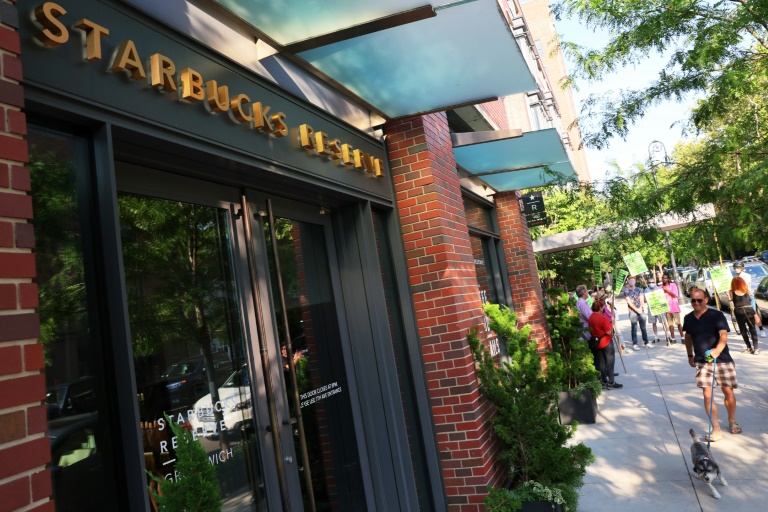
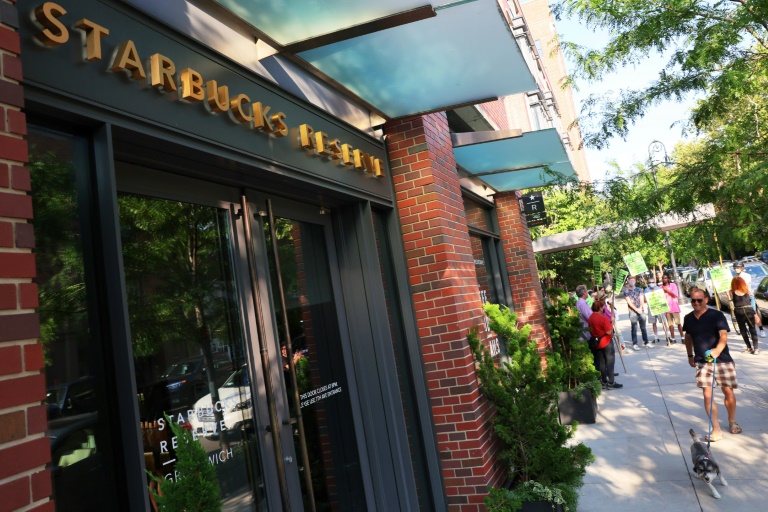
Starbucks reported lower quarterly profits Tuesday despite higher sales, as strong demand and price increases in North America mitigated the hit from Chinese lockdowns.

Executives from the US coffee giant pointed to torrid growth in its home market that helped produce record quarterly revenues, even as operations in its biggest Chinese markets were halted for much of the quarter.

The contrasting performance was starkly apparent in the numbers, with North American comparable sales jumping nine percent, while China’s slumped 44 percent.

Profit for the quarter ending June 27 was $912.9 million, down 21 percent from the year-ago period.

Meanwhile, revenues jumped nine percent to $8.2 billion.

The company’s profit margins in North America declined on higher commodity and labor costs, a trend partially offset by higher prices.

“Starbucks continued to create velocity without any indication of trading down,” interim Starbucks CEO Howard Schultz said Tuesday of consumers’ willingness to absorb price increases.

That boosts confidence in the chain’s ability to weather any downturn, including one that is potentially “significant,” Schultz said.

Starbucks has previously announced plans to spend an additional $1 billion in 2022 on wage increases, training and other store investments as it confronts a unionization campaign that has surfaced at more than 200 US locations.

During a conference call with analysts, Schultz said the company plans more changes following “listening” sessions with employees. 

This includes a program that could allow customers to tip Starbucks workers through the smartphone app.

Schultz, who recently pushed back his departure date to March 2023 from fall 2022, said the company had narrowed down the list of CEO candidates to a “select few” as it moves closer to naming a replacement.

He promised to stay on “as long as necessary to ensure a soft landing” for his successor.

Shares rose 1.7 percent to $85.11 in after-hours trading.

Strong N.America sales boost Starbucks results despite China hit

Starbucks reported lower quarterly profits Tuesday despite higher sales, as strong demand and price increases in North America mitigated the hit from Chinese lockdowns.

Executives from the US coffee giant pointed to torrid growth in its home market that helped produce record quarterly revenues, even as operations in its biggest Chinese markets were halted for much of the quarter.

The contrasting performance was starkly apparent in the numbers, with North American comparable sales jumping nine percent, while China’s slumped 44 percent.

Profit for the quarter ending June 27 was $912.9 million, down 21 percent from the year-ago period.

Meanwhile, revenues jumped nine percent to $8.2 billion.

The company’s profit margins in North America declined on higher commodity and labor costs, a trend partially offset by higher prices.

“Starbucks continued to create velocity without any indication of trading down,” interim Starbucks CEO Howard Schultz said Tuesday of consumers’ willingness to absorb price increases.

That boosts confidence in the chain’s ability to weather any downturn, including one that is potentially “significant,” Schultz said.

Starbucks has previously announced plans to spend an additional $1 billion in 2022 on wage increases, training and other store investments as it confronts a unionization campaign that has surfaced at more than 200 US locations.

During a conference call with analysts, Schultz said the company plans more changes following “listening” sessions with employees. 

This includes a program that could allow customers to tip Starbucks workers through the smartphone app.

Schultz, who recently pushed back his departure date to March 2023 from fall 2022, said the company had narrowed down the list of CEO candidates to a “select few” as it moves closer to naming a replacement.

He promised to stay on “as long as necessary to ensure a soft landing” for his successor.

Shares rose 1.7 percent to $85.11 in after-hours trading.

Percent of Americans without health coverage hits new low

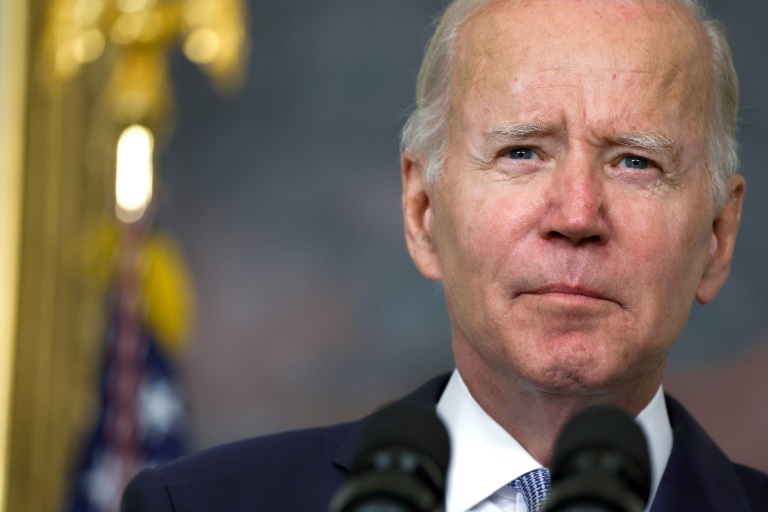
The proportion of the US population with no health insurance in the United States reached a new low in early 2022 at eight percent, President Joe Biden’s administration said Tuesday. 

The rate of uninsured people began to fall sharply after the Affordable Care Act came into effect in 2014. The ambitious reform of medical insurance, better known as “Obamacare,” was the flagship law of former president Barack Obama, with whom Biden served as vice president. 

Between 2018 and 2019, however, the number of uninsured rebounded before falling again. 

The Department of Health said that, based on a household survey it carried out, 5.2 million people have gained medical insurance since early 2021, when Biden came to office, a figure that includes a million children.

However, around 26 million people remain without health coverage in the country.

“No one should worry about whether they can pay for their doctor or choose between paying rent and filing a prescription,” Biden said in a statement.

“Today, we are closer than ever to making that principle a reality,” he added.

The president attributed the rise in the number of medically insured Americans to improvements contained in the American Rescue Plan, the emergency aid plan adopted at the start of his term that contained measures facilitating access to health insurance through grants to help families pay for medical coverage.

“Pretty cool, huh, @BarackObama?” Biden said on Twitter.

“You bet, Joe,” the former president responded.

The two men called on Congress to pass the Inflation Reduction Act, a law largely focused on clean energy and climate but also containing measures to secure subsidies for medical coverage and reduce drug prices.

Uber reports loss, but beats income expectations

Uber reported better-than-expected revenue on Tuesday, fueled by strong demand for its ride-hailing and food delivery services that have drawn a surge in drivers looking to offset inflation’s bite.

Revenue more than doubled to $8.1 billion in the three months through June, a 105 percent increase, at a time when many tech companies are struggling to navigate global economic turbulence.

Still, the firm posted a net loss of $2.6 billion, but investors shrugged it off and shares closed up about almost 19 percent on Wall Street.

Uber primarily attributed the loss to the falling value of its investments in financially strapped companies such as Singapore’s VTC Grab, US self-driving vehicle start-up Aurora and Indian food delivery service Zomato.

The ride hailing giant also reported it now has nearly five million drivers and couriers on its platform, a 31 percent increase from last year. 

Some 70 percent of drivers coming to the platform said inflation played a part in their decision, as people look for additional income to offset price increases, the firm reported.

“We saw an acceleration in both active and new driver growth in the quarter,” Uber CEO Dara Khosrowshahi said. “Against the backdrop of elevated gas prices globally, this is a resounding endorsement.”

– Bumpy earnings season –

Uber also notched gains in monthly active platform consumers, gross bookings and trips compared with a year ago, reflecting higher demand but also a higher number of drivers for its signature ride service and food delivery operations.

“We continue to benefit from an… increase in the on-demand transportation of people and things,” Khosrowshahi said. “We intend to continue capitalizing on these growth tailwinds.”

Analysts noted that the relatively robust earnings were well above expectations, a relief during an earnings season buffeted by inflation, economic uncertainty and the ongoing impact of the coronavirus pandemic.

“Consumers are still moving to the Uber platform especially as travel, shifting to the office, and other post-pandemic trends take hold globally,” wrote analyst Dan Ives.

The California-based firm posted $1.8 billion in revenue from its freight operations, and said income figures got a boost from a change in how it accounts for its rides business in Britain. 

The latest earnings season has been marked both by investors being relieved when results weren’t as bad as feared, but also backing away from companies with less clear futures.

Facebook owner Meta and messaging app Snapchat’s parent company both saw shares fall after results showed their ad-driven models were vulnerable to the current economic uncertainty.

But giants like Apple and Amazon reassured markets last week with better than expected results on strong demand and sales.

Uber reports loss, but beats income expectations

Uber reported better-than-expected revenue on Tuesday, fueled by strong demand for its ride-hailing and food delivery services that have drawn a surge in drivers looking to offset inflation’s bite.

Revenue more than doubled to $8.1 billion in the three months through June, a 105 percent increase, at a time when many tech companies are struggling to navigate global economic turbulence.

Still, the firm posted a net loss of $2.6 billion, but investors shrugged it off and shares closed up about almost 19 percent on Wall Street.

Uber primarily attributed the loss to the falling value of its investments in financially strapped companies such as Singapore’s VTC Grab, US self-driving vehicle start-up Aurora and Indian food delivery service Zomato.

The ride hailing giant also reported it now has nearly five million drivers and couriers on its platform, a 31 percent increase from last year. 

Some 70 percent of drivers coming to the platform said inflation played a part in their decision, as people look for additional income to offset price increases, the firm reported.

“We saw an acceleration in both active and new driver growth in the quarter,” Uber CEO Dara Khosrowshahi said. “Against the backdrop of elevated gas prices globally, this is a resounding endorsement.”

– Bumpy earnings season –

Uber also notched gains in monthly active platform consumers, gross bookings and trips compared with a year ago, reflecting higher demand but also a higher number of drivers for its signature ride service and food delivery operations.

“We continue to benefit from an… increase in the on-demand transportation of people and things,” Khosrowshahi said. “We intend to continue capitalizing on these growth tailwinds.”

Analysts noted that the relatively robust earnings were well above expectations, a relief during an earnings season buffeted by inflation, economic uncertainty and the ongoing impact of the coronavirus pandemic.

“Consumers are still moving to the Uber platform especially as travel, shifting to the office, and other post-pandemic trends take hold globally,” wrote analyst Dan Ives.

The California-based firm posted $1.8 billion in revenue from its freight operations, and said income figures got a boost from a change in how it accounts for its rides business in Britain. 

The latest earnings season has been marked both by investors being relieved when results weren’t as bad as feared, but also backing away from companies with less clear futures.

Facebook owner Meta and messaging app Snapchat’s parent company both saw shares fall after results showed their ad-driven models were vulnerable to the current economic uncertainty.

But giants like Apple and Amazon reassured markets last week with better than expected results on strong demand and sales.

Close Bitnami banner
Bitnami