US Business

Euro drops to dollar parity as eurozone recession fears mount

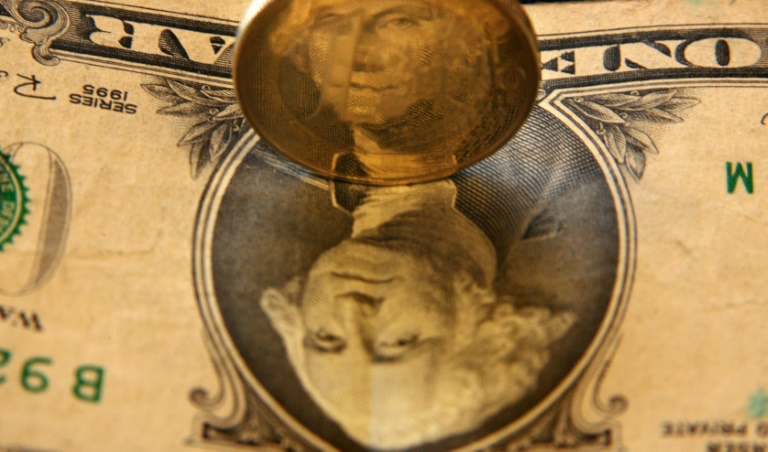
The euro struck parity with the dollar for the first time in nearly 20 years on Tuesday as a cut in Russian gas supplies to Europe heightened fears of a recession in the eurozone.

The European single currency hit exactly one dollar — its lowest level since December 2002 — before bouncing back to as high as $1.0070.

Oil prices plunged on concerns of a wider recession as central banks hike interest rates to fight decades-high inflation, with both main contracts falling back under $100 per barrel at one point.

While European stocks initially moved lower, they rallied in afternoon trading to finish higher. Wall Street’s main stock indices were also up in late morning trading.

“Rising inflation, stalling economic growth and more recently fears that Russia could cut gas supplies have pulled the euro lower,” said Fiona Cincotta at City Index.

“The nail in the coffin today was dire data showing that economic confidence in Germany fell to a decade low,” she added.

Russian energy giant Gazprom on Monday began 10 days of maintenance on its Nord Stream 1 pipeline — with Germany and other European countries watching anxiously to see if the gas comes back on.

“The gas crisis has really spooked markets over the eurozone economy,” Markets.com analyst Neil Wilson told AFP.

With relations between Russia and the West at their lowest in years because of the invasion of Ukraine, Gazprom may not reopen the valves, according to analysts.

“The next few weeks could be challenging for Europe, with possibly maximum uncertainty stretching into August,” said SPI Asset Management’s Stephen Innes.

“Investors increasingly believe that gas may not start to flow through Nord Stream 1 again following the scheduled maintenance on July 11-21, with further ‘temporary’ interruptions seen as likely.”

Worries about a Covid flare-up in China — fuelling fears of more lockdowns — added to the downbeat mood, just as investors prepared for a week of economic data and corporate earnings that could have huge implications for markets.

A forecast-beating US jobs report last week suggested the world’s top economy was coping with higher Federal Reserve rates, but it also gave the central bank more room to continue tightening — leading to concerns it could go too far and cause a contraction.

The European single currency is also under pressure from the Federal Reserve hiking US interest rates more aggressively than the European Central Bank.

The dollar has jumped 14 percent against the euro since the start of the year.

US inflation data due out Wednesday could also solidify the case for the Fed to continue raising interest rates aggressively.

“In anticipation of that, investors have retreated to the safety of the US dollar once more, steering clear of risky assets in favour of haven” assets, said market analyst Craig Erlam at trading platform OANDA.

Central banks have been increasing borrowing costs in a bid to tame inflation, which has been fuelled by soaring energy prices.

Oil and gas prices have rocketed this year after economies reopened from Covid lockdowns and following the invasion of Ukraine by major energy producer Russia, which raised concerns whether supplies will be adequate.

– Key figures at around 1530 GMT –

Euro/dollar: UP at $1.0065 from $1.0041 Monday

Pound/dollar: UP at $1.1911 from $1.1892 

Euro/pound: UP at 84.57 pence from 84.38 pence

Dollar/yen: DOWN at 136.66 yen from 137.41 yen

West Texas Intermediate: DOWN 6.8 percent at $96.99 per barrel

Brent North Sea crude: DOWN 6.3 percent at $100.41 per barrel

New York – Dow: UP 0.5 percent at 31,318.22 points

EURO STOXX 50: UP 0.4 percent at 3,487.05

London – FTSE 100: UP 0.2 percent at 7,209.86 (close)

Frankfurt – DAX: UP 0.6 percent at 12,905.48 (close)

Paris – CAC 40: UP 0.8 percent at 6,044.20 (close)

Tokyo – Nikkei 225: DOWN 1.8 percent at 26,336.66 (close)

Hong Kong – Hang Seng Index: DOWN 1.3 percent at 20,844.74 (close)

Shanghai – Composite: DOWN 1.0 percent at 3,281.47 (close)

burs-rl/bp
US House committee to 'connect the dots' at Capitol riot hearing

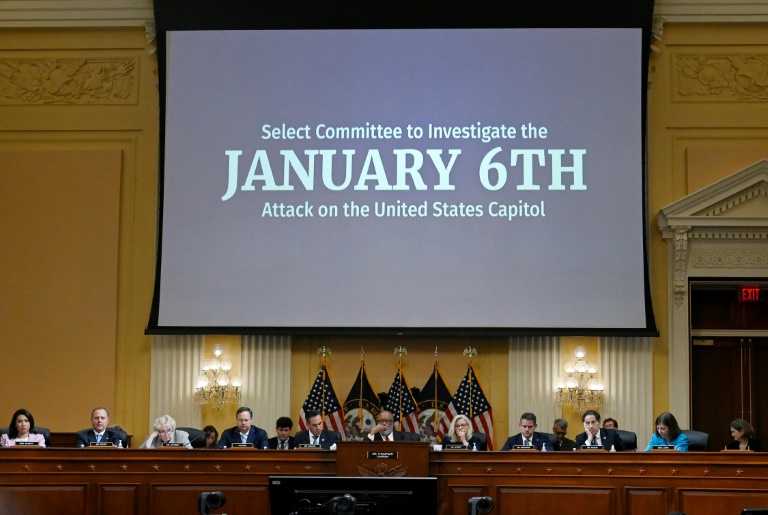
The House committee investigating the 2021 assault on the US Capitol by supporters of Donald Trump will examine links between associates of the former president and right-wing extremist groups at its seventh hearing on Tuesday.

“We’ll give the American public a more complete understanding of the final phase of president Trump and his supporters’ use of radical measures to prevent the peaceful transfer of power and overturn the 2020 election,” a committee aide said.

The session will focus on ties between members of Trump’s inner circle and two militia groups, the Proud Boys and the Oath Keepers, the aide said.

“We are going to be connecting the dots during these hearings between these groups and those who were trying — in government circles — to overturn the election,” Democratic Representative Zoe Lofgren of California said.

Members of the Proud Boys and Oath Keepers stormed Congress on January 6, 2021 along with thousands of Trump loyalists in an attempt to prevent the certification of Democrat Joe Biden’s election victory.

Jason Van Tatenhove, a former member of the Oath Keepers, is expected to testify at Tuesday’s televised hearing, which begins at 1:00 pm (1700 GMT) and is expected to last at least two hours.

Stephen Ayres, an Ohio man who drove to Washington and joined the mob which stormed the Capitol, is also expected to appear as a witness.

Five members of the Proud Boys were indicted in June on seditious conspiracy charges and 11 members of the Oath Keepers face the same charges. Three of the Oath Keepers have pleaded guilty.

More than 850 people have been arrested in connection with the storming of Congress by Trump supporters, but only those 16 face seditious conspiracy charges, which carry a sentence of up to 20 years in prison.

The committee is trying to determine whether Trump or his associates had a role in planning or encouraging the violent insurrection and has subpoenaed numerous advisors and aides to the former president.

Excerpts may be played on Tuesday from an eight-hour interview the committee held Friday with former Trump White House counsel Pat Cipollone.

– ‘Pivotal moment’ –

The assault on the Capitol left at least five people dead and 140 police officers injured, and followed a fiery speech by Trump to thousands of his supporters near the White House.

Trump was impeached for a historic second time by the House of Representatives after the riot — he was charged with inciting an insurrection — but was acquitted by the Senate.

In a statement Tuesday on the Truth Social platform, Trump denounced the committee as “Political Hacks and Thugs.”

“Have you seen them before?” he asked. “Yes, they are essentially the same lunatics that drove the Country ‘crazy’ with their lies and made up stories, like RUSSIA, RUSSIA, RUSSIA, and all of the others.”

Tuesday’s hearing will be the first since blockbuster testimony by Cassidy Hutchinson, an assistant to Trump’s chief of staff Mark Meadows.

Hutchinson testified late last month that she was told Trump had angrily lunged at his Secret Service driver and grabbed at the steering wheel of his limousine in a bid to join the crowd marching on Congress.

The select committee aide said Tuesday’s hearing will focus on a tweet Trump sent in December telling his supporters to come to Washington on January 6 and promising it will be “wild.”

“They immediately started answering his call by zeroing in on that date,” the aide said. “We’ll talk about how that was a pivotal moment that spurred a chain of events.”

The tweet was sent a little more than an hour after Trump met at the White House with his lawyer Rudy Giuliani, former general Mike Flynn, and Sidney Powell, another attorney, the aide said.

The hearing will also look at attempts by some Republican members of Congress to pressure vice president Mike Pence into blocking certification of the election results.

Kyiv 'destroys' Russian arms depot, as EU, US pledge nearly $3 bn

Kyiv said Tuesday it had launched artillery barrages that a destroyed a Russian arms depot and carried out a “special operation” to free military captives in the Moscow-controlled Kherson region.

The bombardments in the south came as Washington and the EU announced nearly $3 billion combined for Ukraine and Turkey said delegations from Moscow and Kyiv would meet in Istanbul Wednesday to discuss restarting stalled grain deliveries across the Black Sea.

Ukrainian military officials said the strikes had destroyed artillery, armoured vehicles “and a warehouse with ammunition” in the town of Nova Kakhovka.

Russian-backed authorities accused Ukraine, however, of damaging civilian infrastructure and killing at least seven people, a toll that could not be independently verified.

“Warehouses were hit, as were shops, a pharmacy, petrol stations and even a church,” the head of the city’s Moscow-backed administration, Vladimir Leontiev, said on social media.

Ukrainian military intelligence said separately its forces had free five captives in a “special operation” in Kherson, including a military serviceman and former police officer, without specifying when.

The Ukrainian army has for several weeks been waging a counter-offensive to recapture Kherson, which was taken by Russian troops early in the February invasion of Ukraine.

The deputy head of the pro-Russian authorities in Kherson, Ekaterina Gubareva, said Ukraine had used long-range, precision artillery systems supplied by the United States in the strikes in Nova Kakhovka.

– Western financial aid –

Military analysts are crediting newly arrived systems from the West — including HIMARS from the United States — with attacks deeper into Russian-controlled territory across the front line.

EU member states, which have been supplying Ukraine with military support, on Tuesday approved one billion euros ($1 billion) in financial support for Kyiv, billing it as the first instalment of a promised nine-billion-euro rescue package agreed in May.

The United States separately announced $1.7 billion to Ukraine to help fund the country’s recovery from Russia’s invasion.

“This aid will help Ukraine’s democratic government provide essential services for the people of Ukraine,” Treasury Secretary Janet Yellen said of the funds that are part of a $7.5 billion aid package signed by President Joe Biden in May.

Moscow was striking back across Ukraine, with officials in the southern city of Mykolaiv saying Russian forces had bombed two medical facilities and homes, injuring 12 people.

Six people were injured in Russian shelling on Ukraine’s second city Kharkiv, said regional governor Oleg Synegubov, after strikes the previous day left seven dead across that region.

But the heaviest fighting in recent weeks has centred on the Donbas where Moscow’s forces have slowly advanced under fierce resistance since failing to capture Kyiv after the February 24 invasion.

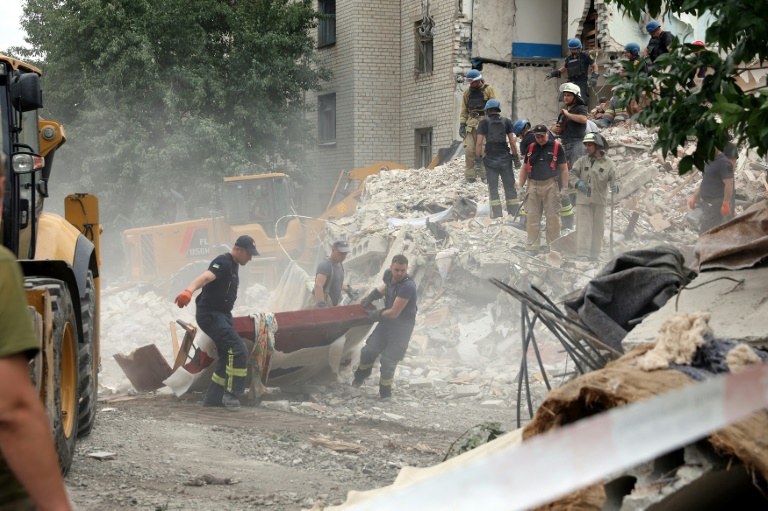
Ukrainian emergency services said the death toll had risen to 38, two days after Russian bombardment flattened a residential building in the eastern town of Chasiv Yar, in the Donetsk region of the Donbas.

In Bakhmut — one of the few remaining cities under Ukrainian control in Donbas — AFP journalists could hear nearby artillery fire.

– Toll rises to 38 –

“The front is getting closer,” said municipal official, Dmytro Podkuyidko, estimating that more than one-third of the town’s population of 73,000 have fled.

“If it gets worse, I’ll end up leaving too,” Podkuyidko said.

Turkey announced meanwhile that Russian and Ukrainian delegations had agreed to meet in Turkey Wednesday for talks to break an impasse on allowing Ukrainian grain to leave its southern ports which are mined and blocked by Russian warships. 

The four-way meeting with Turkish officials and the United Nations comes as food prices soar around the world due to Russia’s invasion of Ukraine.

Turkish President Recep Tayyip Erdogan is due to meet Russian leader Vladimir Putin for the first time since the invasion at talks hosted by Iranian President Ebrahim Raisi in Tehran next Tuesday.

The talks are due to focus on the situation in war-ravaged Syria, but the Kremlin said Putin and Erdogan will hold a separate meeting that is almost certain to focus heavily on Ukraine.

The Kremlin has been working to consolidate its hold over territories it controls like Kherson, both militarily and bureaucratically since the beginning of the conflict.

After Putin on Monday passed a decree fast-tracking Russian passports for all Ukrainians, Foreign Minister Sergei Lavrov was expected Tuesday to open a representative office for separatist authorities in Moscow.

burs-jbr/jm

Indonesian islanders sue cement giant Holcim over climate damage

Residents of Pulau Pari, an Indonesian island threatened by rising sea levels, are suing cement giant Holcim over its carbon dioxide emissions, a Swiss charity said on Tuesday.

“Holcim… bears a significant share of the responsibility for the climate crisis as well as for the situation on… Pari,” Yvan Maillard Ardenti, climate expert at Swiss Church Aid (HEKS), said on the charity’s website.

The complaint was lodged on Monday with a conciliation authority in Zug, Switzerland, where Holcim’s headquarters are located.

The four plaintiffs told German TV channel RTL on Monday they were seeking compensation from Holcim for damage already caused to their island by climate change, money for flood defences and a rapid reduction in the company’s carbon emissions.

“Holcim is globally the leading manufacturer of cement, the basic material for concrete, and one of the 50 biggest CO2 emitters out of all companies worldwide,” HEKS said.

This is in line with the 2021 greenhouse polluters index compiled by the University of Massachusetts Amherst, which ranks “LafargeHolcim” 47th among the top 100 emitters of climate-heating gases.

Contacted by AFP, Holcim, which merged with France’s Lafarge in 2015, declined to comment on the legal case but said it “takes climate action very seriously”. 

“This is the first time that a Swiss company will be held legally accountable for its role in climate change,” HEKS said.

The Swiss NGO is backing the islanders’ campaign alongside the Berlin-based rights group ECCHR and Indonesian environmental pressure group WALHI.

They point out that countries of the South are bearing the brunt of a climate emergency mainly created by the rich countries of the North.

Large portions of Pari, which depends on fishing and tourism, were likely to be under seawater in 30 years, HEKS said.

Holcim sold its Indonesian activities to local cement maker Semen Indonesia in 2019.

But globally, it emitted more than seven billion tonnes of CO2 emissions between 1950 and 2021, according to a new study from the US-based Climate Accountability Institute.

That amounts to more than twice the emissions of Switzerland since the year 1750, HEKS said.

“We significantly reduced our footprint over the last decade and will cut it further by 2030,” Holcim told AFP.

“We are focused on supporting our customers to build more with less to improve living standards for all while reducing emissions.”

NASA releases next wave of images from James Webb Space Telescope

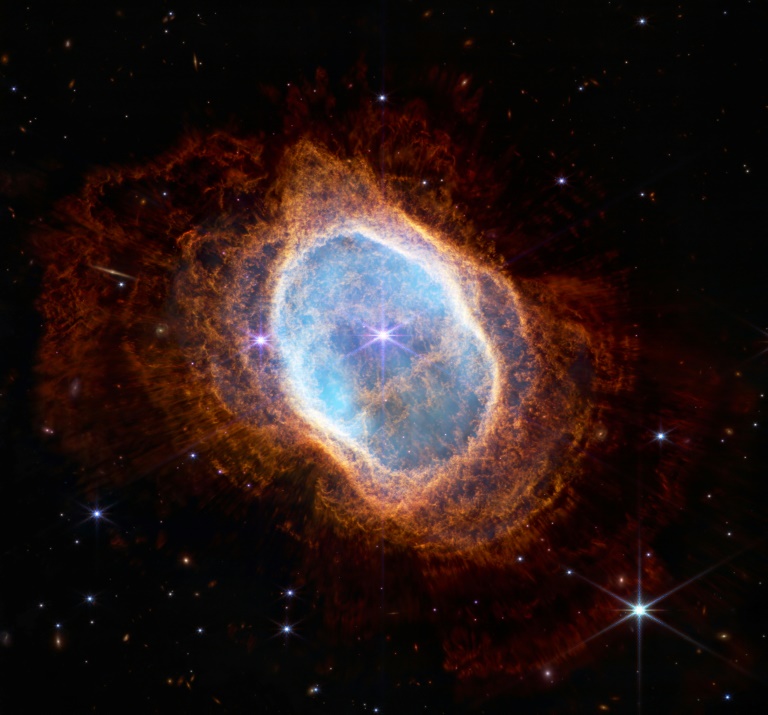
The James Webb Space Telescope began releasing a new wave of cosmic images on Tuesday, heralding a new era of astronomy.

“Every image is a new discovery,” said NASA administrator Bill Nelson. “Each will give humanity a view of the universe that we’ve never seen before.”

On Monday, Webb revealed the clearest image to date of the early universe, going back 13 billion years.

One new image on Tuesday shown water vapor in the atmosphere of a faraway gas planet. The spectroscopy — an analysis of light that reveals detailed information — was of planet WASP-96 b, which was discovered in 2014.

Nearly 1,150 light-years from Earth, WASP-96 b is about half the mass of Jupiter and zips around its star in just 3.4 days.

“We’ve seen the effect of what happens when a planet and its atmosphere passes in front of the star, and the star light filters through the atmosphere, and you can break that down into wavelengths of light,” said NASA’s Knicole Colon.

“So you’re actually seeing bumps and wiggles that indicate the presence of water vapor in the atmosphere of the planet.”

Other targets that will be released include Carina Nebula, a stellar nursery, famous for its towering pillars that include “Mystic Mountain,” a three-light-year-tall cosmic pinnacle captured in an iconic image by Hubble.

One stunning shot released by the White House on Monday was overflowing with thousands of galaxies and features some of the faintest objects observed.

Known as Webb’s First Deep Field, it shows the galaxy cluster SMACS 0723, which acts as a gravitational lens, bending light from more distant galaxies behind it towards the observatory, in a cosmic magnification effect.

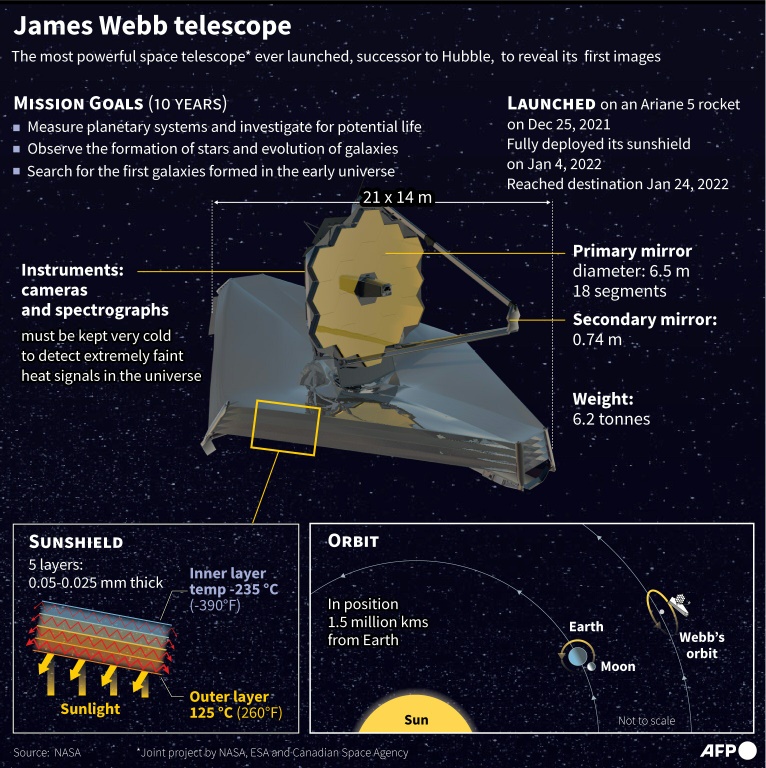
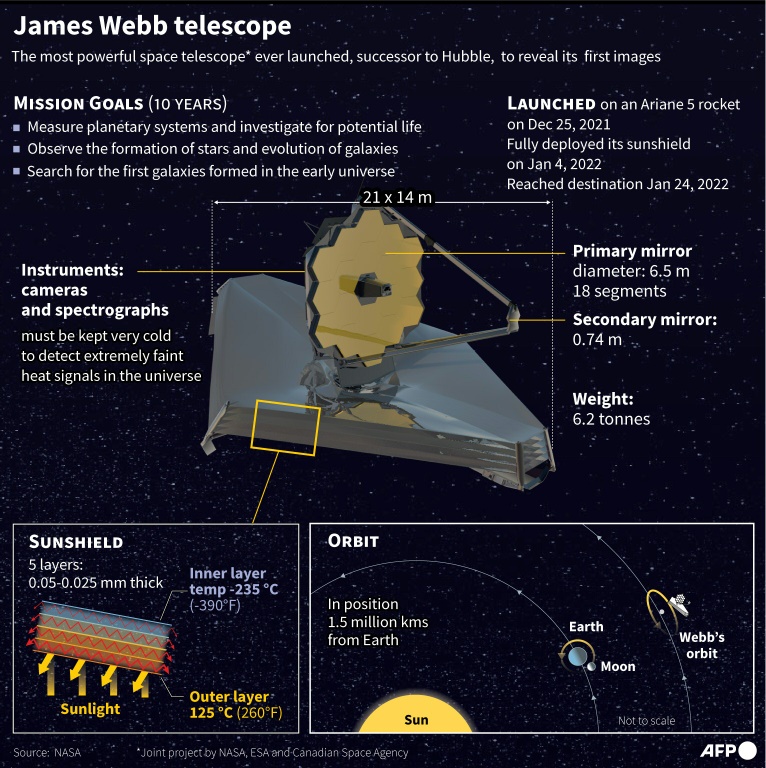
Launched in December 2021 from French Guiana on an Ariane 5 rocket, Webb is orbiting the Sun at a distance of a million miles (1.6 million kilometers) from Earth, in a region of space called the second Lagrange point.

Here, it remains in a fixed position relative to the Earth and Sun, with minimal fuel required for course corrections. 

A wonder of engineering, the total project cost is estimated at $10 billion, making it one of the most expensive scientific platforms ever built, comparable to the Large Hadron Collider at CERN.

Webb’s primary mirror is over 21 feet (6.5 meters) wide and is made up of 18 gold-coated mirror segments. Like a camera held in one’s hand, the structure must remain as stable as possible to achieve the best shots.

After the first images, astronomers around the globe will get shares of time on the telescope, with projects selected competitively through a process in which applicants and selectors don’t know each other’s identities, to minimize bias.

Thanks to an efficient launch, NASA estimates Webb has enough propellant for a 20-year life, as it works in concert with the Hubble and Spitzer space telescopes to answer fundamental questions about the cosmos.

Kyiv says hits Russian arms depot, Istanbul announces grain talks

Kyiv said Tuesday it had launched artillery barrages that a destroyed a Russian arms depot and carried out a “special operation” to free military captives in the Moscow-controlled Kherson region.

The bombardments in the south came as the EU green-lit one billion euros in aid for Ukraine and Turkey announced that delegations from Moscow and Kyiv would meet in Istanbul on Wednesday to discuss the resumption of stalled grain deliveries across the Black Sea.

The bombardment overnight in the Kherson region, which Russian forces captured soon after they invaded in late February, were reported as Kyiv tries to claw back territory in the south.

Ukrainian military officials said the strikes had destroyed artillery, armoured vehicles “and a warehouse with ammunition” in Nova Kakhovka.

Russian-backed authorities, however, accused the Ukrainians of damaging civilian infrastructure and killing at least seven people, a toll that could not be independently verified.

“There are no military targets here,” the head of the city’s Moscow-backed administration, Vladimir Leontiev, said on social media.

“Warehouses were hit, as were shops, a pharmacy, petrol stations and even a church,” he added.

Ukrainian military intelligence said separately that its troops had rescued five people in a “special operation” in Kherson, including a military serviceman and former police officer, without specifying when.

– EU financial aid –

The Ukrainian army has for several weeks been waging a counter-offensive designed to recapture Kherson, while Russian troops have focused on trying to capture the entire eastern Donbas region.

The deputy head of the pro-Russian authorities in Kherson, Ekaterina Gubareva, accused Ukraine of having used long-range, precision artillery systems supplied by the United States in the strikes in Nova Kakhovka.

Military analysts are crediting newly arrived systems from the West — including HIMARS from the United States — with attacks deeper in Russian-controlled territory in Ukraine, including on ammunition depots.

EU member states, which have been supplying Ukraine with military support, on Tuesday also approved one billion euros in financial support for Kyiv.

“This will give Ukraine the necessary funds to cover urgent needs and ensure the operation of critical infrastructure,” said Zbynek Stanjura, the finance minister of the Czech Republic, which holds the EU’s rotating presidency.

The United States, however, cautioned Monday that Iran was planning to supply drones with combat weapon capabilities to Russia for use in Ukraine.

Russian forces early Tuesday launched “massive” strikes on the southern Ukrainian city of Mykolaiv, with missiles hitting two medical facilities and residential buildings, the city’s mayor Oleksandr Sienkevych said.

The regional head, Vitaliy Kim, said 12 people were wounded.

– ‘Front getting closer’ –

The heaviest fighting in recent weeks has centred on the industrial east in the Donbas where Moscow’s forces have slowly advanced despite fierce resistance since failing to capture Kyiv after its February 24 invasion.

Ukrainian emergency services said the death toll had risen to 35, two days after Russian bombardment flattened a residential building in the eastern town of Chasiv Yar, in the Donetsk region of the Donbas.

In Bakhmut — one of the few remaining cities under Ukrainian control in the eastern region — AFP journalists could hear nearby artillery fire.

“I’d like to evacuate too but my parents don’t want to. Everyone has gone. I only have one friend left here,” said eight-year-old Sofia, watching around two dozen people gather near the town hall to evacuate further west.

“The front is getting closer,” said municipal offical, Dmytro Podkuyidko, estimating the more than one-third of the town’s esimtated population of 73,000 have fled.

“If it gets worse, I’ll end up leaving too,” Podkuyidko said.

The Kremlin has been working to consolidate its hold over territories it controls like Kherson, both militarily and bureaucratically since the beginning of the conflict.

After Russian President Vladimir Putin on Monday passed a decree fast-tracking Russian passports for all Ukrainians, Foreign Minister Sergei Lavrov was expected Tuesday to open a representative office for separatist authorities in Moscow.

burs-jbr/jm

Iran to supply Russians with UAVs for Ukraine: White House

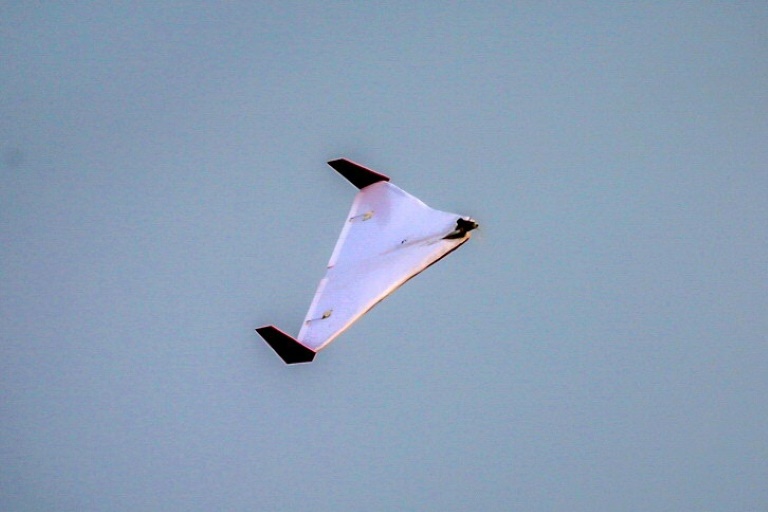
Iran is planning to supply hundreds of drones with combat weapon capabilities to Russia for use in Ukraine, a top US official said Monday.

Jake Sullivan, the White House national security advisor, said the information received by the United States supported views that the Russian military is facing challenges sustaining its weaponry after significant losses in Ukraine.

“The Iranian government is preparing to provide Russia with up to several hundred UAVs (unmanned aerial vehicles), including weapons-capable UAVs, on an expedited timeline,” Sullivan told reporters.

“Our information further indicates that Iran is preparing to train Russian forces to use these UAVs, with initial training sessions slated to begin as soon as early July,” he said.

Iran responded on Tuesday by saying that “no special development” had taken place in technological cooperation with Russia following its invasion of Ukraine in February.

Without specifically mentioning drones, Iran’s foreign ministry spokesman Nasser Kanani said cooperation with Russia “in the field of some modern technologies predates the war in Ukraine, and there has been no special development in that regard recently.”

Tehran’s position regarding the war “is quite clear and has been officially announced many times,” he added.

Iran has maintained that it is against the war in Ukraine and called for a political solution, while blaming the roots of the crisis on the United States and NATO’s expansion.

“The claim of the American official (Sullivan) comes as the US and the Europeans have for years turned the occupying and aggressor countries, including in the West Asia region, into a storehouse of their various deadly weapons,” Kanani added.

Sullivan said it was not clear whether Iran had delivered any of the drones to Russia yet.

He noted that Iran’s drones have been used by the Huthi rebels in Yemen to attack Saudi Arabia.

Drones have played a crucial role on both sides of the war in Ukraine, for everything from firing missiles from a distance, to dropping small bombs on targets, to conducting reconnaissance for artillery forces and ground troops.

Ukraine’s forces have had particular success in using Turkish-made Bayraktar armed combat UAVs, and the United States and other allies have supplied Kyiv with many types of smaller drones.

“From our perspective, we will continue to do our part to help sustain the effective defense of Ukraine and to help the Ukrainians show that the Russian effort to try to wipe Ukraine off the map cannot succeed,” Sullivan said.

James Webb Telescope to release more breathtaking cosmic views

After unveiling the clearest view yet of the distant cosmos, the James Webb Space Telescope has more to come. 

The next wave of images on Tuesday will reveal details about the atmosphere of a faraway gas planet, a “stellar nursery” where stars form, a “quintet” of galaxies locked in a dance of close encounters, and the cloud of gas around a dying star.

They will be published starting from 10:30 am Eastern Time (1430 GMT), in an event live streamed from the NASA Goddard Space Flight Center, just outside Washington.

Targets include Carina Nebula, a stellar nursery, famous for its towering pillars that include “Mystic Mountain,” a three-light-year-tall cosmic pinnacle captured in an iconic image by Hubble.

Webb has also carried out a spectroscopy — an analysis of light that reveals detailed information — on a gas giant planet called WASP-96 b, which was discovered in 2014.

Nearly 1,150 light-years from Earth, WASP-96 b is about half the mass of Jupiter and zips around its star in just 3.4 days.

On Monday, Webb revealed the clearest image to date of the early universe, going back 13 billion years, NASA said Monday.

The stunning shot, released in a White House briefing by President Joe Biden, is overflowing with thousands of galaxies and features some of the faintest objects observed.

Known as Webb’s First Deep Field, it shows the galaxy cluster SMACS 0723, which acts as a gravitational lens, bending light from more distant galaxies behind it towards the observatory, in a cosmic magnification effect.

Launched in December 2021 from French Guiana on an Ariane 5 rocket, Webb is orbiting the Sun at a distance of a million miles (1.6 million kilometers) from Earth, in a region of space called the second Lagrange point.

Here, it remains in a fixed position relative to the Earth and Sun, with minimal fuel required for course corrections. 

A wonder of engineering, the total project cost is estimated at $10 billion, making it one of the most expensive scientific platforms ever built, comparable to the Large Hadron Collider at CERN.

Webb’s primary mirror is over 21 feet (6.5 meters) wide and is made up of 18 gold-coated mirror segments. Like a camera held in one’s hand, the structure must remain as stable as possible to achieve the best shots.

After the first images, astronomers around the globe will get shares of time on the telescope, with projects selected competitively through a process in which applicants and selectors don’t know each other’s identities, to minimize bias.

Thanks to an efficient launch, NASA estimates Webb has enough propellant for a 20-year life, as it works in concert with the Hubble and Spitzer space telescopes to answer fundamental questions about the cosmos.

James Webb Telescope to release more breathtaking cosmic views

After unveiling the clearest view yet of the distant cosmos, the James Webb Space Telescope has more to come. 

The next wave of images on Tuesday will reveal details about the atmosphere of a faraway gas planet, a “stellar nursery” where stars form, a “quintet” of galaxies locked in a dance of close encounters, and the cloud of gas around a dying star.

They will be published starting from 10:30 am Eastern Time (1430 GMT), in an event live streamed from the NASA Goddard Space Flight Center, just outside Washington.

Targets include Carina Nebula, a stellar nursery, famous for its towering pillars that include “Mystic Mountain,” a three-light-year-tall cosmic pinnacle captured in an iconic image by Hubble.

Webb has also carried out a spectroscopy — an analysis of light that reveals detailed information — on a gas giant planet called WASP-96 b, which was discovered in 2014.

Nearly 1,150 light-years from Earth, WASP-96 b is about half the mass of Jupiter and zips around its star in just 3.4 days.

On Monday, Webb revealed the clearest image to date of the early universe, going back 13 billion years, NASA said Monday.

The stunning shot, released in a White House briefing by President Joe Biden, is overflowing with thousands of galaxies and features some of the faintest objects observed.

Known as Webb’s First Deep Field, it shows the galaxy cluster SMACS 0723, which acts as a gravitational lens, bending light from more distant galaxies behind it towards the observatory, in a cosmic magnification effect.

Launched in December 2021 from French Guiana on an Ariane 5 rocket, Webb is orbiting the Sun at a distance of a million miles (1.6 million kilometers) from Earth, in a region of space called the second Lagrange point.

Here, it remains in a fixed position relative to the Earth and Sun, with minimal fuel required for course corrections. 

A wonder of engineering, the total project cost is estimated at $10 billion, making it one of the most expensive scientific platforms ever built, comparable to the Large Hadron Collider at CERN.

Webb’s primary mirror is over 21 feet (6.5 meters) wide and is made up of 18 gold-coated mirror segments. Like a camera held in one’s hand, the structure must remain as stable as possible to achieve the best shots.

After the first images, astronomers around the globe will get shares of time on the telescope, with projects selected competitively through a process in which applicants and selectors don’t know each other’s identities, to minimize bias.

Thanks to an efficient launch, NASA estimates Webb has enough propellant for a 20-year life, as it works in concert with the Hubble and Spitzer space telescopes to answer fundamental questions about the cosmos.

Euro strikes dollar parity as eurozone recession fears mount

The euro struck parity with the dollar Tuesday for the first time in nearly 20 years as a cut in Russian gas supplies to Europe heightened fears of a recession in the eurozone. 

The European single currency hit exactly one dollar — its lowest level since December 2002 — before rising to $1.0023.

Oil prices meanwhile fell heavily on concerns of a wider recession as central banks hike interest rates to fight decades-high inflation.

European stock markets fell approaching the half-way mark and in the wake of overnight losses in Asia and on Wall Street.

“The gas crisis has really spooked markets over the eurozone economy,” Markets.com analyst Neil Wilson told AFP.

Russian energy giant Gazprom on Monday began 10 days of maintenance on its Nord Stream 1 pipeline — with Germany and other European countries watching anxiously to see if the gas comes back on.

With relations between Russia and the West at their lowest in years because of the invasion of Ukraine, Gazprom may not reopen the valves, according to analysts.

“The next few weeks could be challenging for Europe, with possibly maximum uncertainty stretching into August,” said SPI Asset Management’s Stephen Innes.

“Investors increasingly believe that gas may not start to flow through Nord Stream 1 again following the scheduled maintenance on July 11-21, with further ‘temporary’ interruptions seen as likely.”

Worries about a Covid flare-up in China — fuelling fears of more lockdowns — added to the downbeat mood, just as investors prepared for a week of economic data and corporate earnings that could have huge implications for markets.

A forecast-beating US jobs report last week suggested the world’s top economy was coping with higher Federal Reserve rates, but it also gave the central bank more room to continue tightening — leading to concerns it could go too far and cause a contraction.

The European single currency is also under pressure from the Federal Reserve hiking US interest rates more aggressively than the European Central Bank.

The dollar has jumped 14 percent against the euro since the start of the year.

Central banks are increasing borrowing costs in a bid to tame inflation, which has been fuelled by soaring energy prices.

Oil and gas prices have rocketed this year after economies reopened from Covid lockdowns and following the invasion of Ukraine by major energy producer Russia.

– Key figures at around 1015 GMT –

Euro/dollar: DOWN at $1.0023 from $1.0041 Monday

Pound/dollar: DOWN at $1.1847 from $1.1892 

Euro/pound: UP at 84.60 pence from 84.38 pence

Dollar/yen: DOWN at 136.91 yen from 137.41 yen

West Texas Intermediate: DOWN 2.4 percent at $101.55 per barrel

Brent North Sea crude: DOWN 2.5 percent at $104.47 per barrel

London – FTSE 100: DOWN 0.4 percent at 7,170.27 points

Frankfurt – DAX: DOWN 0.8 percent at 12,724.46

Paris – CAC 40: DOWN 0.4 percent at 5,972.14

EURO STOXX 50: DOWN 0.7 percent at 3,447.68

Tokyo – Nikkei 225: DOWN 1.8 percent at 26,336.66 (close)

Hong Kong – Hang Seng Index: DOWN 1.3 percent at 20,844.74 (close)

Shanghai – Composite: DOWN 1.0 percent at 3,281.47 (close)

New York – Dow: DOWN 0.5 percent at 31,173.84 (close)

Close Bitnami banner
Bitnami