US Business

Sri Lanka electricity firm seeks 835% price rise

Sri Lanka’s heavily loss-making state-run electricity monopoly asked for a shocking price rise of over 800 percent for its poorest customers with the bankrupt nation out of fuel, regulators said Monday.

The South Asian nation has been hammered by a foreign exchange crisis, leaving it woefully short of dollars for imports, including fuel to generate electricity and for transport.

The Ceylon Electricity Board (CEB) lost 65 billion rupees ($185 million) in the first quarter and sought an 835 percent price hike for the heavily-subsided smallest power consumers, the Public Utilities Commission of Sri Lanka (PUCSL) said.

Currently, anyone using less than 30 kilowatts a month pays a flat 54.27 rupees ($0.15), which the CEB sought to raise to 507.65 rupees ($1.44).

“A majority of the domestic consumers will not be able to afford this type of steep increase,” PUCSL chairman Janaka Ratnayake told reporters in Colombo. 

“Hence we proposed a direct subsidy from the Treasury to keep the increase to less than half of what they have asked.”

Domestic rates have yet to be decided, but prices will go up by 43 to 61 percent for commercial and industrial users, he added.

The CEB will also be allowed to charge users who earn foreign exchange, such as exporters, in dollars, he added, to help the generator finance imports of oil and spare parts.

The government imposed 13-hour power cuts a few months ago, but blackouts have been reduced to about four hours a day as rains filled hydropower reservoirs.

Over the past six months the government has already increased diesel prices nearly fourfold and petrol  by more than two and a half times.

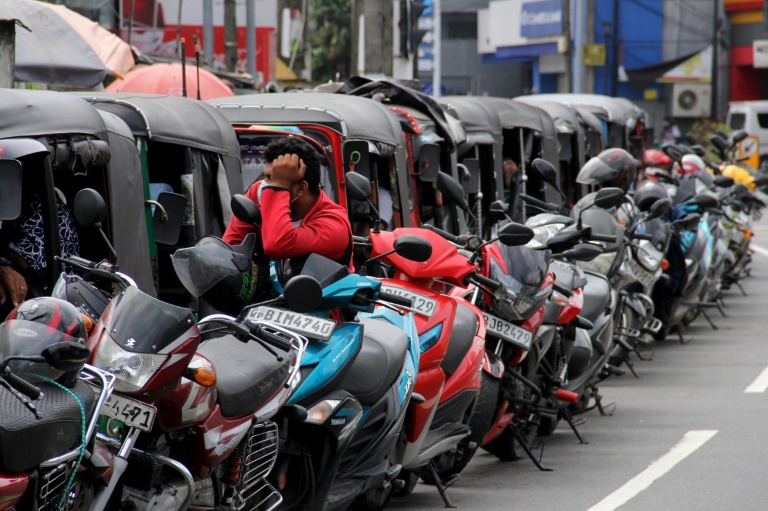
Sri Lanka remains virtually without both diesel and petrol. The energy minister has said he is unable to say when fresh stocks will arrive in the country, which does not have its own oil.

Kanchana Wijesekera apologised to motorists on Sunday and announced two ministers were travelling to Moscow to secure cheaper Russian oil.

Wijesekera himself travelled to Qatar to negotiate concessionary terms for hydrocarbon imports.

Meanwhile, a delegation from the US Treasury and the State Department opened talks with Prime Minister Ranil Wickremesinghe, his office said.

“The United States has agreed to provide technical assistance for fiscal management in Sri Lanka,” the premier’s office said in a brief statement.

Unable to repay its $51 billion foreign debt, the government declared it was defaulting in April and is negotiating with the International Monetary Fund for a possible bailout.
Russia denies defaulting on debts

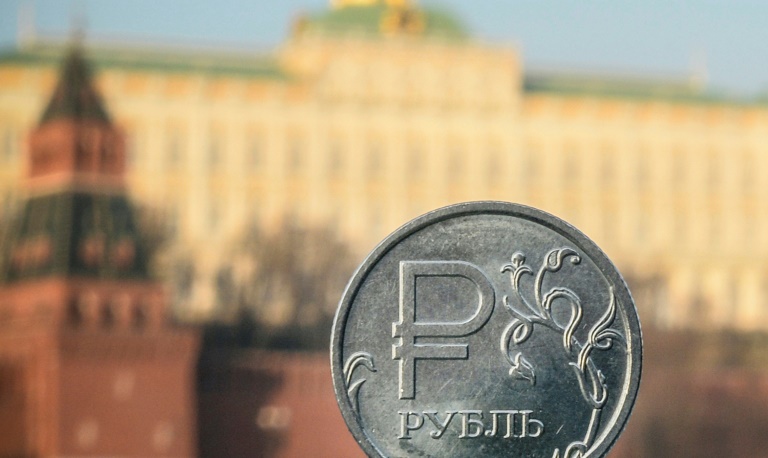
Russia said Monday that two of its debt payments were prevented from reaching creditors, pushing the country closer to its first foreign default in a century due to sanctions over the Ukraine offensive.

The announcement came on the 124th day of Russia’s military intervention in Ukraine, with Western sanctions so far failing to force the Kremlin to change its course.

The Western economic penalties have largely severed the country from the international financial system, making it difficult for Moscow to service its debt.

The Russian authorities insist they have the funds to honour the country’s debt and accuse the West of seeking to drive Moscow into a default artificially.

“There are no grounds to call this situation a default,” Kremlin spokesman Dmitry Peskov told reporters after a key payment deadline expired Sunday.

“These claims about default, they are absolutely wrong,” he said, adding that Russia settled the debt in May.

A 30-day grace period for the payment of $100 million in interest payments expired on Sunday night, most of which had to be paid in foreign currency.

In a statement, the Russian finance ministry said that two of its debt payments had not been transferred to creditors, but denied that the event amounted to a default.

International settlement and clearing systems “received funds in full in advance” but the payments were not transferred to the final recipients due to “the actions of third parties”, the ministry said.

“The non-receipt of money by investors did not occur as a result of the absence of payment, but due to the actions of third parties,” the ministry added, saying such an event did not amount to a default.

“The actions of foreign financial intermediaries are beyond the Russian finance ministry’s control,” the statement said.

Finance Minister Anton Siluanov has earlier dismissed the situation as a “farce”.

– ‘Vicious circle of decline’ – 

While some experts dismiss the event as a technical default, others say it will have far-reaching consequences.

“This default is important as it will impact on Russia’s ratings, market access and financing costs for years to come,” said Timothy Ash, an emerging markets strategist at BlueBay Asset Management.

“And that means lower investment, lower growth, lower living standards, capital and human flight (brain drain), and a vicious circle of decline for the Russian economy.” 

Russia lost the last avenue to service its foreign-currency loans after the United States removed an exemption last month that allowed US investors to receive Moscow’s payments.

In response, Russia said it would pay in rubles that could be converted into foreign currency, using a Russian financial institution as a paying agent, even though the bonds do not allow payments in the local currency.

Russia has accused the West of seeking to push it into an “artificial default” through unprecedented sanctions imposed after President Vladimir Putin sent troops to Ukraine on February 24.

The measures included freezing the Russian government’s stockpile of $300 billion in foreign currency reserves held abroad, making it more complicated for Moscow to settle its foreign debts.

The country last defaulted on its foreign debt in 1918, when Bolshevik revolution leader Vladimir Lenin refused to recognise the massive debts of the deposed tsar’s regime.

Russia defaulted on domestic debt in 1998 when, due to a drop in commodity prices, it faced a financial squeeze that prevented it from propping up the ruble and paying off debts that accumulated during the first war in Chechnya.

The International Monetary Fund’s number two official, Gita Gopinath, said in March that a Russian default would have “limited” impact on the global financial system.

War in Ukraine: Latest developments

Here are the latest developments in the war in Ukraine:

– End war by year end: Zelensky –

Ukrainian President Volodymyr Zelensky urges world leaders gathered at the G7 summit to do their utmost to end Russia’s invasion of his country by the end of the year.

He also calls on the G7 to “intensify sanctions” against Russia, a G7 source says.

In his address via video link to the gathering in the German Alps, Zelensky says battle conditions will make it tougher for his troops as they mount their fightback.  

He urges G7 nations to “not lower the pressure and to keep sanctioning Russia massively and heavily”, in addition to the multiple rounds of sanctions that Western allies have already unleashed on Moscow.

– G7 to up pressure on Putin, vows solidarity –

The G7 vows solidarity with Ukraine “for as long as it takes”, in a statement issued after Zelensky’s video address.

The host of the group’s summit in Germany, Chancellor Olaf Scholz, says the G7 will “increase pressure” on Russian President Vladimir Putin over the invasion of Ukraine.

“This war has to come to an end,” Scholz tweets.

The G7 also tells Russia it must allow grain shipments to leave Ukraine to avoid exacerbating a global food crisis.

It tells Moscow it must allow Ukrainians taken to Russia against their will to return home at once. 

And it expresses “serious concern” over Russia’s plans to deliver missiles capable of carrying nuclear warheads to Belarus in the coming months.

– New G7 sanctions take shape –

A senior US official says the G7 is making progress in talks on capping the amount of money that Russians can get for their key oil exports.

The White House also unveils new measures to hamper Russia’s ability to resupply the weaponry used in its onslaught against Ukraine.

The G7 also plans to turn funds raised in recently imposed trade tariffs on Russian exports into assistance for Ukraine.

– Finland, Sweden to meet Erdogan on NATO bids –  

The leaders of Finland and Sweden will discuss their stalled bids to join NATO with Turkish President Recep Tayyip Erdogan on Tuesday at the start of an alliance summit in Madrid, the Finnish presidency tweets. 

Russia’s invasion of Ukraine on February 24 saw the two Nordic countries abandon decades of military non-alignment by applying for NATO membership in May.

But the joint membership bid, initially believed to be a speedy process, has been delayed by opposition from Ankara, which accuses them of providing safe haven to Kurdish militants.

– Kremlin denies default report –

The Kremlin insists there are “no grounds” to say that Russia has defaulted on its foreign currency sovereign debt, as Western sanctions over its Ukraine offensive bite.

“These claims about default, they are absolutely wrong,” Kremlin spokesman Dmitry Peskov tells reporters after a key payment deadline expired on Sunday. He says Russia settled the debt in May.

Bloomberg News reported earlier on Monday that Russia defaulted on its foreign currency sovereign debt for the first time in more than a century, after the grace period on some $100 million of interest payments due Sunday had expired.

– US anti-aircraft missiles for Ukraine –

The United States is planning to send Ukraine sophisticated anti-aircraft missiles to defend against Russian attacks, a source familiar with the process tells AFP.

An announcement is “likely this week” on the purchase of NASAMS, an “advanced medium- to long-range surface-to-air missile defence system”, as well as other weaponry to help Ukraine fight Russia’s invasion.

Zelensky has pleaded for more powerful defences against Russian air attacks since the start of the invasion in February.

– Putin to visit Tajikistan, Turkmenistan –

Putin will travel to Tajikistan on Tuesday, the Kremlin says, his first trip abroad since Moscow launched its “special military operation” in Ukraine. 

He is also expected in Turkmenistan on Wednesday for a summit of countries bordering the Caspian Sea. 

burs-jmy/mw/gil

Turkey's troubled lira rallies on 'backdoor capital controls'

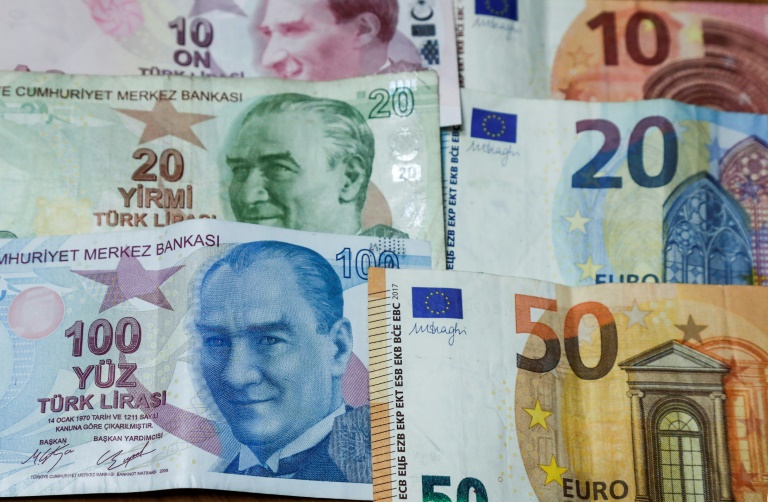
Turkey’s beleaguered lira extended its biggest rally of the year on Monday in response to a new rule that effectively forces many banks to part with some of their foreign currency.

The banking regulation — announced after the market had closed on Friday night — represents Turkey’s latest attempt to prop up the lira without raising the main interest rate.

President Recep Tayyip Erdogan’s pressure on the central bank to keep borrowing costs well bellow the rate of inflation has sparked an economic crisis that has seen the lira slump and prices explode.

Erdogan rejects conventional economics and affirms that high interest rates cause inflation instead of slowing it down.

The annual rate of consumer price increases now officially stands at 73.5 percent. Independent economists believe it could be nearly double that figure.

The dollar dropped to 16.1 liras early Monday before recovering slightly and trading around the 16.7 mark.

The US currency was worth around 17.4 liras before the measure was announced. It stood at 7.4 liras at the start of last year and 5.9 liras in January 2020.

Turkey’s real interest rate of minus 59.5 percent provides a major incentive for consumers to spend money before it loses value and for banks to convert their holdings into dollars and euros.

The new rule attempts to put a stop to that by limiting banks’ foreign-denominated assets.

It requires banks with more than 15 million liras ($900,000) in foreign currency — should that figure represents more than 10 percent of their assets or annual sales — to sell their dollars and euros before issuing any more loans.

The measure meant that some big banks whose lira loans matured Monday had to sell their foreign currencies in order to make the payments.

BlueBay Asset Management economist Timothy Ash called the regulation “backdoor capital controls”.

The banking regulator clarified Sunday that the measure did not apply to individuals or independent entrepreneurs.

– ‘Liraisation’ –

Erdogan’s economic team has ruled out imposing strict currency control and is espousing its allegiance to the markets.

The head of Turkey’s MUSIAD big business association also welcomed the measure — seen by economists as another step in Erdogan’s push for the “liraisation” of the emerging market’s economy.

The new rule will “prevent dollarisation, which is the main factor behind the rise in the exchange rate,” MUSIAD chief Mahmut Asmali told reporters.

But OMG Capital Advisors consultancy head Murat Gulkan said the measure could have a damaging long-term effect on Turkey’s business climate.

The new rules will “complicate the operating conditions of banks and companies,” Gulkan said.

“The cornerstone of the system is the policy rate of the central bank. When that cornerstone is misplaced, it is necessary to take extraordinary steps like this latest decision.”

Ash agreed that the measure “over-complicates things for business and banks when what everyone knows Turkey needs is plain and simple interest rate increases”.

Stock markets extend recovery as rate hike fears subside

Asian and European markets rallied Monday, building on last week’s advances and following a strong pre-weekend performance on Wall Street as speculation that inflation may have peaked tempered expectations about central bank interest rate hikes.

With prices surging at a pace not seen in a generation, finance chiefs have been forced to lift borrowing costs and wind back their ultra-loose monetary policies in recent months, sending a chill across trading floors.

But a string of weak data has led many investors to believe that inflation may have plateaued or is about to, giving room for banks to be less hawkish.

The prospect that rates will not go as high as initially expected helped send Wall Street stocks higher Friday, with the S&P 500 and Nasdaq ending up more than three percent.

Asia and Europe continued the rally on Monday.

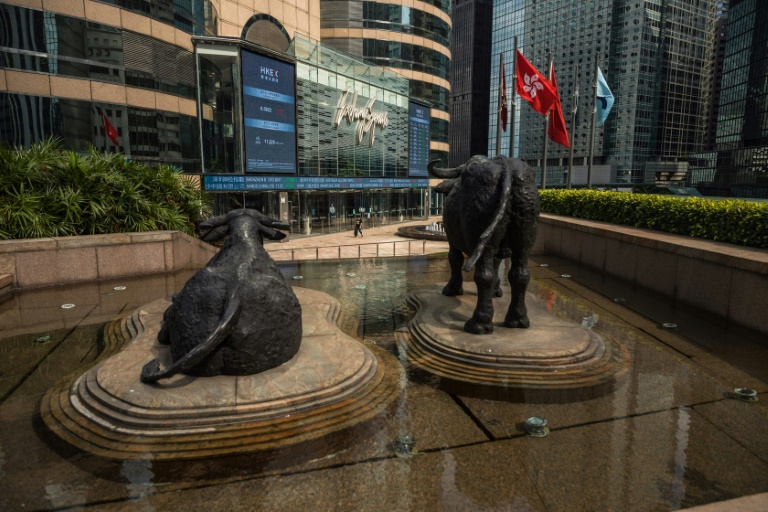
Hong Kong led gainers, climbing more than two percent thanks to a strong performance in Chinese tech firms. 

Indications that China’s crackdown on the sector could be coming to an end added to the upbeat mood in the city.

“Market conviction that perhaps the Fed won’t now hike rates as aggressively as previously feared and/or that rate cuts before the end of 2023 are now an even more realistic prospect… have had a big hand” in boosting sentiment, said National Australia Bank’s Ray Attrill.

While Fed chiefs continue to flag further big interest rate hikes in the pipeline, expectations for a prolonged period of increases have waned, which has in turn taken some heat out of the dollar.

Bitcoin has also won some support, trading above $21,000 after a recent slump.

– G7 action over Russia –

Elsewhere, traders were keeping a close eye on the G7 summit in Germany, focused on further co-ordinated financial action against Russia following its invasion of Ukraine.

Among the new action being weighed by the G7 was a price cap on Russian oil imports and fresh sanctions on Russia’s defence sector, the White House said.

G7 member France meanwhile urged oil producers to ramp up crude output by ‘exceptional’ volumes owing to Russian supply constraints.

The group — comprising also Britain, Canada, Germany, Italy, Japan and the United States — kicked off their gathering Sunday by announcing plans to ban imports of Russian gold.

It was the latest in a series of sanctions aimed at punishing President Vladimir Putin for his February 24 invasion.

– Key figures at around 1100 GMT –

London – FTSE 100: UP 0.6 percent at 7,250.27 points

Frankfurt – DAX: UP 0.8 percent at 13,220.81

Paris – CAC 40: UP 0.1 percent at 6,078.53

EURO STOXX 50: UP 0.7 percent at 3,557.65

Tokyo – Nikkei 225: UP 1.4 percent at 26,871.27 (close)

Hong Kong – Hang Seng Index: UP 2.4 percent at 22,229.52 (close)

Shanghai – Composite: UP 0.9 percent at 3,379.19 (close)

New York – Dow: UP 2.7 percent at 31,500.68 (close)

Euro/dollar: UP at $1.0586 from $1.0559 Friday

Pound/dollar: UP at $1.2282 from $1.2280

Euro/pound: UP at 86.22 pence from 85.95 pence

Dollar/yen: UP at 135.22 yen from 135.17 yen

Brent North Sea crude: UP 0.4 percent at $113.56 per barrel

West Texas Intermediate: UP 0.2 percent at $107.88 per barrel

Billionaire Italian eyewear mogul Del Vecchio dead at 87

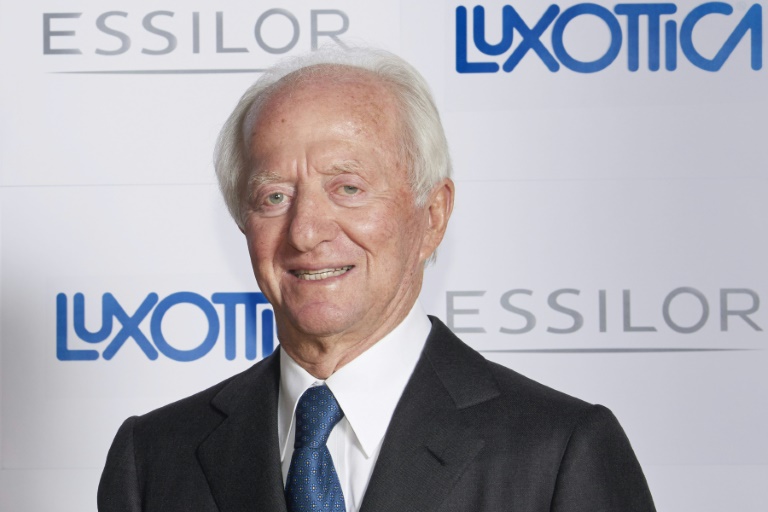
Italy’s second richest man, eyewear magnate Leonardo Del Vecchio, has died aged 87 after building an optical empire that saw him buy up major brands like Ray-Ban, Persol and Oakley.

Del Vecchio was one of Italy’s most successful businessmen, building from scratch an international company that helped turn eyeglasses into a coveted — and pricey — fashion accessory. 

His fortune was worth an estimated $27.3 billion, according to Forbes’ 2022 World’s Billionaires List. 

His company EssilorLuxottica confirmed on Monday that he had “passed away” at the age of 87. 

Del Vecchio had been in intensive care at Milan’s San Raffaele hospital in recent weeks, according to Italian news agency AGI.

Born in Milan on May 22, 1935, to a poor family, he spent part of his youth in an orphanage and began working as a teenager.  

He founded his own company, Luxottica, in 1961, supplying the optical industry with components.

A decade later, Del Vecchio made the strategic decision to control all parts of the production process. 

Luxottica began making its own eyeglasses, distributing them throughout Italy before expanding in Europe through joint ventures.

He spotted the advantage of partnering with fashion design brands, including Giorgio Armani, branched out into retail and snatched up trendy eyewear brands like Ray-Ban, Persol and Oakley.

He signed a first licence agreement with Giorgio Armani in the 1980s, as eyewear morphed into a fashion accessory, a trend that continues today. 

Luxottica also bought such retailers as LensCrafters and Sunglass Hut, allowing the company to tap the consumer market directly without intermediaries.

In 2018, Luxottica merged with France’s Essilor to become EssilorLuxottica, with Del Vecchio serving as chairman. In 2021, the publicly traded company posted 19.8 billion euros ($20.9 billion) in revenue.

“Leonardo Del Vecchio was a great Italian,” said Prime Minister Mario Draghi. 

The European Union commissioner for economic affairs, Italian Paolo Gentiloni called Del Vecchio’s success “an example for today and tomorrow”.  

Climate activists block IMF Paris office doors

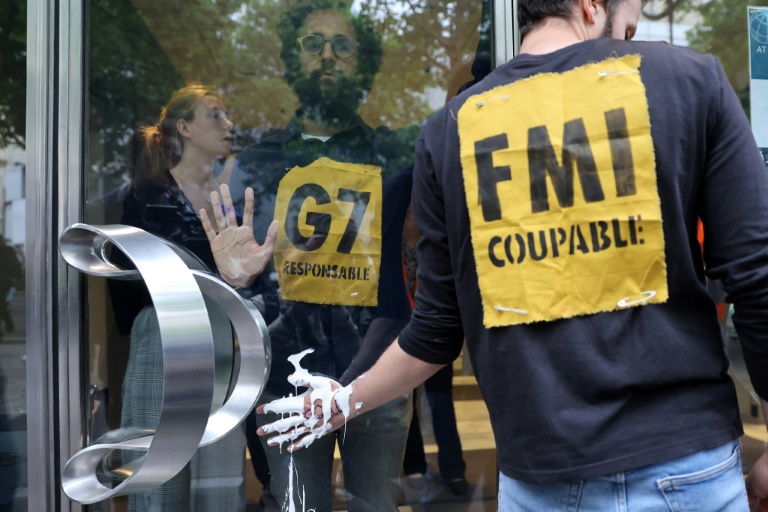
Climate activists on Monday blocked entry to the International Monetary Fund’s Paris office with some gluing their hands to its doors, demanding developing countries’ debt be scrapped to help tackle climate change.

The Paris protest is part of a “Debt for climate” global campaign calling on wealthy-nation leaders attending the G7 summit in Germany to cancel the debts of poorer and less industrialised countries, known as the global south. 

While low-emitting countries in the global south contribute the least to climate change, they tend to be the hardest-hit by the consequences, experts say. 

“We need to give these countries the resources to fight against the climate crisis. They are the first victims and the last ones responsible,” said an Extinction Rebellion activist calling herself “Chalou”, one of dozens in front of the IMF building in Paris’ wealthy 16th district.

Several activists from Extinction Rebellion, Youth for Climate and 350.org glued their hands to glass doors at the building’s entrance, while others sat in front with their arms linked together inside tubes to make it harder to move them.

The group spread a banner reading “G7 responsible, IMF guilty” in front of the building, while some activists scattered fake banknotes marked with the slogan “Stop fossil fuels”.

“The debt crisis is first and foremost the result of an unjust financial system dominated by the richest countries,” activist groups Extinction Rebellion, Attac-France and Youth for Climate France, who organised the Paris action, said in a statement. 

“The G7, the IMF and the World Bank have historical responsibilities in the development of this vicious circle of debt (and) over-exploitation of resources”, they added.

Environmental activists have organised a string of protests in recent weeks to refocus attention on climate change, as the energy crisis and war in Ukraine dominate the news agenda.

Murdered rapper's song pulled from YouTube in India

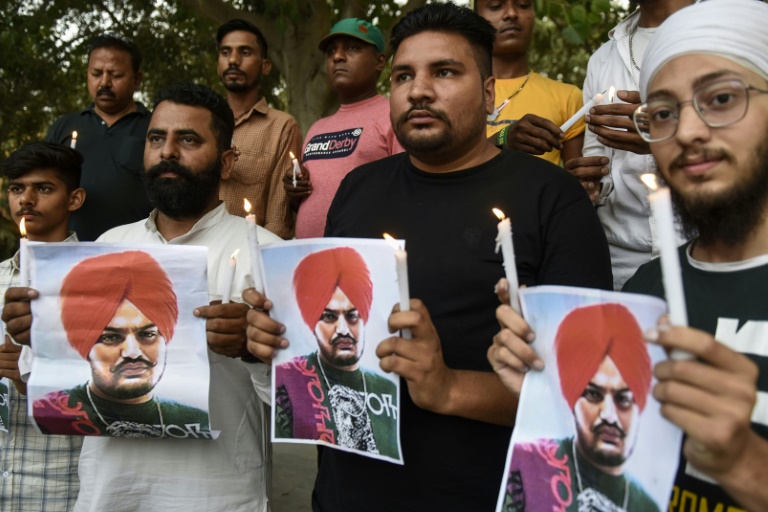
YouTube has removed a viral music video in India released posthumously by murdered Sikh rapper Sidhu Moose Wala following a complaint by the government.

The song “SYL” talks about the Sutlej-Yamuna Link (SYL) canal which has been at the centre of a long-running water dispute between the late Sikh rapper’s home state of Punjab and neighbouring Haryana.

The track, released posthumously on Thursday, also touches on other sensitive topics such as deadly riots targeting the Sikh community that broke out in India in 1984 and the storming of an important Sikh temple in Amritsar by the army the same year.

It had garnered nearly 30 million views and 3.3 million likes on the singer’s YouTube page before it was pulled down over the weekend. 

“This content is not available on this country domain due to a legal complaint from the government,” said a message posted on the song link.

The song is still available in other countries.

In an email to AFP, a YouTube spokesperson said it had only removed the song in “keeping with local laws and our Terms of Service after a thorough review”.

The government did not immediately respond to enquiries.

Moose Wala’s family termed the removal of the song “unjust” and appealed to the government to take back the complaint, local media reports said.

“They can ban the song but they cannot take Sidhu out of the hearts of the people. We will discuss legal options with lawyers,” uncle Chamkaur Singh was quoted as saying by the Hindustan Times daily.

Moose Wala — also known by his birth name Shubhdeep Singh Sidhu — was shot dead in his car in the northern state of Punjab last month.

The 28-year-old was a popular musician both in India and among Punjabi communities abroad, especially in Canada and Britain.

His death sparked anger and outrage from fans from across the world.

Last week, Indian police arrested three men accused of murdering Moose Wala and seized a cache of weaponry including a grenade launcher.

The men had allegedly acted at the behest of Canada-based gangster Goldy Brar and his accomplice Lawrence Bishnoi who is currently in jail in India.

Moose Wala rose to fame with catchy songs that attacked rival rappers and politicians, portraying himself as a man who fought for his community’s pride, delivered justice and gunned down enemies.

He was criticised for promoting gun culture through his music videos, in which he regularly posed with firearms.

His murder also put the spotlight on organised crime in Punjab, a major transit route for drugs entering India from Afghanistan and Pakistan.

Many observers link the narcotics trade — mostly heroin and opium — to an uptick in gang-related violence and the use of illegal arms in the state.

Markets extend rally as rate hike fears subside

Asian and European markets rallied again Monday, building on last week’s advances and following a strong performance on Wall Street as speculation that inflation may have peaked tempered expectations about central bank interest rate hikes.

With prices surging at a pace not seen in a generation, finance chiefs have been forced to lift borrowing costs and wind back their ultra-loose monetary policies in recent months, sending a chill across trading floors.

But a string of weak data has led many investors to believe that inflation may have plateaued or is about to, giving room for banks to be less hawkish.

The prospect that rates will not go as high as initially expected helped send Wall Street stocks higher Friday, with the S&P 500 and Nasdaq ending up more than three percent.

And Asia continued last week’s rally.

Hong Kong led gainers, climbing more than two percent thanks to a strong performance in Chinese tech firms. Indications that China’s crackdown on the sector could be coming to an end added to the upbeat mood in the city.

Tokyo, Shanghai, Seoul, Singapore, Sydney, Manila, Bangkok, Mumbai and Wellington were also well up.

London, Paris and Frankfurt were all up in early trade.

“Market conviction that perhaps the Fed won’t now hike rates as aggressively as previously feared and/or that rate cuts before the end of 2023 are now an even more realistic prospect if recession-like conditions lay ahead, have had a big hand in last week’s improvement in risk sentiment,” said National Australia Bank’s Ray Attrill.

He added that the rally had helped pare about two-thirds of the losses suffered in a painful sell-off from June 9 to 16.

While Fed chiefs continue to flag further big interest rate hikes in the pipeline, expectations for a prolonged period of increases have waned, which has in turn taken some heat out of the dollar.

Bitcoin has also won some support, after falling to as low as $17,600 last week for the first time since December 2020.

“There’s a feeling that things aren’t as bad as we thought they were going to be,” Carol Pepper, of Pepper International, told Bloomberg Radio.

“There’s a hope that perhaps we’ve oversold, perhaps there’s not going to be a recession,” she said.

But others warned that while the markets were enjoying a moment of calm, they were not out of the woods yet.

“Over the last week, equity markets have snapped back from oversold territory, which brought a sense of relief to investors,” said Bank of Singapore’s Eli Lee. 

“It is unsurprising in bear markets to see relief rallies, which can be unpredictable in magnitude and duration. However, we continue to see a fragile environment for risk assets over the next 12 months.”

Traders are keeping an eye on the G7 summit in Germany, which is set to be dominated by Russia’s war in Ukraine.

The leaders agreed money collected from higher trade tariffs imposed on Russian exports should be funnelled as aid to Ukraine, the White House said.

– Key figures at around 0810 GMT –

Tokyo – Nikkei 225: UP 1.4 percent at 26,871.27 (close)

Hong Kong – Hang Seng Index: UP 2.4 percent at 22,229.52 (close)

Shanghai – Composite: UP 0.9 percent at 3,379.19 (close)

London – FTSE 100: UP 0.9 percent at 7,270.69

Dollar/yen: DOWN at 135.06 yen from 135.17 yen late Friday

Pound/dollar: UP at $1.2315 from $1.2280

Euro/dollar: UP at $1.0587 from $1.0559

Euro/pound: UP at 85.97 pence from 85.95 pence

West Texas Intermediate: UP 0.2 percent at $107.80 per barrel

Brent North Sea crude: UP 0.6 percent at $113.72 per barrel

New York – Dow: UP 2.7 percent at 31,500.68 (close)

Rival camps dig in for fight after US abortion ruling

Elected leaders across the US political divide rallied Sunday for a long fight ahead on abortion — state by state and in Congress — with total bans in force or expected soon in half of the country.

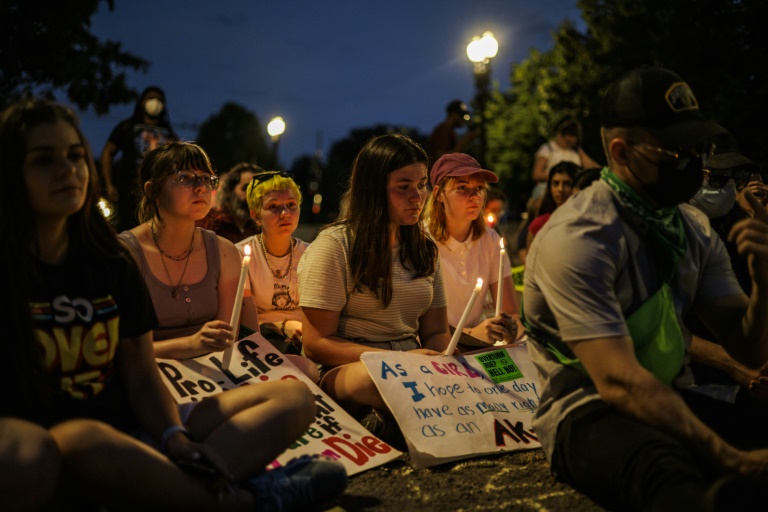
Two days after the US Supreme Court scrapped half-century constitutional protections for the procedure, abortion rights defenders kept up their mobilization, with several hundred gathered outside the high court during a candlelight vigil in Washington Sunday.

Dozens of arrests and some instances of vandalism were reported during a weekend of mostly peaceful protests that turned disorderly in places — as the country grapples with a new level of division: between states where abortion is or will soon be illegal, and those that still allow it.

Conservative-led US state legislatures have moved swiftly, with at least eight imposing immediate bans on abortion — many with exceptions only if a woman’s life is in danger — and a similar number to follow suit within weeks.

In a first glimpse of the legal battles ahead, the nation’s largest abortion provider Planned Parenthood filed suit in Utah seeking to block the state’s ban.

And Democratic governors in Michigan and Wisconsin have stepped in to try to keep abortion legal in their Midwestern states.

Defending the ban now in effect in South Dakota, which makes no exception for victims of rape or incest, Republican Governor Kristi Noem called the Supreme Court’s ruling “wonderful news in the defense of life.”

Speaking on ABC’s “This Week,” Noem also voiced support for legislation banning “telemedicine abortions” in which a doctor prescribes pills to end a pregnancy — set to become a key resource in many places where abortion is illegal.

Governor Asa Hutchinson of Arkansas likewise argued that “forcing someone to carry a child to term” in order to save an unborn baby was an “appropriate” use of government power.

States should now focus on helping mothers and newborns by expanding services including adoption, he said on NBC’s “Meet the Press.”

But the Republican also opposed calls to go further with a federal abortion ban — an ultimate goal of many on the religious right — or restrictions on contraception, which he said is “not going to be touched” in Arkansas.

Fears that the Supreme Court’s strong conservative majority — made possible by Donald Trump — will now seek to target other rights like same-sex marriage and contraception have fueled the nationwide mobilization since Friday.

– ‘Appalling’ –

President Joe Biden has condemned the Supreme Court’s ruling as a “tragic error” — but with power now resting with often anti-abortion state legislatures, he has also acknowledged his hands are largely tied.

The president’s main hope is for voters to turn out in defense of abortion rights in November’s midterm elections — and in the meantime, Biden’s Democrats have vowed to defend women’s reproductive rights every way they can.

In Wisconsin, where an 1849 law banning abortion except to save the life of the mother may go into effect, Governor Tony Evers vowed to offer clemency to any doctors who face prosecution, according to local media.

And Michigan’s Governor Gretchen Whitmer promised to “fight like hell,” saying a temporary injunction has been filed to keep abortion legal in her state.

Congresswoman Alexandria Ocasio-Cortez warned nightmare scenarios may soon come true — as women are forced to continue with unwanted pregnancies, travel long distances to states where abortion remains legal, or undergo clandestine abortions.

“Forcing women to carry pregnancies against their will will kill them. It will kill them,” the progressive lawmaker told NBC, urging Biden to explore opening health care clinics on federal lands in conservative states in order to help people access abortion services.

A CBS poll released Sunday showed that a solid majority — 59 percent — of Americans and 67 percent of women disapproved of the court’s ruling.

While thousands of people rallied peacefully through the weekend — most of them in protest, but many others celebrating — there were isolated incidents of violence. Police fired tear gas on protesters in Arizona and a pickup truck drove through a group of protesters in Iowa.

In the Virginia city of Lynchburg, police were investigating a case of vandalism Saturday at an anti-abortion pregnancy center — which was spray-painted with graffiti and had its windows smashed.

And in Colorado, police were probing a suspected arson attack Saturday at a similar anti-abortion center in the town of Longmont, which was painted with graffiti reading: “If abortions aren’t safe, neither are you.”

Close Bitnami banner
Bitnami