US Business

One justice in US abortion ruling sparks fears for same-sex marriage

A written opinion by one justice in the US Supreme Court’s decision to bury abortion rights has ignited fears that other progressive gains, including same-sex marriage and contraception, could also be overturned.

Clarence Thomas, one of the most conservative justices on the court, wrote that “in future cases” also involving privacy “we should reconsider.”

Thomas cited Griswold v Connecticut, which enshrined the right to contraception in 1965; Lawrence v. Texas, which struck down laws penalizing same-sex relationships in 2003, and Obergefell v. Hodges, the 2015 ruling protecting marriage for all.

Same-sex marriage remains a high-value target for Republicans and the religious right in the United States.

Thomas argued that, since the decisions were based on the same provision of the constitution on privacy as abortion rights, the court has “a duty to ‘correct the error’ established in those precedents.”

He also argued it would be necessary to analyze whether other passages of the constitution “guarantee the myriad rights” generated by the right to privacy.

Thomas — whose wife Ginni Thomas has pushed false claims that Donald Trump won the last election — was the only judge making such arguments out of the nine who sit on America’s top court.

– ‘Extreme and dangerous path’ –

But the court’s shift to the right under Trump, who appointed three new conservative justices, has Democrats, activists and progressive groups fearing its future rulings.

“Justice Thomas explicitly called to reconsider the right of marriage equality, the right of couples to make their choices on contraception,” Biden said Friday.

“This is an extreme and dangerous path that the court has now taken us on.”

In a sign of concern within the court itself, the three left-leaning justices who dissented from the majority also said the abortion decision “places in jeopardy other rights, from contraception to same-sex intimacy and marriage.”

The court’s ruling specifically addressed the fears, saying “we have stated unequivocally that ‘[n]othing in this opinion should be understood to cast doubt on precedents that do not concern abortion.'”

Justice Brett Kavanaugh also addressed the concerns in his concurring opinion, writing: “I emphasize what the Court today states: Overruling Roe does not mean the overruling of those precedents, and does not threaten or cast doubt on those precedents.”

But that will do little to dissuade those who point to statements by some of the justices when they appointed — including Kavanaugh — suggesting that they would not vote to overturn Roe.

US passes first major gun bill in decades

US lawmakers broke a decades-long stalemate on firearms control Friday, passing the first major safety regulations in almost 30 years, less than 24 hours after the Supreme Court bolstered the right to bear arms.

Gun regulation is a touchstone issue for both conservatives and liberals in the United States that has consumed national politics amid multiple mass shootings in recent years.

The Democratic-led House of Representatives voted to rubber-stamp a bipartisan Senate gun bill that — while modest — amounts to the first significant piece of legislation to regulate firearms since 1994.

Fourteen Republicans defied their leader Kevin McCarthy to cross the aisle and approve the 80-page package, which advanced from the evenly-divided upper chamber with cross-party backing late Thursday.

That vote came hours after the Supreme Court’s conservative majority had struck down a century-old New York law requiring permits for concealed-carry handguns.

The gun legislation includes enhanced background checks for younger buyers and federal cash for states introducing “red flag” laws that allow courts to temporarily remove weapons from those considered a threat.

Billions of dollars have been allocated to crack down on “straw purchasers” who buy firearms for people who are not allowed them and to curb gun trafficking.

– ‘Long-sought triumph’ –

The deeply-divisive issue of gun control was reignited by two massacres in May that saw 10 Black supermarket shoppers gunned down in upstate New York and 21 people, mostly young children, slain at a school in Texas.

The Supreme court had voted along party lines, with the six Republican appointees in favor of bolstering the constitutional right to bear arms and the three Democratic appointees dissenting.

The ruling was hailed by campaigners for boosted gun rights, but took the shine off what was expected to be a day of jubilation for weapons control activists.

Liberals had been celebrating the congressional action despite disappointment at the limited scope of the legislation, which doesn’t include universal background checks and omits any ban on semi-automatic weapons or high-capacity magazines.

“This decision won’t stop our grassroots army from doing what we’ve done for a decade: fighting to keep our families safe,” added Shannon Watts, founder of Moms Demand Action, said after the Supreme Court ruling was announced.

“Just as we’re breaking the logjam in Congress, we’re going to work day-in, day-out to mitigate the fallout in New York and any other states impacted by this decision and elect gun-sense lawmakers up and down the ballot.”

Eric Tirschwell, chief litigation counsel at legal non-profit Everytown Law, said the Supreme Court had misapplied fundamental constitutional principles, and added that the group was “ready to go to court” to defend restrictions.

Top Republicans celebrated the court’s decision.

“This is not just a long-sought triumph for lawful gun owners across America, it is a victory for all citizens and our constitutional order itself,” said Senate Minority Leader Mitch McConnell.

McCarthy hailed the ruling as a victory that “rightfully ensures the right of all law-abiding Americans to defend themselves without unnecessary government interference.”

“The decision comes at an important time — as the Senate considers legislation that undermines Second Amendment freedom,” Wayne LaPierre, the National Rifle Association’s executive vice president, said in a statement.

“This decision unequivocally validates the position of the NRA and should put lawmakers on notice: no law should be passed that impinges this individual freedom.”

Key reactions after top US court ends right to abortion

Divine intervention, or a “tragic error” that risks the health of millions of women: reactions to the US Supreme Court’s decision on Friday to strike down constitutional protections for abortion illustrated the country’s stark divides.

Here are some key quotes.

– Praise –

Former Republican president Donald Trump:

“God made the decision.” 

“I think, in the end, this is something that will work out for everybody.”

“This brings everything back to the states where it has always belonged.”

Former Republican vice president Mike Pence:

“Now that Roe v. Wade has been consigned to the ash heap of history, a new arena in the cause of life has emerged and it is incumbent on all who cherish the sanctity of life to resolve that we will take the defense of the unborn.”

Marjorie Dannenfelser, president of the anti-abortion organization Susan B. Anthony List:

“After 50 years of lobbying, building centers of hope to serve pregnant women, on our knees praying, off our knees marching, and ensuring the powerful pro-life voice could be heard in our elections, we have arrived at this day. A culminating day of so much, and the first day of a bright pro-life future for our nation.”

– Criticism –

Democratic President Joe Biden:

“It is a sad day for the court and for the country.”

“The court has done what it has never done before, expressly take away a constitutional right that is so fundamental to so many Americans.”

“It’s a realization of an extreme ideology and a tragic error by the Supreme Court in my view.”

Former Democratic president Barack Obama:

“Today, the Supreme Court not only reversed nearly 50 years of precedent, it relegated the most intensely personal decision someone can make to the whims of politicians and ideologues — attacking the essential freedoms of millions of Americans.” 

Former first lady Michelle Obama: 

“I am heartbroken that we may now be destined to learn the painful lessons of a time before Roe was made law of the land — a time when women risked losing their lives getting illegal abortions.”

Planned Parenthood, the leading abortion provider in the United States:

“We know you may be feeling a lot of things right now — hurt, anger, confusion. Whatever you feel is OK. We’re here with you — and we’ll never stop fighting for you.”

Amnesty International USA:

“Abortion is a human right. For everyone. Everywhere. We will never stop fighting.”

– International response –

Canadian Prime Minister Justin Trudeau: 

“The news coming out of the United States is horrific. My heart goes out to the millions of American women who are now set to lose their legal right to an abortion. I can’t imagine the fear and anger you are feeling right now.”

British Prime Minister Boris Johnson:

“I think it’s a big step backwards. I’ve always believed in a woman’s right to choose and I stick to that view, and that’s why the UK has the laws that it does.”

UN High Commissioner for Human Rights Michelle Bachelet:

“It is a huge blow to women’s human rights and gender equality.”

“More than 50 countries with previously restrictive laws have liberalized their abortion legislation over the past 25 years. 

“With today’s ruling, the US is regrettably moving away from this progressive trend.”

French President Emmanuel Macron:

“They must be protected. I express my solidarity with women whose freedoms are today challenged by the Supreme Court of the United States of America.”

Biden slams 'extreme' Supreme Court for 'tragic error' on abortion

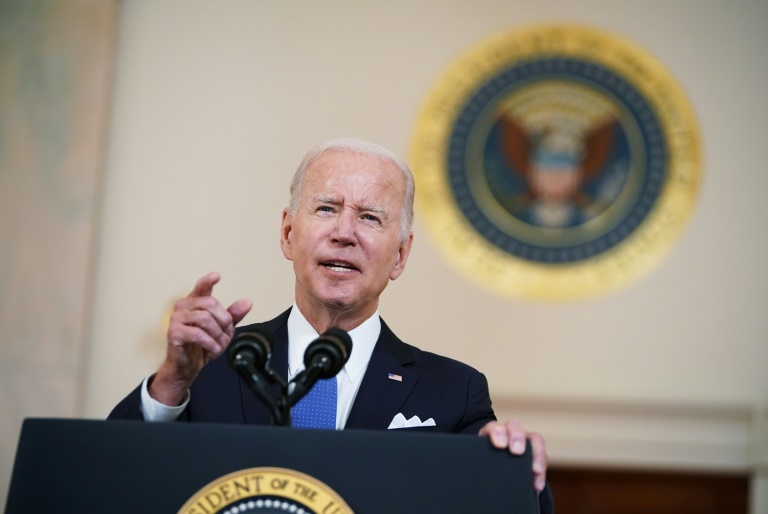
An angry President Joe Biden called on voters Friday to rise up over the Supreme Court’s “tragic error” in ending the constitutional right to abortion, warning that an “extreme ideology” is already targeting other rights.

“The court has done what it has never done before — expressly take away a constitutional right that is so fundamental to so many Americans,” Biden said in the White House after the conservative-dominated Supreme Court overturned “Roe v. Wade.”

“It’s a realization of an extreme ideology and a tragic error by the Supreme Court in my view.”

The Democrat vowed to do everything he could to shield abortion access, but with the Supreme Court stripping away the federal right and handing power to often anti-abortion state legislatures, he acknowledged that his hands are largely tied.

The only way to ensure the right now “is for Congress to restore the protections of ‘Roe v. Wade’ as federal law,” he said. “No executive action from the president can do that.”

About half of the US states are moving immediately to either ban or severely restrict abortion, responding to decades of activism by the so-called “pro-life” movement, which finally got its chance when Republican president Donald Trump named three more conservative justices to the top court, tilting the balance firmly right.

Biden did not hide his anger as he described some of the laws emerging from states, saying they are “jeopardizing the health of millions of women.” In some cases, state legislators are allowing women to be “punished for protecting their health” and forcing women to “bear their rapist’s child,” he said.

With the ruling, the Supreme Court has made the United States an “outlier” in the world, Biden charged.

Signaling the Democrats’ intention to make the abortion debate an important part of their campaign to retain control of Congress in November midterm elections, Biden said the fight is just starting.

According to Biden, the end to the constitutional right to abortion also threatens the future of other social issues where the Supreme Court had previously ruled in favor of individual choice, including contraception and same-sex marriage.

“I have warned how this decision risks the broader right to privacy,” Biden said, describing the landmark 1973 “Roe” decision as underpinning “so many more rights that have come to be taken for granted and are ingrained.”

That is the “extreme and dangerous path the court has now taken us on,” he said. 

Urging activists to remain peaceful, Biden said the answer should come at the polls.

“Voters need to make their voices heard. This fall, you must elect more senators and representatives who will codify the woman’s right to choose in federal law once again,” he said.

“This fall, ‘Roe’ is on the ballot. Personal freedoms are on the ballot — the right to privacy, liberty, equality, are all on the ballot.”

US Supreme Court strikes down right to abortion

The US Supreme Court on Friday struck down the right to abortion in a seismic ruling that shreds half a century of constitutional protections on one of America’s most divisive issues.

The conservative-dominated court overturned the landmark 1973 “Roe v. Wade” decision enshrining a woman’s right to an abortion, saying individual states can restrict or ban the procedure themselves — which half appear poised to do.

“The Constitution does not confer a right to abortion,” the court said in a 6-3 decision. “The authority to regulate abortion is returned to the people and their elected representatives.”

A somber President Joe Biden called the ruling a “tragic error” stemming from “extreme ideology” and said it was a “sad day for the court and the country.”

“The health and life of women in this nation are now at risk,” Biden said, warning that other rights could be threatened next, such as same-sex marriage and contraception.

The Democratic president urged Congress to restore abortion protections as federal law and said Roe will be “on the ballot” in midterm elections in November. 

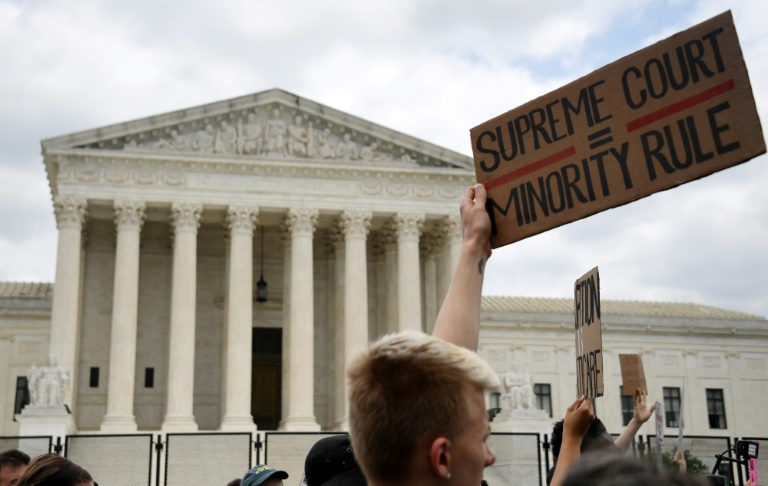
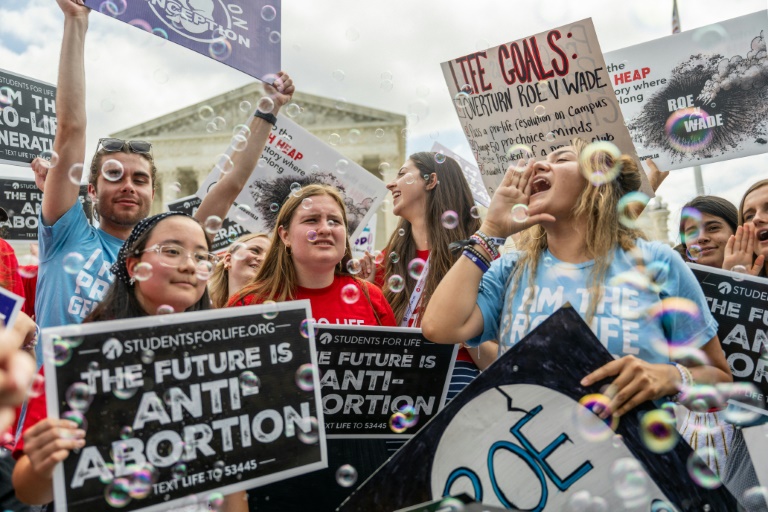
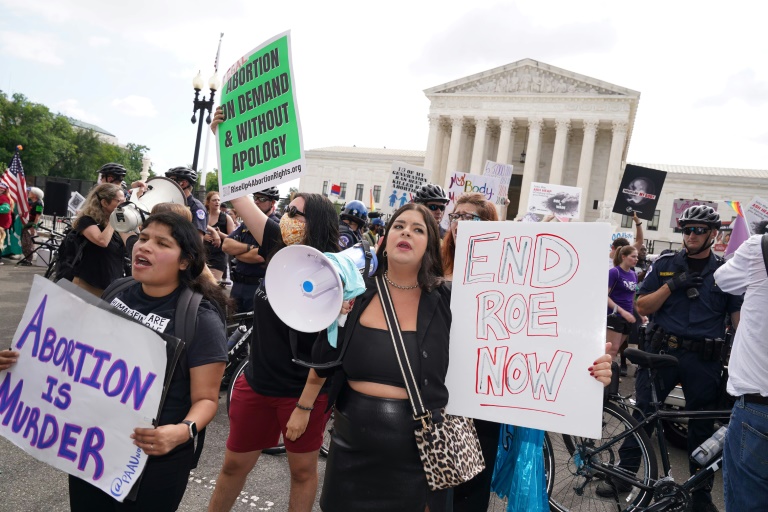
Hundreds of people — some weeping for joy and others with grief — gathered outside the fenced-off Supreme Court as the ruling came down.

“It’s hard to imagine living in a country that does not respect women as human beings and their right to control their bodies,” said Jennifer Lockwood-Shabat, 49, a mother of two daughters who was choking back tears.

But Gwen Charles, a 21-year-old opponent of abortion, was jubilant.

“This is the day that we have been waiting for,” Charles told AFP. “We get to usher in a new culture of life in the United States.”

The Supreme Court ruling will likely set into motion a cavalcade of new laws in roughly half of the 50 US states that will severely restrict or outright ban and criminalize abortions, forcing women to travel long distances to states that still permit the procedure.

Just hours later, Missouri banned abortion — making no exception for rape or incest — and so did South Dakota, except where the life of the mother is at risk.

“This is a monumental day for the sanctity of life,” Missouri attorney general Eric Schmitt said. 

– ‘Egregiously wrong’ –

In the majority opinion, Justice Samuel Alito said Roe v. Wade was “egregiously wrong.”

“Abortion presents a profound moral issue on which Americans hold sharply conflicting views,” he said. “The Constitution does not prohibit the citizens of each State from regulating or prohibiting abortion.”

The court tossed out the legal argument in Roe v. Wade that women had the right to abortion based on the constitutional right to privacy over their own bodies.

The ruling represents a victory of 50 years of struggle against abortion by the religious right — with campaigners now expected to push for an outright nationwide ban.

“God made the decision,” said former Republican president Donald Trump in praising the court’s decision.

Alito’s opinion largely mirrors his draft opinion that was the subject of an extraordinary leak in early May, sparking nationwide demonstrations, with an armed man arrested this month near the home of conservative justice Brett Kavanaugh.

Nancy Pelosi, the Democratic speaker of the House of Representatives, called the ruling “outrageous and heart-wrenching,” while leading abortion provider Planned Parenthood vowed to “never stop fighting.” 

Former president Barack Obama charged that the ruling “relegated the most intensely personal decision someone can make to the whims of politicians and ideologues — attacking the essential freedoms of millions of Americans.”

But Trump’s former vice president Mike Pence said the court had “righted a historic wrong,” consigning the US right to abortion to the “ash heap of history.”

– ‘Will not stop there’ –

The three liberal justices on the court dissented from the ruling — which came a day after the court ushered in a major expansion of US gun rights.

“One result of today’s decision is certain: the curtailment of women’s rights, and of their status as free and equal citizens,” they said.

Abortion providers could now face criminal penalties and “some States will not stop there,” they warned.

“Perhaps, in the wake of today’s decision, a state law will criminalize the woman’s conduct too, incarcerating or fining her for daring to seek or obtain an abortion,” they said.

The court’s ruling goes against an international trend of easing abortion laws, including in such countries as Ireland, Argentina, Mexico and Colombia where the Catholic Church continues to wield considerable influence.

It was made possible by Trump’s nomination of three conservative justices — Neil Gorsuch, Kavanaugh and Amy Coney Barrett.

The case before the court was a Mississippi law that would restrict abortion to 15 weeks but while hearing the case in December several justices indicated they were prepared to go further.

According to the Guttmacher Institute, 13 states have adopted so-called “trigger laws” that will ban abortion virtually immediately.

Ten others have pre-1973 laws that could go into force or legislation that would ban abortion after six weeks, before many women even know they are pregnant.

Women in states with strict anti-abortion laws will either have to continue with their pregnancy, undergo a clandestine abortion, obtain abortion pills, or travel to another state where the procedure remains legal.

Several Democratic-ruled states, anticipating an influx, have taken steps to facilitate abortion and three of them — California, Oregon and Washington — issued a joint pledge to defend access in the wake of the Supreme Court’s decision.

Ryanair, Brussels Airlines strikes disrupt Europe air travel

Strikes by staff at Ryanair and Brussels Airlines over pay and working conditions forced the cancelation of dozens of flights in Europe on Friday as the busy summer travel season gets underway.

The strikes are adding more headaches to passengers and the aviation sector, which has struggled with staff shortages as it struggles to recruit people after massive layoffs during the Covid pandemic.

Ryanair cabin crew unions in Spain, Portugal and Belgium called a three-day strike starting on Friday, and in Italy and France on Saturday.

The biggest impact was felt in Belgium, where the work stoppage led Europe’s biggest budget airline to cancel 127 flights to and from Charleroi airport near Brussels between Friday and Sunday.

Ryanair could only guarantee 30-40 percent of its scheduled flights at the airport, said a spokeswoman for Brussels South Charleroi Airport.

The situation in Belgium was further complicated by a three-day strike by staff at Brussels Airlines, a unit of German airline Lufthansa, which began on Thursday.

The company has cancelled 315 flights to and from Brussels’ international airport during the three-day strike.

The Ryanair strike had very little impact in Portugal and none in Spain where no flights were cancelled. 

“We didn’t even know there was a strike…we didn’t have any problem at all,” said Manuel Carrion, a Spanish passenger with a Ryanair flight at Madrid airport.

Spain’s transport ministry on Thursday ordered Ryanair to operate 73 percent to 82 percent of flights over the strike period to maintain minimum services.

It argued there needs to be a balance between the “right to strike” and the “interest of travellers”.

– ‘Threats’ –

But unions said Ryanair had gone beyond what was required and forced staff to maintain all 438 flights scheduled in Spain on Friday. 

“The company informed staff that all flights were subject to the minimum service, and threated them with disciplinary action,” Ernesto Iglesias of local USO told reporters at Madrid airport.

The airline was not “respecting the law,” he added.

Ryanair cabin crew unions in Spain have called another strike from June 30 to July 2.

A strike on the weekend of June 12 and 13 already prompted the cancellation of about 40 Ryanair flights in France, or about a quarter of the total.

Ryanair boss Michael O’Leary has been dismissive of the strikes, saying earlier this month that most of the company’s flights “will continue to operate even if there is a strike in Spain by some Mickey Mouse union or if the Belgian cabin crew unions want to go on strike.”

Less than two percent of the airline’s 3,000 flights on Friday have been affected by strikes, Ryanair said in a statement.

– ‘Pushed to the brink’ –

Ryanair’s low-cost rival easyJet also faces nine days of strikes on different days in July at the Barcelona, Malaga and Palma de Mallorca airports.

British Airways workers at London’s Heathrow airport have voted to strike over pay as the cost-of-living crisis worsens in the UK, though no dates were set yet.

The strikes come as air travel has rebounded since Covid-19 restrictions have been lifted.

But the staff shortages have forced airlines to cancel flights, with German carrier Lufthansa cancelling more than 3,000 of them during the summer holidays.

On Monday, the European Transport Workers’ Federation called “on passengers not to blame the workers for the disasters in the airports, the cancelled flights, the long queues and longer time for check-ins, and lost luggage or delays caused by decades of corporate greed and a removal of decent jobs in the sector.”

The Federation said it expects “the chaos the aviation sector is currently facing will only grow over the summer as workers are pushed to the brink.”

Stocks and oil rally

Global stock markets and oil prices jumped higher on Friday following recent heavy losses on fears that interest rate hikes aimed at cooling decades-high inflation will spark a global recession.

With a spate of data pointing to an economic slowdown, market watchers are saying investors now believe central banks may need to deal out less punishing interest rate hikes, and thus the pushing of equity markets into bear market territory may have been an overreach.

London stocks rallied 2.7 percent with investors brushing aside news of bruising defeats for Britain’s ruling Conservatives in by-elections on Thursday. 

The pound firmed against the dollar, despite data showing a drop in UK retail sales volumes as inflation soars.

Paris stocks jumped 3.2 percent in eurozone trade, while Frankfurt rose 1.6 percent with gains tempered by news of the worsening German business climate.

“Stock markets are taking a breather after being beat up… as recession fears took their toll,” OANDA trading platform analyst Craig Erlam told AFP.

But he warned that stock markets remain “vulnerable to another onslaught if the news does not improve”.

Asian stock markets closed higher after Thursday’s gains on Wall Street.

Wall Street kept on rising on Friday, with all three major indices up over two percent in late morning trading.

The recoveries come after global markets have been thrown into turmoil for months owing to soaring inflation, interest-rate hikes, the Ukraine war and China lockdowns.

US equity markets tumbled into bear market territory — a drop of more than 20 percent from recent highs — as the US Federal Reserve began to aggressively raise interest rates.

Federal Reserve boss Jerome Powell this week told lawmakers a recession was “certainly a possibility”.

He suggested officials were ready to press on with big rate hikes, following last week’s three-quarter point increase for US borrowing costs that sent markets tanking.

Sentiment in Asia has meanwhile been boosted by comments from Chinese President Xi Jinping suggesting an end to China’s tech crackdown as well as possible new measures aimed at lifting the economy.

Hong Kong shares were among the biggest winners Friday thanks to a rally in tech giants including Alibaba, Tencent and NetEase.

Analysts have been pointing to falling commodity prices, a primary driver of inflation, in the face of a possible recession reducing the need for sharp interest rate hikes as one possible explanation for the renewed bullish sentiment on equity markets. 

“Falling interest rates and falling commodity prices, which typically go hand-in-hand with a growth slowdown, have been held out as developments working in favor of the rebound effort,” said Patrick O’Hare, analyst at Briefing.com.

“There is some truth to that, knowing that rising interest rates and rising commodity prices have been upsetting factors for most of the year, but one has to be careful stretching the credibility of those rally catalysts knowing that slower growth is going to translate into lower earnings growth prospects” for companies, he added.

Revised US consumer sentiment data — the initial reading of which may have helped push the US Fed into its massive 0.75 percentage point hike — also showed weaker inflation expectations and a new record low in consumer confidence.

“Today’s numbers would appear to suggest that the Federal Reserve may have overreacted,” said Michael Hewson at CMC Markets.

“This decline in inflation expectations has served to act as an additional tonic for markets as we headed towards the weekend,” he added.

– Key figures at around 1530 GMT –

New York – Dow: UP 2.2 percent at 31,338.15 points

EURO STOXX 50: UP 3.0 percent at 3,538.15

London – FTSE 100: UP 2.7 percent at 7,208.81 (close)

Frankfurt – DAX: UP 1.6 percent at 13,118.13 (close)

Paris – CAC 40: UP 3.2 percent at 6,073.35 (close)

Tokyo – Nikkei 225: UP 1.2 percent at 26,491.97 (close)

Hong Kong – Hang Seng Index: UP 2.1 percent at 21,719.06 (close)

Shanghai – Composite: UP 0.9 percent at 3,349.75 (close)

Euro/dollar: UNCHANGED from late Thursday at $1.0523

Pound/dollar: UP at $1.2290 from $1.2260

Euro/pound: UP at 85.85 pence from 85.83 pence

Dollar/yen: UP at 135.10 yen from 134.95 yen 

Brent North Sea crude: UP 3.5 percent at $113.85 per barrel

West Texas Intermediate: UP 3.9 percent at $108.34 per barrel

burs-rl/pvh

Furious Democratic leader vows to fight 'cruel' abortion ruling

The top Democrat in the US Congress blasted the conservative-led Supreme Court’s “outrageous and heart-wrenching” decision overturning the federally-guaranteed right to abortion Friday — urging Americans to vote out Republicans in November’s midterm elections.

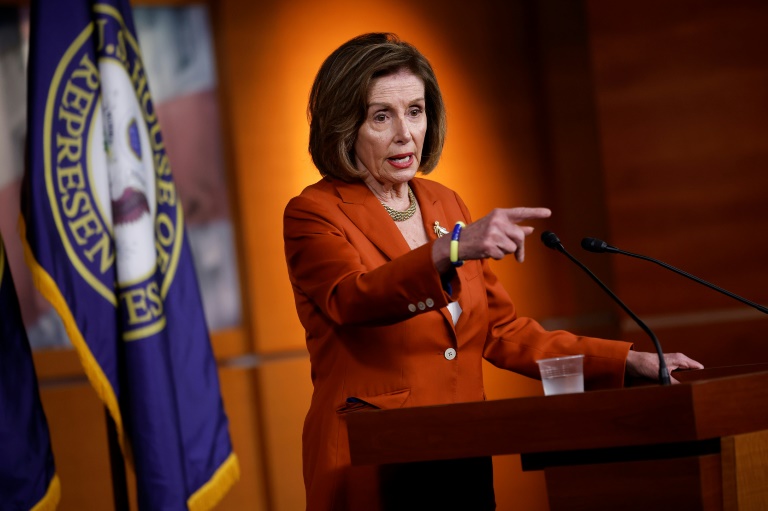
In an emotional news conference, a seething House Speaker Nancy Pelosi accused the court of delivering a “slap in the face” to women seeking to make their own decisions about their reproductive freedom.

“This cruel ruling is outrageous and heart wrenching, but make no mistake: it’s all on the ballot in November,” Pelosi said.

The high court’s six Republican appointees overturned the landmark 1973 “Roe v. Wade” decision that enshrined a woman’s right to an abortion, saying that individual states can now permit or restrict the procedure themselves. The three Democratic appointees dissented.

Pelosi told reporters the move was part of a wider crackdown by Republicans on reproductive freedom.

“With Roe now out of their way, radical Republicans are charging ahead with their crusade to criminalize health freedom. In the Congress, Republicans are plotting a nationwide abortion ban,” she said.  

“In the states, Republicans want to arrest doctors for offering reproductive care and women for terminating a pregnancy. (Republican) extremists are even threatening to criminalize contraception, as well as in-vitro fertilization and post-miscarriage care.”

Ukraine forced to cede key battleground city

Ukrainian forces prepared Friday to retreat from the strategic city of Severodonetsk after weeks of fierce fighting, a setback that could pave the way for Russia to seize a larger swath of eastern Ukraine. 

The announcement came shortly after the European Union granted Ukraine candidate status in a show of support for the former Soviet republic, though there is still a long path ahead to membership.

Russia has focused its offensive on the Donbas region of eastern Ukraine after being repelled from the capital Kyiv and other areas in the first weeks of the February invasion. Since then its forces have gradually made progress despite encountering fierce resistance and sustaining heavy losses. 

The industrial hub of Severodonetsk has been the scene of weeks of street battles as outgunned Ukrainians put up a stubborn defence.

But Sergiy Gaiday, governor of the Lugansk region that includes Severodonetsk, said that Ukrainian military forces in the city had received the order to withdraw. 

“Remaining in positions that have been relentlessly shelled for months just doesn’t make sense,” he said on Telegram, adding that 90 percent of the city had been damaged. 

The head of Severodonetsk’s military administration, Roman Vlasenko, told Radio Svoboda that the Ukrainian army was still in the city and that it would “take them some time to retire”.

Capturing Severodonetsk and its twin city of Lysychansk would effectively give the Russians control of Lugansk, and allow them to push further into the wider Donbas.

But Ukraine’s retreat from Severodonetsk will not change the course of the war, said Ivan Klyszcz, an international relations researcher at Estonia’s University of Tartu.

“The big picture — of a slow war of entrenched positions — has hardly changed. We cannot expect a massive Russian breakthrough,” he told AFP.

– Lysychansk under fire –

Gaiday said Russians were now advancing on Lysychansk, which has been facing increasingly heavy bombardments. 

The situation for those that remain in the city is bleak.

Liliya Nesterenko, who was cycling toward a friend’s house to feed her pets, said her house had no gas, water or electricity, forcing her and her mother to cook on a campfire. 

But the 39-year-old was upbeat about the city’s defences: “I believe in our Ukrainian army, they should (be able to) cope.”

Andrei Marochko, a spokesman for the Moscow-backed army of Lugansk, said Friday on Telegram that all the villages in the neighbouring areas of Zolote and Hirske were now under the control of Russian or pro-Russian forces.

In a video on Marochko’s Telegram channel, a man in military clothing could be seen replacing a Ukrainian flag featuring a Zolote coat of arms with a red hammer-and-sickle flag. 

Russia’s defence ministry said Friday that up to 2,000 people were “completely blocked” near Zolote and Hirske, and that around half of Zolote was under Russian control.

– Missiles hit university –

Russia has also intensified its offensive in the northern city of Kharkiv in the past days. 

An AFP team at the scene heard strong explosions in the city centre Thursday night, and in the morning saw that the Kharkiv Polytechnic Institute had been hit by missiles, breaking windows and causing its roof to partially collapse. 

According to an unidentified military official at the scene, the Russians “thought there might be something military in there but there was not”. 

In the southern Kherson region, a Moscow-appointed official was killed by an explosive device planted in his car, Russian news agencies reported.

Moscow’s deputy head of Kherson, Kirill Stremousov, said the regional head of the department of family, youth and sports had died “as a result of a terrorist act”.

It was the first confirmed death of a pro-Russian official during a string of attacks on pro-Kremlin officials in Ukrainian regions under Russian control.

With Ukraine pleading for accelerated weapon deliveries, the United States announced it was sending another $450 million of fresh armaments, including HIMARS rocket systems, which can launch multiple missiles at extended range. 

Ukraine’s President Volodymyr Zelensky put in a video appearance at Britain’s famed Glastonbury music festival on Friday, urging revellers to “spread the truth about Russia’s war” and help Ukrainian refugees.

– ‘Future equal EU partner’ –

At a Brussels summit Thursday, EU leaders granted candidate status to Ukraine as well as Moldova, which Zelensky hailed as “a unique and historic moment”. 

“Today it is recognised that Ukraine is not a bridge, not a pillow between the West and Russia, not a buffer between Europe and Asia, not a sphere of influence,” Zelensky said in a video address to Ukrainians on Friday. 

“Ukraine is a future equal partner for at least 27 EU countries,” he said.

Kremlin spokesman Dmitry Peskov dismissed Ukraine’s new EU candidacy status as a “domestic European affair” — though Russian President Vladimir Putin has strongly resisted what Moscow sees as attempts to bring the country into NATO. 

But Ukraine’s NATO aspirations are far from being realised and EU membership is at least years away.

Western officials also reiterated an accusation that Russia is weaponising its key exports of gas as well as grain from Ukraine.

On Friday, German Economy Minister Robert Habeck told Der Spiegel magazine that his country would be confronted with “difficult societal decisions” in the event of a gas shortage.

“When there is not enough gas some industries that need gas will have to be turned off,” Habeck said.

burs-ech/js/pvh

Abortion access threatened in half of US states

The US Supreme Court’s overturning of America’s constitutional right to abortion gives all 50 states the freedom to ban the procedure, with nearly half expected to do so in some form.

– Automatic bans –

Thirteen states, mostly in the conservative and more religious south of the country, have in recent years adopted so-called “trigger” laws to come into force virtually automatically after the decision was handed down.

They differ in how they ban abortions. Idaho provides exceptions for rape or incest but Kentucky only does so if the pregnant woman’s life is in danger.

Laws in Louisiana could see health professionals jailed for up to ten years for carrying out in abortions. In Missouri, it’s 15 years.

In some states, such as South Dakota, the bans were due to go into effect the day of the Supreme Court’s ruling. 

Missouri’s attorney general Eric Schmitt tweeted a photo of himself signing an opinion banning abortion in the midwestern state less than two hours after the Supreme Court’s decision was announced. 

In others, such as Arkansas or Mississippi, the attorney general will first have to confirm that the court has changed the legal framework. 

Texas and Tennessee have set a period of 30 days between the release of the judgement and a new ban coming into force.

– Restrictions –

Iowa, Georgia, Ohio and South Carolina are among states that have passed laws restricting abortion after six weeks, before many women even know they are pregnant.

While currently blocked by the courts, those laws could take effect now that the Supreme Court has changed the legal landscape.

– Complex patchwork –

Ten states, including Arizona and Michigan, have pre-1973 laws banning abortion on the books that they could theoretically revive, but it is uncertain.

In Wisconsin — where the Democratic governor supports abortion rights, but the majority Republican lawmakers do not — Planned Parenthood has said it does not plan to carry out abortions from the end of June, citing a legal risk.

In Michigan, Democratic Attorney General Dana Nessel has added to the confusion by promising not to prosecute people who violate its 1931 law banning abortion.

Local prosecutors will still be able to do so though and the state risks becoming a complex patchwork of laws.

In Arizona, Republican Governor Doug Ducey believes that a law passed this year to ban abortions after 15 weeks of pregnancy will override previous rules. 

Senators in his party do not see it that way and Ducey is expected to go to court to get clarity.

– Others to watch –

According to the Guttmacher Institute, four states have signaled that they are unfavorable to abortion but do not currently have laws prohibiting them.

Lawmakers in Nebraska and Indiana have failed to pass abortion bans. Officials in Montana and Florida have reduced deadlines for terminating a pregnancy, but supreme courts in those states have protected the right to abortion. 

– Liberal states –

Twenty-two states — mostly in the northeast and west coast — will retain the right to abortion and are preparing for an influx of women seeking abortions.

Connecticut and Delaware, for example, have expanded the categories of professionals who are authorized to carry out abortions to include nurses and midwives.

Lawmakers in California have allocated $152 million to assist access to abortion and the governor of New York has pledged $35 million.

Close Bitnami banner
Bitnami