US Business

Asian markets climb as calm returns after sharp sell-off

Equities rose Tuesday in Asia as some stability returned to markets after last week’s upheaval, but analysts warned of further pain for traders after central bank officials hinted at further interest rate hikes to reel in inflation.

While there was no catalyst from Wall Street owing to a public holiday, a healthy performance across Europe provided a little boost, while bargain-buying was also lending support.

However, there remains an overarching sense of gloom as traders speculate that the sharp lift in borrowing costs around the world will tip economies into recession.

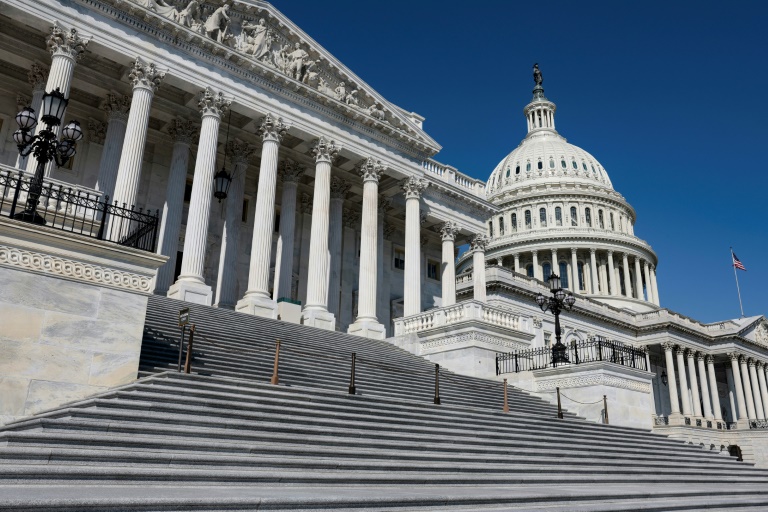
Focus this week is on Federal Reserve boss Jerome Powell’s two days of testimony to lawmakers in Washington, which will be closely watched for some insight into the bank’s thinking and possible clues about its plans for fighting surging prices.

The Fed announced a three-quarter point lift last week, after inflation data days earlier had smashed forecasts and hit a four-decade high.

“While (investors do) not expect Powell to reinvent the policy wheel, we could expect him to reinforce the idea that the Fed is in data-dependent mode,” said Stephen Innes of SPI Asset Management. 

“Hence, any shift in Fed rhetoric will be a function of incoming data, virtually all of which now presents event risk. From that perspective, further evidence of persistent inflation will trigger policy panic, while any signs of sluggish growth momentum will confirm the recession narrative.

“Neither suggests that now is the time to board the rally wagon.”

In early trade, Tokyo, Hong Kong, Shanghai, Sydney, Seoul, Singapore, Wellington, Taipei, Manila and Jakarta all rose.

“There might be a narrative that we’ve hit a bottom, we are oversold, the Fed is taking inflation seriously and that might be slightly bullish in the interim,” Frances Stacy, of Optimal Capital, told Bloomberg TV.

However, while the volatility of last week has gone, banks’ intention to continue hiking rates could cause fresh ructions.

Several officials — including at the Fed, Bank of England, Reserve Bank of Australia and European Central Bank — have come out in recent days to flag a further tightening of borrowing costs.

In commodities markets, oil extended gains as traders moved back in after Friday’s plunge fuelled by concerns over a possible recession.

The gains have been helped by optimism for a boost to demand as China gradually eases out of its period of Covid containment, while the US summer driving period picks up.

– Key figures at around 0230 GMT –

Tokyo – Nikkei 225: UP 1.8 percent at 26,225.15 (break)

Hong Kong – Hang Seng Index: UP 1.1 percent at 21,392.60

Shanghai – Composite: UP 0.1 percent at 3,319.07

Euro/dollar: UP at $1.0534 from $1.0528 Monday

Pound/dollar: UP at $1.2269 from $1.2243

Euro/pound: DOWN at 85.86 pence from 86.02 pence

Dollar/yen: UP at 135.10 yen from 135.06 yen

West Texas Intermediate: UP 2.2 percent at $112.012

Brent North Sea crude: UP 1.6 percent at $115.91 per barrel

London – FTSE 100: UP 1.5 percent at 7,121.81 points (close)

New York – Dow: DOWN 0.1 percent at 29,888.78 (close)
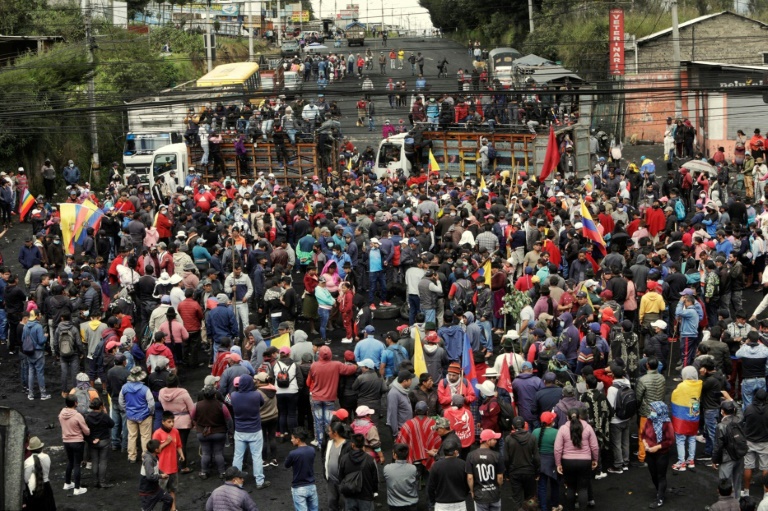
Eighth day of Indigenous fuel price protests in Ecuador

Thousands of Indigenous people and members of other disgruntled groups marched into Ecuador’s capital on the eighth day of fuel price protests Monday, accused by the president of seeking only “chaos” and his removal.

President Guillermo Lasso extended a state of emergency to cover six provinces, with a nighttime curfew in Quito, as he seeks to curtail demonstrations that have seen roads barricaded countrywide, cost the economy tens of millions of dollars, and left dozens of people injured.

“With this decision, the welfare of citizens is safeguarded in the face of violence. At the same time, the rights of those who demonstrate peacefully are protected,” the government said.

On foot, on motorcycles and in crowded trucks, the Indigenous protesters began a peaceful march towards the city center from Cutuglagua, an area in southern Quito where they have been steadily growing in number since Sunday.

A hundred Indigenous people also entered the city from the north.

The powerful Confederation of Indigenous Nationalities of Ecuador (Conaie) — credited with helping topple three presidents between 1997 and 2005 — called the protest as Ecuadorans increasingly struggle to make ends meet.

Indigenous people comprise more than a million of Ecuador’s 17.7 million inhabitants, and their protest has since been joined by students, workers and others feeling the economic pinch.

“We have reached out, we have called for dialogue, but they do not want peace,” Lasso said in a video on Twitter Monday.

“They seek chaos. They want to eject the president.”

Police say 63 personnel have been wounded in clashes and 21 others briefly held hostage since the protests began, while human rights observers reported 79 arrests and 55 civilians wounded.

– ‘Zone of peace’ –

A state of emergency declared last Friday allowed Lasso to mobilize the armed forces to maintain order, suspend certain civil rights and declare curfews.

On Sunday, Ecuadoran police requisitioned an Indigenous cultural center in Quito to use as a base for protest monitoring.

The center had sheltered thousands of Indigenous people during anti-government demonstrations in 2019 that left 11 dead and more than 1,000 injured but forced then-president Lenin Moreno to abandon plans to eliminate fuel subsidies.

The Salesian University, in the north of the capital, decided on Monday to “open the doors” of its facilities as a “zone of peace and humanitarian shelter” for the indigenous people and called “to stop actions and attitudes that interfere or alter the processes of dialogue and the search for solutions.”

Oil producer Ecuador has been hit by rising inflation, unemployment and poverty exacerbated by the coronavirus pandemic.

Fuel prices have risen sharply since 2020, almost doubling for diesel from $1 to $1.90 per gallon and rising from $1.75 to $2.55 for gasoline.

Conaie demands a price cut to $1.50 a gallon for diesel and $2.10 for gasoline.

It also wants food price controls and a commitment to renegotiating the personal bank loans of about four million families.

Russian Nobel laureate sells medal for $103.5 mn to benefit Ukraine kids

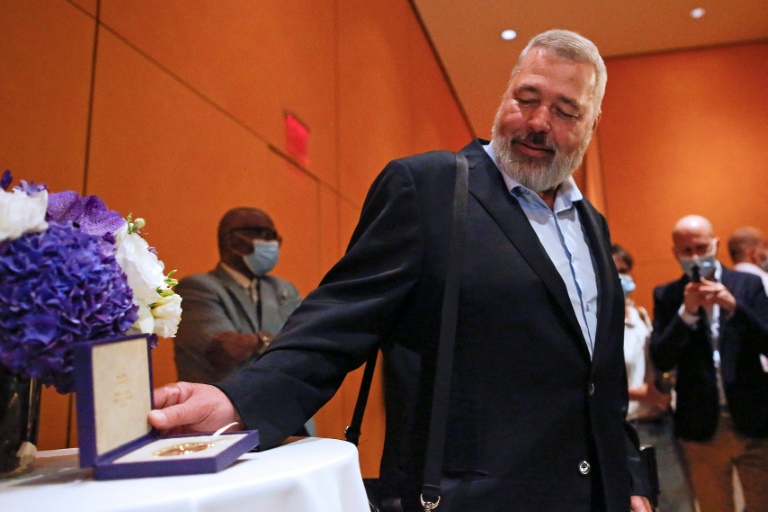
Dmitry Muratov, the Russian editor-in-chief of the independent newspaper Novaya Gazeta, on Monday auctioned off his Nobel Peace Prize gold medal for a whopping $103.5 million to benefit children displaced by the war in Ukraine.

The medal was sold to an as yet unidentified phone bidder at the sale in New York organized by Heritage Auctions.

The sale was a spirited one, with lots of applause and bidders egging one another on to increase the total. Muratov was seen recording videos of the bidding screen and those in the room.

When the final bid came in, at tens of millions of dollars more than the previous offer, many in the room expressed shock, including Muratov himself.

“I’m just like you in that regard,” he told AFP, speaking through a translator after the sale.

Muratov won the prize in 2021 alongside journalist Maria Ressa of the Philippines, with the committee honoring the pair “for their efforts to safeguard freedom of expression.”

He was among a group of journalists who founded Novaya Gazeta in 1993 after the fall of the Soviet Union. 

This year, it became the only major newspaper left voicing criticism of President Vladimir Putin and his tactics inside and outside the country.

In March, more than a month into Moscow’s invasion of Ukraine, Novaya Gazeta suspended operations in Russia, after Moscow adopted legislation providing for tough jail terms against anyone criticizing the Kremlin’s bloody military campaign.

In April, Muratov was assaulted on a train when a person threw oil-based paint mixed with acetone on him, causing his eyes to burn.

Muratov’s medal was available to bidders both in person and online, with all proceeds going to UNICEF’s Humanitarian Response for Ukrainian Children Displaced by War.

When asked why he chose UNICEF as the recipient of the funds, Muratov said: “It’s critical to us that that organization does not belong to any government. It can work above government. There are no borders for it.”

– ‘We must stay in our jobs’ –

Since 2000, six of Novaya Gazeta’s journalists and collaborators have been killed in connection with their work, including investigative reporter Anna Politkovskaya.

Muratov dedicated his Nobel prize to their memory.

On Monday, he hailed the persistence of journalists as an important check on governments, and one way that war can be prevented.

“So no matter how many times each one of us wants to turn in our notice and quit, we must stay in our jobs,” he told AFP. 

Speaking in a video released by Heritage in connection with the sale, the prominent journalist said that winning the Nobel “gives you an opportunity to be heard.”

“The most important message today is for people to understand that there’s a war going on and we need to help people who are suffering the most,” he said.

Air industry could fly back into black next year, IATA says

Global air transport is on course to return to profit after two pandemic-battered years but the war in Ukraine and the cost-of-living crisis lurk as threats, the industry’s world body said on Monday.

Renewed profitability “appears within reach” in 2023, the International Air Transport Association said, predicting a rebound in passenger levels to 83 percent of pre-pandemic levels this year.

Industry losses are expected to drop to $9.7 billion in 2022, a “huge improvement” from $137.7 billion in 2020 and $42.1 billion in 2021, IATA said in an upgraded industry outlook at its annual general meeting in Doha.

“Airlines are resilient. People are flying in ever greater numbers. And cargo is performing well against a backdrop of growing economic uncertainty,” IATA director general Willie Walsh said.

The air industry was sent reeling by the pandemic, with passenger numbers plunging 60 percent in 2020 and remaining 50 percent down in 2021. Airlines lost nearly $200 billion over two years.

While some firms in the sector went bankrupt, others — often those backed by states — have emerged with profits intact.

IATA said there were positive signs in the latest figures, with North American carriers expected to return an $8.8 billion profit this year.

More than 1,200 aircraft are expected to be delivered in 2022, while cargo volumes should reach a record 68.4 million tonnes “despite economic challenges”, it added.

“Strong pent-up demand, the lifting of travel restrictions in most markets, low unemployment in most countries, and expanded personal savings are fuelling a resurgence in demand that will see passenger numbers reach 83 percent of pre-pandemic levels in 2022,” IATA said.

– Clouds on the horizon –

Turnover should reach 93 percent of 2019 levels this year or $782 billion, a rebound of 54.5 percent on 2021, as revenues from passenger flights more than double to $498 billion.

Cargo, a rare bright spot for air transport in the depths of the pandemic, will retreat slightly with revenues of $191 billion — still double the level of 2019.

Clouds remain on the horizon, however, especially the war in Ukraine after the closure of Russian airspace to several long-haul carriers forced them into costly detours.

Airlines, desperate to put the coronavirus pandemic behind them, are facing a potential summer of chaos with shortages and strikes that could threaten their recovery.

In the past few weeks, delays and cancellations caused by a lack of staff at airports and strikes for better pay have wreaked havoc upon travellers.

The problems originate with the pandemic when airlines and airports laid off thousands of workers during its worst-ever crisis. Now, they are scrambling for employees.

However, Walsh played down the difficulties, saying they weren’t widespread and should ease in time.

High inflation will also erode the purchasing power of consumers, although airlines could profit from rising prices and interest rates as their debts are locked in at lower levels.

Meanwhile, the industry remains wary of new coronavirus variations that could close borders once again. 

China is still bound up with restrictions that are depressing the world’s second-biggest domestic market and are creating “chaos” in global logistics, said IATA’s chief economist Marie Owens Thomsen.

IATA originally planned to hold its annual general meeting in Shanghai, but moved it to Qatar as China, pursuing its “zero-Covid” policy, continues to grapple with the pandemic.

Dutch join Germany, Austria, in reverting to coal

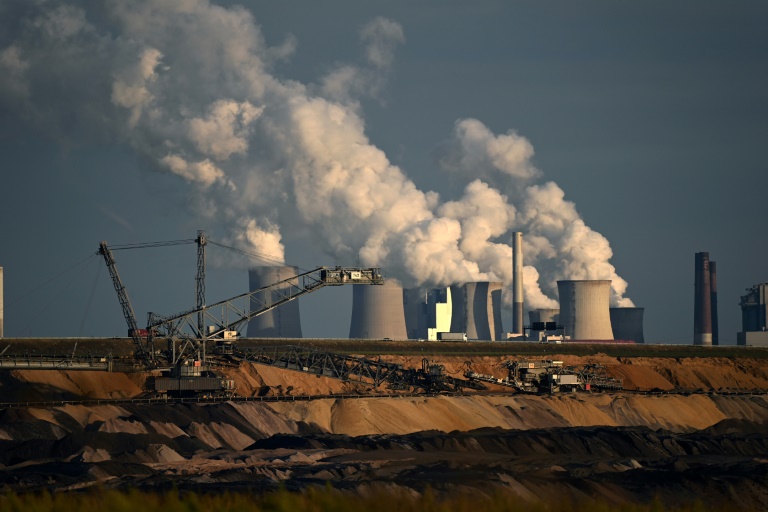
The Dutch joined Germany and Austria in reverting to coal power on Monday following an energy crisis provoked by Russia’s invasion of Ukraine.

The Netherlands said it would lift all restrictions on power stations fired by the fossil fuel, which were previously limited to just over a third of output.

Berlin and Vienna made similar announcements on Sunday as Moscow, facing biting sanctions over Ukraine, cuts gas supplies to energy-starved Europe.

“The cabinet has decided to immediately withdraw the restriction on production for coal-fired power stations from 2002 to 2024,” Dutch climate and energy minister Rob Jetten told journalists in The Hague.

The Dutch minister said his country had “prepared this decision with our European colleagues over the past few days”.

Germany however said it still aimed to close its coal power plants by 2030, in light of the greater emissions of climate-changing CO2 from the fossil fuel.

“The 2030 coal exit date is not in doubt at all,” economy ministry spokesman Stephan Gabriel Haufe said at a regular news conference.

The target was “more important than ever”, he added.

– ‘More countries being squeezed’ –

Russia’s invasion of its pro-Western neighbour has sent global prices for energy soaring and raised the prospect of shortages if supplies were to be cut off. 

Russian energy giant Gazprom has already stopped deliveries to a number of European countries, including Poland, Bulgaria, Finland and the Netherlands.

Germany’s reliance on Russian energy imports has made it particularly vulnerable as Moscow looks for leverage against the West.

The Dutch are less reliant, depending on Russia for around 15 percent of their gas supplies compared to the EU average of 40 percent. But they are still concerned.

“I want to emphasise that at the moment there’s no acute gas shortage,” Dutch minister Jetten said. “However, more countries are now being squeezed (by Russia). That worries us.” 

The Dutch government said it was also making an “urgent appeal” to companies and business to save as much energy as possible ahead of the winter.

Germany’s decision to power up its coal power plants came after Gazprom cut deliveries to Germany via the Nord Stream gas pipeline last week.

The move, presented by Gazprom as a technical issue, has been criticised as “political” by Berlin. 

German Economy Minister Robert Habeck, a Green party politician, described the decision to revert to coal as “bitter, but indispensable for reducing gas consumption”.

– ‘Unexpected situation’ –

Austria’s government meanwhile announced Sunday that it would reopen a mothballed coal power station because of power shortages arising from reduced deliveries of gas from Russia.

The authorities would work with the Verbund group, the country’s main electricity supplier, to get the station in the southern city of Mellach back in action, said the Chancellery.

The European Commission noted Monday that “some of the existing coal capacities might be used longer than initially expected” because of the new energy landscape in Europe.   

“We know that the energy mix and the plans of member states will adjust slightly because we are in an unexpected situation,” Commission spokesman Tim McPhie said at a press briefing. 

Germany, Europe’s largest economy, has managed to reduce the share of its natural gas supplied by Russia from 55 percent before the invasion to 35 percent.

The government has also mandated the filling of gas reserves to 90 percent ahead of the European winter at the end of the year, to hedge against a further reduction in supply.

Germany’s government, a coalition between the Social Democrats, Liberals and Greens, aims “ideally” to close all coal power plants by 2030.

Their agreement, reached at the end of last year, brought forward the previous government’s aim to shut the plants by 2038.

burs-dk/jhe/jj

Tens of thousands salute triumphant Warriors in San Francisco

Tens of thousands of fans poured onto the streets of San Francisco on Monday to salute the victorious Golden State Warriors as the team celebrated its fourth NBA championship in eight seasons with an open-top bus parade.

A blizzard of blue and gold confetti billowed along downtown San Francisco’s Market Street as buses carrying the Warriors players and team staff made their way along the 1.4 mile-long parade route.

The Warriors clinched their seventh NBA crown on Thursday after defeating the Boston Celtics on the road in game six of the finals to close out a 4-2 series victory.

The victory completed a triumphant return to the pinnacle of the sport just two years after the Warriors finished the 2019-2020 season with the worst record in basketball.

Warriors talisman Stephen Curry — wearing a gold chain carrying his collection of NBA championship rings — led the festivities as Golden State players sprayed hordes of fans with champagne in brilliant sunshine.

“I had to bring the jewelry back out,” Curry said of his ring-laden necklace.

“I don’t look at it during the year. Every so often though you gotta remind yourself -– we got four!”

Curry said the Warriors had been motivated to get back in the winner’s circle after a painful defeat in the 2019 NBA Finals.

“I’d be lying if I said I knew we’d be champions because it’s a lot of work –- but sometimes you’ve got to manifest it,” Curry said. 

“We had some reverses, hit some road bumps, but peaked at the right time and everybody, 1 through 16, our coaching staff, everyone, played a significant part in this.”

– ‘An amazing year’ –

The Warriors’ defensive star Draymond Green paid tribute to the Warriors players and team personnel that made the win possible.

“This has been an amazing year,” Green said. “I told you no one could stop us from winning a championship. I warned you all. 

“I really love this group, and when I say this group, I mean this entire group.

“There were times in the past when we won a championship and everything didn’t have to be aligned, like we were just that good. 

“But for this to work, every single person up here had to be aligned. It’s just so special.

“You talk about which championship means more, but the reality is every single one of them has their own journey.

“What you appreciate about the journey is the people you go through it with. And what brings me the most joy is seeing the guys who are winning it for the first time.”

Warriors coach Steve Kerr meanwhile revealed he had been inundated with messages of congratulations ranging from fellow NBA coaches such as Gregg Popovich to former president Barack Obama.

“I got a text from president Obama, which was pretty cool. That was pretty special,” Kerr said. 

“This is incredible. When we started camp I thought we would be pretty good but I didn’t know we could win the whole thing. 

“To be sitting here enjoying the parade and feeling the love of the whole Bay Area is pretty incredible.”

Kerr once again reserved special praise for Warriors star Curry, the NBA Finals MVP.

“We’ve got a bunch of great guys who want to play together,” said Kerr. 

“And it starts with Steph. Everybody wants to play with and for Steph, and we just had a great group of guys and that’s the key.”

Kyiv braces for heavier fighting as Russia-EU tensions climb

Moscow’s blockade of Ukrainian grain exports and a rail transit row sparked fresh tensions between Russia and the European Union on Monday, as Kyiv warned that Russian troops were intensifying their battle for control of eastern Ukraine.

Ukrainian President Volodymyr Zelensky accused Russia of holding Africa “hostage” by blocking wheat deliveries, which has spurred food shortages and fears of famines in vulnerable areas.

Russia hit back by blaming soaring grain prices on the West’s “destructive” policies and “illegal restrictions” imposed since the war began.

Nearly four months after Russia launched its bloody invasion, Zelensky said Ukraine was headed into a “fateful” week with EU leaders set to discuss Kyiv’s bid to become a candidate for bloc membership on Thursday and Friday.

European Council President Charles Michel on Monday invited the bloc’s leaders to back granting candidate status to Ukraine and Moldova ahead of the pivotal Brussels summit.

Zelensky warned to expect heavier fighting in the days to come in strategic areas in eastern Ukraine already under relentless Russian bombardment.

Ukraine said Russian troops appeared to be making small gains, including capturing a village near the industrial city of Severodonetsk, a focus of recent fighting.

The fallout from the war continued to reverberate beyond Ukraine’s borders, with Russia threatening EU member Lithuania over its “openly hostile” restrictions on the rail transit of goods to Moscow’s exclave of Kaliningrad.

Russia’s foreign ministry said if the cargo transit between Kaliningrad and the rest of the country was not fully restored “Russia reserves the right to take actions to protect its national interests”.

Lithuania and EU foreign policy chief Josep Borrell said the ban was in line with European sanctions over Moscow’s aggression.

Turkey dealt a fresh blow to Sweden and Finland’s hopes for swift NATO membership on Monday, saying next week’s alliance summit in Madrid was not a deadline.

NATO chief Jens Stoltenberg said talks between Turkey, Sweden and Finland in Brussels were “constructive” but conceded that Ankara’s “legitimate” concerns had not been fully addressed.

Turkey says the Nordic nations offer a safe haven to the Kurdistan Workers’ Party, an organisation listed as a “terrorist” group by its Western allies.

Elsewhere on the diplomatic front, US President Joe Biden said it was “not likely” that a trip to Europe this week would include Ukraine, after the leaders of France, Germany, Italy and Britain met Zelensky in Kyiv last week.

Biden is one of few Western leaders yet to visit the country since Russia’s invasion.

– ‘Complex’ grain talks –

The West’s deteriorating relationship with Moscow was highlighted in harsh comments from Borrell, who called Russia’s blockade of vitally needed grain exports from Ukraine “a real war crime”.

“One cannot imagine that millions of tonnes of wheat remain blocked in Ukraine while in the rest of the world people are suffering hunger,” Borrell said as EU foreign ministers met in Luxembourg.

Moscow denies responsibility for the disruption to deliveries. 

Russian foreign ministry spokeswoman Maria Zakharova on Monday called the West “provokers and destroyers”, blaming its policies and anti-Russian sanctions for the logistical upheaval that has pushed up cereal prices and fanned fears of famines in vulnerable regions. 

Zelensky said Ukraine was engaged in “complex multilevel negotiations” to end Russia’s blockade of Ukrainian ports.

“But there is no progress yet… That is why the global food crisis will continue as long as this colonial war continues,” he said in a video address to the African Union.

Germany said it will host a meeting on Friday on the crisis, with US Secretary of State Antony Blinken among those attending.

– Oil site strike –

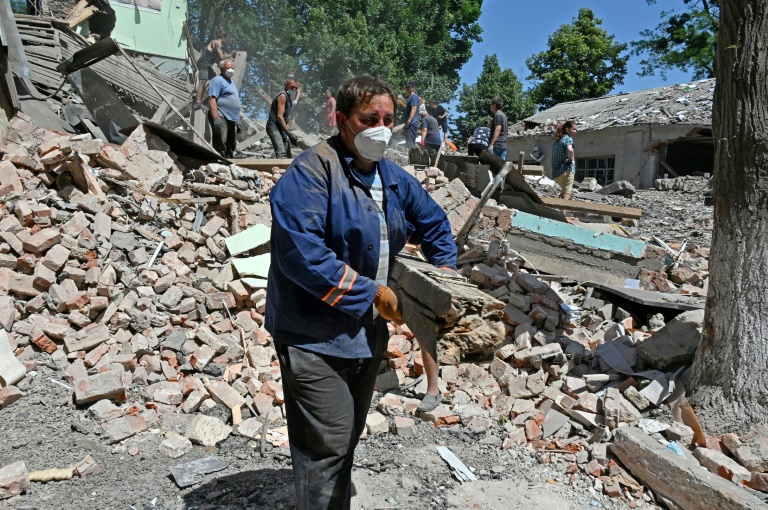
On the ground, Ukraine’s presidency said the intensity of shelling in the Donetsk area of the eastern Donbas region was “growing along the entire frontline”, leaving at least one person dead over the last 24 hours and injuring seven others, including a child.

Ukraine announced it had lost control of the village of Metyolkine, adjacent to Severodonetsk.

In Severodonetsk, “Russians control most of the residential areas”, the head of the city administration Oleksandr Stryuk told Ukrainian television Monday.

A chemical plant in Severodonetsk where hundreds of civilians are said to be sheltering was being shelled “constantly”, Ukraine said.

Kyiv also reported heavier Russian shelling in the Kharkiv region in the northeast.

Crimea leader Sergey Aksyonov said three people were injured and seven more missing after Ukrainian forces attacked oil drilling platforms in the Black Sea off the coast of the peninsula annexed by Russia in 2014.

Aksyonov vowed that search and rescue operations would continue.

It was the first reported strike against offshore energy infrastructure in Crimea since Russia launched its invasion.

– Energy crisis –

The Ukraine war is fuelling not only a global food crisis but an energy crisis too. 

Hit by punishing sanctions, Moscow has turned up the pressure on European economies by sharply reducing gas supplies, which has in turn sent energy prices soaring.

The Netherlands on Monday lifted restrictions preventing its coal-fired power stations from operating at full capacity to counter the fall in Russian gas supplies, a day after Germany and Austria took similar steps.

But Berlin insisted it still aims to close its coal power plants by 2030.

China’s imports of oil from Russia meanwhile jumped by 55 percent year on year in May, customs data showed Monday, helping to make up for losses from Western sanctions as Beijing refuses to publicly condemn Moscow’s war.

burs-mfp/imm/pvh

No relief as heat wave in US moves east

A heat wave that baked much of the central United States last week will start to move eastward with dangerously high temperatures, forecasters said Monday.

The National Weather Service told Americans to gird for another day of well above normal, near-record or even record-breaking heat from the central Plains to the Upper Midwest.

“Dangerous heat will continue to make headlines,” the service said in an advisory.

The scorching blast will start to drift eastward Tuesday into the Great Lakes region with highs in the upper 90s Fahrenheit (mid 30s Celsius) — which is up to 20 degrees F above normal.

Around 120 million people were under some sort of advisory last week as a heat wave burned the Upper Midwest and the Southeast. 

This stemmed from what forecasters called a dome of high pressure, with wild weather such as thunderstorms, flash flooding and extreme rainfall erupting around its edges.

Yellowstone National Park, the oldest in the United States, closed down last week because of extensive flood damage as roads were washed away.

Torrential rainfall and snowmelt sent months’ worth of run-off into rivers in just a couple of days. The sprawling park sits mainly in Wyoming and is home to the Old Faithful geyser.

Helicopters were used to rescue nearly 90 people.

The park said its southern section will reopen to visitors on Wednesday, but officials say other parts will remain closed for the rest of the season.

As heat scorched the southwest, a wildfire burning its way up a mountainside in Arizona consumed four buildings at the Kitt Peak National Observatory but they apparently did not contain telescopes or other scientific equipment, officials said.

“This is the most threatening fire I can remember at Kitt Peak in the last 25 years,” said Buell Jannuzi, who heads the University of Arizona astronomy department, according to ABC News. 

The university is a tenant at the observatory, which is operated by the National Science Foundation.

A fire was raging meanwhile in the Wharton State Forest in the northeastern state of New Jersey, officials said.

The New Jersey Forest Fire Service said the blaze, which began on Sunday, had consumed 7,200 acres (2,900 hectares) by Monday and was 45 percent contained.

It said 18 structures were threatened but no injuries have been reported.

Wildfires are common in the western United States during the summer but are unusual in the east of the country.

Dutch join Germany, Austria, in reverting to coal

The Dutch joined Germany and Austria in reverting to coal power on Monday following an energy crisis provoked by Russia’s invasion of Ukraine.

The Netherlands said it would lift all restrictions on power stations fired by the fossil fuel, which were previously limited to just over a third of output.

Berlin and Vienna made similar announcements on Sunday as Moscow, facing biting sanctions over Ukraine, cuts gas supplies to energy-starved Europe.

“The cabinet has decided to immediately withdraw the restriction on production for coal-fired power stations from 2002 to 2024,” Dutch climate and energy minister Rob Jetten told journalists in The Hague.

The Dutch minister said his country had “prepared this decision with our European colleagues over the past few days”.

Germany however said it still aimed to close its coal power plants by 2030, in light of the greater emissions of climate-changing CO2 from the fossil fuel.

“The 2030 coal exit date is not in doubt at all,” economy ministry spokesman Stephan Gabriel Haufe said at a regular news conference.

The target was “more important than ever”, he added.

– ‘More countries being squeezed’ –

Russia’s invasion of its pro-Western neighbour has sent global prices for energy soaring and raised the prospect of shortages if supplies were to be cut off. 

Russian energy giant Gazprom has already stopped deliveries to a number of European countries, including Poland, Bulgaria, Finland and the Netherlands.

Germany’s reliance on Russian energy imports has made it particularly vulnerable as Moscow looks for leverage against the West.

The Dutch are less reliant, depending on Russia for around 15 percent of their gas supplies compared to the EU average of 40 percent. But they are still concerned.

“I want to emphasise that at the moment there’s no acute gas shortage,” Dutch minister Jetten said. “However, more countries are now being squeezed (by Russia). That worries us.” 

The Dutch government said it was also making an “urgent appeal” to companies and business to save as much energy as possible ahead of the winter.

Germany’s decision to power up its coal power plants came after Gazprom cut deliveries to Germany via the Nord Stream gas pipeline last week.

The move, presented by Gazprom as a technical issue, has been criticised as “political” by Berlin. 

German Economy Minister Robert Habeck, a Green party politician, described the decision to revert to coal as “bitter, but indispensable for reducing gas consumption”.

– ‘Unexpected situation’ –

Austria’s government meanwhile announced Sunday that it would reopen a mothballed coal power station because of power shortages arising from reduced deliveries of gas from Russia.

The authorities would work with the Verbund group, the country’s main electricity supplier, to get the station in the southern city of Mellach back in action, said the Chancellery.

The European Commission noted Monday that “some of the existing coal capacities might be used longer than initially expected” because of the new energy landscape in Europe.   

“We know that the energy mix and the plans of member states will adjust slightly because we are in an unexpected situation,” Commission spokesman Tim McPhie said at a press briefing. 

Germany, Europe’s largest economy, has managed to reduce the share of its natural gas supplied by Russia from 55 percent before the invasion to 35 percent.

The government has also mandated the filling of gas reserves to 90 percent ahead of the European winter at the end of the year, to hedge against a further reduction in supply.

Germany’s government, a coalition between the Social Democrats, Liberals and Greens, aims “ideally” to close all coal power plants by 2030.

Their agreement, reached at the end of last year, brought forward the previous government’s aim to shut the plants by 2038.

burs-dk/jhe/jj

Petrobras CEO quits in fuel price standoff with Bolsonaro

The CEO of Brazil’s state-owned oil company Petrobras, who has stayed in his post despite being fired by Jair Bolsonaro in May, resigned Monday after a new fuel price hike that enraged the far-right president.

Jose Mauro Coelho is the third Petrobras CEO to leave since February last year in a stand-off between the company and Bolsonaro over fuel prices.

Petrobras announced Coelho’s resignation on Monday.

The company said Fernando Borges — its head of exploration and production — would take over temporarily until government pick Caio Paes de Andrade, an economy ministry official, assumes the top job.

Coelho was appointed for a one-year term in April after Bolsonaro fired his predecessor Joaquim Silva e Luna in March after slightly more than a year in the post.

The far-right president said then that the price of petrol — set by Petrobras but tied to international market movement — was “unaffordable” and amounted to a “crime” against Brazilians.

Silva e Luna, in turn, had replaced Roberto Castello Branco, fired by Bolsonaro in February 2021.

– ‘Absurd’ profits –

In May, Bolsonaro dismissed Coelho after just 40 days on the job. He had been waiting to be formally removed at the company’s next shareholders’ meeting, scheduled for July.

Bolsonaro, seeking reelection in October, is widely blamed by voters for double-digit inflation, polls show, on the back of skyrocketing global and local fuel prices.

Bolsonaro faces an uphill battle against leftist ex-president Luiz Inacio Lula da Silva (2003-2010), remembered for presiding over a booming economy.

Brazil has seen fuel prices surge by over 33 percent in a year, according to official figures.

Inflation stands at 11.73 percent, far above the central bank’s target of 3.5 percent.

Russia’s war in Ukraine has led to a sharp rise in crude prices in recent weeks, adding to the pressure.

On Friday, Petrobras announced a 5.18-percent hike in gasoline prices and more than 14 percent for diesel, blaming “a challenging scenario in Brazil and the world.”

Bolsonaro reacted angrily, saying Petrobras “could sink Brazil in chaos.”

The company reported a net profit of 44.6 billion reais (about $8,6 billion) in the first quarter of this year — about 38 times the result of a year earlier.

Arthur Lira, the president of Brazil’s chamber of deputies and a Bolsonaro ally, has proposed raising taxes on Petrobras profits — which he has described as “absurd.”

Congress is also mulling a Bolsonaro proposal to lower the tax on fuel.

Petrobras shares fell two percent on the Sao Paulo Stock Exchange after a temporary halt to morning trading on news of Coelho’s resignation.

Close Bitnami banner
Bitnami