US Business

EU backs Ukraine's 'European dream' as Russia cuts gas supplies

Europe sent a powerful symbol of solidarity with Ukraine on Friday, when Brussels backed Kyiv’s bid for EU candidate status, even as Russia shelled frontline Ukrainian cities and cut back gas supplies to the West.

With the European Commission’s backing, Ukraine could now be added to the list of countries vying for EU membership as early as next week, when member state leaders meet at their Brussels summit. 

All 27 EU leaders will have to agree to the candidacy, but the heads of the European Union’s biggest members — France, Germany and Italy — already gave their full-throated support to the idea on Thursday, on a trip to a war-torn suburb of Kyiv.

Then on Friday, the European Commission gave the executive’s formal backing to the bid, and EU chief Ursula von der Leyen made her position clear by donning a striking jacket in Ukraine’s national colours.

“We all know that Ukrainians are ready to die for the European perspective. We want them to live with us for the European dream,” she said.

Ukraine’s President Volodymyr Zelensky immediately welcomed the decision as a “first step on the EU membership path that’ll certainly bring our victory closer”.

He thanked von der Leyen for the commission’s “historic decision” and said he expected that EU leaders would give Ukraine a “positive result” at the June 23-24 summit.

As Brussels celebrated their breakthrough, British Prime Minister Boris Johnson — whose country has left the European Union — returned to Kyiv for his second visit since Russia’s February 24 invasion. 

“Many days of this war have proved that Great Britain’s support for Ukraine is firm and resolute,” Zelensky wrote on social media. Johnson’s office tweeted a picture of the premier meeting the Ukrainian leader, carrying a stack of books and paperwork under one arm.

“My visit today, in the depths of this war, is to send a clear and simple message to the Ukrainian people: the UK is with you, and we will be with you until you ultimately prevail,” Johnson said.

According to Downing Street, Johnson offered to launch a major training operation for Ukrainian forces, to train up to 10,000 soldiers every 120 days and “change the equation of the war”.

Each Ukrainian soldier would spend three weeks on the British training course, learning combat tactics, basic medical skills, cyber-security and counter explosive tactics.

Russia responded to Brussels’ decision with scorn, accusing the West of “manipulating” Ukraine with promises of integration. 

– Russian bombardment –

Foreign ministry spokeswoman Maria Zakharova said Ukraine “is not getting a bright future, for some reason, despite the promises becoming more and more sweet and alluring”.

Once Ukraine joins the EU candidates’ list — alongside several countries in the western Balkans — it could still take years to meet all the formal membership requirements, even if Kyiv prevails in the war.

“Yes, Ukraine should be welcomed as a candidate country — this is based on the understanding that good work has been done but important work also remains to be done,” von der Leyen said.

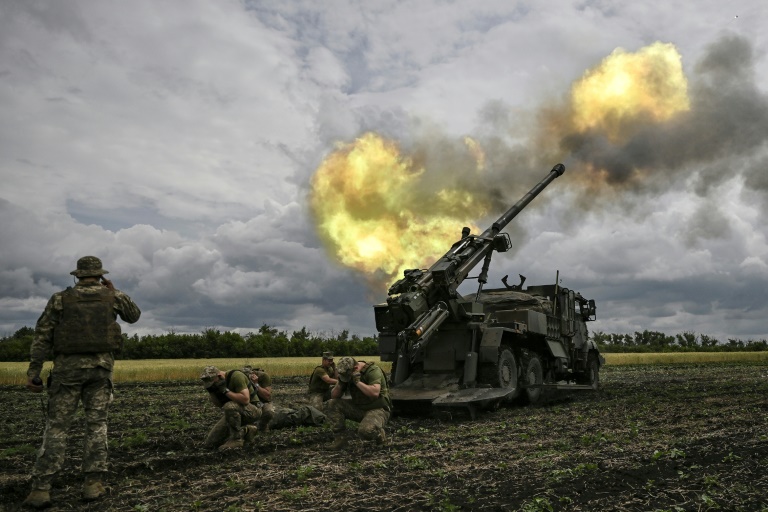
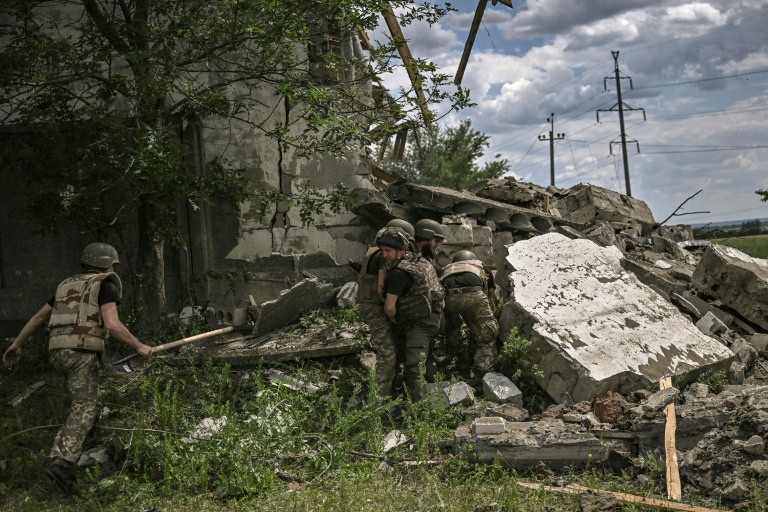
And in the meantime, the fighting continues, with Russian forces bombarding Ukrainian pockets of resistance in frontline Severodonetsk, including civilians holed up in a chemical plant in the eastern Ukrainian city.

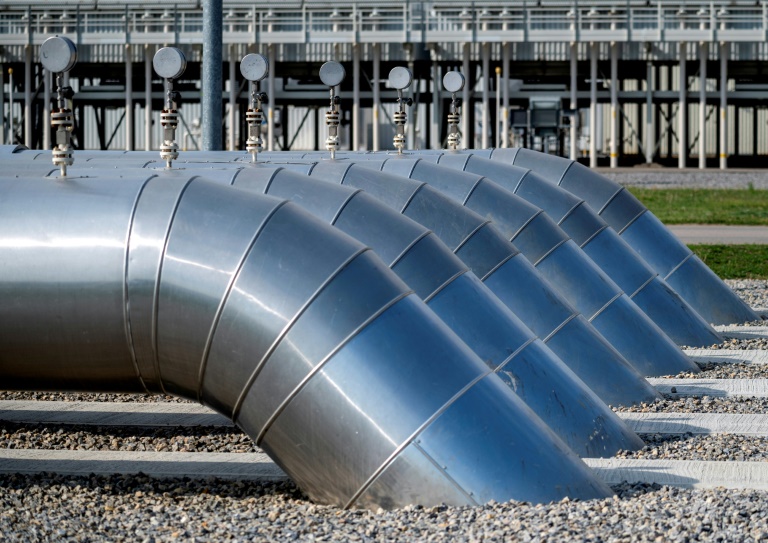
And Moscow turned up the pressure on Western allies, sharply reducing flows of natural gas in its pipelines to Western Europe, driving up energy prices.

France’s network provider said it had not received any Russian gas by pipeline from Germany since June 15, and Italy’s Eni said it expected Russian firm Gazprom to cut its supplies by half on Friday.

Several European countries, including Italy and Germany, are highly reliant upon Russian gas for their energy needs and, as the West sides with Ukraine, Moscow is cutting supplies.

– ‘Extremely alarming’ –

Berlin and Rome have rejected Russia’s argument that technical issues have caused the drop in supplies, arguing that state-owned Gazprom’s move is political.

But western Europe is sweltering in a heatwave and energy prices are already soaring, adding to runaway inflation and industrial action in several economies.

The situation is, of course, starker in Ukraine itself, where Russian troops have occupied a swathe of the south and east of the country during the 113-day war, including much of the Donbas region.

“The humanitarian situation across Ukraine — particularly in the eastern Donbas — is extremely alarming and continues to deteriorate rapidly,” the UN humanitarian agency, OCHA, said.

The statement said the situation is “particularly worrying in and around Severodonetsk” — where bloody battles have raged for weeks. 

Severodonetsk is in the Lugansk region, where governor Sergiy Gaiday called for a ceasefire, stating hundreds of civilians were trapped in the besieged Azot chemical plant in the city.  

“It is now impossible and physically dangerous to get out of the plant due to constant shelling and fighting. There are 568 people in the shelter, including 38 children,” he said.

– ‘God’s will’ –

Gaiday said earlier this week that around 10,000 civilians remained in the city, which is controlled mostly by Russian forces.

In the frontline Donbas village of Adamivka near the city of Sloviansk, a community of Orthodox nuns have seen a rocket hole blasted into the wall of their well-tended garden.

Under near-constant bombardment by Russian forces, Sister Anastasi and a group of other black-clad nuns and pilgrims live day-to-day, praying for deliverance.

“We are all alive, yes. No one has left. This is our home,” she said quietly, her face framed by a black veil, as shells crashed in the distance.

“We trust in God’s will, in God’s help, in the help of all the saints and the Holy Virgin. This is our home, we have nowhere else to go.” 

At least two people were killed and 20 injured in a Russian strike on a residential area in the southern Ukrainian city of Mykolaiv, the local governor said.

Separately, Zelensky announced an end to the visa-free travel that Russian citizens, many of whom have Ukrainian relatives, have enjoyed since Ukraine became independent from the Soviet Union in 1991.

burs-dc/har
Biden calls clean energy matter of national security

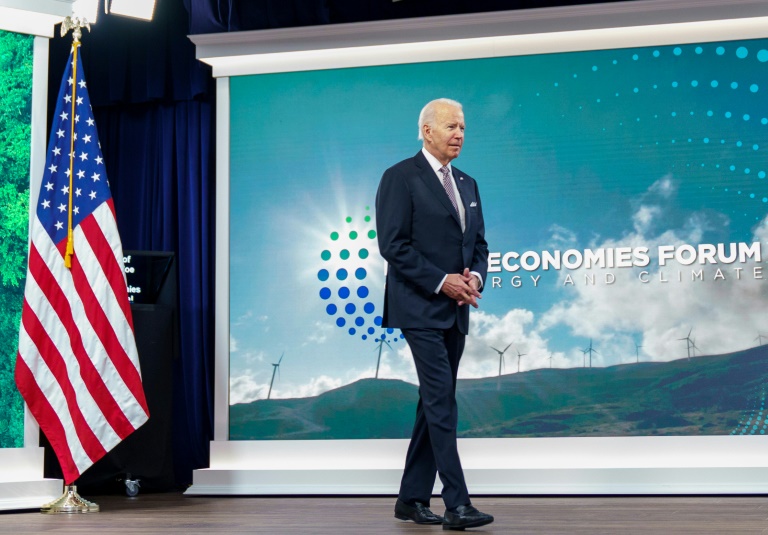
US President Joe Biden told a climate conference for major economies Friday that Russia’s war in Ukraine shows the shift to renewable energy is a matter of national security as well as key to preventing global warming.

“Russia’s brutal and unprovoked assault on its neighbor Ukraine has fueled a global energy crisis and sharpened the need to achieve longterm reliable energy security and security,” Biden told the virtual summit hosted from the White House. “The good news is that climate security and energy security go hand in hand.”

This was Biden’s third convening of the Major Economies Forum on Energy and Climate since he took office in 2021 with a vow to make the United States a leader in the world’s attempt to halt catastrophic global warming.

But it comes just as Biden faces public anger over soaring fuel prices linked to fallout from Russia’s invasion of Ukraine. At the same time, European countries are struggling to find ways to circumvent dependence on Russian oil and gas imports.

In his speech, UN Secretary General Antonio Guterres delivered a blistering attack on the oil and gas industry, accusing it of mirroring tobacco companies’ tactics to push a “false narrative to minimize their responsibility for climate change.”

“Nothing could be more clear or present than the danger of fossil fuel expansion. Even in the short-term, fossil fuels don’t make political or economic sense. Yet we seem trapped in a world where fossil fuel producers and financiers have humanity by the throat,” he said.

However, the UN chief’s message ran counter to the political realities facing Biden as he tries to persuade the domestic oil industry to amp up production and prepares for a visit to Saudi Arabia next month.

Americans are currently paying an average of $5 a gallon to fill their cars, up from $3 a year ago, and the hike is in turn fueling wider inflation, now at a 40-year high.

– India, Russia absent –

A senior Biden administration official said 23 countries were represented at the video conference, representing most of the world’s major economies and “focused around the mitigation that they will be taking” on climate impacts.

At a previous session in September 2021, Biden and the European Union announced a pledge to cut emissions of methane, a planet-warming gas. This was formally launched at the COP26 UN climate summit in Glasgow and now has 115 countries signed on.

Friday’s gathering was the largest leader-level gathering before COP27, the follow-up summit, set to take place in Egypt this November.

But highlighting diplomatic complications besetting the search for international cooperation on the global climate threat, Russia did not attend Friday’s summit.

China was represented only at the level of its climate envoy, rather than President Xi Jinping, the White House said. And India was not on the official list of attendees, either.

– Methane opportunity –

Warning that the world must not let global climate change mitigation goals “slip out of our reach,” Biden said “the window for action is rapidly narrowing.”

Despite the scramble to adapt global energy markets to fallout from the Ukraine war, Biden insisted that longterm climate management, immediate economic goals and ending reliance on energy exporter Russia can all work together.

He cited the global pledge to end methane gas leaks and the practice of burning off, or flaring, unwanted gas at oil fields, calling on countries to “ramp up” their responses.

European economies are heavily reliant on Russian energy, but Biden said an end to methane waste alone could solve that problem.

“Each year our existing energy system leaks enough methane to meet the needs for the entire European power sector. We flare enough gas to offset nearly all of the EU’s gas imports from Russia,” he said.

“So by stopping the leaking and flaring of this super-potent greenhouse gas and capturing this resource for countries that need it we’re addressing two problems at once.”

Stocks rise but recession fears linger

US and European stock markets rose Friday after a global rout, but investors remain anxious that inflation-fighting interest rate hikes could spark a recession.

Investors were shaken this week after the US Federal Reserve unleashed its biggest hike in borrowing costs for almost 30 years to tackle runaway consumer prices.

This was followed by the fifth straight hike by the Bank of England and the first in 15 years by the Swiss central bank, underscoring the growing global concerns about inflation.

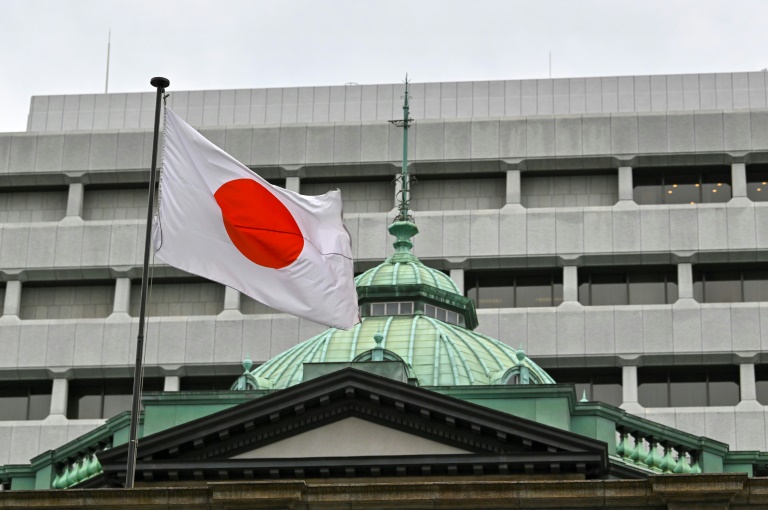
On Friday, however, the Bank of Japan stood by its decision not to raise its rate, sending the yen close to the lowest level against the dollar since 1998.

Officials in Tokyo insist that low rates are still needed to nurture a struggling economy, though the BoJ did say it “was necessary to pay due attention to developments in financial and foreign exchange markets”.

Asian stock markets mostly closed lower Friday after an overnight slump on Wall Street.

US indices opened higher on Friday, with the Dow back up above 30,000 points after falling below the mark for the first time in more than a year. 

European markets were all about 0.5 percent higher in afternoon trading, lower than earlier in the day.

“Stock markets are ending the week on a positive note, not that anyone is getting carried away with today’s price action after turbulent trading conditions in recent days,” said Craig Erlam, analyst at OANDA online trading platform.

“Recessions are increasingly likely as central banks race to dramatically raise rates before inflation spirals out of control,” he said.

– ‘Sinking feeling’ –

Commentators remain unconvinced that Friday’s rebound would be prolonged — because they argue that further rate tightening is needed to bring down sky-high inflation.

Investors worry that while the rate increases can help tame inflation, they can have the adverse side effect of crimping economic growth.

“There is unlikely to be sustained relief from the sinking feeling that has hit financial markets this week, as worries rise that countries around the world won’t avoid falling into the economic pit of recession,” said Hargreaves Lansdown analyst Susannah Streeter.

“After the initial boost of optimism that the Federal Reserve was going to get a handle on inflation… concerns mounted that the price spiral was going to be an even harder nut to crack without fresh aggressive hikes.”

Stock markets have been tumbling for months as traders contemplate the end of the era of cheap cash that had sent share prices to record or multi-year highs.

Inflation worldwide stands at levels not seen for decades owing in particular to surges in energy and food prices.

Oil prices, however, fell by more than two percent on Friday, though they remained elevated at more than $117 per barrel for the main international contract.

– Key figures at around 1340 GMT –

New York – Dow: UP 0.3 percent at 30,012.30 points

London – FTSE 100: UP 0.5 percent at 7,079.02 

Frankfurt – DAX: UP 0.6 percent at 13,119.37 

Paris – CAC 40: UP 0.6 percent at 5,921.31

EURO STOXX 50: UP 0.7 percent at 3,453.20

Tokyo – Nikkei 225: DOWN 1.8 percent at 25,963.00 (close)

Hong Kong – Hang Seng Index: UP 1.1 percent at 21,075.00 (close)

Shanghai – Composite: UP 1.0 percent at 3,316.79 (close)

Euro/dollar: DOWN at $1.0482 from $1.0549 late Thursday

Pound/dollar: DOWN at $1.2235 from $1.2353

Euro/pound: UP at 85.68 pence from 85.41 pence

Dollar/yen: UP at 134.80 yen from 132.21 yen

Brent North Sea crude: DOWN 2.2 percent at $117.15 per barrel

West Texas Intermediate: DOWN 2.4 percent at $112.45

burs-lth/jv

EU backs Ukraine's 'European dream' as Russia cuts gas supplies

Europe sent a powerful symbol of solidarity with Ukraine on Friday, when Brussels backed Kyiv’s bid for EU candidate status, even as Russia shelled frontline Ukrainian cities and cut back gas supplies to the West.

With the European Commission’s backing, Ukraine could now be added to the list of countries vying for EU membership as early as next week, when member state leaders meet at their Brussels summit. 

All 27 EU leaders will have to agree to the candidacy, but the heads of the European Union’s biggest members — France, Germany and Italy — already gave their full-throated support to the idea on Thursday, on a trip to a war-torn suburb of Kyiv.

Then on Friday, the European Commission gave the executive’s formal backing to the bid, and EU chief Ursula von der Leyen made her position clear by donning a striking jacket in Ukraine’s national colours.

“We all know that Ukrainians are ready to die for the European perspective. We want them to live with us for the European dream,” she said.

Ukraine’s President Volodymyr Zelensky immediately welcomed the decision as a “first step on the EU membership path that’ll certainly bring our victory closer”.

He thanked von der Leyen for the commission’s “historic decision” and said he expected that EU leaders would give Ukraine a “positive result” at the June 23 to 24 summit.

Russia responded to Brussels’ decision with scorn, accusing the West of “manipulating” Ukraine with promises of integration. 

– Russian bombardment –

Foreign ministry spokeswoman Maria Zakharova said Ukraine “is not getting a bright future, for some reason, despite the promises becoming more and more sweet and alluring”.

Once Ukraine joins the EU candidates’ list — alongside several countries in the western Balkans — it could still take years to meet all the formal membership requirements, even if Kyiv prevails in the war.

“Yes, Ukraine should be welcomed as a candidate country — this is based on the understanding that good work has been done but important work also remains to be done,” von der Leyen said.

And in the meantime, the fighting continues, with Russian forces bombarding Ukrainian pockets of resistance in frontline Severodonetsk, including civilians holed up in a chemical plant in the eastern Ukrainian city.

And Moscow turned up the pressure on the Western allies, sharply reducing flows of natural gas in its pipelines to Western Europe, driving up energy prices.

France’s network provider said it had not received any Russian gas by pipeline from Germany since June 15, and Italy’s Eni said it expected Russian firm Gazprom to cut its supplies by half on Friday.

Several European countries, including Italy and Germany, are highly reliant upon Russian gas for their energy needs and, as the West sides with Ukraine, Moscow is cutting supplies.

– ‘Extremely alarming’ –

Berlin and Rome have rejected Russia’s argument that technical issues have caused the drop in supplies, arguing that state-owned Gazprom’s move is political.

But western Europe is sweltering in a heatwave and energy prices are already soaring, adding to runaway inflation and industrial action in several economies.

The situation is, of course, starker in Ukraine itself, where Russian troops have occupied a swathe of the south and east of the country during the 113-day war, including much of the Donbas region.

“The humanitarian situation across Ukraine — particularly in the eastern Donbas — is extremely alarming and continues to deteriorate rapidly,” the UN humanitarian agency, OCHA, said.

The statement said the situation is “particularly worrying in and around Severodonetsk” — where bloody battles have raged for weeks. 

Severodonetsk is in the Lugansk region, where governor Sergiy Gaiday called for a ceasefire, stating hundreds of civilians were trapped in the besieged Azot chemical plant in the city.  

“It is now impossible and physically dangerous to get out of the plant due to constant shelling and fighting. There are 568 people in the shelter, including 38 children,” he said.

– ‘God’s will’ –

Gaiday said earlier this week that around 10,000 civilians remained in the city, which is controlled mostly by Russian forces.

In the frontline Donbas village of Adamivka near the city of Sloviansk, a community of Orthodox nuns have seen a rocket hole blasted into the wall of their well-tended garden.

Under near-constant bombardment by Russian forces, Sister Anastasi and a group of other black-clad nuns and pilgrims live day-to-day, praying for deliverance.

“We are all alive, yes. No one has left. This is our home,” she said quietly, her face framed by a black veil, as shells crashed in the distance.

“We trust in God’s will, in God’s help, in the help of all the saints and the Holy Virgin. This is our home, we have nowhere else to go.” 

At least two people were killed and 20 injured in a Russian strike on a residential area in the southern Ukrainian city of Mykolaiv, the local governor said.

Separately, Zelensky announced an end to the visa-free travel that Russian citizens, many of whom have Ukrainian relatives, have enjoyed since Ukraine became independent from the Soviet Union in 1991.

burs-dc/jm

US approves Pfizer and Moderna vaccines for youngest children

The US Food and Drug Administration granted emergency authorization Friday for the use of Pfizer and Moderna Covid-19 vaccines in the youngest children, the final age group awaiting immunization in most countries.

The agency authorized Moderna’s two-dose vaccine for children aged six months to five years, and three doses of Pfizer’s shots for those between six months and four years old.

“Many parents, caregivers and clinicians have been waiting for a vaccine for younger children and this action will help protect those down to six months of age,” Food and Drug Administration chief Robert Califf said in a statement.

“We expect that the vaccines for younger children will provide protection from the most severe outcomes of Covid-19, such as hospitalization and death.”

The Centers for Disease Control and Prevention (CDC) must now also recommend the vaccines before they are put into use — a final green light that will be given after a meeting of an advisory committee of experts that is expected to be held shortly.

But the US government has said that as soon as the FDA decision is made, 10 million doses could immediately be sent around the country, followed by millions more in subsequent weeks. 

Both vaccines are based on messenger RNA, which delivers genetic code for the coronavirus spike protein to human cells that then grow it on their surface, training the immune system to be ready. The technology is now considered the leading Covid vaccination platform.

The vaccines were tested in trials of thousands of children. They were found to cause similar levels of mild side effects as in older age groups and triggered similar levels of antibodies.

Efficacy against infection was higher for Pfizer, with the company placing it at 80 percent, compared to Moderna’s estimates of 51 percent for children aged six-months to two years old and 37 percent for those aged two to five years.

But the Pfizer figure is based on very few cases and is thus considered preliminary. It also takes three doses to achieve its protection, with the third shot given eight weeks after the second, which is given three weeks after the first.

Moderna’s vaccine should provide strong protection against severe disease after two doses, given four weeks apart, and the company is studying adding a booster that would raise efficacy levels against mild disease.

However, Moderna’s decision to go with a higher dose is associated with higher levels of fevers in reaction to the vaccine compared to Pfizer.

There are some 20 million children aged four years and under in the United States.

Assange vows to fight UK approval of extradition to US

Supporters of Julian Assange on Friday vowed to fight his extradition to the United States after Britain approved a US request for the WikiLeaks founder to face trial over the publication of secret military files.

“We’re not at the end of the road here. We’re going to fight this. We’re going to use every appeal avenue,” Stella Assange, who married the Australian publisher earlier this year, told reporters.

His lawyer, Jen Robinson, urged US President Joe Biden to drop the charges and called on the Australian government to press for her client’s release.

“We will appeal this all the way through the British courts and if necessary to the European Court of Human Rights,” she added.

The Assange case has become a cause celebre for media freedom and his supporters accuse Washington of trying to muzzle reporting of legitimate security concerns.

He is wanted to face trial for violating the US Espionage Act by publishing military and diplomatic files in 2010 and could face up to 175 years in jail if found guilty, although the exact sentence is difficult to estimate.

The UK interior ministry earlier announced that Home Secretary Priti Patel had approved the extradition order but that he had 14 days to appeal.

– ‘Dark day’ –

That sets up yet another court hearing in the long-running legal saga, which began in 2010 after WikiLeaks published more than 500,000 classified US documents about the wars in Iraq and Afghanistan.

His supporters have held frequent rallies to protest the planned deportation, accusing Washington of a politically motivated campaign as Assange, 50, had exposed US war crimes and a cover-up.

WikiLeaks said the decision was a “dark day for press freedom and for British democracy” and alleged that Assange had been on a CIA hit-list.

“Julian did nothing wrong. He has committed no crime and is not a criminal. He is a journalist and a publisher, and he is being punished for doing his job,” the group said in a statement.

Extradition was a work of “revenge” and an attempt to “try to disappear him into the darkest recesses of their prison system for the rest of his life to deter others from holding governments to account”.

Amnesty International said the government’s approval of the extradition “sends a chilling message” to journalists and exposed Assange to torture and ill-treatment if he were kept in solitary confinement.

The human rights monitor’s secretary-general Agnes Callamard said diplomatic assurances that he would be well treated were not to be trusted, she added.

– No grounds –

The Home Office, however, said there were no grounds for Patel to block the extradition order, which was made on April 20.

“In this case, the UK courts have not found that it would be oppressive, unjust or an abuse of process to extradite Mr Assange,” a spokesperson said.

“Nor have they found that extradition would be incompatible with his human rights, including his right to a fair trial and to freedom of expression, and that whilst in the US he will be treated appropriately, including in relation to his health.”

Legal experts said Assange’s decision to appeal sets up potentially months of legal hearings.

He would first need permission to appeal from the High Court. If that was granted, the hearing might not be until early next year.

“He could also make an application to the European Court of Human Rights,” said Kate Goold, an extradition lawyer at London firm Bindmans.

– ‘Lengthy process’ –

“Once you get to the European Court of Human Rights, it’s a very, very slow process,” added another specialist Rebecca Niblock, from lawyers Kingsley Napley.

“Extradition is a very lengthy process and it is very unlikely that this will be the end of it.”

Assange has been held on remand at a top-security jail in southeast London since 2019 for jumping bail in a previous case accusing him of sexual assault in Sweden.

That case was dropped but he was not released from prison after serving time for breaching bail on the grounds he was a flight risk in the US extradition case.

His supporters have tried to secure his release and block his extradition on the grounds that he was a suicide risk if held in punishing isolation in US custody.

Assange, who got married behind bars in March, spent seven years at Ecuador’s embassy in London to avoid being removed to Sweden.

He was arrested when the government changed in Quito and his diplomatic protection was removed.

Russia gas squeeze threatens Europe's stockpiling plans

With France becoming the latest country to be cut off from Russian natural gas, and supplies sharply reduced in Italy and Germany, Europe’s summer stockpiling plans are looking shaky.

As the war in Ukraine nears its fourth month, Moscow is hitting Europe — which gets some 40 percent of its gas from Russia — where it hurts.

Several European countries, including Italy and Germany, are highly reliant upon Russian gas for their energy needs and Italian Prime Minister Mario Draghi has bluntly accused energy giant Gazprom of lying over the reasons for the cuts.

Europe uses less gas in summer months as it does not need to heat buildings, but countries are racing to replenish their reserves for the following winter.

The EU wants the gas storage infrastructures of its member states to be filled to at least 80 percent of their capacity by November.

The gas squeeze, which pushes prices up, “has consequences, not immediately on consumption, but on stockpiling”, Draghi said Thursday, adding that Italy’s reserves were at 52 percent.

– ‘Gas as weapon’ –

The reduction in supplies will also be costly for manufacturers — especially in countries like Germany, where factories in the chemical, steel, cement and fertiliser industries need huge quantities of gas.

“The Russians have been using gas as a weapon for a long time,” Thierry Bros, a professor at the Sciences Po university in Paris, told AFP.

“The Kremlin uses the principle of uncertainty, one day something and the next day something else, to… stretch the commodities market and drive up prices”.

Poland, Bulgaria, Finland and the Netherlands have had their natural gas deliveries suspended over refusing to follow Russia’s demand that it be paid in rubles.

The latest blows hit France Friday, where operator GRTgaz said it had not received any Russian gas by pipeline since 15 June, and Italy, which faced a third day of reduced supplies.

On Friday, Europe’s reference natural gas price, Dutch TTF, reached 130 euros ($137) per megawatt/hour compared to 100 euros on Wednesday — and 30 euros a year earlier.

– Breaking European unity –

France had been relying on Russia for about 17 percent of its gas, most of which arrived via pipeline, with the rest being brought in in liquid form by LNG ships.

The reason for the cut is unknown — but follows a 60 percent reduction in deliveries to Germany via the Nord Stream 1 pipeline.

Italy’s Eni said it will receive only 50 percent of the gas requested Friday.

Draghi has rejected Gazprom’s excuses, saying the reasons “we are told, are technical”.

“We and Germany and others believe that these are lies”.

The Russian company, he insisted Thursday, was using gas for “political” ends.

Germany’s economy and climate minister, Robert Habeck, has described the gas cuts as “a showdown with (Russian President Vladimir) Putin”.

“This is a decision he is making arbitrarily – that’s how dictators and despots act.” 

Gazprom, however, says Moscow has every right to play by its own rules over the cuts.

Bros at Sciences Po said Gazprom “does not need any justification”.

“It is cutting in a differentiated way to break European unity.”

EU countries have scrambled to wean themselves off Russian energy but are divided about imposing a natural gas embargo because several member states are heavily reliant on Moscow’s supplies.

Some are considering installing new terminals to boost their capabilities for liquefied natural gas (LNG).

France has already greatly upped purchases of LNG since the February invasion and its terminals are close to their maximum, according to GRTgaz.

The country has become the largest buyer of Russian LNG in the world, according to Lauri Myllyvirta, an analyst at the Centre for Research on Energy and Clean Air (CREA), which published a report on Russian oil and gas sales this week.

Tesla shareholder sues Musk over racism and sexual harassment complaints

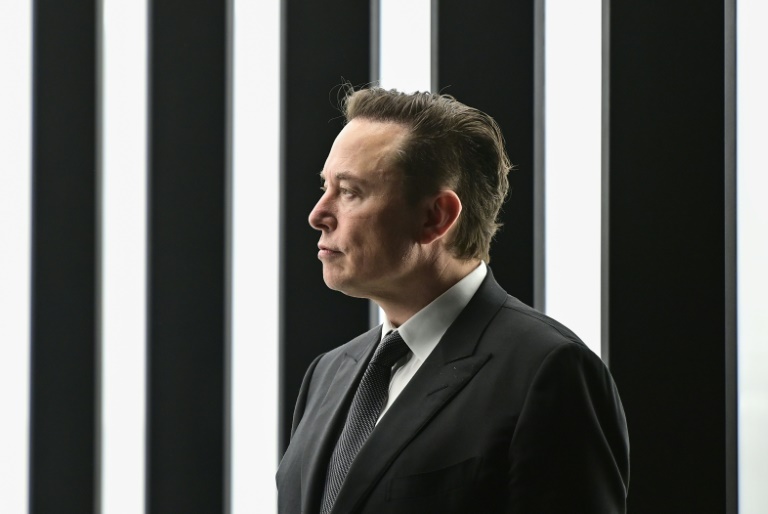
A Tesla shareholder has filed legal proceedings against Elon Musk and the company’s board of directors, accusing them of ignoring employee complaints of racism and sexual harassment.

The lawsuit — brought forward Thursday by plaintiff Solomon Chau in Texas where Tesla is headquartered — argues that an unaddressed “toxic workplace culture” at the company has caused “irreparable” reputational damage and financial harm.

The action was the latest against Tesla, which has been hit by a spate of sexual harassment lawsuits and Black employees complaining of rampant racism. 

In February, the state of California sued Tesla over alleged discrimination and harassment against Black employees at its Fremont plant near San Francisco, saying in a complaint that the company had created a “racially segregated workplace.”

Thursday’s court filing stated that a “toxic environment took shape internally for years and the truth about Tesla’s culture has only recently emerged, leading to actions by both regulators and private individuals.”

The lawsuit asserts that Musk, who is Tesla’s executive director, and its 11 board members ignored several “red flags”, which resulted in the departure of numerous highly qualified employees and set off a series of costly legal proceedings.

“These wrongs resulted in significant damages to Tesla’s reputation, goodwill, and standing in the business community”, the lawsuit states, and “exposed Tesla to hundreds of millions of dollars in potential liability for violations of state and federal law.”

In another lawsuit last year, Tesla was ordered to pay $137 million plus interest to a former elevator operator at its Fremont factory for turning a blind eye to racism. Earlier this year, the penalty was reduced to $15 million.

Other legal proceedings, in particular from Black women employees who claim to have been victims of racial slurs and inappropriate sexual remarks by colleagues or superiors, are underway.

Tesla, which has barely responded to requests from journalists since late 2020, did not respond to a request from AFP.

Musk was also sued on Thursday by an investor in dogecoin, who says he lost money after investing in the cryptocurrency, and described himself as an “American citizen who was defrauded” by what he called a “Dogecoin Crypto Pyramid Scheme.”

Tesla shareholder sues Musk over racism and sexual harassment complaints

A Tesla shareholder has filed legal proceedings against Elon Musk and the company’s board of directors, accusing them of ignoring employee complaints of racism and sexual harassment.

The lawsuit — brought forward Thursday by plaintiff Solomon Chau in Texas where Tesla is headquartered — argues that an unaddressed “toxic workplace culture” at the company has caused “irreparable” reputational damage and financial harm.

The action was the latest against Tesla, which has been hit by a spate of sexual harassment lawsuits and Black employees complaining of rampant racism. 

In February, the state of California sued Tesla over alleged discrimination and harassment against Black employees at its Fremont plant near San Francisco, saying in a complaint that the company had created a “racially segregated workplace.”

Thursday’s court filing stated that a “toxic environment took shape internally for years and the truth about Tesla’s culture has only recently emerged, leading to actions by both regulators and private individuals.”

The lawsuit asserts that Musk, who is Tesla’s executive director, and its 11 board members ignored several “red flags”, which resulted in the departure of numerous highly qualified employees and set off a series of costly legal proceedings.

“These wrongs resulted in significant damages to Tesla’s reputation, goodwill, and standing in the business community”, the lawsuit states, and “exposed Tesla to hundreds of millions of dollars in potential liability for violations of state and federal law.”

In another lawsuit last year, Tesla was ordered to pay $137 million plus interest to a former elevator operator at its Fremont factory for turning a blind eye to racism. Earlier this year, the penalty was reduced to $15 million.

Other legal proceedings, in particular from Black women employees who claim to have been victims of racial slurs and inappropriate sexual remarks by colleagues or superiors, are underway.

Tesla, which has barely responded to requests from journalists since late 2020, did not respond to a request from AFP.

Musk was also sued on Thursday by an investor in dogecoin, who says he lost money after investing in the cryptocurrency, and described himself as an “American citizen who was defrauded” by what he called a “Dogecoin Crypto Pyramid Scheme.”

Germans turn to food banks as inflation hits

German pensioner Gabriele Washah waits in line to fill her trolley with bags of carrots for 50 cents, yoghurts just past their sell-by date and bunches of wilting flowers.

With the cost of living soaring across Europe, the 65-year-old retired shop assistant is one of many Germans turning to food banks to make ends meet. 

“Sometimes I go home from the shop almost crying because I can’t afford it any more,” she told AFP outside the row of stalls in Bernau, near Berlin.

Nestled in an alleyway behind a big chain supermarket, the food bank sells at greatly reduced prices groceries donated by supermarkets, as well as cheap prepared meals.

Here, customers can pick up a full trolley of food for around 30 euros (around $32).

For Washah, that means bread, butter and her favourite sandwich filling, sausage — “which used to cost 99 cents ($1.02) but now sometimes costs more than two euros”.

Driven by the war in Ukraine, inflation in Germany soared to 7.9 percent in May — its highest level since reunification in 1990, with food prices among those worst affected.

Demand for food banks across the country has increased “significantly” since the start of the year and doubled in some areas, according to a spokeswoman for the Tafel food bank network.

There are around 1,000 such schemes in Germany, run by volunteers and available to customers on a means-tested basis. 

Groceries, while donated, are still sold rather than given away free to the customers as the Tafel has to cover running costs, including rents and electricity. The organisation too has had to put up prices because their running costs have risen.

“It’s not just one product,” said 69-year-old pensioner Peter Behme. “All the prices are going up.”

– Poverty line –

In a bid to ease the pressure on squeezed finances, the government has lowered taxes on fuel, drastically slashed the cost of public transport and promised all taxpayers a one-off payment of 300 euros.

But Behme remains unimpressed. “I don’t know where the government help is going,” he said.

Even the food banks themselves are feeling the effects of the massive inflation.

“We have had to raise some prices by 20 or 50 cents because we need money to replenish our stocks,” said Malina Jankow, manager of the Bernau food bank.

Along with pensioners and unemployed people, the queues are now also filling up with Ukrainian refugees.

Anna Dec, a 35-year-old hospital worker, has come to Bernau with two Ukrainian women who are staying in her home and currently each receiving 449 euros a month in benefits.

“They have to pay for water, energy, food, hygiene products… That’s almost nothing,” she said.

Overwhelmed by the influx of customers, some food banks in Germany have had to turn away new arrivals or ration the food they distribute.

“We have been asking the government for a long time for a law to force supermarkets to give away their unsold food,” said Norbert Weich, 72, chairman of the food bank.

Some 16 percent of Germans, or more than 13 million people, were living below the poverty line in 2020, according to a study by the charity Deutscher Paritaetische Gesamtverband, published in December 2021.

“The federation of food banks has a resolution: as soon as we are no longer needed, we will disband,” said Weich. “But I don’t think it will be in my lifetime.”

Close Bitnami banner
Bitnami