US Business

Macron seeks bigger military budget in 'war economy'

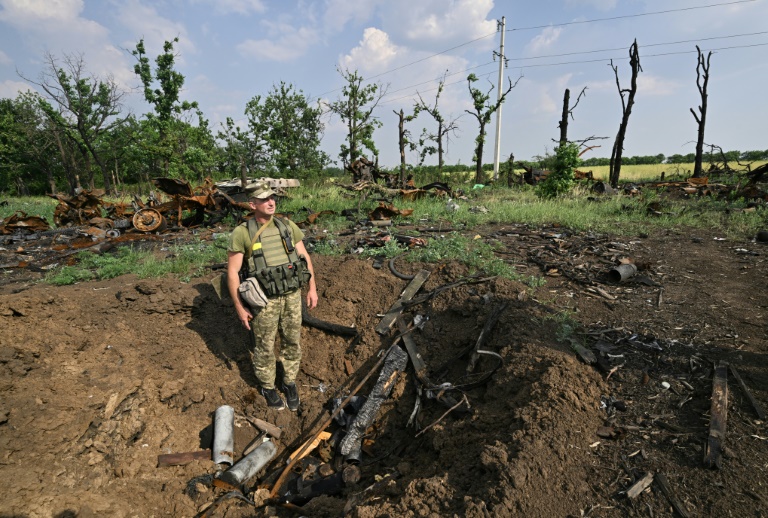
French President Emmanuel Macron on Monday called for a boost to defence budgets following Russia’s invasion of Ukraine, saying France was now on a “war economy” footing. 

Speaking at Eurosatory, a weapons industry fair, Macron said Europe needed “a much larger defence industry” to avoid relying on suppliers elsewhere for its equipment needs.

Since Russia’s invasion of Ukraine in February, France “has entered into a war economy in which I believe we will find ourselves for a long time”.

Macron said he had asked the defence ministry and armed forces chiefs of staff to adjust a six-year framework defence spending plan running to 2025 to the new geopolitical situation, to “match the means to the threats”.

Even before Ukraine, French military spending had gradually increased since Macron came to power in 2017 to reach 41 billion euros ($43 billion) this year, and is currently scheduled to hit 50 billion euros in 2025.

“We didn’t wait for strategic changes to re-invest,” Macron said, but Russia’s war had created “an additional need to move faster and become stronger at a lower cost”.

Macron said that “anybody doubting the urgency of these efforts only needs to look to Ukraine, where soldiers are asking for quality weaponry and they are entitled to a response from us”.

According to Le Monde newspaper, the government’s armament agency DGA is considering a draft law that would allow the requisitioning of civilian equipment or civilian factories to make weapons.

As European governments bolster defence budgets, they need a larger EU-based defence industry to meet the new military needs, Macron said.

“Let’s not repeat the errors of the past going forward,” he said. “Spending large sums on purchases from elsewhere is not a good idea.”

Europe needs a defence industry that is “much stronger and much more ambitious” than now, he said, “or we will create our own future dependencies”.

A European fighter plan project is, according to experts, currently running about a decade late, while a new French-German battle tank project, MGCS, is not expected to be operational for nearly another two decades.

WTO seeks shot in the arm with Covid jab IP idea

The WTO’s search for a role in fighting the pandemic sharpened up on Monday as ministers seek a compromise to lift intellectual property rights on Covid-19 vaccines.

The World Trade Organization’s first ministerial meeting since December 2017 is wrestling with the wording of a text that would temporarily waive patents on coronavirus jabs.

It is the main pandemic-combating idea being negotiated at MC12, the global trade body’s 12th ministerial conference, being held from Sunday to Wednesday at its headquarters in Geneva.

But serious objections remain from some of the countries that host major pharmaceutical companies, like Britain and Switzerland — a problem at the WTO, where decisions are taken by consensus rather than by majority.

The world’s big pharma firms are dead set against the idea, insisting that stripping patents will cripple investment and innovation.

They also say the plan — first proposed in October 2020 when the pandemic was raging and before jabs were even rolled out — has gone past its sell-by date as the world now has a surplus of vaccine doses rather than a dearth.

After Sunday’s opening ceremony and countries setting out their positions, ministers from the 164 WTO members went into rooms at the organisation’s HQ — the grand 1920s, classical Florentine-style Centre William Rappard on Lake Geneva — to start talking it out face to face.

– Birthday present? –

This week’s conference is a crunch moment for WTO chief Ngozi Okonjo-Iweala, who has staked her leadership on breathing new life into the crippled organisation, where progress has been stumbling for years.

The Nigerian former finance and foreign minister took over in March 2021 on a mission to make the WTO relevant again.

But on her 68th birthday Monday, there was no immediate sign of a breakthrough on vaccine patents.

Public interest groups say the draft text falls far short of what is needed, by time-limiting and complicating the vaccine patents waiver — and by leaving out Covid treatments and diagnostics.

Non-governmental organisations staged a protest in the WTO’s central atrium, chanting slogans and unfurling banners reading: “No monopolies on Covid-19 medical tools” and “End vaccine apartheid”.

“The WTO rules are contributing to exacerbating the pandemic, because it’s the WTO that enforces IP rules,” demonstration organiser Deborah James told AFP.

“Folks have been campaigning on this for two years and it’s been a complete wall by a few countries,” she said.

“It’s an indictment of the WTO system: it’s completely broken, it can’t respond to a pandemic, it has no ability to put anything other than maximising profits for corporations ahead of anything else.”

– ‘We are choosing death’ –

In October 2020, India and South Africa began pushing for the WTO to lift IP rights on Covid-19 vaccines, tests and treatments to help ensure more equitable access in poorer nations.

After multiple rounds of talks, the United States, the European Union, India and South Africa hammered out a compromise.

The text would allow most developing countries, although not China, to produce Covid vaccines without authorisation from patent holders.

Beijing has promised not to use the facilities granted to developing countries in the draft agreement, but, according to several diplomats, Washington wants this commitment in writing.

“In a pandemic, sharing technology is life or death and we are choosing death,” said the UNAIDS agency’s executive director Winnie Byanyima.

Besides production, a second text being negotiated seeks to tackle some of the supply constraints faced by certain countries in getting hold of Covid-fighting tools.

And beyond the pandemic, the WTO faces pressure to eke out long-sought trade deals on a range of issues and show unity amid an impending global hunger crisis.

Okonjo-Iweala voiced cautious optimism on Sunday that ministers could reach agreement on food security threatened by Russia’s invasion of Ukraine, overfishing and on Covid vaccines.

She said to expect a “rocky, bumpy road with a few landmines along the way”.

Ukraine forces pushed back from Severodonetsk centre

Ukraine said Monday its forces had been pushed back from the centre of key industrial city Severodonetsk, where President Volodymyr Zelensky described a fight for “literally every metre”.

The cities of Severodonetsk and Lysychansk, which are separated by a river, have been targeted for weeks as the last areas still under Ukrainian control in the eastern Lugansk region.

Regional governor Sergiy Gaiday said Monday Russian forces were “gathering more and more equipment” to “encircle” Severodonetsk, and that they had “pushed our troops from the centre and continue to destroy our city”.

The local Azot chemical plant, where hundreds of civilians have reportedly taken refuge, was being “heavily shelled”, Gaiday said.

In Lysychansk, bombardments killed three civilians, including a six-year-old boy, he said.

Severodonetsk had been “de facto” blocked off after Russian forces blew up the “last” bridge connecting it to Lysychansk Sunday, Eduard Basurin, a representative for pro-Russian separatists, said Monday.

“The Ukrainian units that are there, they are there forever. They have two options: to surrender or die,” Basurin said.

On Sunday, Zelensky said the latest fighting in Severodonetsk was “very fierce”, adding that Russia was deploying undertrained troops and using its young men as “cannon fodder”.

Russia’s massed artillery in that region gave it a tenfold advantage, the commander-in-chief of the Ukrainian military, Valeriy Zaluzhny, said Sunday. 

“Every metre of Ukrainian land there is covered in blood — but not only ours, but also the occupier’s.”

The capture of Severodonetsk would open the road for Moscow to another major city, Kramatorsk, in their steps toward conquering the whole of Donbas, a mainly Russian-speaking region partly held by pro-Russian separatists since 2014.

– ‘War crimes’ –

On Monday, Amnesty International accused Russia of war crimes in Ukraine, saying that attacks on the northeastern city of Kharkiv — many using banned cluster bombs — had killed hundreds of civilians. 

“The repeated bombardments of residential neighbourhoods in Kharkiv are indiscriminate attacks which killed and injured hundreds of civilians, and as such constitute war crimes,” the rights group said in a report on Ukraine’s second biggest city.

Away from the battlefield, World Trade Organization members gathered in Geneva Sunday, with the threat posed to global food security by Russia’s war in wheat-producing Ukraine top of the agenda.

Tensions ran high during a closed-door session, where several delegates took the floor to condemn Russia’s war, including Kyiv’s envoy who was met with a standing ovation, WTO spokesman Dan Pruzin told journalists.

Just before Russian Minister of Economic Development Maxim Reshetnikov spoke, around three dozen delegates “walked out”, the spokesman said.

On a farm near the city of Mykolaiv in the south, the harvest has been delayed by the need to undo the damage done by Russian troops that passed through the area in March.

“We planted really late because we needed to clear everything beforehand,” including bombshells, Nadiia Ivanova, 42, told AFP.

The farm’s warehouses currently hold 2,000 tonnes of last season’s grain but there are no takers.

The railways have been partially destroyed by the Russian army, while any ship that sails faces the threat of being sunk.

– ‘Out of it’ –

The war has prompted Finland and Sweden to give up decades of military non-alignment and seek to join the NATO alliance.

But Turkey is blocking their bids and NATO chief Jens Stoltenberg said Sunday the issue may not be resolved in time for an alliance summit later this month.

Speaking to AFP, Mikhail Kasyanov, Russia’s prime minister from 2000 to 2004, said he thought President Vladimir Putin was “out of it”, after seeing the Russian leader summon the country’s top brass for a theatrical meeting three days before the invasion on February 24.

“I knew a different Putin,” said Kasyanov, 64, who served under Putin but has become one of the Kremlin’s most vocal critics.

Kasyanov predicted the war could last for up to two years and said it is imperative that Ukraine win.

“If Ukraine falls, the Baltic states will be next,” he said.

– Chortkiv strike –

The United States and Europe have sent weapons and cash to help Ukraine blunt Russia’s advance, alongside punishing Moscow with unprecedented economic sanctions. 

Russian forces said Sunday they had struck a site in the town of Chortkiv in western Ukraine storing US- and EU-supplied weapons.

Russia’s defence ministry said the strike destroyed a “large depot of anti-tank missile systems, portable air defence systems and shells provided to the Kyiv regime by the US and European countries”.

The strike — a rare attack by Russia in the relatively calm west of Ukraine — left 22 people injured, regional governor Volodymyr Trush said.

Concerns eased Sunday over Ukraine’s largest nuclear power plant in Zaporizhzhia. Captured months ago by Russian forces but still operated by Ukrainians, the station had ceased transmitting vital safeguards data two weeks ago.

But plant officials working with the International Atomic Energy Agency have succeeded in restoring transmission, the IAEA said. 

Rafael Grossi, director general of the UN agency, said it still wanted to send inspectors to the plant “as soon as possible”.

burs-sea/raz

Bitcoin slumps under $25,000, lowest in 18 months

Bitcoin tumbled Monday to an 18-month low under $25,000 as investors shunned risky assets in the face of a vicious global markets selloff, months after the cryptocurrency hit a record high.

The unit took a heavy knock also from news that cryptocurrency lending platform Celsius Network paused withdrawals, citing volatile conditions.

World stock markets have plunged since Friday when data showed US inflation at a fresh four-decade high, increasing recession fears and sending investors running for safer assets like the dollar.

“It is not very surprising to see such a strong downturn as we have noticed an increased correlation over the last few years between traditional stocks, which have also tanked recently, and the cryptocurrency market,” noted XTB chief market analyst Walid Koudmani.

The world’s most popular cryptocurrency dived about 10 percent to hit $23,794 in morning London deals, striking a level last seen in December 2020.

The virtual unit has collapsed by 65 percent in value since striking a record peak $68,991.85 in November.

Investors on Monday sought safety with the US central bank seen likely to aggressively ramp up borrowing costs further to combat runaway inflation.

Bitcoin’s decline accelerated after the news from Celsius Network. 

“Today we are announcing that Celsius is pausing all withdrawals, swap, and transfers between accounts,” the platform said in a statement.

Celsius made the move “due to extreme market conditions”, it added.

The total value of customer deposits had already shrunk by more than half to under $12 billion in May compared with the end of last year.

– $1 trillion market –

Koudmani said further falls for bitcoin “may trigger a cascading effect of liquidations of hedging positions” taken against the cryptocurrency. 

The global crypto market, comprising other virtual currencies which are tanking such as Ethereum, is worth about $1 trillion, according to crypto data aggregator CoinGecko.

That is down from a level of more than $3 trillion at its peak seven months ago, when the market rode a wave of massive investor demand amid growing acceptance from large financial institutions.

In a sign of the growing importance of cryptocurrencies, two countries, El Salvador and the Central African Republic, have taken the gamble of adopting bitcoin as legal tender — despite strong criticism from international financial institutions.

Markets dive on inflation woes as dollar spikes against yen, rupee

Markets tumbled in Asia and Europe on Monday to extend a global rout while the dollar soared after a forecast-beating US inflation print ramped up bets on a more aggressive campaign of Federal Reserve interest rate hikes.

Fresh Covid outbreaks in Shanghai and Beijing have also seen authorities reimpose containment measures soon after lifting them, leading to fears about the world’s number two economy.

The possibility of more restrictions in China’s biggest cities weighed on oil prices, with concerns about a possible US recession and the stronger dollar adding to downward pressure on the black gold.

Investors were left surprised Friday when data showed US inflation jumped 8.6 percent in May, the fastest pace since December 1981, as the Ukraine war and China’s lockdowns pushed up energy and food prices.

The reading has led to fervent speculation that the Fed will now be contemplating a 75 basis point lift in interest rates at some point, though it is still expected to stick to a flagged half-point hike when it meets this week.

With the central bank forced to be more aggressive, there is a concern that the US economy could be sent into recession next year.

“For the last few weeks, there has been a cautious calm in markets — rates not pricing anything unforeseen, and equities able to make small gains,” said SPI Asset Management’s Stephen Innes.

“But the strength of (US consumer prices) completely upended that apple cart.

“The market is now thinking much more about the Fed driving rates sharply higher to get on top of inflation and then having to cut back as growth drops.”

And Bank of Singapore chief economist Mansoor Mohi-uddin added that officials would likely lift borrowing costs 50 basis points for the next four meetings and eventually push the overall rate to 4.0 percent in 2023. 

– Rupee hits record low –

Wall Street’s three main indexes tanked, with the Nasdaq taking the heaviest blow as tech firms — which are susceptible to higher rates — were battered, while European markets were also hammered.

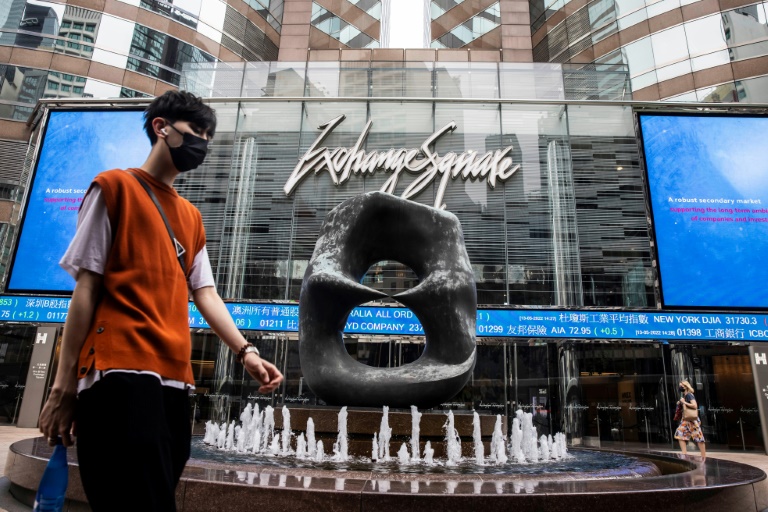
Asia followed suit, with Hong Kong, Tokyo, Mumbai, Jakarta, Taipei, Wellington, Shanghai, Singapore, Manila and Bangkok all taking a beating.

And Europe joined the retreat with London losing more than one percent as data showed the UK economy shrank for the second month in a row in April. Frankfurt and Paris were also deep in the red during morning trade. 

Goldman Sachs analysts said in a note: “At some point financial conditions will tighten enough and/or growth will weaken enough such that the Fed can pause from hiking.

“But we still seem far from that point, which suggests upside risks to bond yields, ongoing pressure on risky assets, and likely broad US dollar strength for now.”

The dollar continued to push higher on expectations for a sharp increase in US rates, hitting a 24-year peak of 135.19 yen while it also broke above 78 Indian rupees for the first time. 

The greenback was also at multi-year highs on the euro and sterling.

“The ongoing backdrop to the yen’s fall is the growing gap between long-term interest rates in Japan and the United States,” Takahide Kinouchi, executive economist at Nomura Research Institute, said in a recent commentary.

But the head of the Bank of Japan remained steadfast in sticking to its policies, saying last week that “monetary tightening is not at all a suitable measure” for Japan, whose economy is still recovering from the pandemic.

Questioned in parliament on Monday, Haruhiko Kuroda said: “The recent rapid depreciation of the yen increases uncertainties and means companies face difficulties in drafting business plans, thus it is negative for the economy and not desirable.”

Oil prices sank, extending Friday’s retreat, on demand concerns as China sticks to an economically damaging zero-Covid policy to fight a fresh outbreak of the disease.

Parts of Shanghai were put back into lockdown and officials carried out mass testing on millions of people, just weeks after lifting strict measures in the country’s biggest city.

The uncertainty has also hit Bitcoin, with the cryptocurrency falling below $25,000 for the first time since the end of 2020.

– Key figures at around 0810 GMT –

Tokyo – Nikkei 225: DOWN 3.0 percent at 26,987.44 (close)

Hong Kong – Hang Seng Index: DOWN 3.4 percent at 21,067.58 (close)

Shanghai – Composite: DOWN 0.9 percent at 3,255.55 (close)

London – FTSE 100: DOWN 1.2 percent at 7,230.38

Dollar/yen: UP at 134.60 yen from 134.42 yen late Friday

Euro/dollar: DOWN at $1.0465 from $1.0526

Pound/dollar: DOWN at $1.2240 from $1.2309

Euro/pound: UP at 85.51 pence from 85.39 pence

Brent North Sea crude: DOWN 1.7 percent at $119.95 per barrel

West Texas Intermediate: DOWN 1.7 percent at $118.60 per barrel

New York – Dow: DOWN 2.7 percent at 31,392.79 (close)

Markets track Wall St plunge on inflation woes, dollar rallies

Markets tumbled in Asia on Monday to extend a global rout while the dollar soared after a forecast-beating US inflation print ramped up bets on a more aggressive campaign of Federal Reserve interest rate hikes.

Fresh Covid outbreaks in Shanghai and Beijing have also seen authorities reimpose containment measures soon after lifting them, leading to fears about the world’s number two economy.

The possibility of more restrictions in China’s biggest cities also weighed on oil prices, with concerns about a possible US recession and the stronger dollar adding to downward pressure on the black gold.

Investors were left surprised Friday when data showed US inflation jumped 8.6 percent in May, the fastest pace since December 1981, as the Ukraine war and China’s lockdowns pushed energy and food prices.

The reading has led to fervent speculation that the Fed will now be contemplating a 75 basis point lift in interest rates at some point, though it is still expected to stick to a flagged half-point hike when it meets this week.

With the central bank forced to be more aggressive, there is a concern that the US economy could be sent into recession next year.

“For the last few weeks, there has been a cautious calm in markets — rates not pricing anything unforeseen, and equities able to make small gains,” said SPI Asset Management’s Stephen Innes.

“But the strength of (US consumer prices) completely upended that apple cart.

“The market is now thinking much more about the Fed driving rates sharply higher to get on top of inflation and then having to cut back as growth drops.”

And Bank of Singapore chief economist Mansoor Mohi-uddin added that officials would likely lift borrowing costs 50 basis points for the next four meetings and eventually push the overall rate to 4.0 percent in 2023. 

– Rupee hits record low –

Wall Street’s three main indexes tanked, with the Nasdaq taking the heaviest blow as tech firms — which are susceptible to higher rates — were battered, while European markets were also hammered.

Asia followed suit, with Hong Kong, Tokyo and Seoul down more than three percent, while Mumbai, Jakarta, Taipei, Jakarta and Wellington were off more than two percent. Shanghai, Singapore, Manila and Bangkok also well down.

The slump filtered through to Europe, with Frankfurt, Paris and London all opening down. 

Goldman Sachs analysts said in a note: “At some point financial conditions will tighten enough and/or growth will weaken enough such that the Fed can pause from hiking.

“But we still seem far from that point, which suggests upside risks to bond yields, ongoing pressure on risky assets, and likely broad US dollar strength for now.”

The dollar continued to push higher on expectations for a sharp increase in US rates, hitting a 24-year peak of 135.19 yen while it also broke above 78 Indian rupees for the first time. 

The greenback was also at multi-year highs on the euro and sterling.

“The ongoing backdrop to the yen’s fall is the growing gap between long-term interest rates in Japan and the United States,” Takahide Kinouchi, executive economist at Nomura Research Institute, said in a recent commentary.

And as higher oil prices fuel US inflation, “expectations are growing stronger that aggressive US monetary tightening will continue for the time being, causing US yields to rise further”.

Oil prices sank, extending Friday’s retreat, on demand concerns China sticks to an economically damaging zero-Covid policy to fight a fresh outbreak of the disease.

Parts of Shanghai were put back into lockdown and officials carried out mass testing on millions of people, just weeks after lifting strict measures in the country’s biggest city.

– Key figures at around 0720 GMT –

Tokyo – Nikkei 225: DOWN 3.0 percent at 26,987.44 (close)

Hong Kong – Hang Seng Index: DOWN 3.2 percent at 21,098.62

Shanghai – Composite: DOWN 0.9 percent at 3,255.55 (close)

London – FTSE 100: DOWN 0.8 percent at 7,262.18

Dollar/yen: UP at 134.56 yen from 134.42 yen late Friday

Euro/dollar: DOWN at $1.0482 from $1.0526

Pound/dollar: DOWN at $1.2268 from $1.2309

Euro/pound: UP at 85.44 pence from 85.39 pence

Brent North Sea crude: DOWN 2.0 percent at $120.05 per barrel

West Texas Intermediate: DOWN 2.0 percent at $118.67 per barrel

New York – Dow: DOWN 2.7 percent at 31,392.79 (close)

Plays about Black artists and Wall St are big winners on Broadway

A musical about a Black and queer author won a top prize at the Broadway awards in New York on Sunday, while a play about Lehman Brothers and a Michael Jackson biopic also triumphed at the Oscars of the theater.

The 75th Tony Awards concluded a season of renewal for the theaters of the American cultural capital, which reopened in the fall of 2021 after 18 months of closure because of Covid-19. 

Wall Street finance story “The Lehman Trilogy” emerged victorious with five awards, including best play, best actor (Simon Russell Beale) and best director (Sam Mendes).

The play by Italian Stefano Massini follows the long life of the US investment bank Lehman Brothers, founded in the 19th century by three German immigrant brothers, whose collapse in 2008 triggered a global financial crisis. 

“MJ the Musical,” a successful biopic on Michael Jackson, which received the assent of his heirs and a mixed reception from critics because it virtually ignores the accusations of child abuse against the “King of Pop,” won four awards, including that of best actor in a musical for Myles Frost. 

Two of the children of the star who died in 2009 at age 50, Paris and Prince Jackson, made an appearance on stage. 

“A Strange Loop,” a favorite with 11 nominations, ultimately won two Tonys, including the most prestigious best musical and best libretto for its author, Michael R. Jackson — no relation to the “King of Pop.”  

– ‘Life raft’ –

The musical tells the story of the torments of a theater usher, an aspiring artist, Black and queer like Michael R. Jackson, who wants to become a Broadway writer.

“I felt unseen. I felt unheard. I felt misunderstood. And I just wanted to create a little bit of a life raft for myself as a black gay man,” the artist, wrapped in a large fuchsia cape, recounted to a standing ovation.

Upon his arrival on the stage of Radio City Music Hall, the mistress of ceremony Ariana DeBose, Oscar winner for her role as Anita in the remake of “West Side Story,” said she was “proud” of Broadway’s efforts to be more open to diversity.

After the pandemic and the death of George Floyd, an African-American killed by police in June 2020, provoking a broad movement against racism in the United States, Broadway reopened in the fall of 2021 with seven plays or musicals written by black authors, the first time this has ever happened. 

“There have been incremental changes, but the work continues,” said the singer and actor Darius de Haas, one of the founders of Black Theatre United, which advocates for a more diverse representation in American theaters. 

“Producers and theater owners have opened their eyes and seen that they can not only have stories that reflect more diversity on Broadway, but also that it can work economically.” 

Located around the bustling Times Square, the 41 Broadway theaters are not only the stuff of New York City legend, but also one of its cultural, economic and tourist lungs.

Before the pandemic, revenues easily exceeded $30 million per week, and $50 million for the week of Christmas. 

This 2021-2022 season has been disrupted again, but Broadway is back in the black, with 230,000 patrons last week, compared to about 300,000 the equivalent week in 2019. 

UK economy shrinks for second month in a row

British economic output declined for a second month in a row in April, weighed down by decades-high inflation, official data showed Monday.

Gross domestic product fell 0.3 percent in April after a drop of 0.1 percent in March, the Office for National Statistics said in a statement.

Output in the services, production and construction sectors fell — “the first time that all main sectors have contributed negatively to a monthly GDP estimate since January 2021”, the ONS said, as the data added to fears of recession.

The ONS noted that “businesses continued to report the impact of price increases and supply chain shortages”.

The data comes as the Bank of England is set to raise its main interest rate at a fifth straight meeting Thursday in a bid to cool the pace of price rises.

“Despite weakening economic growth, the Bank of England this week is expected to raise rates further as it seeks to get inflation under control,” said Paul Craig, portfolio manager at Quilter Investors.

“While a recession is still a while away, it is looming on the horizon and its effects will begin to be felt in the UK well before we are officially in one.”

Inflation is being fuelled by soaring food and energy prices as economies reopen from pandemic lockdowns and following the invasion of Ukraine by major oil and gas producer Russia.

“Businesses from all sectors are facing unprecedented rises in raw material costs, soaring energy bills, and wage pressures,” David Bharier, head of research at the British Chambers of Commerce, said following Monday’s GDP data.

UK annual inflation stands at nine percent, the highest level in 40 years, causing a cost-of-living crisis for millions of Britons.

In the United States meanwhile, Friday’s forcecast-beating inflation print has triggered expectations that the Federal Reserve will ramp up the pace of its interest-rate increases.

That has sent investors running for cover, with world stock markets tumbling since Friday.

Yen slides to 24-year low against dollar

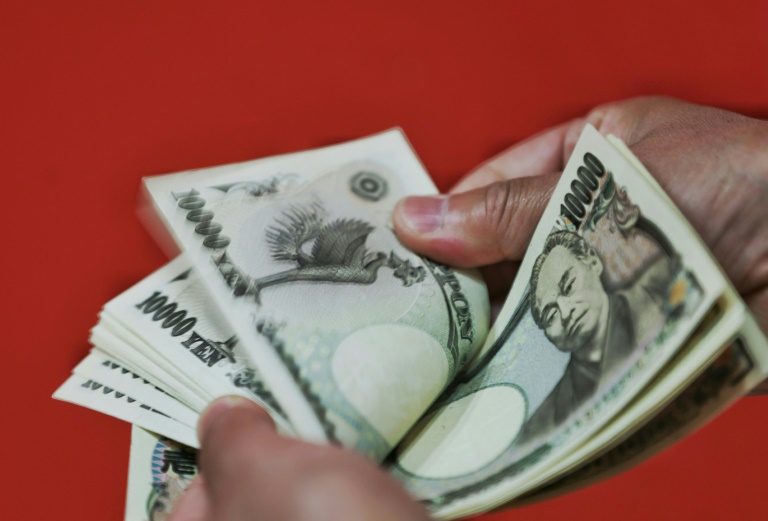
The yen plunged to its lowest level against the dollar since 1998 on Monday as sky-high US inflation fuels a widening monetary policy gap between Japan and the world’s largest economy.

Japan’s currency has been weakening for months, accelerated by the US Federal Reserve’s aggressive monetary tightening to tackle soaring inflation caused by the war in Ukraine and other factors.

But unlike the Fed, the Bank of Japan has said it will stick with its long-standing monetary easing programme which it hopes will lead to stable growth.

The increasingly polar policies have strengthened the greenback, and on Monday one dollar bought 135.19 yen.

It’s a level not seen since October 1998 during the Asian currency crisis, and marks a dramatic drop from January rates of around 115 yen per dollar.

“The ongoing backdrop to the yen’s fall is the growing gap between long-term interest rates in Japan and the United States,” Takahide Kinouchi, executive economist at Nomura Research Institute, said in a recent commentary.

And as higher oil prices fuel US inflation, “expectations are growing stronger that aggressive US monetary tightening will continue for the time being, causing US yields to rise further.”

US consumer prices for May hit a new four-decade high, rising 8.6 percent and topping what economists thought was the peak in March.

In Japan however, inflation has only just hit the central bank’s long-term target of two percent.

And while the figure represents a seven-year high, the BoJ sees current inflationary pressures as temporary, and believes its monetary policy is necessary to produce more long-lasting growth.

Questioned in parliament on Monday, central bank Governor Haruhiko Kuroda acknowledged that the yen’s rapid depreciation was “not desirable”.

“The recent rapid depreciation of the yen increases uncertainties and means companies face difficulties in drafting business plans, thus it is negative for the economy and not desirable,” he said.

– Benefits for tourism, exporters –

But he has shown no inclination to adjust the bank’s policy soon, saying last week that “monetary tightening is not at all a suitable measure” for Japan, whose economy is still recovering from the pandemic, according to Kyodo News.

He has pointed to the benefits of a weaker yen for Japanese exporters, whose overseas profits are inflated when they are repatriated and have seen their stock prices rise in recent months.

On Monday, he urged companies that benefit from the exchange rate to “expand investment and raise wages, which will strengthen a virtuous cycle.”

The weaker yen could also be a boon for the tourism sector, with Japan cautiously reopening to foreign visitors now allowed in on group tours.

“The weak yen helps to support Japan’s export sector directly, and a weaker exchange rate also contributes to looser monetary conditions domestically,” said Alvin Tan, head of Asia forex strategy at RBC Capital Markets in Singapore.

“These will help drive the economic recovery further,” he told AFP.

Although “higher import prices will negatively affect consumers” and the weaker yen will contribute to inflation, particularly given Japan’s reliance on energy imports, this could also be “seen as a positive”, he said.

“It could help to deepen more persistent inflation expectations in a country that has suffered under deflation for so many years.”

The yen’s trajectory may depend on how the US Fed acts in its September meeting, with worse-than-expected inflation figures for May raising expectations of further rate hikes.

But “there is still a lot of time left until then”, said Kinouchi, and other factors may also be at play including energy prices rising further after a European Union ban on most Russian oil imports.

Yen slides to 24-year low against dollar

The yen plunged to its lowest level against the dollar since 1998 on Monday as sky-high US inflation fuels a widening monetary policy gap between Japan and the world’s largest economy.

Japan’s currency has been weakening for months, accelerated by the US Federal Reserve’s aggressive monetary tightening to tackle soaring inflation caused by the war in Ukraine and other factors.

But unlike the Fed, the Bank of Japan has said it will stick with its long-standing monetary easing programme which it hopes will lead to stable growth.

The increasingly polar policies have strengthened the greenback, and on Monday one dollar bought 135.19 yen.

It’s a level not seen since October 1998 during the Asian currency crisis, and marks a dramatic drop from January rates of around 115 yen per dollar.

“The ongoing backdrop to the yen’s fall is the growing gap between long-term interest rates in Japan and the United States,” Takahide Kinouchi, executive economist at Nomura Research Institute, said in a recent commentary.

And as higher oil prices fuel US inflation, “expectations are growing stronger that aggressive US monetary tightening will continue for the time being, causing US yields to rise further.”

US consumer prices for May hit a new four-decade high, rising 8.6 percent and topping what economists thought was the peak in March.

In Japan however, inflation has only just hit the central bank’s long-term target of two percent.

And while the figure represents a seven-year high, the BoJ sees current inflationary pressures as temporary, and believes its monetary policy is necessary to produce more long-lasting growth.

– Benefits for tourism, exporters –

As the war in Ukraine pressures global fuel and food prices, household brands from Uniqlo to 7-Eleven have anounced price hikes, with budget sushi chain Sushiro causing shock when it said it would no longer offer plates for 100 yen ($0.75).

But BoJ governor Haruhiko Kuroda said last week that “monetary tightening is not at all a suitable measure” for Japan, whose economy is still recovering from the pandemic, according to Kyodo News.

He also pointed to the benefits of a weaker yen for Japanese exporters, whose overseas profits are inflated when they are repatriated and have seen their stock prices rise in recent months.

The weaker yen could also be a boon for the tourism sector, with Japan cautiously reopening to foreign visitors now allowed in on group tours.

“The weak yen helps to support Japan’s export sector directly, and a weaker exchange rate also contributes to looser monetary conditions domestically,” said Alvin Tan, head of Asia forex strategy at RBC Capital Markets in Singapore.

“These will help drive the economic recovery further,” he told AFP.

Although “higher import prices will negatively affect consumers” and the weaker yen will contribute to inflation, particularly given Japan’s reliance on energy imports, this could also be “seen as a positive”, he said.

“It could help to deepen more persistent inflation expectations in a country that has suffered under deflation for so many years.”

The yen’s trajectory may depend on how the US Fed acts in its September meeting, with worse-than-expected inflation figures for May raising expectations of further rate hikes.

But “there is still a lot of time left until then,” said Kinouchi, and other factors may also be at play including energy prices rising further after a European Union ban on most Russian oil imports.

Close Bitnami banner
Bitnami