US Business

Zelensky defiant as Russia claims Severodonetsk gains

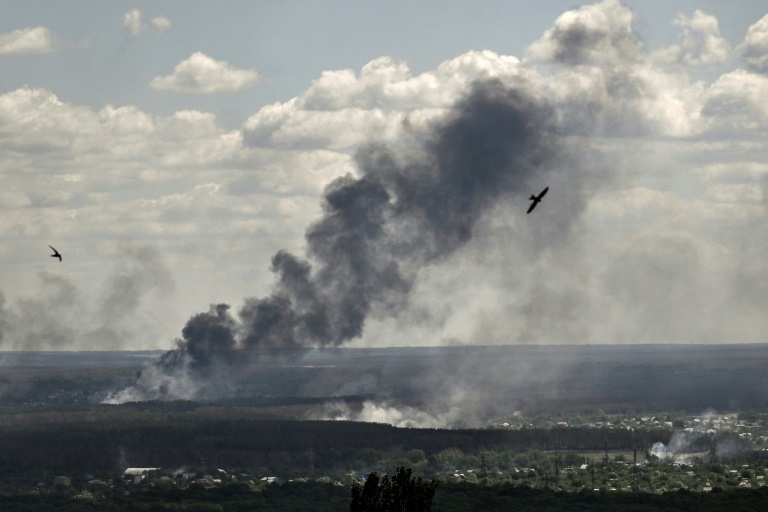
Russia claimed its forces have taken full control of residential neighbourhoods in eastern Ukraine’s Severodonetsk, as President Volodymyr Zelensky vowed the “heroic defence” of the Donbas region will persist against the odds.

The strategic city is currently the focus of Russia’s offensive after their forces were repelled from other parts of Ukraine following the February invasion.

Intense street fighting has raged for days, with the situation on the ground changing rapidly. 

Russia claimed Tuesday residential areas had been “fully liberated” but that Ukrainian forces still hold the industrial zone and surrounding settlements.

Ukrainian officials later countered that the Russians weren’t in control of the city, and Zelensky struck a defiant tone in his daily video address late Tuesday.

“The absolutely heroic defence of Donbas continues,” he said.

“The occupiers did not believe that the resistance of our military would be so strong.”

The cities of Severodonetsk and Lysychansk, which are separated by a river, are the last areas still under Ukrainian control in the Lugansk, which together with Donetsk forms the Donbas region. 

After being repelled from Kyiv, Russia is seeking to capture a vast swathe of eastern Ukraine.

The war’s impact continued to reverberate, with the World Bank cutting its global growth estimate to 2.9 percent — 1.2 percentage points below the January forecast — due largely to the invasion of Ukraine.

The toxic combination of weak growth and rising prices could trigger widespread suffering in dozens of poorer countries still struggling to recover from the upheaval of the Covid-19 pandemic, the bank said.

“The risk from stagflation is considerable with potentially destabilising consequences for low and middle income economies,” World Bank President David Malpass told reporters.

“For many countries recession will be hard to avoid,” Malpass said.

The bank additionally announced $1.5 billion more in aid for Ukraine, bringing the total planned support package to more than $4 billion.

– Lavrov in Turkey –

Amid stark warnings of global food shortages partly blamed on the war, Russian Foreign Minister Sergei Lavrov is set to meet Wednesday with his Turkish counterpart Mevlut Cavusoglu during a visit to Ankara.

Talks will focus on efforts to open a security corridor to ship Ukrainian grain — cereals and wheat in particular — stuck in the war-torn country’s ports due to a Russian blockade. 

“Right now we have about 20-25 million tonnes blocked. In the autumn that could be 70-75 million tonnes,” Zelensky said Monday.

At the request of the United Nations, Turkey has offered its services to escort maritime convoys from Ukrainian ports, despite the presence of mines — some of which have been detected near the Turkish coast.

Both sides accuse one another of destroying agricultural areas, which could worsen global food shortages.

“Those who pretend to be concerned about the global food crisis are, in fact, hitting agricultural fields and infrastructure, where fires are breaking out on an impressive scale,” the Ukrainian military said Tuesday, pointing to attacks in the southern city of Mykolaiv.

– Trapped in chemical plant –

Severodonetsk appeared close to being captured just days ago but Ukrainian forces launched counterattacks and have so far managed to hold out, despite Zelensky warning the defenders are outnumbered by superior forces.

Lanny Davis, a US lawyer for Ukraine tycoon Dmytro Firtash, said 800 civilians had taken refuge in the bunkers inside Firtash’s huge Azot chemical plant in the city.

“These 800 civilians include around 200 out of the plant’s 3,000 employees and approximately 600 inhabitants of the city of Severodonetsk,” Davis said.

The Ukrainian army said Tuesday that Russian troops were also preparing to attack the key city of Sloviansk, about 65 kilometers (40 miles) west of Severodonetsk.

Its capture would open up the route to Kramatorsk, the main city of the Ukrainian-held part of the Donetsk region.

The leader of Ukraine’s pro-Russian separatists in Donetsk, Denis Pushilin, on Tuesday confirmed the death of another Russian general in the fighting.

Pushilin expressed on Telegram his “sincere condolences to the family and friends” of Major General Roman Kutuzov, “who showed by example how to serve the fatherland”.

Ukraine’s forces have claimed to have killed several of Russia’s top brass but their exact number is not known as Moscow is tight-lipped on losses. 

On Tuesday, Zelensky announced the launch next week of a “Book of Torturers”, a system that will collect details of alleged war crimes and Russian soldiers accused of committing them. 

“I have repeatedly stressed that they will all be held accountable. And we are approaching this step by step,” he said.

“Everyone will be brought to justice.”

burs-sr/oho
Thai railway market back on track post-pandemic

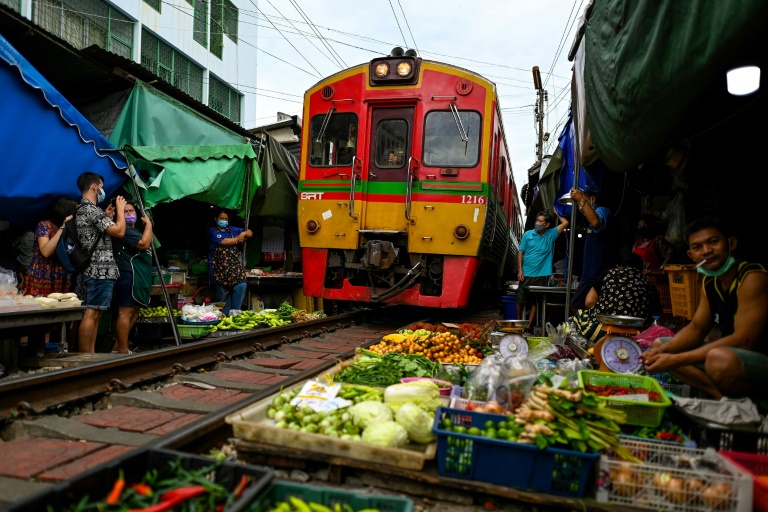
A train bell rouses a Thai grandmother dozing in her fruit and flower stall, sending her rushing to fold in her awning before the locomotive slowly rumbles past, so close it almost touches her wares.

Six times a day at the Mae Klong Railway Market, local customers and foreign tourists scramble into nooks and crannies while vendors calmly move their woven baskets of goods away from the tracks and close their umbrellas to make way.

Hundreds of stallholders carve out a living along this 500-metre stretch of railway in Samut Songkhram, 80 kilometres (50 miles) west of Bangkok, selling everything from fresh produce to live turtles to clothes and souvenirs.

“Even though it looks risky and dangerous, it’s not dangerous at all,” said fruit and vegetable vendor Samorn Armasiri.

Her family has run a stall in the bazaar — nicknamed in Thai “talad rom hup”, or the umbrella-pull-down market — for five decades, and she’s never witnessed an accident.

“When the train enters, officers sound the horn and everybody packs their stuff — they know the drill,” she said.

– Big train, tiny space –

The sides of the train carriages pass directly over — with just centimetres to spare — bags of lettuce, broccoli, onions, ginger, chilli, tomatoes and carrots placed carefully on the outside of the rails.

In recent years, the spectacle had become a hub for coconut-drinking backpackers in elephant pants and Instagram selfie enthusiasts, but the pandemic hit hard.

Now, with Thailand dropping Covid-19 entry restrictions, tourism is picking up once more.

Australian Ella McDonald, on a two-day stopover on her way to Turkey, was among those marvelling at the market’s organised chaos.

“It was crazy and hectic,” she told AFP. “I was shocked at how big the train was in the small amount of space.

“It’s a unique experience. I’ve never seen anything like this anywhere else in the world.”

– Not just for tourists –

Before Covid-19 hit, the market was also beloved by Chinese tourists buying durian — the pungent-smelling “king of fruit”.

Strict quarantine rules presently discourage would-be visitors from China, who once made up the largest share of foreign tourists in Thailand.

But even without them, fishmonger Somporn Thathom — a stallholder since 1988 — said business was finally picking up after two years of hardship and financial strain.

“During Covid, I barely made enough to pay my staff. I managed to sell 10 fish per day,” the 60-year-old said.

“I used up all my savings… and had to borrow money from the bank.”

Station manager Charoen Charoenpun believes the market’s authenticity ensures its popularity.

“It’s not made up. It’s not built for the tourists,” he said.

“The tourists, when they come they can see the tradition and culture of the local people of Samut Songkhram.”

But for eight-year-old Australian William, the pandemonium ensuing as the train passed through was captivating.

“The most exciting thing is when you get the train going past — just seeing the (market vendors) pack up,” he said.

Out of the frying pan: Indonesians pay price of cooking oil crisis

About three weeks after Russian troops invaded Ukraine, Indonesian housewife Liesye Setiana was forced to close her banana chip business as cooking oil supplies dried up across the country.

Millions of consumers and small business owners in the world’s fourth most populous nation have been rattled for months by skyrocketing cooking oil prices. 

As the war between the two major grain and sunflower seed producers sent jitters through global markets, many producers rushed to shift their goods abroad to cash in on soaring rates.

Setiana would travel to a supermarket over an hour from her remote East Java village of Baruharjo to buy a daily eight-litre batch of palm oil that could keep her business alive.

But the 49-year-old mother of two would be turned away, with sellers heavily rationing the commodity used in products ranging from cosmetics to chocolate spreads.

“I was fuming and told the employees that I really need the cooking oil for personal use, not for hoarding,” said Setiana, who used to make up to 750,000 rupiah ($52) a day selling her savoury yellow snack.

“How come we have cooking oil shortages when Indonesia is the world’s top palm oil producer?” 

Her battle for supplies is just a snapshot of the cooking oil crisis that has spurred hours-long queues of residents with jerry cans in hand across Indonesia’s most populous island, Java, and others such as Borneo.

Two people died in March from exhaustion — including one who had queued at three different supermarkets, according to local media — as they waited in searing heat to get their hands on a product that rose to 20,100 rupiah a litre at its height.

– Counting costs –

Indonesia produces about 60 percent of global palm oil supplies, with one-third consumed domestically. India, China, the European Union and Pakistan are among its major export customers.

The squeeze on cooking oil at home forced the Indonesian government to impose a now-lifted ban on exports last month, easing prices and shoring up domestic supplies.

But at the end of May, the price of bulk cooking oil, the most affordable in the country, still hovered at about 18,300 rupiah per litre on average, above the government’s target of 14,000 rupiah, according to official data.

The price spike has left many with difficult decisions to make.

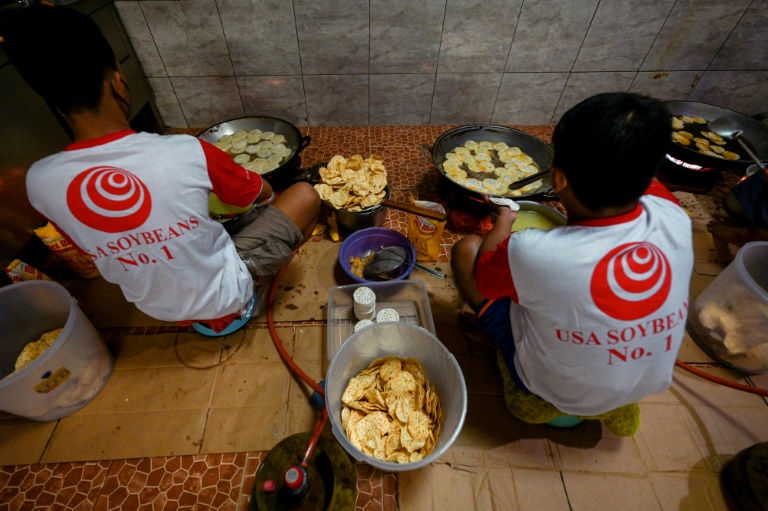
Sutaryo, who like many Indonesians goes by one name, runs a tempe chip business out of his home in South Jakarta. He was forced to jack up his prices and lay off four employees to stay afloat.

“After the surge of cooking oil prices, we have to be smart in calculating our production cost. Our consumers are left with no other choice but to accept a higher price for our kripik tempe,” he said, referring to the traditional soy-based crackers.

With demand yet to recover, production at Sutaryo’s home factory has slid from 300 to 100 kilogrammes a day, and daily revenue is down to six million rupiah from 15 million before the pandemic.

About half-a-dozen workers cut thin slices of tempe before throwing them into frying pans of hot oil, letting them sizzle until crispy. 

It is a far cry from the hustle and bustle of the business’s pre-pandemic peak, said Sutaryo, when he had workers frying tempe chips outside for lack of space.

– ‘Significant’ impact on poor – 

Cooking oil prices were already on the rise in 2021, but the impact of Moscow’s assault has driven them to record highs, said Mohammad Faisal, executive director of the Center of Reform on Economics (CORE Indonesia) think tank.

The government is now moving to secure even more supplies at home, meaning there is unlikely to be a repeat of the spike seen after Russia’s invasion of Ukraine, he said.

But while prices may come down in Indonesia’s towns and cities, they will stay high for those living in rural and remote areas like Setiana.

“For lower-income people, the impact is significant because, at the same time, there are increases in the prices [of other commodities],” Faisal told AFP.

With local prices unlikely to fall, and with little money coming in since her husband was laid off, Setiana now has other worries — like no longer being able to afford school fees for her children.

“If prices of staple goods go up, we have little left for other expenses.”

Asian markets track Wall St rally, boosted by China hopes

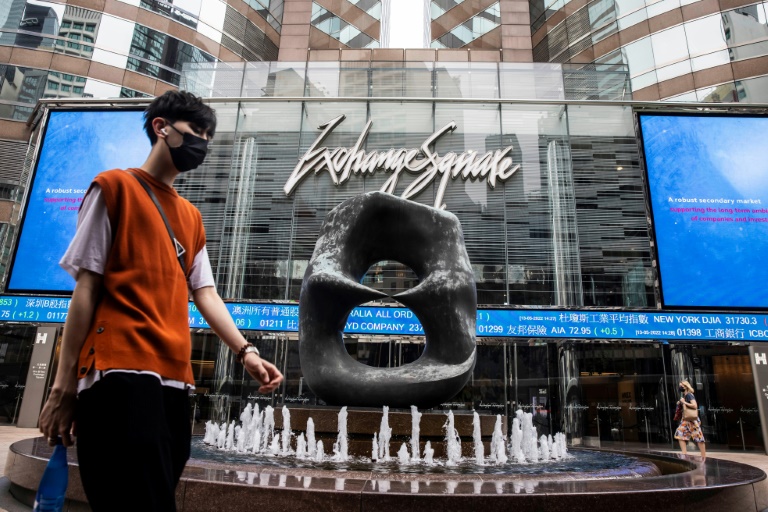
Asian markets rallied Wednesday, building on a hearty performance on Wall Street and helped by the reopening in China, though analysts continue to warn of near-term volatility caused by surging inflation, rising interest rates and the Ukraine war.

Equities have enjoyed some respite in recent weeks from a painful sell-off caused by central bank monetary tightening — particularly by the Federal Reserve — and a spike in prices that is beginning to hit consumers, raising concerns of an economic slowdown or recession.

A retreat in US Treasury yields provided a lift to New York traders, as did a jump in Chinese firms listed there fuelled by growing optimism that Beijing is to ease back on its long-running crackdown against the tech sector.

The improved mood around tech has come after a report this week said China was close to ending a probe into ride-hailing app Didi Global and restoring its main apps this week.

The Wall Street Journal also said investigations into two other firms — Full Truck Alliance and recruitment platform Kanzhun — were coming to a conclusion.

And on Tuesday authorities approved a second batch of 60 games in a further step to lightening their approach in the world’s largest mobile entertainment market.

Citi analysts said the “announcement will also send a positive signal of policy support to the overall China internet sector”.

Market heavyweights rallied in Hong Kong with Alibaba up more than six percent, Netease four percent higher and Tencent up more than three percent, helping the Hang Seng Index climb more than one percent.

Shanghai, Tokyo, Sydney, Seoul, Wellington, Taipei and Manila were also well in positive territory.

The moves come as Beijing relaxes its strict Covid lockdown measures, allowing the world’s number two economy to edge back into life after months.

“The bounce in risk sentiment is due to a more positive China tilt where the outlook is set to brighten up as Covid restrictions ease, and state-owned banks are obliged to increase lending again,” said SPI Asset Management’s Stephen Innes.

“It certainly feels like the tide is turning on the Mainland, though the overall tone still leans more cautiously optimistic, with key emphasis on ‘cautiously’.”

All eyes are on the release Friday of US inflation data for a better idea about the Fed’s plans as it hikes borrowing costs.

Officials are expected to lift rates half a point each in June and July with some commentators warning a strong report on Friday could allow them to unveil a three-quarter-point move in September.

Such a move would push the dollar up even further against its peers, with the unit at a 20-year high against the yen.

And observers said that the uncertainty would continue to cause volatility on markets.

“The reality for the economy and probably the stock markets is that aggressive central bank rate hikes are likely to take a sharp bite out of household consumption as costs of living pressures come from goods and services, depressed real wage gains and markedly higher mortgage servicing,” Innes added. 

“Hence, the central bank’s endgame is to cool inflation by slowing the economy and tightening financial conditions at stock market investors’ expense until price pressures abate.”

And Kate Moore at BlackRock explained to Bloomberg Television that “figuring out the direction over the next couple of months becomes increasingly difficult”.

“There seems to be across all of the investing segments a lack of strong conviction in the direction of the market. We are going to see a lot more investors remain on the sidelines, remain cautiously positioned.”

– Key figures at around 0230 GMT –

Tokyo – Nikkei 225: UP 1.0 percent at 28,208.92 (break)

Hong Kong – Hang Seng Index: UP 2.0 percent at 21,696.89

Shanghai – Composite: UP 0.7 percent at 3,264.90

Dollar/yen: UP at 133.00 yen from 132.62 yen late Tuesday

Euro/dollar: DOWN at $1.0693 from $1.0715 

Pound/dollar: DOWN at $1.2580 from $1.2592

Euro/pound: DOWN at 85.00 pence from 85.02 pence

Brent North Sea crude: UP 0.1 percent at $120.71 per barrel

West Texas Intermediate: UP 0.2 percent at $119.65 per barrel

New York – Dow: UP 0.8 percent to 33,180.14 (close)

London – FTSE 100: DOWN 0.1 percent at 7,598.93 (close)

US VP Harris announces migration funds as Mexico snubs Americas summit

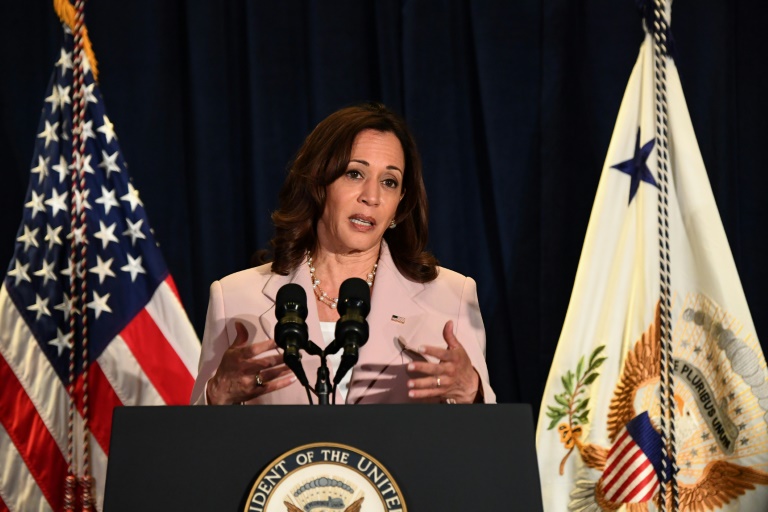
US Vice President Kamala Harris on Tuesday announced a fresh $1.9 billion in private sector funding to boost jobs in hopes of reducing migration from Central America, at a Latin America summit in Los Angeles snubbed by the leaders of Mexico and other affected countries.

Harris has been given the unenviable task of tackling the root causes of rising migration into the United States, an issue seized upon by the rival Republican Party that has turned into a top priority for President Joe Biden at a week-long Summit of the Americas.

A day before Biden’s arrival, Harris unveiled $1.9 billion in commitments by businesses — in addition to $1.2 billion announced last year — for the impoverished and violence-ravaged so-called Northern Triangle of El Salvador, Guatemala and Honduras.

Harris, who met business leaders, female entrepreneurs and civil society as part of the summit in her home state, said the efforts come from “our shared belief that most people don’t want to leave home” but also that “government cannot do it alone.”

“We know the American people will benefit from stable and prosperous neighbors. And when we provide economic opportunity for people in Central America, we address an important driver of migration,” she said.

Harris also announced the creation of the “Central American Service Corps” funded through US aid to mentor young people.

But none of the Northern Triangle leaders are attending the summit, nor is President Andres Manuel Lopez Obrador of Mexico, the crucial US partner on migration policy due to the 2,000-mile (3,200-kilometer) shared border. 

Lopez Obrador, a leftist populist, had insisted that Biden invite all governments including Cuba, Nicaragua and Venezuela — which the United States is excluding on the grounds that the summit is only for democracies.

– Seeking ‘unity’ –

Argentina’s center-left president, Alberto Fernandez, who confirmed his attendance after a phone call and invitation to Washington from Biden, said he would try to “give a voice” to the absent countries.

“We enormously regret the non-presence of the countries that weren’t invited,” he told reporters before heading to Los Angeles.

“Unity is not spoken, it is exercised, and the best way to exercise it is by not segregating anyone,” he said.

Mexican Foreign Secretary Marcelo Ebrard, attending instead of Lopez Obrador, said his president would visit Washington next month and insisted that ties were not at risk.

The relationship between the neighbors “is positive and will remain so and we don’t expect any change in that,” he said.

But Lopez Obrador’s absence set a sour tone after the Mexican leader’s surprisingly close partnership with Biden’s predecessor Donald Trump, who had threatened Mexico with sanctions unless it cracked down on Central American migrants.

US Secretary of State Antony Blinken sought until the last minute to woo Lopez Obrador, including by seeking lower-level participation by Cuba and easing some restrictions including on US flights to the communist island.

But US officials said they saw no reciprocation from Cuban authorities, who recently went ahead with the trial of two dissident artists.

– No Venezuela –

On Venezuela, the United States does not recognize President Nicolas Maduro, whose 2018 re-election was clouded by widespread reports of irregularities. Maduro instead traveled to Turkey, which maintains relations with him.

But Biden also did not invite opposition leader Juan Guaido, whom the United States still considers interim president despite what some Latin American officials privately see as his dwindling chances.

Biden will instead speak to Guaido by telephone, Brian Nichols, the top US diplomat for Latin America, told VPI television.

Biden is separately expected to meet President Jair Bolsonaro of Brazil, Latin America’s most populous nation, despite rising fears that the Trump ally will not accept the legitimacy of upcoming elections.

Ebrard hoped that the summit would address the needs for “massive investment” in Latin America and the Caribbean in the wake of the Covid-19 pandemic.

The new funding announced by Harris included a commitment by credit card giant Visa to invest more than $270 million over five years with an aim of bringing another 6.5 million people into a formal financial system in a region rife with corruption.

The North America branch of Yazaki, the Japanese auto parts maker, will invest $110 million, hiring more than 14,000 new employees in Guatemala and El Salvador, the White House said. 

Other companies making commitments include clothing maker Gap and Millicom, a telecommunications company that plans to invest $700 million to expand mobile and broadband networks across the three countries.

US VP Harris announces migration funds as Mexico snubs Americas summit

US Vice President Kamala Harris on Tuesday announced a fresh $1.9 billion in private sector funding to boost jobs in hopes of reducing migration from Central America, at a Latin America summit in Los Angeles snubbed by the leaders of Mexico and other affected countries.

Harris has been given the unenviable task of tackling the root causes of rising migration into the United States, an issue seized upon by the rival Republican Party that has turned into a top priority for President Joe Biden at a week-long Summit of the Americas.

A day before Biden’s arrival, Harris unveiled $1.9 billion in commitments by businesses — in addition to $1.2 billion announced last year — for the impoverished and violence-ravaged so-called Northern Triangle of El Salvador, Guatemala and Honduras.

Harris, who met business leaders, female entrepreneurs and civil society as part of the summit in her home state, said the efforts come from “our shared belief that most people don’t want to leave home” but also that “government cannot do it alone.”

“We know the American people will benefit from stable and prosperous neighbors. And when we provide economic opportunity for people in Central America, we address an important driver of migration,” she said.

Harris also announced the creation of the “Central American Service Corps” funded through US aid to mentor young people.

But none of the Northern Triangle leaders are attending the summit, nor is President Andres Manuel Lopez Obrador of Mexico, the crucial US partner on migration policy due to the 2,000-mile (3,200-kilometer) shared border. 

Lopez Obrador, a leftist populist, had insisted that Biden invite all governments including Cuba, Nicaragua and Venezuela — which the United States is excluding on the grounds that the summit is only for democracies.

– Seeking ‘unity’ –

Argentina’s center-left president, Alberto Fernandez, who confirmed his attendance after a phone call and invitation to Washington from Biden, said he would try to “give a voice” to the absent countries.

“We enormously regret the non-presence of the countries that weren’t invited,” he told reporters before heading to Los Angeles.

“Unity is not spoken, it is exercised, and the best way to exercise it is by not segregating anyone,” he said.

Mexican Foreign Secretary Marcelo Ebrard, attending instead of Lopez Obrador, said his president would visit Washington next month and insisted that ties were not at risk.

The relationship between the neighbors “is positive and will remain so and we don’t expect any change in that,” he said.

But Lopez Obrador’s absence set a sour tone after the Mexican leader’s surprisingly close partnership with Biden’s predecessor Donald Trump, who had threatened Mexico with sanctions unless it cracked down on Central American migrants.

US Secretary of State Antony Blinken sought until the last minute to woo Lopez Obrador, including by seeking lower-level participation by Cuba and easing some restrictions including on US flights to the communist island.

But US officials said they saw no reciprocation from Cuban authorities, who recently went ahead with the trial of two dissident artists.

– No Venezuela –

On Venezuela, the United States does not recognize President Nicolas Maduro, whose 2018 re-election was clouded by widespread reports of irregularities. Maduro instead traveled to Turkey, which maintains relations with him.

But Biden also did not invite opposition leader Juan Guaido, whom the United States still considers interim president despite what some Latin American officials privately see as his dwindling chances.

Biden will instead speak to Guaido by telephone, Brian Nichols, the top US diplomat for Latin America, told VPI television.

Biden is separately expected to meet President Jair Bolsonaro of Brazil, Latin America’s most populous nation, despite rising fears that the Trump ally will not accept the legitimacy of upcoming elections.

Ebrard hoped that the summit would address the needs for “massive investment” in Latin America and the Caribbean in the wake of the Covid-19 pandemic.

The new funding announced by Harris included a commitment by credit card giant Visa to invest more than $270 million over five years with an aim of bringing another 6.5 million people into a formal financial system in a region rife with corruption.

The North America branch of Yazaki, the Japanese auto parts maker, will invest $110 million, hiring more than 14,000 new employees in Guatemala and El Salvador, the White House said. 

Other companies making commitments include clothing maker Gap and Millicom, a telecommunications company that plans to invest $700 million to expand mobile and broadband networks across the three countries.

January 6, 2021: When US democracy was shaken to its core

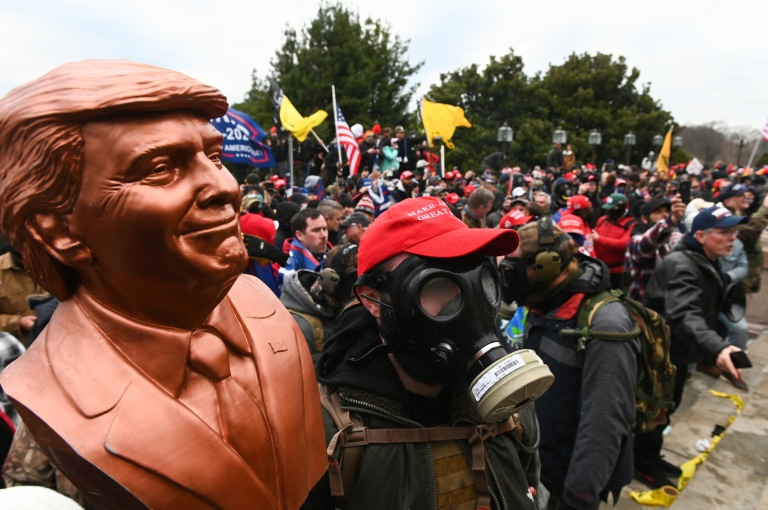
On January 6, 2021, thousands of Americans answered defeated president Donald Trump’s call to descend on Washington and protest against the outcome of the presidential election.

Within a few hours, the US Congress had been overrun in scenes of mayhem without precedent in two centuries.

A year and a half later, the House of Representatives select committee investigating the insurrection launches a series of public hearings on Thursday, hoping to demonstrate Trump’s culpability for the violence.

Here is a look back at this frigid January day when American democracy was shaken to its foundations.

– 7:00 am: Trump supporters hit Washington –

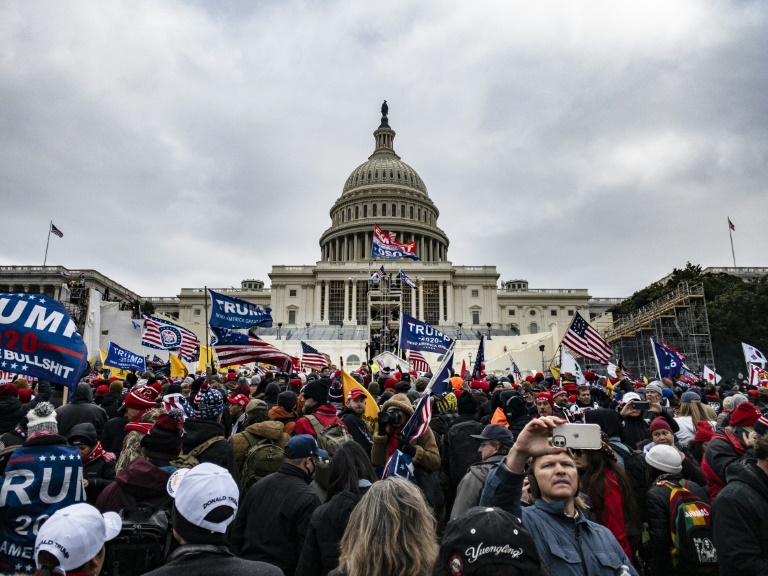
Brandishing Trump 2020 flags and wearing red “Make America Great Again” caps, tens of thousands of Trump supporters crowd into central Washington, convinced that the election he lost was tainted by fraud.

Coming from across the United States, many in buses, they cross the deeply liberal capital city, where most downtown stores and office fronts are barricaded, with locals fearing trouble. 

They converge at a stage erected near the White House, where Trump is due to speak around midday. The Republican leader has previewed proceedings in a tweet predicting the day will be “wild.”

– 11:57 am: Trump on stage –

The US president arrives on stage under heavy winter cloud cover.  

“We will never give up, we will never concede,” he vows. 

“You’ll never take back our country with weakness. You have to show strength and you have to be strong.” 

The crowd gathered in the bracing January chill is galvanized. 

The Republican billionaire urges his vice president, Mike Pence, not to certify Joe Biden’s victory during the upcoming special session of Congress, over which Trump’s most loyal lieutenant is due to preside. 

As he concludes his speech, Trump says: “We’re going to the Capitol.”

His compliant supporters take note and head to the US Congress, at the eastern end of the National Mall. 

– 1:02 pm: The Pence letter –

At the same time, lawmakers in both chambers begin the process of certifying the results of the presidential election.  

Just before the start of the session, Pence makes clear in a letter that he has no plans to oppose certification, a right he says belongs solely to the legislators.

Mitch McConnell, the leader of the Senate’s Republican majority, has been broadly supportive of Trump during his four years in office — but now warns colleagues that doing his will and blocking certification would send democracy into a “death spiral.”  

But from the beginning of the session, some Republicans raise objections to the results of the election in the state of Arizona. 

– 2:00 pm: Protesters breach the Capitol –

Meanwhile, pro-Trump protesters begin to deluge Congress.

Nearby buildings are evacuated as rioters force their way through police barricades. The election certification session is halted and both chambers are placed in lockdown.  

Tear gas is fired into the Capitol rotunda, under the famous neoclassical dome, where police draw their weapons. 

Images of a shirtless man sporting buffalo horns as he wanders the halls of Congress, and of another putting his feet up on Democratic House Speaker Nancy Pelosi’s desk, circulate quickly around the world. 

Police shoot dead a protester who is trying to slip into the chamber through a broken window. 

Ashli Babbitt — an extremist and conspiracy theorist to some, a patriotic martyr for others — will come to symbolize the deep political faultline that divides the United States after the events of January 6.  

– 2:24 pm: Tweets and texts –

While the vice president and lawmakers are evacuated from the chaos of the Capitol, Trump castigates Pence for not having “the courage to do what was necessary to protect the country.” 

The president is following the events on television in a room next to the Oval Office. 

Republican politicians and conservative celebrities implore his chief of staff Mark Meadows to push him to act, text messages released by the House investigation show.  

“Hey Mark, The president needs to tell people in the Capitol to go home. This is hurting all of us,” star Fox News host Laura Ingraham says in a text message at 2:32 pm. 

“He needs to condemn this shit ASAP,” warns the president’s son, Donald Trump Jr., in another message at 2:53 pm. 

– 4:17 pm: Trump tells supporters: ‘Go home’ –

At 4:17 pm, Trump finally posts a video on his Twitter account. 

“I know your pain, I know you’re hurt,” he says from the White House grounds, before launching into by now familiar falsehoods about election fraud.

“We had an election that was stolen from us. It was a landslide election and everyone knows it, especially the other side. But you have to go home now, we have to have peace.” 

– 6:30 pm: Calm restored –

At 6:00 pm, a curfew imposed by the mayor of Washington goes into effect. The demonstrators still on site are dispersed by law enforcement. 

Half an hour later, an official announces that the Capitol is once again secure. 

At 8:06 pm, Congress resumes the certification process.

From the chamber floor where members of the pro-Trump mob were parading a few hours earlier, Pence vows: “To those who wreaked havoc in our Capitol today — you did not win.”

At 3:42 am, the election of Joe Biden is officially certified.

The US Capitol riot public hearings: six questions

The investigation into last year’s assault on the US Capitol by a mob of Donald Trump’s supporters is entering a public phase, with two weeks of blockbuster televised hearings slated to start Thursday.

The seven Democrats and two Republicans who make up the House of Representatives committee probing the insurrection will set out exactly what happened on January 6, 2021 and who they believe aided the ringleaders.

A final hearing in September is expected to reveal the committee’s finished report, outlining its findings and recommendations to prevent such attacks in the future.

Republicans including House Minority Leader Kevin McCarthy say the committee is partisan and “not conducting a legitimate investigation” — an argument that has been rejected by a Trump-appointed federal judge.

– What has the committee been doing? –

The panel has issued around 100 subpoenas and has conducted around 1,000 interviews, with star witnesses including two of Trump’s children — Ivanka and Don Jr. — as well as his son-in-law and senior advisor Jared Kushner.

Investigators have collected more than 100,000 documents, including emails, texts and official White House photographs allowing the committee to dig into the goings-on in and around the Oval Office.

Four of Trump’s most senior aides have refused to comply with subpoenas, and five Republican lawmakers — including McCarthy — have dismissed their subpoenas for testimony as illegitimate.

– What have we learned? –

Revelations around who knew what and when have largely dripped out via court filings in civil cases involving potential committee witnesses and separate criminal cases against the insurrectionists.

Among the most explosive was a trove of text messages between Trump’s chief of staff Mark Meadows and lawmakers, media allies and the Trump family urging the then-president to call on his supporters to end the riot. 

Other texts among more than 2,000 handed over by Meadows show Ginni Thomas, the wife of US Supreme Court Justice Clarence Thomas, agitating for the election results to be overturned.

Meadows burned documents in his office after a meeting with House Republican Scott Perry, who was working to challenge the 2020 election, according to testimony by a former Meadows aide.

– What will the hearings reveal? –

The committee will seek to distill a sprawling, multi-faceted year-long probe into a compelling narrative that will “paint a picture as clear as possible as to what occurred,” chairman Bennie Thompson told reporters.

Investigators hope to set out through public testimony the role the Trump White House played in the campaign to overturn his 2020 election defeat to Democrat Joe Biden.

Those efforts allegedly include an illegal scheme to send fake “electors” — the people appointed to vote for president in the state-by-state “Electoral College” — to Congress.

They also take in an authoritarian plan to seize voting machines and the alleged plot to delay the certification of Biden’s win through the violence at the Capitol.

Investigators want to get to the bottom of a 187-minute delay before law enforcement was beefed up to protect the Capitol and learn why there is a gap of almost eight hours in White House logs of Trump calls as the violence played out.

– Will anyone face charges? –

A federal judge ruled in March that Trump more likely than not committed a crime in the run-up to January 6, 2021.

While the Justice Department is prosecuting more than 800 suspects for alleged lawbreaking at the Capitol, the committee itself has no powers to issue indictments.

The panel is expected to turn over evidence to federal prosecutors but has not announced whether it will recommend charges, a largely symbolic gesture.

– How will the hearings work? –

The committee will hold prime-time hearings at 8:00 pm (0000 GMT) on June 9 and 23, bookending 10:00 am hearings on June 13, 15, 16 and 21. 

Testimony is expected to be accompanied by visual illustrations such as text messages, photographs and videos.

Thursday’s hearing is set to feature testimony from US Capitol Police officer Caroline Edwards, the first to be injured by rioters, and filmmaker Nick Quested, who recorded the first moments of violence.

J. Michael Luttig, a former federal judge who advised Trump’s vice president Mike Pence, is expected to testify.

Other witnesses could include Marc Short, a chief of staff to Pence, Justice Department official Richard Donoghue and Jeffrey Rosen, Trump’s last attorney general.

All four were party to much of the relevant discussion between Trump’s election defeat and the insurrection two months later, investigators say.

The committee has been lukewarm about the idea of forcing Trump to testify, asserting that his appearance would likely add little to its understanding of the facts.

– Will they change any minds? –

Supporters see the committee’s work as vital in ensuring one of the darkest episodes in the history of US democracy is never repeated.

Yet Democrats worry the hearings could be seen as another “partisan” attack on Trump, imperiling bipartisan efforts at reform and obscuring the broader story of a slow-moving coup attempt aided by a violent insurrection.

“The top issues for most US voters have nothing to do with the January 6 insurrection, unfortunately,” Democratic analyst Mike Hernandez told AFP as his party faces tricky midterm elections later this year. 

“Inflation, gas prices, school shootings, school safety and reproductive rights are all issues that more Americans care about.”

Helium shortage deflates American celebrations

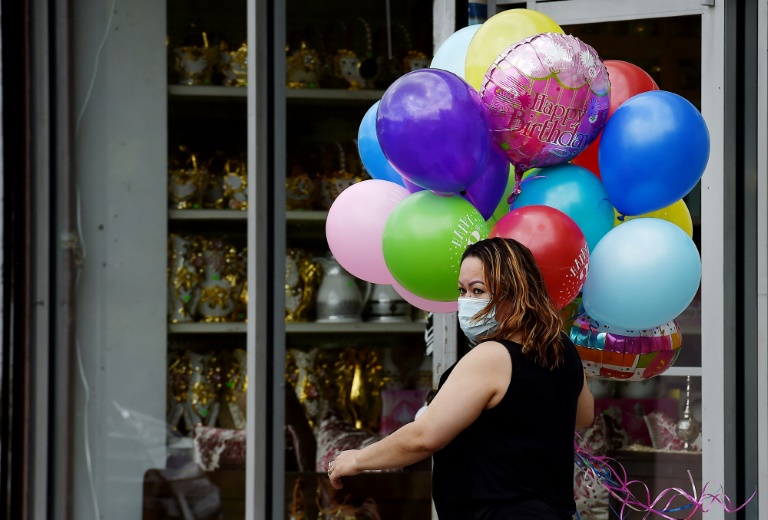
Helium balloons are part of nearly every American celebration, but a global shortage of the lighter-than-air gas has disrupted many traditions.

One college football team has suspended its traditional release of red balloons, and party planners will have to make do with less — if they get any.

“Due to the global helium shortage, we only allow 20 balloons to be ordered,” Litin’s Party Value, a party supplier in Minneapolis, Minnesota, warns on its website. 

“We’ve had some customers pretty disappointed that they couldn’t get more,” Kristi Holmstrom, the chain’s general manager, told AFP. 

“I’ve never seen it this bad before,” she said, adding that many stores have run out of helium entirely.

Whether it floats at the end of a string or grouped in a bouquet, shaped like a cartoon character, a number, or a Halloween pumpkin, helium balloons are a must. 

Between the lost sales and the suspension of the helium rental business, Holmstrom estimates the shortfall to be between $5,000 and $10,000 a month. 

The University of Nebraska football team, the Cornhuskers, will do without its traditional release of red balloons — the school color — before each home game this season. 

“Acquiring helium … is really challenged and it’s been hard to get,” university athletic director Trev Alberts said in late May. 

University officials asked “that the helium we are getting as a university we need to use for medical purposes” at the university’s medical center in Omaha,” he said.

The inert gas, a byproduct of natural gas production, is liquified to cool magnetic resonance imaging scanners (MRIS), was once deployed on space shuttle missions, and also is used in the manufacturing of semiconductors.

– ‘No store had helium’ –

Only a handful of countries — led by the United States — produce the gas, and the already-fragile supply chain has been disrupted by plant closures: in Texas over safety issues, in Russia after a fire (prior to the war in Ukraine), and in Qatar for maintenance.

Brad Weston, chief executive officer of Party City, said during an earnings call last month that the party supply chain has faced higher costs for helium, which cut about $2 million from gross profit in the first three months of the year and will inflict a bigger hit in the second quarter.

“The good news is we’ve secured helium to meet our customers’ needs,” ahead of the peak graduation season in May and June, he said of the retailer, which has 830 stores in North America.

The situation is even worse for the Dollar Tree discount chain.

“We are once again, experiencing shortages in availability of helium, and have not been able to procure the volume and the needs which will negatively affect balloon sales,” CEO Mike Witynski lamented late last month.

That’s small comfort for families trying to celebrate graduations, weddings and birthdays.

“Tried to get my baby some balloons for her graduation. No stores got helium,” Guy Fisher of Indiana said on Twitter.

– Priority for medical use –

Anna Bondareva, creator of the Wonder Party Rental agency outside of Washington, DC, along with her partner Laura Badmaev, said they are trying to find alternatives. 

“I think it’s getting worse because it’s getting more expensive. It’s harder to get it,” Bondareva told AFP. “That should give us a chance to more creative to rethink our decorations.”

One client opted against using helium balloons for her 33rd birthday celebration due to the high cost. They no longer offer their customers this expensive option, and instead have focused on using balloons in other ways, including arches.

Even the National Weather Service has had to reduce the launch of balloons used for forecasting at a handful of its sites. 

“Where needed, we reduced launches during clear weather to conserve the supply so we can launch in support of forecasts for bad weather days,” a spokeswoman said.

Harvey Weinstein sues Stellantis for 2019 car accident

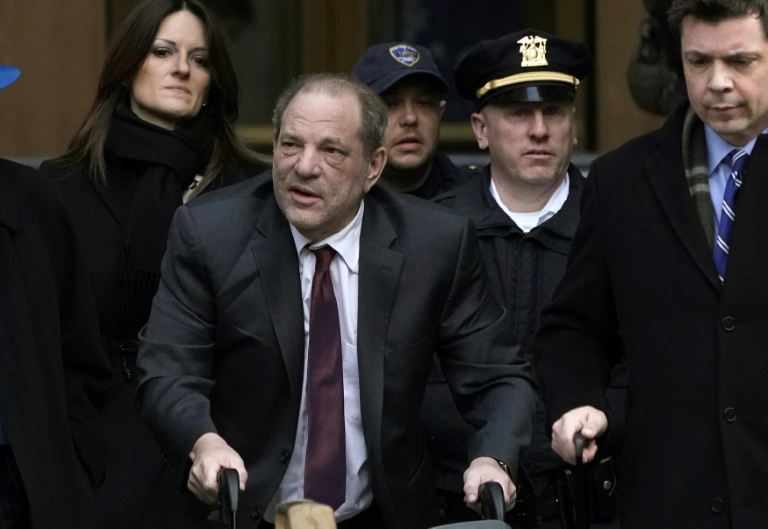
Jailed movie producer Harvey Weinstein filed a lawsuit in New York court on Tuesday against the Fiat Chrysler company, which is now part of Stellantis, claiming $5 million in compensation for an accident he had in 2019 in a Jeep.

Stellantis, in a message sent to AFP, said, “We intend to vigorously defend our product against these claims.”

Weinstein, who was sentenced in 2020 to 23 years in prison for a sexual assault and rape, said in his complaint that he was driving in a Jeep loaned by the company in return for product placement in one of his movies, on August 17, 2019 and that the vehicle’s brakes failed when he tried to avoid hitting a deer. 

The car then overturned, causing Weinstein, who had properly buckled his seat belt, to suffer “catastrophic, permanent paralyzing injuries as well as significant and continuing conscious pain and suffering,” the complaint said.

Weinstein had back surgery in December 2019 following the car accident according to his lawyers, and appeared physically weakened during his trial, often moving with a walker. 

Aged 70, Weinstein is currently incarcerated in a prison in California where he is awaiting another trial for alleged sexual assault against five women.

Close Bitnami banner
Bitnami