US Business

On 100th day of Russian invasion, Zelensky vows victory

Ukraine will emerge victor in the war started by Russia, President Volodymyr Zelensky said Friday as Moscow’s invasion of its neighbour entered its 100th day with Russian troops pounding the Donbas region.

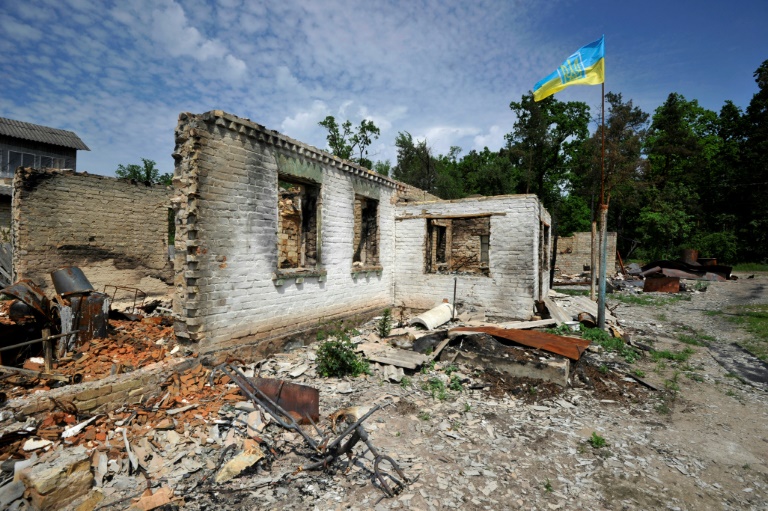
Thousands of people have been killed, millions sent fleeing and towns turned into rubble, since Russian President Vladimir Putin ordered his troops into Ukraine on February 24.

Russia’s advance has been slowed by a fierce Ukrainian resistance which repelled them from around the capital and forced Moscow to shift its aims towards capturing the east.

Russia has since taken a fifth of Ukrainian territory — tripling the land under its occupation from 2014 when it seized Crimea and parts of Donbas.

Moscow assessed that “certain results have been achieved,” Kremlin spokesman Dmitry Peskov told reporters, pointing to the “liberation” of some areas from what he called the “pro-Nazi armed forces of Ukraine”.

But Zelensky said Russia will not prevail appearing in a video accompanied by the same key political leaders also shown in a video posted on February 24 when they vowed to defend their country.

“Our team is much bigger. The Armed Forces of Ukraine are here. The most important — the people, the people of our state are here. Defending Ukraine for 100 days already,” he said. 

“Victory will be ours,” he declared in a show of defiance in the video with the presidential office building as a backdrop.

– ‘Levelling everything’ –

Putin’s troops are now concentrating their forces in the Donbas, in the east, where some of the fiercest fighting is centred on the industrial hub city of Severodonetsk.

Fighting continues in Severodonetsk’s city centre, the president’s office said, adding that the invaders were “shelling civilian infrastructure and Ukrainian military”. 

Severodonetsk “is the toughest area at the moment,” Zelensky said late Thursday. 

“For 100 days, they have been levelling everything”, Lugansk regional governor Sergiy Gaiday said on Telegram. 

Accusing the Russians of destroying hospitals, schools and roads, Gaiday said, however, that “we are only getting stronger.

“Hatred of the enemy and faith in our victory make us unbreakable.”

Ukrainian troops were still holding an industrial zone, Gaiday said, a situation reminiscent of Mariupol, where a steelworks was the south-eastern port city’s last holdout until Ukrainian troops finally surrendered in late May.

The situation in Lysychansk — Severodonetsk’s twin city, which sits just across a river — also looked increasingly dire. 

About 60 percent of infrastructure and housing had been destroyed, while internet, mobile network and gas services had been knocked out, said the city’s mayor Oleksandr Zaika.

– ‘Getting worse’ –

“The shelling is getting stronger every day,” he said.

In the city of Sloviansk, about 80 kilometres (50 miles) from Severodonetsk, the mayor has urged residents to evacuate as bombing intensified and water and electricity are cut off.

Student Goulnara Evgaripova, 18 recounted heavy bombardments as she boarded a minibus to leave the city.

“The situation is getting worse, the explosions are stronger and stronger and the bombs are falling more often,” she told AFP. 

And in Mykolaiv in the south, Russian shelling killed at least one person and injured several others, Ukrainian military officials said late Thursday.

“This war has and will have no winner,” Amid Awad, Assistant Secretary-General and United Nations Crisis Coordinator for Ukraine, said in a statement.

“Rather, we have witnessed for 100 days what is lost: lives, homes, jobs and prospects.”

Led by the United States, Western nations have pumped arms and military supplies into Ukraine to help it survive the onslaught.

Earlier this week, the United States announced that it was sending more advanced rocket launch systems to Ukraine, part of a $700 million package. The Kremlin accused Washington of “adding fuel to the fire”.

– Sall-Putin talks –

Western allies have also sought to choke off Russia’s financial lifeline in a bid to get Putin to change course.

Ramping up an already long list of embargoes, the United States on Thursday blacklisted Putin’s money manager and a Monaco company that provides luxury yachts to Moscow’s elite.

Across the Atlantic, EU nations agreed new sanctions that would halt 90 percent of Russian oil imports to the bloc by the end of the year. 

Russia warned that European consumers would be the first to pay the price for the partial oil embargo.

Major crude producers agreed to boost output by about 50 percent more a month in an effort to calm an overheated market and ease pressure on inflation.

But the move disappointed investors, and prices rose following the announcement.

With a global food crisis also looming, the head of the African Union, Senegalese President Macky Sall, is due Friday in Russia for talks with Putin.

Sall will seek to get Putin to free up stocks of cereals and fertilisers blocked 

Ukraine is one of the world’s top grain producers, and the war was already translating into higher costs for essentials from cereals to sunflower oil to maize, with the poorest among the hardest hit.

burs-hmn/jm
Global plastic waste on track to triple by 2060

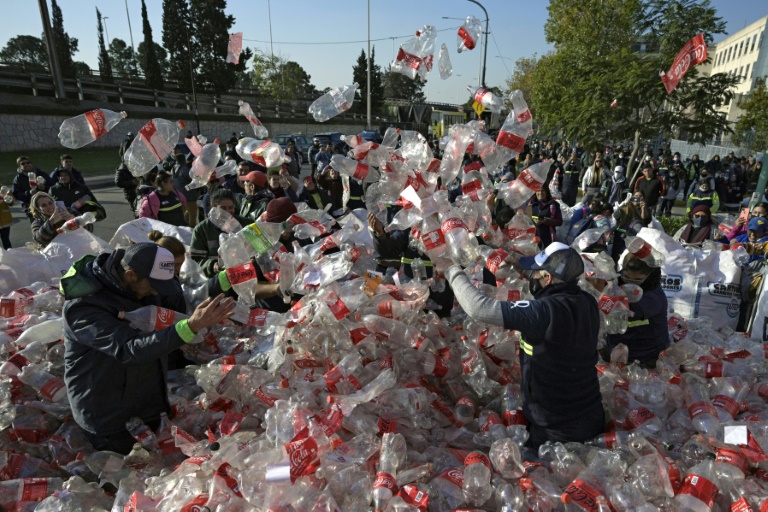
A world severely blighted by plastic pollution is on track to see the use of plastics nearly triple in less than four decades, according to findings released Friday.

Annual production of fossil-fuel-based plastics are set to top 1.2 billion tonnes by 2060 and waste to exceed one billion tonnes, according to the Organisation for Economic Co-operation and Development (OECD).

Even with aggressive action to cut demand and improve efficiencies, plastic production would almost double in less than 40 years, the 38-nation body projects in a report.

Such globally coordinated policies, however, could hugely boost the share of future plastic waste that is recycled, from 12 to 40 percent.

There is increasing international alarm over volume and omnipresence of plastics pollution, and its impact. 

Infiltrating the most remote and otherwise pristine regions of the planet, microplastics have been discovered inside fish in the deepest recesses of the ocean and locked inside Arctic ice.

The debris is estimated to cause the deaths of more than a million seabirds and over 100,000 marine mammals each year.

“Plastic pollution is one of the great environmental challenges of the 21st century, causing wide-ranging damage to ecosystems and human health,” OECD chief Mathias Cormann said.

Since the 1950s, roughly 8.3 billion tonnes of plastic have been produced with more than 60 percent of that tossed into landfills, burned or dumped directly into rivers and oceans.

Some 460 million tonnes of plastics were used in 2019, twice as much as 20 years earlier.

The amount of plastic waste has also nearly doubled, exceeding 350 million tonnes, with less than 10 percent of it recycled.

The new report contrasts a business-as-usual trajectory with the benefits of more ambitious global policies of reduced plastic use and pollution.

Driven by economic growth and an expanding population, plastics production is set to increase under either scenario, the OECD warns.

Where policies can make a huge difference is in the handling of waste.

Currently, nearly 100 million tonnes of plastic waste is either mismanaged or allowed to leak into the environment, a figure set to double by 2060.

“Co-ordinated and ambitious global efforts can almost eliminate plastic pollution by 2060,” the report concludes. 

Earlier this year, the United Nations set in motion a process to develop an internationally binding treaty to limit plastic pollution.

As EU squeezes Russia, Serbia embraces old ally

While the European Union scrambles to isolate Russia and reduce energy imports from the country, EU candidate Serbia is tightening its bond with Moscow through a new gas supply deal.

Belgrade has condemned the Russian invasion of Ukraine at the United Nations, but it has refused to take part in sanctions against its old ally, even though Serbia aims to join the EU.

A day before the Europeans agreed to ban most Russian oil imports this week, Belgrade announced a three-year natural gas contract with Moscow, drawing a rebuke from Brussels.

Serbian President Aleksandar Vucic revealed the “very favourable” gas deal — with “by far the best terms in Europe” — following a phone call with Russia’s Vladimir Putin on Sunday.

“We will have a safe winter when it comes to gas supply,” the populist leader boasted, adding that in winter, Serbia will pay “one tenth” of the price shelled out by other European countries.

Russia, meanwhile, has cut gas supplies to several EU nations. The bloc aims to reduce gas imports by two-thirds this year, but an embargo is not in the cards so far.

Underscoring Belgrade’s friendly ties with Moscow, Russian Foreign Minister Sergei Lavrov is to visit the Balkan country’s capital early next week, the foreign ministry in Moscow said Friday.

Lavrov is to meet Vucic, his Serbian counterpart Nikola Selakovic and Serbian Patriarch Porfirije.

EU spokesman Peter Stano said the bloc expects Serbia “not to further strengthen its ties with Russia”.

“Candidate countries, including Serbia, are expected to progressively align their policies towards third countries with the policies and positions adopted by the European Union, including with restrictive measures,” Stano said in a statement.

– ‘Side deals’ –

Belgrade officially proclaims EU accession is a priority, but it has consistently shied away from European policies going against Russian interests while pro-government media echo the fierce messages coming from the Kremlin.

Serbian officials have accused Western countries of pressuring Belgrade to impose sanctions against Russia, and some even suggested that the country should drop its EU bid over the issue.

“It’s like they spent the last decade preparing Serbian society not for EU accession, but for an alliance with Moscow,” Srdjan Cvijic, member of The Balkans in Europe Policy Advisory Group (BiEPAG) think tank, told AFP.

According to a recent opinion poll, 40 percent of Serbians said they would be “happy” if their country gave up trying join the EU and formed an alliance with Russia instead.

Goran Vasic, assistant research professor at University of Novi Sad, said there is always a “brotherly clause” in gas prices that “is not in the contract but implies side deals or political concessions.”

Belgrade rejected the notion that cheap gas was  Kremlin’s “reward” for not heeding the calls for sanctions.

“All those who accuse us of not imposing sanctions against Russia because of a gas deal should be ashamed of themselves”, Serbian Prime Minister Ana Brnabic told local media. 

“We don’t impose sanctions against Russia out of principle.”

Lavrov told Serbian media that Moscow was “certain that they (Serbians) will continue taking the smart choice in this situation”.

– Energy monopoly –

Serbia’s president has underlined the diplomatic importance of Russia’s refusal to allow international recognition of Serbia’s breakaway province of Kosovo and historic, political and cultural ties between Belgrade and Moscow.

But the reality is that there was little room for manoeuver from Belgrade.

The previous gas deal with Russia — which was also well under market price — was about to expire with no viable alternative in the near future.

In the last few decades, Serbia gradually allowed Moscow almost complete monopoly over its energy sector by building pipelines solely for Russian gas and selling the majority stake of its oil and gas company (NIS) to Russian energy giant Gazprom.

The 2008 deal, penned only months after Kosovo declared independence, was widely seen as a political concession — allowing Moscow to connect a major European gas pipeline through Serbia in exchange for the Kremlin vetoing the recognition of Kosovo at the UN.

“It’s obvious that all this time there was a well-organised lobbyist group that has defended the monopoly, and still continues to do so,” Vasic said.

Depp-Heard trial's impact 'potentially catastrophic' for abuse survivors

The acrid US defamation trial between actors Johnny Depp and Amber Heard — and the decision to televise it — will have a “potentially catastrophic” impact on abuse survivors, advocates say.

Jurors in the six-week trial, in which the former husband and wife traded claims and counterclaims of violent domestic abuse, sided largely with Depp this week, ordering Heard to pay him $10.35 million for defaming him in a 2018 Washington Post editorial in which she never mentioned his name.

Judge Penney Azcarate decided weeks before the trial began to allow cameras in the state court, fearing that if she did not, too many reporters would show up for the high-profile case.

“I don’t see any good cause not to do it,” Azcarate said, according to Variety — a decision that Depp’s lawyers welcomed and Heard’s lawyers fought. 

Michele Dauber, a law professor at Stanford University and advocate against campus sexual assault, branded it “the single worst decision for survivors by a court in decades” that showed “a profound lack of understanding by the judge of sexual violence.”

Heard was forced “to describe her alleged rape in graphic detail on television. That shocks the conscience and should offend every woman and survivor regardless of whether they agree with the verdict or not,” she said.

The last time she could recall a rape survivor being forced to testify publicly was in 1983, she said.

“There is no way to justify the judge’s decision to allow cameras in this case… There is no public interest in this case that could possibly outweigh the harm done.”

Instead, she argued, “every victim is going to think twice before coming forward and seeking a restraining order or telling anyone about any abuse they are experiencing after this. 

“Women may be injured or even killed as a result of not seeking help. This case has been a complete disaster. It is potentially catastrophic.”

The trial riveted a global audience not used to watching sexual assault and intimate partner allegations play out in court and that — regardless of opinions on the verdict — is a problem, warned Ruth Glenn, president of the National Coalition Against Domestic Violence.

“I don’t think we have a society yet that understands the dynamics of domestic violence,” Glenn told AFP in an interview. 

That crucial context was not discussed enough during the court proceedings in Fairfax, Virginia, she argued, saying that for her and her colleagues there was “no doubt” about the patterns of abuse that were displayed. 

“You make sure that there are people present that understand that. And until you do that, let’s not televise this,” she said. 

– ‘Open misogyny’ –

Dauber, who has received online abuse for tweeting about the case, said it also underscores the growing backlash against women’s rights in the United States.

Public opinion came down solidly on Depp’s side, with Heard targeted by countless online posts and memes, some of which Dauber described as “open misogyny.”

The verdict was greeted with celebration by many on the political right, she noted — including in tweets by Donald Trump Jr, son of the former president, and the powerful Republican House Judiciary Committee.

Heard was “metaphorically tarred and feathered,” and the verdict “makes it clear that for now the backlash against women’s rights is taking control,” she wrote, also citing fears that the US Supreme Court is set to overturn the right to abortion.

For many the case has raised questions about the future of #MeToo, the movement created out of the 2017 hashtag that encouraged women to speak out about the men who had abused them. 

“It’s impossible not to see this as a backlash to #MeToo — like women have gone too far. Okay, ladies, we listened to you and locked a couple of men up. Don’t get too greedy, now,” wrote one Reddit user in a blog post for the Embedded Substack newsletter.

Tarana Burke, who founded the #MeToo movement, tweeted a defiant post listing its achievements, calling on followers to focus on the millions now speaking out without shame instead of ping-ponging between legal victories and losses.

“This movement is very much ALIVE,” she wrote. 

But Glenn was more philosophical. 

“I would say that, I don’t know how much traction we had gained anyway. So let us use this as a reminder of the work that we still have to do,” she told AFP.

For her, the future remains uncertain.

“This is a perfect example of a case influencing a culture,” she said.

“And I don’t know that we’ll know tomorrow what that influence will have been and how much impact it’s had, either positively or negatively.”

Asian markets track Wall St up before jobs data, oil holds gains

Asian equities rose Friday following a strong performance on Wall Street ahead of a key US jobs data release, while crude gave up some of the previous day’s gains after an output hike disappointed traders.

A below-forecast reading on US private jobs offered some support to New York, even as inflation and interest rate hike concerns remained major headaches.

While observers said the reading from payroll firm ADP was not usually a good guide for the official report, a soft number on Friday could give the Federal Reserve a little room to ease off its rate hike drive and provide a much-needed boost to sentiment.

“Seemingly, anything that keeps the Fed from a more aggressive rate-hiking path appears to be greeted with open arms by equities,” said Stephen Innes of SPI Asset Management.

For now, expectations are for the US central bank to continue tightening monetary policy with half-point hikes at upcoming meetings, while vice chair Lael Brainard warned she did not yet see any reason to take a breather in the third quarter, as some had hoped. 

Still, a rally in beaten-down tech firms helped drive healthy gains on Wall Street, and Asia managed to ride on the coattails.

Tokyo rose more than one percent, while Sydney, Seoul, Singapore, Mumbai, Manila, Wellington and Jakarta were also up.

Hong Kong, Shanghai and Taipei were closed for holidays.

– Oil pressure –

But analysts remain on edge about the near-term outlook owing to uncertainty caused by a range of issues including the Ukraine war and China’s economic travails.

“We believe a slight lean toward defensive sectors and away from the growth-oriented areas of this market still make sense,” said Scott Brown, of LPL Financial.

“Outside of this recent rally, very little about this market has changed from a technical standpoint and that makes us wary of calling the all-clear.”

Hopes that OPEC and other major crude producers could ease pressure on inflation by ramping up output were dealt a blow when they agreed to pump just 50 percent more per month.

The announcement did little to soothe worries about a supply shortage caused by bans on US and UK imports from Russia, and came just as European leaders said they would impose a partial embargo on shipments.

A report showing a steep drop in US stockpiles added to the woes on oil trading floors, with some commentators saying prices could once again spike as China relaxes long-running lockdown measures in major cities.

– Key figures at around 0610 GMT –

Tokyo – Nikkei 225: UP 1.3 percent at 27,761.57 (close)

Hong Kong – Hang Seng Index: Closed for a holiday

Shanghai – Composite: Closed for a holiday

Brent North Sea crude: DOWN 0.4 percent at $116.35 per barrel

West Texas Intermediate: DOWN 0.2 percent at $117.25 per barrel

Euro/dollar: UP at $1.0754 from $1.0753 on Thursday

Pound/dollar: UP at $1.2572 from $1.2568

Euro/pound: UP at 85.54 pence from 85.49 pence

Dollar/yen: DOWN at 129.82 yen from 129.85 yen

New York – Dow: UP 1.3 percent at 33,248.28 (close)

London – FTSE 100: Closed for a holiday

Russia's invasion of Ukraine enters 100th day as fighting rages

Ukraine marked 100 days since Russia’s invasion on Friday with fighting raging across the east of the country, where Moscow’s forces are tightening their grip on the Donbas region.

The sombre milestone came as Kyiv announced Moscow was now in control of a fifth of Ukrainian territory, including Crimea and parts of Donbas seized in 2014.

After being repelled from around the capital, President Vladimir Putin’s troops have set their sights on capturing eastern Ukraine, prompting warnings the war could drag on.

Some of the fiercest fighting is now centred on Severodonetsk in the Donbas region, 80 percent of which the Russians have seized, but Ukrainian forces are putting up stiff resistance.

President Volodymyr Zelensky said late Thursday Ukrainian forces had had some success in the battle for the industrial hub, which is in the Lugansk region.

“But it is still too early. It is the toughest area at the moment,” he added.

Lugansk regional governor Sergiy Gaiday said on Telegram that “for 100 days, they have been levelling everything”, accusing the Russians of destroying hospitals, schools and roads. 

“But we are only getting stronger. Hatred of the enemy and faith in our victory make us unbreakable.”

Since Russia’s February 24 invasion, thousands of people have been killed and millions forced to flee, while Zelensky says up to 100 Ukrainian soldiers are dying every day on the battlefield. 

Severodonetsk’s Azot factory, one of Europe’s biggest chemical plants, was targeted by Russian soldiers who fired on one of its administrative buildings and a warehouse where methanol was stored.

– ‘Shelling getting stronger’ –

Ukrainian troops were still holding an industrial zone, Gaiday said, a situation reminiscent of Mariupol, where a huge steelworks was the southeastern port city’s last holdout until Ukrainian troops finally surrendered in late May.

The situation in Lysychansk — Severodonetsk’s twin city, which sits just across a river — also looked increasingly dire. 

About 60 percent of infrastructure and housing had been destroyed, while internet, mobile network and gas services had been knocked out, said the city’s mayor Oleksandr Zaika.

“The shelling is getting stronger every day,” he said.

In the city of Sloviansk, about 80 kilometres (50 miles) from Severodonetsk, residents said there were constant bombardments by Russian troops. 

“It’s very difficult here,” said paramedic Ekaterina Perednenko, 24, who only returned to the city five days ago but realises that she will have to leave again.

“Shooting is everywhere, it’s scary. No water, electricity or gas,” she said.

And in Mykolaiv in the south, Russian shelling killed at least one person and injured several others, Ukrainian military officials said late Thursday.

– Financial squeeze –

Led by the United States, Western nations have pumped arms and military supplies into Ukraine to help it survive the onslaught.

Bridget Brink, the new US ambassador to Kyiv, promised Thursday that the United States would “help Ukraine prevail against Russian aggression,” after presenting her credentials to Zelensky.

Earlier this week, the United States announced that it was sending more advanced Himar multiple rocket launch systems to Ukraine.

The mobile units can simultaneously fire multiple precision-guided munitions at targets up to 80 kilometres away.

They are the centrepiece of a $700 million package that also includes air-surveillance radar, ammunition, helicopters and vehicles.

Kremlin spokesman Dmitry Peskov accused Washington of “adding fuel to the fire,” although US officials insist Ukraine has promised not to use them to strike inside Russia.

Beyond sending arms to Ukraine, Western allies have also sought to choke off Russia’s financial lifeline in a bid to get Putin to change course.

Ramping up an already long list of embargoes, the United States blacklisted Putin’s money manager and a Monaco company that provides luxury yachts to Moscow’s elite.

Across the Atlantic, EU nations agreed new sanctions that would halt 90 percent of Russian oil imports to the bloc by the end of the year. 

– Oil move disappoints –

Russia warned that European consumers would be the first to pay the price for the partial oil embargo.

Major crude producers agreed to boost output by about 50 percent more a month in an effort to calm an overheated market and ease pressure on inflation.

But the move disappointed investors, and prices rose following the announcement.

The war risks triggering a global food crisis, as Ukraine is one of the world’s top grain producers.

It was already translating into higher costs for essentials from cereals to sunflower oil to maize, with the poorest among the hardest hit.

The head of the African Union, Senegalese President Macky Sall, is to visit Russia on Friday for talks with Putin.

The visit is aimed at “freeing up stocks of cereals and fertilisers, the blockage of which particularly affects African countries”, along with easing the Ukraine conflict, Sall’s office said.

burs-sr/je

As EU squeezes Russia, Serbia embraces old ally

While the European Union scrambles to isolate Russia and reduce energy imports from the country, EU candidate Serbia is tightening its bond with Moscow through a new gas supply deal.

Belgrade has condemned the Russian invasion of Ukraine at the United Nations, but it has refused to take part in sanctions against its old ally, even though Serbia aims to join the EU.

A day before the Europeans agreed to ban most Russian oil imports this week, Belgrade announced a three-year natural gas contract with Moscow, drawing a rebuke from Brussels.

Serbian President Aleksandar Vucic revealed the “very favourable” gas deal — with “by far the best terms in Europe” — following a phone call with Russia’s Vladimir Putin on Sunday.

“We will have a safe winter when it comes to gas supply,” the populist leader boasted, adding that in winter, Serbia will pay “one tenth” of the price shelled out by other European countries.

Russia, meanwhile, has cut gas supplies to several EU nations. The bloc aims to reduce gas imports by two-thirds this year, but an embargo is not in the cards so far.

Underscoring Belgrade’s friendly ties with Moscow, Serbian media reported that Russian Foreign Minister Sergei Lavrov is expected to visit the Balkan country’s capital soon.

EU spokesman Peter Stano said the bloc expects Serbia “not to further strengthen its ties with Russia”.

“Candidate countries, including Serbia, are expected to progressively align their policies towards third countries with the policies and positions adopted by the European Union, including with restrictive measures,” Stano said in a statement.

– ‘Side deals’ –

Belgrade officially proclaims EU accession is a priority, but it has consistently shied away from European policies going against Russian interests while pro-government media echo the fierce messages coming from the Kremlin.

Serbian officials have accused Western countries of pressuring Belgrade to impose sanctions against Russia, and some even suggested that the country should drop its EU bid over the issue.

“It’s like they spent the last decade preparing Serbian society not for EU accession, but for an alliance with Moscow,” Srdjan Cvijic, member of The Balkans in Europe Policy Advisory Group (BiEPAG) think tank, told AFP.

According to a recent opinion poll, 40 percent of Serbians said they would be “happy” if their country gave up trying join the EU and formed an alliance with Russia instead.

Goran Vasic, assistant research professor at University of Novi Sad, said there is always a “brotherly clause” in gas prices that “is not in the contract but implies side deals or political concessions.”

Belgrade rejected the notion that cheap gas was the Kremlin’s “reward” for not heeding the calls for sanctions.

“All those who accuse us of not imposing sanctions against Russia because of a gas deal should be ashamed of themselves”, Serbian Prime Minister Ana Brnabic told local media. 

“We don’t impose sanctions against Russia out of principle.”

Lavrov told Serbian media that Moscow was “certain that they (Serbians) will continue taking the smart choice in this situation”.

The Russian chief diplomat’s potential trip to Belgrade would be a rare visit to Europe since the February invasion of Ukraine. Moscow has not confirmed the travel plan.

– Energy monopoly –

Serbia’s president has underlined the diplomatic importance of Russia’s refusal to allow international recognition of Serbia’s breakaway province of Kosovo and historic, political and cultural ties between Belgrade and Moscow.

But the reality is that there was little room for manoeuver from Belgrade.

The previous gas deal with Russia — which was also well under market price — was about to expire with no viable alternative in near future.

In the last few decades, Serbia gradually allowed Moscow almost complete monopoly over its energy sector by building pipelines solely for Russian gas and selling the majority stake of its oil and gas company (NIS) to Russian energy giant Gazprom.

The 2008 deal, penned only months after Kosovo declared independence, was widely seen as a political concession — allowing Moscow to connect a major European gas pipeline through Serbia in exchange for the Kremlin vetoeing the recognition of Kosovo at the UN.

“It’s obvious that all this time there was a well-organised lobbyist group that has defended the monopoly, and still continues to do so,” Vasic said.

Russia's invasion of Ukraine enters 100th day as fighting rages

Ukraine marked 100 days since Russia’s invasion on Friday with fighting raging across the east of the country, where Moscow’s forces are tightening their grip on the Donbas.

The sombre milestone came as Kyiv announced Moscow was now in control of a fifth of Ukrainian territory, including Crimea and parts of the Donbas seized in 2014.

After being repelled from around the capital, President Vladimir Putin’s troops have set their sights on capturing eastern Ukraine, prompting warnings the war could drag on.

Following White House talks with US President Joe Biden, NATO chief Jens Stoltenberg warned Thursday that Ukraine’s allies needed to brace for a gruelling “war of attrition”.

“We just have to be prepared for the long haul,” Stoltenberg said, while reiterating that NATO does not want direct confrontation with Russia.

Despite a slower than expected advance, Moscow’s forces are making progress — President Volodymyr Zelensky told Luxembourg lawmakers about 20 percent of Ukrainian territory was now in Russian hands. 

Since Russia’s February 24 invasion, thousands of people have been killed and millions forced to flee. On the battlefield, up to 100 Ukrainian soldiers are dying every day, according to Zelensky.

Street battles are raging in the industrial hub of Severodonetsk in Lugansk, part of the Donbas.

Russia already controls about 80 percent of the strategic city but its defenders are putting up stiff resistance, with Lugansk regional governor Sergiy Gaiday vowing Ukrainian forces will fight “until the end”.

Severodonetsk’s Azot factory, one of Europe’s biggest chemical plants, was targeted by Russian soldiers who fired on one of its administrative buildings and a warehouse where methanol was stored.

– ‘Shooting is everywhere’ –

Ukrainian troops were still holding an industrial zone, Gaiday said, a situation reminiscent of Mariupol, where a huge steel works was the southeastern port city’s last holdout until Ukrainian troops finally surrendered in late May.

In the city of Sloviansk, about 80 kilometres (50 miles) from Severodonetsk, residents said there were constant bombardments by Russian troops. 

“It’s very difficult here,” said paramedic Ekaterina Perednenko, 24, who only returned to the city five days ago but realises that she will have to leave again.

“Shooting is everywhere, it’s scary. No water, electricity or gas,” she said.

In the southern city of Mykolaiv, Russian shelling killed at least one person and injured several others, Ukrainian military officials said late Thursday.

Valeriy Zaluzhnyi, the commander in chief of Ukraine’s armed forces, pleaded for modern armaments, saying that “the enemy has a decisive advantage in artillery.”

“It will save the lives of our people,” he added.

– Financial squeeze –

Led by the United States, Western nations have pumped arms and military supplies into Ukraine to help it survive the onslaught.

Bridget Brink, the new US ambassador to Kyiv, promised Thursday that the United States would “help Ukraine prevail against Russian aggression,” after presenting her credentials to Zelensky.

Earlier this week, the United States announced that it was sending more advanced Himar multiple rocket launch systems to Ukraine.

The mobile units can simultaneously fire multiple precision-guided munitions at targets up to 80 kilometres away.

They are the centrepiece of a $700 million package that also includes air-surveillance radar, ammunition, helicopters and vehicles.

Kremlin spokesman Dmitry Peskov accused Washington of “adding fuel to the fire,” although US officials insist Ukraine has promised not to use them to strike inside Russia.

Beyond sending arms to Ukraine, Western allies have also sought to choke off Russia’s financial lifeline in a bid to get Putin to change course.

Ramping up an already long list of embargoes, the United States blacklisted Putin’s money manager and a Monaco company that provides luxury yachts to Moscow’s elite.

Across the Atlantic, EU nations agreed new sanctions that would halt 90 percent of Russian oil imports to the bloc by the end of the year. 

– Oil move disappoints –

Russia warned that European consumers would be the first to pay the price for the partial oil embargo.

Major crude producers agreed to boost output by about 50 percent more a month in an effort to calm an overheated market and ease pressure on inflation.

But the move disappointed investors, and prices rose following the announcement.

The war risks triggering a global food crisis, as Ukraine is one of the world’s top grain producers.

It was already translating into higher costs for essentials from cereals to sunflower oil to maize, with the poorest among the hardest hit.

The head of the African Union, Senegalese President Macky Sall, is to visit Russia on Friday for talks with Putin.

The visit is aimed at “freeing up stocks of cereals and fertilisers, the blockage of which particularly affects African countries”, along with easing the Ukraine conflict, Sall’s office said.

burs-sr/oho

Asian markets track Wall St rally ahead of jobs data, oil holds gains

Asian equities rose Friday following a strong performance on Wall Street ahead of a key US jobs data release, while crude held most of the previous day’s gains after an output hike disappointed traders.

A below-forecast reading on US private jobs offered some support to New York, even as inflation and interest rate hike concerns remained major headaches.

While observers said the reading from payroll firm ADP was not usually a good guide for the official report, a soft number on Friday could give the Federal Reserve a little room to ease off its rate hike drive and provide a much-needed boost to sentiment.

“Seemingly, anything that keeps the Fed from a more aggressive rate-hiking path appears to be greeted with open arms by equities,” said Stephen Innes of SPI Asset Management.

For now, expectations are for the US central bank to continue tightening monetary policy with half-point hikes at upcoming meetings, while vice chair Lael Brainard warned she did not yet see any reason to take a breather in the third quarter, as some had hoped. 

Still, a rally in beaten-down tech firms helped drive healthy gains on Wall Street, and Asia managed to ride on the coattails.

Tokyo rose more than one percent, while Sydney, Seoul, Singapore, Wellington and Jakarta were also up, though Manila dipped.

Hong Kong, Shanghai and Taipei were closed for holidays.

– Oil pressure –

But analysts remain on edge about the near-term outlook owing to uncertainty caused by a range of issues including the Ukraine war and China’s economic travails.

“We believe a slight lean toward defensive sectors and away from the growth-oriented areas of this market still make sense,” said Scott Brown, of LPL Financial.

“Outside of this recent rally, very little about this market has changed from a technical standpoint and that makes us wary of calling the all-clear.”

Hopes that OPEC and other major crude producers could ease pressure on inflation by ramping up output were dealt a blow when they agreed to pump just 50 percent more per month.

The announcement did little to soothe worries about a supply shortage caused by bans on US and UK imports from Russia, and came just as European leaders said they would impose a partial embargo on shipments.

A report showing a steep drop in US stockpiles added to the woes on oil trading floors, with some commentators saying prices could once again spike as China relaxes long-running lockdown measures in major cities.

– Key figures at around 0230 GMT –

Tokyo – Nikkei 225: UP 1.1 percent at 27,713.23 (break)

Hong Kong – Hang Seng Index: Closed for a holiday

Shanghai – Composite: Closed for a holiday

Brent North Sea crude: DOWN 0.1 percent at $117.54 per barrel

West Texas Intermediate: DOWN 0.2 percent at $116.70 per barrel

Euro/dollar: UP at $1.0762 from $1.0753 on Thursday

Pound/dollar: UP at $1.2581 from $1.2568

Euro/pound: UP at 85.54 pence from 85.49 pence

Dollar/yen: DOWN at 129.80 yen from 129.85 yen

New York – Dow: UP 1.3 percent at 33,248.28 (close)

London – FTSE 100: Closed for a holiday

Biden makes emotional appeal for action on gun violence

US President Joe Biden on Thursday made a fervent appeal for lawmakers to pass tougher gun control laws, including a ban on assault weapons, to curb a scourge of mass shootings turning American communities into “killing fields.”

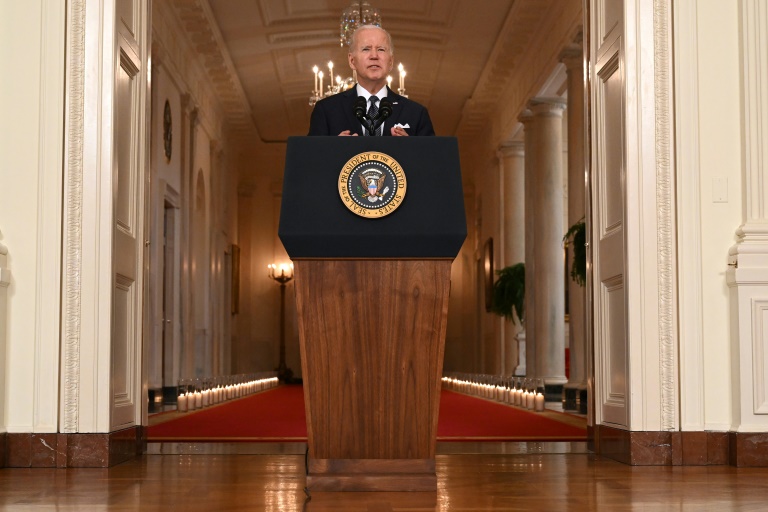
Biden made the 17-minute address — his latest call for tougher firearms measures — with 56 lighted candles arrayed along a long corridor behind him, representing US states and territories suffering from gun violence.

“How much more carnage are we willing to accept?” the president asked in the speech, which he delivered with anger in his voice, and at times dipping close to a whisper.

“We can’t fail the American people again,” he said, condemning the refusal of a majority of Republican senators to support tougher laws as “unconscionable.”

At a minimum, Biden said, lawmakers should raise the age at which assault weapons can be purchased from 18 to 21.

He also urged them to take steps including strengthening background checks, banning high-capacity magazines, mandating safe storage of firearms, and allowing gun manufacturers to be held liable for crimes committed with their products.

“Over the last two decades, more school-age children have died from guns than on-duty police officers and active duty military combined. Think about that,” Biden said.

He highlighted the story of a young student who smeared a dead classmate’s blood on herself to hide from a gunman at a Texas elementary school, saying: “Imagine what it would be like for her to walk down the hallway of any school again.”

“There are too many other schools, too many other everyday places that have become killing fields, battlefields here in America,” Biden said.

While Republican lawmakers have largely resisted tougher gun laws, a cross-party group of US senators held talks Thursday on a package of firearms controls.

Nine senators have been meeting this week to discuss a response to the mass shootings that have appalled the nation, projecting optimism over the prospects for modest reforms.

The group has focused on school security, bolstering mental health services and incentives for states to grant courts “red flag” authority to temporarily remove guns from owners considered a threat — a measure Biden also called for in his remarks.

– Hospital attack –

Even as lawmakers were mulling a response to the racist murder of 10 Black supermarket shoppers in Buffalo and the school shooting in Texas that killed 19 children and two teachers, another attack took place in Oklahoma on Wednesday.

A man with a pistol and a rifle murdered two doctors, a receptionist and a patient in a Tulsa hospital complex before killing himself as police arrived.

Lawmakers are aware that they risk wasting momentum as the urgency for reforms sparked by the killings dissipates, and another smaller group of senators is holding parallel discussions on expanding background checks on gun sales.

The political challenge of legislating in a 50-50 Senate, where most bills require 60 votes to pass, means that more wide-ranging reforms are unrealistic.

Mitch McConnell, leader of the Senate Republicans, told reporters that senators were trying to “target the problem” — which he said was “mental illness and school safety” rather than the availability of firearms. 

House Democrats are nevertheless set to pass a much broader but largely symbolic “Protecting Our Kids Act,” which calls for raising the purchasing age for semi-automatic rifles from 18 to 21 and a ban on high-capacity magazines.

The package will likely pass the Democratic-led House next week before dying amid Republican opposition in the Senate.

With regulation being so difficult at the federal level, an effort is also underway among state legislatures to push for tighter gun laws.

California lawmakers advanced a gun control package in the aftermath of the Uvalde shooting that included proposals to open up gunmakers to civil legal liability in certain cases.

The proposals echo action by lawmakers in New York state, while a permit-to-buy bill is moving through the Delaware legislature and pro-gun rights Texas is looking to “make legislative recommendations” in response to the Uvalde shooting.

Activists for greater restrictions fear a setback at the federal level however as the Supreme Court is set to issue its first major Second Amendment opinion in more than a decade.

Justices are expected to rule in the coming weeks in a dispute over New York state’s stringent limits on the concealed carry of handguns outside the home.

A narrow opinion could affect just a few states with similar laws, but campaigners fear the conservative majority will make a broader ruling clearing the way for constitutional challenges to gun safety laws across the country.

Close Bitnami banner
Bitnami