US Business

Philip Morris in talks to buy Swedish Match

Tobacco giant Philip Morris International is in talks to acquire Swedish Match, the companies said Monday, in a deal that would boost its smokeless offerings. 

While they confirmed the negotiations, first reported by The Wall Street Journal, both companies said there was no guarantee of a transaction. The Journal described the negotiations as “advanced talks” and said the deal could be valued at $15 billion or more.

Philip Morris, which sells cigarette brands such as Marlboro and Chesterfield in 180 markets outside the United States and has invested billions of dollars since 2008 in vapor products, oral nicotine and other “reduced-risk” products, said the talks were “in progress,” according to a statement.

“It is uncertain whether an offer will be made,” Philip Morris said. “PMI intends to make no further comment regarding the discussions unless and until it is appropriate to do so.”

Stockholm-based Swedish Match derives more than 65 percent of its revenue from smoke-free products, including chewing tobacco and nicotine pouches. 

The company’s noted “recent speculation and confirms that discussions with Philip Morris International regarding a possible public takeover offer for Swedish Match are ongoing,” the statement said 

“There can be no certainty than an offer will be made, nor as to the terms of any such potential offer.”

Shares of Swedish Match dipped 0.6 percent in Stockholm, while Philip Morris international gained 2.5 percent in afternoon trading.

Companies envision taxis flying above jammed traffic

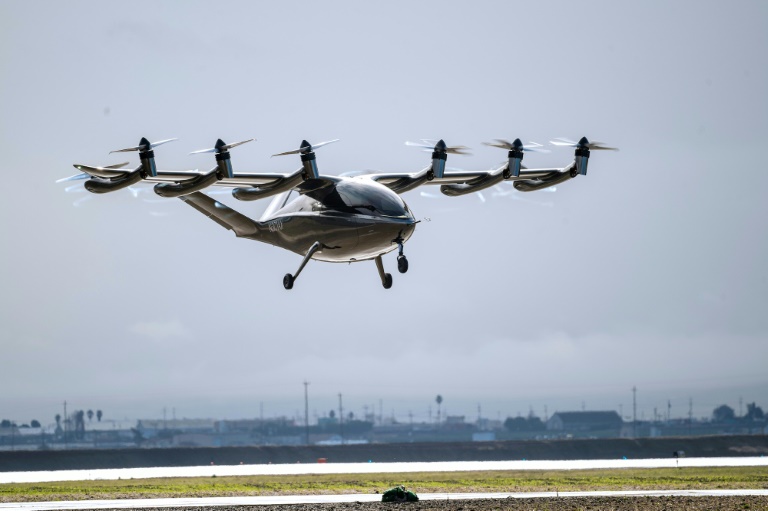
As urban traffic gets more miserable, entrepreneurs are looking to a future in which commuters hop into “air taxis” that whisk them over clogged roads.

Companies such as Archer, Joby and Wisk are working on electric-powered aircraft that take off and land vertically like helicopters then propel forward like planes.

“‘The Jetsons’ is definitely a reference that people make a lot when trying to contextualize what we are doing,” Archer Vice President Louise Bristow told AFP, referring to a 1960s animated comedy about a family living in a high-tech future.

“The easiest way to think about it is a flying car, but that’s not what we’re doing.”

What Archer envisions is an age of aerial ride-sharing, an “Uber or Lyft of the skies,” Bristow said.

Neighborhood parking garage rooftops or shopping mall lots could serve as departure or arrival pads for electric vertical take-off and landing (eVTOL) aircraft.

Commuters would make it the rest of the way however they wish, even synching trips with car rideshare services such as Uber which owns a stake in Santa Cruz, California-based Joby.

Joby executives said on a recent earnings call that its first production model aircraft should be in the skies later this year.

That comes despite a Joby prototype crashing early this year while being tested at speeds and altitudes far greater than it would have to handle as part of an air taxi fleet.

Joby has declined to discuss details of the remotely piloted aircraft’s crash, which occurred in an uninhabited area, saying it is waiting for US aviation regulators to finish an investigation.

“We were at the end of the flight test expansion campaign at test points well above what we expect to see in normal operations,” Joby executive chairman Paul Sciarra told analysts.

“I’m really excited about where we are right now; we have demonstrated the full performance of our aircraft.”

Its eVTOL aircraft have a maximum range of 150 miles (241 kilometers), a top speed of 200 miles per hour and a “low noise profile” to avoid an annoying din, the company said.

Joby has announced partnerships with SK Telecom and the TMAP mobility platform in South Korea to provide emissions-free aerial ridesharing.

“By cooperating with Joby, TMAP will become a platform operator that can offer a seamless transportation service between the ground and the sky,” TMAP chief executive Lee Jong Ho said in a release.

Joby has also announced a partnership with Japanese airline ANA to launch air taxi service in Japan.

And Toyota has additionally joined the alliance, with an aim to explore adding ground transportation to such a service there, Joby said.

– Rethinking required –

Hurdles on the path include establishing infrastructure and adapting attitudes to make air taxis a part of everyday life.

“For mass adoption, people need to have a mindset change,” Bristow said.

“Getting people to want to travel in a different way will take some rethinking.”

The need for the change, though, is clear, she reasoned.

Roads are congested with traffic that wastes time, frays nerves and spews pollution.

“There is nowhere else for traffic to go,” Bristow said.

“You have to go up.”

Miami and Los Angeles are already exploring the potential of aerial ridesharing, and Archer is hoping to have a small air taxi service operating in at least one of those cities by the end of 2024.

“It’s a monumental task that we’re taking on,” Bristow said.

“It’s going to take a while before the infrastructure supports the mass expansion of what we’re trying to do.”

Archer last month announced that it teamed with United Airlines to create an eVTOL advisory committee.

The US airline has pre-ordered 200 Archer aircraft with an eye toward using them for “last-mile” transportation from airports, Bristow told AFP.

“Imagine flying from London to Newark, New Jersey, then getting in an Archer and being deposited somewhere in Manhattan,” Bristow said.

– More time for life –

Silicon Valley startup Xwing specializes in making standard aircraft capable of flying safely without pilots, with an aim of turning commuting by air into a cheaper and more efficient way to travel.

“We’re strong believers here that the industry is going through a pretty dramatic transformation,” Xwing chief and founder Marc Piette told AFP.

“In a few years you’ll start seeing taxi networks of electric aircrafts regionally or on long hauls and it’s going to be quite a different landscape.”

Thousands of regional airports used mostly for recreation could become part of aerial commute networks, air mobility consultant Scott Drennan told AFP.

To Drennan, the primary reason for taking to the skies is to “give people back their time.”

Saudi fights to lead 'saturated' MidEast aviation market

Saudi Arabia on Monday pitched aviation industry leaders on its plans to become a global travel hub, drawing scepticism from analysts who questioned how it could compete against regional heavyweights. 

The conservative kingdom’s aviation goals, part of Crown Prince Mohammed bin Salman’s wide-ranging “Vision 2030” reforms, include more than tripling annual traffic to 330 million passengers by the end of the decade. 

It also wants to draw $100 billion in investments to the sector by 2030, establish a new national flag carrier, construct a new “mega airport” in Riyadh and move up to five million tonnes of cargo each year. 

Officials outlined how they intend to hit those targets during a global aviation forum that began Monday in Riyadh. Organisers said 2,000 delegates are trying to chart the airline industry’s post-pandemic recovery. 

“Over the next 10 years the kingdom will emerge as the Middle East’s leading aviation hub,” Transport Minister Saleh Al-Jasser told the forum’s opening session. 

The strategy hinges on tapping the large domestic market of Saudi Arabia, whose population is around 35 million, he told AFP in an interview, citing what analysts described as a major advantage for Saudi carriers over regional rivals Emirates and Qatar Airways. 

“We are very focused on building connectivity to Saudi Arabia, in helping the tourism industry to grow in Saudi Arabia and helping the Saudi people connect to the world… That’s what we are focused on,” he said. 

But steep competition raises questions about how feasible the Saudi plans are. 

“They’re fighting multiple headwinds on the aviation front,” said Robert Mogielnicki with the Arab Gulf States Institute in Washington. 

“You have established regional players that have great brand recognition and are already important parts of the economies of Qatar and Dubai.” 

In Saudi Arabia, by contrast, “the air transport sector is not as central to the economy so that urgency is not there, though the Saudis do have big ambitions for the sector. It’s a new entity, so they’re going to have to play catch-up.” 

– ‘Not going to be easy’ –

The kingdom is currently served by flag carrier Saudia and its budget subsidiary flyadeal, both based in the coastal city of Jeddah, as well as other budget carriers including the Riyadh-based flynas. 

Even without the kingdom’s planned new airline, Saudi carriers are fighting for space not just with Emirates and Qatar Airways but also regional budget airlines like flydubai and Air Arabia.

“It is a rather saturated market,” Henrik Hololei, the European Commission’s Director-General for Mobility and Transport, told AFP. 

“It’s clear that it’s not going to be easy for any airline that wants to have a global reach to enter that market.” 

Multiple analysts highlighted the need for Saudi Arabia to improve its airports.

Last weekend the head of the company that operates the airport in Jeddah, gateway to the holy sites in Mecca and Medina, was fired after what state media described as “a crisis of overcrowding and flight delays”. 

Hololei said “the vision and very ambitious announcements” need to be complemented by details. 

“How they are going to play the cards, this remains to be seen.”

Global stocks and oil slump on China lockdowns, interest rates

World stock markets mostly sank Monday and oil prices slumped as China’s Covid lockdowns added to stubborn fears over the impact of rising US interest rates and surging inflation.

Frankfurt, London and Paris all fell more than two percent, as did Tokyo.

On Wall Street, the Dow was down nearly two percent in late morning trading, with the tech-heavy Nasdaq continuing a steep decline with a 3.7 percent drop.

Meanwhile, bitcoin plunged to a 2022 low below $33,000 as investors shunned the volatile cryptocurrency.

“The bloodletting on stock markets has continued today as we start a new week … with the biggest declines being seen in basic resources after the latest China trade data showed that imports ground to a halt in April,” said market analyst Michael Hewson at CMC Markets UK.

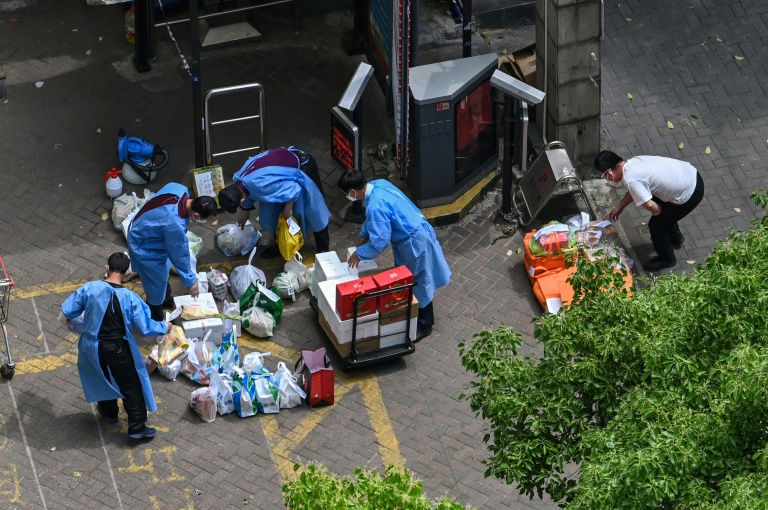
Millions of people in Beijing stayed home on Monday as China’s capital tries to fend off a Covid-19 outbreak with creeping restrictions on movement.

Beijing residents fear they may soon find themselves in the grip of the same draconian measures that have trapped most of Shanghai’s 25 million people at home for weeks.

Lockdowns across dozens of Chinese cities — from the manufacturing hubs of Shenzhen and Shanghai to the breadbasket of Jilin — have wreaked havoc on supply chains over recent months and further stoked global inflationary pressures.

Investors were given more bad news on Monday as China’s April exports slumped to their lowest level in almost two years, due to the nation’s strict zero-Covid policy.

Exports plunged to 3.9 percent on-year, while imports were stagnant for April.

Data also showed the lockdowns have already hit oil demand in China, prompting a five percent drop in oil prices. 

“Oil is offside too as China confirmed its oil imports in the first four months of the year fell by 4.8 percent,” said David Madden at Equiti Capital.

– Anxiety spreads –

Stock markets had dived last week after the Federal Reserve ramped up interest rates by a half-percentage point and flagged more hikes to tackle decades-high inflation.

“Anxiety is stemming from the Fed’s next moves, with uncertainty creeping in about the scale and speed of interest rate hikes,” said Hargreaves Lansdown analyst Sophie Lund-Yates.

Analysts at Charles Schwab brokerage said that “elevated inflation pressures continue to cloud conviction, with the Fed and other central banks beginning to tighten monetary policy. 

“Meanwhile, inflation concerns continue to be exacerbated by the war in Ukraine and ongoing supply chain challenges,” they added.

Global markets have also taken a beating this year from Russia’s invasion of Ukraine.

President Vladimir Putin on Monday defended Russia’s offensive in Ukraine and blamed Kyiv and the West, as he looked to use grand Victory Day celebrations to mobilise patriotic support for the campaign.

However, investors were relieved that Putin made no major announcements, despite reports he could use the anniversary to announce an escalation of the conflict or a general mobilisation.

“Putin has not declared a war on Ukraine to enable full mobilisation which is obviously a relief,” noted Markets.com analyst Neil Wilson.

– Key figures at around 1530 GMT –

New York – Dow: DOWN 1.9 percent at 32,266.84 points

EURO STOXX 50: DOWN 2.5 percent at 3,486.21

London – FTSE 100: DOWN 2.3 percent at 7,216.58 

Frankfurt – DAX: DOWN 2.2 percent at 13,380.67

Paris – CAC 40: DOWN 2.8 percent at 6,086.02

Shanghai – Composite: UP 0.09 percent at 3,004.14 (close)

Tokyo – Nikkei 225: DOWN 2.5 percent at 26,319.34 (close)

Hong Kong – Hang Seng Index: Closed for a holiday  

Brent North Sea crude: DOWN 5.0 percent at $106.77 per barrel

West Texas Intermediate: DOWN 5.4 percent at $103.87 per barrel

Euro/dollar: DOWN at $1.0536 from $1.0551 on Friday

Pound/dollar: DOWN at $1.2311 from $1.2348

Euro/pound: UP at 85.55 pence from 85.45 pence

Dollar/yen: DOWN at 130.23 yen from 130.56 yen

burs-rl/lcm

EasyJet tackles Covid staff shortage by removing seats

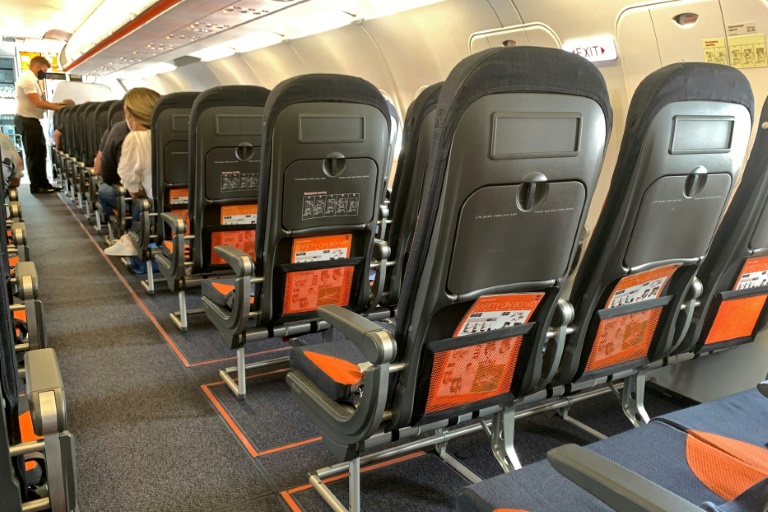
EasyJet plans to remove seats from Airbus aircraft this summer, allowing the British airline to fly with fewer cabin crew as it struggles with Covid absences and staff recruitment.

The carrier over the weekend revealed that during the upcoming peak flying season, it will cut the number of passenger seats on its A319 jets to 150 from 156.

This will allow it to fly with three cabin crew instead of four, under regulations imposed by the Civil Aviation Authority watchdog in Britain.

EasyJet said in a statement that its seat reduction “is an effective way of… building additional resilience and flexibility into our operation this summer”.

While the global aviation sector was ravaged by the coronavirus outbreak that grounded planes and slashed thousands of jobs, demand is recovering strongly after travel curbs were lifted.

This is turn has caused a rush for new staff.

EasyJet said only its UK fleet of A319 planes would be affected by the removal of seats.  

This numbers 60 jets, or slightly half of its A319 fleet.

The announcement comes after EasyJet cancelled a large number of flights over Easter as the sector faced a high level of absences owing to Covid.

Also last month, the no-frills carrier forecast its flight bookings to return to pre-Covid levels this summer, guiding it towards a lower-than-expected loss.

Global stocks deepen losses on rising rates, China lockdowns

World stock markets mostly sank Monday on stubborn fears over the impact of rising US interest rates, surging inflation and China’s Covid lockdowns.

Frankfurt, London and Paris each shed more than one percent nearing the half-way stage after Tokyo closed down 2.5 percent.

On Wall Street, all three major indices fell by more than one percent at the start of trading. 

Shanghai edged higher and Hong Kong was shut for a holiday.

Oil prices lost two percent on demand worries and the haven dollar rose, while bitcoin plunged to a 2022 low below $33,000 as investors shunned the volatile cryptocurrency.

Stock markets had dived last week after the Federal Reserve ramped up interest rates by a half-percentage point and flagged more hikes to tackle decades-high inflation.

“Elevated inflation pressures continue to cloud conviction, with the Fed and other central banks beginning to tighten monetary policy,” said analysts at Charles Schwab brokerage. 

“Meanwhile, inflation concerns continue to be exacerbated by the war in Ukraine and ongoing supply chain challenges,” they added.

– Anxiety spreads –

“Anxiety is stemming from the Fed’s next moves, with uncertainty creeping in about the scale and speed of interest rate hikes,” said Hargreaves Lansdown analyst Sophie Lund-Yates.

“All this comes at the same time as China grapples with ongoing lockdowns and the prevailing economic storm these entail.”

Millions of people in Beijing stayed home on Monday as China’s capital tries to fend off a Covid-19 outbreak with creeping restrictions on movement.

Beijing residents fear they may soon find themselves in the grip of the same draconian measures that have trapped most of Shanghai’s 25 million people at home for weeks.

Lockdowns across dozens of Chinese cities — from the manufacturing hubs of Shenzhen and Shanghai to the breadbasket of Jilin — have wreaked havoc on supply chains over recent months and further stoked global inflationary pressures.

Investors were given more bad news on Monday as China’s April exports slumped to their lowest level in almost two years, due to the nation’s strict zero-Covid policy.

Exports plunged to 3.9 percent on-year, while imports were stagnant for April.

Global markets have also taken a beating this year from Russia’s invasion of Ukraine.

President Vladimir Putin on Monday defended Russia’s offensive in Ukraine and blamed Kyiv and the West, as he looked to use grand Victory Day celebrations to mobilise patriotic support for the campaign.

However, investors were relieved that Putin made no major announcements, despite reports he could use the anniversary to announce an escalation of the conflict or a general mobilisation.

“Putin has not declared a war on Ukraine to enable full mobilisation which is obviously a relief,” noted Markets.com analyst Neil Wilson.

– Key figures at around 1330 GMT –

London – FTSE 100: DOWN 1.5 percent at 7,272.51 points

Frankfurt – DAX: DOWN 1.3 percent at 13,499.06

Paris – CAC 40: DOWN 1.7 percent at 6,151.30

EURO STOXX 50: DOWN 1.5 percent at 3,520.86

New York – Dow: DOWN 1.3 percent at 32,460.23

Shanghai – Composite: UP 0.09 percent at 3,004.14 (close)

Tokyo – Nikkei 225: DOWN 2.5 percent at 26,319.34 (close)

Hong Kong – Hang Seng Index: Closed for a holiday  

Brent North Sea crude: DOWN 2.2 percent at $110.18 per barrel

West Texas Intermediate: DOWN 2.4 percent at $107.42 per barrel

Euro/dollar: DOWN at $1.0543 from $1.0551 on Friday

Pound/dollar: UP at $1.2350 from $1.2348

Euro/pound: DOWN at 85.38 pence from 85.45 pence

Dollar/yen: UP at 130.73 yen from 130.56 yen

burs-rl/lcm

Western multinationals congratulate Hong Kong's new leader

Western multinationals and local tycoons published newspaper adverts congratulating John Lee on becoming Hong Kong’s next leader, following a rubber-stamp selection process decried as anti-democratic by many major economies Monday.

Lee, 64, a former security chief who oversaw the crackdown on Hong Kong’s democracy movement, was anointed the business hub’s new leader on Sunday in a near-unanimous vote by a small committee of Beijing loyalists.

He was the sole candidate in the race to succeed outgoing leader Carrie Lam at a time when Hong Kong is being remoulded in China’s authoritarian image.

Canada, France, Germany, Italy, Japan, the UK and the United States on Monday joined the European Union in voicing alarm.

“We… underscore our grave concern over the selection process for the Chief Executive in Hong Kong as part of a continued assault on political pluralism and fundamental freedoms,” the G7 group said in a joint statement with the EU.

Beijing hailed the process as “a real demonstration of democratic spirit” and said it was the culmination of a strategy to ensure only “patriots” run Hong Kong.

– Corporate congratulations –

Ta Kung Pao and Wen Wei Po, two newspapers that answer to the office which sets Beijing’s Hong Kong policy, were filled with adverts on Monday from leading companies and business figures praising Lee’s selection.

Most were from Chinese and Hong Kong businesses as well as community organisations. 

The “Big Four” accountancy firms — KPMG, Deloitte, EY and PwC — were among Western multinationals placing adverts, as were city airline Cathay Pacific and conglomerates Swire and Jardine Matheson.

Messages were also carried by Hong Kong’s family tycoon-dominated property giants, including Sun Hung Kai and Henderson Land Development.

Western businesses have found themselves in an increasingly precarious position in Hong Kong, especially as tensions have risen with China.

Many have embraced progressive political causes in Western markets, such as the anti-racism Black Lives Matter movement, same-sex equality and ridding supply chains of labour abuses.

But they usually steer clear of any criticism of China’s policies towards hotspots such as Hong Kong, Xinjiang, Tibet and Taiwan.

Some companies such as HSBC, Standard Chartered, Swire and Jardine Matheson publicly backed Beijing’s national security law, which was imposed on Hong Kong after 2019’s democracy protests to curb dissent.

– Can Hong Kong reopen? –

The elevation of Lee, who is under US sanctions, places a security official in Hong Kong’s top job for the first time after a tumultuous few years for a city battered by political unrest and economically debilitating pandemic controls.

Despite the city’s mini-constitution promising universal suffrage, Hong Kong has never been a democracy, the source of years of protests since the 1997 handover from Britain to China.

Lee won 99 percent of the votes cast by the 1,461-strong committee that picks the city’s leader.

The former police officer has vowed to strengthen Hong Kong’s national security and integrate the city further with the mainland.

He wants to reboot the city’s economy and slowly reopen its pandemic-sealed borders at a time when its rivals have moved to living with the coronavirus.

But it is unclear how he can do that given China has doubled down on its strict zero-Covid strategy.

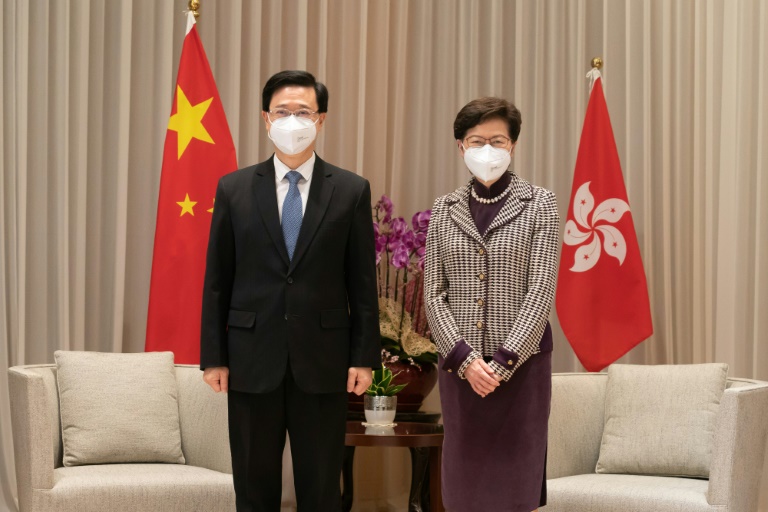
On Monday morning, Lam met her successor and both gave short speeches stressing that they would prepare for an orderly transition.

Lee, who takes over on July 1, was Lam’s security chief and then her deputy.

He was asked by reporters whether Hong Kongers could criticise his administration or risk being arrested for “speech crimes” like dozens of democracy activists in recent years. 

Lee took umbrage at that description.

“I think you are very wrong to describe that people are now charged simply because of their expressed opinions,” he said.

“People are brought to court because of the suspicion against them and their actions contravening the law,” he added. “It is their action.”

Lee said his first port of call would be China’s top agencies in Hong Kong — the Liaison Office, the national security committee, the foreign ministry’s office and the People’s Liberation Army garrison.

Global stocks deepen losses on rising rates, China lockdowns

World stock markets mostly sank Monday on stubborn fears over the impact of rising US interest rates, surging inflation and China’s Covid lockdowns.

Frankfurt, London and Paris each shed more than one percent nearing the half-way stage after Tokyo closed down 2.5 percent.

Shanghai edged higher and Hong Kong was shut for a holiday.

Oil prices lost two percent on demand worries and the haven dollar rose, while bitcoin plunged to a 2022 low below $34,000 as investors shunned the volatile cryptocurrency.

Stock markets had dived last week after the Federal Reserve ramped up interest rates by a half-percentage point and flagged more hikes to tackle decades-high inflation.

– Anxiety spreads –

“Anxiety is stemming from the Fed’s next moves, with uncertainty creeping in about the scale and speed of interest rate hikes,” said Hargreaves Lansdown analyst Sophie Lund-Yates.

“All this comes at the same time as China grapples with ongoing lockdowns and the prevailing economic storm these entail.”

Millions of people in Beijing stayed home on Monday as China’s capital tries to fend off a Covid-19 outbreak with creeping restrictions on movement.

Beijing residents fear they may soon find themselves in the grip of the same draconian measures that have trapped most of Shanghai’s 25 million people at home for weeks.

Lockdowns across dozens of Chinese cities — from the manufacturing hubs of Shenzhen and Shanghai to the breadbasket of Jilin — have wreaked havoc on supply chains over recent months and further stoked global inflationary pressures.

Investors were given more bad news on Monday as China’s April exports slumped to their lowest level in almost two years, due to the nation’s strict zero-Covid policy.

Exports plunged to 3.9 percent on-year, while imports were stagnant for April.

Global markets have also taken a beating this year from Russia’s invasion of Ukraine.

President Vladimir Putin on Monday defended Russia’s offensive in Ukraine and blamed Kyiv and the West, as he looked to use grand Victory Day celebrations to mobilise patriotic support for the campaign.

However, investors were relieved that Putin made no major announcements, despite reports he could use the anniversary to announce an escalation of the conflict or a general mobilisation.

“Putin has not declared a war on Ukraine to enable full mobilisation which is obviously a relief,” noted Markets.com analyst Neil Wilson.

– Key figures at around 1015 GMT –

London – FTSE 100: DOWN 1.3 percent at 7,291.71 points

Frankfurt – DAX: DOWN 1.1 percent at 13,531.25

Paris – CAC 40: DOWN 1.4 percent at 6,167.96

EURO STOXX 50: DOWN 1.6 percent at 3,572.92

Shanghai – Composite: UP 0.09 percent at 3,004.14 (close)

Tokyo – Nikkei 225: DOWN 2.5 percent at 26,319.34 (close)

Hong Kong – Hang Seng Index: Closed for a holiday  

New York – Dow: DOWN 0.3 percent at 32,899.37 (close)

Brent North Sea crude: DOWN 2.1 percent at $110.02 per barrel

West Texas Intermediate: DOWN 2.3 percent at $107.30 per barrel

Euro/dollar: DOWN at $1.0538 from $1.0551 on Friday

Pound/dollar: DOWN at $1.2319 from $1.2348

Euro/pound: UP at 85.57 pence from 85.45 pence

Dollar/yen: UP at 131.16 yen from 130.56 yen

burs-rfj/bcp/lth

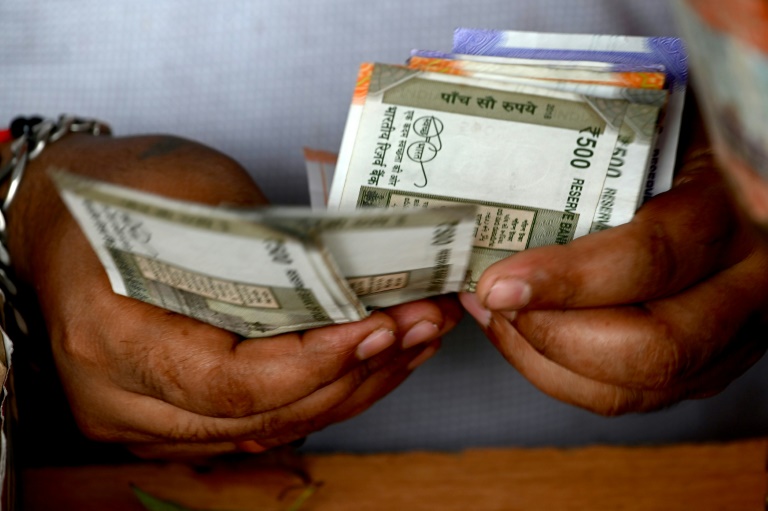
Indian rupee falls to new low on Fed action, inflation fears

The Indian rupee plunged to an all-time low against the greenback on Monday, as US monetary policy tightening roiled sentiment and foreign investors continued to dump domestic stocks.

Rising oil prices and a strengthening US dollar have weighed heavy on the rupee with a surprise rate hike by the Reserve Bank of India (RBI) last week doing little to stem capital outflows.

The rupee fell past its previous record low of 76.98 against the US dollar in March to 77.56 on Monday.

The fall came as Indian stocks on the benchmark Sensex and Nifty50 indices extended losses for a fourth day, falling more than one percent each on Monday before recovering ground later in the day.

Banks, metals and oil and gas stocks declined the most, with market heavyweight, the conglomerate Reliance, losing more than 3.0 percent following its quarterly results reported late on Friday.

Foreign investors have withdrawn a net 1.34 trillion rupees ($17.3 billion) from Indian equities so far this year, stock exchange data showed.

The war in Ukraine and resurgence of Covid-19 restrictions in China have exacerbated outflows from emerging markets like India as foreign funds turn risk-averse.

Inflation worries on the back of rising commodity prices have also soured sentiment in Asia’s third-largest economy, which imports more than 80 percent of its oil needs.

Consumer price inflation in India hit a 17-month high of 6.95 percent year-on-year in March, and economists expect data to be released later this week to show that number rising beyond seven percent in April.

The US Federal Reserve last week hiked the key lending rates by half a percentage point, but also held off on signalling more aggressive measures.

“After an unscheduled rate hike by the Reserve Bank of India, if India’s inflation moves higher than 7.0 percent… the pressure will be on for the RBI to act again,” forex firm OANDA’s Jeffrey Halley said in a note.

“That may give some strength to the rupee but is unlikely to be bullish for local equities.”

India’s forex reserves declined for an eighth consecutive week, slipping below $600 billion in the week ending April 29 as the central bank sold foreign currency in an effort to stabilise the rupee.

Indonesia maintains steady growth in first quarter thanks to exports

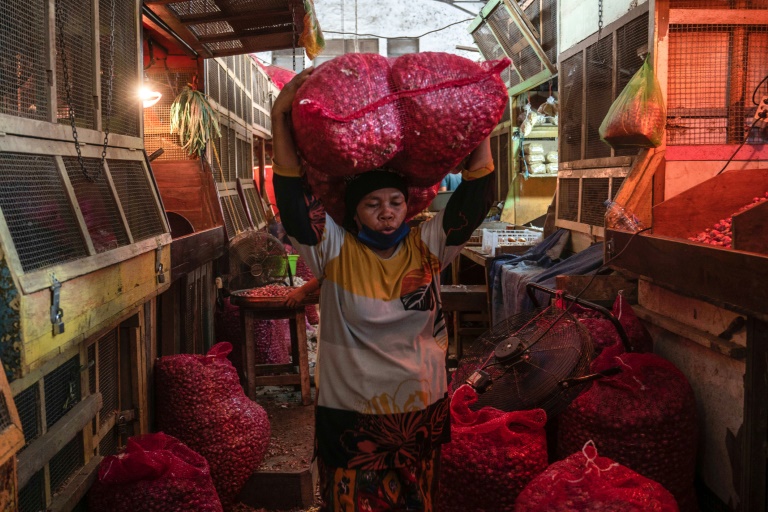
Indonesia’s economy maintained steady growth in the first quarter of 2022 despite global tensions, official data showed on Monday, as the nation reaped the benefits of soaring commodities prices and an easing of Covid restrictions.

Indonesia was badly affected by the coronavirus pandemic, with its exports and tourism-reliant economy taking a massive hit in 2020 as GDP shrunk by 2.07 percent — its first recession since the 1997 Asian financial crisis. 

But Southeast Asia’s largest economy has picked up in recent months, and the Central Statistics Agency (BPS) on Monday reported an on-year expansion of 5.01 percent in January-March. 

“The high economic growth for the first quarter of 2022 is caused by the recovery of public activities,” head of the bureau Margo Yuwono said during a press conference. 

“Public mobility in the first quarter of 2022 has been really good.”

Exports showed an especially impressive growth of 16.22 percent in the first quarter of 2022 as prices for Indonesia’s palm oil, nickel and tin soared on the global market. 

Moody’s Analytics said Indonesia’s first-quarter showing exceeded their forecast. 

“The result indicates that Southeast Asia’s largest economy is on track to achieve the government’s full-year growth target of 4.5 percent to 5.3 percent,” it said in a note released Monday.

Indonesia in March had dropped quarantine requirements for all travellers with a negative PCR test. 

It has also seen a tripling of foreign tourist arrivals between January to March this year, compared to the same period in 2021. 

The country’s economy expanded 3.69 percent in 2021 as coronavirus cases started to decline and export prices for key commodities like palm oil, coal and nickel rose significantly. 

But while Indonesia — the world’s top palm oil producer accounting for 35 percent of global trade — has reaped the benefits of the high prices in recent months, in April it suspended exports in the face of domestic shortages. 

Close Bitnami banner
Bitnami