US Business

French court fines Deliveroo for 'undeclared labour'

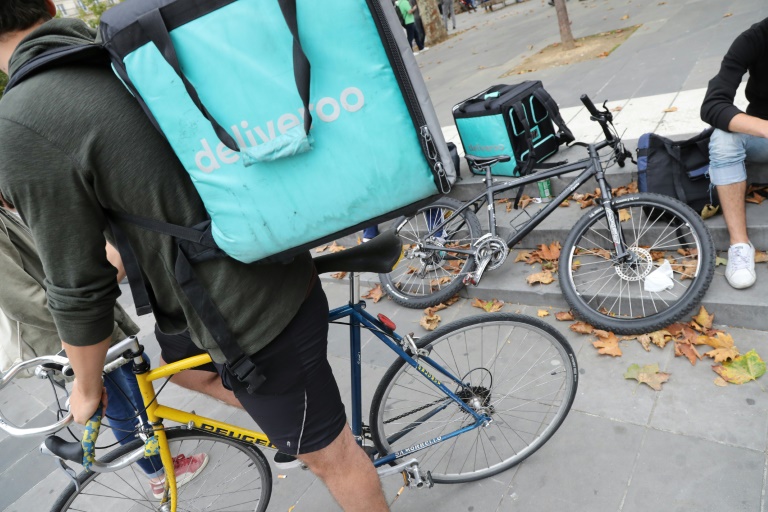
A Paris court on Tuesday handed the food delivery group Deliveroo a fine of 375,000 euros ($405,000) after finding it guilty of “undeclared labour” by using freelance delivery riders who should have been considered employees.

It was the latest move by courts to recognise the rights of “gig economy” workers who are often classified as independent contractors by start-ups and other firms, and thus ineligible for health insurance and other benefits.

The court ordered the maximum fine sought by prosecutors and also handed suspended one-year prison sentences to two former French executives at the Britain-based Deliveroo.

A third executive got a suspended four-month sentence and a 10,000 euro fine for complicity in the system, and Deliveroo was ordered to pay 50,000 euros each in damages to five labour unions who joined the case as plaintiffs.

State prosecutor Celine Ducournau also sought in vain to question Deliveroo’s American founder and CEO Will Shu over a “fraud” that gave “all the benefits to the employer… without any of the inconveniences.”

Over 100 Deliveroo riders were plaintiffs in the case prosecutors opened in 2015 but which got fresh impetus in 2020, when France’s URSSAF agency in charge of employer social security collections demanded millions of euros in back payments.

Several riders told the court they had sought jobs that offered “flexibility” in terms of scheduling, only to find intense pressure to work at peak meal times, strict oversight of their routes and days off, and penalties if orders weren’t delivered fast enough.

Deliveroo France had already been convicted of undeclared labour in a civil case in February 2000, when a labour court sided with a rider seeking to be recognised as an employee and not a contractor.

URSSAF is seeking to recover some 9.7 million euros from Deliveroo, and a court had already ordered in 2020 the seizure of three million euros in Deliveroo’s account while the case was ongoing.

A Deliveroo spokesman said after the verdict that the company was “considering” an appeal.

European stocks slide on return from Easter break

European stock markets slid Tuesday, catching up with losses in Asia and on Wall Street caused by slow growth concerns in China and rising US interest rates. 

Trading for the first time since Thursday, London’s benchmark FTSE 100 index was down 0.4 percent nearing the half-way stage.

Losses were steeper in the eurozone, with Frankfurt’s DAX index and the Paris CAC 40 shedding around one percent, also after an extended weekend.

“Despite the public holiday in most of Europe yesterday, this is shaping up to be another volatile and eventful week for global markets,” noted Lukman Otunuga, senior research analyst at FXTM.

“Later today, the International Monetary Fund will release its updated global economic outlook with markets expecting a downgrade for growth this year.”

Otunuga said “such a development may hit investor confidence, sweetening appetite for safe-haven assets”.

One traditional haven, the yen, struck a fresh 20-year low Tuesday at 128 to the dollar, with the Japanese currency heavily weighed down by diverging monetary policy in Japan and the United States.

High oil prices in Japan — a major importer of crude — have also pushed the currency lower, according to analysts.

Japan’s Nikkei 225 rebounded from losses Monday — and led other major Asian stock markets higher.

But Hong Kong plummeted by its largest margin in three weeks — knocked by concerns around Beijing’s tough tech-sector regulations and economic growth concerns in China.

Millions of residents are still cloistered in their homes in China’s financial capital Shanghai.

Investors were left weighing whether attempts to lift the economy by Chinese policymakers — who have held off cutting interest rates — would offset Beijing’s zero-Covid policies.

“The focus in Asia is on mainland policy easing to cushion the impact of lockdowns,” said Stephen Innes at SPI Asset Management.

China’s economic growth accelerated in the first quarter of the year to 4.8 percent, official data showed Monday, but the government warned of “significant challenges” ahead.

– Key figures around 1030 GMT –

London – FTSE 100: DOWN 0.4 percent at 7,586.79 points

Frankfurt – DAX: DOWN 0.9 percent at 14,036.68

Paris – CAC 40: DOWN 1.0 percent at 6,523.90

EURO STOXX 50: DOWN 1.1 percent at 3,807.47

Tokyo – Nikkei 225: UP 0.69 percent at 26,985.09 (close)

Shanghai – Composite: DOWN 0.05 percent at 3,194.03 (close)

Hong Kong – Hang Seng Index: DOWN 2.28 percent at 21,027.76 (close)

New York – Dow: DOWN 0.1 percent at 34,411.69 (close)

Dollar/yen: UP at 128.21 yen from 126.54 yen

Euro/dollar: DOWN at $1.0793 from $1.0802

Pound/dollar: FLAT at $1.3023

Euro/pound: FLAT at 82.87 pence

Brent North Sea crude: DOWN 1.3 percent at $111.68 per barrel

West Texas Intermediate: DOWN 1.6 percent at $106.49 per barrel

Japan fast-food chain fires official over sexist comments

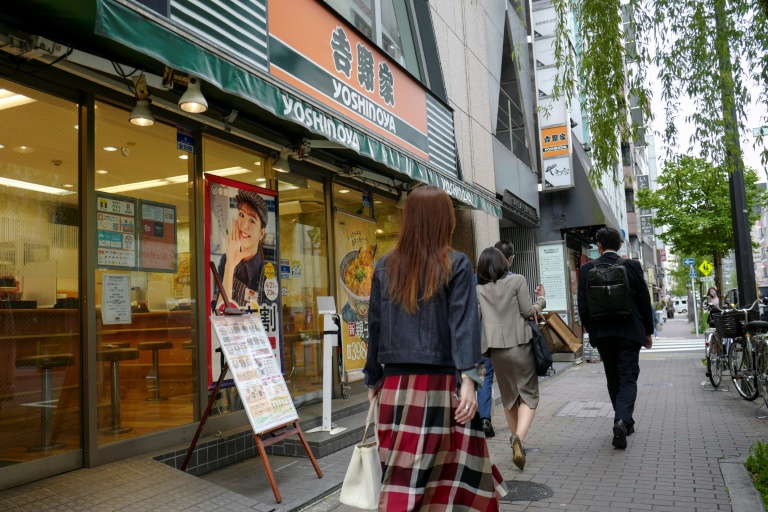
One of Japan’s most popular fast-food firms said on Tuesday that it had fired a top executive who reportedly suggested a marketing strategy of getting “virgins addicted” to the company’s products.

Yoshinoya, which operates a chain of restaurants serving cheap beef bowls in Japan and abroad, did not immediately confirm the exact comments made by Masaaki Ito, who was a managing director.

In a statement, the company said he had been fired for “extremely unacceptable words and deeds”.

Ito reportedly said the firm should try to “get virgins addicted” to Yoshinoya’s food because “once men treat them to expensive meals they won’t eat beef bowls any more”.

His comments were posted on social media by a person who said they had attended a university lecture where Ito spoke.

The firing came after outrage against the comments on social media sites. 

On Twitter, former Japanese Communist Party lawmaker Saori Ikeuchi called the remark “blatantly sexist” and “disgusting”.

Other users pointed out that Ito appeared to be disparaging Yoshinoya’s food.

“What’s equally incredible is how little pride and love he has for his company’s own products,” one Twitter user wrote.

Japan often appears towards the bottom of international gender equality rankings. In 2021, the World Economic Forum placed it 120 out of 156 countries on its Global Gender Gap Index rankings.

There is little female representation in the higher levels of business and politics despite women in the country being highly educated and present in the workforce.

Sexist gaffes by high-ranking officials and politicians have made waves before, including the resignation of Tokyo Olympics chief Yoshiro Mori before the Games after he suggested women speak too much in meetings.

Asia markets cautious over China growth news

Asian stocks were digesting growth concerns in China and rising interest rates in the United States on Tuesday with Hong Kong dropping sharply while Japan edged higher on the back of a plummeting yen.

Chinese growth numbers for the first quarter of 2022 exceeded expectations on Monday but the government warned of “significant challenges” ahead with key economic hubs in the throes of a Covid-19 lockdown. 

Millions of residents are still cloistered in their homes in economic centre Shanghai with restrictions — which have also hit tech hub Shenzhen and the northeastern grain basket of Jilin — shutting supply lines.

Investors were left weighing whether attempts to lift the economy by Chinese policymakers — who have held off cutting interest rates — would offset Beijing’s zero-Covid policies.

“The focus in Asia is on mainland policy easing to cushion the impact of lockdowns,” Stephen Innes at SPI Asset Management said, adding that while first quarter growth was marginally better than predicted, “there was no positive follow-through in China-sensitive assets”.

“Reopening cities is the only fix to drive credit growth, which could translate into a sustainable economic rebound that supports equity markets and a load of other China proxy assets,” he said.

Japan’s Nikkei 225 made healthy gains, with South Korea, Taiwan, India, and Australia all edging upward.

But Hong Kong plummeted by its largest margin in three weeks after a four-day holiday hiatus, with China’s central bank still reluctant to introduce a comprehensive policy easing program. 

The Hang Seng Index shed over 2.7 percent before recovering slightly to around 2.2 percent down, with the Shanghai Composite Index also slipping.

The impact of monetary policy tightening in the United States to combat inflation was another variable watched closely by investors, particularly with European markets resuming trade after a lengthy holiday break.

Based on inflation concerns, pandemic lockdowns in China, and the war in Ukraine, the World Bank last week downgraded its forecast for global growth this year, and the IMF is expected to do the same when it releases its updated forecasts on Tuesday.

“Its current estimate for 2022 is 4.4 percent which it set in January, with Europe and Central Asia likely to take the brunt, due to the Russian war in Ukraine, and Covid restrictions, respectively,” said Michael Hewson, Chief Market Analyst at CMC Markets UK.  

“With the return of European markets from the long Easter weekend break we look set to get off to a negative start in the wake of yesterday’s lower finish for US markets, amidst concerns that the growth downgrades seen yesterday could well be the first of many.”

Oil prices declined after initial gains on Tuesday, a day after Libya’s National Oil Corporation announced the closure of operations after staff in the key export terminal of Zueitina and the Al-Sharara oil field were blocked from working. 

The move will prevent Libya from exporting almost a quarter of its 1.2 million barrels per day of production.

And the Japanese yen plunged below 128 to the dollar, reaching yet another 20-year low on Tuesday, reflecting the continued accommodation of Japan’s monetary policy, while US policymakers move to hike interest rates.

“Although the effects of the lower JPY are a net positive for the Japanese economy, positive effects from higher export volume and an increase in inbound foreign tourists have waned and effectively gone,” UBS said in a note. 

“More importantly, negative effects are mainly borne by households with negative real income and domestic-oriented industries(mainly small firms) with higher import costs.”

– Key figures around 0700 GMT –

Tokyo – Nikkei 225: UP 0.69 percent at 26,985.09 (close)

Shanghai – Composite: DOWN 0.05 percent at 3,194.03 (close)

Hong Kong – Hang Seng Index: DOWN 2.23 percent at 21,038.95

Euro/dollar: DOWN at $1.0783 from $1.0802

Pound/dollar: DOWN at $1.3006 from $1.3023

Euro/pound: UP at 82.89 pence from 82.87

Dollar/yen: UP at 128.10 yen from 126.54 yen

Brent North Sea crude: DOWN 0.47 percent at $112.63 per barrel

West Texas Intermediate: UP 0.66 percent at $107.50 per barrel

New York – Dow: DOWN 0.1 percent at 34,411.69 (close)

London – FTSE 100: Closed for a holiday

Asia markets react to China growth news

Asian stocks were digesting news about growth concerns in China and rising interest rates in the United States on Tuesday with Japan edging marginally higher, but Hong Kong falling sharply in early trade.

Chinese growth numbers for the first quarter of 2022 exceeded expectations on Monday but the government warned of “significant challenges” ahead.

Shanghai, the country’s economic centre, is in the throes of an intense Covid-19 lockdown with restrictions — which have also hit tech hub Shenzhen and the northeastern grain basket of Jilin — shutting supply lines.

Investors were left weighing whether attempts to lift the economy by Chinese policymakers — who have held off cutting interest rates — would offset Beijing’s zero-Covid policies.

“The unwillingness to loosen monetary policy further before Covid is under control means that market sentiment will probably remain bleak in coming weeks,” the Gavekal Dragonomics team told Bloomberg.

“However, equities will rally even harder if lockdowns lift and policymakers start to make up for lost growth with additional easing measures.”

Japan’s Nikkei 225 made healthy gains in early trade with South Korea, mainland China, Taiwan, and Australia all edging upward.

But Hong Kong plummeted more than 2.5 percent in the first hour of trading after a four-day holiday hiatus.

The impact of monetary policy tightening in the United States to combat inflation was another variable watched closely by investors.

Meanwhile, oil prices continued to climb as Libya’s National Oil Corporation announced the closure of operations in major sites after staff in the key export terminal of Zueitina and the Al-Sharara oil field were blocked from working.

Stephen Innes at SPI Asset Management said the rise in prices shows “just how bullishly reactive oil markets have become to supply shocks.”

And the Japanese yen continued its drop against the dollar after crossing a new 20-year low Monday, reflecting the continued accommodation of Japanese monetary policy, while US policymakers move to hike interest rates.

– Key figures around 0230 GMT –

Tokyo – Nikkei 225: UP 0.20 percent at 26,854.87

Shanghai – Composite: UP 0.10 percent at 3,198.84

Hong Kong – Hang Seng Index: DOWN 2.72 percent at 20,933.13

Euro/dollar: DOWN at $1.0767 from $1.0802

Pound/dollar: DOWN at $1.2993 from $1.3023

Euro/pound: FLAT at 82.87 pence

Dollar/yen: UP at 127.77 yen from 126.54 yen

Brent North Sea crude: UP 0.36 percent at $113.55 per barrel

West Texas Intermediate: UP 0.14 percent at $108.36 per barrel

New York – Dow: DOWN 0.1 percent at 34,411.69 (close)

London – FTSE 100: Closed for a holiday
After failed tests, NASA's Moon rocket heads back to workshop

NASA’s Space Launch System rocket is heading back to its assembly building for repairs next week, pushing the earliest possible launch date for its uncrewed test flight to the Moon to later this summer, officials said Monday.

Since April 1 the space agency has been unsuccessfully attempting a key “wet dress rehearsal” test, so dubbed because it involves loading liquid propellant.

The procedure is meant as a run-through of launch operations, including a final countdown to within ten seconds before blast off, but without actually firing the engines.

But NASA teams have encountered several technical hitches.

These included a leak involving flammable liquid hydrogen, a faulty valve that prevented fueling of the upper stage and running low on supply of nitrogen that is used to purge oxygen from the rocket prior to tanking operations, for safety reasons.

The rocket, which is 322 feet (98 meters) tall with the Orion crew capsule fixed on top, will begin its slow journey back from Kennedy Space Center’s Launch Complex 39B to the vehicle assembly building on April 26, where it will be repaired.

Asked what this might mean for the earliest opportunity to launch the Artemis-1 test flight to the Moon and back, senior official Tom Whitmeyer said: “I think the early June window would be challenging.”

NASA had previously envisaged a test flight as early as May.

There are subsequent launch windows in July and in August. These depend on factors like the relative positions of the Earth and Moon, as well as how long the rocket will have to fly in an eclipse, since it requires the Sun to keep it powered and thermally regulated.

A delay in Artemis-1 will have a cascading effect on subsequent missions — Artemis-2, the first uncrewed test flight around the Moon, and Artemis-3, which will see the first woman and first person of color touch down on the lunar south pole.

NASA wants to build a permanent presence on the Moon and use it as a proving ground for technologies necessary for a Mars mission envisioned for sometime in the 2030s.

Workers at New York Apple store launch union campaign

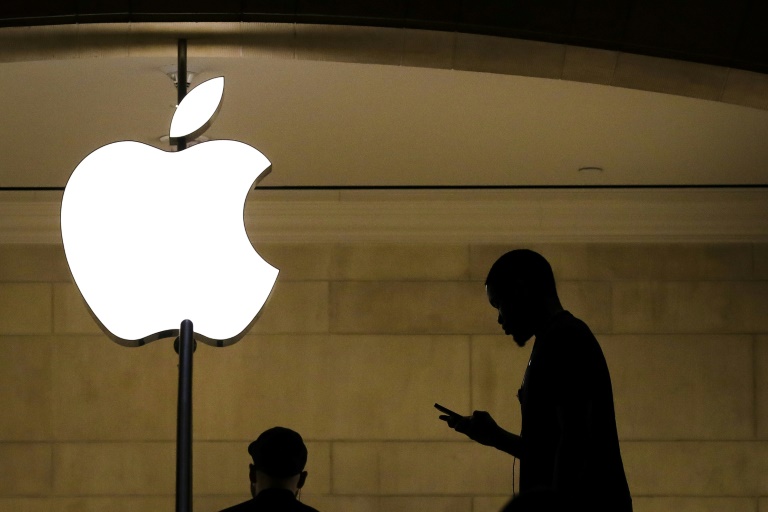
Workers at Apple’s Grand Central Station store announced Monday they are organizing to establish a union, in what would be a first at one of the tech giant’s retail locations in the United States.

The effort, calling itself “Fruit Stand Workers United,” aims to garner signatures from at least 30 percent of the New York store, the minimum needed to qualify for a unionization election.

The campaign is connected to Workers United, an affiliate of the national Service Employees International Union, which was established in 2009 from several earlier unions. 

Workers United confirmed its involvement.

“Like so many recent campaigns, this has been worker-driven, and worker led,” Workers United said in an email. “We recognize the tremendous bravery and courage these workers have taken to stand up for their rights, and we will support them every step of the way.”

Organizers of the Grand Central campaign described themselves as working in “extraordinary times with the ongoing Covid-19 pandemic and once-in-a-generation consumer price inflation,” though their website did not disclose the name of staff members leading the effort.

“Grand Central is an extraordinary store with unique working conditions that make a union necessary to ensure our team has the best possible standards of living,” the workers said on the campaign website for the prospective union.

The Apple effort comes as a Starbucks unionization drive backed by Workers United has spread nationally after election victories last year in New York. 

Amazon is also facing a growing challenge from unions after an upstart campaign won an election at a warehouse in nearby Staten Island earlier this month. A vote at a second Staten Island Amazon site is scheduled for later in April.

On Monday, the National Labor Relations Board, which oversees union elections, indicated it received enough signatures from another Amazon warehouse to hold a vote in Bayonne, New Jersey at a site with about 200 workers.

Employees working in at least three other Apple stores are also attempting to organize, according to The Washington Post.

Apple did not immediately respond to a request for comment from AFP.

Asian markets slide on growth fears, US stocks end volatile day lower

Asian stocks closed lower on Monday as Chinese officials offered a cautious outlook despite better-than-expected growth data, while US stocks edged lower amid worries over higher interest rates.

On a day when bourses in Europe and some Asian cities were closed for holiday, Tokyo’s benchmark Nikkei 225 ended down more than one percent and Shanghai posted small losses.

China’s economic growth accelerated in the first quarter of the year to 4.8 percent, official data showed, but the government warned of “significant challenges” ahead while massive Covid-19 lockdowns started to bite.

Virus restrictions in March have already gouged at retail sales, as consumers shied away from shopping, and drove up unemployment.

“With the domestic and international environment becoming increasingly complicated and uncertain, economic development is facing significant difficulties and challenges,” NBS spokesman Fu Linghui said on Monday.

Jeffrey Halley, senior market analyst with OANDA, said the data “suggest that China started the year well, but as the quarter has moved on, the headwinds have gotten stronger.”

Shanghai reported its first Covid-19 deaths since the start of its weeks-long lockdown.

China’s largest city and economic powerhouse has stewed under a patchwork of restrictions this year amid the country’s worst Covid-19 outbreak since the start of the pandemic.

Back in the United States, Wall Street stocks gyrated in a roller-coaster session, with the S&P 500 finishing down less than 0.1 percent.

The yield on the 10-year US Treasury note rose further above 2.8 percent, its latest jump in the upward march seen over the last month as the Federal Reserve has coalesced around an aggressive plan to counter  inflation.

Meanwhile, survey data pointed to a decline in US homebuilding sentiment, reflecting the drag from higher mortgage rates, according to the National Association of Home Builders.

Oil prices pushed higher as Libya’s National Oil Corporation announced the closure of operations in major sites after staff in the key export terminal of Zueitina and the Al-Sharara oil field were blocked from working.

The Japanese yen, meanwhile, skidded to a fresh 20-year low against the dollar reflecting the continued accommodation of Japanese monetary policy, while US policy makers move to hike interest rates.

– Key figures around 2030 GMT –

New York – Dow: DOWN 0.1 percent at 34,411.69 (close)

New York – S&P 500: DOWN less than 0.1 percent at 4,391.69 (close)

New York – Nasdaq: DOWN 0.1 percent at 13,332.36 (close)

Frankfurt – DAX: Closed for a holiday

Paris – CAC 40: Closed for a holiday

London – FTSE 100: Closed for a holiday

Tokyo – Nikkei 225: DOWN 1.1 percent at 26,799.71 (close)

Shanghai – Composite: DOWN 0.5 percent at 3,195.52 (close)

Hong Kong – Hang Seng Index: Closed for a holiday

Euro/dollar: DOWN at $1.0785 from $1.0810

Pound/dollar: DOWN at $1.3012 from $1.3060

Euro/pound: UP at 82.87 pence from 82.78 pence

Dollar/yen: UP at 126.96 yen from 126.46 yen

Brent North Sea crude: UP 1.3 percent at $113.16 per barrel

West Texas Intermediate: UP 1.2 percent at $108.21 per barrel

As major economies meet, US looks to increase pressure on Russia

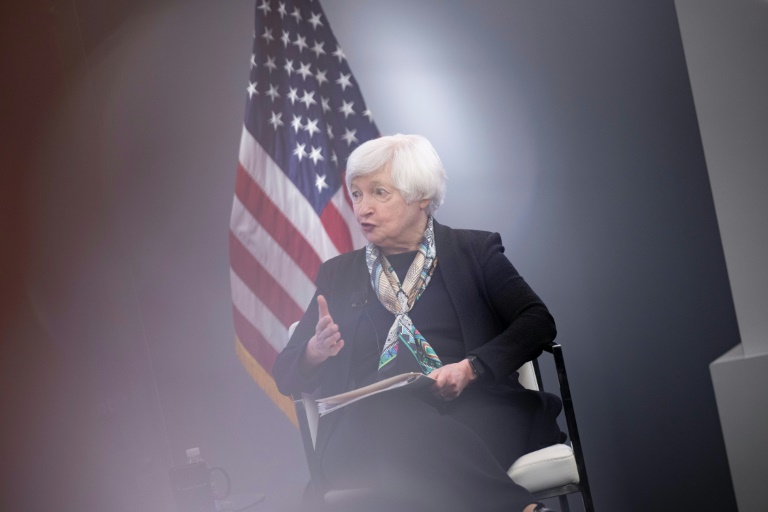
US Treasury Secretary Janet Yellen this week will call on her counterparts in major economies to ramp up the economic pain on Moscow over its invasion of Ukraine, a senior official said Monday.

The fallout from the war and the impact on the global economy will be key topics of discussion during the spring meetings of the IMF and World Bank, which began Monday.

Finance officials from the G7 and G20 nations also will meet this week.

“The secretary believes the Russian invasion of Ukraine has demonstrated the need for the world’s largest economies to stand together to defend international order and protect peace and prosperity,” the Treasury official told reporters.

“She will use this week’s meetings to work with allies to continue our united efforts to increase economic pressure on Russia while mitigating spillover effects.”

The IMF and World Bank have warned of the devastating costs the war is imposing on the global economy, especially through rising prices for energy and food at a time of high inflation.

Western sanctions on Moscow have contributed to the price pressures, which are hitting the poorest countries the hardest.

While Yellen is “deeply concerned” about the impacts, “We are firm in our resolve to hold Russia and its leadership accountable, and have imposed crippling sanctions,” the official said.

In a speech at the Peterson Institute for International Economics, Deputy Treasury Secretary Wally Adeyemo vowed to “take apart Russia’s war machine, piece by piece, by disrupting their military industrial complex and its supply chains.”

“We are continuing our efforts to use sanctions and export controls to deny Russia the critical inputs it needs, targeting key sectors like aerospace, electronics and others related to the defense sector,” he said, noting their invasion has taken longer than Moscow expected.

The Treasury official noted Washington also will continue to work to penalize countries that try to evade the sanctions and restrict Russian leader Vladimir Putin’s ability to project power, though they did not provide any specifics on the type of sanctions or the targets being considered.

– Boycotting Russia –

While Yellen will participate in key meetings this week, especially the opening session of the G20 focused on the fallout from the Russian invasion, she will not attend other sessions if officials from Moscow are included, the Treasury official said.

She will make it clear that “the benefits and privileges of the leading economic institutions of the world — which we helped create after (World War II) — are reserved for countries that demonstrate respect for the core principles that underpin peace and security across the world,” the Treasury official said. 

Russian finance officials are expected to participate remotely in the G20 meeting on Wednesday, which is led by Indonesia this year.

Other officials from the world’s leading economies may boycott the sessions as well, a French source told AFP last week.

US President Joe Biden has proposed ejecting Russia from the G20.

Yellen will meet with Ukraine’s Prime Minister Denys Shmyhal and “will reiterate the Biden administration’s firm support for the people of Ukraine as they defend their lives and their country,” according to Treasury.

Adeyemo will meet with Ukrainian Finance Minister Sergii Marchenko on Thursday.

Yellen also will call for a coordinated multilateral effort to support Ukraine’s short-term funding needs for humanitarian relief and rebuilding.

Workers at New York Apple store launch union campaign

Workers at Apple’s Grand Central Station store announced Monday they are organizing to establish a union, in what would be a first at one of the tech giant’s retail locations in the United States.

The effort, calling itself “Fruit Stand Workers United,” aims to garner signatures from at least 30 percent of the New York store, the minimum needed to qualify for a unionization election.

The campaign is connected to Workers United, an affiliate of the national Service Employees International Union, which was established in 2009 from several earlier unions. 

“Grand Central is an extraordinary store with unique working conditions that make a union necessary to ensure our team has the best possible standards of living,” the workers said on the campaign website for the prospective union.

They described themselves as working in “extraordinary times with the ongoing Covid-19 pandemic and once-in-a-generation consumer price inflation,” though their website did not disclose the name of staff members leading the effort.

The Apple effort comes as a Starbucks unionization drive backed by Workers United has spread nationally after election victories last year in New York. 

Amazon is also facing a growing challenge from unions after an upstart campaign won an election at a warehouse in nearby Staten Island earlier this month.

Employees working in at least three other Apple stores are also attempting to organize, according to The Washington Post.

Apple did not immediately respond to a request for comment from AFP.

Close Bitnami banner
Bitnami