US Business

Asian markets rise but inflation, Ukraine fears linger

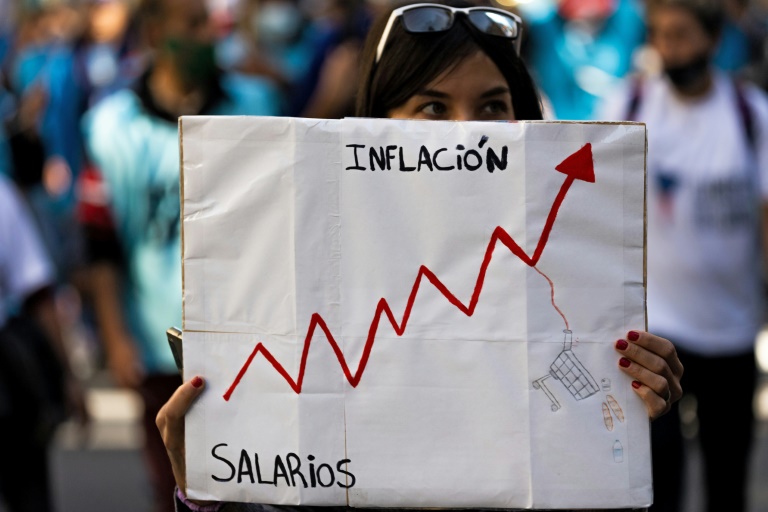
Asian stock markets mostly rose in early trade Thursday after a recovery on Wall Street, but investors remained cautious about the ongoing impact of skyrocketing inflation and the war in Ukraine.

Prices were already soaring in major economies when Russia’s invasion of Ukraine sent shockwaves through the global energy, food and commodity markets.

Despite lingering concerns about the US Federal Reserve’s next moves to contain prices, Wall Street enjoyed a buoyant session — especially the tech-rich Nasdaq, which surged 2.0 percent.

Asia was in a similar mood Thursday as Tokyo soared 1.3 percent and Hong Kong put on 0.8 percent. Sydney, Shanghai and Taipei were also in positive territory, but Seoul dipped.

South Korea’s central bank on Thursday raised its key interest rate to the highest level since August 2019 to tame rising inflation.

Analysts warned overnight that the uncertainty is far from over.

“With a thicker fog of war starting to roll in and engulf the global markets again, it is another worrying setup amid the widespread bearish sentiment out there,” Stephen Innes of SPI Asset Management said in a note.

Data this week from the United States — the world’s biggest economy — and Britain showed inflation at levels not seen in decades.

Analysts said, however, that markets had welcomed an indication that US inflation may be approaching its peak.

– ‘Countervailing forces’ –

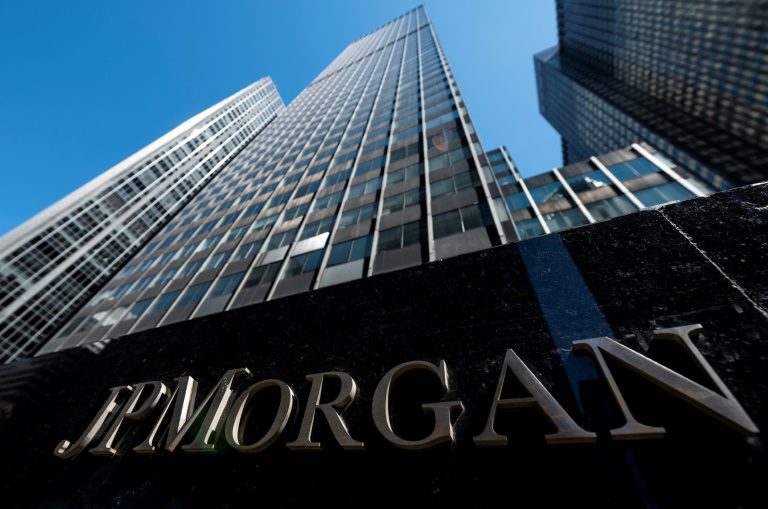
The grim outlook was reflected in the latest earnings report from JP Morgan Chase, the largest American bank by assets.

“There’s this very strong underlying economy,” its chief executive Jamie Dimon said.

But he pointed to “countervailing forces”, including rising interest rates, inflation and the war in Ukraine.

“And those things are going to collide at one point, probably sometime next year,” he said in a conference call with reporters.

“I’m not predicting a recession… But is it possible? Absolutely.”

Both main oil contracts hovered above the $100 per barrel mark, with fears swirling about global supply constraints over the invasion of Ukraine by Russia — a major producer of oil and gas.

“The oil complex is heavily fixated on the short-term,” Vandana Hari of Singapore-based Vanda Insights told Bloomberg News.

“The prospect of an EU ban on Russian oil will keep the market on edge as long as Ukraine festers.”

– Key figures around 0230 GMT –

Tokyo – Nikkei 225: UP 1.3 percent at 27,182.50

Hong Kong – Hang Seng: UP 0.8 percent at 21,535.37

Shanghai – Composite: UP 0.6 percent at 3,203.94

Euro/dollar: DOWN at 1.0888 from $1.0894 at 2100 GMT

Pound/dollar: UP at $1.3117 from $1.3109

Euro/pound: DOWN at 83.01 pence from 83.03 pence

Dollar/yen: UP at 125.62 from 125.59

Oil – Brent: DOWN 0.7 percent at 108.05 per barrel

Oil – WTI: DOWN 0.8 percent at 103.41 per barrel

New York – Dow: UP 1.0 percent at 34,564.59 (close)

London – FTSE 100: UP 0.1 percent at 7,580.80 (close)

— Bloomberg News contributed to this story —
Grave injustice: Not even the dead rest easy in Pakistan megacity

In the teeming metropolis of Karachi, Pakistan’s biggest city, graveyards are filling up and the dead are running out of space to rest. 

But for the right price to the right person, a plot can be “found” for the body of a loved one by shady crews who demolish old graves to make room for the new.

In the coastal megacity — a crush of 20 million people — the Pakistan Employees Cooperative Housing Society (PECHS) cemetery has been officially full for five years.

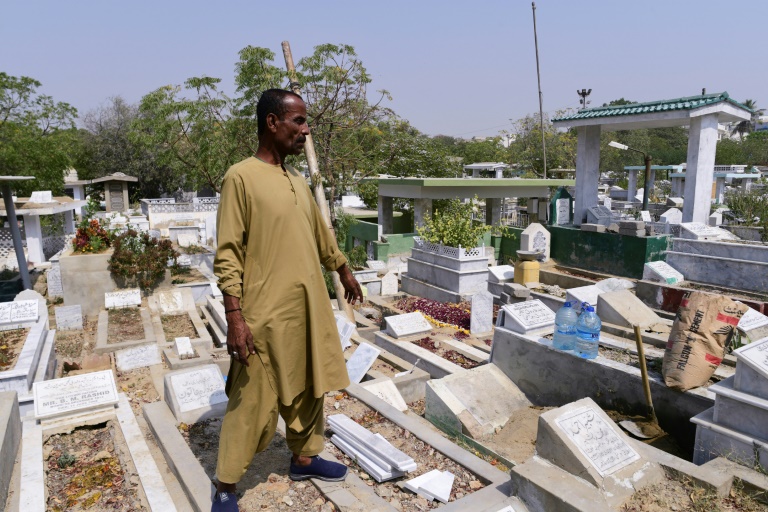
The necropolis is choc-full. Tombs big and small are slotted like Tetris into every nook — some pitted deep in the ground, others raised high on petal-strewn plinths.

Still, new tombs appear all the time, erected on smashed or scooped-out graves by men charging outsized fees.

AFP witnessed one team hacking at stonework and furtively carrying away baskets of dirt until they had carved out a fresh opening in the cramped earth.

“There’s no space in the whole of Karachi — none of the graveyards has space for fresh burials,” said digger Khalil Ahmed. 

“We have to destroy old graves if we want to create new ones.”

The government burial fee in this district is 7,900 rupees ($44) but two locals reported paying 55,000 and 175,000 to lay a loved one to rest in the PECHS graveyard last year.

Ahmed said the fees are split between 40 men and teens who, when not working, spend their time lolling on day beds in the shade.

– Gravedigger mafia –

Ahmed and his colleagues are part of what politicians and the media call the “gravedigger mafia” — a typically flamboyant term in the parlance of Pakistan social affairs.

Officials rail against the “milk mafia” watering their wares, the “sugar mafia” driving up prices and the “land mafia” annexing space.

But the freelance gravediggers are profiting on Pakistan’s changing population dynamic.

Pakistan is the world’s fifth most-populous nation with 220 million citizens and more than four million added every year.

As the population grows, so does the migration of people from the countryside to the cities, looking for work to escape rural poverty.

Muhammad Aslam has witnessed the gravedigger mafia flourish as Karachi’s population boomed.

The 72-year-old said the PECHS graveyard was a “deserted place” when he moved next door in 1953 but “space shrank fast” as burial prices rose for 14 family members interred over the years.

In 1967 Aslam’s family paid 50 rupees to bury his grandfather but a relative buried at the hands of the mafia in 2020 cost 33,000.

“The basic issue is that infrastructure is insufficient,” said Ali Hassan Sajid, a spokesman for the Karachi Metropolitan Corporation (KMC).

The KMC manages 39 of around 250 graveyards citywide — including PECHS Six are closed, while the rest are “almost full”.

“In some parts of the city the infrastructure is the same that existed when Pakistan was founded,” Sajid admitted.

He openly acknowledged the existence of gravedigger mafias conducting burials at closed sites — and claimed efforts to evict them are underway.

The gangs are also reported to be flourishing in the cities of Rawalpindi, Peshawar and Lahore.

– A missing memorial –

Fault for the gravedigger mafia — and even whether they represent a problem — depends on who you ask.

Sajid said families eager to bury relatives alongside previous generations in full yards offer high prices that “lure the gravedigger so he falls prey to his greed”.

Ahmed the gravedigger says he provides an essential service in a city unable to administer itself, scratching out a meagre living in return.

And while some locals view the practice as part of the faulty fabric of life in a teeming city, for others it is a source of angst.

Muhammad Abdullah Saif’s father was buried in the PECHS graveyard decades ago. 

Today the faded green tomb is surrounded by empty sacks of cement and the shattered cusps of tombstones –the mafias generally pick untended graves for demolition.

“We have to come and visit regularly or the grave will be knocked down,” said the 32-year-old.

Muzammil Asif, meanwhile, must clamber over a carpet of ankle-twisting hazards to reach the grave of his teenage sister, buried here last summer.

“Graves are desecrated when one walks over them,” the 21-year-old complains.

And in the nearby Korangi graveyard Muhammad Munir has experienced the saddest loss.

Every year he comes to offer prayers in the cemetry where his father was buried — an amphitheatre of tumbledown tombstones fringed by ragged flags.

But the grave is long gone, demolished more than 20 years ago and replaced by another. That replacement is gone too, swapped out for a new one.

Some years when Munir visits he finds a fresh crop of tombstones bearing unfamiliar names, erected in smeared cement.

Now he’s unsure of exactly where his father lies in rest.

“It’s painful,” he said. “The grave was the last sign of him.”

JPMorgan Chase says US economy still solid, but risks rising

JPMorgan Chase said the US economy remains on solid footing in the short term, but warned of heightened longer-term risks due to inflation and the Ukraine war as it reported lower quarterly profits.

Executives from the giant bank said households and businesses generally remained in good shape amid a tightening labor market.

But higher consumer prices, the Ukraine war and the shifts in Federal Reserve policy have together slightly raised the recession risk, which led the bank to set aside $902 million in additional reserves as a buffer against possible bad loans.

“There’s this very strong underlying economy,” Chief Executive Jamie Dimon said, noting that many consumers are flush with cash and businesses are in “good shape” for the most part.

But he pointed to “countervailing forces,” including rising interest rates and inflation, and the war in Ukraine. 

“And those things are going to collide at one point, probably sometime next year,” he said.

“I’m not predicting a recession,” Dimon added in a conference call with reporters. “But is it possible? Absolutely.”

– ‘Wars are unpredictable’ –

The biggest US bank by assets, JPMorgan reported $8.3 billion in first-quarter profits, down 42 percent from the same three months of the prior year. Revenues dipped five percent to $30.7 billion. 

JPMorgan scored higher net interest income, reflecting a boost to lending fees because of higher lending rates. 

Profits fell in investment banking on lower equity and debt underwriting fees. The division also suffered a $120 million hit tied to upheaval in the nickel market in March that pressured some commodity brokerages, company officials said.

The results contrasted sharply from a year ago, when JPMorgan saw surging profits after it unlocked $5.2 billion in funds it had set aside early in the pandemic against potential defaults, but didn’t need because of the surprisingly solid condition of clients.

In the latest quarter, JPMorgan set aside $902 million for bad loans, citing “downside risks” including the Ukraine war and surging inflation.

About $300 million of that amount is connected to Russia-related exposures, with the remaining funds reflecting broader economic risks, executives said.

Charge offs for the first quarter came in at a relatively modest $582 million, another sign of the healthy condition of consumers.

In terms of customer trends, Dimon cited an uptick in credit card spending on dining and travel, but said higher mortgage rates had dented home lending originations, while limited vehicle availability crimped car loan originations.

Dimon highlighted the Ukraine situation as a wildcard, warning that “wars are unpredictable” and the oil market could “change dramatically.”

“The oil markets are precarious,” he said, adding that “clouds are on the horizon.”

The CEO also predicted elevated volatility throughout financial markets given the scale of the Fed’s asset unwind.

“We’ve never been through a (quantitative tightening) like this,” Dimon said. 

“So this is a new thing for the world and I think is more substantially important than other people think, because the huge change of flows of funds is going to create as people change their investment portfolio.”

Briefing.com called the earnings report a “red flag” for the banking industry. 

While far from disastrous, the JPMorgan results “shows that some cracks are forming, particularly in consumer lending (home and auto), adding to growth concerns for banks and the economy,” Briefing.com said.

JPMorgan’s shares fell 3.2 percent to $127.30.

Other large banks, including Goldman Sachs, Citigroup and Bank of America, will report results in coming days.

'Green cities' focus of largest Dutch garden expo

Dutch King Willem-Alexander on Wednesday opened the gates to one of Europe’s largest gardening fairs, a once-in-a-decade show focusing this year on how to make cities greener.

But critics have denounced the show, which features displays by 200 participants from 25 countries, as a “money pit” that has massively over-run its budget.

The Floriade 2022 exposition, which runs until early October, is expected to draw more than two million enthusiasts to the central city of Almere.

The Floriade 2022 shows “what a green city could be like in the future… what kind of materials could be used for this and what role the horticultural sector could play in it”, said its curator, Annemarie Jorritsma, a former mayor of the city.

“On top of that, when the show is finished it will be a fantastic residential area,” she told AFP.

Each decade, a different Dutch city gets to host the gardening extravaganza. Almere, the latest, is a city that was itself created by the Dutch by draining part of the former Zuiderzee bay to reclaim land.

As well as being a showcase for Dutch horticulture, each participating country has its own pavilion.

China’s is showing “new ways of using bamboo”, said Jorritsma. Italy is focusing on permaculture, while France shows how metallic imitations of trees can be used to cool cities.

The German pavilion is decorated with plants including garden plants, trees, food crops and wildflowers to form a “living ecosystem whose appearance would change throughout the exhibition”, organisers said.

“The Floriade is the best place to show what countries have to change their cities,” Detlef Wintzen, one of the exhibitors at the German pavilion, told AFP.

– Cost controversy –

The event has however been criticised for budget overruns that threatened its very existence.

Dutch media have reported that Almere has significantly over-run its 10-million-euro budget ($10.8 million) for the project.

Financial daily Financieele Dagblad estimated that costs could be as high as 200 million euros — with losses of up to 100 million — but said there was a “thick fog” hanging over the official costs.

First held in Rotterdam in 1960, the organisers of the last three Floriades — 1992, 2002 and 2012 — have all been criticised for losses totalling millions of euros.

And some media reports have even suggested that this could be the last-ever edition of the show.

Almere — the country’s youngest city — plans to have a “green residential area by the water” after the end of the Floriade designed by Dutch architect Winy Maas.

Some 660 homes will be built in the “Hortus” district, many of them made from durable materials such as moss and mushrooms.

An imposing colourful building in the middle of the exhibition will eventually serve as social housing, and “floating homes” are also planned.

Members of the public can visit the Floriade from Thursday onwards.

Iran says preliminary deal reached on frozen funds abroad

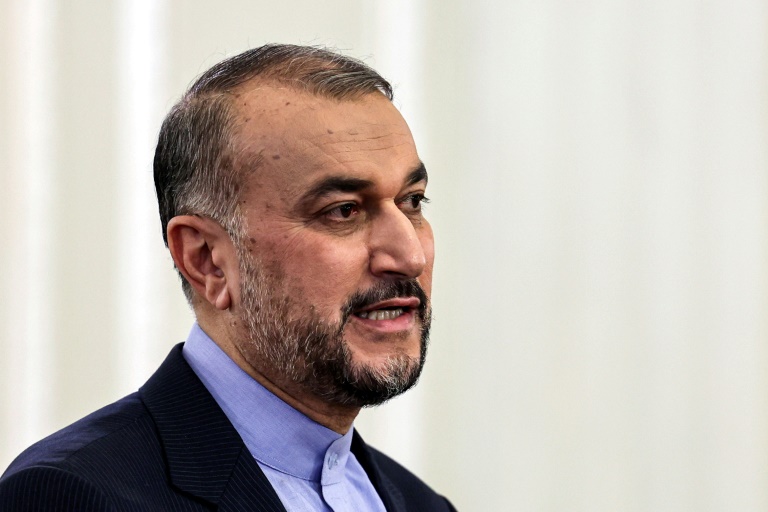
Iran’s foreign minister said Wednesday that a preliminary deal had been reached with a foreign bank over frozen funds belonging to the Islamic republic.

“An accord was concluded with a foreign bank to release a part of our financial claims,” Hossein Amir-Abdollahian said at a news conference.

“This is a preliminary agreement on when and how to release the funds,” he added.

Tens of billions of dollars in Iranian money were blocked in a number of countries, including China, South Korea and Japan, after the United States reimposed sanctions on the Islamic republic in 2018.

A 2015 nuclear deal had granted Tehran much-needed sanctions relief but the US unilaterally pulled out and reimposed punishing sanctions under then-president Donald Trump.

Until then, Iran had been one of South Korea’s main suppliers of crude.

According to Tasnim news agency, the deal announced on Wednesday aims to find a solution for frozen Iranian assets valued at more than $7 billion.

Last year Tehran threatened legal action unless Seoul released frozen funds for oil shipments, worth that same amount.

In early January, Iran had urged South Korea to unlock the funds and not to await the outcome of Vienna talks aiming to revive the nuclear agreement.

Amir-Abdollahian said a delegation from the concerned country, which he did not identify, had visited Tehran on Tuesday to follow up on the implementation of the deal with the foreign bank.

The delegation met officials from the Iranian central bank and the foreign ministry, he added.

Iran has been engaged for a year in talks with France, Germany, Britain, Russia and China directly, and the United States indirectly, to revive the nuclear deal, known formally as the Joint Comprehensive Plan of Action (JCPOA).

The talks have been paused since March 11, having progressed most of the way towards reviving the deal, but pending issues are still unresolved.

Half of US warehouse injuries in 2021 at Amazon: unions

Nearly half of all recorded injuries in US warehouses last year occurred at Amazon, according to a report released Tuesday by a coalition of unions.

The e-commerce giant has boomed during the pandemic with soaring home delivery demand, but has also faced criticism over workers’ conditions and its labor practices. 

“Amazon employed one-third of all warehouse workers in the US, but it was responsible for nearly one-half (49 percent) of all injuries in the warehouse industry,” according to the report by the Strategic Organizing Center (SOC).

The SOC report said US Amazon workers sustained more than 34,000 “serious injuries” on the job last year, a rate more than twice as high as that at warehouses not owned by the company.

Amazon acknowledged an increase in the number of injuries as tens of thousands of employees joined its workforce, but argued the rate at which its people got hurt had declined.

“Like other companies in the industry, we saw an increase in recordable injuries during this time from 2020 to 2021 as we trained so many new people,” the company said.

“However, when you compare 2021 to 2019, our recordable injury rate declined more than 13 percent year over year,” it added.

The coalition said it relies on data provided by Amazon to the US Occupational Safety and Health Administration — the federal agency responsible for preventing workplace injuries. 

“After relaxing some of its discipline systems in the first months of the Covid-19 pandemic, Amazon reimplemented its monitoring systems and production pressures in late 2020, and its injury rates rose substantially,” the SOC said. 

Hiring at Amazon has spiked during the pandemic.

In the United States, the company has gone from some 700 sites in 2020 to more than 900 in 2021, and from more than 200,000 employees in 2017 to over 560,000 in 2021, according to the report. 

In June 2021, Amazon changed working conditions, including longer breaks for its workers who prepare, ship and deliver packages. 

That decision came after a previous damning SOC report, and an attempt to unionize at an Amazon warehouse in Alabama. That failed, but the campaign exposed what many employees described as the company’s intense pace. 

“We need a better vision for our employees’ success,” wrote Amazon founder Jeff Bezos in an annual letter to shareholders in 2020. 

“We are going to be Earth’s Best Employer and Earth’s Safest Place to Work,” he promised. 

But “in stark contrast to Jeff Bezos’ recent pledge… the injury rate at Amazon facilities increased by 20 percent between 2020 and 2021,” the SOC said.

Amazon workers in New York have voted to launch the first US union at the e-commerce giant, an underdog upset against a company that has steadfastly opposed organized labor in its massive workforce.  

Stocks, oil rise as inflation soars

Stock markets mostly rose and oil prices climbed Wednesday as investors pored over data showing further spikes to inflation.

A day after data showed US annual consumer inflation hit a 40-year high in March, information showed wholesale price inflation hit a record annual rate of 11.2 percent over the same period.

Meanwhile in Britain, data showed that UK prices had jumped at the fastest pace in three decades in March. 

Global inflation, already rocketing on supply constraints as economies look to fully reopen following pandemic lockdowns, is rising further on fallout from the Ukraine war.

Analysts said markets had welcomed an indication that US inflation was approaching its peak, though it has raised expectations that the Federal Reserve will take more aggressive action to contain prices.

Wall Street stocks rose across the board, with the Dow rising 0.6 percent.

In Europe, London and Paris ended the day barely in positive territory, while Frankfurt dipped.

The gains on Wall Street also came despite a lacklustre start to the corporate earnings season, as JPMorgan Chase saw its first-quarter net profit plunge by 40 percent as it set $900 million aside to deal with potential losses due to the Ukraine conflict and inflation.

It already booked $524 million in losses as it sought to lower its exposure to soaring commodities prices and Russian counterparties.

Shares in JPMorgan Chase fell 2.5 percent.

Meanwhile, Delta Air Lines beat expectations even if it still lost money. It said it expected second-quarter revenue to come in at 97 percent of the pre-pandemic level in 2019.

Its shares rose 4.6 percent.

– Oil rises –

Elsewhere Wednesday, oil prices climbed further in a volatile trading week.

“Having rebounded strongly yesterday, oil prices are showing little sign of softening after Russian President Vladimir Putin said that peace talks with Ukraine were a ‘dead-end situation’,” said market analyst Michael Hewson at CMC Markets UK.

Russia is a major producer of oil and gas and the war has triggered fears of supply constraints.

“On the other hand, further gains in prices could be constrained after the IEA downgraded its global demand forecasts for this year due to the imposition of extended new lockdowns in China,” Hewson added.

The International Energy Agency also said that Russian oil supply is expected to continue to fall in April by 1.5 million barrels per day.

In currency trading Wednesday, the yen hit its lowest level against the dollar in two decades, extending recent falls as the gap widens between Japan’s ultra-loose monetary policy and Fed tightening.

Despite being traditionally considered a haven currency, uncertainty fuelled by the war in Ukraine has not caused the yen to strengthen.

Instead, the Fed’s move towards a more aggressive rate-tightening policy and the shock of rising oil prices in Japan — a major importer of fossil fuels — have pushed the currency lower, analysts said.

– Key figures around 1530 GMT –

New York – Dow: UP 0.6 percent at 34,408.95 points

EURO STOXX 50: DOWN 0.2 percent at 3,824.23

London – FTSE 100: UP less than 0.1 percent at 7,580.80 (close)

Paris – CAC 40: UP less than 0.1 percent at 6,542.14 (close)

Frankfurt – DAX: DOWN 0.3 percent at 14,076.44 (close)

Tokyo – Nikkei 225: UP 1.9 percent at 26,843.49 (close)

Hong Kong – Hang Seng Index: UP 0.3 percent at 21,374.37 (close)

Shanghai – Composite: DOWN 0.8 percent at 3,186.82 (close)

Brent North Sea crude: UP 2.6 percent at $107.32 per barrel

West Texas Intermediate: UP 2.2 percent at $102.85 per barrel

Euro/dollar: UP at $1.0854 from $1.0818

Pound/dollar: UP at $1.3050 from $1.2977

Euro/pound: DOWN at 83.22 pence from 83.36 pence

Dollar/yen: DOWN at 125.74 from 126.22 yen

burs-rl/jj

Delta shares fly as strong demand offsets jet fuel drag

Delta Air Lines offered an upbeat outlook for the summer travel season on Wednesday, saying strong demand is providing enough pricing power to make up for soaring fuel costs.

Shares jumped on the report and outlook, with Delta reporting a smaller than expected loss in the first quarter, even as it contended with a nearly 50 percent increase in jet fuel prices.

“Delta is well-positioned to capitalize on robust consumer demand and accelerating return of business and international travel,” said Delta President Glen Hauenstein in a press release. 

“In the June quarter, we are successfully recapturing higher fuel prices,” he said, adding that the company expects revenues equivalent to between 93 and 97 percent of the 2019 quarter. 

For the quarter ending March 31, Delta reported a loss $940 million, smaller than the year-ago loss. 

Revenues were $9.3 billion, more than double those from the 2021 quarter, but lower than the $10.5 billion in the pre-pandemic 2019 quarter.

Airlines are adjusting to a higher cost environment in general amid the tight labor market and supply chain problems. Jet fuel is typically the biggest cost for an airline, after labor.

Hauenstein said in March that the airline was targeting price increases of about $15 to $20 a ticket on a fare of $200 to make up for higher jet fuel costs.

On Wednesday, Delta executives declined to update those figures, but said brisk ticket sales meant higher prices on remaining available seats.

A July flight between Orlando and Los Angeles is currently priced at about $750 or more at most times.

“We haven’t seen a lot of resistance in the price points,” Hauenstein said. “My advice is to book early and be flexible if fare is your main attribute.” 

Executives said the heady market reflects pent-up consumer demand after two years of Covid-19 constraints.

“You’re seeing a pretty significant shift from goods to experiences,” said Delta Chief Executive Ed Bastian on a conference call with analysts.

“Consumers have not been traveling the last two years. So this is a category they have been prioritizing.”

Shares rose 4.3 percent to $40.26 in late-morning trading.

California start-up sends tiny robots on voyage into brains

Sending miniature robots deep inside the human skull to treat brain disorders has long been the stuff of science fiction — but it could soon become reality, according to a California start-up.

Bionaut Labs plans its first clinical trials on humans in just two years for its tiny injectable robots, which can be carefully guided through the brain using magnets.

“The idea of the micro robot came about way before I was born,” said co-founder and CEO Michael Shpigelmacher.

“One of the most famous examples is a book by Isaac Asimov and a film called ‘Fantastic Voyage,’ where a crew of scientists goes inside a miniaturized spaceship into the brain, to treat a blood clot.”

Just as cellphones now contain extremely powerful components that are smaller than a grain of rice, the tech behind micro-robots “that used to be science fiction in the 1950s and 60s” is now “science fact,” said Shpigelmacher. 

“We want to take that old idea and turn it into reality,” the 53-year-old scientist told AFP during a tour of his company’s Los Angeles research and development center.

Working with Germany’s prestigious Max Planck research institutes, Bionaut Labs settled on using magnetic energy to propel the robots — rather than optical or ultrasonic techniques — because it does not harm the human body.

Magnetic coils placed outside the patient’s skull are linked up to a computer that can remotely and delicately maneuver the micro-robot into the affected part of the brain, before removing it via the same route.

The entire apparatus is easily transportable, unlike an MRI, and uses 10 to 100 times less electricity.

– ‘You’re stuck’ –

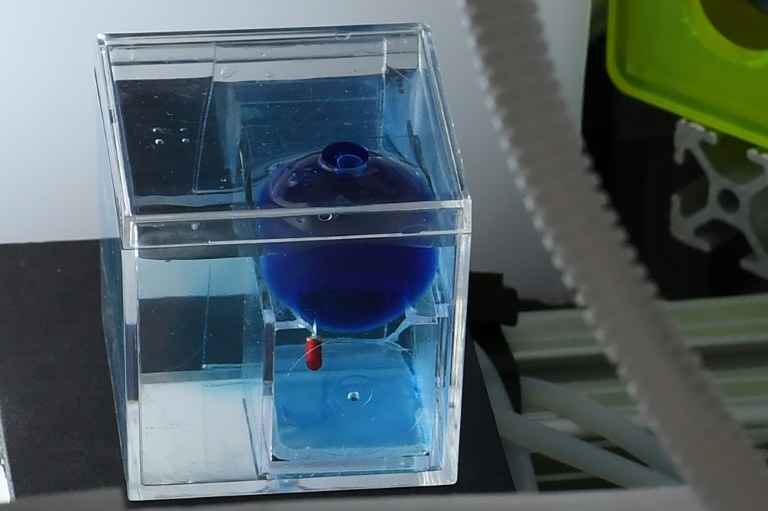
In a simulation watched by AFP, the robot — a metal cylinder just a few millimeters long, in the shape of a tiny bullet — slowly follows a pre-programed trajectory through a gel-filled container, which emulates the density of the human brain.

Once it nears a pouch filled with blue liquid, the robot is swiftly propelled like a rocket and pierces the sack with its pointed end, allowing liquid to flow out.

Inventors hope to use the robot to pierce fluid-filled cysts within the brain when clinical trials begin in two years.

If successful, the process could be used to treat Dandy-Walker Syndrome, a rare brain malformation affecting children.

Sufferers of the congenital ailment can experience cysts the size of a golf ball, which swell and increase pressure on the brain, triggering a host of dangerous neurological conditions.

Bionaut Labs has already tested its robots on large animals such as sheep and pigs, and “the data shows that the technology is safe for us” human beings, said Shpigelmacher.

If approved, the robots could offer key advantages over existing treatments for brain disorders.

“Today, most brain surgery and brain intervention is limited to straight lines — if you don’t have a straight line to the target, you’re stuck, you’re not going to get there,” said Shpigelmacher.

Micro-robotic tech “allows you to reach targets you were not able to reach, and reaching them repeatedly in the safest trajectory possible,” he added.

– ‘Heating up’ –

The US Food and Drug Administration (FDA) last year granted Bionaut Labs approvals that pave the way for clinical trials to treat Dandy-Walker Syndrome, as well as malignant gliomas — cancerous brain tumors often considered to be inoperable.

In the latter case, the micro-robots will be used to inject anti-cancer drugs directly into brain tumors in a “surgical strike.”

Existing treatment methods involve bombarding the whole body with drugs, leading to potential severe side effects and loss of effectiveness, said Shpigelmacher.

The micro-robots can also take measurements and collect tissue samples while inside the brain.

Bionaut Labs — which has around 30 employees — has held discussions with partners for the use of its tech to treat other conditions affecting the brain including Parkinson’s, epilepsy or strokes.

“To the best of my knowledge, we are the first commercial effort” to design a product of this type with “a clear path to the clinic trials,” said Shpigelmacher.

“But I don’t think that we will be the only one… This area is heating up.”

JPMorgan Chase says US economy still solid, but risks rising

JPMorgan Chase said the US economy remains on solid footing for the short-term, but warned of heightened longer-term risks due to inflation and the Ukraine war as its reported lower quarterly profits.

Executives from the giant bank said households and businesses generally remained in good shape, amid a tightening labor market.

But higher consumer prices, the Ukraine war and the shifts in Federal Reserve policy together have slightly raised the recession risk, which led the bank to set aside $902 million in additional reserves as a buffer against possible bad loans.

“There’s this very strong underlying economy,” said Chief Executive Jamie Dimon, noting that many consumers are flush with cash and businesses in “good shape” for the most part.

But he pointed to “countervailing forces,” including rising interest rates and inflation, and the war in Ukraine. 

“And those things are going to collide at one point, probably sometime next year,” he said.

“I’m not predicting a recession,” Dimon added in a conference call with reporters. “But is it possible? Absolutely.”

– ‘Wars are unpredictable’ –

The biggest US bank by assets, JPMorgan reported $8.3 billion in first-quarter profits, down 42 percent from the same three months of the prior year. Revenues dipped five percent to $30.7 billion. 

JPMorgan scored higher net interest income, reflecting a boost to lending fees because of higher interest rates. 

Profits fell in investment banking on lower equity and debt underwriting fees. The division also suffered a $120 million hit tied to upheaval in the nickel market in March that pressured some commodity brokerages, company officials said.

The results contrasted sharply from a year ago, when JPMorgan saw surging profits after it unlocked $5.2 billion in funds it had set aside early in the pandemic against potential defaults, but didn’t need because of the surprisingly solid condition of clients.

In the latest quarter, JPMorgan set aside $902 million for bad loans, citing “downside risks” including the Ukraine war and surging inflation.

About $300 million of that amount is connected to Russia-related exposures, with the remaining funds reflecting broader economic risks, executives said.

Charge offs for the first quarter came in at a relatively modest $582 million, another sign of the healthy condition of consumers.

In terms of customer trends, Dimon cited an uptick in credit card spending on dining and travel, but said higher mortgage rates had dented home lending originations, while limited vehicle availability crimped car loan originations.

Dimon highlighted the Ukraine situation as a wildcard, warning that “wars are unpredictable” and the oil market could “change dramatically.”

“The oil markets are precarious,” he said, adding that “clouds are on the horizon.”

JPMorgan’s shares fell 3.5 percent to $126.90 in early trading.

Other large banks, including Goldman Sachs, Citigroup and Bank of America, will report results in coming days.

Close Bitnami banner
Bitnami