US Business

As EU eyes stopping Russian gas imports, Israel sees an opening

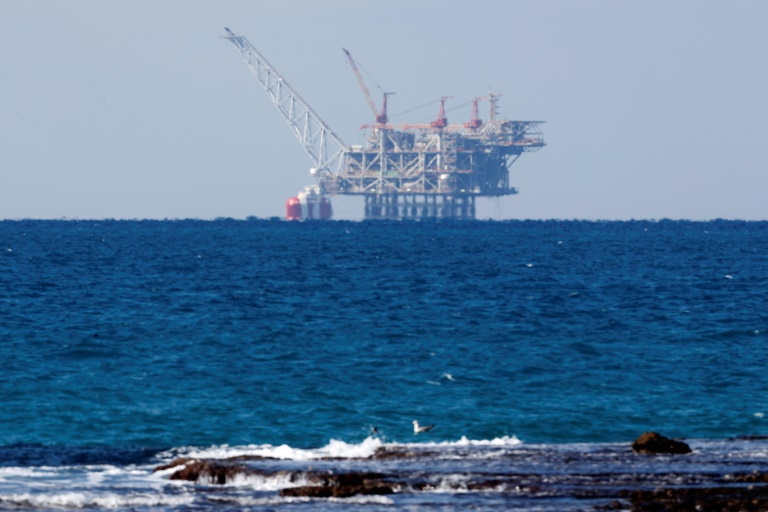
As Europe aims to wean itself off Russian fossil fuel because of the Ukraine invasion, Israel hopes to help fill the gap with gas from its offshore reserves.

EU states remain divided on the time scale, but European Commission President Ursula von der Leyen has said the bloc hopes to phase out its dependency on Russian gas, oil and coal by 2027.

Israel could build one or more pipelines, potentially via Greece or Turkey, or increase the quantity of gas piped to Egypt to be liquified and shipped off, say officials and experts. 

Israeli Foreign Minister Yair Lapid said after a recent visit to Athens that “the war in Ukraine stands to change the structure of the European and Middle Eastern energy market”. 

“We are also examining additional economic cooperation, with an emphasis on the energy market.”

The Jewish state has worked for years to create gas export routes, with mixed results so far. 

Turkey, whose ties with Israel have recently thawed after over a decade of rupture, has expressed new interest in a pipeline, and its energy minister is expected in Israel in the coming weeks.

During the years of diplomatic alienation from Turkey, Israel signed an accord with Greece and Cyprus in 2020 aiming to build the EastMed pipeline through those two countries from Israel to Europe. 

Turkey opposed the project, and a senior US diplomat said last week it would be too expensive and take too long to build. 

Energy Minister Karine Elharrar also hailed the potential for gas sales to Europe, telling the French Association of Defence Journalists that “we have the ability and we will try to do as much as we can”.

– Regional alliances –

With both Greece and its regional rival Turkey vying to be the conduit for the gas, Israel would have to tread carefully amid the regional alliances it wishes to uphold and strengthen.

Major gas finds in the eastern Mediterranean — nearly 1,000 billion cubic meters (bcm) — have in the past decade turned Israel from a natural gas importer into an exporter.

It now sells small quantities from its two major offshore fields, Leviathan and Tamar, to Egypt and Jordan. 

Israel’s domestic consumption over the next three decades would leave some 600 bcm available for export, said opposition lawmaker Yuval Steinitz, Israel’s energy minister until last year.

“In 2016 the pipeline to Turkey was examined, including with Turkey and commercial companies,” said Orit Ganor, director of natural gas international trade at Israel’s energy ministry. 

“The project didn’t reach fruition mainly due to economic reasons.”

Ganor said “the EastMed pipeline is still an option, and the company advancing it, Poseidon, is in the final stages of geophysical and geotechnical surveys of the pipe’s route in our waters and those of Greece and Cyprus”.

No financing has been secured for the project, which Steinitz said would cost about $6 billion and take around four years to complete.

He said there was also agreement with Cairo on a seabed pipeline from Leviathan to Egypt’s liquification plants that would allow for greater exports to Europe.

– ‘Catch-22’ –

Israel’s Leviathan field, which would be the source for European exports, is operated by an Israeli-American consortium including NewMed Energy and US major Chevron. 

NewMed Energy CEO Yossi Abu recently stated his ambition of “bringing Israeli gas to Europe and Asia”.

Experts say Israel’s current gas fields represent a third of potential reserves, but a means to sell future finds would be needed to encourage further exploration by private companies.

The state of Israel provides exploitation licenses and regulatory support, but does not drill for gas or build pipelines.

“There’s a ‘Catch-22’ here,” said Elai Rettig, a political scientist at Tel Aviv’s Bar-Ilan university.

“You need to find a customer that will agree to pay for this very, very expensive pipeline, and they won’t do it until you show them you’ve found enough gas to justify it.

“And you won’t find enough gas to justify it until you show that there’s someone to sell the gas to.”

Europe’s efforts to diversify gas imports began before the Ukraine war when it “experienced harsh weather and gas prices rose significantly,” said Ganor, the energy ministry official. 

Steinitz said a pipeline to Turkey would cost $1.5 billion and take two to three years to build.

Israel “could definitely be a serious factor in creating more independence and a wealth of energy sources for Europe,” he said.

He said Israel could even export via Greece, Turkey and Egypt at the same time because “we have enough gas to export through the three channels”.

Rettig stressed Israel’s need for “balance” between Turkey and Greece and to “continuously talk to both sides and to reassure them that one doesn’t come at the expense of the other”.
Crisis-hit Sri Lanka defaults on all foreign debt

Sri Lanka defaulted on its $51 billion foreign debt Tuesday as the island nation grapples with its worst economic crisis in memory and widespread protests demanding the government’s resignation.

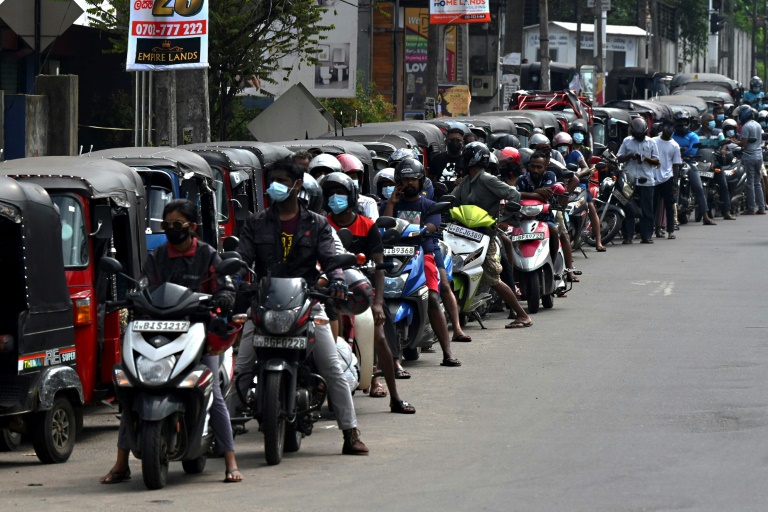
Acute food and fuel shortages, alongside long daily electricity blackouts, have brought widespread suffering to the country’s 22 million people in the most painful downturn since independence in 1948.

Public anger has flared in recent weeks with crowds attempting to storm the homes of government leaders and security forces dispersing protesters with tear gas and rubber bullets. 

Sri Lanka’s finance ministry said the country was defaulting on all external obligations, including loans from foreign governments, ahead of an International Monetary Fund bailout.

“The government is taking the emergency measure only as a last resort in order to prevent further deterioration of the republic’s financial position,” a statement from the ministry said.

Creditors were free to capitalise any interest payments due to them or opt for payback in Sri Lankan rupees, the ministry added.

Sri Lanka’s snowballing economic crisis began with an inability to import essential goods, after the coronavirus pandemic torpedoed vital revenue from tourism and remittances. 

The government imposed a wide import ban to conserve its foreign currency reserves and use them to service the debts it has now defaulted on.

Economists say the crisis has been made worse by government mismanagement, years of accumulated borrowing and ill-advised tax cuts.

Public frustration with the government is widespread, with long queues around the island nation forming each day to buy scarce supplies of petrol, gas and kerosene for cooking stoves. 

Thousands of people were camped outside President Gotabaya Rajapaksa’s seafront office in the capital Colombo in the fourth straight day of protests calling for him to step down.

– Rating downgrade –

International rating agencies also downgraded Sri Lanka last year, effectively blocking the country from accessing foreign capital markets to raise new loans and meet demand for food and fuel.

Sri Lanka had sought debt relief from India and China, but both countries instead offered more credit lines to buy commodities from them.

Official figures show that China and Japan, two key bilateral sovereign creditors, hold about 10 percent each of Sri Lanka’s foreign debt while India’s share is under five percent.

Just under half of Sri Lanka’s debt is market borrowings through international sovereign bonds and other similar instruments.

Estimates showed Sri Lanka needed $7 billion to service its debt load this year, against just $1.9 billion in reserves at the end of March. 

Asia markets mostly down ahead of key US data

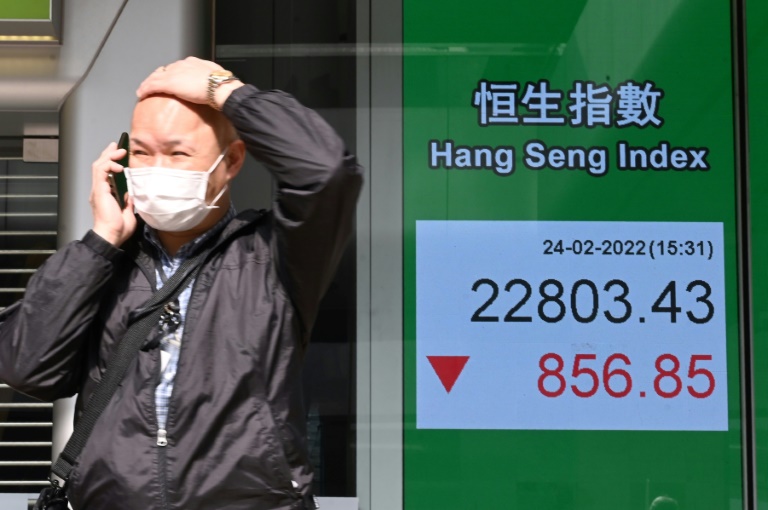
Most Asian markets were down Tuesday afternoon, after a weak lead from Wall Street and with all eyes on key US inflation data due later in the day.

Tokyo closed down by nearly two percent, though Hong Kong was up more than one percent by the afternoon.

Shanghai also posted gains, while Seoul, Taipei, Sydney and Jakarta were all in the red.

This followed a weak Monday performance from Wall Street and Europe, with sentiment souring on flat UK economic growth and expectations for another strong US inflation report, which will likely bring aggressive interest rate hikes from the Federal Reserve.

The government is set to release the US consumer price index (CPI) for March on Tuesday, after inflation rose 7.9 percent over the 12 months to February, the biggest increase in 40 years.

Calling it the “Putin price hike” in reference to the economic ramifications of Russia’s invasion of Ukraine, White House Press Secretary Jen Psaki told reporters: “We expect March headline inflation to be extraordinarily elevated.”

Economists are expecting annual US inflation to spike to nearly 8.5 percent, which would be the highest since late 1981.

“It’s not really about the level of inflation anymore, as it has been well broadcast that CPI is hotter than hot,” said Matt Simpson, senior market analyst at City Index. “The big question is how long it takes to come back down and whether the Fed will tip the US into a recession in doing so.”

“What we’re faced with this year is stagflation,” Kathryn Rooney Vera, head of global macro research at Bulltick LLC, told Bloomberg Television. 

“It’s a very complicated environment that the Fed has found itself in”, and the market is pricing in potentially 50 basis points of hikes at each of the next two policy meetings, she added.

US Treasuries declined, taking the 10-year yield past 2.80 percent.

All those concerns were weighing on the Tokyo market, Okasan Online Securities said in a note.

“Investors will then likely refrain from making major moves ahead of the release of the March US consumer prices data later in the day. The market will likely lose a sense of clear direction” until the data’s release, the brokerage said.

“The Chinese government gave out its first online game approvals in months,” noted Jeffrey Halley, senior markets analyst at OANDA, in relation to the gains in Hong Kong and Shanghai.

The approvals were for the first batch of new video game licences since July, a step that could ease some of the worst concerns about Beijing’s gaming-sector curbs.

But “sentiment hasn’t been helped by the latest Covid extended lockdown measures being initiated by Chinese authorities in Shanghai in what is likely to be a fruitless attempt to stem the spread of the more contagious Omicron variant”, said Michael Hewson, chief market analyst at CMC Markets UK.

Oil steadied, with Brent crude back just over $100 a barrel, after a tumble that erased most of the commodity’s gains sparked by Russia’s war in Ukraine.

– Key figures around 0710 GMT –

Tokyo – Nikkei 225: DOWN 1.81 percent at 26,334.98 (close)

Hong Kong – Hang Seng Index: UP 1.09 percent at 21,440.35

Shanghai – Composite: UP 1.46 percent at 3,213.33

Brent North Sea crude: UP 3.15 percent at $101.58 per barrel

West Texas Intermediate: UP 3.21 percent at $97.32 per barrel

Euro/dollar: DOWN at $1.0857 from $1.0871

Pound/dollar: DOWN at $1.3005 from $1.3021

Euro/pound: FLAT at 83.49 pence

Dollar/yen: UP at 125.68 yen from 125.40

New York – Dow: DOWN 1.19 percent at 34,308.08 (close)

London – FTSE 100: DOWN 0.67 percent at 7,618.31 (close)

— Bloomberg News contributed to this report —

From Denmark to Portugal, Europe ups effort to quit Russian gas

In Denmark, large black pipes are about to be buried in a muddy trench, as construction of a gas pipeline from Norway to Poland resumes following Russia’s invasion of Ukraine.

From plans for liquefied natural gas terminals in northern Germany, Finland and France to potential new routes through Spain and the Mediterranean, Europe is striving to rid itself of its dependence on Russian gas, though experts say the task will take years to complete.

In Middelfart in central Denmark, work resumed last month on the Baltic Pipe project, a planned 900-kilometre link, mainly intended to help Poland reduce its dependence on Russian natural gas.

“Of course it’s also to have the gas in the Danish system but mainly also to help our good neighbours’ gas systems and our Polish good friends,” Soren Juul Larsen, head of the project at Danish energy infrastructure operator Energinet, told AFP in English.

Just a week after the invasion of Ukraine, the Danish environmental authority — which had concerns about the project’s impact on local populations of mice and bats — granted a permit to continue construction, after a nine-month suspension.

“The pipeline was stopped because of a lack of permissions concerning the protection of nature and rare species,” Trine Villumsen Berling, a researcher at the Danish Institute for International Studies, told AFP.

“We were expecting it to soon be approved but of course the war made it a more pressing issue,” Villumsen said.

– Not enough for all –

Envisioned almost 20 years ago, construction of the partly submerged pipeline began in 2018. It is now expected to start operations in October, before becoming fully operational on January 1, 2023.

“We really have a good cooperation with all contractors to speed up (and) do whatever we can to protect the schedule,” Juul Larsen explained during a visit to the construction site.

With an annual transport capacity of 10 billion cubic metres of gas, the pipeline should cover around 50 percent of consumption by Poland, which announced three years ago it would end its contract with Russian giant Gazprom in 2022.

While this may be good news for Poland, it could spell trouble for other European countries seeking to free themselves of Russian gas.

Norway, Europe’s second-largest gas supplier after Russia, is delivering at full capacity, so more gas to Poland means less for the rest of the continent.

“This project would help out Poland but may lead to less Norwegian gas exports to the UK and Germany,” Zongqiang Luo, an expert at research firm Rystad Energy, told AFP.

In addition, many long-term contracts between Russia and European suppliers are valid for another 10 to 15 years, he noted.

While the European Union has resisted calls to ban Russian gas immediately, it has announced plans to slash imports by two thirds this year and eliminate them entirely before the end of the decade.

With Norway at full capacity, Dutch and UK fields in decline, and Russian gas declared undesirable, Europe is looking for gas from further away, including liquefied natural gas (LNG) transported by ship from the US, Qatar and Africa. 

But such imports require the construction of large LNG terminals to turn it back into gas or, at the very least, the purchase of so-called floating storage regasification units (FSRUs).

– Emancipation –

As the entry into service of the Nord Stream 2 gas pipeline from Russia has been suspended, Germany has urgently relaunched three LNG terminal projects previously considered to be of low priority.

One is expected to be completed in the winter of 2023-24 but the other two not before 2026.

Finland and Estonia last week announced a project to lease an import terminal ship. Estonia and the other two Baltic countries say they have stopped importing Russian gas since April 1.

In southern Europe, Spain and Portugal are strengthening an alternative supply route to help Europe wean itself off Russian gas.

To this end, the port of Sines, Portugal’s largest, plans to double the capacity of its gas terminal in under two years.

Spain, which is linked to Algeria via a pipeline and has vast LNG terminals, could provide another supply option for Europe but this would require major work to improve connections with the rest of the EU, notably via France. 

Another option under consideration is to connect Europe to the gas from the eastern Mediterranean, where large reserves have been discovered off Israel and Cyprus over the past 20 years.

Film industry guns for fresh start at Cannes

The Cannes Film Festival will hope to relaunch the industry’s hopes with another star-packed line-up to be announced on Thursday. 

After a slow return to cinema-going after the Covid-19 pandemic, the film business will be hoping for a boost on the French Riviera when the 75th edition of the world’s leading cinema festival returns from May 17 to 28. 

Tom Cruise is already confirmed for the festival promoting the world premiere of “Top Gun: Maverick”, the sequel to his 1986 blockbuster. Also attending is Tom Hanks, who co-stars in “Elvis” as the rock’n’roll star’s manager, Colonel Tom Parker. 

The latter is the latest spectacle from Australian director Baz Luhrmann, who has previously lit up Cannes with “Moulin Rouge!” and “Gatsby”.  

The rest of the line-up will be announced on Thursday, including the 20-odd films competing for the top prize Palme d’Or.

The selection committee, who have been working their way through more than 2,000 entries in recent weeks, have a tough act to follow after last year’s vintage edition. 

Coming after the festival was cancelled by the pandemic in 2020, it launched several films that went on to global success, especially “Drive My Car”.

After picking up three awards at Cannes, it went on to win this year’s Oscar for best international feature film — and was the first Japanese film to be nominated in the best picture category.

– Big-name speculation –

Last year’s jury — led by US director Spike Lee — gave the Palme d’Or to Julia Ducournau’s body-horror “Titane” — ensuring the festival maintained its reputation for boosting bold and edgy filmmaking alongside starry entertainment. 

The organisers have left it late to announce who will chair the jury this year, but Penelope Cruz and Marion Cotillard are among the favourites according to industry insiders. 

Film experts have also been picking through the release schedules for ideas on who might be in competition. 

Many are hoping to see the return of David Cronenberg, whose upcoming sci-fi/horror cross-over stars Viggo Mortensen, Kristen Stewart and Lea Seydoux. 

Also hotly tipped is Australian George Miller, the man behind “Mad Max”, who takes a new direction with “Three Thousand Years of Longing” about a djinn (played by Idris Elba) offering three wishes to Tilda Swinton. 

Another possibility is Terrence Malick, who won previously for “Tree of Life” starring Brad Pitt. His new film follows the life of Jesus Christ and stars Mark Rylance as Satan.

Though women have been getting more of a presence on the festival circuit, they remain poorly represented.

One possible contender in competition at Cannes might be US director Kelly Reichardt, with her new film, “Showing Up”. Her lo-fi hit “First Cow” was on many critics’ end-of-year lists in 2021. 

– Shadow of war –

As with everything in the arts at the moment, the Russian invasion of Ukraine hangs over the selection. 

Possible names include exiled Russian filmmaker Kantemir Balagov, 30, whose film “Beanpole” won the directing award of the Un Certain Regard section in 2019. 

Or there may be the return of Kirill Serebrennikov, who was unable to attend Cannes last year for his Palme nominee “Petrov’s Flu”, after being banned from travelling due to a controversial court case.

One possible Ukrainian entry is a film about the Allied destruction of German cities at the end of World War II by director Sergei Loznitsa. 

Meanwhile, festival director Thierry Fremaux has been pushing for a change to the rule that bars streaming platforms from competing at Cannes. 

But French cinema distributors, who have a seat on the festival board, continue to block the move even as big-name directors such as Martin Scorcese and Jane Campion have turned to Netflix and other streamers for financial support.

In the short term, that means that the much-anticipated Marilyn Monroe biopic, “Blonde”, starring Ana de Armas, a Netflix film, cannot compete for Palme, although fans are still hoping it will get a premiere on the Cote d’Azur.

Asia markets open lower ahead of key US data

Most Asian markets opened lower Tuesday, after a weak lead from Wall Street and with eyes on key US inflation data later in the day.

Tokyo was down more than one percent, while Hong Kong dipped slightly into the red.

There were small gains in Taipei and Jakarta.

This followed a weak lead Monday from Wall Street and Europe, with sentiment souring on flat UK economic growth and expectations for another strong US inflation report, which will likely bring aggressive US interest rate hikes.

The US S&P 500 fell 1.7 percent in the first trading day of the holiday-shortened week.

The government is set to release the US consumer price index for March on Tuesday, after inflation rose 7.9 percent over the 12 months to February, the biggest increase in 40 years.

Calling it the “Putin price hike” in reference to the economic ramifications of Russia’s invasion of Ukraine, White House Press Secretary Jen Psaki told reporters: “We expect March headline inflation to be extraordinarily elevated.”

Economists are expecting annual US inflation to spike to nearly 8.5 percent, which would be the highest since late 1981.

“What we’re faced with this year is stagflation,” Kathryn Rooney Vera, head of global macro research at Bulltick LLC, told Bloomberg Television. “It’s a very complicated environment that the Fed has found itself in” and the market is pricing in potentially 50 basis points of hikes at each of the next two policy meetings, she added.

“Risk assets are starting to respond to the relentless rise in yields with US equities falling sharply overnight as the US 10-year yield hit 2.79 percent, its highest in three years,” said Tapas Strickland of National Australia Bank in a note.

All those concerns were weighing on the Tokyo market, Okasan Online Securities said in a note.

“Investors will then likely refrain from making major moves ahead of the release of the March US consumer prices data later in the day. The market will likely lose a sense of clear direction” until the data’s release, the brokerage said.

Hong Kong’s modest gains were fuelled by tech shares after China’s approval of the first batch of new video game licences since July. That step may ease some of the worst concerns about Beijing’s gaming-sector curbs.

Oil steadied, with Brent crude back just over $100 a barrel, after a tumble that erased most of the commodity’s gains sparked by Russia’s war in Ukraine. China’s coronavirus outbreaks and mobility curbs are imperilling demand.

– Key figures around 0230 GMT –

Tokyo – Nikkei 225: DOWN 1.37 percent at 26,454.87 (break)

Hong Kong – Hang Seng Index: DOWN 0.09 percent at 21,188.38

Shanghai – Composite: UP 0.03 percent at 3,168.00

Brent North Sea crude: UP 1.81 percent at $100.26 per barrel

West Texas Intermediate: UP 1.94 percent at $96.12 per barrel

Euro/dollar: DOWN at $1.0871 from $1.0882

Pound/dollar: DOWN at $1.3021 from $1.3029

Euro/pound: FLAT at 83.49 pence

Dollar/yen: UP at 125.40 yen from 125.37 yen

New York – Dow: DOWN 1.19 percent at 34,308.08 (close)

London – FTSE 100: DOWN 0.67 percent at 7,618.31 (close)

— Bloomberg News contributed to this report —

Meta tests sale of virtual goods in metaverse

Meta, the parent company of Facebook and Instagram, will give content creators the opportunity to sell virtual items to users in Horizon Worlds, its main platform in the metaverse, the company said Monday. 

“For example, someone could make and sell attachable accessories for a fashion world or offer paid access to a new part of a world,” the Californian tech group said in a press release.

The metaverse, touted by Meta and other companies as the future of the internet, consists of a set of parallel “universes” accessed primarily through augmented and virtual reality platforms. 

It already exists in a basic way in the form of video games such as Minecraft, Fortnite and Roblox and social platforms such as Horizon Worlds, and VRChat, where people come together not only to play, but also to interact and participate in events. 

Meta, whose income is overwhelmingly dependent on large-scale targeted advertising, has made it its mission to make a major contribution to the emergence of the metaverse, and is staking out its place in the next battle for the public’s attention. 

To that end, the social networking giant is seeking to attract content creators who are likely in turn to attract more new users. 

It had already set up a $10 million fund for creators on Horizon in October, where more than 10,000 different “worlds” already exist, according to the company.

“While we’re launching this today as a test with a handful of creators to get their feedback, these types of tools are steps toward our long-term vision for the metaverse where creators can earn a living and people can purchase digital goods, services, and experiences,” Meta said.

The company also plans to test bonuses for creators who achieve certain goals — such as “building worlds that attract the most time spent.” 

These bonuses will not be “subject to fees and will be paid to creators in full,” Meta said, unlike revenue from virtual items, which is subject to a commission. 

Horizon Worlds has more than 300,000 users in the United States and Canada, according to an article by the specialized site The Verge published in February.

Pregnancy trap for workers in controversial Japan scheme

When Vanessa, a worker with Japan’s “technical intern” programme, told her supervisors she was pregnant, she says they first suggested an abortion and then pressured her to quit.

It’s an example, activists say, of the abuses faced by vulnerable workers in a controversial programme that helps Japan meet its labour needs.

The programme, which had around 275,000 workers from countries including China and Vietnam last year, is supposed to give participants specialised experience that will be of use in their home country.

It’s a valuable source of labour given Japan’s ageing population and small pool of migrant workers, but the scheme has been dogged by allegations of discrimination and physical abuse.

And female technical interns can face particular pressure around pregnancy.

Vanessa, who asked to be identified by her first name only, was working in a care home in southern Japan’s Fukuoka when she discovered she was pregnant, and hoped to return to work after the birth. 

Instead, the 25-year-old Filipina says bosses pushed her and her partner for an abortion despite terminations being both taboo and a crime in her deeply Catholic homeland.

“I thought, ‘how dare (they),'”. “Having an abortion is a mother’s choice, not someone else’s,” she told AFP. 

When she refused to have an abortion, her supervisors forced her to quit.

Japan’s health ministry says 637 technical interns quit because of pregnancy or childbirth between 2017 and 2020, including 47 who said they wished to continue the programme.

But advocates say that is likely the “tip of the iceberg”, and no statistics capture how many others have been pressured to avoid or end pregnancies.

– Interchangeable, cheap labour –

“Most technical interns are of reproductive age… but the idea of them getting pregnant during their stay in Japan is often considered out of the question,” said Masako Tanaka, a Sophia University professor who studies the reproductive rights of migrant women.

Technical interns are covered by Japanese laws banning harassment or discrimination based on pregnancy.

But “maternity harassment” remains a problem for Japanese women, and foreign technical interns are often even more vulnerable. 

Reports of pregnancy-based discrimination in 2019 prompted Japan’s immigration agency to remind employers about the rights of interns.

“We understand that it’s entirely possible that technical interns, as human beings, get pregnant and give birth, and they shouldn’t suffer detrimental treatment for that,” an immigration agency official told AFP.  

Hiroki Ishiguro, a lawyer who has represented technical interns, says employers often consider them interchangeable cheap labour. 

“For some employers, it’s easier to just send them back home and have them replaced with entirely new trainees, rather than go through these extra burdens (to accommodate pregnancy),” he told AFP. 

Now back in the Philippines, Vanessa says she was told her pregnancy would give fellow Filipina trainees a bad reputation. 

They said “because of my situation… the ‘value’ of Filipino trainees will decrease,” she recalled. 

– ‘I’m sorry you two’ –

Financial pressures, including debt from recruitment fees and the needs of family, also weigh on interns like Le Thi Thuy Linh, a Vietnamese worker on a farm in southern Japan’s Kumamoto who found out she was pregnant in July 2020.

She feared her family back home would be “destroyed financially” if she was deported over the pregnancy, said Ishiguro, who is representing Linh.

She hid the pregnancy from her employer and sought a termination.

But abortion pills are not approved in Japan, where surgical terminations typically cost upwards of 100,000 yen ($815), and some interns fear clinics could reveal the procedure to their employers.

That leaves some women seeking unauthorised abortion pills — a “very risky act that could see them charged with foeticide,” Tanaka said.

Linh took abortion pills that she got over the internet soon after she discovered her pregnancy in July, but to no avail.

Her employer began to suspect the pregnancy, though Linh denied it, and warned her of “difficulties” if she gave birth and raised a child, Ishiguro said.

In November, she gave birth prematurely, alone and at home, to stillborn twin boys.

Exhausted, she wrapped them in a towel and placed them in a cardboard box in her room, tucking a note inside: “I’m sorry you two.”

She sought help the following day from a doctor, who reported her to authorities. In January, she received a three-month suspended sentence for having “abandoned” her babies’ bodies. She is appealing.

Vanessa’s story ended differently — she gave birth to her son in the Philippines, but still hopes to return to Japan.

“I want to prove that it’s possible for a pregnant trainee to give birth in her country and go back to Japan to finish her contract,” she said.

Italy freezes villa of Russian F1 driver and father

Italian authorities said Monday they have frozen a 100-million-euro ($109 million) Sardinia villa linked to Russian motor racing driver Nikita Mazepin and his oligarch father Dmitry.

The financial police imposed a freezing order on the Rocky Ram villa in Porto Cervo, on the spectacular Costa Smeralda coast on the northeast of the Italian island, a government official said.

Nikita Mazepin, 23, was sacked by the Haas Formula One team last month after Russia’s invasion of Ukraine.

Days later, he was added to a list of Russians sanctioned by the European Union, alongside his father, Dmitry Mazepin, the owner and chief executive of chemical giant Uralchem.

Italy has blocked hundreds of millions of euros of property, notably villas and luxury yachts, linked to Russian oligarchs sanctioned following Moscow’s invasion of its neighbour.

Gas tank graveyard has Mexico City residents up in arms

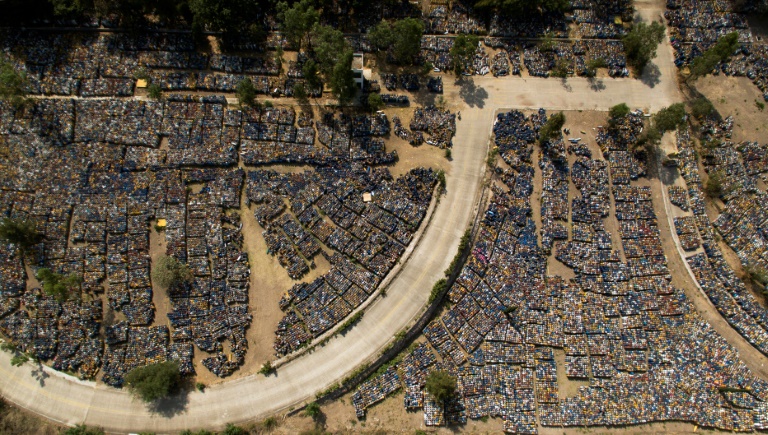
Thousands of disused gas cylinders sit outside under the sun at a former refinery in Mexico City, producing a foul smell that neighbors say has made their lives a nightmare.

Almost every night, Cesar Rivera and his wife leave their apartment because the odor becomes too much, the 37-year-old web programmer told AFP.

“The smell is so strong at night — so unbearable — that it’s like the stove isn’t turned off properly,” he said.

The couple also fear that the liquefied petroleum gas seeping from the cylinders — which are used by many households in Mexico City — will cause an explosion or make them sick.

“The building administration has asked us not to smoke or use the stove burners when the smell’s stronger. It has completely changed our lives,” said Rivera.

“It’s a time bomb,” he added.

Aerial images taken by AFP show what looks like a huge graveyard in the west of the capital, surrounded by residential districts.

But instead of human remains the disused refinery of state-owned oil giant Pemex has become the resting place of thousands of old multicolored gas cylinders.

Rivera said that he and his wife had suffered due to the smell for eight months, but only discovered in January what the source was.

– ‘Vomiting, headaches –

LP gas, made up mainly of butane and propane, is odorless so producers add mercaptan to give it a nauseating smell that allows it to be detected.

Although “the gases produced by its combustion are not toxic or carcinogenic” a leak can cause a build-up that “can be explosive and can suffocate people in small spaces,” Mexico’s National Commission for the Efficient Use of Energy says on its website.

The tanks were stored at the old refinery by the state firm Gas Bienestar, which was created in 2021 to expand competition in the sector, after exchanging old or damaged cylinders free of charge for new ones.

In January, the Mexico City authorities said in a statement that Pemex was in the process of removing them.

Contacted by AFP, the company said it was unable to give an interview about the matter.

Mexican civil protection authorities did not respond to a request for information about the risks posed by the cylinders.

According to Ricardo Torres, an expert at the National Autonomous University of Mexico, LP contributes to the formation of ozone, which at ground level is a harmful pollutant for people and the environment.

Firefighters at a nearby station said they receive daily reports of gas leaks, when in fact the odor comes from the disused tanks.

“We’ve gone to the former refinery, but they don’t see us,” says station chief Cesar Suarez.

Juan Macias, who runs a carpentry workshop next door to the old refinery, said that he now closes the windows in the afternoon despite the stifling heat.

“We feel like vomiting and have really bad headaches,” he said.

“The authorities say there’s nothing to worry about,” the 44-year-old added.

“But everyone here thinks there’s some danger, so we always take care not to light anything when it smells a lot for fear of an explosion,” he said.

Close Bitnami banner
Bitnami