US Business

Fleeing Russians help Uzbekistan chase IT dreams

Hit by regular power cuts and with popular sites like Twitter and TikTok blocked, the Central Asian nation of Uzbekistan hardly seems a likely candidate for a tech boom.

But with Russia’s invasion of Ukraine driving an exodus of IT specialists to former parts of the Soviet Union, authorities in Uzbekistan are hoping to speed up plans to modernise an economy best known for its vast production of cotton.

It took only one day after Russia’s February 24 invasion of Ukraine for Uzbekistan to launch a one-stop government relocation programme for IT specialists and companies. 

Offering visas, housing and child care support to individuals, and registration assistance and tax exemptions to companies, the programme has already attracted some 2,000 foreign IT specialists, the government said.

People like Anastasia Markova, a Russian citizen who recently became a public relations manager at Uzbekistan’s state-run IT Park in the capital Tashkent.

Markova, 22, had been due to be married in Russia in April, but left Moscow with her fiance — an employee of a company registered at the park — for Tashkent and the two are now seeking permanent residence.

Markova said she feels comfortable in the city, where Russian is still widely spoken three decades after Uzbekistan gained independence during the collapse of the Soviet Union.

“The country accepted us as one of their own. The people are so friendly and hospitable,” she said.  

– Thousands in IT leave Russia –

Markova was more keen to speak about her new home than the country she left behind, saying only that her decision to leave Russia had been “rushed, as it was for many people” and due to “a number of social and economic factors”.

Several other Russian citizens contacted by AFP after moving to Uzbekistan and neighbouring Kyrgyzstan refused to talk, saying they feared the consequences of potentially being seen as critical of Russia. 

The IT Park in Tashkent is home to some 550 companies and at the heart of plans to increase Uzbek IT exports to more $1 billion by 2028, a 25-fold rise from last year’s figure.

The park’s motto, “START local and GO Global” is emblazoned on a wood panel facade at the entrance. Inside, young support staff in casual attire and headsets work at desks. 

The IT Park is already seeing benefits from the relocation programme dubbed TashRush — “a name that seemed most suited to the phenomenon we are witnessing,” the park’s deputy director Bakhodir Ayupov said.

The Russian Association of Electronic Communications, a lobby group, said on March 22 that 50,000 to 70,000 specialists had left Russia and up to 100,000 more may follow them out of the door this month. 

For the moment, Uzbekistan is a less popular destination for departing Russian IT workers than Georgia, Turkey or Armenia.

Uzbekistan has lagged behind other ex-Soviet nations in developing the sector. The country has of late battled winter energy shortages, while power cuts are not uncommon, even in Tashkent.

– ‘Flywheel of repression’ 

But internet speed has “improved greatly” in Uzbekistan, driving a doubling of IT exports last year in comparison with 2020, Ayupov said.

In an apparent nod to business, Uzbek authorities last month lifted a long-term block on the Skype communications platform. 

Microblogging service Twitter, video-sharing platform TikTok and Russia’s most popular social network VKontakte remain blocked in the authoritarian republic of around 35 million people.

Despite these difficulties, some of the Russians who left said they would rather stick it out in Uzbekistan than return home.

Olga, a 42-year-old who moved to the historic Uzbek city of Samarkand with her husband immediately after the invasion, said she had fallen in love with the former Silk Road citadel and hoped her experience as a content curator for digital museums would help her find work.

“To begin with we thought we would be here for a few days, but we decided to stay longer. People who were complete strangers have been so good to us,” said Olga, who asked that she not be fully identified. 

She has no plans to return to Russia, where “the flywheel of repression is spinning and may be spinning for a long time to come,” she said. 

Samsung forecasts Q1 operating profit up 50.3% year-on-year

Samsung Electronics expects operating profits for the first quarter to rise 50.3 percent, the South Korean tech giant said in a statement Thursday, despite global supply chain woes.

The world’s biggest smartphone maker forecast 2022 first-quarter operating profits of about 14.1 trillion won ($11.6 billion), up from 9.4 trillion won in the same quarter last year.

Samsung did not provide details on the performance of its various divisions. The company is expected to release its full results on April 28.

Analysts said the forecast was likely driven by strong smartphone sales, but warned of an expected drop in profits in the memory chip division.

“Price decline in memory chips will be contained on the back of stronger than expected demand,” Kim Un-ho, an analyst at IBK Investment & Securities, said in a report.

Profits in Samsung’s mobile business are expected to soar by 55.8 percent compared with Q4 to over 4.1 trillion won, offsetting an anticipated six percent decline in profits from its memory chips division, the report said.

With memory chips now used in a wide-ranging array of devices and cloud servers — essential for remote working in the pandemic era — the sector has become less dependent on seasonally-driven demand for gadgets such as smartphones and laptops. 

Last year saw a surge in chip prices amid strong demand for those used in personal devices and data centres, helping Samsung hit record annual sales.

Going forward, Kim forecast the conglomerate would make 60.5 trillion won in operating profits for 2022 overall, a 17 percent increase on-year.

– Smartphone app –

But Samsung’s smartphones division was in hot water in its native South Korea recently over a pre-installed app called Game Optimizations Service on the latest Galaxy S phone lineup. 

Designed to fine-tune system performances, consumers claim it actually throttled the speed of thousands of non-gaming apps.

The issue forced Samsung’s vice chairman, Han Jong-hee, to apologise at a shareholders’ meeting last month, and prompted a class action by nearly 2,000 consumers seeking 300,000 won in compensation each.

But sales of its latest Galaxy S22 series are likely to exceed one million units in South Korea on Friday in the first six weeks of release, selling at a 20 percent faster pace than the previous S21 edition.

“It is a significant feat considering global supply chain woes,” Samsung said in a press release Wednesday.

While the coronavirus pandemic has wreaked havoc on the world economy, it has helped many tech companies boom.

The shift to working from home during the pandemic has boosted demand for devices powered by Samsung’s chips as well as home appliances such as televisions and washing machines.

The world’s biggest memory chip maker, Samsung Electronics has aggressively stepped up investment in its semiconductor business as the world battles chip shortages that have hit everything from cars and home appliances to smartphones and gaming consoles.

In November, it announced a new microchip factory in Texas, a $17 billion investment. The plant is expected to be operational by the end of 2024.

The firm is also investing in the development of advanced technologies such as artificial intelligence, robotics and 5G/6G communications.

Samsung Electronics is the flagship subsidiary of the giant Samsung group, by far the largest of the family-controlled empires known as chaebols that dominate business in South Korea.

The conglomerate’s overall turnover is equivalent to about one-fifth of South Korea’s gross domestic product.

Asia tracks Wall St losses as Fed prepares to tighten screws

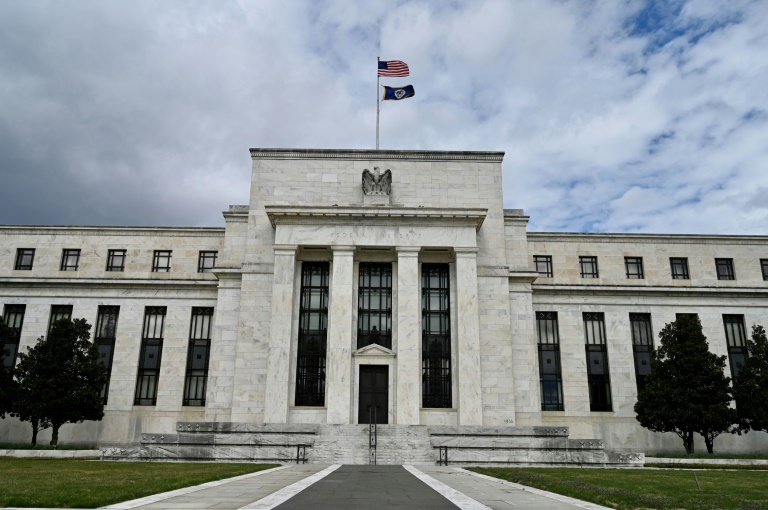
Asian equity markets fell Thursday after minutes from the Federal Reserve’s latest policy meeting indicated it is preparing to aggressively wind back its monetary policy, while oil prices bounced back from another big drop.

The eagerly awaited summary dealt another blow to traders, who have grown increasingly concerned that officials will not be able to rein in 40-year-high inflation while also preventing the world’s top economy from tipping into recession.

According to the minutes, several policymakers were in favour of lifting interest rates half a percentage point while they also talked about offloading their bond holdings at a rate of $95 million per month — a process known as quantitative tightening.

The Fed’s balance sheet runs to about $9 trillion. 

News that such measures were being considered comes after several members of the policy board made hawkish comments about lifting rates. The next meeting takes place May 3-4.

The prospect of borrowing costs rising at a quicker pace and to a higher level over the coming months has added to a wave of uncertainty across trading floors caused by the war in Ukraine.

And while data at the moment points to a healthy economy, commentators warn of possible hard times ahead.

“This job of orchestrating a soft landing (for the economy) is going to be difficult,” Tracie McMillion, at Wells Fargo Investment Institute, told Bloomberg Television.

“We’ve only seen quantitative tightening once before and it was to a lesser degree than it will be this time, and it ended shortly after it started.”

Wall Street tumbled for the second day in a row, with the Nasdaq again losing more than two percent, as tech firms are more susceptible to higher rates.

And Asia broadly followed suit, with Tokyo, Sydney, Seoul, Taipei, Singapore, Wellington and Manila all down.

Hong Kong and Shanghai fluctuated on hopes that China will move to ease monetary policy as its giant economy struggles under the weight of lockdowns in various parts of the country.

Authorities will step in to use tools at an “appropriate time”, according to the readout of a State Council meeting chaired by Premier Li Keqiang, adding they would also look at other ways to increase consumption. 

On oil markets, both main contracts enjoyed healthy gains a day after tanking more than five percent on concerns about demand caused by a possible economic slowdown.

The commodity had also been hit by an announcement from the International Energy Agency that it will release tens of millions of barrels to offset those lost through sanctions on Russia over its invasion of Ukraine.

And Stephen Innes of SPI Asset Management said: “China’s Omicron outbreak is spreading much faster than previous virus strains, and authorities, not ready to switch to a different strategy, are still trying to contain outbreaks by implementing strict controls.

“In light of that, oil traders continue to downgrade their mainland demand forecasts.”

– Key figures around 0230 GMT –

Tokyo – Nikkei 225: DOWN 2.0 percent at 26,803.34 (break)

Hong Kong – Hang Seng Index: DOWN 0.1 percent at 22,065.84

Shanghai – Composite: DOWN 0.3 percent at 3,272.12

Brent North Sea crude: UP 1.9 percent at $102.94 per barrel

West Texas Intermediate: UP 1.8percent at $97.94 per barrel

Euro/dollar: UP at $1.0910 from $1.0900 late Wednesday

Pound/dollar: UP at $1.3081 from $1.3071

Euro/pound: UP at 83.41 pence from 83.38 pence

Dollar/yen: DOWN at 123.63 yen from 123.79 yen

New York – Dow: DOWN 0.4 percent at 34,496.51 (close)

London – FTSE 100: DOWN 0.3 percent at 7,587.70 (close)

Streamers come of age after 'CODA' Oscar win

Almost buried by the attention surrounding The Slap at the Oscars was a historic first: a streaming film won best picture, taking Hollywood’s top prize from the legacy studios that have long dominated the town.

If Will Smith had not mounted the stage and hit Chris Rock, the best picture win for Apple TV+ crowd-pleaser “CODA” would have been the talk of Tinseltown ever since the Academy Awards.

“There was clearly going to be a streaming service break through that barrier. And I think it’s an important break,” said Kendall Phillips, a Syracuse University professor who specializes in pop culture.

“I do think it’s going to open up a much wider body of films to be taken more seriously by Academy voters.”

For months before the ceremony at the Dolby Theatre, streaming’s coming of age had appeared likely to be the main storyline from the 2022 Oscars.

The smart money for best picture was initially on arty Western “The Power of the Dog,” Jane Campion’s brooding meditation on toxic masculinity.

The film, starring Benedict Cumberbatch as a sexually repressed cowboy, was a Netflix title that the streamer — the biggest player on the small screen — had spent heavily to promote as it chased Hollywood’s ultimate stamp of approval.

But a late surge from “CODA” as audiences warmed to its charming cast of loveable characters — and its hopeful message of a deaf family overcoming  adversity — pushed it into the top slot.

– Money –

Streaming services first barged their way into Hollywood’s premier awards in 2017, when Amazon’s “Manchester by the Sea” bagged a best picture nomination.

It lost out to “Moonlight,” at the ceremony when “La La Land” was briefly and incorrectly announced as the year’s winner.

Netflix now has a growing stable of best picture nominations — including “Roma,” “The Irishman,” “Marriage Story,” “Mank,” “The Trial of the Chicago 7,” and “Don’t Look Up.” 

For the past three years, Netflix has snagged the most Oscar nominations of any distributor. This year alone it had 27, though only won one — best director for Campion.

Apple TV+, by contrast, received its first-ever Oscar nomination last year, and this year managed three wins from six nods.

Trade title Variety reported Apple had lavished more than $10 million on its Oscars campaign — about as much as it cost to make “CODA.”

Netflix spent heavily on its bid for Oscar glory — Los Angeles was awash for months with advertisements puffing its prize bull.

For some in the industry, all that money being thrown around was a little difficult to swallow.

“Everywhere you drive in LA you are faced with a billboard saying it’s ‘The Best Film of the Year,'” one anonymous director told Indiewire.

“If anyone is to blame for pushback it’s Netflix themselves for pushing really hard on the movie.”

– Modern-day Medicis –

There was off-the-record griping from some Academy members who felt they were unable to vote for a streaming movie because of a general distaste for the upstart format.

For a start, there’s a nostalgia for the medium.

Many moviemakers bemoan the solitary experience of watching on a small screen at home, and talk warmly of the joy of being in a dark cinema with scores of other movie lovers.

Kevin Costner emerged at the Oscars to award best director with an elegy to the artform (and some of the most eloquent speechifying of the night).

“Once I too was a boy, in that magic castle of story and narrative, my seat there in the flickering dark of imagination… projected phantoms painting portraits of poets past,” he waxed.

But, says Phillips of Syracuse University, audiences ultimately care about the content — and streamers are up to the task.

“It’s increasingly difficult to determine where [a film is] coming from, whether it’s a streaming service production, or big studio production. Those lines have probably blurred forever,” he said.

Audiences who went to see “CODA” during its limited run in movie theaters didn’t care who made it, he said.

“That boundary, where one side is the motion picture theater experience, and the other side is the at-home streaming experience, I think that boundary is probably never going to be reestablished, at least the way it was, for many decades.”

Increasingly, filmmakers themselves are less bothered about the distinction.

“Netflix is not what I would have wanted historically, but they’re a little like the Medicis of our time,” Campion told the Los Angeles Times last year, referring to the moneyed patrons that funded many of the best-known pieces of Renaissance art.

“The people at the top do love cinema; they want to see good things. When you’ve got a lot of money, beauty counts.”

Turkey fishermen fear mines in Black Sea

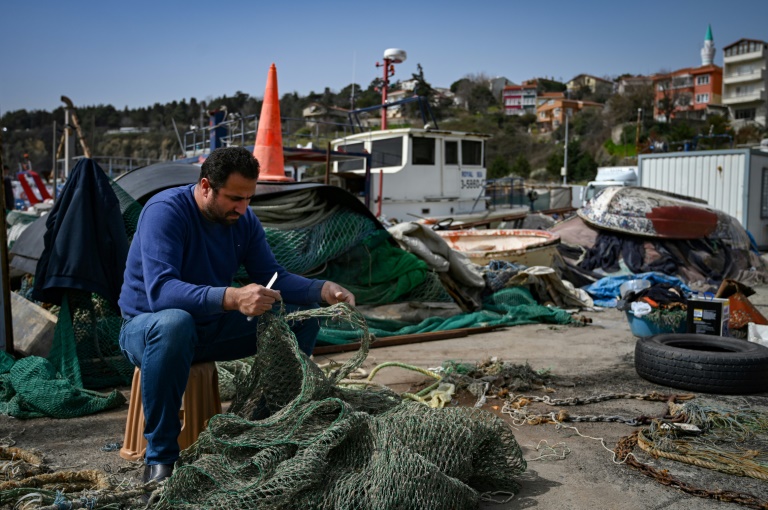
Turkish fisherman Sahin Afsut fears the worst: hitting a mine and “disappearing underwater in the blink of an eye”. 

Like many fishermen in Rumelifeneri, a village set on the rocks of the Bosphorus in northern Istanbul, Afsut and his team remain in port since the discovery of a drifting mine last month in the Black Sea. 

Fears grew after a second mine was found on March 28, which could have come from Ukraine where Russia launched an invasion in February.

A third stray mine was found Wednesday in the Black Sea off the town of Kefken in northwestern Turkey. 

Turkish authorities fear an accident and believe the mines became unmoored from the Ukrainian coast during storms. 

“If you hit (a mine), you’re finished,” says Afsut, wearing a grey cap in front of his small trawler from which he usually catches whiting, red mullet and anchovies. 

He did not see the first mine two kilometres (1.2 miles) offshore, first discovered by a local fisherman but several others described the scene.

“It was large, like half a barrel. We watched from above there, the (special Turkish navy) units neutralised it,” says 55-year-old Ahmet Tarlaci who has been a fisherman for 43 years.

– ’90 percent stopped’ –

The Turkish navy warned five days before the first was found on March 26 of the risk of mines coming from Ukrainian waters. 

But “the mines arrived quickly, even the Turkish armed forces were surprised,” Tarlaci says. 

The Russian defence ministry last week said 420 mines — 370 mines of them in the Black Sea — were placed by Ukraine to protect its coast but around 10 had broken off. 

Kyiv dismissed Moscow’s version of events, accusing the Russian navy of letting the mines wander to discredit Ukraine. 

At Rumelifeneri port, where around 100 boats, from small fishing boats to 40-metre (131-foot) trawler boats were waiting Friday, “90 percent of people that we know have stopped” going out to sea, says fisherman Sefki Deniz, 42. 

Turkish officials have banned fishing at night, and with the price of diesel reaching spectacular heights, many fishermen decided to end the fishing season three weeks ahead of time.

“We already have financial losses, there shouldn’t be any human losses,” says Deniz, wearing plastic boots and a blue fleece. 

The fisherman regrets the little information provided by officials who say they cannot reveal how many mines there are, where they came from or how dangerous they may be. 

“For the time being, (the mines) are not a problem, but we won’t let our guard down,” Turkish President Recep Tayyip Erdogan said Friday. 

“They speak now of 10 mines and what if the others wander off? The Black Sea is not a large sea, it’s like a lake,” says Deniz, despite 24-hour searches by minehunters in the area.

– ‘Never found their bodies’ – 

“Across from us, there is Ukraine, Russia: if the wind blows violently from the north, it’s only a question of time” before the mines arrive in Turkey’s waters, fears fishing captain Saban Ucar, 32. 

The 30-40 metre (98-foot to 131-foot) fishing boats “have radars, sonars… but the 9-10 metre boats only have binoculars,” he says from a building overlooking the port.

Ucar was not born at the time, but the memory is still vivid in the village of two accidents in the 1980s caused by mines dating back to World War II.

“There was one that exploded at the port in 1983, five people from the village died. And in 1989, it happened at sea while lifting a net, the mine exploded and so did the boat: four people died. 

“We never found their bodies,” says Deniz, one of the veterans at the port.

The fisherman now fears a mine will be able to make its way to the Bosphorus Strait used by 38,500 ships last year.

The strait, which crosses Istanbul, is in some places less than 700 metres (2,296 feet) wide. 

“At sea, the risk (of an accident) is 10 percent,” Deniz says, adding: “In the Bosphorus, it’s 100 percent.” 

Canada approves controversial Bay du Nord offshore oil project

Canada’s environment minister approved Wednesday a controversial offshore oil project expected to see 300 million barrels of oil extracted over 30 years — and to set back efforts to curb climate change.

In a statement, Steven Guilbeault said Norwegian firm Equinor’s proposed development of oil discoveries in the Flemish Pass Basin, some 500 kilometers (310 miles) east of St. Johns, Newfoundland, passed an environmental assessment.

That four-year review, the minister said, determined that the Bay du Nord project “is not likely to cause significant adverse environmental effects when mitigation measures are taken into account.”

“The project is therefore allowed to proceed with strict measures to protect the environment,” he said.

Canada is the world’s fourth largest oil producer.

The Bay du Nord project, which split Prime Minister Justin Trudeau’s Liberals and was widely seen as a test of the government’s resolve in tackling climate change and curtailing oil output, is expected to generate an estimated Can$3.5 billion in government revenue.

For Newfoundland province, which has the highest unemployment rate in the country, it also represents a much needed economic boost.

Ottawa set 137 binding conditions on the project, including incorporating reduced greenhouse gas emissions in its design, protecting fish habitat and air quality — which Guilbeault said represent “some of the strongest environmental conditions ever” applied in Canada.

But environmental groups immediately panned the decision, citing UN warnings to stop tapping new oil sources or risk irreversible and catastrophic climate impacts.

“Approving Bay du Nord is another leap towards an unlivable future,” Environmental Defence’s Julia Levin said in a statement. “The decision is tantamount to denying that climate change is real and threatens our very existence.”

– ‘Burning the planet’ –

Greenpeace Canada climate campaigner Patrick Bonin said fossil fuels need to be phased out as quickly as possible, and that the approval of Bay du Nord “only worsens the climate crisis and the global reliance on fossil fuels that are burning the planet.”

Even the New Democratic Party, a small leftist faction that recently agreed to prop up Trudeau’s minority government, accused the Liberals of caving to “their corporate buddies from the oil and gas sector instead of listening to climate scientists.”

“Under the Liberals we have the worst record of any G7 country when it comes to emissions reductions, and we are the only country who has increased emissions every single year,” the NDP said in a statement.

“With the approval of the Bay du Nord project, it’s difficult to imagine this record will improve,” it said.

The decision on the project had twice been delayed, after the Trudeau government last year enhanced its Paris Agreement target to reduce carbon emissions by 40-45 percent from 2005 levels by 2030.

Guilbeault, a former eco-warrior picked by Trudeau to guide Canada’s climate policy, said the floating oil rig’s emissions are expected to produce five times less emissions than the average Canadian oil project and incorporate new technologies.

He said it fits within Ottawa’s climate strategy and “is an example of how Canada can chart a path forward on producing energy at the lowest possible emissions intensity while looking to a net-zero future.”

In an interview with public broadcaster CBC, Guilbeault touted the stringent emissions controls imposed on Bay du Nord while adding: “The world still needs oil.”

West ramps up sanctions as Russia threatens Ukraine's east

The United States and Britain announced new sanctions against Russia Wednesday after Ukraine said hundreds of civilians were found dead around its capital, as Kyiv warned residents in the east to get out “now” ahead of a feared assault.

The White House unveiled measures targeting Russia’s top banks and two daughters of President Vladimir Putin, while Britain sanctioned two banks — and vowed to eliminate all Russian oil and gas imports by year-end.

Their actions followed an international outcry as Ukraine said its forces found hundreds of civilians dead around Kyiv, including the town of Bucha, after the pullout of Russian troops.

“They burned families. Families. Yesterday we found again a new family: father, mother, two children. Little, little children, two. One was a little hand, you know,” Ukraine President Volodymyr Zelensky said Wednesday.

In Washington, US President Joe Biden joined in describing the horrors in Bucha.

“Civilians executed in cold blood, bodies dumped into mass graves, the sense of brutality and inhumanity left for all the world to see, unapologetically,” Biden said.

“There’s nothing less happening than major war crimes,” he added, urging the world to hold the killers accountable.

The Kremlin denies responsibility and has claimed Kyiv staged civilian deaths — with Putin on Wednesday accusing Ukrainian authorities of “crude and cynical provocations” in Bucha.

The Russian withdrawal from areas around Kyiv and the north is part of a shift towards Ukraine’s southeast, in a bid to create a land bridge between occupied Crimea and Moscow-backed separatist statelets in the Donbas region.

Ukraine Deputy Prime Minister Iryna Vereshchuk on Wednesday warned residents in the eastern Kharkiv, Lugansk and Donetsk regions to leave immediately ahead of a feared Russian attack.

“It has to be done now because later people will be under fire and face the threat of death,” she wrote on Telegram.

The threat was already very real in the industrial city of Severodonetsk, the easternmost city held by Ukrainian forces, where shells and rockets were landing at regular intervals on Wednesday.

“We have nowhere to go, it’s been like this for days,” one of them, 38-year-old Volodymyr, told AFP standing opposite a burning building.

Elsewhere, preparations for the feared attack were hard under way, such as on a two-lane highway through the rolling eastern plains connecting Kharkiv and Donetsk.

Trench positions were being dug, and the road was littered with anti-tank obstacles. Nearby water reservoirs had been opened and bridges were being destroyed, all in an effort to slow any Russian advance.

“We’re waiting for them!” said a lieutenant tasked with reinforcing the positions, giving a thumbs up.

– ‘Leaving forever’ –

Thousands of people have been killed and more than 11 million displaced since Russia invaded Ukraine on February 24.

In Bucha, where Ukrainian officials blame Russian forces for carrying out a “massacre,” residents were desperate to know the fate of their loved ones.

But Tetiana Ustymenko knows the conclusion to her story. Her son and his two friends were gunned down in the street, and she buried them in the garden of the family home. 

“How can I live now?” she said.

Meanwhile efforts to evacuate civilians continued Wednesday, with a Red Cross convoy arriving in the southern city of Zaporzhzhia.

It was carrying hundreds of evacuees from Russian-occupied areas, but had failed to reach the besieged port of Mariupol. 

One of the evacuees, Iryna Nikolaienko, told how she had been able to make her way out of Mariupol during a pause in the fighting.

“The Mariupol that I knew and loved, it does not exist anymore,” she said.

“I understood that I was leaving forever.”

– EU ‘indecisiveness’ –

Western powers have already pummelled Russia with debilitating economic sanctions, which forced Moscow on Wednesday to make foreign debt payments on dollar-denominated bonds in rubles, raising the prospect of a potential default.

Washington’s new sanctions targeted Maria Vorontsova and Katerina Tikhonova, two adult daughters of Putin, plus the wife and daughter of Foreign Minister Sergei Lavrov and members of Russia’s Security Council.

The White House also declared “full blocking” sanctions on Russia’s largest public and private financial institutions, Sberbank and Alfa Bank, and said all new US investment in Russia was now prohibited.

Britain meanwhile froze the overseas assets of both Sberbank and Credit Bank of Moscow. 

The EU is also poised to implement a fifth round of sanctions cutting off Russian coal imports — and European Council chief Charles Michel said that “sooner or later”, it must also impose oil and gas sanctions.

And rich countries will tap an additional 120 million barrels of oil from emergency reserves in a bid to calm crude prices that have soared following the invasion.

But addressing the Irish parliament Wednesday, Ukraine’s Zelensky condemned the “indecisiveness” of European nations dependent on Russian energy.

In other moves to isolate Moscow, the US and Britain have pressed to have Russia excluded from the UN Human Rights Council, with a vote in the General Assembly scheduled for Thursday.

But US Secretary of State Antony Blinken admitted there was little anyone could do about Russia’s position on the UN Security Council, where it has a veto.

“There’s a pretty fundamental problem there,” he said, a day after Zelensky called for Russia to be expelled from the council.

– ‘Unbelievable’ morale –

Peace talks between the sides have so far gone nowhere.

Moscow says it is “ready” to continue — however NATO chief Jens Stoltenberg said there was no sign Putin had dropped “his ambition to control the whole of Ukraine”.

Spirits are high yet in Kyiv, however, said American veteran Steven Straub, who has been training with the national guard in the capital.

Straub, 73, fought during the Vietnam war, and said Ukraine was “much different.”

“What surprised me here is the morale… It’s unbelievable,” he told AFP. 

burs-st/mlm

World stock markets beat retreat with all eyes on Fed

Global equities sank Wednesday and oil prices retreated as Federal Reserve meeting minutes added to expectations for aggressive central bank monetary tightening.

Several US Federal Reserve officials supported raising interest rates by half a percentage point in the future to combat inflation, according to minutes of the central bank’s meeting last month.

Officials also discussed lowering their bond holdings by a total of $95 million per month as soon as the upcoming May 3-4 meeting, according to the minutes.

The disclosures added to a stream of hawkish commentary from Fed officials, exacerbating worries that the central bank’s efforts to rein in prices could harm economic growth.

“The markets remain unnerved by the economic implications of a highly aggressive Fed and a potential policy mistake,” Charles Schwab investment bank said in a note.

Wall Street tumbled for a second straight session, with the S&P 500 losing one percent and large tech equities like Amazon, Facebook parent Meta and Microsoft all shedding more than three percent.

Earlier, Asian and European bourses retreated, while the euro hit a one-month low. 

“Investor confidence might have improved from the low point in early March when the Ukraine war was unfolding,” said AJ Bell investment director Russ Mould. 

“However, there remain significant headwinds for equities and the latest trouble spot is what the Federal Reserve might do to curb inflation.”

Worries about a potential slowing of the economy due to higher interest rates also weighed on oil prices, which dropped more than five percent.

Analysts also pointed to an announcement from the International Energy Agency outlining plans to release crude stockpiles after Russia’s invasion of Ukraine destabilized oil markets.

Data from the US Energy Information Administration also showed a surprise build in crude inventories.

“It seems that the concerns are a little bit of weakness in demand short term, which is raising concerns of some demand destruction, along with the Federal Reserve minutes today,” said Phil Flynn, analyst at the Price Futures Group.

The retreat in crude prices came as Democrats in the US Congress pressed CEOs from ExxonMobil, Chevron and other oil giants on the reasons for spiking gasoline prices.

Oil executives rejected suggestions they had withheld supply to drive up prices and said they are in the process of increasing investments in response to higher commodity prices.

– Key figures around 2100 GMT –

New York – Dow: DOWN 0.4 percent at 34,496.51 (close)

New York – S&P 500: DOWN 1.0 percent at 4,481.15 (close)

New York – Nasdaq: DOWN 2.2 percent at 13,888.82 (close)

London – FTSE 100: DOWN 0.3 percent at 7,587.70 points (close)

Frankfurt – DAX: DOWN 1.9 percent at 14,151.69 (close) 

Paris – CAC 40: DOWN 2.2 percent at 6,498.83 (close) 

EURO STOXX 50: DOWN 2.4 percent at 3,824.69 (close)

Tokyo – Nikkei 225: DOWN 1.6 percent at 27,350.30 (close)

Hong Kong – Hang Seng Index: DOWN 1.9 percent at 22,080.52 (close)

Shanghai – Composite: FLAT at 3,283.43 (close)

Brent North Sea crude: DOWN 5.2 percent at $101.07 per barrel

West Texas Intermediate: DOWN 5.6 percent at $96.23 per barrel

Euro/dollar: DOWN at $1.0900 from $1.0905 late Tuesday

Pound/dollar: DOWN at $1.3071 from $1.3074

Euro/pound: DOWN at 83.38 pence from 83.41 pence

Dollar/yen: UP at 123.79 yen from 123.60 yen

burs-jmb/cs

Good times: Luxury watchmakers face soaring demand

Times have been so good for luxury watchmakers that they are running behind demand, forcing some to delay the release of new collections and others to invest more in production capacity.

After the pandemic severely hit the global economy in 2020, the sector enjoyed a spectacular recovery last year and started 2022 with a bang, though Russia’s war in Ukraine created new uncertainties.

Watches were the best performing business for French luxury group Hermes, with sales soaring by 73 percent last year.

“We had an extraordinary year in the watches business,” Hermes vice president Guillaume de Seynes told AFP at Watches and Wonders in Geneva this week, one of the industry’s biggest annual showcases.

“We can feel a very strong dynamic for watchmaking everywhere in the world,” he said, adding that there was hot demand for a men’s watch model last year.

“We could have even sold more if we had been able to make more,” de Seynes said, noting that watchmakers face a “demand phenomenon that exceeds production capacity.”

His priority for 2022 is to invest in production. 

– Solid year –

The Oris brand also had “a very strong year”, said its chief executive, Rolf Studer.

Oris watches range between 1,800 and 7,200 Swiss francs ($1,928 and $7,710 or 1,767 euros and 7,064 euros).

The company had to delay the launch of a new collection in the higher price range because it did not produce enough watch movements — their internal mechanisms — in its workshops.

The watch was supposed to come out last summer but it is only launching now.

“We planned too conservatively,” Studer said.

“So we decided to keep the movements for the watches that were already out instead of launching new models and not be able to supply existing models already on the market,” he added.

Swiss watch exports rebounded last year, rising by 31.2 percent after a 21.8-percent contraction in 2020, when countries closed borders and went into strict Covid lockdowns.

Exports have not only exceeded pre-pandemic levels, they beat their 2014 record, too.

They went up by almost 16 percent in the first two months of this year, according to industry data, though the recovery has been seen only in watches worth more than 3,000 Swiss francs.

– Wait list –

The sector is now bracing for the fallout from the war in Ukraine and sanctions on Russia, which has a sizeable rich client base.

But the industry can rely on long wait lists for higher-end timepieces.

“Since we didn’t have enough watches for other markets, we will sell those that won’t be delivered to Russia elsewhere,” Edouard Meylan, CEO of H. Moser & Cie., told AFP.

All of his 2022 production is already pre-sold to retailers and partly pre-paid by final customers.

H. Moser only makes 2,000 watches per year at an average price of 45,000 Swiss francs. The watchmaker is even rejecting orders for timepieces that require a more than two-year wait.

“There’s uncertainty that can be created in other markets, particularly financial markets,” Meylan said.

“But we would have to have a big crash for an independent brand like ours to be affected,” he added.

'Amazon, here we come': Biden cheers US union drive

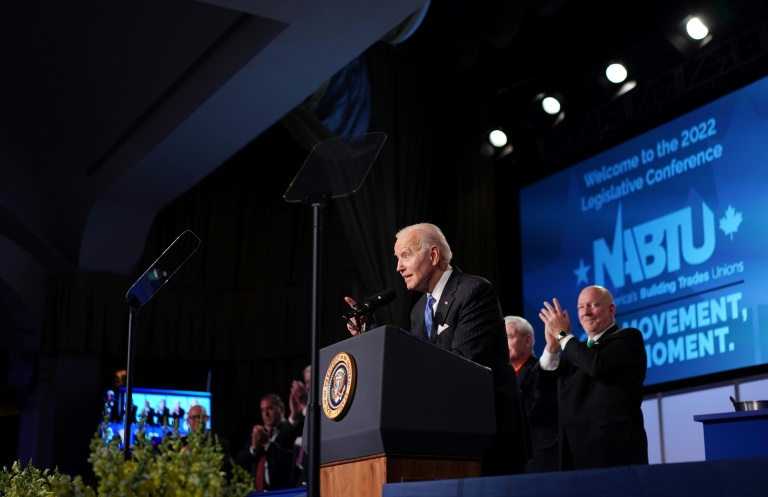
President Joe Biden sang praises for organized labor once again Wednesday, hailing last week’s triumph by union backers at Amazon as a sign of what is possible throughout the United States.

“That’s what unions are about in my view, by providing dignity and respect for people who” work hard, the US president said during a speech to a construction workers union.

The Democratic president, a self-professed “union guy,” alluded to his White House task force on union organizing to “make sure the choice to join a union belongs to workers alone,” Biden said.

“By the way: Amazon, here we come!”

The remarks came after Friday’s landmark ballot in which workers at a New York warehouse voted to establish the first  US union at Amazon.

Close Bitnami banner
Bitnami