US Business

Turkish inflation hits fresh record at 61.1 percent

Turkey’s inflation has soared to a new record, official data showed Monday, as analysts see an impact from Russia’s invasion of Ukraine and President Recep Tayyip Erdogan’s unorthodox interest rate policy.

Exacerbating a cost of living crisis, consumer prices accelerated to 61.14 percent at an annual rate, up from 54.4 percent in February, according to the statistics agency.

The weakening lira and runaway inflation have become major sources of public discontent in Turkey as President Recep Tayyip Erdogan faces an election next year.

Turkey has recorded double digit inflation since early 2017 but the latest figure is the highest since the ruling Justice and Development Party (AKP) came to power in 2002.

The currency was stable following the latest inflation data, trading at 14.7 lira against the dollar and 16.2 lira against euro.

The war in Turkey’s Black Sea neighbourhood has had a major impact on the country as Russia is a key supplier of energy while Ukraine ships wheat. Turkish tourism industry also mainly relies on Russian tourists. 

On Friday, S&P global rating agency kept a negative outlook on Turkey and cut its credit rating. 

“The fallout of the Russia-Ukraine military conflict, including rising food and energy prices, will further weaken Turkey’s already tenuous balance of payments and exacerbate inflation,” it said.

The biggest price increases in March were in transportation and food prices, according to the statistics agency.

-‘Be patient’-

While countries around the world are facing rising inflation as energy prices have soared while economies emerge Covid restrictions, Turkey’s problems have also been affected by Erdogan’s unorthodox economic approach. 

The Turkish leader rejects the idea that inflation should be fought by hiking the main interest rate, which he believes causes prices to grow even higher — the exact opposite of conventional economic thinking.

Turkish central bank “policies are just not working in countering inflation,” said Timothy Ash, emerging markets strategist at BlueBay Asset Management. 

“Indeed, I think the overwhelming consensus is that the unorthodox policy settings of the CBRT (central bank) are a major cause of inflation,” he said in a note to clients.

“The war in Ukraine is just making things that much worse.”

On Saturday, Erdogan said increase in food and energy prices triggered by the war in Ukraine “is affecting us too.”

“We are fighting against those who are charging unreasonably high prices,” he said. 

“There are problems we need to address … I ask you to be patient and trust us,” in reference to people squeezed by the biting inflation. 

In January, Erdogan changed the head of the state statistics agency.

Turkish media reported that he was unhappy with the inflation figures it published while the opposition believes that the official figures grossly underestimate the reality.

Jason Tuvey, senior emerging markets economist at the London-based Capital Economics, said inflation was likely to rise further over the coming months and stay close to the current high rates for much of this year.

“But there is still little sign that the central bank and, crucially, President Erdogan are about to shift tack and hike interest rates,” he said. 
Markets mostly up on US jobs data but rate worries linger

Asian markets mostly rose Monday as another strong jobs report provided some reassurance that the recovery in the US economy remained on track, though it also solidified expectations for more aggressive Federal Reserve interest rate hikes.

The gains were helped by another recent drop in oil prices after the 31-nation International Energy Agency agreed to tap its vast reserves to offset the removal of Russian exports, while the start of a ceasefire in Yemen eased concerns over supplies from the region.

Officials said Friday that the world’s top economy added 431,000 positions in March while the unemployment rate fell to just slightly above pre-pandemic levels. 

The figures showed that while inflation has surged to a 40-year high and the Ukraine war has fanned uncertainty, the recovery continues.

The economy’s resilience will be taken as further evidence that it could withstand a sharper rise in interest rates to bring prices under control, with many observers now predicting a half-point hike in May.

However, expectations that rates will continue to go up have seen Treasury yields surge, with commentators saying there were warning signs that growth will slow as the year progresses.

“It would not be surprising to see yields rise further from here and it is very hard to know where they will land,” Angela Ashton, of Evergreen Consultants, noted.

“Markets are volatile and there is every chance they will overshoot.”

A positive close on Wall Street was followed by a broadly upbeat start to the week in Asia.

Hong Kong led gains, jumping more than two percent thanks to a rally in tech firms after Beijing removed a rule preventing US authorities from inspecting the audits of Chinese companies listed in New York.

The announcement came after a drawn-out row between the two countries with Washington saying Chinese firms could be delisted by 2024 if they do not comply with audit requirements. 

The demand put at risk more than 200 companies, including e-commerce titans Alibaba and JD.com and Tencent.

Tokyo, Singapore, Sydney, Mumbai, Seoul, Manila, Jakarta and Bangkok also rose, though Wellington struggled.

London rose at the open, though Paris and Frankfurt dipped.

Shanghai and Taipei were closed for a holiday.

Crude bounced after Friday’s losses, responding to the IEA pledge to dip into stockpiles to shore up tight supplies caused by Russia’s invasion of Ukraine.

The grouping made the promise at an emergency ministerial meeting, having already announced last week a plan to release more than 60 million barrels.

That came a day after US President Joe Biden said he would release a record 180 million barrels onto the market over six months.

Meanwhile, there was also some cheer from news of a 60-day ceasefire in Yemen’s six-year civil war, which has seen several attacks on Saudi facilities that have hit output from the world’s biggest producer.

Still, analysts said that while markets equity and crude markets have shown some stability after the wild swings seen at the start of the Ukraine war, uncertainty continued to act as a drag and traders remained nervous.

“Risk sentiment over the past week has been inconsistent,” said SPI Asset Management’s Stephen Innes.

“Market signals could be characterised by a repetitive cat-and-mouse game whereby headlines initially emerge around the progress in ceasefire talks before being typically walked down by Russian officials who deny the odds of any close peace deal.”

– Key figures around 0810 GMT –

Tokyo – Nikkei 225: UP 0.3 percent at 27,736.47 (close)

Hong Kong – Hang Seng Index: UP 2.1 percent at 22,502.31 (close)

Shanghai – Composite: Closed for a holiday

London – FTSE 100: UP 0.3 percent at 7,557.60

Brent North Sea crude: UP 1.1 percent at $105.51 per barrel

West Texas Intermediate: UP 1.1 percent at $100.33 per barrel

Euro/dollar: DOWN at $1.1028 from $1.1049 late Friday

Pound/dollar: UP at $1.3125 from $1.3118

Euro/pound: DOWN at 84.02 pence from 84.24 pence 

Dollar/yen: UP at 122.58 yen from 122.49 yen

New York – Dow: UP 0.4 percent at 34,818.27 (close)

Markets mostly up on US jobs data but rate worries linger

Asian markets mostly rose Monday as another strong jobs report provided some reassurance that the recovery in the US economy remained on track, though it also solidified expectations for more aggressive Federal Reserve interest rate hikes.

The gains were helped by another recent drop in oil prices after the 31-nation International Energy Agency agreed to tap its vast reserves to offset the removal of Russian exports, while the start of a ceasefire in Yemen eased concerns over supplies from the region.

Officials said Friday that the world’s top economy added 431,000 positions in March while the unemployment rate fell to just slightly above pre-pandemic levels. 

The figures showed that while inflation has surged to a 40-year high and the Ukraine war has fanned uncertainty, the recovery continues.

The economy’s resilience will be taken as further evidence that it could withstand a sharper rise in interest rates to bring prices under control, with many observers now predicting a half-point hike in May.

However, expectations that rates will continue to go up have seen Treasury yields surge with commentators saying there were warning signs that growth will slow as the year progresses.

“It would not be surprising to see yields rise further from here and it is very hard to know where they will land,” Angela Ashton, of Evergreen Consultants, noted.

“Markets are volatile and there is every chance they will overshoot.”

A positive close on Wall Street was followed by a broadly upbeat start to the week in Asia.

Hong Kong led gains thanks to a rally in tech firms after Beijing removed a rule preventing US authorities from inspecting the audits of Chinese companies listed in New York.

The announcement came after a drawn-out row between the two countries with Washington saying Chinese firms could be delisted by 2024 if they do not comply with audit requirements. 

The demand put at risk more than 200 companies, including e-commerce titans Alibaba and JD.com and Tencent.

Tokyo, Singapore, Sydney, Mumbai, Seoul, Manila, Jakarta and Bangkok also rose, though Wellington struggled.

London, Paris and Frankfurt all rose at the open.

Shanghai and Taipei were closed for a holiday.

Crude bounced after Friday’s losses, responding to the IEA pledge to dip into stockpiles to shore up tight supplies caused by Russia’s invasion of Ukraine.

The grouping made the promise at an emergency ministerial meeting, having already announced last week a plan to release more than 60 million barrels.

That came a day after US President Joe Biden said he would release a record 180 million barrels onto the market over six months.

Meanwhile, there was also some cheer from news of a 60-day ceasefire in Yemen’s six-year civil war, which has seen several attacks on Saudi facilities that have hit output from the world’s biggest producer.

Still, analysts said that while markets equity and crude markets have shown some stability after the wild swings seen at the start of the Ukraine war, uncertainty continued to act as a drag and traders remained nervous.

“Risk sentiment over the past week has been inconsistent,” said SPI Asset Management’s Stephen Innes.

“Market signals could be characterised by a repetitive cat-and-mouse game whereby headlines initially emerge around the progress in ceasefire talks before being typically walked down by Russian officials who deny the odds of any close peace deal.

– Key figures around 0720 GMT –

Tokyo – Nikkei 225: UP 0.3 percent at 27,736.47 (close)

Hong Kong – Hang Seng Index: UP 1.8 percent at 22,443.36

Shanghai – Composite: Closed for a holiday

London – FTSE 100: UP 0.4 percent at 7,566.36

Brent North Sea crude: UP 0.9 percent at $105.37 per barrel

West Texas Intermediate: UP 0.9 percent at $100.20 per barrel

Euro/dollar: DOWN at $1.1039 from $1.1049 late Friday

Pound/dollar: UP at $1.3129 from $1.3118

Euro/pound: DOWN at 84.08 pence from 84.24 pence 

Dollar/yen: UP at 122.67 yen from 122.49 yen

New York – Dow: UP 0.4 percent at 34,818.27 (close)

Pipe dreams: Pakistan sewage workers hope for better future

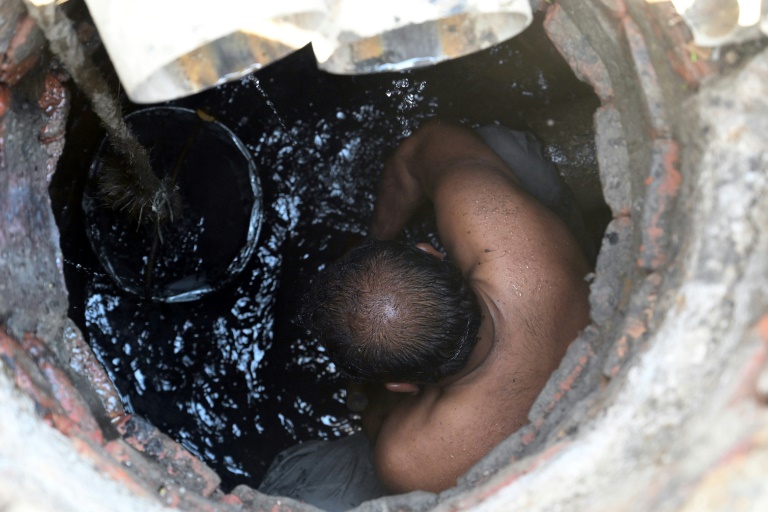
Nearly naked and covered with a black, foul-smelling muck, Shafiq Masih struggles out of a sewer he has just cleaned by hand in an upmarket district of Lahore, Pakistan’s second biggest city.  

Every day the 44-year-old descends into the city’s sewers, braving toxic gases emitted by excrement, pollutants and other waste, to manually unblock the drains of the city.

“When someone goes down, they have to sacrifice all self-respect,” he told AFP.

“People go to the toilet, flush the toilet, and all the dirt gets dumped on us.”

Like the vast majority of sanitation workers in Pakistan, Shafiq is a Christian, and doing a job that comes with strong social stigma — one considered impure by many Muslims.

Even in death there is no dignity.

In 2017 Muslim doctors sparked outrage and protests in Umerkot when they refused to treat a Christian sewage worker overcome by toxic gases, saying they could not touch his soiled body because they had to remain pure during Ramadan.

– Caste discrimination –

Most Christians in Pakistan are descendants of lower-caste Hindus who converted during the British colonial era in the hope of escaping a system that frequently forced them into a life of toil almost from birth.

They make up less than two percent of the population, but occupy more than 80 percent of jobs involving refuse collection, sewage work and street sweeping, according to figures cited regularly by the National Human Rights Commission (NHRC).

The remainder are filled mostly by Hindus, another tiny community in the Muslim-majority nation.

Even though the caste system doesn’t officially exist in Pakistan, it persists in these occupations, experts say. 

The word “chuhra”, traditionally used to describe those working in the sanitation industry — and considered extremely derogatory — is now synonymous with being a Christian.

Institutionalised discrimination is also rampant: some job adverts from public bodies have specified menial cleaning jobs are reserved for “non-Muslims”, with the Centre for Law and Justice, a local NGO, identifying nearly 300 such announcements over the past decade.

The NCHR has recently launched a campaign to protest against this practice.

– Immense risks –

Like much of Pakistan, the drains in Lahore — a city of 11 million — are routinely unclogged with a long bamboo stick. If this doesn’t work, someone has to go in.

For doing this, and after 22 years of service, Shafiq receives just 44,000 rupees ($240) a month — still, almost double the salary of street sweepers and garbage collectors.

But the associated risks are immense with infections including tuberculosis and hepatitis common, as well as skin and eye diseases.

Accidents also happen frequently.

At least ten people have died since 2019 in Pakistani sewers, according to the Centre for Law and Justice (CLJ), a local NGO which says the figures are probably far higher than reported.

In October in Sargodha, two Christian sewage workers died rescuing a third who had been forced by his Muslim supervisors to enter a sewer he knew to be full of poisonous gas.

Their families filed a complaint of criminal negligence — a first in Pakistan — but agreed to an out-of-court settlement.

“When you go to work, you are never sure you will get home,” said Shahbaz Masih, 32, who was once overcome by fumes in the sewer before being revived in hospital.

– State exploitation –

Industry insiders say companies responsible for the city contracts take advantage of worker illiteracy and disorganisation to pay them monthly salaries of under 10,000 rupees (50 euros) — less than half the legal minimum.

“The state is directly responsible for this exploitation,” says Mary James Gill, a Pakistani lawyer and politician who heads the CLJ and received the 2021 Human Rights Award from France for her “Sweepers are Superheroes” campaign.

“From their recruitment to their death, we have clear and undeniable evidence that they are discriminated against by society and the state.”

Gill says there is a vicious circle, with poverty preventing many Christians from providing an education for their children, who have no choice but to turn to the same occupation.

Shafiq knows that he is not about to be promoted and leave the sewers.

Still, every day he “thanks God for another day to live”.

Asian markets mixed as strong US jobs data boosts rate hike bets

Asian markets were mixed Monday as another strong jobs report provided some reassurance that the recovery in the US economy remained on track but also solidified expectations for more aggressive Federal Reserve interest rate hikes.

The gains were helped by another drop in oil prices after the 31-nation International Energy Agency agreed to tap its vast reserves to offset the removal of Russian exports, while the start of a ceasefire in Yemen eased concerns over supplies from the region.

Officials said Friday that the world’s top economy added 431,000 positions in March while the unemployment rate fell to just slightly above pre-pandemic levels. 

The figures showed that while inflation has surged to a 40-year high and the Ukraine war has fanned uncertainty, the recovery continues.

The economy’s resilience will be taken as further evidence that the economy could withstand a sharper rise in interest rates to bring prices under control, with many observers now predicting a half-point hike in May.

However, expectations that rates will continue to go up have seen Treasury yields surge with commentators saying there were warning signs that growth will slow as the year progresses.

“It would not be surprising to see yields rise further from here and it is very hard to know where they will land,” Angela Ashton, of Evergreen Consultants, noted.

“Markets are volatile and there is every chance they will overshoot.”

A positive close on Wall Street was followed by a broadly upbeat start to the week in Asia.

Hong Kong led gains thanks to a rally in tech firms after Beijing removed a rule preventing US authorities from inspecting the audits of Chinese companies listed in New York.

The announcement came after a drawn-out row between the two countries with Washington saying Chinese firms could be delisted by 2024 if they do not comply with audit requirements. 

The demand put at risk more than 200 companies including ecommerce titans Alibaba and JD.com and Tencent.

Singapore, Sydney and Seoul also rose, though Tokyo, Manila and Jakarta struggled.

Crude extended Friday’s losses — with WTI holding below $100 — after IEA members including the United States, Japan the European Union pledged to dip into stockpiles to shore up tight supplies caused by Russia’s invasion of Ukraine.

The grouping made the promise at an emergency ministerial meeting, having already announced last week a plan to release more than 60 million barrels.

That came a day after Joe Biden said he would release a record 180 million barrels onto the market over six months.

Meanwhile, there was also some cheer from news of a 60-day ceasefire in Yemen’s six-year civil war, which has seen several attacks on Saudi facilities that have hit output from the world’s biggest producer.

Still, analysts said that while markets equity and crude markets have shown some stability after the wild swings seen at the start of the Ukraine war, uncertainty continued to act as a drag and traders remained nervous.

“Risk sentiment over the past week has been inconsistent,” said SPI Asset Management’s Stephen Innes.

“Market signals could be characterised by a repetitive cat-and-mouse game whereby headlines initially emerge around the progress in ceasefire talks before being typically walked down by Russian officials who deny the odds of any close peace deal.

– Key figures around 0230 GMT –

Tokyo – Nikkei 225: DOWN 0.1 percent at 27,626.77 (break)

Hong Kong – Hang Seng Index: UP 1.2 percent at 22,297.32

Shanghai – Composite: Closed for a holiday

Brent North Sea crude: DOWN 0.4 percent at $104.00 per barrel

West Texas Intermediate: DOWN 0.3 percent at $99.01 per barrel

Euro/dollar: UP at $1.1051 from $1.1049 late Friday

Pound/dollar: DOWN at $1.3112 from $1.3118

Euro/pound: UP at 84.28 pence at 84.24 pence 

Dollar/yen: UP at 122.61 yen from 122.49 yen

New York – Dow: UP 0.4 percent at 34,818.27 (close)

London – FTSE 100: UP 0.3 percent at 7,537.90 (close)

Ukraine war sows more turmoil for UK farms

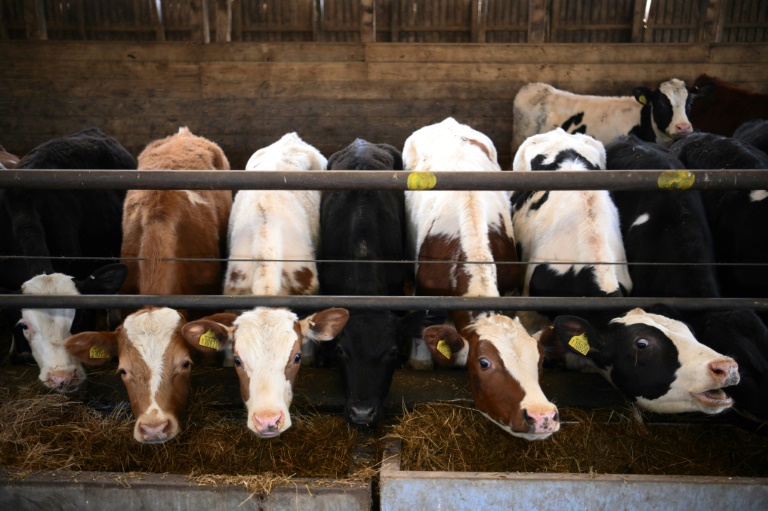
Hungry cows at Westons Farm jostle for position at the feeding trough, blissfully unaware that Ukraine’s war has sowed more turmoil for UK farms ploughing through Covid and Brexit fallout.

Westons — based in the picturesque village of Itchingfield in southern England — uses excrement from the farm’s cattle, chickens, pigs and sheep to fertilise arable crops like carrots, pumpkins, spinach and wheat.

The agriculture sector, like large swathes of the UK economy, is grappling with sky-high energy prices following pandemic lockdowns and labour shortages in the wake of Britain’s exit from the European Union.

Now, Moscow’s invasion of Ukraine has fuelled rocketing prices for fertiliser because Russia is a major producer.

Farms like Westons have therefore become more and more reliant on animal slurry to grow crops and cut costs.

“The thing that’s really concerning us as farmers are the multiple issues that are coming our way all at once,” the farm’s owner David Exwood told AFP as he fed the cattle.

There is the “high fertiliser price, we have a high fuel price, we’ve got a shortage of labour, and we’ve got regulatory change”, said Exwood, who is also vice-president of the National Farmers’ Union (NFU).

Fertiliser prices in the UK have soared almost fourfold over the past year, sector data show.

The nutrient-rich material was already in short supply after surging gas prices forced leading UK manufacturer, CF Fertilisers, to pause production in September.

Six months later, the Ukraine war sent fertiliser prices hurtling even higher.

Wheat hit recent record peaks because sanctions-hit Russia is a key producer alongside Ukraine.

– Staff shortages –

Meanwhile, worsening labour shortages, sparked by Brexit and exacerbated by Covid, are particularly acute in Britain’s agricultural sector.

The industry had 500,000 job vacancies in September, according to NFU data.

Visa issues and Covid restrictions have caused many farm workers to return abroad, notably including many European lorry drivers.

Britain’s departure from the European Union at the start of last year formalised Brexit.

“The lack of labour has meant that crops… have gone unpicked and are rotting away in fields,” said Jack Ward, chief executive of the British Growers’ Association.

The British Meat Packing Association has expressed similar troubles.

“Our main concerns are the lack of staff able to process (carcasses) in the UK,” it noted.

Thousands of pigs have been culled because of a chronic lack of butchers in abattoirs.

“UK pigs are being killed, incinerated and not entering the food chain,” said farmer Andrew Ward, who grows wheat in Leadenham in central England.

“We have pig farmers going out of business, but imports of pig meat have gone up 20 percent in the last six months (to meet demand) and the government is standing by and letting it happen.”

– Birds, bees and trees –

At the same time, the rollout of its Environmental Land Management Scheme (ELMS) will replace the UK’s participation in the EU Common Agricultural Policy.

The proposed scheme places greater emphasis on the environment and is expected to ramp up costs for farmers.

“All they are interested in is birds, bees and trees… we can’t go green if our bank balance is in the red,” said farmer Ward.

Following Brexit, the government of Prime Minister Boris Johnson has agreed a number of new trade deals, including for Australian beef and lamb.

Britain’s livestock farmers are concerned they will be undercut, complaining that overseas meat may not be held to the same quality or environmental standards as domestic producers. 

Back on the farm in Itchingfield, the turmoil is palpable.

“Farmers are uncertain, they’re scared, and I’ve never known them so afraid of the future (and) not sure what it means to them,” said Exwood.

Myanmar military's beer sales tumble after junta boycott

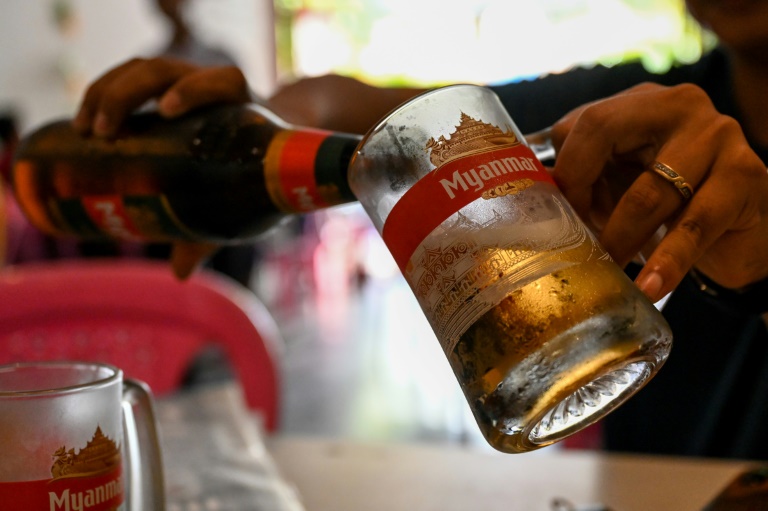
When Japanese brewing giant Kirin called time on its Myanmar operations last month, the news made little difference to Kyaw Gyi — like many drinkers, he had long boycotted the beer it produced with a military conglomerate.

For years, Myanmar Beer dominated bars and supermarket shelves, its Japanese backing a sign of the economic liberalisation washing into the Southeast Asian country after the military relaxed its iron grip on power in 2011. 

But after the generals ousted Aung San Suu Kyi’s civilian government in February last year, many turned their backs on the brew, along with a host of other goods made by companies linked to the armed forces, from soap to coffee.

“We know other beer brands are paying tax to the military, but we don’t want all of our money going to them,” said sailor Kyaw Gyi, sitting outside a bar on Yangon’s 19th Street, a popular drinking haunt.

“We avoid it. If there is only Myanmar Beer in the restaurant, then we don’t drink beer,” he said, using a pseudonym.

Farther along the street in Yangon’s bustling downtown, restaurant manager Zaw Naing said his establishment hadn’t sold the light, five percent brew since April last year.

It was not just the beer orders they had cancelled, he added — they also asked the brand to take back all the chairs, tables and umbrellas that bore its red, white and gold emblem.

“If people see the Myanmar Beer logo with our restaurant name, they won’t come,” he said, also asking to use a pseudonym.

– Demand down –

As anger seethes at the military’s crackdown on dissent — which a local monitoring group says has killed more than 1,700 people — establishments still serving the beer have faced more serious consequences.

In early March, bombs were set off outside two Yangon bars and a restaurant in second city Mandalay that were still selling the beer, according to local media.

Drivers transporting the beer in the rural central plains have also been stopped by local anti-coup groups and their cargoes trashed, according to local media reports. 

Myanmar Brewery — the firm run by Kirin and military conglomerate Myanma Economic Holdings — enjoyed a market share of nearly 80 percent, according to figures published by Kirin in 2018.

Following months of Covid- and coup-related disruption in 2021, its year-end operating profit was just 6.6 billion yen ($54 million) — compared with 13.8 billion the previous year.

In February, after months of trying to dissolve its partnership with the military-backed firm, and as pressure from rights groups escalated, the Japanese giant announced it would leave Myanmar.

The boycott and its upcoming exit is leaving rivals Heineken, Carlsberg and Thailand’s Chang eyeing the market gap.

The three breweries “have picked up market share from Myanmar Beer, particularly in the cities”, said a Yangon-based market observer who did not want to be named.

AFP has contacted Carlsberg for comment.

A representative for Heineken who requested anonymity said it was “too early to assess and comment on consumer purchasing habits”.

– ‘We keep drinking’ –

But back on 19th Street, Aung Myo said customers had long switched to beers untainted by connections to military-backed firms, like Chang, Tiger — owned by Heineken — and Carlsberg’s Tuborg. 

“People don’t want to drink Myanmar Beer even though it tastes good,” he told AFP.

“The demand is definitely down.”

In Myanmar’s complex political landscape, there are still some areas where punters can enjoy a Myanmar Beer in peace.

Crowded bars in the military-built capital Naypyidaw were still serving it on a recent Saturday night, and the brew is reportedly still available in further-flung rural areas that have seen little coup-related violence. 

The boycott has also been rebuffed in Rakhine in the west, where a truce between the junta and Arakan Army (AA) rebels fighting for greater autonomy has insulated the state from the turmoil gripping much of the rest of Myanmar.

“We don’t see any boycott movement here,” said government employee Htun Htun, 28, at a bar in state capital Sittwe, where billboards for the beer still lined the streets.

“So, we keep drinking it… The alcohol rate is not too high and the taste is good.” 

Analysts say the AA is taking advantage of the calm to expand its presence in the state, setting up its own courts and administration while the junta battles anti-coup dissidents elsewhere.

Clashes between the AA and the military in 2019 displaced more than 200,000 people across the state, one of Myanmar’s poorest. 

While the current peace lasts, Nyi Nyi, 27, said he would not be looking to change. 

“If there’s no problem with the military, we will still choose our usual Myanmar Beer,” he said.

From Beirut to Baghdad: Lebanese flee crisis seeking jobs in Iraq

Iraq, once synonymous with conflict and chaos, is becoming a land of opportunity for Lebanese job-seekers fleeing a deep economic crisis back home.

Akram Johari is one of thousands who fled Lebanon’s tumbling currency and skyrocketing poverty rates.

Last year, he packed his bags and boarded a plane from Beirut to Baghdad, using social media to search for opportunities.

“I didn’t have enough time to look for a job in the Gulf,” the 42-year-old said, explaining why he eschewed the more traditional path for those seeking economic opportunities in the region.

With its relative proximity and visas on arrival for Lebanese, the Iraqi capital seemed a good option.

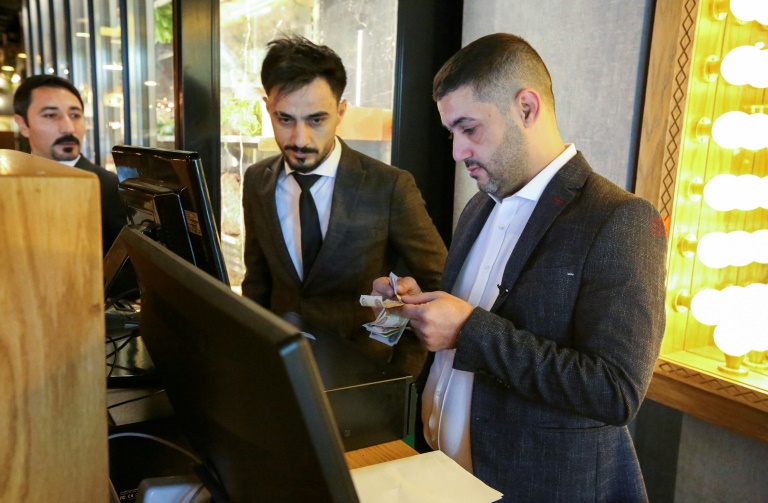
“I had to take quick action, and so I came to Baghdad and began searching for work on Instagram,” Johari said, speaking in a restaurant he has run for about a month.

Lebanon is grappling with an unprecedented financial crisis that the World Bank says is of a scale usually associated with war.

Beirut’s crisis, driven by years of endemic corruption, has seen Lebanon’s currency lose more than 90 percent of its value against the dollar.

Lebanon’s 675,000-pound monthly minimum wage now fetches around $30 on the black market, and about 80 percent of the population now lives in poverty, according to the UN.

When he left Beirut, Johari was earning the equivalent of about $100 per month. In Iraq, he earns enough to support his family back home, he said.

– Thousands flock to Iraq –

More than 20,000 Lebanese citizens arrived in Iraq between June 2021 and February 2022, excluding pilgrims visiting the Shiite holy cities of Najaf and Karbala, according to the Iraqi authorities.

Lebanon’s ambassador in Baghdad, Ali Habhab, said that movement from Lebanon to Iraq “has recently multiplied”.

There are more than 900 Lebanese businesses now operating in Iraq, the majority of them in the restaurant trade, tourism and health, Habhab said. 

In particular, there have been “dozens of Lebanese doctors who offer their services” in Iraqi hospitals, he said.

Iraq’s decades of conflict — from the Iran-Iraq war of the 1980s, to the US-led invasion of 2003 and  subsequent sectarian conflict, and on to the rise of the Islamic State group in 2014 — means that Baghdad might appear to be an unlikely magnet for those seeking to build a new life.

But since the country declared victory over IS in 2017, Iraq has slowly begun to recover its stability.

Today, streets in Baghdad that once witnessed atrocities are buzzing with shops lining main thoroughfares and cafes open late into the night.

According to Iraqi economic expert Ali al-Rawi, many Lebanese companies came to Iraq because they “know the investment environment well”, while many foreign companies from other countries “fear investing” because of its violent past.

“There is a lot of space for Lebanese enterprises in the Iraqi economy,” he said.

But Iraqis themselves have seen their fair share of economic hardship.

In a country where 90 percent of revenues come from oil sales, roughly a third of the population lives in poverty, according to the World Bank. 

In 2019, nationwide protests erupted across Iraq, driven by anger over rampant corruption, the absence of basic services and unemployment — similar factors behind protests in Lebanon that erupted around the same time.

– Lebanese firms flourish –

Lebanon was once a prime destination for medical tourism, as Iraqis flocked to better equipped medical centres in Beirut and other cities.

But, as with other sectors, Lebanon’s economic crisis has hit healthcare.

The Beirut Eye & ENT Specialist Hospital was once popular with Iraqi patients, but an official at the hospital, Michael Cherfan, said that “many doctors had left Lebanon”.

The hospital responded to the crisis in the way many Lebanese have — by opening a branch in Baghdad, sparing Iraqis the trip to Beirut.

“Our doctors come on a rotating basis,” Cherfan said. “Every week, one or two doctors come and do consultations and surgeries, earn some money and then return to Lebanon, which helps offset some of their losses.”

For Johari, while the money he earns in Iraq supports his family, it comes with a bitter taste. He flies home once a month, but he misses his family.

“It saddens me a lot that I can’t watch my two-month-old daughter grow up”, he said.

Clock ticking on Swiss watches' raw materials from Russia

Diamonds shine brightly at this year’s Geneva watch fair but the sanctions slapped on Russia could soon force the Swiss watch industry to produce more subdued designs.

Russia is a major supplier of diamonds, gold and other precious metals to the luxury watchmakers exhibiting at Watches and Wonders, one of the world’s top salons for the prestige industry.

The Russian group Alrosa — the world’s largest diamond mining company — was hit by US sanctions within hours of the Kremlin-ordered invasion of Ukraine on February 24.

According to US Treasury figures, it accounts for 90 percent of Russia’s diamond mining capacity, and 28 percent globally.

And while trade between Switzerland and Russia is modest, gold is the chief import, ahead of precious metals such as platinum followed by diamonds not mounted or set, according to the Swiss customs office.

Compared to other sectors of the Swiss economy, “watchmaking was a branch that was less affected than others by supply problems in 2021”, Jean-Daniel Pasche, president of the Federation of the Swiss Watch Industry, told AFP.

But that may no longer be the case, he acknowledged, adding that it was hard to assess the repercussions for the watch industry at this stage.

“There are obviously reserves. Afterwards, we will have to see, depending on how long the conflict lasts,” Pasche said.

– Recycled gold and palladium –

The Swiss luxury giant Richemont owns the Cartier and Van Cleef & Arpels jewellery firms, plus eight prestigious watch brands, including Piaget and IWC.

The group took the lead on Wednesday, saying all its brands have stopped sourcing diamonds from Russia.

The move will create a lot of work on the supply chain to find responsibly-sourced, quality diamonds from elsewhere, Richemont chief executive Jerome Lambert told a press conference.

Gold supply is of less concern. For a decade or so, Richemont has been sourcing recycled gold for watchmaking, bought from industry and the electronics sector.

For palladium, used for instance for wedding and engagement rings, the group decided “ahead of the sanctions” to switch to suppliers specialising in recycled palladium, Lambert said.

– Draining the stocks –

At Patek Philippe, one of the most prestigious Swiss brands, the firm’s president is counting on his stockpile to ride out the storm.

“Luckily I produce in small quantities,” said Thierry Stern, who represents the fourth generation of his family at the company helm.

“So I don’t feel any difference yet,” he told AFP. For 2022, Patek Philippe plans to manufacture 66,000 timepieces.

“And if I can’t find certain stones, I can always do engraving,” said the head of the  brand, which relies on a wide range of disciplines including ceramics, marquetry and enamel.

H. Moser, a niche brand producing 2,000 watches a year for wealthy collectors, struck much the same tone.

“Purchases are made in advance. For example, for the casings that I want to make in 2023, I have already bought all the gold I need,” said boss Edouard Meylan.

“But maybe in six months’ time some of our suppliers will call to push back the deadlines because they haven’t received the materials,” he admitted.

Concerns over raw materials “will drive up prices, of course”, said Jon Cox, an industry analyst with the Kepler Cheuvreux financial services company.

However, compared to other sectors, luxury firms have more leeway to pass on costs to customers, he added.

At the Watches and Wonders salon in Geneva, where 38 brands are exhibiting until Tuesday, the displays are brimming with diamonds, reflecting the “generally upbeat mood” of the industry this year after a prosperous 2021.

However, given the war and its repercussions, “I imagine product development will move to more subdued luxury goods”, Cox said.

Tesla delivers over 1 million electric cars over past year

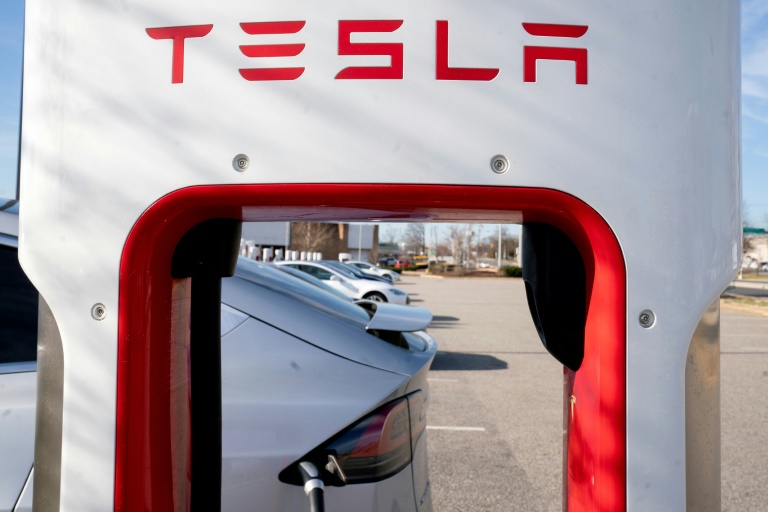
US electric car manufacturer Tesla shipped a record number of more than one million cars over the past year, according to figures published Saturday. 

The company delivered 1.06 million cars from April 2021 to March 2022, including more than 310,000 cars in the first quarter of this year alone, which is 67 percent higher than over the same period last year.

Still, the figure fell short of analysts’ expectations of 317,000 cars, according to data compiled by FactSet.

Deliveries are considered similar to sales figures published by other manufacturers.

Growth, however, slowed sharply in recent months for the Austin, Texas-based company, with deliveries rising a minuscule 0.4 percent since the fourth quarter of last year.

The number of vehicles produced is also slightly down against the previous quarter (-0.1 percent).

“This was an exceptionally difficult quarter due to supply chain interruptions & China zero Covid policy,” Tesla CEO Elon Musk said on Twitter, referring to China’s strict health restrictions. “Outstanding work by Tesla team & key suppliers saved the day.”

However, Tesla is still faring better than its competitors, with the entire automobile industry affected by supply chains snarls.

Toyota saw its sales in North America fall 23.5 percent in volume in the first quarter of 2022, compared to the same period last year, and 26.3 percent in value.

General Motors earned a profit of $1.7 billion for the quarter ending December 31, down 38.7 percent from the final three months of 2020 as revenues dropped 10.5 percent to $33.6 billion.

Close Bitnami banner
Bitnami