World

UN to release Xinjiang rights report within hours

The UN rights chief will release a long-awaited report on alleged violations in China’s Xinjiang region before leaving office later Wednesday, despite intense pressure from Beijing not to publish the assessment at all.

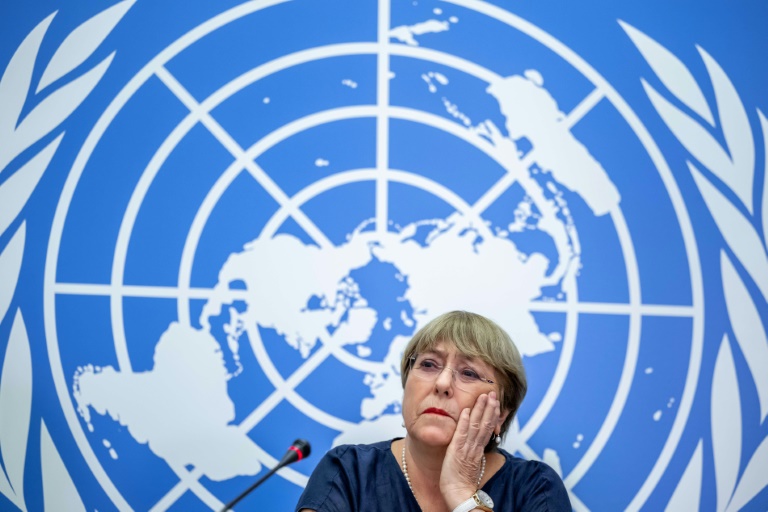
The outgoing High Commissioner for Human Rights Michelle Bachelet promised to release the report before her mandate expires at the end of August.

“The report on Xinjiang will go out by the end of the day,” spokesman Jeremy Laurence told AFP.

Her report is therefore set to come out in the final seven hours of her four-year term and should stand as her last act in office.

Beijing stands accused of detaining more than one million Uyghurs and other Muslim minorities in the far-western Xinjiang region.

Campaigners accuse China of a litany of abuses, including mass incarceration, forced labour, compulsory sterilisation and the destruction of Uyghur cultural and religious sites.

The United States and lawmakers in other Western countries have gone as far as accusing China of committing “genocide” against the minority groups.

Beijing vehemently rejects the claims and has long insisted it is running vocational training centres in Xinjiang designed to counter extremism.

It claims the allegations are part of a plot by the United States and other Western nations to smear China and contain its rise.

Bachelet came under increasing pressure to investigate and speak out as the allegations mounted.

Nearly a year ago, the former Chilean president told the UN Human Rights Council that an independent evaluation of the situation was needed — and indicated that her office was finalising a report.

But it was repeatedly delayed amid growing impatience from rights groups and some countries.

– A ‘fabricated lie’: China –

Zhang Jun, China’s ambassador to the UN in New York, said Beijing had made it clear to Bachelet that it was “firmly opposed” to the rights assessment.

“The so-called Xinjiang issue is a completely fabricated lie out of political motivations and its purpose is definitely to undermine China’s stability and to obstruct China’s development,” he told reporters.

Zhang said Bachelet should “stay independent and… not resign to the political pressure of a number of Western countries.

“We haven’t seen this report yet, but we are completely opposed to such a report,” he added.

“We do not think it will produce any good to anyone. It simply undermines the cooperation between the UN and a member state. It completely interferes in China’s internal affairs.”

In her farewell press conference last Thursday, Bachelet admitted she was under “tremendous pressure to publish or not to publish” the long-delayed report.

“But I will not publish or withhold publication due to any such pressure,” she said.

Bachelet released a departing video on Wednesday in which she said the world was at a critical juncture, with increasing attempts to shrink the space for debate, too often coupled with attacks on rights defenders.

She did not reference the Xinjiang report but said: “That’s the essence of human rights work: doing the hard job of putting the finger where it hurts.

“Not looking away when things don’t go smoothly. Seeing when people are excluded and attacked. Bringing hope for change and a better life when people have become desperate and frustrated.

“The journey to defend human rights never ends,” she concluded.

– ‘Better late than never’ –

In May, Bachelet concluded a rare six-day visit to China that took her to Xinjiang.

During her visit, she had urged Beijing to avoid “arbitrary and indiscriminate” measures in Xinjiang.

But rights groups criticised her for a perceived lack of firmness. They said she had capitulated to a stage-managed tour of the region orchestrated by Beijing.

Human Rights Watch said the report would help to show that no state is above the law.

“Better late than never,” HRW’s China director Sophie Richardson told AFP. “If this does in fact happen, it will be a watershed moment.”

The non-governmental organisation would like to see the report reach the same assessments as HRW and others, given the “mountains of evidence”.

But she said that more than the content, the publication of the report itself would be important since it would force the UN Human Rights Council to address the issue.

“Not taking this forward is not an option,” she said.

nl-rjm-burs/jj
Greenhouse gas, sea levels at record in 2021: US agency

Earth’s concentration of greenhouse gases and sea levels hit new highs in 2021, a US government report said Wednesday, showing that climate change keeps surging ahead despite efforts to curb emissions.

“The data presented in this report are clear — we continue to see more compelling scientific evidence that climate change has global impacts and shows no sign of slowing,” said Rick Spinrad, administrator of the National Oceanic and Atmospheric Administration.

The rise in greenhouse gas levels comes despite an easing of fossil fuel emissions the previous year as much of the global economy slowed sharply due to the Covid-19 pandemic.

The US agency said that the concentration of greenhouse gas in the atmosphere stood at 414.7 parts per million in 2021, 2.3 parts higher than in 2020.

The level is “the highest in at least the last million years based on paleoclimatic records,” the annual State of the Climate report found.

The planet’s sea levels rose for the 10th straight year, reaching a new record of 3.8 inches (97 millimeters) above the average in 1993 when satellite measurements began.

Last year was among the six warmest on record since the mid-19th century, with the last seven years all the seven hottest years on record, it said.

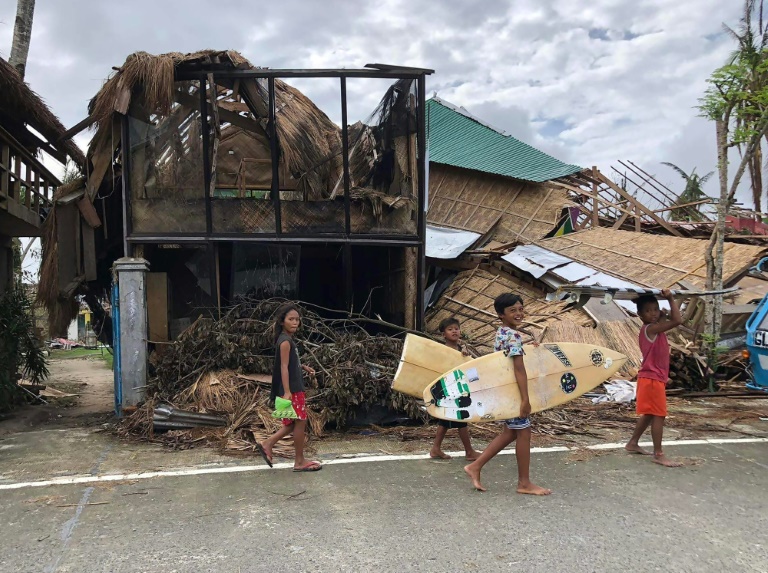
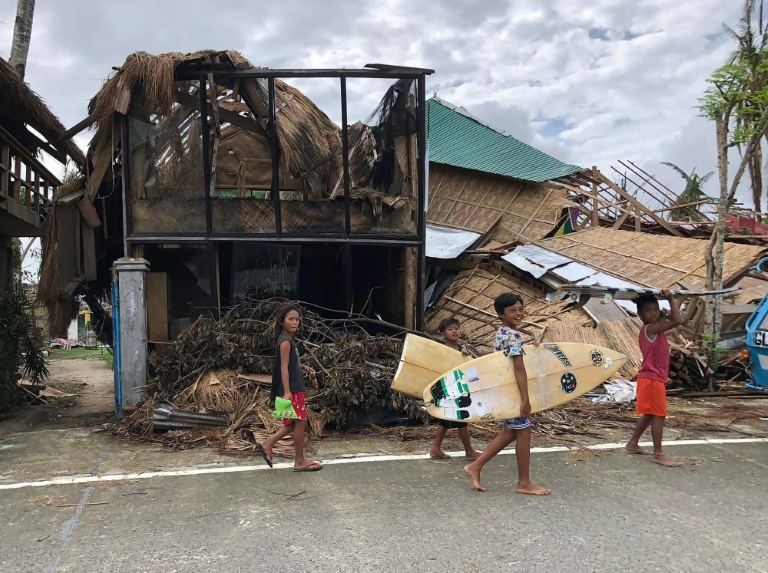
The number of tropical storms were also well above average last year including Typhoon Rai, which killed nearly 400 people in the Philippines in December, and Ida, which swept the Caribbean before becoming the second strongest hurricane to hit Louisiana after Katrina.

Greenhouse gas, sea levels at record in 2021: US agency

Earth’s concentration of greenhouse gases and sea levels hit new highs in 2021, a US government report said Wednesday, showing that climate change keeps surging ahead despite efforts to curb emissions.

“The data presented in this report are clear — we continue to see more compelling scientific evidence that climate change has global impacts and shows no sign of slowing,” said Rick Spinrad, administrator of the National Oceanic and Atmospheric Administration.

The rise in greenhouse gas levels comes despite an easing of fossil fuel emissions the previous year as much of the global economy slowed sharply due to the Covid-19 pandemic.

The US agency said that the concentration of greenhouse gas in the atmosphere stood at 414.7 parts per million in 2021, 2.3 parts higher than in 2020.

The level is “the highest in at least the last million years based on paleoclimatic records,” the annual State of the Climate report found.

The planet’s sea levels rose for the 10th straight year, reaching a new record of 3.8 inches (97 millimeters) above the average in 1993 when satellite measurements began.

Last year was among the six warmest on record since the mid-19th century, with the last seven years all the seven hottest years on record, it said.

The number of tropical storms were also well above average last year including Typhoon Rai, which killed nearly 400 people in the Philippines in December, and Ida, which swept the Caribbean before becoming the second strongest hurricane to hit Louisiana after Katrina.

'Heavenly' Pakistan mountain town becomes site of ruin

Bahrain is a town in ruins –- reduced to rubble by the incredible force of flash floods that swelled the river running through it, severing a lifeline bridge.

Hundreds of settlements in Pakistan’s north have been cut off by monsoon rains that came to a head last week, causing the worst floods in the country’s history.

But in the past few days, the heavily damaged road heading through the Swat Valley has slowly opened up, revealing the extent of the destruction.

In Bahrain, hotels have disappeared, the town’s mosque is a bare shell, and waist-high water still gushes through the main bazaar.

“It was a heavenly place but now it is a wreckage,” Muhammad Asif, a 22-year-old college student, told AFP on Wednesday. 

“In the past week, everything has changed dramatically. The river added to the beauty, but now it is a threat.”

The town usually bustles with more than a thousand summer tourists every day, drawn by majestic mountain views from hotels and restaurants perched on the riverbank.

It will likely take years for them to return, and with tourists gone, the fear of economic ruin is also setting in.

“My hotel is still partly under water,” said Muhammad Nawaz, whose 40 employees at his various establishments are now jobless.

“I am pulling sand out of my restaurant and searching for furniture in the ruins.” 

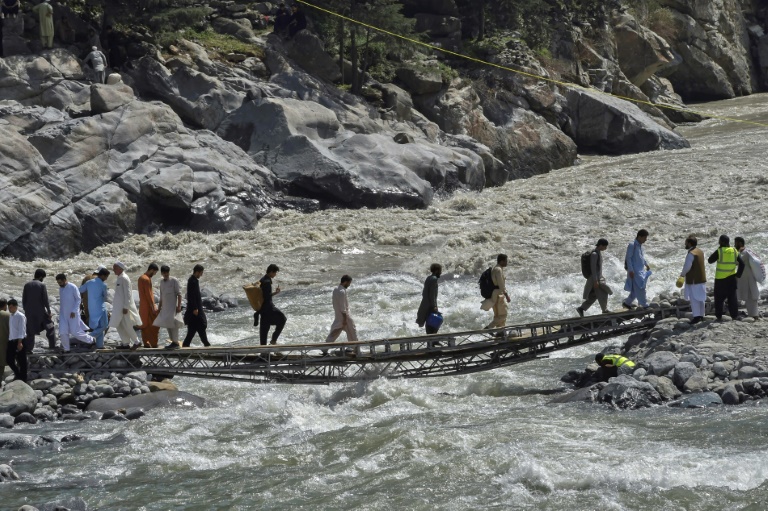
The road north ends at the edge of the Swat River, where the bridge that once connected the two halves of the town is now a mass of debris. 

Rickety wooden planks stand in its place, crossed by men carrying sacks of rice, flour and sugar to their villages — hours away by foot. 

Further north, their valleys remain cut off. 

– Desperate for help –

What was once a 20-minute journey by motorbike for Karim Farman is now close to a four-hour walk over crumbling roads.

No help has reached his flooded village of Balakot yet.

“We are desperate for any sort of assistance. We are in dire need of medicine, it is very tough to bring patients here,” said Muhammad Amir, who is from the same village.

“There has been no electricity in our village for nearly a week, people don’t even have a candle for light. Several people are sick with diarrhoea.”

Bahrain’s destruction unfolded late last Thursday night.

Many locals reported not receiving any warnings, but as the river rapidly rose tourists began to evacuate from hotels.

Like in many riverside villages and towns, locals believed only the homes on the banks were vulnerable. 

But just hours later the full scale of the water’s rage became clear. 

“In a few minutes the water suddenly encircled my shop from every side,” said Aftab Khan.

“I couldn’t take anything with me because I had to save my life.”

The army arrived on Wednesday, local residents said, to oversee the chaos of diggers clearing rubble and to manage the flow of foot traffic across the river.

Helicopters fly overhead, dropping food packages to the stranded valleys.

A district government official who asked not to be named told AFP it could be months before the road and bridge are repaired.

“Before, this place was like a paradise but now even locals want to escape,” said restaurant owner Sheer Bahadur.

War in Ukraine: latest developments

Here are the latest developments in the war in Ukraine:

– Nuclear inspectors arrive in Zaporizhzhia – 

UN nuclear inspectors arrive in the southern Ukrainian city of Zaporizhzhia ahead of a visit to Europe’s largest nuclear power plant, the fate of which has stoked global concern following repeated shelling of the area.

Ukraine and Russia have both accused each other over the attacks which have led to fears of another nuclear disaster in Ukraine, home of the Chernobyl facility which was the site of the world’s worst nuclear accident in 1986.

Rafael Grossi, the head of the International Atomic Energy Agency, who is leading the delegation said his mission was to prevent another accident. The team, which is travelling from Ukrainian-held territory will have to cross the frontline to access the plant.

– More Gazprom gas cuts –

Russian energy giant Gazprom suspends gas deliveries to Germany through the Nord Stream 1 pipeline for three days, in the latest in a series of supply halts that have fuelled an energy crisis in Europe.

Gazprom said “preventative work” at a compressor unit had forced it to turn off the tap and said it would also suspend gas supplies to France’s main provider Engie from Thursday over what it said were missed payments. 

German Chancellor Olaf Scholz assured Tuesday that his country was prepared for the winter, with or without Russian gas.

– EU curtails Russian visas –

EU foreign ministers agree to suspend a 2007 visa facilitation deal with Russia that made it easier for Russians to travel to the EU, but stop short of a wider ban sought by some members.

Estonia, Finland, Latvia, Lithuania and Poland had urged Brussels to ban Russian tourists from obtaining visas for the EU’s Schengen common travel area.

But several other EU members, including Germany and France had resisted the move, arguing that it could prevent young Russians from experiencing democracy at work abroad.

– Heavy fighting in Kherson – 

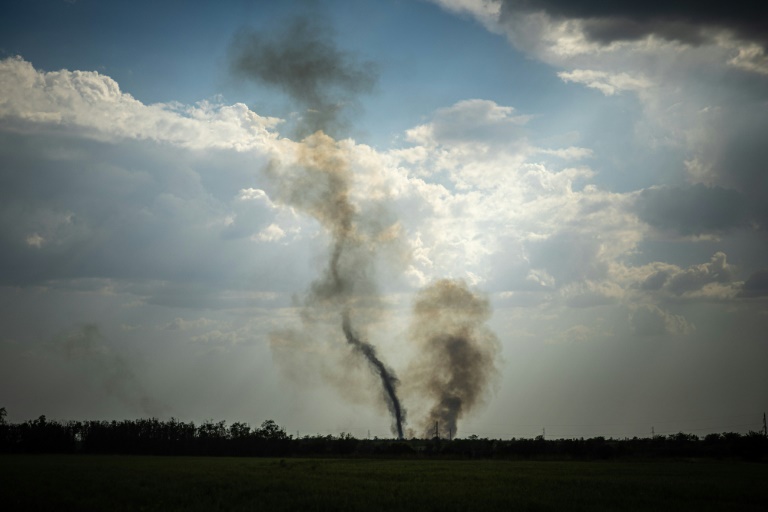
Intense fighting continues across the southern region of Kherson, where Ukrainian forces have been trying to claw back areas seized by Russia at the start of the war.

Kyiv began a major offensive on Monday to retake the city of Kherson itself.

The Russian defence ministry said Wednesday the counteroffensive had “failed” with Ukrainian forces suffering “significant losses and were driven back by Russian troops”. 

But the Ukrainian presidency claimed its forces had destroyed “almost all large bridges” over the Dnipro River, a key supply route for Russian forces.

burs-cb/jmy/pvh

'I never corrupted anyone,' diamond magnate tells Swiss court

A French-Israeli businessman and diamond magnate insisted Wednesday he had never bribed anyone, as he sought to overturn his conviction in a vast corruption case involving mining rights in West Africa.

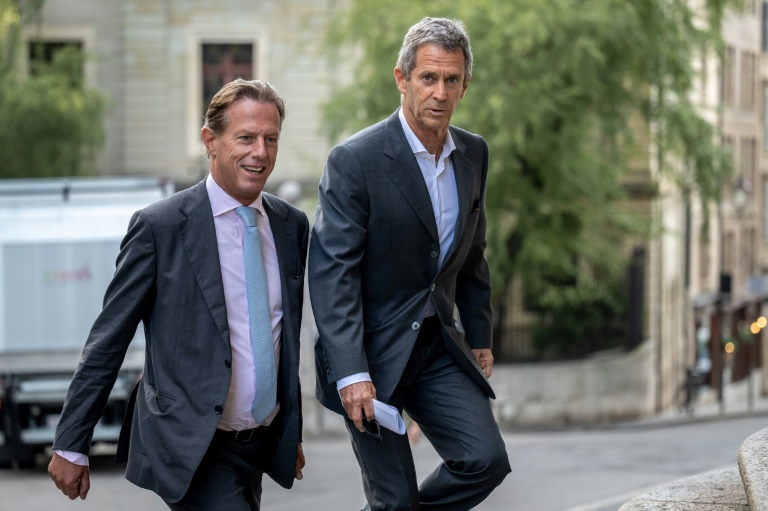
Beny Steinmetz, 66, told the Geneva appeals court he was innocent and “had done nothing wrong”.

“I never corrupted anyone.”

Steinmetz was found guilty in January 2021 of setting up a complex financial web to pay bribes to ensure his company could obtain permits in Guinea’s southeastern Simandou region, which is estimated to contain the world’s biggest untapped iron ore deposits.

He was sentenced by a Geneva court in 2021 to five years in prison and ordered to pay 50 million Swiss francs ($52 million) in compensation.

Wearing a grey suit and white shirt with his collar unbuttoned, Steinmetz told court president Catherine Gavin he was proud of the massive mining project Beny Steinmetz Group Resources, BSGR, had set up in Guinea, claiming it would have been hugely beneficial for the country.

“I am fully convinced that BSGR never crossed the red line,” and the company had become victim to a local power struggle and corruption, he said.

Steinmetz, who maintained his innocence throughout the original trial, changed his lawyers and beefed up his communications team for the appeal.

– ‘Pact of corruption’ –

During the first trial, prosecutors convinced the court Steinmetz and two associates had bribed a wife of then Guinean president Lansana Conte and others in order to win lucrative mining rights in Simandou.

The prosecutors said Steinmetz obtained the rights shortly before Conte died in 2008 after about $10 million was paid in bribes over a number of years.

Conte’s military dictatorship ordered global mining giant Rio Tinto to relinquish two concessions that were subsequently obtained by BSGR against an investment of $160 million.

Just 18 months later, BSGR sold 51 percent of its stake in the concession to Brazilian mining giant Vale for $2.5 billion.

But in 2013, Guinea’s first democratically-elected president Alpha Conde launched a review of permits allotted under Conte and stripped the VBG consortium formed by BSGR and Vale of its permit.

To secure the initial deal, prosecutors claimed Steinmetz and representatives in Guinea entered a “pact of corruption” with Conte and his fourth wife Mamadie Toure.

– ‘Local tragedy’ –

Toure, who has admitted to having received payments, has protected status in the United States as a state witness.

A request from Steinmetz’s lawyer Daniel Kinzer for her written testimony to be deemed inadmissible due to lacking insight into the “opaque” US deal, was rejected by the court.

The defence meanwhile maintains there was nothing inappropriate about how BSGR obtained the permits, and that Rio Tinto lost half the concessions for failing to develop them.

Steinmetz rejected suggestions his company was seeking to cash in and make “a quick exit”, saying the BSGR and Vale consortium had planned to stay for the long term.

“This was not a 20-year deal, but a 50-year deal,” he told the court, calling it “Africa’s largest mining project” that would have included  building a railway system.

It would have tripled Guinea’s gross domestic product, he said.

The abandonment of the project was “a local tragedy, created by local corruption,” according to Steinmetz, indicating Conde’s decision to strip VBG of the rights was linked to promises made to secure his election.

Cambodian psychiatrist helping genocide survivors wins 'Asia's Nobel Prize'

A Cambodian psychiatrist treating victims of the Khmer Rouge and a French environmentalist cleaning up Indonesian rivers were among the winners Wednesday of the 2022 Ramon Magsaysay Award — considered Asia’s Nobel Prize.

The annual award, established in 1957 and named after a Philippine president who died in a plane crash, honours those who have performed “selfless service to the peoples of Asia”.

The foundation that runs the award named four winners in an online announcement.

Among them was Sotheara Chhim, 54, a psychiatrist and survivor of the murderous, ultra-Maoist Khmer Rouge regime that killed nearly a quarter of Cambodia’s population through starvation, overwork and mass executions in the 1970s.

He was cited for devoting his life to helping people who suffered under the Khmer Rouge, with a focus on treating “baksbat” — or “broken courage” — a syndrome seen in Cambodia that is similar to post-traumatic stress disorder.

The Magsaysay Award organisers praised “his calm courage in surmounting deep trauma to become his people’s healer”.

“It’s not easy to work with trauma survivors, to listen to the trauma stories of the people as it reminded me a lot about the trauma I suffered myself,” Sotheara Chhim told AFP in an interview Wednesday, adding the award came as a “surprise”.

“I feel that the more I help people, it heals myself too,” said the psychiatrist, describing his work as “a kind of catharsis”.

He also testified as an expert witness before a United Nations-backed tribunal trying senior Khmer Rouge leaders.

French environmental activist and filmmaker Gary Bencheghib, 27, was given the award for his efforts to clean up Indonesia’s polluted waterways.

Bencheghib and his brother have built kayaks made of plastic bottles and bamboo to pick up trash in the Citarum river, one of the most polluted in the world.

Filipino doctor Bernadette Madrid, 64, also received the award for setting up child protection centres across the Philippines to help domestic abuse victims.

And Japanese ophthalmologist Tadashi Hattori, 58, was honoured for providing free eye surgeries in Vietnam, where such specialists and facilities are limited. 

His generosity, the Magsaysay Award foundation said, was “the embodiment of individual social responsibility”.

An in-person ceremony honouring the winners will be held in Manila in November.

burs/cgm/axn

Russians divided over Gorbachev legacy

For some he brought winds of change that could have paved the way for a better Russia, for others economic hardship and bitterness. 

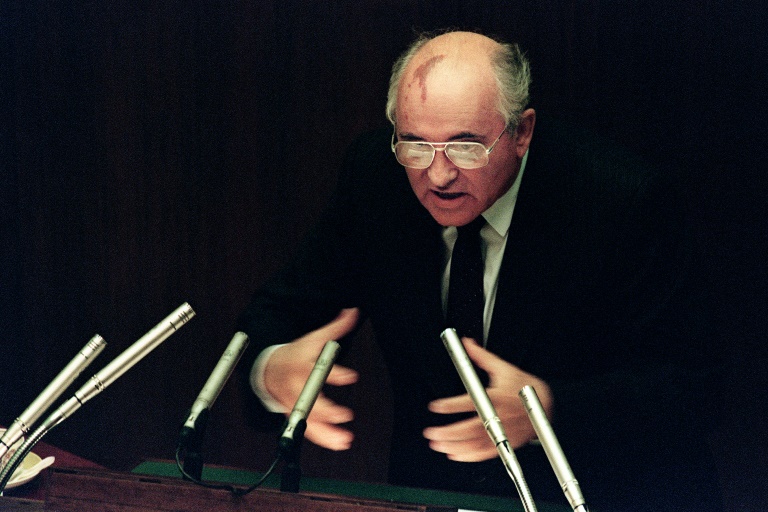
But despite his controversial legacy, many Russians on Wednesday agreed that Mikhail Gorbachev, who has died at the age of 91, was a key figure in the country’s history.

Gorbachev was in power between 1985 and 1991, stepping down in the final days of the Soviet Union. 

Some Russians lament the end of the Soviet era, holding Gorbachev personally responsible.

Among them is 70-year-old Vladimir Zavkov, who did not mince words speaking to AFP in central Moscow, calling Gorbachev a “traitor”. 

“For me he is some kind of illiterate politician, who let such a great country fall apart. And anything good he may have done is crossed out by that,” said the retired Zavkov.

Another Muscovite, Nadezhda Aleksina, was not so harsh, but did admit that Gorbachev was “controversial”.

“For Russia, I think he was a really significant figure. It was thanks to him that Russia appeared. So I think it’s a big loss for many,” said Aleksina, a web designer in her 30s. 

Gorbachev was superseded by the younger Boris Yeltsin, who became the first president of modern Russia. 

Yeltsin’s transition of Russia to a market economy was marked by galloping inflation and food shortages in the 1990s, a time remembered bitterly by many Russians today.

Some believe that without the collapse of the Soviet Union they would not have had to live through these economic hardships.

– ‘Traitor’ or reformer? –

“We may not have been rich then, but we were guaranteed jobs,” said Tatyana Silayeva, a retired 67-year-old. 

As for Gorbachev, Silayeva said she views him “very negatively”. 

“He did a good deed for the United States — he let our country fall apart. And for us, he turned out to be a complete traitor.”

Gorbachev was credited with diffusing soaring Cold War-era tensions between Moscow and Washington, earning him respect in the West.

He was awarded the 1990 Nobel Peace Prize for negotiating a historic nuclear arms control pact with then US president Ronald Reagan. 

“He gave both the country and the world an incredible gift — he gave us 30 years of peace. Without the threat of global and nuclear war,” Dmitry Muratov, the editor-in-chief of newspaper Novaya Gazeta, wrote in a tribute to Gorbachev.

During his tenure, Gorbachev championed freedom and change, and in particular used part of his Nobel prize winnings to help set up Novaya Gazeta — a leading independent publication for over two decades.

Novaya Gazeta, however, suspended publication in late March following Moscow’s military intervention in Ukraine, with independent media facing unprecedented pressure.

The growing crackdown on media and activism under President Vladimir Putin during his more than 20 years in power has been seen as a reversal of Gorbachev’s legacy.

However, for prominent post-Soviet rights activist Svetlana Gannushkina, the reforms started by Gorbachev cannot be undervalued.  

“People who show aggression today are people who want to return to the Soviet system. These are people who were slaves and want to keep it that way,” the 80-year-old told AFP.

“They do not want to appreciate the one who gave them freedom. And Gorbachev gave us freedom.”

Crisis-hit Sri Lanka's inflation hits another record

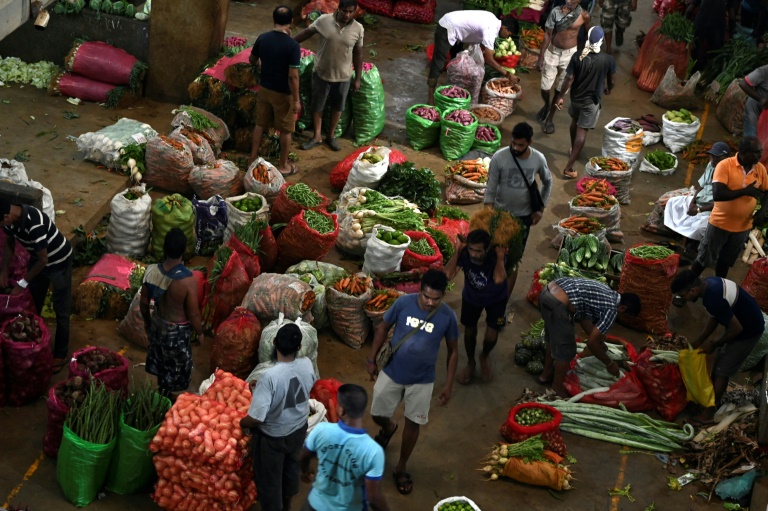
Crisis-hit Sri Lanka’s inflation hit an eleventh consecutive monthly record in August, official data showed on Wednesday, rising to 64.3 percent as the International Monetary Fund extended bailout talks by one more day.

The benchmark year-on-year Colombo Consumer Price Index (CCPI) in August was more than eight times higher than the 7.6 percent recorded in October 2021. Since then it has set a new record high every month.

According to the department of census and statistics, food inflation in August was even higher, hitting 93.7 percent.

Inflation in August was impacted by a more than threefold increase in electricity tariffs and kerosene oil prices that hit in the middle of the month.

The CCPI figures were released hours after the IMF said it had extended by a day official-level talks with the Sri Lankan government on a possible bailout.

“The IMF Mission in Colombo has been extended by one day because discussions are still ongoing with the authorities,” the IMF said in a brief statement.

The IMF had asked Sri Lanka to contain spiralling inflation and address corruption as part of efforts to salvage the troubled economy, which has been ravaged by a foreign exchange crisis.

The Sri Lankan rupee has lost more than 45 percent of its value against the US dollar this year.

An unprecedented economic crisis — which saw the country default on its $51 billion debt in April — forced Gotabaya Rajapaksa to step down as president last month, after prolonged protests against acute shortages of food, fuel and medicines.

The country’s 22 million people have also been enduring lengthy electricity blackouts due to the government’s inability to import enough fuel to run generators.

G20 climate talks in Indonesia end without joint communique

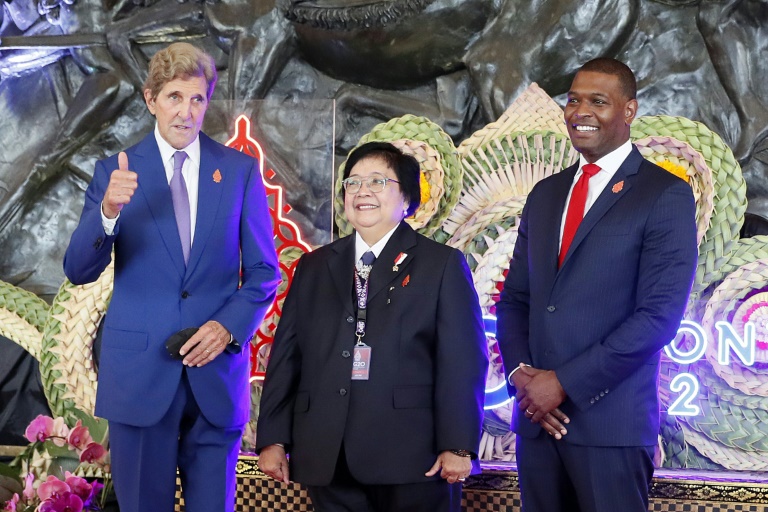
Group of 20 climate talks in Bali ended without a joint communique Wednesday despite host Indonesia warning the world’s leading economies they must act together to combat a warming planet or risk plunging into “uncharted territory”.

The one-day meeting on the resort island concluded with Indonesia’s environment chief saying G20 chair Jakarta would only issue a summary of the forum’s aims, reflecting divisions between its members over how to tackle climate change.

The failure to agree a unified statement came at the end of a month in which more than 1,000 people died in Pakistan from flooding blamed on climate change and after a drought exacerbated by a record heatwave spread across half of China.

At a closing press conference, Indonesian Minister of Environment and Forestry Siti Nurbaya Bakar said the summary would detail the forum’s “shared commitment and shared steps”.

It is a similar move to that seen in finance talks in Indonesia last month where the host — which maintains a neutral foreign policy — issued a chair statement after ministers disagreed over Russia’s responsibility for global economic turmoil in light of its invasion of Ukraine.

“We cannot say that,” Bakar told AFP when asked if there was no communique because of geopolitical disagreements. 

“But the chair summary is something we can achieve given the geopolitical issues and (given) some countries cannot be flexible on certain issues. 

“Just like in many working groups, issues on Russia and Ukraine have become geopolitical tension.”

Another source close to the meeting said G20 members “did not manage to reach a joint communique” and most countries started their speeches by condemning Russia’s invasion of Ukraine, though there were no walkouts or clashes when the Russian representative spoke.

“The reason that killed the communique from the start is the presence of Russia today,” the source told AFP.

Moscow only sent a deputy minister for economic development to the talks, according to a list of attendees seen by AFP.

In her opening remarks Bakar had told delegates that “global environmental problems require global solutions” and nations “cannot solve those global environmental problems on our own”.

Countries around the world are being increasingly hit by record heat, flash floods and droughts — phenomena that scientists say will become more frequent and intense due to climate change.

– ‘Hostile actors’ –

Research published this month showed the Arctic has warmed nearly four times faster than the rest of the planet over the last 40 years, suggesting climate models and governments are underestimating the rate of polar heating.

“We cannot hide from the fact that the world is facing increasingly compounding challenges,” Bakar said, referencing energy price spikes and global food shortages.

“We know that climate change could become an amplifier and multiplier of the crises.”

She added that climate change “would not only wipe out all development progress that has been achieved over past decades, particularly in emerging economies, but it would also propel us over an environmental tipping point into uncharted territory where no future will be sustainable”.

At the meeting were US Special Presidential Envoy for Climate John Kerry, Britain’s climate minister Alok Sharma and officials from India, Australia, Italy, Brazil, Japan, South Korea and the European Union among others.

China –- the world’s biggest emitter of greenhouse gases –- only sent a vice minister of ecology and environment, with higher-level officials staying home because of the Covid-19 pandemic.

The meeting was a prelude to a November leaders’ summit which Indonesian President Joko Widodo has said Russian counterpart Vladimir Putin will attend despite Moscow’s isolation after invading Ukraine.

Britain said the Russian military assault had exacerbated energy problems, with Sharma arguing it showed “the vulnerability of countries relying on fossil fuels controlled by hostile actors”. 

Climate security had become synonymous with energy security, he said.

The United Nations’ next climate change talks will take place in Sharm el-Sheikh, Egypt in November.

Close Bitnami banner
Bitnami