World

Amazon offers to settle EU antitrust cases over rival data

Amazon has offered a settlement against EU charges that the online giant undermined rivals by misusing the sensitive information of independent sellers to benefit its own retail business, the EU said Thursday.

The offer by Amazon is a huge step by the US-based behemoth that has denied for years accusations by rivals and regulators that it unfairly uses the troves of data parked on its platform to benefit its own products and services.

In its offer, the US tech giant commits to stop using non-public data such as sales performance and revenue that are “relating to or derived from the activities of independent sellers on its marketplace,” an EU statement said.

Amazon also made an offer to end a second EU investigation on whether its hugely popular Prime service unfairly pushes buyers towards sellers using Amazon’s logistics service.

This probe also looked into the Buy Box in which a user can swiftly make a purchase, skipping through the inconvenience of several screens and choices.

The company said it would display an alternative offer in the Buy Box feature if there is a substantial difference in price or delivery from the first one.

Amazon said while “we… disagree with several conclusions the European Commission made, we have engaged constructively with the Commission to address their concerns.”

This will “preserve our ability to serve European customers and the more than 185,000 European small and medium-sized businesses selling through our stores”.

– ‘Win-win’ –

The EU said it was asking rivals for feedback on Amazon’s concessions by September 9 and, if approved, they would remain in place for five years under close monitoring by Brussels.

Many of these accusations towards Amazon are being answered separately in the EU’s landmark Digital Markets Act (DMA), a major EU legislation set to come into force next year.

The DMA imposes a long list of do’s and don’ts on tech giant gatekeepers, including how they handle the sensitive data of competitors who use their platforms.

Alfonso Lamadrid, a competition lawyer at Garrigues in Brussels said the settlement offer was “a win-win” for both the Commission and Amazon.

On the one hand, it kept the commission from potentially fighting a long battle in court, and “at the same time the commitments essentially anticipate what Amazon would have needed to do to comply with the upcoming DMA,” he said.

Amazon had previously settled a case with the EU commission over e-books and still faces scrutiny with national regulators in Germany, as well as non-EU Britain.

The commission said the settlement would not apply in Italy, where Amazon paid a huge fine and changed its business practices over similar concerns.
US vows to use all means to stop Iran nuclear bomb in new Israel pact

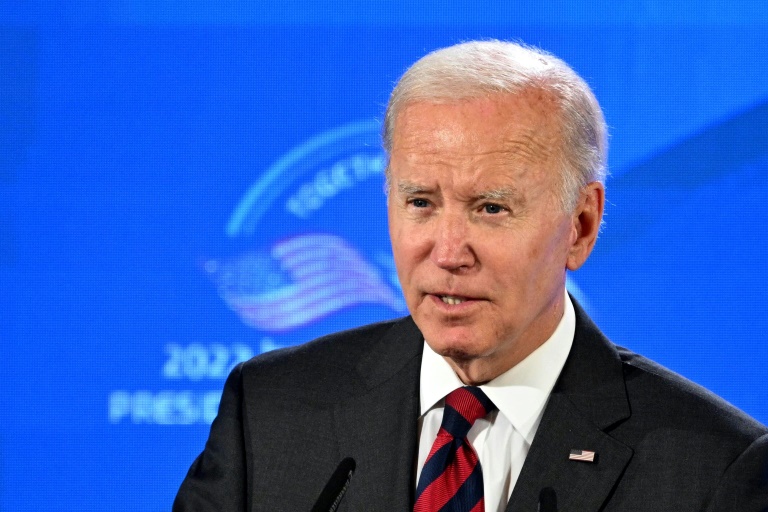
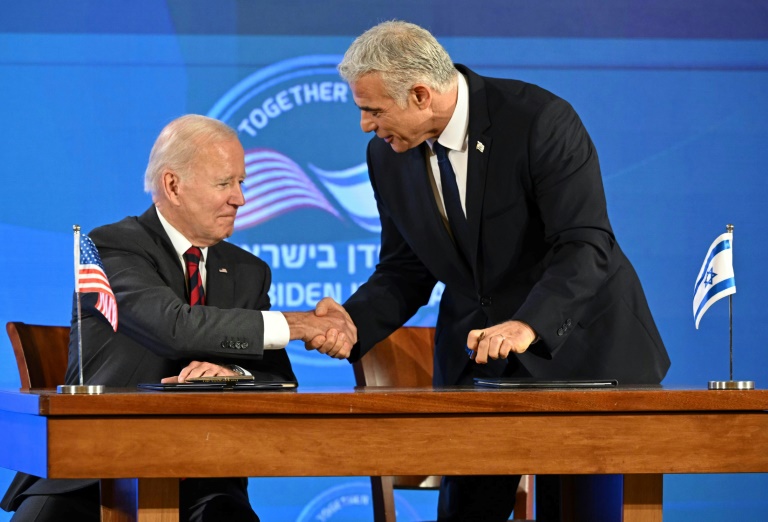
The US and Israel signed a new security pact on Thursday reinforcing their common front against Iran, as President Joe Biden pledged to use “all” American power to stop the Islamic republic from acquiring nuclear weapons.

The declaration was inked by Israeli Prime Minister Yair Lapid and Biden, who was making his first trip to the Middle East as president.

It commits the United States to “never to allow Iran to acquire a nuclear weapon”, stating that it “is prepared to use all elements of its national power to ensure that outcome”.

A landmark deal that imposed curbs on Iran’s suspect nuclear programme in exchange for sanctions relief was torpedoed in 2018 by former US president Donald Trump. Efforts to revive the accord have been stalled since March.

Asked on Thursday how long the US was prepared to give those efforts, Biden said “we’re not going to wait forever” for a response from the Islamic republic.

A day after Israeli officials presented Biden with their latest military hardware, the president said the two countries would co-operate on developing “high-energy laser weapon systems”.

Israel, which has the Middle East’s sole but undeclared nuclear arsenal, is staunchly opposed to the deal with Iran, which has always denied seeking the bomb.

Lapid warned “words” and “diplomacy” were not enough to thwart Iran’s alleged nuclear ambitions.

“The only thing that will stop Iran is knowing that if they continue to develop their nuclear programme the free world will use force,” he said.

Iran’s ultra-conservative President Ebrahim Raisi warned the US and its allies that his country “will not accept any crisis or insecurity in the region”.

“Any mistake made in this region will be met with a harsh and regrettable response,” Raisi said in televised remarks.

– Saudi oil –

Biden touched down in Israel on Wednesday, his 10th visit to the Jewish state since 1973, when he came as a newly elected senator.

He held talks with Israeli President Isaac Herzog later Thursday and was due to meet an old acquaintance, opposition leader Benjamin Netanyahu.

On Friday the US president will travel to the occupied West Bank to meet Palestinian president Mahmud Abbas, before Air Force Once makes the first publicly acknowledged direct flight from Israel to Saudi Arabia.

Biden said the journey itself “represents important progress”, following Israel launching diplomatic ties in 2020 with Riyadh’s Gulf neighbours the United Arab Emirates and Bahrain.

“Israel’s integration in the region, Israel’s peace with its neighbours, these are essential goals,” Biden said.

Russia’s invasion of Ukraine will be a top priority for the president’s meetings with Arab leaders, with volatile oil prices due to be the focus of talks with Saudi officials in particular.

The president will seek to persuade Saudi Arabia to pump more oil in order to drive down prices, which have fuelled US inflation to the highest levels in decades.

– ‘Israel wants peace’ –

On Thursday, Biden reaffirmed Washington’s policy of pressing for “a two-state solution for two people, both of whom have deep and ancient roots in this land, living side by side in peace and security.”

But he made it clear he has no plans to reverse Trump’s controversial decision to recognise Jerusalem as Israel’s capital.

Lapid is serving as caretaker prime minister ahead of elections in November — Israel’s fifth vote in less than four years — and is therefore not expected to launch new talks with Palestinians.

“I haven’t changed my position,” the centrist politician said alongside Biden. “A two-state solution is a guarantee for a strong, democratic state of Israel, with the Jewish majority.”

A US official said the administration would announce during the visit “a significant funding package” for hospitals that serve Palestinians in Israeli-annexed east Jerusalem, which Palestinians claim as their future capital.

It will also announce measures towards providing 4G internet access in the West Bank and Israeli-blockaded Gaza Strip, the official said, addressing a persistent Palestinian frustration.

But long-term peace negotiations were not on this week’s agenda, the official said.

“We are not going to come in with a top down peace plan because we don’t believe that would be the best approach.”

aue-bs/rsc/dv

France nods to Ukraine in Bastille Day military parade

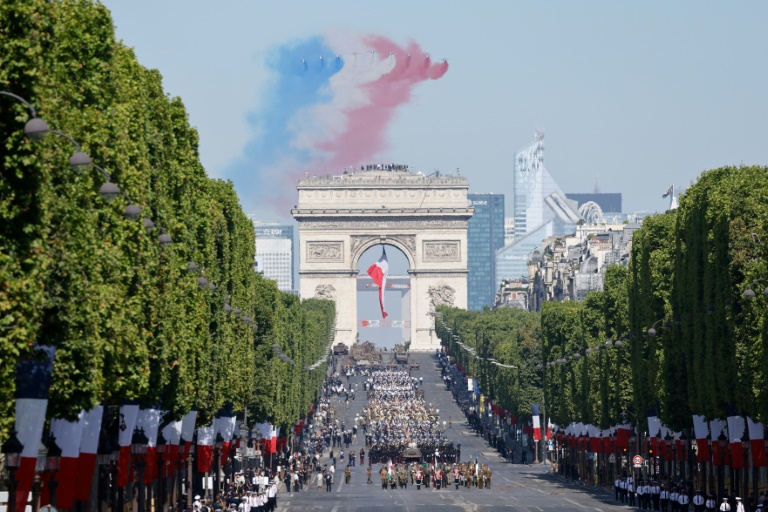
The war in Ukraine made its mark on Paris’s traditional Bastille Day military parade on Thursday as France honoured its eastern European NATO allies.

French troops deployed close to Ukraine since the Russian assault in February had a special place at the event, attended by President Emmanuel Macron, his government and French and foreign dignitaries.

“The parade is marked by, and takes account of, the strategic context,” an official in Macron’s office said. 

“The idea is to highlight the strategic solidarity with our allies.”

Almost five months after Russia invaded Ukraine, the parade on the Champs-Elysees opened with the presentation of the national flags of nine allied guest countries, most of them neighbours of Ukraine or Russia: Estonia, Latvia, Lithuania, Poland, the Czech Republic, Slovakia, Hungary, Romania and Bulgaria.

Troops representing France’s contingent on NATO’s eastern flank were next. Paris expedited the deployment of 500 troops to Romania days after the Russian attack on Ukraine, and has signalled its readiness to boost numbers if needed.

France also participates in ground and air operations in Estonia, and has sent Rafale fighter jets to bolster Poland’s air defences.

Macron’s increased military commitment to eastern Europe coincides with a reduction in French troops in Africa’s Sahel region. Paris will have no more than 2,300 troops stationed there by the end of the summer, down from more than 5,000 a year ago.

– ‘Produce more and faster’ –

In light of the Ukraine conflict and inflationary pressures, Macron has announced an increased defence budget.

On Wednesday, Macron asked the defence ministry to come up with a revision of the next procurement plan running to 2030.

“At a time when conflicts are intensifying, we must raise our targets,” he told a military gathering.

The ongoing war in Ukraine has revealed gaps in the military capabilities of France which, like several other western countries, has been sending aid and hardware to Ukraine that says it needs far more.

The current shift to artillery warfare in Ukraine especially has highlighted France’s lacking capacity to produce large amounts of ammunition quickly.

“We must absolutely re-invest in our stocks and our production capacity,” Macron said in a live TV interview marking Bastille Day Thursday.

“We must produce more and faster,” he said. “Those who predicted the end of high-intensity warfare got it wrong. Our military budget is not going to diminish, quite on the contrary.”.

The July 14 parade marks the anniversary of the 1789 assault by rebels on the Bastille, then a prison, an event that is credited with kicking off the French Revolution.

It is an annual opportunity to showcase France’s latest military hardware, in a spectacular setting attended by thousands of spectators lining the Champs-Elysees and viewed by millions more on TV.

Some 6,300 took part in Thursday’s parade, 5,000 of whom were on foot.

There was a respite from a severe heatwave engulfing France in recent days, with temperatures dropping to a manageable 25 Celsius in central Paris, much to the relief of the marchers in full uniform.

The show involved 64 planes, 25 helicopters, 200 horses and 181 motorised vehicles.

The air force demonstration, the parade’s most spectacular part, included aircraft from European allies and the Patrouille de France fighter jet squadron — already seen flying over the Cannes Film Festival this year for the world premiere of “Top Gun: Maverick” starring Tom Cruise.

Their roar could be heard even from far away as they released smoke, drawing the French flag’s blue-white-red colours across the sky.

The Reaper drone, used in the Sahel in the hunt for jihadists, made its first Bastille Day appearance.

Like countless other cities across France, Paris has scheduled gigantic fireworks after nightfall.

But some, like Nimes in southwestern France, have cancelled the event because of a high fire risk brought on by unseasonal heat.

burs-jh/jv

Stocks, oil drop on fresh inflation spikes

Stock markets mostly retreated Thursday as fresh evidence of runaway global inflation ramped up expectations of more aggressive interest rate hikes by central banks.

Eurozone inflation will end the year at 7.6 percent, much higher than previously forecast, the EU said Thursday.

The prediction comes one day after US inflation came in at a blistering 9.1 percent last month, the highest level for more than 40 years, as the Ukraine war fuelled energy prices.

US producer prices rose by a faster-than-expected 1.1 percent in June from the previous month, data released Thursday showed.

Market watchers are now wondering whether the Federal Reserve could hike US borrowing costs by a full percentage point at a scheduled policy meeting this month.

The central bank in June unveiled its first 75 basis-point rise in three decades and is one of dozens to hike rates. 

Singapore and the Philippines became the latest to tighten policy Thursday, a day after Canada, New Zealand, Chile and South Korea announced hikes.

The US inflation reading followed last week’s news of a surprise spike in jobs creation, which suggested the world’s top economy was withstanding the rate hikes, giving the Fed more room for further increases.

“Stubbornly high inflation increases the risk that the (Fed) continues to hike aggressively and triggers a recession,” said Kristina Clifton at Commonwealth Bank of Australia, adding that belief was picking up momentum on trading floors.

The European Commission on Thursday slashed growth forecasts for the eurozone, saying the consequences from the war in Ukraine were continuing to destabilise the economy.

Growing fears of a global recession sent oil prices tumbling, with the main US contract, WTI, losing more than five percent.

Federated Hermes senior economist Silvia Dall’Angelo said that while commodity prices were off their recent peaks, they remained elevated amid risks of further supply shocks.

The Fed’s drive to tighten monetary policy continues to send the dollar higher, and on Wednesday it finally rose above parity with the euro for the first time since late 2002, before falling again.

The euro fell back below parity once again shortly after US markets opened.

Europe’s main stock indices were down around 1.5 percent in afternoon trading, with Milan down more than three percent over fears political tensions within Prime Minister Mario Draghi’s coalition government could bring it crashing down and spark snap elections.

Former anti-establishment Five Star Movement did not support the government in a confidence vote, despite Draghi’s warning that his cabinet would not carry on without it.

On Wall Street stocks tumbled with the Dow falling two percent as data showed wholesale price rises accelerating and bank earnings disappointing. 

JPMorgan Chase reported a drop in second-quarter profits, reflecting the impact of a weakening macroeconomic outlook that led it to set aside funds in case of bad loans.

The big US bank’s earnings came in at $8.6 billion for the quarter, down 28 percent from the year-ago period in results that missed analyst expectations.

Chief Executive Jamie Dimon said key elements in the US economy remained healthy, but that macroeconomic headwinds including inflation “are very likely to have negative consequences on the global economy sometime down the road”.

The bank’s shares fell 3.8 percent as trading got underway.

– Key figures at around 1330 GMT –

London – FTSE 100: DOWN 1.5 percent at 7,052.94 points

Frankfurt – DAX: DOWN 1.6 percent at 12,548.59

Paris – CAC 40: DOWN 1.4 percent at 5,917.51

EURO STOXX 50: DOWN 1.5 percent at 3,401.76

New York – Dow: DOWN 2.0 percent at 30,155.37

Tokyo – Nikkei 225: UP 0.6 percent at 26,643.39 (close)

Hong Kong – Hang Seng Index: DOWN 0.2 percent at 20,751.21 (close)

Shanghai – Composite: DOWN 0.1 percent at 3,281.74 (close)

Euro/dollar: DOWN at $0.9956 from $1.0061 Wednesday

Pound/dollar: DOWN at $1.1770 from $1.1893 

Euro/pound: DOWN at 84.57 pence from 84.59 pence

Dollar/yen: UP at 139.21 yen from 137.36 yen

West Texas Intermediate: DOWN 5.2 percent at $91.32 per barrel

Brent North Sea crude: DOWN 4.4 percent at $95.21 per barrel

burs-rl/bp

Biden talks joint investment with Israel, India, UAE

US President Joe Biden held joint investment talks Thursday with Israel, India and the United Arab Emirates, as Washington seeks to counter the global reach of China.

The multilateral summit was convened in Jerusalem where Biden is on his first Middle East tour as president, with leaders from India and the UAE joining remotely.

During the summit the UAE announced it would invest 2 million euros (dollars) in agricultural projects in India, which will supply the land.

Private firms from Israel and the US will be invited to also finance the scheme.

An Indian solar and wind energy project was also discussed in Jerusalem.

Biden joined the summit before speaking alongside Israeli Prime Minister Yair Lapid, during which the president said he wants to secure US interests in the Middle East.

“I want to make clear that we can continue to lead in the region and not create a vacuum, a vacuum that is filled by China, and or Russia, against the interest of both Israel and the United States, and many other countries,” Biden said.

The president departs for Saudi Arabia on Friday, following talks with Palestinian president Mahmud Abbas in the occupied West Bank.

UN urges Africa to swap commodities for tech

The UN’s trade body on Thursday said African economies were vulnerable to a triple shock as it urged governments to pave the way for tech startups that would  ease dependence on commodities.

“A recent analysis by the UN Global Crisis Response Group on Food, Energy and Finance, which analyses the global economic cost by the war in Ukraine, indicates that Africa and especially sub-Saharan Africa is now one of the world’s most exposed regions to the current crisis,” Rebeca Grynspan, secretary-general of the United Nations Conference on Trade and Development (UNCTAD), said at the launch of the body’s latest Africa report. 

“One out of two Africans — that means over 600 million people — are severely vulnerable to food, energy and finance shocks, all at once,” she added.

The report recommended diversifying away from both commodities exports, on which many African economies continue to depend, and traditional service sectors — such as travel and transport — towards more knowledge-intensive services.

“We have been talking about diversification as long as I can remember, and how Africa can diversify its economy, and the fact is  that we’ve been looking at it through the lens of diversifying within the commodity sector,” said Paul Akiwumi, a director with UNCTAD. 

“Now it’s also very timely because of technology,” he added.

He pointed to budding fintech, healthtech, agritech, e-mobility and other tech-focused sectors in African countries.  

“Africa has a growing educated middle class who need these jobs, and these types of small and medium size enterprises provide high skilled jobs — operational officers, finance officers, government liaison relations officers, software engineers, HR managers, administrative accountants,” he said. 

Akiwumi said governments must provide entrepreneurs the necessary regulatory frameworks, as well as training and capacity building. 

He also said they must implement the African Continental Free Trade Area (AfCFTA) agreement, a trade pact that came into force last year, to scale up developments across the continent.

Russian strikes kill 20 as Zelensky urges 'special tribunal' for Moscow

Russian missiles struck Vinnytsia in central Ukraine Thursday, killing at least 20 people including three children, in what President Volodymyr Zelensky called “an open act of terrorism”.

The midday attack on the city hundreds of kilometres from the frontlines and invading Russian troops came as EU officials convened in The Hague to discuss war crimes in Ukraine.

The charred remains of upturned cars surround by burnt debris were seen in images distributed by officials next to a business gutted by a fire with brown smoke billowing nearby.

“There were eight rockets, two of which hit the centre of the city. Twenty people have died, including three children. There a large, large number of wounded,” Zelensky said during an address European official at The Hague.

The Ukrainian leader led a moment of silence before urging European and International Criminal Court officials during an address to open a “special tribunal” into Russia’s invasion.

“I believe it is inevitable that International Criminal Court will bring accountability to those guilty of crimes under its jurisdiction: war crimes, crimes against humanity, genocide.”

– War crimes tribunal –

The ICC in The Hague opened an investigation into possible war crimes in Ukraine just days after Moscow’s forces invaded and it dispatched dozens of investigators to the country to gather evidence.

Russia invaded on February 24 and the conflict has seen thousands of people killed, destroyed cities and forced millions to flee their homes.

“Every day, Russia kills civilians, kills Ukrainian children, carries out missile attacks on the civilian facilities where there is no military target. What is this, if not an open act of terrorism?” Zelensky said after the Vinnytsia attack.

A Ukraine military spokesman said its forces had managed to knock out two from a barrage of cruise missiles that were launched from a Russian submarine in the Black Sea and caused widespread damage in Vinnytsia.

Deadly strikes in central Ukraine have become relatively rare, but the war has raged around cities like Mykolaiv in the south which the presidency said was hit by a “massive missile strike”.

“Two schools, transport infrastructure and a hotel were damaged,” the presidency said in its morning military update early Thursday.

The skeletal insides of one building gutted by the strikes were visible in images distributed by local officials, with municipal workers clearing bricks and rubble strewn after the attack.

The heaviest fighting in Ukraine, however, has focused recently on the industrial Donbas region in the east.

– ‘Total victory’ –

Moscow-backed troops there said Thursday they were closing in on their next target, after wresting control of sister cities Lysychansk and Severodonetsk two weeks ago.

“Siversk is under our operational control, which means that the enemy can be hit by our aimed fire all over the area,” a pro-Moscow rebel official, Daniil Bezsonov, was cited as saying by Russian state-run news agency TASS.

In a Ukrainian trench position along the eastern frontline, a 25-year-old soldier who goes by the nom de guerre Moryak was working to fortify defences.

“We hide when they shell, we dig when it’s calm,” another soldier nearby told AFP journalists.

A fellow serviceman in their trench dismissed the idea Ukrainian and Russian forces could reach an agreement to halt fighting, explaining their goal was “total victory”.

– High-stakes grain talks –

Several rounds of negotiations to end the fighting at the beginning of the conflict fell through, but delegations from Kyiv and Moscow met in Istanbul this week to discuss unblocking Ukraine’s grain exports.

The meeting involving UN and Turkish officials ended after more than three hours with an agreement to meet again in Turkey next week.

Zelensky said “the entire world” was counting on the negotiations to finalise a deal.

The conflict has pushed up grain prices and Europe is suffering from sky-rocketing energy bills stemming from sanctions on Russia and Moscow’s move to limit gas flows to Europe.

US Treasury Secretary Janet Yellen said Thursday that Russia’s war in Ukraine posed the “greatest challenge” to the global economy, as G20 ministers prepare to start talks in Indonesia.

The European Commission meanwhile slashed growth forecasts for the eurozone, saying the consequences from the war in Ukraine were continuing to destabilise the economy because of record high inflation.

burs-jbr/cdw

UK gallery unearths hidden Van Gogh self-portrait

A gallery in Scotland said Thursday it was “thrilled” to announce the discovery of a previously unknown self-portrait of Vincent Van Gogh, with his ear intact, hidden behind another painting.

The portrait was found on the back of the canvas of “Head of a Peasant Woman”, an 1885 work by the Dutch post-Impressionist, covered by layers of glue and cardboard.

It shows a bearded sitter in a brimmed hat with a neckerchief tied loosely at the neck. It was completed before Van Gogh cut off his left ear in 1888.

Visitors to the National Galleries of Scotland in Edinburgh will be able to see it at a forthcoming exhibition, as an X-ray image through a specially designed lightbox.

Longer term, curators are working on safely extracting it from the overlaying canvas without damaging the paintings.

Lesley Stevenson, senior paintings conservator at the National Galleries, said they were “thrilled to bits” at the find.

“When we saw the X-ray for the first time of course we were hugely excited,” she said.

“This is a significant discovery because it adds to what we already know about Van Gogh’s life.

“There is lots to think about with regards to the next steps, but for us it is another little nugget to get us a little bit closer to an incredible artist.”

– Cardboard stuck on it –

Curators believe the painting, which was only sold after his 1890 death by suicide, is one of a series of experimental self-portraits.

Five similar works are displayed at the Van Gogh Museum in Amsterdam, painted before he moved to Paris in 1886.

Van Gogh, who was unknown and penniless when he died, often painted on both sides of a canvas in order to save money. 

The main painting was gifted to the gallery in 1960 by Edinburgh lawyer Alexander Maitland, and depicts a local woman from a town in the southern Netherlands where the artist lived from 1883 to 1885.

The self-portrait is believed to have disappeared from public view in around 1905, when it was deemed the less finished of the two pieces and had cardboard stuck on it before being framed.

The uncovered work is believed to date from the period when Van Gogh first encountered the work of the French impressionists. He later adopted the expressive, colourful style that has made his works among the most famous in the world.

The artist suffered from depression, and cut off his ear with a razor shortly before Christmas 1888 after suffering from what the hospital called “acute mania with generalised delirium”.

After spending time in an asylum, the 37-year-old Van Gogh shot himself in the chest on July 27, 1890.

He was able to walk and find medical help, but nobody could remove the bullet and he died two days later from an untreated infection. 

According to his brother Theo, his last words were: “The sadness will last forever.”

Swedish court jails ex-Iran official for life over 1988 executions

A Swedish court on Thursday handed a life sentence to former Iranian prison official Hamid Noury for crimes committed during a 1988 purge of dissidents, in the first trial related to the mass executions.

Noury, 61, was convicted of a “serious crime against international law” and “murder”, the Stockholm district court said in a statement. 

“The sentence is life imprisonment.” 

According to the court, Noury was an assistant prosecutor in a prison near Tehran at the time of the events.

“The investigation has shown that the accused, jointly and in collusion with others, participated in the commission of the criminal acts,” the court said.

“He has, under an alias and in the role of assistant to the deputy prosecutor, retrieved prisoners, brought them to the committee and escorted them to the execution site.” 

The proceedings, which have been running since August 2021, have strained relations between Sweden and Iran, raising concerns about reprisals against Western prisoners held by the Islamic regime. Two Swedish-Iranian citizens are on death row.

The case related to the killing of at least 5,000 prisoners across Iran, allegedly ordered by supreme leader Ayatollah Khomeini.

The killings were to avenge  attacks carried out by exiled opposition group the People’s Mujahedin of Iran (MEK) at the end of the Iran-Iraq war of 1980-88.

Noury was sentenced both for his role in the killings targeting the MEK and for participating in a second wave directed at “left-wing sympathisers who were deemed to have renounced their Islamic faith,” the court said. 

The charge of “a serious crime against international law” related to the first wave and the “murder” charge related to the second.

– ‘We won this time’ –

Throughout the nine months of hearings, Noury, often theatrical and smiling, rejected the testimony of former detainees.

He argued that he was on leave during the period in question, and said he worked in another prison. Noury denounced the accusations as a plot by the MEK to discredit the Islamic Republic.

Noury’s lawyer Thomas Soderqvist told AFP they were “disappointed”, and that they would now review the verdict.

“The sentence will be appealed,” Soderqvist added.

Noury was arrested at a Stockholm airport in November 2019 after Iranian dissidents in Sweden filed police complaints against him.

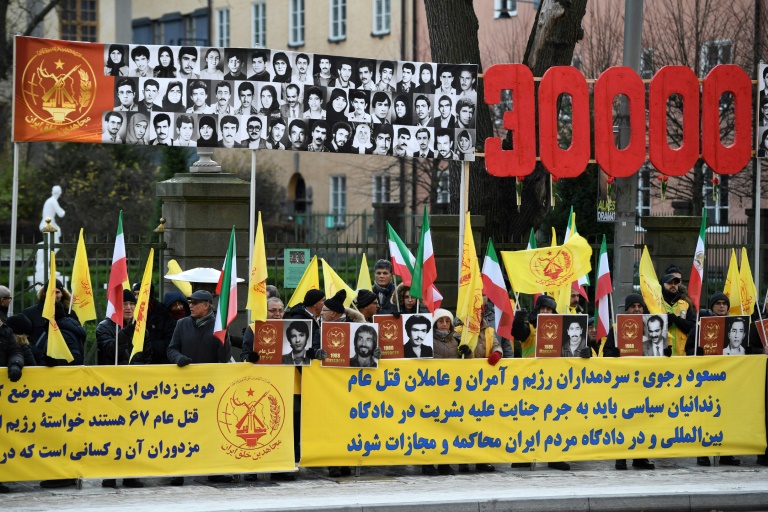
During the trial, which briefly relocated to Albania to hear  testimony at the end of 2021, MEK supporters protested loudly outside the Stockholm courthouse, and a few hundred had gathered ahead of the verdict.

“We won this time,” protesters chanted as they cheered and waved flags after the verdict.

“This is a great day for me, a great day for all the victims’ families,” Mehri Emrani, a 61-year-old MEK supporter who served in prison herself and whose husband was a plaintiff, told AFP.

“This is not only against Hamid Noury, this decision is against the whole regime in Iran,” Kenneth Lewis, a lawyer for the plaintiffs, told reporters on the steps of the courthouse.

The trial has rendered Stockholm’s already chilly relations with Tehran even frostier.

This is partly because rights activists accuse senior Iranian officials now in power — including current President Ebrahim Raisi — of having been members of the committees that handed down the death sentences.

The so-called “death committees” are thought to have sent at least 5,000 to be executed. The MEK puts the figure as high as 30,000 victims.

Raisi himself has denied ever having been part of these committees.

– ‘Hostage’ –

Tehran has repeatedly called on the Swedish government for Hamid Noury’s release. 

Swedish Foreign Minister Ann Linde reaffirmed to her Iranian counterpart in early July that the government was unable to do anything as the Nordic country’s courts are “completely independent”.

Concerned about a recent spate of arrests of Europeans in the country “for no apparent reason”, Sweden has been advising  citizens against travel to Iran since late June. 

The main concern is the Iranian-Swedish academic Ahmadreza Djalali. Sentenced to death in Iran in 2017 on espionage charges, and currently awaiting the sentence to be carried out.

Amnesty International has accused Tehran of holding him “hostage” in an attempt to force an exchange with Noury and a former Iranian diplomat sentenced to 20 years in prison in Belgium, Assadollah Assadi. 

A controversial treaty is being considered by the Belgian parliament that would allow the exchange of prisoners with Iran. 

Outage hits Twitter service in US, Europe

Twitter experienced a widespread but seemingly brief outage in the United States and parts of Europe on Thursday — fresh turbulence for the firm locked in a buyout battle with Elon Musk.

The Downdetector website showed that outage reports spiked in the United States around 8:00 am (1200 GMT), while users reported service interruptions in France and elsewhere.

However, by around 1245 GMT reports of outages to Downdetector were dropping off and users were back on the social media platform joking about the disruption.

“I’ve just had my most productive 30 minutes for years. In unrelated news, it seems Twitter went down for 30 minutes,” tweeted @joelyagar.

Twitter did not immediately respond to a request for comment.

Service disruptions on social media platforms happen periodically, but major and long-term service outages are not common.

The service problems on Twitter come as the company has embarked on a legal fight with Musk over his moves to walk away from his $44 billion buyout bid that has roiled the company.

Twitter has sued to force Musk to complete the deal after he said he was terminating it over issues including his argument that the company has not been forthcoming about the number of fake accounts.

Close Bitnami banner
Bitnami