World

Death toll climbs to 11 in Italy glacier collapse

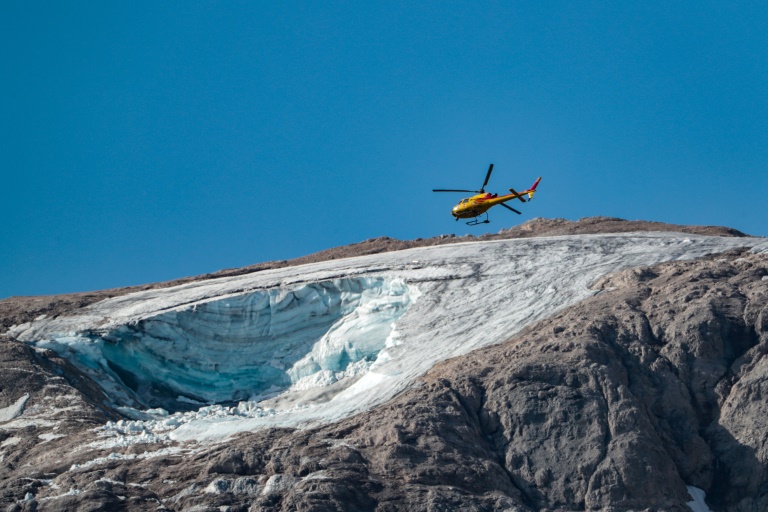
The number of people killed in an avalanche in the Italian Dolomites rose to 11 on Saturday, which was expected to be the final death toll, police said.

A section of Italy’s biggest Alpine glacier gave way last Sunday, sending ice and rock hurtling down the mountain, in a disaster blamed by officials on climate change.

“We have identified all the victims,” said Colonel Giampietro Lago, from the police scientific department.

“We’ve reached a toll of 11. As of today, we have no indications to make us think more people could be involved,” he said.

The search operation continued, however, and further materials were found on Saturday around the Marmolada glacier, said Maurizio Fugatti, president of the northern autonomous province of Trentino.

“The search goes on with drones and we will do the same thing tomorrow,” he said.

The public prosecutor’s office in Trentino has launched an inquiry into the cause of the disaster with some families accusing the authorities of leaving the glacier open despite clearly dangerous climbing conditions.

The avalanche struck one day after a record-high temperature of 10 degrees Celsius (50 degrees Fahrenheit) was recorded at the summit of Marmolada.

Sri Lanka leader flees as protesters storm home, office

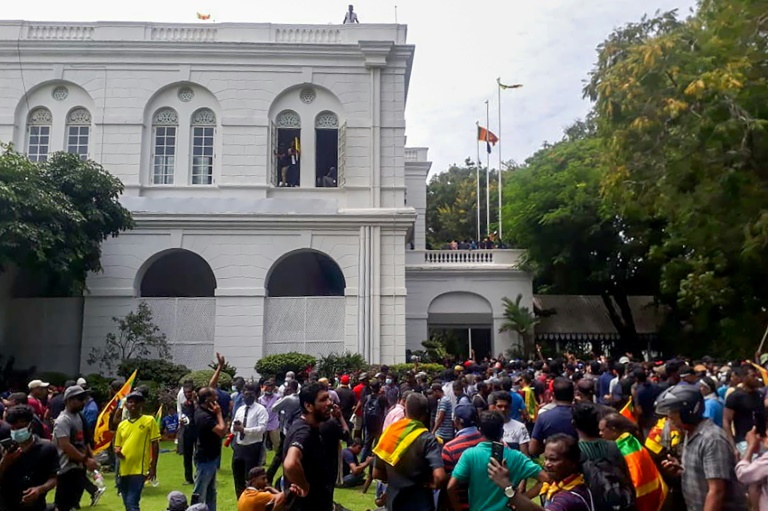
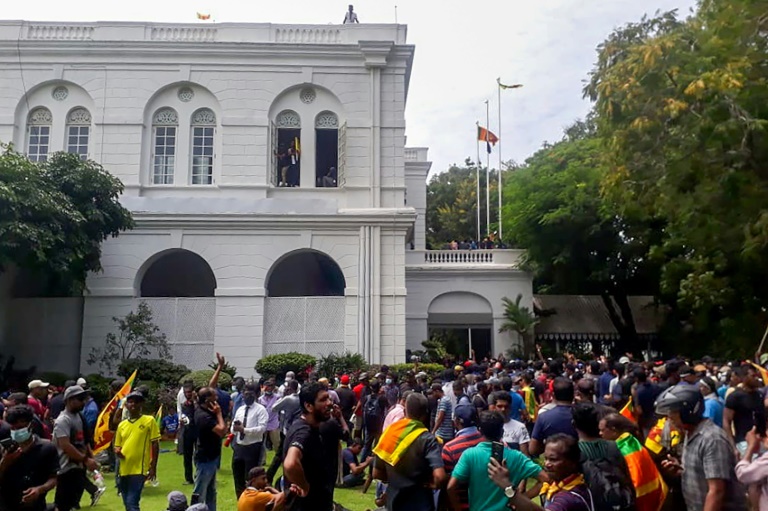
Sri Lanka’s President Gotabaya Rajapaksa fled his official residence on Saturday shortly before protesters, angered by an unprecedented economic crisis, overran the compound and stormed his nearby office.

Hundreds of thousands of people massed on the streets around the leader’s home, according to police estimates, to demand he step down over the government’s mismanagement of the unprecedented downturn. 

After storming the gates of the presidential palace, hundreds of people could be seen in live broadcasts on social media walking through its rooms, with some among the boisterous crowd jumping into the compound’s pool. 

Some were seen laughing and lounging in the stately bedrooms of the residence with one pulling out what he claimed was a pair of the president’s underwear.

Not long earlier, troops guarding the residence fired in the air to hold the crowd back until Rajapaksa was safely removed.

“The president was escorted to safety,” a top defence source told AFP on condition of anonymity. “He is still the president, he is being protected by a military unit.”

The colonial-era mansion he left is one of Sri Lanka’s key symbols of state power, and officials said Rajapaksa’s departure raised questions as to whether he intended to remain in office.

“We are awaiting instructions,” a top civil servant told AFP. “We still don’t know where he is, but we know he is with the Sri Lanka navy and is safe.”

Soon after the crowd stormed the presidential palace, Rajapaksa’s nearby seafront office also fell into the hands of protesters.

Three people were hospitalised after being shot along with 36 others who suffered breathing difficulties following intense tear gas barrages near the president’s house, a spokeswoman for the main hospital in Colombo said.

Security forces attempted to disperse the huge crowds that had mobbed Colombo’s administrative district.

Prime Minister Ranil Wickremesinghe, who would assume the presidency in the event of Rajapaksa’s resignation, called an urgent cabinet meeting to discuss a “swift resolution” to the political crisis.

– ‘Not a deterrent’ –

Sri Lanka has suffered through months of food and fuel shortages, lengthy blackouts and galloping inflation after running out of foreign currency to import vital goods.

The government has defaulted on its $51 billion external debt and is seeking an International Monetary Fund bailout.

Thousands of people had poured into the capital for Saturday’s demonstration, the latest outbreak of unrest sparked by the crisis.

Police had withdrawn a curfew issued on Friday after opposition parties, rights activists and the bar association threatened to sue the police chief.

Thousands of anti-government protesters ignored the stay-home order and even forced railway authorities to operate trains to take them to Colombo for Saturday’s rally, officials said.

“The curfew was not a deterrent, in fact it encouraged more people to get on the streets in defiance,” the defence official said.

Sri Lanka has nearly exhausted already scarce supplies of petrol, but protesters backed by the main opposition parties hired private buses to travel to the capital.

Other Sri Lankans unable to travel to the capital held protests in cities across the island. 

Demonstrators had already maintained a months-long protest camp outside Rajapaksa’s seafront office demanding his resignation. 

The camp was the scene of clashes in May when a gang of Rajapaksa loyalists attacked peaceful protesters gathered there. 

Nine people were killed and hundreds were wounded after the violence sparked reprisals against pro-government mobs and arson attacks on the homes of lawmakers. 

– Cricket goes on –

The unrest comes at the tail end of Australia’s ongoing cricket tour of Sri Lanka, with Pakistan’s squad also on the island for their upcoming series. 

Cricket officials said there were no plans to change their schedules, adding that the sport was unaffected by the political turmoil.

“The Australian Test is coming to an end and we are due to start the Pakistan series,” a cricket board official told AFP. 

“There is no opposition to having the games. In fact, fans are supportive and we have no reason to reschedule.”

US, China top diplomats hold 'constructive' first talks in months

The United States and China held constructive talks Saturday, the two sides said, after an unusually long meeting aimed at preventing bilateral tensions from spiralling out of control.

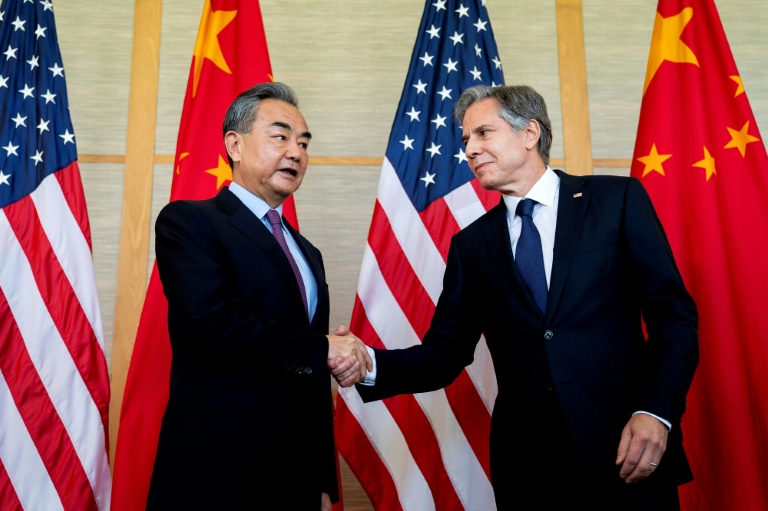
US Secretary of State Antony Blinken and Chinese Foreign Minister Wang Yi held their first talks since October on the Indonesian island of Bali as the two powers stepped up interaction at a time when the West is focused on Russia’s invasion of Ukraine.

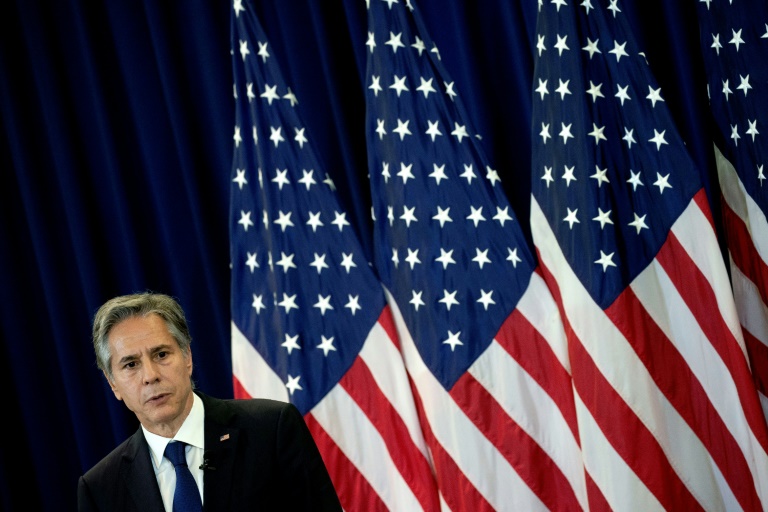
“Despite the complexities of our relationship, I can say with some confidence that our delegations found today’s discussions useful, candid and constructive,” Blinken said after five hours of talks.

“The relationship between the United States and China is highly consequential for our countries but also for the world. We are committed to managing this relationship — this competition — responsibly,” he said, promising to keep open channels of diplomacy with Beijing.

China’s foreign ministry said the two sides had broadly agreed to work to improve ties — but also reeled off a laundry list of grievances against Washington, accusing the United States of “smearing and attacking” its political system.

“The two sides… reached a consensus to promote the Sino-US joint working group consultation to achieve more results,” it said, reporting they “also agreed to strengthen cooperation on climate change and public health”.

“Both sides believe that this dialogue is substantive and constructive, which will help enhance mutual understanding, reduce misunderstandings and misjudgements, and accumulate conditions for future high-level exchanges between the two countries,” it added.

The meeting, in which the pair held morning talks and then a working lunch, largely focused on preventing competition spilling over into unintentional conflict but also Washington’s opposition to Beijing on a range of issues including Taiwan and human rights.

“I conveyed deep concerns of the United States regarding Beijing’s increasingly provocative rhetoric and activity towards Taiwan and the vital importance of maintaining peace and stability across the Taiwan Strait,” Blinken said.

He also voiced concerns over Ukraine, pressing Wang on Beijing’s tacit support of Moscow’s invasion of its neighbour and calling for it to distance itself from Russia a day after the Kremlin’s top diplomat faced a barrage of Western criticism at the G20 talks.

“This really is a moment where we all have to stand up, as we heard country after country in the G20 do, to condemn the aggression, to demand among other things that Russia allow access to food that is stuck in Ukraine,” Blinken said.

US officials have also been cautiously upbeat about China’s stance on Ukraine, condemning its rhetorical backing of Russia but seeing no sign that Beijing is backing its words with material support.

Before the meeting started, Wang told reporters Chinese President Xi Jinping believed in cooperation as well as “mutual respect” between the world’s two largest economic powers and that there needed to be “normal exchanges” between them.

“We do need to work together to ensure that this relationship will continue to move forward along the right track,” Wang said in front of US and Chinese flags.

– Moderating tone –

It was Blinken and Wang’s first in-person meeting in months, and they are expected to prepare for virtual talks in the coming weeks between Xi and President Joe Biden as both powers increase engagement and moderate their tone.

After a long chill during the pandemic between the two countries, since last month their defence, finance and national security chiefs as well as their top military commanders have all spoken.

China’s state-run Global Times, known for its criticism of the United States, wrote that the growing diplomacy “underscored the two sides’ consensus on avoiding escalating confrontation”.

US views of China have hardened in recent years and Biden has largely maintained the substance of his predecessor Donald Trump’s hardline approach of treating Beijing as the pre-eminent global competitor of the United States.

But Blinken in a recent speech made clear that the United States was not seeking a new “Cold War”, even as he held firm on criticism — including accusing Beijing of genocide against the mostly Muslim Uyghur people, an accusation he repeated after Saturday’s talks.

The Biden administration is widely expected soon to ease some of Trump’s tariffs on Chinese goods, a move that could ease soaring inflation, which has become a major political liability in the United States.

Xi, China’s most powerful leader in decades, is expected to shake up the foreign policy team at the Communist Party’s National Congress later this year.

But Craig Singleton, who follows China at the hawkish Washington-based Foundation for Defense of Democracies, expected Xi to again appoint technocrats who can work with Washington.

“The reason is simply — China’s economy is facing considerable headwinds and Chinese policymakers appear eager to recognise that China’s aggressive rhetoric has backfired,” he said.

'Relentless' Russian shelling pounds east Ukraine

Russian troops pursued their “relentless” shelling of Ukraine’s eastern Donetsk region on Saturday as Ukrainian officials warned Moscow was preparing for further attacks and Washington promised new military aid to Kyiv.

Having endured long battles to capture cities in the neighbouring Lugansk region, Russia is now seeking to push deeper into Donetsk to consolidate its hold over the entire Donbas region. 

Air raid sirens sounded overnight throughout the country’s east and south.

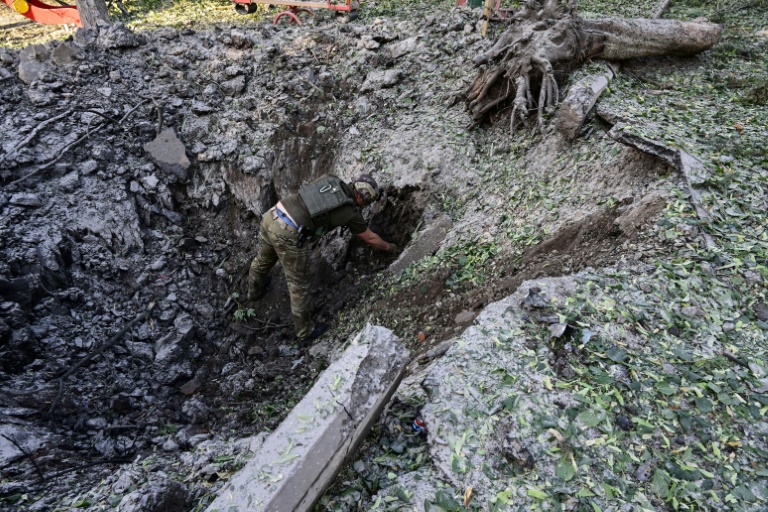
Residents in the small town of Druzhkivka, south of the eastern Ukrainian industrial city of Kramatorsk, woke up to a suspected missile attack on Saturday which ripped apart a supermarket and left a massive crater outside.

Ukrainian officials said on Saturday five people were killed in the Donetsk region in the past 24 hours while seven were injured.

“The entire frontline is under relentless shelling,” Donetsk military administration chief, Pavlo Kyrylenko said in a Telegram message on Friday night. 

He said the city of Sloviansk, on which Moscow’s troops have now set their sights, is being “shelled day and night”. 

He also accused Russian forces of setting agricultural fields on fire, saying they were “trying to destroy the harvest by all means”.  

Lugansk governor Sergiy Gaiday, said on Saturday the Russians were attacking Donetsk from their bases in his region.

“We are trying to contain their armed formations along the entire frontline… Where it is inconvenient for them to go forward, they create real hell, shelling the territories on the horizon,” he said.

Kyrylenko warned the Russians were in the process of replenishing troops in the region to prepare for further assaults.

Oleksandr Vilkul, the mayor of President Volodymyr Zelensky’s hometown of Kryvyi Rih in central Ukraine, said on Saturday Russia had attacked the city with cluster munitions, killing at least one person and injuring two.

– ‘Terrorising cities’ –

Zelensky said in his nightly address on Friday he had spent the day on the frontlines in the eastern Dnipropetrovsk region, where he met civilian and military leaders. 

“The eyes of all aggressive political movements and regimes in the world are now focused on what Russia is doing against us, against Ukraine,” Zelensky  said Saturday in an Instagram post.

“Will the world be able to bring real war criminals to justice?” he asked, warning failure to do so would lead to “hundreds of other aggressions”.

But in a Telegram message on Saturday, an official from the region’s military administration warned Russia had “intentionally shelled residential areas”, and had not stopped “terrorising” cities and villages.

The Ukrainian general staff said the majority of bombardments took place in east Ukraine and the second-largest city of Kharkiv but there was no ground offensive.

In the south, the mayor of Mykolaiv begged citizens not to leave shelters, as he said explosions were heard throughout the night. 

Ukraine’s Deputy Prime Minister Iryna Vereshchuk was quoted by Ukrainian media as urging people in occupied areas to evacuate by any means possible. 

“Massive fighting is going to happen,” she said.

Kharkiv governor Oleg Sinegubov on Saturday said four people were injured in attacks on the region, adding that the Russians were “engaged in defensive actions”.

– ‘Further evolution of support’ –

In a boost to Kyiv, Washington announced $400 million of further military aid, including a type of artillery ammunition with “greater precision”, and that has previously not been sent. 

“It’s a further evolution in our support for Ukraine in this battle in the Donbas,” a senior defence official was quoted by the US Department of Defense as saying. 

Also included in the aid package are four additional High Mobility Artillery Rocket Systems to add to eight already in place. 

“From a security assistance perspective, this is a steady drumbeat now, and it is a long-term commitment to Ukraine,” the same official was quoted as saying. 

Britain’s defence ministry on Saturday said the first group of up to 10,000 inexperienced Ukrainian military recruits began training in England as part of a UK-led programme.

– US urges China to condemn ‘aggression’ –

The United States also put pressure on Russia diplomatically at a meeting of Group of 20 foreign ministers in Indonesia. 

Washington and allies condemned Russia’s assault ahead of the gathering before Russian Foreign Minister Sergei Lavrov faced what US Secretary of State Antony Blinken called a barrage of Western criticism at the closed-door talks.

Blinken on Saturday called for China to distance itself from Russia after talks with his Chinese counterpart in Indonesia.

Blinken said he told Wang Yi “this really is a moment where we all have to stand up, as we heard country after country in the G20 do, to condemn the aggression, to demand among other things that Russia allow access to food that is stuck in Ukraine”.

He added there were “no signs” Moscow was willing to engage after the G20 talks.

“If there is an opportunity for diplomacy, we will seize it,” he said.

Lavrov was defiant Friday and accused Western nations of avoiding “talking about global economic issues” instead of the war.

burs-raz/bp

Sri Lanka leader flees as protesters storm home, office

Sri Lanka’s President Gotabaya Rajapaksa fled his official residence on Saturday shortly before protesters, angered by an unprecedented economic crisis, overran the compound and stormed his nearby office.

Thousands of people had surrounded the leader’s home to demand his resignation, blaming government mismanagement for a downturn that has subjected the island nation’s 22 million people to months of bitter hardship.

As the crowd surged at the gates of the presidential palace, troops guarding the compound fired in the air to hold them back until Rajapaksa was safely removed.

“The president was escorted to safety,” a top defence source told AFP on condition of anonymity. “He is still the president, he is being protected by a military unit.”

Footage broadcast live on social media showed hundreds of people walking through the palace, with some among the boisterous crowd jumping into the compound’s pool for a swim.

Others were seen laughing and lounging in the stately bedrooms of the residence. 

The colonial-era state mansion is one of Sri Lanka’s key symbols of state power and officials said Rajapaksa’s departure raised questions as to whether he intended to remain in office.

“We are awaiting instructions,” a top civil servant told AFP. “We still don’t know where he is, but we know he is with the Sri Lanka navy and is safe.”

Private broadcasters showed what appeared to be a vehicle convoy belonging to the president at Sri Lanka’s main international airport, but there was no confirmation on whether he had left the island.

Soon after the crowd stormed the presidential palace, Rajapaksa’s nearby office also fell into the hands of protesters.

Security forces attempted to disperse the huge crowds that had mobbed Colombo’s administrative district.

Three people were hospitalised after being shot along with 36 others who suffered breathing difficulties following intense tear gas barrages, a spokeswoman for the main hospital in Colombo said.

Prime Minister Ranil Wickremesinghe, who would assume the presidency in the event of Rajapaksa’s resignation, has called an urgent cabinet meeting to discuss a “swift resolution” to the political crisis.

– ‘Not a deterrent’ –

Sri Lanka has suffered through months of food and fuel shortages, lengthy blackouts and galloping inflation after running out of foreign currency to import vital goods.

Thousands of people had poured into the capital for Saturday’s demonstration, the latest outbreak of unrest sparked by the crisis.

Police had withdrawn a curfew issued on Friday after opposition parties, rights activists and the bar association threatened to sue the police chief.

Thousands of anti-government protesters ignored the stay-home order and even forced railway authorities to operate trains to take them to Colombo for Saturday’s rally, officials said.

“The curfew was not a deterrent, in fact it encouraged more people to get on the streets in defiance,” the defence official said.

“Passengers had commandeered trains to reach Colombo.”

The country has nearly exhausted already scarce supplies of petrol, but protesters backed by the main opposition parties hired private buses to travel to the capital. 

Demonstrators had for months been camped outside Rajapaksa’s seafront office to demand his resignation over the government’s mismanagement of the crisis.

Soldiers armed with assault rifles were bussed into Colombo on Friday to reinforce police guarding Rajapaksa’s official residence.

Authorities said they had deployed nearly 20,000 troops and police officers for a security operation to protect the president.

Sri Lanka has defaulted on its $51 billion external debt and has been in bailout talks with the International Monetary Fund. 

Nine people were killed and hundreds wounded when clashes erupted across the country after Rajapaksa loyalists attacked peaceful protesters outside the president’s office in May.

Blinken says 'no signs' at G20 of Russia engaging on Ukraine

US Secretary of State Antony Blinken said Saturday that Washington saw “no signs” of Russia engaging with G20 diplomats over its invasion of Ukraine after Moscow faced a barrage of criticism at talks in Indonesia.

Russia’s top diplomat Sergei Lavrov stormed out of a meeting with G20 foreign ministers on the resort island of Bali on Friday after Washington and its allies condemned Moscow’s assault on its neighbour during the closed-door talks.

“We saw no signs whatsoever that Russia is prepared to engage in meaningful diplomacy,” Blinken said after meeting with his Chinese counterpart Wang Yi on Saturday.

“If there is an opportunity for diplomacy, we will seize it.”

Lavrov walked out of a morning session on Friday as his German counterpart Annalena Baerbock criticised the invasion. He then left an afternoon session before Ukrainian Foreign Minister Dmytro Kuleba addressed the ministers virtually.

“There was a strong consensus and Russia was left isolated, as it has been many times since this war begin,” Blinken said.

“In fact, Foreign Minister Lavrov left the meeting early, maybe because this message had been so resoundingly clear.”

Speaking after an unusually long five hours of talks with Wang, Blinken said he had pressed Beijing on its tacit support of the invasion and called on China to distance itself from the Kremlin.

He also announced the United States would provide another $360 million in support to Ukraine, including for food, clean drinking water, emergency health care and shelter.

The G20 meeting in Indonesia came against the backdrop of raging battles in eastern Ukraine, and with tensions between Moscow and Western nations at their highest in decades.

Blinken snubbed a direct meeting with Lavrov and instead accused Russia of triggering a global food crisis, demanding Moscow allow grain shipments out of war-battered Ukraine.

“To our Russian colleagues: Ukraine is not your country. Its grain is not your grain. Why are you blocking the ports? You should let the grain out,” Blinken said in the closed-door session on Friday, according to a Western official present.

Lavrov had previously told reporters he would not “go running” after Washington for talks.

“It was not us who abandoned contact, it was the United States,” he said.

French Foreign Minister Catherine Colonna told AFP on Friday that the Russian diplomat left after finding little support on the Ukraine war. 

EU foreign policy chief Josep Borrell said Lavrov was not listening to his colleagues.

“That’s not the most constructive way to attend a G20 meeting,” he told AFP.

Thousands 'stone the devil' as packed hajj winds down

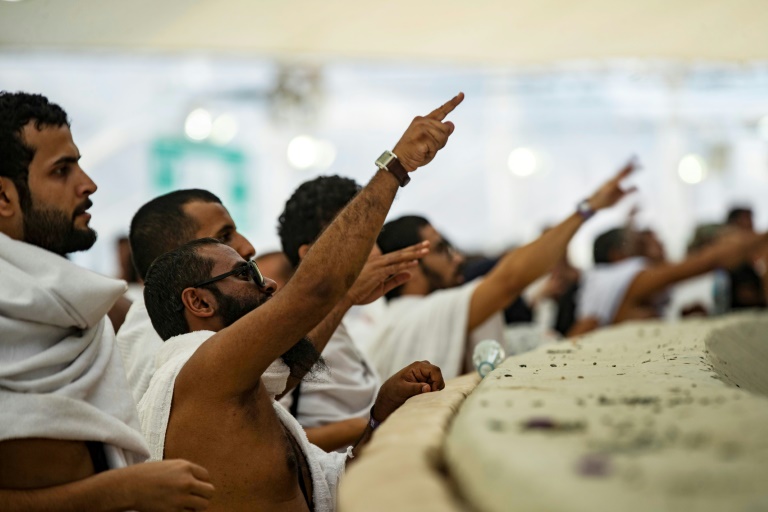
Thousands of Muslim pilgrims cast pebbles in the “stoning of the devil” ritual marking the start of the Eid al-Adha holiday Saturday, as a hajj pilgrimage that drew 900,000 visitors began winding down.

Enormous crowds of white-robed worshippers thronged Mina, near Mecca in western Saudi Arabia, for the stoning ritual where each threw seven pebbles at three large concrete walls representing Satan.

Deadly stampedes have previously overshadowed the ritual, the last major act of the hajj, but high temperatures and the ongoing Covid pandemic appeared the biggest immediate risk.

“I feel I am about to faint, hurry up,” said one woman, asking her companion to splash her face with water. No health or safety incidents were reported. 

The pilgrims threw stones that they had collected in nearby Muzdalifah. In 2020 and 2021, when Covid restrictions reduced numbers to tens of thousands, worshippers were handed sanitised pebbles in sealed bags.

The hajj started on Wednesday at the Grand Mosque in Mecca, Islam’s holiest site, before an overnight stay in tents and prayers on Mount Arafat, where the Prophet Mohammed is believed to have delivered his final sermon.

After the stoning ritual, pilgrims return to Mecca to perform a farewell “tawaf” — circling seven times around the Kaaba, the large black cube at the Grand Mosque that is the focal point of Islam.

– ‘Eid Mubarak’ –

An hour after sunrise on Saturday, the Kaaba was already surrounded by circumambulating pilgrims, while others at the Grand Mosque prayed on the first day of Eid. 

Facing the mosque, the Mecca Clock Tower — one of the world’s tallest buildings — displayed the message “Eid Mubarak” (blessed Eid) in green. 

Eid al-Adha, the feast of the sacrifice, marks the end of the hajj.

Muslims across the world celebrate the holiday, buying livestock for slaughter to commemorate the willingness of Abraham to sacrifice his son to show obedience to Allah.

The hajj, usually one of the world’s largest annual religious gatherings, is one of the five pillars of Islam and must be undertaken by all Muslims with the means at least once in their lives.

In 2019, some 2.5 million Muslims from around the world took part. 

But that figure slumped to only a few thousand in 2020 and 60,000 in 2021, all of them Saudi citizens or residents, as the kingdom tried to mitigate the effects of the Covid-19 pandemic. 

This year, participation was capped at one million fully vaccinated worshippers. Authorities said Friday that almost 900,000 were in attendance, nearly 780,000 of them from abroad.

– Covid fears –

Hosting the pilgrimage is a matter of prestige and a powerful source of political legitimacy for Saudi rulers, the custodians of Islam’s holiest sites. 

Barring overseas pilgrims for the past two years had caused deep disappointment among Muslims worldwide, who typically save for years to take part.

The hajj, which costs at least $5,000 per person, and umrah pilgrimages that occur at other times of the year are a major engine of Saudi Arabia’s tourism sector.

In normal times, they generate about $12 billion annually, keeping the economy humming in Mecca.

“We thank God the Almighty that we saw the pilgrims of his house, from different countries of the world, performing their rituals with ease,” tweeted Saudi ruler King Salman, 86.

The large crowds have spurred fears that Covid-19 will spread, especially after many pilgrims remained maskless against the orders of Saudi authorities. 

The hajj has been taking place against the backdrop of a resurgence of cases in the region, with some Gulf countries tightening restrictions to keep outbreaks in check.

All participants were required to submit proof of vaccination and pilgrims visiting from abroad also had to provide negative PCR tests.

Since the start of the pandemic, Saudi Arabia has registered more than 795,000 coronavirus cases, over 9,000 of them fatal. Some 67 million vaccine doses have been administered in the country of over 34 million people.

The hajj can be physically draining even in ideal conditions, but worshippers this year faced an added challenge: scorching sun and temperatures climbing to 44 degrees Celsius (111 Fahrenheit).

mah/rcb/th/dwo

'In pain, distraught': Japan devastated by Abe assassination

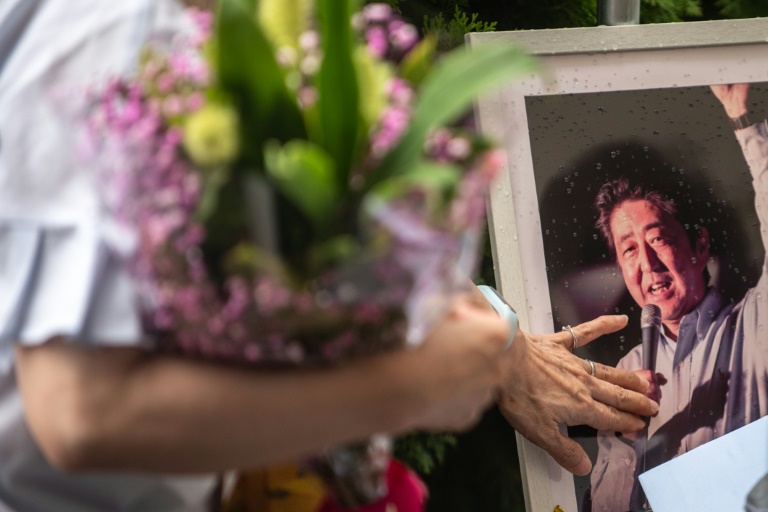
A day after the assassination of former prime minister Shinzo Abe, a steady stream of mourners, many in tears, arrived at the scene of his murder in western Japan to offer flowers and prayers.

People from all walks of life formed a long line on Saturday on the otherwise ordinary street outside a train station where Abe was shot while campaigning ahead of weekend elections.

Afternoon downpours did not deter the crowds who came to offer condolences, some having travelled great distances like 51-year-old Yoshikazu Tokudome, who flew hundreds of kilometres from the Tokyo region to the city of Nara.

“I’m just in pain, and I thought the least I could do was come here and lay some flowers,” the company worker told AFP.

When he heard about the death of Abe, Japan’s longest-serving prime minister, “I could understand what was being said in the news, but I just couldn’t accept it.”

Visitors like Tokudome bowed deeply with their eyes closed, some weeping as they laid flowers on a table in a tent set up near Yamato-Saidaiji Station.

Friday’s events unfolded rapidly, with Abe speaking confidently into a microphone before he was shot down and the suspect immediately tackled to the ground.

“It’s just shocking and I’m so sad. I was feeling really restless at home,” said Sumiko Hayashi, 50.

“I really liked him as a person, too,” she said, especially “the way he looked so happy with his wife.”

– ‘Security was lax’ –

As bouquet after bouquet was piled onto the table, it became a makeshift altar adorned by framed photos and cartoon illustrations of a smiling Abe, who was forced to resign from office in 2020 due to poor health.

Cans of beer and other drinks were also placed on the table for the politician to enjoy in the afterlife, but the overriding mood was sombre.

Wiping away tears, 52-year-old Kayoko Ueda, from the neighbouring region of Osaka, told AFP she was “distraught” and “couldn’t believe something like this could actually happen in Japan”.

Violent crime is very rare in the country, which also has some of the world’s strictest gun laws.

The suspect has been identified as 41-year-old Tetsuya Yamagami, who footage showed approaching Abe from behind and then opening fire with an apparently handmade gun.

The killing has sparked scrutiny over whether security measures at the stump speech were sufficient, and some mourners told AFP more could have been done.

“Security was lax. It exposed, I think, how Japan was complacent in thinking everything is safe here,” Ueda said. 

Akira Takahashi, a 54-year-old Osaka resident, agreed.

“High-ranking officials from overseas, like prime ministers and cabinet members, often visit Japan under the assumption that this is a safe country,” he said. 

“But I think security should be strengthened much more in the future.”

With tears in his eyes, Takahashi, who always thought highly of Abe, said that as he laid flowers, “I told him ‘thank you for everything, and please rest in peace.'”

16 dead in flash floods at Indian Kashmir pilgrimage site

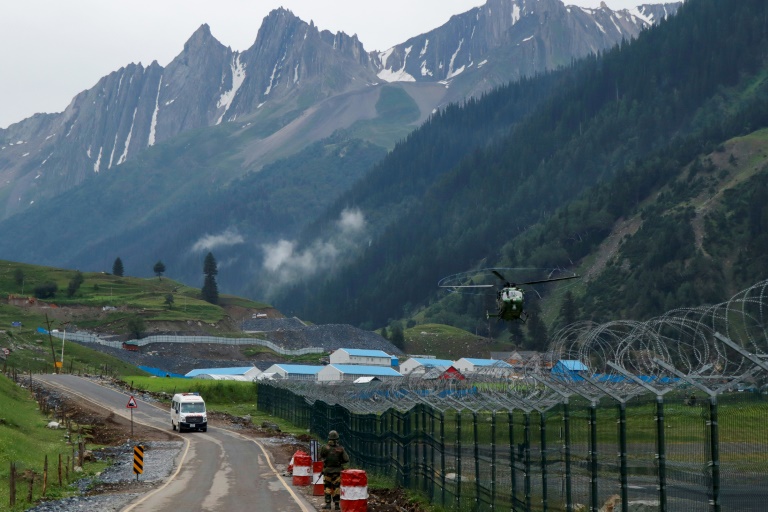
Sixteen people were killed in Indian-administered Kashmir, with rescuers searching for dozens more missing, after flash floods swept away hundreds of tents near a popular Hindu pilgrimage site, officials said Saturday.

Around 10,000 people were camped near the remote Amarnath temple, nestled in a Himalayan mountain cave, when a sudden cloudburst triggered a deluge.

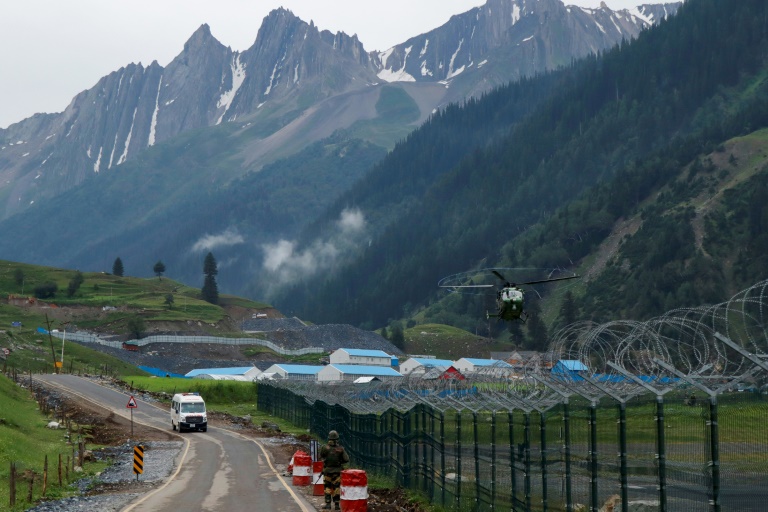
Frequent whirring helicopter sorties were evacuating the dead and an unknown number of panicked and injured pilgrims from the Baltal base camp to the north of the shrine. 

“We found 16 bodies so far and at least 40 are missing,” an official from the state disaster response agency told AFP.

“Security forces and all the rescue teams are looking for the missing and injured,” the official said on condition of anonymity, as he was not authorised to speak to media.

The Indian army said it had deployed two infantry battalions and special forces units to help with the search alongside search and rescue dog squads.

They have so far taken 63 people with injuries away for treatment, including to a field hospital set up by the army in mountains near the shrine. 

Rescuers were using handheld thermal imaging devices to look for victims who might be trapped under the mud, the army statement said.

Vivek, a pilgrim who escaped the destructive downpour, said that some of his family and members of the group he travelled to the site with were still missing. 

“We were a group of 150 and 30 of us are still stuck up there. Their phones are switched off.”

The annual pilgrimage sees hundreds of thousands of people trek up for days through rugged mountain passes to reach the shrine.

Visitors pay their respects to a large ice formation they believe is an incarnation of Shiva, the Hindu god of destruction. 

Prime Minister Narendra Modi and several senior government officials expressed their grief over the loss of life.

“Condolences to the bereaved families,” Modi tweeted late Friday.

– Treacherous weather –

The pilgrimage is being held for the first time since 2019 after a two-year halt brought on by the coronavirus pandemic.

In normal times it is one of the biggest religious events in Kashmir, a Muslim-majority region disputed between India and Pakistan that has long been the site of an insurgency against Indian rule.

This year the pilgrimage is being staged alongside a huge security deployment involving tens of thousands of soldiers and police.

But treacherous weather in the mountains has in the past posed a bigger threat than security issues in the restive territory.

Nearly 250 people died in 1996 when they were suddenly caught up in snowstorms that hit the area.

Heavy rains have lashed South Asia this monsoon season, with scores killed in June after flooding, landslides and lightning strikes in India’s remote northeast. 

More than 100 others were killed in Bangladesh the same month when rivers swelled to record levels and inundated rural villages after some of the heaviest rains in a century.

Floods are a regular menace in India and Bangladesh, but experts say climate change is increasing their frequency, ferocity and unpredictability.

16 dead in flash floods at Indian Kashmir pilgrimage site

Sixteen people were killed in Indian-administered Kashmir, with rescuers searching for dozens more missing, after flash floods swept away hundreds of tents near a popular Hindu pilgrimage site, officials said Saturday.

Around 10,000 people were camped near the remote Amarnath temple, nestled in a Himalayan mountain cave, when a sudden cloudburst triggered a deluge.

Frequent whirring helicopter sorties were evacuating the dead and an unknown number of panicked and injured pilgrims from the Baltal base camp to the north of the shrine. 

“We found 16 bodies so far and at least 40 are missing,” an official from the state disaster response agency told AFP.

“Security forces and all the rescue teams are looking for the missing and injured,” the official said on condition of anonymity, as he was not authorised to speak to media.

The Indian army said it had deployed two infantry battalions and special forces units to help with the search alongside search and rescue dog squads.

They have so far taken 63 people with injuries away for treatment, including to a field hospital set up by the army in mountains near the shrine. 

Rescuers were using handheld thermal imaging devices to look for victims who might be trapped under the mud, the army statement said.

Vivek, a pilgrim who escaped the destructive downpour, said that some of his family and members of the group he travelled to the site with were still missing. 

“We were a group of 150 and 30 of us are still stuck up there. Their phones are switched off.”

The annual pilgrimage sees hundreds of thousands of people trek up for days through rugged mountain passes to reach the shrine.

Visitors pay their respects to a large ice formation they believe is an incarnation of Shiva, the Hindu god of destruction. 

Prime Minister Narendra Modi and several senior government officials expressed their grief over the loss of life.

“Condolences to the bereaved families,” Modi tweeted late Friday.

– Treacherous weather –

The pilgrimage is being held for the first time since 2019 after a two-year halt brought on by the coronavirus pandemic.

In normal times it is one of the biggest religious events in Kashmir, a Muslim-majority region disputed between India and Pakistan that has long been the site of an insurgency against Indian rule.

This year the pilgrimage is being staged alongside a huge security deployment involving tens of thousands of soldiers and police.

But treacherous weather in the mountains has in the past posed a bigger threat than security issues in the restive territory.

Nearly 250 people died in 1996 when they were suddenly caught up in snowstorms that hit the area.

Heavy rains have lashed South Asia this monsoon season, with scores killed in June after flooding, landslides and lightning strikes in India’s remote northeast. 

More than 100 others were killed in Bangladesh the same month when rivers swelled to record levels and inundated rural villages after some of the heaviest rains in a century.

Floods are a regular menace in India and Bangladesh, but experts say climate change is increasing their frequency, ferocity and unpredictability.

Close Bitnami banner
Bitnami