World

Russians 'pushed away from Kharkiv' as Washington warns of long war

Russian troops are being pushed away from Ukraine’s second city Kharkiv, President Volodymyr Zelensky said, but sounded a note of caution as Washington said Vladimir Putin won’t stop with the east and is ready for a long war.

Following that bleak prediction, and after President Joe Biden warned that Ukraine would likely run out of funds to keep fighting within days, the US House of Representatives voted Tuesday to send a $40 billion aid package to the country.

The US Senate is expected to rubber-stamp the decision by the end of this week or next, a show of rare bipartisan support that would bring total US help to Ukraine to around $54 billion.

“With this aid package, America sends a resounding message to the world of our unwavering determination to stand with the courageous people of Ukraine until victory is won,” House Speaker Nancy Pelosi told her Democratic colleagues ahead of the vote.

In his nightly address on Tuesday, Zelensky said he had “good news” from the northeastern Kharkiv region.

“The occupiers are gradually being pushed away,” he said. “I am grateful to all our defenders who are holding the line and demonstrating truly superhuman strength to drive out the army of invaders.”

The head of the Kharkiv regional state administration Oleg Synegubov said on Telegram that “fierce battles” were ongoing in the region, and that the city itself was under heavy fire.

“Due to successful offensive operations, our defenders liberated Cherkasy Tyshky, Rusky Tyshky, Rubizhne and Bayrak from the invaders,” he said.

“Thus, the enemy was driven even further from Kharkiv, and the occupiers had even less opportunity to fire on the regional centre.”

– ‘Temporary shift’?  –

Despite the apparent headway made, Zelensky urged Ukrainians not to “create an atmosphere of specific moral pressure, when certain victories are expected weekly and even daily”, a reflection of the intense pressure being exerted by Russia on its neighbour. 

A stark example of that could be seen in the Kharkiv region itself, where Synegubov announced that 44 civilian bodies had been found under the rubble of a destroyed building in the eastern town of Izyum, now under Russian control.

Since trying and failing to capture Kyiv in the first weeks of the invasion in late February, Moscow has moved its focus to the Russian-speaking Donbas region in the east.

But on Tuesday US Director of National Intelligence Avril Haines said the decision to concentrate Russian forces there was “only a temporary shift”. 

“We assess President Putin is preparing for prolonged conflict in Ukraine during which he still intends to achieve goals beyond the Donbas,” Haines said, adding US intelligence thinks he is determined to build a land bridge to Russian-controlled territory in Moldova. 

A path to achieving that goal would be taking the southern city of Odessa, where missile strikes have destroyed buildings, set ablaze a shopping centre and killed one person, as well as interrupting a visit by European Council President Charles Michel on Monday. 

– ‘Total apathy’ –

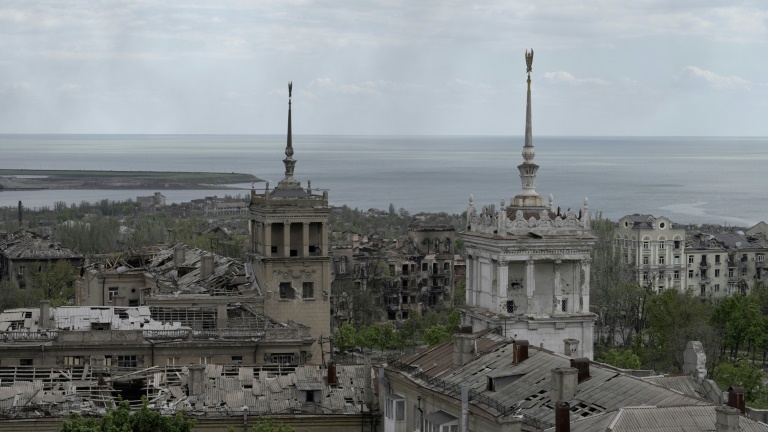
In the similarly strategic port of Mariupol, around 1,000 troops remain trapped in increasingly dire circumstances at the Azovstal steelworks, Ukrainian Deputy Prime Minister Iryna Vereshchuk told AFP.

The plant is the final bastion of resistance in the city, which has seen relentless destruction.

An online petition calling on the United Nations to extract all remaining soldiers garnered more than 1.1 million signatures Tuesday.

Many civilians have been evacuated from the plant in recent days, as Russia pushes for full control of Mariupol to open up another land corridor from Crimea, which it seized in 2014.

But the Ukrainian presidency said the “epicentre of the fighting has moved” to Bilogorivka in the Lugansk region of the Donbas, the site of a deadly Russian air strike Sunday that Ukrainian officials said killed 60 people.

Shelling also continued in Ukraine’s easternmost strongholds, the sister cities of Severodonetsk and Lysychansk, it said.

“The constant shelling by Russian troops does not allow for a full-fledged evacuation of civilians and wounded from the war zone,” Ukraine’s army said Wednesday.

Civilians are struggling to survive between the constantly shifting front lines.

“I feel total apathy. I am morally starved — not to mention physically,” said bricklayer Artyom Cherukha, 41, as he collected water trickling from a natural spring in Lysychansk.

He was trying to get supplies for his family of nine, as people in the area steadily lose access to water and food.

“We sit here counting the bombs,” said Cherukha.

– Germany ‘changed position’ –

Despite the scale of the Russian offensive, its current force might not be large or strong enough to capture and hold the territory it aspires to, US intelligence chief Haines said. 

The United States views it as increasingly likely that Putin will mobilise his entire country, including ordering martial law, and is counting on his perseverance to wear down Western support for Ukraine.

“He is probably counting on US and EU resolve to weaken as food shortages, inflation and energy prices get worse,” Haines said. 

Ukraine has been pushing Western countries for more support, and has been particularly critical of Germany for its slow response and unwillingness to give up Russian energy.

The tone changed on Tuesday with German Foreign Minister Annalena Baerbock’s surprise visit to Bucha, a town outside Kyiv where Russian troops have been accused of war crimes.

“I would like to thank Germany for changing its position on a number of issues” including arms supplies to Kyiv and supporting a Russian oil embargo, Ukrainian Foreign Minister Dmytro Kuleba told reporters in Kyiv with Baerbock.

Kuleba pushed for the European Union to admit his country.

“Ukraine’s membership in the EU is a matter of war and peace in Europe,” said Kuleba. “One of the reasons that this war started is that Putin was convinced that Europe doesn’t need Ukraine.”

Western powers on Tuesday separately accused Russian authorities of carrying out a cyberattack against a satellite network an hour before the February 24 invasion of Ukraine to pave the way for its assault.

The Russian embassy in the United States denied the allegations. 

“Such statements are absurd and ripped from the real state of affairs,” it said on Telegram. 

“Our country has never engaged in cyber aggression.” 

burs-reb/mtp

EA Sports to end FIFA video-game partnership after three decades

The wildly popular FIFA video-game series will be rebranded EA Sports FC next year, its publisher Electronic Arts said on Tuesday, ending a three-decade relationship with football’s governing body.

Launched in 1993, a generation of millions of football fans and gamers across the globe grew up playing the game and it became a huge money-spinner.

But “months of tense negotiations” between California-based Electronic Arts (EA) and governing body FIFA failed to end in an agreement to extend the partnership, The New York Times reported.

FIFA reportedly wanted the $150 million it gets annually from EA to be increased to $250 million or more. 

The game has more than 150 million player accounts, according to EA, and The New York Times said it had generated more than $20 billion in sales over the past two decades.

No major changes to how the game plays are anticipated and EA said that it has retained relationships with other leagues and associations, such as UEFA, the Premier League and Spain’s La Liga.

However, FIFA events such as the World Cup will not feature.

“Our vision for EA Sports FC is to create the largest and most impactful football club in the world, at the epicenter of football fandom,” said EA chief executive Andrew Wilson.

“For nearly 30 years, we’ve been building the world’s biggest football community with hundreds of millions of players, thousands of athlete partners, and hundreds of leagues, federations, and teams. 

“EA Sports FC will be the club for every one of them, and for football fans everywhere.”

FIFA swiftly responded by saying that it will launch “new football video games developed with third-party studios and publishers”.

“I can assure you that the only authentic, real game that has the FIFA name will be the best one available for gamers and football fans,” said its president Gianni Infantino.

Summer heatwave bleaches 91% of Great Barrier Reef: report

A prolonged summer heatwave in Australia left 91 percent of the Great Barrier Reef’s coral damaged by bleaching, according to a new government monitoring report.

It was the first time on record the reef had suffered bleaching during a La Nina weather cycle, when cooler temperatures would normally be expected.

The Reef Snapshot report offered new details of the damage caused by the fourth “mass bleaching” the world’s largest coral reef system has experienced since 2016, which was first revealed in March.

“Climate change is escalating, and the Reef is already experiencing the consequences of this,” the report warned.

The Great Barrier Reef Marine Park Authority, which published the report late Tuesday, conducted extensive surveys of the World Heritage-listed reef between September 2021 and March 2022.

It found that after waters began to warm last December, all three major regions of the reef experienced bleaching — a phenomenon that occurs when coral is stressed and expels brightly coloured algae living in it.

– ‘Higher mortality’ –

Although bleached corals are still alive, and moderately affected sections of the reef may recover, “severely bleached corals have higher mortality rates”, the report said.

Of the 719 reefs surveyed, the report said 654 — or 91 percent — showed some level of coral bleaching.

The report was published 10 days before Australia’s May 21 federal election, in which climate change policy has emerged as a key issue for voters.

Australia’s 2019-2020 “Black Summer” bushfires and deadly east coast floods that swept away cars and engulfed homes this year have highlighted the country’s growing climate risks.

Prime Minister Scott Morrison has, however, resisted calls to make the country’s 2030 emissions reduction target more ambitious, while vowing to mine and export coal for as long as there are buyers.

The Labor opposition has promised to boost renewables and commit to a 43 percent cut in greenhouse gases by 2030 but made no mention of phasing out coal burning. 

– ‘Not normal’ –

“Although bleaching is becoming more and more frequent, this is not normal, and we should not accept that this is the way things are,” Australian Marine Conservation Society campaigner Lissa Schindler said.

“Both major political parties need to face up to the fact that their climate goals are not enough for the Reef.”

During Australia’s election campaign, there has been another force in favour of climate action at play, with more than 20 climate-focused independent candidates running for key seats.

These independents — mostly women — are being financed to stand for election by a fund, Climate 200, set up by activist-philanthropist Simon Holmes a Court.

Most of them are standing in urban, conservative seats against ruling Liberal Party candidates, seeking to sway voters who want stronger climate action. 

Polls indicate a few conservative-held seats may be at risk, including Treasurer Josh Frydenberg’s.

Greenpeace activist Martin Zavan, meanwhile, said fossil fuels were to blame for the coral bleaching.

“Whoever leads the Australian government after the election must have the courage to stand up to the vested interests of the fossil fuel industry and drastically cut emissions by replacing coal and gas with clean energy,” he said.

Next month, the United Nations’ World Heritage Committee will decide whether to list the reef as “in danger”.

Australia was able to avoid a threatened UN downgrade of the reef’s World Heritage status in 2015 by creating a “Reef 2050” plan and pouring billions of dollars into protection.

Summer heatwave bleaches 91% of Great Barrier Reef: report

A prolonged summer heatwave in Australia left 91 percent of the Great Barrier Reef’s coral damaged by bleaching, according to a new government monitoring report.

It was the first time on record the reef had suffered bleaching during a La Nina weather cycle, when cooler temperatures would normally be expected.

The Reef Snapshot report offered new details of the damage caused by the fourth “mass bleaching” the world’s largest coral reef system has experienced since 2016, which was first revealed in March.

“Climate change is escalating, and the Reef is already experiencing the consequences of this,” the report warned.

The Great Barrier Reef Marine Park Authority, which published the report late Tuesday, conducted extensive surveys of the World Heritage-listed reef between September 2021 and March 2022.

It found that after waters began to warm last December, all three major regions of the reef experienced bleaching — a phenomenon that occurs when coral is stressed and expels brightly coloured algae living in it.

– ‘Higher mortality’ –

Although bleached corals are still alive, and moderately affected sections of the reef may recover, “severely bleached corals have higher mortality rates”, the report said.

Of the 719 reefs surveyed, the report said 654 — or 91 percent — showed some level of coral bleaching.

The report was published 10 days before Australia’s May 21 federal election, in which climate change policy has emerged as a key issue for voters.

Australia’s 2019-2020 “Black Summer” bushfires and deadly east coast floods that swept away cars and engulfed homes this year have highlighted the country’s growing climate risks.

Prime Minister Scott Morrison has, however, resisted calls to make the country’s 2030 emissions reduction target more ambitious, while vowing to mine and export coal for as long as there are buyers.

The Labor opposition has promised to boost renewables and commit to a 43 percent cut in greenhouse gases by 2030 but made no mention of phasing out coal burning. 

– ‘Not normal’ –

“Although bleaching is becoming more and more frequent, this is not normal, and we should not accept that this is the way things are,” Australian Marine Conservation Society campaigner Lissa Schindler said.

“Both major political parties need to face up to the fact that their climate goals are not enough for the Reef.”

During Australia’s election campaign, there has been another force in favour of climate action at play, with more than 20 climate-focused independent candidates running for key seats.

These independents — mostly women — are being financed to stand for election by a fund, Climate 200, set up by activist-philanthropist Simon Holmes a Court.

Most of them are standing in urban, conservative seats against ruling Liberal Party candidates, seeking to sway voters who want stronger climate action. 

Polls indicate a few conservative-held seats may be at risk, including Treasurer Josh Frydenberg’s.

Greenpeace activist Martin Zavan, meanwhile, said fossil fuels were to blame for the coral bleaching.

“Whoever leads the Australian government after the election must have the courage to stand up to the vested interests of the fossil fuel industry and drastically cut emissions by replacing coal and gas with clean energy,” he said.

Next month, the United Nations’ World Heritage Committee will decide whether to list the reef as “in danger”.

Australia was able to avoid a threatened UN downgrade of the reef’s World Heritage status in 2015 by creating a “Reef 2050” plan and pouring billions of dollars into protection.

US takes first step to approve $40 bn in Ukraine aid

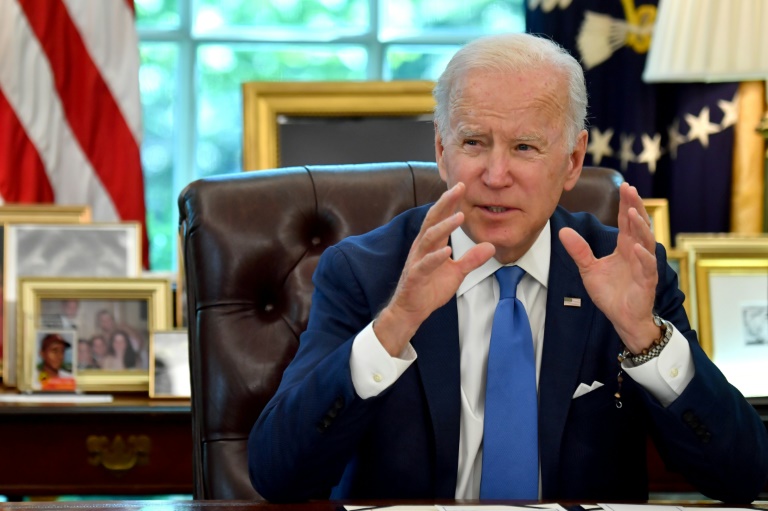
US lawmakers voted Tuesday to send a $40 billion aid package to Ukraine, as Washington warned that Russia was likely girding for a long conflict with its neighbor.

The defense, humanitarian and economic funding passed the House of Representatives by 368 votes to 57, with the two parties’ leaders having already reached an agreement on the details. It will likely pass the Senate by the end of the week or next week.

All the dissenting votes came from the Republican ranks.

“With this aid package, America sends a resounding message to the world of our unwavering determination to stand with the courageous people of Ukraine until victory is won,” House Speaker Nancy Pelosi told her Democratic colleagues ahead of the vote.

Congressional leaders struck a deal Monday to release $6.8 billion more than the $33 billion previously requested by the White House to help the Eastern European nation ward off Moscow’s invasion.

The financial boost includes an extra $3.4 billion for both military and humanitarian assistance on top of the funding requested by the administration.

If the package passes the Senate as expected, US spending to bolster Ukraine’s defenses against Russia’s invasion and address the ensuing humanitarian crisis will soar to around $54 billion. 

The White House applauded Tuesday’s vote as a “critical step” toward helping Ukraine “defend their democracy” against Russian aggression.

“As the president said yesterday, we cannot afford any delay in this vital effort,” White House press secretary Jen Psaki said in a statement. 

“We look forward to continuing to work with Senate leadership to get this bill to the president’s desk quickly and keep assistance flowing to Ukraine without interruption.”

The aid effort comes as a top US official warned that Russian President Vladimir Putin was preparing for a long war that may not end with Russian victory in the east.

“We assess President Putin is preparing for prolonged conflict in Ukraine during which he still intends to achieve goals beyond the Donbas,” Director of National Intelligence Avril Haines said at a hearing on Capitol Hill.

She added that Putin was counting on US and EU resolve to weaken as the conflict continues to cause food shortages and inflation, including spiraling energy prices.

– Covid aid complications –

The Democratic leadership had hoped to tie the Ukraine money to $10 billion in new funding for Covid-19 tests, therapeutics and vaccines, with the United States experiencing a new spike in cases as it nears one million deaths.

But they decided against the move as they were unwilling to get drawn into another fight over border control.

Republicans stopped the Covid aid package last month, demanding an amendment vote to keep in place Title 42, the pandemic-related provision used to deny asylum requests and allow the quick expulsion of migrants. 

With the policy due to end on May 23, Democrats are reluctant to allow a vote, as several of their moderate lawmakers, and those in tough re-election fights, would likely vote with Republicans.

President Joe Biden said in a statement Monday he was prepared to accept the decoupling of Ukraine and Covid aid, with “approximately 10 days” to go until the current funding for Kyiv runs out.

Two senators — Republican Lindsey Graham and Democrat Richard Blumenthal — unveiled a resolution Tuesday calling on Secretary of State Antony Blinken to designate Russia as a state sponsor of terrorism.

“If there is anybody who embodies terrorism, totalitarianism and torture, it is Vladimir Putin,” Blumenthal said at a news conference.

The White House and State Department have resisted calls to add Russia to the list, which currently features Cuba, Iran, North Korea and Syria, as Russia is already facing many of the consequences a terror sponsor designation would bring.

Tokyo to recognise same-sex partnerships from November

Tokyo will begin recognising same-sex partnerships from November after revising current rules, officials said Wednesday, becoming the largest city in Japan to do so.

Japan is the only nation of the Group of Seven countries that does not recognise same-sex unions, and its constitution stipulates that “marriage shall be only with the mutual consent of both sexes”.

But in recent years, local authorities across the country have made moves to recognise same-sex partnerships, although such recognition does not carry the same rights as marriage under the law.

“We collected opinions from the public for the past two months and we heard opinions (from same-sex couples) who said they want to be recognised as partners,” a Tokyo government spokesman told AFP.

The metropolitan government plans to ask legislators to approve revising a local ordinance next month, and will then begin accepting applications for the certificates in October and issuing them in November.

The city is considering offering various services currently only available to married couples to those with the partnership certificate, including applying for city-administered apartments, the spokesman said.

Tokyo’s Shibuya district in 2015 became the first place in Japan to begin issuing symbolic “partnership” certificates to same-sex couples.

Many areas have followed suit, with activists saying more than 200 municipalities now recognise same-sex partnerships, granting couples rights including the ability to visit a partner in hospital and rent property together.

In a landmark ruling last year, a court in northern Sapporo said Japan’s failure to recognise same-sex marriage is unconstitutional, a verdict hailed by campaigners as a major victory.

But Japan’s Prime Minister Fumio Kishida has been cautious on the possibility of any legislative changes at the national level to recognise same-sex unions.

Taiwan is currently the only place in Asia with marriage equality, having taken the unprecedented step of legalising same-sex unions in 2019.

The 1997 chess game that thrust AI into the spotlight

With his hand pushed firmly into his cheek and his eyes fixed on the table, Garry Kasparov shot a final dark glance at the chessboard before storming out of the room: the king of chess had just been beaten by a computer.

May 11, 1997 was a watershed for the relationship between man and machine, when the artificial intelligence (AI) supercomputer Deep Blue finally achieved what developers had been promising for decades. 

It was an “incredible” moment, AI expert Philippe Rolet told AFP, even if the enduring technological impact was not so huge. 

“Deep Blue’s victory made people realise that machines could be as strong as humans, even on their territory,” he said.

Developers at IBM, the US firm that made Deep Blue, were ecstatic with the victory but quickly refocused on the wider significance. 

“This is not about man versus machine. This is really about how we, humans, use technology to solve difficult problems,” said Deep Blue team chief Chung-Jen Tan after the match, listing possible benefits from financial analysis to weather forecasting. 

Even Chung would have struggled to comprehend how central AI has now become — finding applications in almost every field of human existence.

“AI has exploded over the last 10 years or so,” UCLA computer science professor Richard Korf told AFP. 

“We’re now doing things that used to be impossible.”

– ‘One man cracked’ –

After his defeat, Kasparov, who is still widely regarded as the greatest chess player of all time, was furious.

He hinted there had been unfair practices, denied he had really lost and concluded that nothing at all had been proved about the power of computers. 

He explained that the match could be seen as “one man, the best player in the world, (who) has cracked under pressure”.

The computer was beatable, he argued, because it had too many weak points. 

Nowadays, the best computers will always beat even the strongest human chess players. 

AI-powered machines have mastered every game going and now have much bigger worlds to conquer.

Korf cites notable advances in facial recognition that have helped make self-driving cars a reality. 

Yann LeCun, head of AI research at Meta/Facebook, told AFP there had been “absolutely incredible progress” in recent years. 

LeCun, one of the founding fathers of modern AI, lists among the achievements of today’s computers an ability “to translate any language into any language in a set of 200 languages” or “to have a single neural network that understands 100 languages”. 

It is a far cry from 1997, when Facebook didn’t even exist. 

– Machines ‘not the danger’ –

Experts agree that the Kasparov match was important as a symbol but left little in the way of a technical legacy.

“There was nothing revolutionary in the design of Deep Blue,” said Korf, describing it as an evolution of methods that had been around since the 1950s.

“It was also a piece of dedicated hardware designed just to play chess.”

Facebook, Google and other tech firms have pushed AI in all sorts of other directions.

They have fuelled increasingly powerful AI machines with unimaginable amounts of data from their users, serving up remorselessly targeted content and advertising and forging trillion-dollar companies in the process. 

AI technology now helps to decide anything from the temperature of a room to the price of vehicle insurance. 

Devices from vacuum cleaners to doorbells come with arrays of sensors to furnish AI systems with data to better target consumers. 

While critics bemoan a loss of privacy, enthusiasts believe AI products just make everyone’s lives easier. 

Despite his painful history with machines, Kasparov is largely unfazed by AI’s increasingly dominant position. 

“There is simply no evidence that machines are threatening us,” he told AFP last year. 

“The real danger comes not from killer robots but from people — because people still have a monopoly on evil.”

The 1997 chess game that thrust AI into the spotlight

With his hand pushed firmly into his cheek and his eyes fixed on the table, Garry Kasparov shot a final dark glance at the chessboard before storming out of the room: the king of chess had just been beaten by a computer.

May 11, 1997 was a watershed for the relationship between man and machine, when the artificial intelligence (AI) supercomputer Deep Blue finally achieved what developers had been promising for decades. 

It was an “incredible” moment, AI expert Philippe Rolet told AFP, even if the enduring technological impact was not so huge. 

“Deep Blue’s victory made people realise that machines could be as strong as humans, even on their territory,” he said.

Developers at IBM, the US firm that made Deep Blue, were ecstatic with the victory but quickly refocused on the wider significance. 

“This is not about man versus machine. This is really about how we, humans, use technology to solve difficult problems,” said Deep Blue team chief Chung-Jen Tan after the match, listing possible benefits from financial analysis to weather forecasting. 

Even Chung would have struggled to comprehend how central AI has now become — finding applications in almost every field of human existence.

“AI has exploded over the last 10 years or so,” UCLA computer science professor Richard Korf told AFP. 

“We’re now doing things that used to be impossible.”

– ‘One man cracked’ –

After his defeat, Kasparov, who is still widely regarded as the greatest chess player of all time, was furious.

He hinted there had been unfair practices, denied he had really lost and concluded that nothing at all had been proved about the power of computers. 

He explained that the match could be seen as “one man, the best player in the world, (who) has cracked under pressure”.

The computer was beatable, he argued, because it had too many weak points. 

Nowadays, the best computers will always beat even the strongest human chess players. 

AI-powered machines have mastered every game going and now have much bigger worlds to conquer.

Korf cites notable advances in facial recognition that have helped make self-driving cars a reality. 

Yann LeCun, head of AI research at Meta/Facebook, told AFP there had been “absolutely incredible progress” in recent years. 

LeCun, one of the founding fathers of modern AI, lists among the achievements of today’s computers an ability “to translate any language into any language in a set of 200 languages” or “to have a single neural network that understands 100 languages”. 

It is a far cry from 1997, when Facebook didn’t even exist. 

– Machines ‘not the danger’ –

Experts agree that the Kasparov match was important as a symbol but left little in the way of a technical legacy.

“There was nothing revolutionary in the design of Deep Blue,” said Korf, describing it as an evolution of methods that had been around since the 1950s.

“It was also a piece of dedicated hardware designed just to play chess.”

Facebook, Google and other tech firms have pushed AI in all sorts of other directions.

They have fuelled increasingly powerful AI machines with unimaginable amounts of data from their users, serving up remorselessly targeted content and advertising and forging trillion-dollar companies in the process. 

AI technology now helps to decide anything from the temperature of a room to the price of vehicle insurance. 

Devices from vacuum cleaners to doorbells come with arrays of sensors to furnish AI systems with data to better target consumers. 

While critics bemoan a loss of privacy, enthusiasts believe AI products just make everyone’s lives easier. 

Despite his painful history with machines, Kasparov is largely unfazed by AI’s increasingly dominant position. 

“There is simply no evidence that machines are threatening us,” he told AFP last year. 

“The real danger comes not from killer robots but from people — because people still have a monopoly on evil.”

The 1997 chess game that thrust AI into the spotlight

With his hand pushed firmly into his cheek and his eyes fixed on the table, Garry Kasparov shot a final dark glance at the chessboard before storming out of the room: the king of chess had just been beaten by a computer.

May 11, 1997 was a watershed for the relationship between man and machine, when the artificial intelligence (AI) supercomputer Deep Blue finally achieved what developers had been promising for decades. 

It was an “incredible” moment, AI expert Philippe Rolet told AFP, even if the enduring technological impact was not so huge. 

“Deep Blue’s victory made people realise that machines could be as strong as humans, even on their territory,” he said.

Developers at IBM, the US firm that made Deep Blue, were ecstatic with the victory but quickly refocused on the wider significance. 

“This is not about man versus machine. This is really about how we, humans, use technology to solve difficult problems,” said Deep Blue team chief Chung-Jen Tan after the match, listing possible benefits from financial analysis to weather forecasting. 

Even Chung would have struggled to comprehend how central AI has now become — finding applications in almost every field of human existence.

“AI has exploded over the last 10 years or so,” UCLA computer science professor Richard Korf told AFP. 

“We’re now doing things that used to be impossible.”

– ‘One man cracked’ –

After his defeat, Kasparov, who is still widely regarded as the greatest chess player of all time, was furious.

He hinted there had been unfair practices, denied he had really lost and concluded that nothing at all had been proved about the power of computers. 

He explained that the match could be seen as “one man, the best player in the world, (who) has cracked under pressure”.

The computer was beatable, he argued, because it had too many weak points. 

Nowadays, the best computers will always beat even the strongest human chess players. 

AI-powered machines have mastered every game going and now have much bigger worlds to conquer.

Korf cites notable advances in facial recognition that have helped make self-driving cars a reality. 

Yann LeCun, head of AI research at Meta/Facebook, told AFP there had been “absolutely incredible progress” in recent years. 

LeCun, one of the founding fathers of modern AI, lists among the achievements of today’s computers an ability “to translate any language into any language in a set of 200 languages” or “to have a single neural network that understands 100 languages”. 

It is a far cry from 1997, when Facebook didn’t even exist. 

– Machines ‘not the danger’ –

Experts agree that the Kasparov match was important as a symbol but left little in the way of a technical legacy.

“There was nothing revolutionary in the design of Deep Blue,” said Korf, describing it as an evolution of methods that had been around since the 1950s.

“It was also a piece of dedicated hardware designed just to play chess.”

Facebook, Google and other tech firms have pushed AI in all sorts of other directions.

They have fuelled increasingly powerful AI machines with unimaginable amounts of data from their users, serving up remorselessly targeted content and advertising and forging trillion-dollar companies in the process. 

AI technology now helps to decide anything from the temperature of a room to the price of vehicle insurance. 

Devices from vacuum cleaners to doorbells come with arrays of sensors to furnish AI systems with data to better target consumers. 

While critics bemoan a loss of privacy, enthusiasts believe AI products just make everyone’s lives easier. 

Despite his painful history with machines, Kasparov is largely unfazed by AI’s increasingly dominant position. 

“There is simply no evidence that machines are threatening us,” he told AFP last year. 

“The real danger comes not from killer robots but from people — because people still have a monopoly on evil.”

Asian stocks open mixed as investors fret over oil prices

Asian stocks opened mixed on Wednesday, following a volatile day on Wall Street that had investors concerned about surging inflation and sent global oil prices retreating. 

Equities have been on a roller coaster ride in recent weeks, fuelled by inflationary pressures, Russia’s war in Ukraine and concerns about China’s Covid-19 lockdowns affecting the global supply chain. 

The mainland’s sinking April exports — the lowest in almost two years — have not reassured global investors, and on Tuesday it reported that its consumer inflation had risen at its quickest pace in nearly half a year.

But while the tea leaves remain far from clear for market readers, many are preparing for the worst.

“Equity investors are positioning for a recession; that pressure will remain acute until they see calming in rate volatility,” said Stephen Innes of SPI Asset Management. 

“The market seems to be fighting too many things to find its footing… The unavoidable growth concerns related to China are leaving a colossal contagion footprint across a plethora of global assets.”

Millions across China — particularly in its economic engine Shanghai — have been under a Covid-spurred lockdown for weeks, while restrictions have crept up in the capital Beijing. 

The World Health Organization on Tuesday said Beijing’s zero-Covid strategy is not sustainable given the behavior of recent ultra-contagious variants.

But it is also wreaking havoc on the political and economic fronts, stopping up ports and factories, while inciting rare outrage from residents forced to stay at home with no end in sight.

In New York, the Dow fell for the fourth straight day at Tuesday’s close, while the broader S&P 500 edged back up above 4,000 points and Nasdaq jumped one percent. 

European markets were more positive — London, Paris and Frankfurt ended on slight gains. 

But Asia’s equities on Tuesday showed deep uncertainty, with Tokyo, Hong Kong and Korea opening slightly up, while Singapore, Sydney and Seoul volleyed in the negatives. 

Crude was sent on a ride, with benchmark US crude contract WTI falling below $100 a barrel on Tuesday. By Wednesday morning, it crept up to about $101. 

Despite it being a temporary dip, “energy traders won’t forget how tight the oil market is”, said Edward Moya, senior market analyst at OANDA. 

“Everything in the past 48 hours seems to have turned bearish for oil prices as EU sanctions on Russian energy have completely stalled and as the US dollar rallies over economic growth concerns.”

– Key figures at around 0230 GMT –

Hong Kong – Hang Seng Index: UP 0.8 percent at 19,801.05   

Shanghai – Composite: UP 1.2 percent at 3,073.11

Tokyo – Nikkei 225: UP 0.3 percent at 26,249.83 (break)

Brent North Sea crude: UP 1.5 percent at $104.03 per barrel

West Texas Intermediate: UP 1.5 percent at $101.22 per barrel

Euro/dollar: DOWN at $1.0534 from $1.0534 on Tuesday 

Pound/dollar: FLAT at $1.2319 from $1.2332

Euro/pound: DOWN at 85.41 pence from 85.49 pence

Dollar/yen: DOWN at 130.34 yen from 130.41 yen

New York – Dow: DOWN 0.3 percent at 32,160.74 (close)

London – FTSE 100: UP 0.4 percent at 7,243.22 (close) 

Close Bitnami banner
Bitnami