World

Iran general says more than 300 dead in Amini unrest

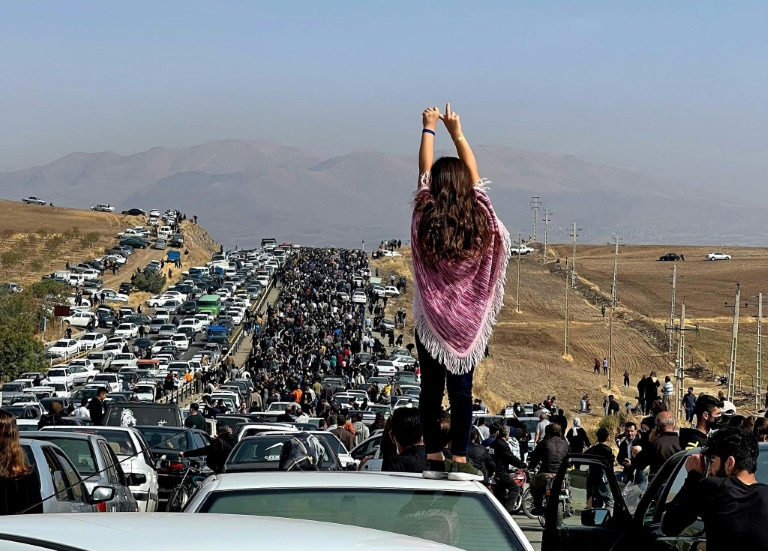
Iran has for the first time reported that more than 300 people have died in over two months of protests sparked by the death of Mahsa Amini in police custody.

The Islamic republic has deployed state security forces against what it labels “riots” that broke out after the 22-year-old died on September 16, three days after her arrest for allegedly breaching Iran’s dress code for women.

“Everyone in the country has been affected by the death of this lady,” said Brigadier General Amirali Hajizadeh of the Islamic Revolutionary Guard Corps (IRGC) in a video published by the Mehr news agency.

“I don’t have the latest figures, but I think we have had perhaps more than 300 martyrs and people killed,” among them some of “the best sons of the country”, said Hajizadeh, head of the Guards’ aerospace division.

The Iranian toll includes those who have taken to the streets as well as dozens of police, troops and Basij paramilitary force members who have died in clashes with demonstrators or who were killed elsewhere.

The latest official toll is much closer to figures published by human rights groups based abroad.

Oslo-based non-governmental organisation Iran Human Rights said at least 448 people had been “killed by security forces in the ongoing nationwide protests”, in an updated toll issued on Tuesday.

The group says its toll includes those killed in violence related to the Amini protests and in distinct unrest in the southeastern province of Sistan-Baluchistan, which borders Pakistan and Afghanistan.

– Hijab rules –

Thousands of Iranians and around 40 foreigners have been arrested and more than 2,000 people have been charged, according to judicial authorities.

Among these, six have been sentenced to death, with their appeals set to be heard by the supreme court.

One more man, identified as Majid Rahnavard, went on trial Tuesday accused of stabbing to death two Basij members in the northeastern city of Mashhad on November 17, Mizan Online reported. 

He faces the death penalty if found guilty of killing the pair who, Iranian media reported, had tried to intervene against “rioters threatening businesses to force them to close”.

Since the Islamic Revolution of 1979 that overthrew the monarchy, Iranian law has required all women to wear modest dress and a hijab head covering that conceals their hair, rules enforced by morality police squads that patrol public places.

In the past two decades, however, many women, especially in Tehran and other major cities, have shown more of their hair, before the rules were tightened again — a flashpoint issue in the protests.

Iran has blamed its enemies for the civil unrest, pointing at the United States, other Western powers and Israel, as well as exiled Iranian Kurdish opposition groups based in northern Iraq whom it has hit with repeated missile and drone strikes.

Amid the heightened tensions, Iran’s national football team will play the US side at the World Cup in Qatar from 1900 GMT Tuesday — a match seen as highly political between two countries that have had no diplomatic relations since 1980.

Iran’s judiciary Tuesday announced the release of more than 1,100 detainees in 20 provinces, including protesters, following Iran’s World Cup win Friday against Wales, its Mizan Online website reported.

The site also reported Tuesday the release on bail of former national football team goalkeeper Parviz Boroumand.

Boroumand had been arrested in mid-November during protests in Tehran, Iranian media outlets reported.
200 fishermen rescued from drifting ice in US lake

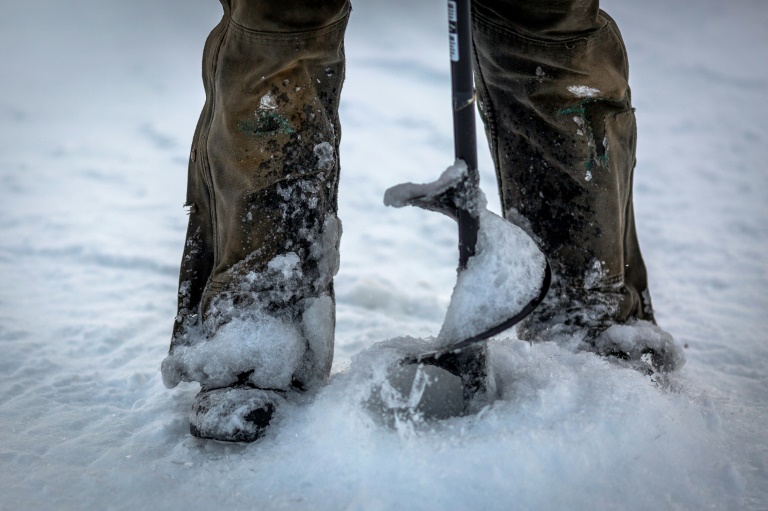
About 200 early-season ice fishers were caught by surprise and stranded in a Minnesota lake when the frozen slab under their feet broke free and drifted into open water — triggering a complex rescue operation.

A member of the group called emergency services Monday when they realized the people ice fishing — a popular winter sport in the northern US state known as the Land of 10,000 Lakes — were slowly drifting away from the shoreline of Upper Red Lake, local police said on Facebook. 

“The Beltrami County Sheriff’s Office and other first responders arrived on scene and discovered a large portion of the ice with up to 30 yards (27 meters) of open water stranding the fishermen,” Chief Deputy Jarrett Walton said in a statement.

Some of the group had not even realized the ice floe had snapped free. But “due to the urgent nature of getting people off the ice,” Beltrami County sent out an alert to the fishermen’s cellphones to notify them they would soon be rescued in an emergency evacuation.

The alert “allowed notifications to be sent to cell phones of those who are not enrolled in the local notification system and provided GPS coordinates of the evacuation site,” the sheriff’s department said. 

It took over three hours to complete the evacuate from the ice.

“A number of apparatus were deployed including airboats, water rescue boats, ATVs, drones and a temporary bridge,” the sheriff’s department said.

It also warned other local fisherman to use “extreme caution” on unsteady ice.

“The Beltrami County Sheriff’s Office reminds those who are thinking of heading on the ice that early season ice is very unpredictable,” the statement said.

China warns of 'crackdown' after major protests

China’s top security body called for a “crackdown” against “hostile forces” on Tuesday, after a weekend of protests in major cities opposing Covid lockdowns and demanding greater political freedoms.

The stark warning came after security services were out in force across China following demonstrations not seen in decades, as anger over unrelenting lockdowns fuelled deep-rooted frustration with the political system.

A deadly fire last week in Urumqi, the capital of the northwestern region of Xinjiang, was the catalyst for the outrage, with protesters taking to the streets in cities around China. 

The demonstrators said Covid-19 restrictions were to blame for hampering rescue efforts in Urumqi, claims the government swiftly denied.

China is the world’s last major economy still wedded to a zero-Covid policy, which compels local governments to impose snap lockdowns and quarantine orders, and limit freedom of movement in response to minor outbreaks.

Anger over the lockdowns has widened to calls for political change, with protesters holding up blank sheets of paper to symbolise the pervasive censorship to which the world’s most populous country is subjected.

On Tuesday, the ruling Communist Party’s Central Political and Legal Affairs Commission called for a “crackdown” on what it described as “hostile forces” — a possible warning to the protesters, which the readout published in state news agency Xinhua did not mention directly.

The body —  which oversees all domestic law enforcement in China — also agreed at its meeting that it was time to “crack down on illegal criminal acts that disrupt social order” as well as “safeguard overall social stability.”

The warning came after a heavy police presence across cities on Monday and Tuesday appeared to have quelled protests for the time being.

In another sign of the government’s zero-tolerance of dissent, people who had attended weekend rallies in the Chinese capital told AFP on Monday they had received phone calls from law enforcement officers demanding information about their movements.

– ‘Liberty or death’ –

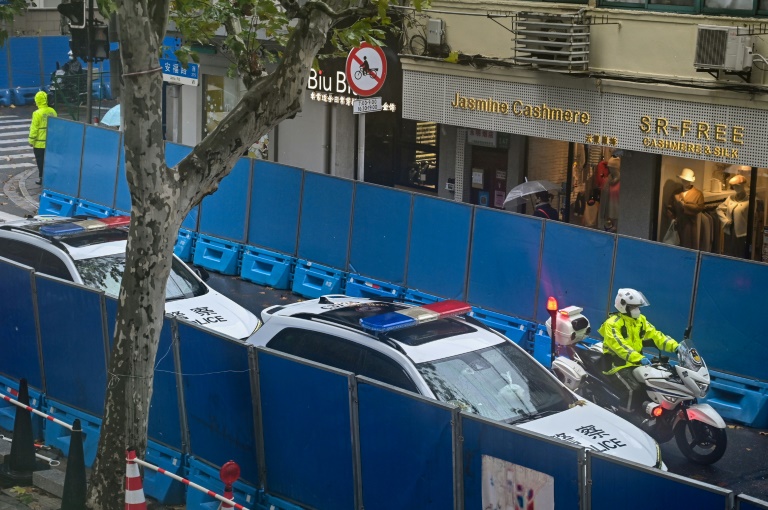
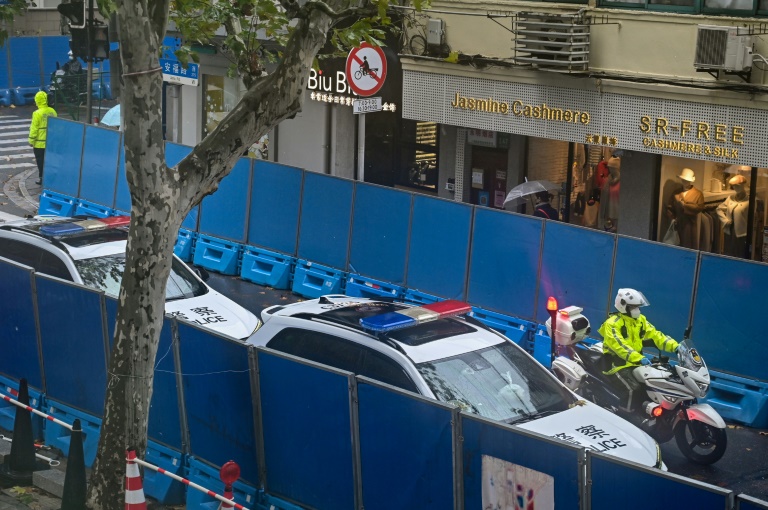
On Tuesday hundreds of officers appeared to have been drawn back from the streets of a rain-drenched Shanghai, where weekend protests had seen bold calls for the resignation of President Xi Jinping, an AFP reporter said.

A broad effort by police to stop passersby taking pictures of the site of the protest also appeared to have been tapered down, the reporter added, with one officer telling AFP that it “depends on the nature of the photo” but that there was no blanket ban in place.

In Beijing, AFP reporters saw a few marked and unmarked police vehicles but no sign of protesters at an intersection near the Asian Games Village, where a demonstration had been planned for Tuesday night. 

Freezing temperatures of minus nine degrees Celsius (15.8 degrees Fahrenheit) likely also kept protesters away.

Some rallies did go ahead elsewhere on Monday and Tuesday, however. 

At Hong Kong’s oldest university, over a dozen people led the crowd Tuesday in chanting slogans such as “give me liberty or give me death”. 

“We are not foreign forces, we are Chinese citizens. China should have different voices,” one woman shouted, while another held a placard mourning victims of the Urumqi fire. 

In Hangzhou, just over 170 kilometres (105 miles) southwest of Shanghai, there was heavy security and sporadic protests in the city’s downtown on Monday night. 

“The atmosphere was disorderly. There were few people and we were separated. There were lots of police, it was chaos,” she said.

– ‘Many died in vain’ –

China’s strict control of information and continued travel curbs have made verifying protester numbers across the vast country challenging.

But the widespread rallies seen over the weekend are exceptionally rare in China, with authorities harshly clamping down on all opposition to the central government.

US President Joe Biden is monitoring the unrest, the White House said Monday.

US Secretary of State Antony Blinken said Tuesday that Washington’s position was “the same everywhere”, and that was to “support the right of people everywhere, to peacefully protest to make known their views, their concerns, and their frustrations”.

Solidarity protests have meanwhile mushroomed around the world.

“Officials are borrowing the pretext of Covid, but using excessively strict lockdowns to control China’s population,” said one 21-year-old Chinese protester in Washington, who gave only his surname, Chen.

“They disregarded human lives and caused many to die in vain,” he told AFP.

– Vaccination drive –

While China’s leaders are committed to zero-Covid, there have been some signs that central authorities may be seeking a path out of the rigid policy.

China’s National Health Commission (NHC) announced on Tuesday a renewed effort to expand low vaccination rates among the elderly — long seen as a key obstacle to relaxing the measures.

Many fear that opening the country up while swaths of the population remain not fully immunised could overwhelm China’s healthcare system and cause more than a million deaths.

Just 65.8 percent of people over 80 are fully vaccinated, NHC officials told a news conference.

China has also not yet approved mRNA vaccines, which are proven to be more effective, for public use.

The NHC also said local efforts “inconsistent with national policies” had caused a “great impact on people’s work and life”, and warned that “those who cause serious consequences will be held accountable in accordance with laws and regulation”.

However, it did not suggest a change in policy was imminent.

bur-bys-hol-reb/oho/ser

China warns of 'crackdown' after major protests

China’s top security body called for a “crackdown” against “hostile forces” on Tuesday, after a weekend of protests in major cities opposing Covid lockdowns and demanding greater political freedoms.

The stark warning came after security services were out in force across China following demonstrations not seen in decades, as anger over unrelenting lockdowns fuelled deep-rooted frustration with the political system.

A deadly fire last week in Urumqi, the capital of the northwestern region of Xinjiang, was the catalyst for the outrage, with protesters taking to the streets in cities around China. 

The demonstrators said Covid-19 restrictions were to blame for hampering rescue efforts in Urumqi, claims the government swiftly denied.

China is the world’s last major economy still wedded to a zero-Covid policy, which compels local governments to impose snap lockdowns and quarantine orders, and limit freedom of movement in response to minor outbreaks.

Anger over the lockdowns has widened to calls for political change, with protesters holding up blank sheets of paper to symbolise the pervasive censorship to which the world’s most populous country is subjected.

On Tuesday, the ruling Communist Party’s Central Political and Legal Affairs Commission called for a “crackdown” on what it described as “hostile forces” — a possible warning to the protesters, which the readout published in state news agency Xinhua did not mention directly.

The body —  which oversees all domestic law enforcement in China — also agreed at its meeting that it was time to “crack down on illegal criminal acts that disrupt social order” as well as “safeguard overall social stability.”

The warning came after a heavy police presence across cities on Monday and Tuesday appeared to have quelled protests for the time being.

In another sign of the government’s zero-tolerance of dissent, people who had attended weekend rallies in the Chinese capital told AFP on Monday they had received phone calls from law enforcement officers demanding information about their movements.

– ‘Liberty or death’ –

On Tuesday hundreds of officers appeared to have been drawn back from the streets of a rain-drenched Shanghai, where weekend protests had seen bold calls for the resignation of President Xi Jinping, an AFP reporter said.

A broad effort by police to stop passersby taking pictures of the site of the protest also appeared to have been tapered down, the reporter added, with one officer telling AFP that it “depends on the nature of the photo” but that there was no blanket ban in place.

In Beijing, AFP reporters saw a few marked and unmarked police vehicles but no sign of protesters at an intersection near the Asian Games Village, where a demonstration had been planned for Tuesday night. 

Freezing temperatures of minus nine degrees Celsius (15.8 degrees Fahrenheit) likely also kept protesters away.

Some rallies did go ahead elsewhere on Monday and Tuesday, however. 

At Hong Kong’s oldest university, over a dozen people led the crowd Tuesday in chanting slogans such as “give me liberty or give me death”. 

“We are not foreign forces, we are Chinese citizens. China should have different voices,” one woman shouted, while another held a placard mourning victims of the Urumqi fire. 

In Hangzhou, just over 170 kilometres (105 miles) southwest of Shanghai, there was heavy security and sporadic protests in the city’s downtown on Monday night. 

“The atmosphere was disorderly. There were few people and we were separated. There were lots of police, it was chaos,” she said.

– ‘Many died in vain’ –

China’s strict control of information and continued travel curbs have made verifying protester numbers across the vast country challenging.

But the widespread rallies seen over the weekend are exceptionally rare in China, with authorities harshly clamping down on all opposition to the central government.

US President Joe Biden is monitoring the unrest, the White House said Monday.

US Secretary of State Antony Blinken said Tuesday that Washington’s position was “the same everywhere”, and that was to “support the right of people everywhere, to peacefully protest to make known their views, their concerns, and their frustrations”.

Solidarity protests have meanwhile mushroomed around the world.

“Officials are borrowing the pretext of Covid, but using excessively strict lockdowns to control China’s population,” said one 21-year-old Chinese protester in Washington, who gave only his surname, Chen.

“They disregarded human lives and caused many to die in vain,” he told AFP.

– Vaccination drive –

While China’s leaders are committed to zero-Covid, there have been some signs that central authorities may be seeking a path out of the rigid policy.

China’s National Health Commission (NHC) announced on Tuesday a renewed effort to expand low vaccination rates among the elderly — long seen as a key obstacle to relaxing the measures.

Many fear that opening the country up while swaths of the population remain not fully immunised could overwhelm China’s healthcare system and cause more than a million deaths.

Just 65.8 percent of people over 80 are fully vaccinated, NHC officials told a news conference.

China has also not yet approved mRNA vaccines, which are proven to be more effective, for public use.

The NHC also said local efforts “inconsistent with national policies” had caused a “great impact on people’s work and life”, and warned that “those who cause serious consequences will be held accountable in accordance with laws and regulation”.

However, it did not suggest a change in policy was imminent.

bur-bys-hol-reb/oho/ser

World Cup pitch invader defends 'breaking rules' despite ban

The Italian who ran onto the World Cup pitch wearing a T-shirt in support of Ukraine and Iranian women defended his protest Tuesday, despite being served a tournament ban.

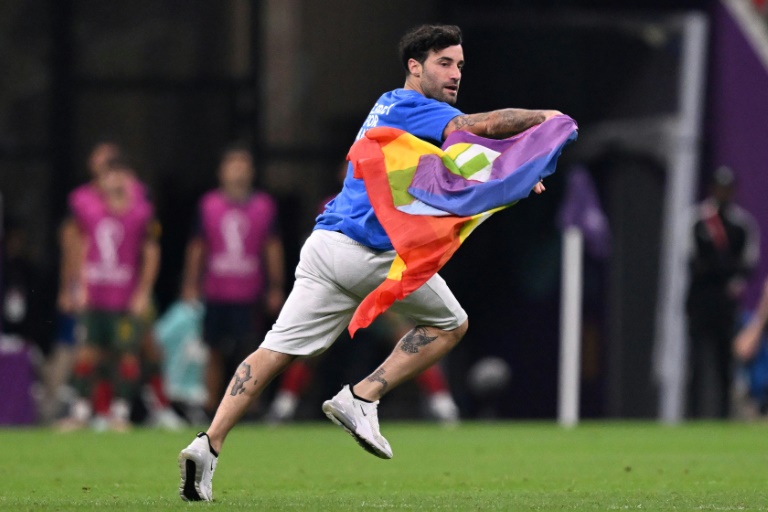
Mario Ferri, 35, a football player with a history of similar stunts, interrupted the Portugal-Uruguay game Monday when he sprinted onto the pitch wearing a blue Superman T-shirt with “Save Ukraine” on the front and “Respect for Iranian Woman” on the back. 

Ferri, who calls himself “The Falcon”, also carried a rainbow-coloured flag adorned with the words PACE, meaning peace in Italian.

“I’m BACK,” wrote Ferri on his Instagram page Tuesday, where he describes himself as a “modern pirate”.

FIFA said Ferri’s official card to access the Qatar stadiums was cancelled and that he had been banned from future World Cup matches. 

Italy’s foreign ministry confirmed that Ferri had been briefly detained after running onto the pitch before being released “without any further consequences”.

To his 133,000 followers on Instagram, Ferri said he undertook the stunt to send “important messages”, including for Iran “where I have friends who are suffering, where women are not respected”.

“FIFA banned rainbow captain’s armbands and human rights flags in the stands, they blocked everyone, BUT NOT ME, like a Robin Hood,” he wrote.

“SAVE UKRAINE. I spent a month in the war in Kyiv as a volunteer and saw how much those people are suffering,” he wrote, calling for peace in the country heading into a tenth month of fighting after Moscow’s invasion in February.

– Defending Naples –

He added that “breaking the rules for a good cause is never a crime”.

Gay rights and the use of the rainbow flag have been a simmering issue at the World Cup in Qatar, where homosexuality is illegal. The rainbow features in both the flag for LGBTQ rights and the peace flag. 

According to the Gazzetta dello Sport newspaper, Ferri has played on teams in Jordan, India, San Marino, the Seychelles and Switzerland — part of his desire to play on every continent.

In 2010, Ferri invaded the Club World Cup pitch in Abu Dhabi during an Inter-Mazembe game waving an AC Milan scarf.

Four years later during the World Cup in Brazil, he again sported his Superman T-shirt as he ran onto the field during a Belgium-USA game.

The T-shirt read “Save the children of the favelas,” referring to slums in Brazilian cities, with “Ciro lives” underneath, in memory of Naples fan Ciro Esposito who was shot by a hooligan before the Coppa Italia final and later died.

In 2017, Ferri threw a Naples scarf in the face of Juventus player Gonzalo Higuain during a Naples-Juventus match. 

“I decided to avenge the Neapolitans for Higuain’s move to Juventus,” he told the Corriere dello Sport newspaper.

“I said, ‘Traitor!’ and left.”

Uranium-rich Niger struggles despite nuclear resurgence

Prospects for the world’s nuclear industry have been boosted by the war in Ukraine and mounting hostility towards climate-wrecking fossil fuels — but Niger, one of the world’s biggest sources of uranium, has yet to feel the improvement.

The deeply impoverished landlocked Sahel state is a major supplier of uranium to the European Union, accounting for a fifth of its supplies, and is especially important to France, its former colonial power. 

But its mining industry is in the doldrums.

“Over the past few years, the uranium industry worldwide has been marked by a trend of continuously falling prices,” Mining Minister Yacouba Hadizatou Ousseini told AFP in an interview.

She blamed “pressure from ecologists” after the 2011 Fukushima nuclear accident in Japan, but also the emergence of “particularly rich deposits” of uranium in Canada for depressing the market.

A concrete example of Niger’s problems can be found in its vast mine at Imouraren, which experts had said would yield 5,000 tonnes of ore for 35 years, but which has been closed since 2014.

“Mining at… Imouraren, which is one of the world’s largest uranium deposits, will get underway as soon as market conditions permit,” French miner Orano, which has the operating licence, says on its website.

Orano, previously known as Areva, has two subsidiaries in Niger.

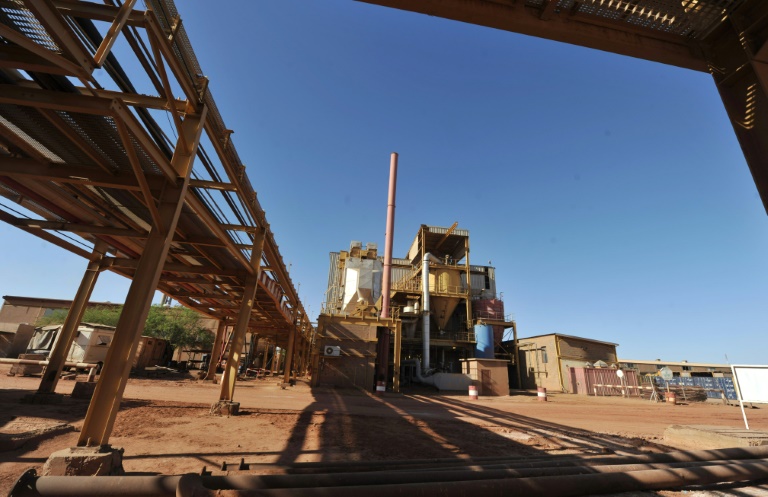
Last year, its offshoot Cominak wound up activities at a mine in the desert region of Arlit which had been operating since the 1970s after commercially exploitable deposits of uranium ore ran out.

Production at a second site in Arlit by its other subsidiary Somair was 2,000 tonnes in 2021, compared with 3,000 tonnes nine years earlier.

– Grounds for optimism –

But there is good news, too, for the sector.

Prices have recently been on the upward track over the past two years. At around $50 a pound (half a kilo), they are double the price of six years ago, although still way off the record of $140 per pound, reached during a spike in 2007.

“Prices are low compared to production costs. Many mines have closed because of that,” a French uranium expert told AFP.

“But a slow improvement is underway. In the long term, there will be major demand, especially for power stations in Russia or China,” the specialist said, asking not to be identified.

This explains why foreign miners — from Australia, Britain, Canada, China, India, Italy, Russia and the United States — have been knocking on Niger’s door.

“There are 31 current authorisations for uranium prospecting, and 11 permits to mine uranium,” the minister said.

On November 5, the Canadian company Global Atomic Corporation began the symbolic start of uranium extraction at a site about 100 kilometres (60 miles) south of Arlit.

It has promised to invest 121 billion CFA francs (around $185 million) there next year.

“(Niger’s) uranium… is open to those who have the technological capacity to exploit it,” Nigerien President Mohamed Bazoum said last year.

“There is a future for uranium in Niger, but not necessarily with France,” the French expert said.

– Tensions with France –

Niger’s open-doors policy today contrasts with the half-century entwinement it previously had with France — a once-cosy relationship that suffered from repeated rows out about pricing.

In 2007, former president Mamadou Tandja successfully fought for a 40-percent increase in price for uranium paid by Areva.

His successor, Mahamadou Issoufou — a former Areva employee — once voiced indignation that his country earned so little from uranium, even though it was the fourth biggest producer in the world at the time.

In 2014, Areva and Niger signed a deal, after 18 months of negotiations, that set down improved conditions for Niger through operations at the Imouraren mine.

Those benefits are still awaited, as the huge mine is closed.

“There’s no win-win partnership. Niger has had no benefit from uranium mining,” said Ali Idrissa, coordinator of a coalition of campaign groups called the Nigerien Network of Organisations for Budget Transparency and Analysis.

Uranium “has brought us only (landscape) desolation… and all the profits went to France,” said Nigerien specialist Tchiroma Aissami Mamadou.

In 2020, mining contributed to 1.2 percent of the national budget.

Accusations of abuse or exploitation are rejected by Orano, which said it had invested millions of euros in projects to improve health and education for local communities and spur economic activities around mining sites.

It also pointed to taxes, dividends and other payments that mining companies paid into state coffers, directly or indirectly.

Uranium-rich Niger struggles despite nuclear resurgence

Prospects for the world’s nuclear industry have been boosted by the war in Ukraine and mounting hostility towards climate-wrecking fossil fuels — but Niger, one of the world’s biggest sources of uranium, has yet to feel the improvement.

The deeply impoverished landlocked Sahel state is a major supplier of uranium to the European Union, accounting for a fifth of its supplies, and is especially important to France, its former colonial power. 

But its mining industry is in the doldrums.

“Over the past few years, the uranium industry worldwide has been marked by a trend of continuously falling prices,” Mining Minister Yacouba Hadizatou Ousseini told AFP in an interview.

She blamed “pressure from ecologists” after the 2011 Fukushima nuclear accident in Japan, but also the emergence of “particularly rich deposits” of uranium in Canada for depressing the market.

A concrete example of Niger’s problems can be found in its vast mine at Imouraren, which experts had said would yield 5,000 tonnes of ore for 35 years, but which has been closed since 2014.

“Mining at… Imouraren, which is one of the world’s largest uranium deposits, will get underway as soon as market conditions permit,” French miner Orano, which has the operating licence, says on its website.

Orano, previously known as Areva, has two subsidiaries in Niger.

Last year, its offshoot Cominak wound up activities at a mine in the desert region of Arlit which had been operating since the 1970s after commercially exploitable deposits of uranium ore ran out.

Production at a second site in Arlit by its other subsidiary Somair was 2,000 tonnes in 2021, compared with 3,000 tonnes nine years earlier.

– Grounds for optimism –

But there is good news, too, for the sector.

Prices have recently been on the upward track over the past two years. At around $50 a pound (half a kilo), they are double the price of six years ago, although still way off the record of $140 per pound, reached during a spike in 2007.

“Prices are low compared to production costs. Many mines have closed because of that,” a French uranium expert told AFP.

“But a slow improvement is underway. In the long term, there will be major demand, especially for power stations in Russia or China,” the specialist said, asking not to be identified.

This explains why foreign miners — from Australia, Britain, Canada, China, India, Italy, Russia and the United States — have been knocking on Niger’s door.

“There are 31 current authorisations for uranium prospecting, and 11 permits to mine uranium,” the minister said.

On November 5, the Canadian company Global Atomic Corporation began the symbolic start of uranium extraction at a site about 100 kilometres (60 miles) south of Arlit.

It has promised to invest 121 billion CFA francs (around $185 million) there next year.

“(Niger’s) uranium… is open to those who have the technological capacity to exploit it,” Nigerien President Mohamed Bazoum said last year.

“There is a future for uranium in Niger, but not necessarily with France,” the French expert said.

– Tensions with France –

Niger’s open-doors policy today contrasts with the half-century entwinement it previously had with France — a once-cosy relationship that suffered from repeated rows out about pricing.

In 2007, former president Mamadou Tandja successfully fought for a 40-percent increase in price for uranium paid by Areva.

His successor, Mahamadou Issoufou — a former Areva employee — once voiced indignation that his country earned so little from uranium, even though it was the fourth biggest producer in the world at the time.

In 2014, Areva and Niger signed a deal, after 18 months of negotiations, that set down improved conditions for Niger through operations at the Imouraren mine.

Those benefits are still awaited, as the huge mine is closed.

“There’s no win-win partnership. Niger has had no benefit from uranium mining,” said Ali Idrissa, coordinator of a coalition of campaign groups called the Nigerien Network of Organisations for Budget Transparency and Analysis.

Uranium “has brought us only (landscape) desolation… and all the profits went to France,” said Nigerien specialist Tchiroma Aissami Mamadou.

In 2020, mining contributed to 1.2 percent of the national budget.

Accusations of abuse or exploitation are rejected by Orano, which said it had invested millions of euros in projects to improve health and education for local communities and spur economic activities around mining sites.

It also pointed to taxes, dividends and other payments that mining companies paid into state coffers, directly or indirectly.

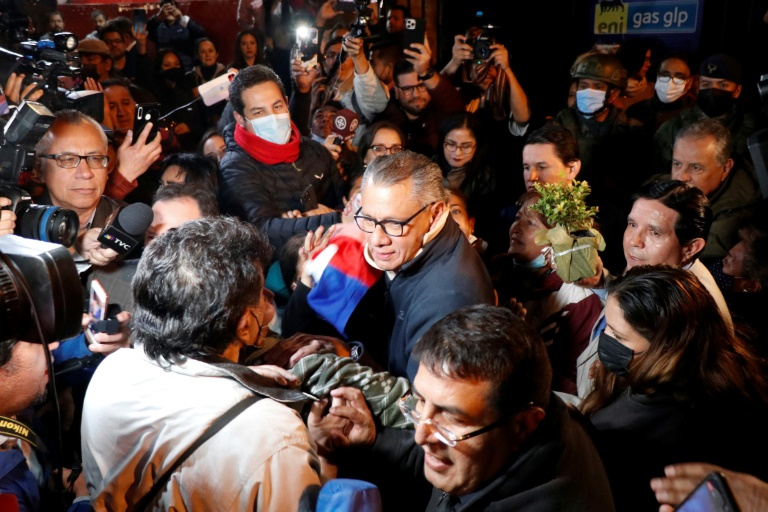
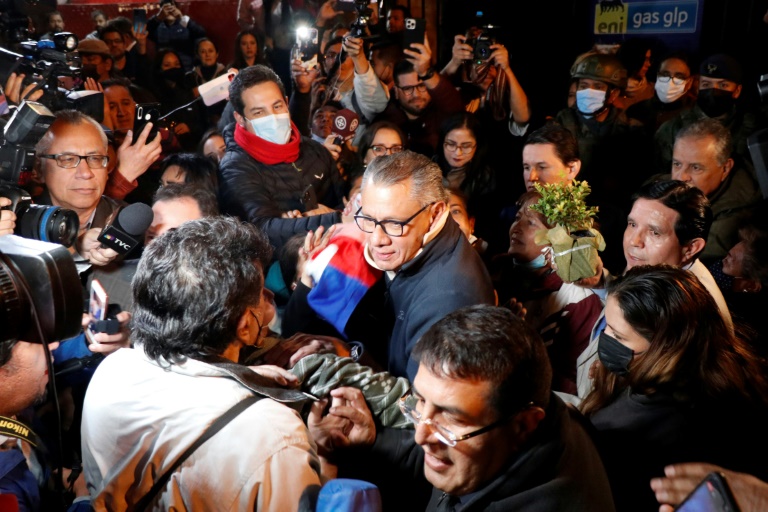
Ecuador's ex-VP freed from jail after graft sentence

Ecuador’s former vice president Jorge Glas has been released from prison after serving time for corruption in a vast scandal involving the Brazilian construction giant Odebrecht.

Glas was jailed in 2017 for receiving millions of dollars in kickbacks from Odebrecht in a graft scandal that has seen several former Latin American presidents implicated or dragged into court.

Glas, 53, left the Pichincha Nº2 prison in the north of the capital Quito on Monday night after a judge issued an injunction in his favor, said prison administration body SNAI.

The judge’s decision comes after a court earlier this month annulled a separate conviction in which Glas was sentenced in 2021 to eight years for misuse of public funds.

This allowed his lawyers to request an early release on probation on two other corruption charges — with sentences of six and eight years respectively — as he had served more than 40 percent of the sentences.

The SNAI said it would “abide by the judge’s decision,” but left open the possibility of filing an appeal as there had been no “threat or infringement” of Glas’s rights.

Glas was briefly freed for about a month in April over poor health, but a court ordered him to serve out the rest of his sentence.

He served as the vice president under leftist Rafael Correa between 2013 and 2017, and under president Lenin Moreno until he was stripped of his office in 2018.

Correa has also been sentenced to eight years in jail for corruption, but is living in exile in Belgium.

According to the US Justice Department, Odebrecht paid $788 million in bribes across 12 countries to secure public works contracts.

Earlier this month, a Panama court ordered two of its former presidents to stand trial over the scandal.

Ecuador's ex-VP freed from jail after graft sentence

Ecuador’s former vice president Jorge Glas has been released from prison after serving time for corruption in a vast scandal involving the Brazilian construction giant Odebrecht.

Glas was jailed in 2017 for receiving millions of dollars in kickbacks from Odebrecht in a graft scandal that has seen several former Latin American presidents implicated or dragged into court.

Glas, 53, left the Pichincha Nº2 prison in the north of the capital Quito on Monday night after a judge issued an injunction in his favor, said prison administration body SNAI.

The judge’s decision comes after a court earlier this month annulled a separate conviction in which Glas was sentenced in 2021 to eight years for misuse of public funds.

This allowed his lawyers to request an early release on probation on two other corruption charges — with sentences of six and eight years respectively — as he had served more than 40 percent of the sentences.

The SNAI said it would “abide by the judge’s decision,” but left open the possibility of filing an appeal as there had been no “threat or infringement” of Glas’s rights.

Glas was briefly freed for about a month in April over poor health, but a court ordered him to serve out the rest of his sentence.

He served as the vice president under leftist Rafael Correa between 2013 and 2017, and under president Lenin Moreno until he was stripped of his office in 2018.

Correa has also been sentenced to eight years in jail for corruption, but is living in exile in Belgium.

According to the US Justice Department, Odebrecht paid $788 million in bribes across 12 countries to secure public works contracts.

Earlier this month, a Panama court ordered two of its former presidents to stand trial over the scandal.

Christians now a minority in England and Wales

Fewer than half of people in England and Wales identify as Christian, according to census data released on Tuesday, underlining a landmark shift towards secularism in multicultural Britain. 

The findings from the 10-yearly census, carried out in 2021, came just over a month after Rishi Sunak became Britain’s first Hindu prime minister.

They showed rapid growth among the Muslim population. However, “no religion” was the second most common response after “Christian”, the Office for National Statistics (ONS) said.

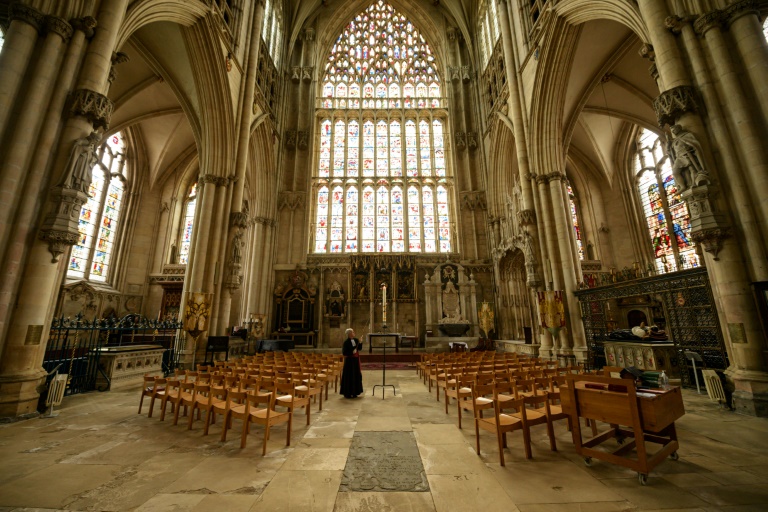
Archbishop of York Stephen Cottrell said it was no “great surprise” that the Christian proportion was declining over time.

But he said that, facing a cost-of-living crisis and war in Europe, people still needed spiritual sustenance.

“We will be there for them, in many cases, providing food and warmth. And at Christmas, millions of people will still come to our services,” said the Anglican Church’s second-ranking cleric.

But the group Humanists UK, which campaigns for the rights of non-religious people, said the government should take on board policy implications.

Those included government backing for religious schools and for the established Church of England, its chief executive Andrew Copson said.

“Iran is the only other state in the world that has clerics voting in its legislature. And no other country in the world requires compulsory Christian worship in (non-religious) schools as standard,” he said.

“This census result should be a wake-up call which prompts fresh reconsiderations of the role of religion in society.”

– ‘That’s just Britain’ –

Some 27.5 million people, or 46.2 percent in England and Wales, described themselves as Christian, down 13.1 percentage points from 2011.

“No religion” rose by 12 points to 37.2 percent or 22.2 million, while Muslims stood at 3.9 million or 6.5 percent of the population, up from 4.9 percent before.

The next most common responses were Hindu (1.0 million) and Sikh (524,000), while Buddhists overtook Jewish people (273,000 and 271,000 respectively).

“Obviously the UK is a diverse country and that is to be welcomed, and that includes diversity of religion as well,” Sunak’s spokesman told reporters in response to the census.

Sunak won the race to replace Liz Truss as prime minister and leader of the Conservative Party on October 24, the same day that Hindus marked Diwali, the festival of lights.

The next day, the new premier’s first formal event in 10 Downing Street was a Diwali reception.

On Tuesday, Sunak was hosting a Downing Street reception marking the Advent build-up to Christmas with “guests invited from across the Christian community”, the spokesman said.

The former finance minister’s grandparents hailed from Punjab in northern India and emigrated to Britain from eastern Africa in the 1960s.

“As chancellor I was able to light my Diwali diyas (lamps) on the steps of Downing Street,” Sunak told The Times newspaper this month. 

“It said something wonderful about our country that that was possible, but also that it wasn’t a big deal.

“It was in a sense ‘Gosh, this is great’ but also that’s just Britain,” he added, reflecting on his ascent to the political peak.

– African evangelicals –

The ONS has been releasing key sections from last year’s census piecemeal. The latest dealt with religion and ethnic identity. 

Data for Scotland and Northern Ireland are released separately.

It found the number of people in England and Wales identifying their ethnic group as white had fallen by around 500,000 since 2011, from 86.0 percent to 81.7 percent.

The second most common ethnic group was “Asian” broadly, at 9.3 percent, up from 7.5 percent a decade ago.

Within that group, most respondents identified their family heritage as Indian, followed by Pakistani, “other Asian”, Bangladeshi and Chinese.

The next largest ethnic group was the fast-growing African population, followed by Caribbean.

African evangelical churches have proliferated in London and elsewhere, providing some succour to the Christian share.

Close Bitnami banner
Bitnami