World

European, US stocks held back by economic gloom

European and US stocks made modest gains on Wednesday on news that major economies contracted in November and as traders looked ahead to Federal Reserve committee minutes.

Paris and London closed in positive territory and Wall Street gained around 0.2 percent in early deals, while Frankfurt ended flat.

The eurozone’s composite purchasing managers index (PMI), a key economic indicator, improved from 47.3 in October to 47.8 in November, S&P Global said.

But activity languished under 50 — signifying the fifth consecutive month of economic contraction as inflation spikes and dampening the outlook for the fourth quarter.

The United States’ composite PMI hit a three-month low of 46.3 in November, down from the October figure of 48.2, with services business activity and manufacturing output data also falling.

Traders were expecting the results of a meeting of the influential Federal Open Market Committee in the United States.

“It’s been a fairly lacklustre session as investors weigh up the release of tonight’s FOMC minutes against a backdrop of a weakening economic outlook,” noted Michael Hewson, chief market analyst at CMC Market UK.

“Stock markets have remained supported as optimism over a less hawkish Fed is outweighing growth concerns. But I can’t imagine investors will continue to take excessive risk heading into a potential recession,” said City Index analyst Fawad Razaqzada.

– ‘Recession is inevitable’ –

Britain’s composite PMI was fractionally higher, from 48.2 to 48.3 in November, but that marked the fourth straight contraction.

The news comes after the UK government recently confirmed that the nation’s economy was in recession, with inflation sitting at a 41-year high.

“Both data suggest that recession is inevitable in both eurozone and UK economies, with the UK likely to be designated officially before the eurozone due to the weaker Q3 data,” Monex Europe analyst Maria Marcos told AFP.

Oil prices slid on disappointing US data and fears of more painful Covid lockdowns in China that could ravage the Asian giant’s energy demand.

The main American oil contract, West Texas Intermediate, briefly sank by more than five percent on Wednesday on China concerns and the underwhelming US data.

Reports that the European Union is considering a price cap on Russian crude and pessimistic global growth forecasts by the OECD are also holding back prices, according to analysts.

“With China also grappling with record numbers of Covid cases the macro-outlook has continued to deteriorate for oil this week, with prices on course to decline for the third week in a row,” said Hewson.

The dollar sank more than one percent against the British pound and weakened against other rival currencies as investors mulled mixed earnings and economic data.

“The US dollar fell sharply again today as concerns intensified that the economy is heading for a recession after a poor set of PMI numbers came out from the services and manufacturing sectors,” said Razaqzada.

“An economic slowdown is expected to weigh on inflation, reducing the need for the Fed to maintain an aggressive tightening stance.”

– Key figures around 1630 GMT –

London – FTSE 100: UP 0.2 percent at 7,465.24 points (close)

Paris – CAC 40: UP 0.3 percent at 6,679.09 (close)

Frankfurt – DAX: FLAT at 14,427.59 (close)

EURO STOXX 50: UP 0.4 percent at 3,946.44

New York – Dow: UP 0.2 percent at 34,175.97

Hong Kong – Hang Seng Index: UP 0.6 percent at 17,523.81 (close)

Shanghai – Composite: UP 0.3 percent at 3,096.91 (close)

Tokyo – Nikkei 225: closed for a holiday

Euro/dollar: UP at $1.0367 from $1.0304 on Tuesday

Dollar/yen: DOWN at 139.69 yen from 141.23 yen

Pound/dollar: UP at $1.2071 from $1.1886

Euro/pound: DOWN at 85.89 pence from 86.69 pence

West Texas Intermediate: DOWN 4.5 percent at $77.30 per barrel

Brent North Sea crude: DOWN 3.8 percent at $84.34 per barrel
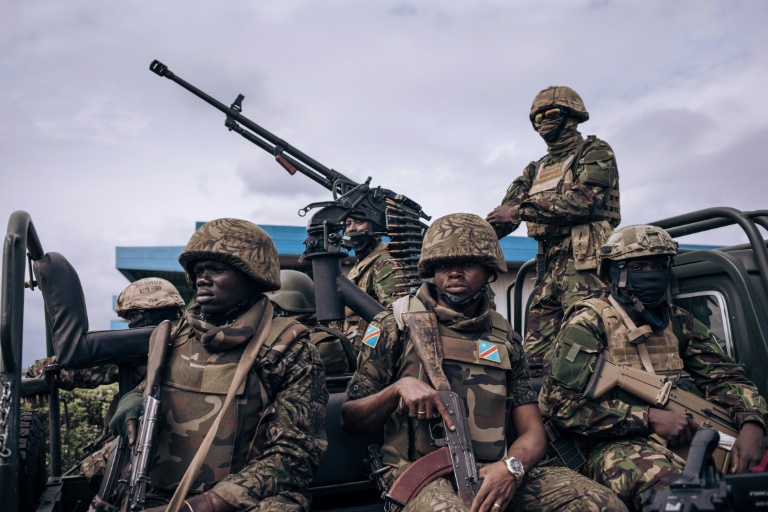
DR Congo and Rwanda in fresh talks in Angola, Kagame absent

DR Congo President Felix Tshisekedi and Rwandan Foreign Minister Vincent Biruta met in Angola on Wednesday amid a surge in tensions triggered by militia violence in eastern Congo.

Tshisekedi and Biruta were received at a hotel in the capital Luanda by Angolan President Joao Lourenco, acting as a mediator between the two neighbours, an AFP correspondent saw.

But Rwandan President Paul Kagame was not in attendance, for reasons that were not immediately clear. 

Eastern Democratic Republic of Congo has witnessed fierce fighting in recent months between Congolese troops and the M23 rebel group.

The clashes have triggered a diplomatic row, with the DRC accusing Rwanda of abetting the rebels, something that its far smaller neighbour denies.

The East African Community (EAC), of which Rwanda is a member, has also vowed to deploy a joint force to quell the violence.

Kenyan soldiers arrived in the DRC earlier this month and Uganda says it will shortly deploy around 1,000 troops. 

The EAC’s chair, Burundian President Evariste Ndayishimiye, and former Kenyan president Uhuru Kenyatta — the EAC’s “facilitator” in efforts to restore peace and security in the mineral-rich region — were also in Luanda.

Ahead of the talks, the UN Security Council members called for a halt to fighting, for the M23 to withdraw from occupied areas and for the end to “all external support to non-state armed actors, including the M23.”

The M23, a largely Congolese Tutsi militia, has seized swathes of territory across North Kivu province, edging towards the region’s main city of Goma.

The DRC and Rwanda agreed to a de-escalation plan in July, but clashes resumed the very next day.

On Tuesday, Kinshasa said it would not sit down for talks with M23 rebels until the group withdrew from the areas it controlled.  

The M23 first leapt to prominence 10 years ago when it captured Goma, before being driven out and going to ground. 

It re-emerged late last year, claiming the DRC had failed to honour a pledge to integrate its fighters into the army, among other grievances.

Rwanda, denying the DRC’s charges against it, accuses Kinshasa of colluding with the Democratic Forces for the Liberation of Rwanda (FDLR) — a former Rwandan Hutu rebel group that was established in the DRC after the 1994 genocide.

Teen killed in twin Jerusalem bus stop bombings

An Israeli-Canadian teen was killed and 14 people were wounded Wednesday as the first bombings in Jerusalem in years hit two bus stops, with Palestinian militant group Hamas cheering the unclaimed attacks.  

A search was underway for suspects who targeted an area frequented by ultra-Orthodox Jews at the city’s western exit, as violence in the Israeli-Palestinian conflict flares and while Israeli politicians discuss the make-up of a coalition government. 

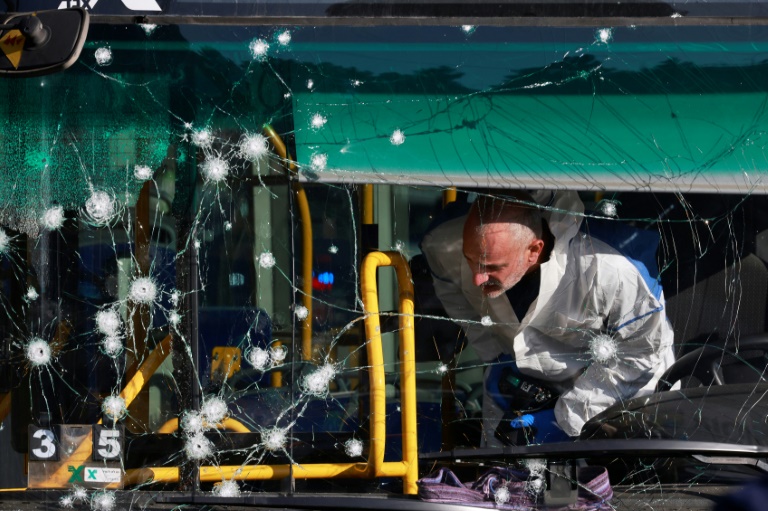
Israeli police described the blasts as “a combined terror attack” and said explosive charges were planted at the two bus stops.

The first blast killed one teenager and wounded 11 other people, before a second injured three at a stop nearby, hospitals treating the casualties said. 

The prime minister’s office identified the boy killed as 15-year-old Aryeh Schupak, who Canada said was one of its citizens. 

Canadian Prime Minister Justin Trudeau said he was “saddened” by the killing and condemned the violence “in the strongest possible terms”. 

The Shin Bet domestic security agency told AFP the blasts were the first in Jerusalem since 2016, and said 34 bombings had been thwarted this year. 

– Coalition talks –

An AFP photographer said the first blast had ripped a hole through a metal fence behind the bus stop. 

Police said the second explosion struck half an hour later, tearing through the side of a bus.

The bus driver said the stop was “very full” when the blast hit. 

“As I was leaving it, I heard a loud explosion. I opened the doors, people ran out,” Motty Gabai told army radio.

A security source told AFP the bombs were detonated remotely. 

Hundreds of mourners including senior politicians gathered later Wednesday for Schupak’s funeral in Jerusalem.  

Rabbi Akiva Orlanski, who taught the boy, said Schupak was the “heart” of the religious school and “wanted to come closer to God”.

Palestinian militant group Hamas, which controls the Gaza Strip, praised the bombings. 

“We congratulate our Palestinian people and our people in the occupied city of Jerusalem on the heroic special operation at the bus stop,” Hamas spokesman Abd al-Latif al-Qanua said. 

The attacks hit amid talks on the make-up of a coalition government being formed by prime minister-designate Benjamin Netanyahu, a veteran hawk.

Outgoing premier Yair Lapid briefed Netanyahu following a meeting with security chiefs.

“We must form a government as soon as possible,” said extreme-right lawmaker Itamar Ben-Gvir, a key ally in the proposed alliance.

“The terror is not waiting,” he added as he visited the scene of the blasts. 

– West Bank violence –

The United States condemned “unequivocally the acts of terror” in Jerusalem.  

“Our commitment to Israel’s security is ironclad and unbreakable,” White House spokeswoman Karine Jean-Pierre said. 

During the second intifada, or uprising, in the early 2000s, Palestinian militants repeatedly planted bombs at urban bus stops, including in Jerusalem. 

Violence has flared in recent months, particularly in the occupied West Bank, where Israeli forces have launched often deadly raids following a series of fatal attacks on Israeli targets.

Tensions were running high Wednesday in the flashpoint West Bank city of Jenin, where Lapid said an Israeli critically wounded in a car crash a day earlier was abducted and subsequently died. 

The Israeli military said it had shut two checkpoints in the area. 

Hossam Fero, the father of the Israeli Druze teenager, said Palestinian militants “kidnapped” his son from hospital. 

“When I saw him he was breathing, they disconnected him from the machines and kidnapped him,” Fero told Ynet radio. 

Israelis abducted dead or alive have been used in the past as bargaining chips by Palestinian militant groups to secure the release of prisoners or the return of bodies of Palestinians killed in clashes by Israel.

Also Wednesday, Palestinians gathered in the West Bank city of Nablus for the funeral of Ahmed Amjad Shehadeh, a 16-year-old boy killed overnight during clashes with Israeli forces.

“This occupation (Israel) doesn’t have mercy for the old or the young, everyone’s a target,” said the boy’s father, Ahmed Shehadeh. 

European Space Agency names new astronauts, agrees record budget

The European Space Agency announced five new career astronauts as well as history’s first astronaut recruit with a disability on Wednesday after adopting a record budget to fund its projects.

The two female and three male career astronauts “will start working immediately,” ESA director-general Josef Aschbacher told a ministerial council meeting in Paris.

From more than 22,500 applicants, the agency chose France’s Sophie Adenot, Spain’s Pablo Alvarez Fernandez, Britain’s Rosemary Coogan, Belgium’s Raphael Liegeois and Switzerland’s Marco Sieber.

They start training next year, with a first mission into orbit not expected until 2026.

They will join the astronauts from the ESA’s previous 2009 astronaut class, including Britain’s Timothy Peake and France’s Thomas Pesquet, one of whom will go to the Moon as part of the Artemis mission.

“No one is retiring today,” Pesquet told AFP, advising the new recruits to “hang on tight”.

The ESA also announced the first astronaut recruit with a physical disability, Britain’s John McFall, who will join a separate “parastronaut” programme.

McFall’s right leg was amputated after a motorcycle accident at the age of 18. He went on to represent the UK as a Paralympic sprinter and works as a trauma and orthopaedic specialist in the south of England, the ESA said in a statement.

– New budget –

The new astronauts were named after two days of tough talks by ministers from the ESA’s 22 member states meeting in Paris to decide on the agency’s future funding. 

They settled on a budget of 16.9 billion euros ($17.5 billion) for the next three years, a 17-percent increase from the 14.5 billion euros agreed at the last ministerial council meeting in 2019. But it is well short of the 18.5 billion requested by Aschbacher.

“With inflation being so high, I have to say that I’m very impressed by this figure,” Aschbacher told the meeting. 

Aschbacher said the increased funds were necessary for Europe not to “miss the train” in the face of competition in space from the United States and China.

French Economy Minister Bruno Le Maire hailed a “great success” that was “beyond expectations”.

Negotiations about each country’s contribution continued until the last moment before the announcement.

Germany contributed 3.5 billion euros, France 3.25 billion and Italy 3.1 billion.

The total committed remains far below US space agency NASA’s budget of $24 billion for this year alone.

Earth observation programmes, which monitor climate change back on Earth, had a six percent funding increase to almost 2.7 billion euros.

Robotic and human exploration’s budget jumped 36 percent to 2.7 billion, while telecommunications rose 19 percent to 1.9 billion euros.

– Rocket boost –

The budget for rocket launcher systems was increased by a third to 2.8 billion euros. Launchers, a subject of delicate negotiations, are crucial for Europe to be able send missions into space without outside help.

The ESA has struggled to get off the ground since Russia withdrew its Soyuz rockets earlier this year in response to European sanctions over Moscow’s invasion of Ukraine.

The job has been made more difficult by delays to its flagship Ariane 6 rocket, which was supposed to have its maiden flight in 2020 but will now blast off at the end of next year.

The ESA has even had to resort to using the Falcon 9 rockets of its rival SpaceX to launch two upcoming scientific missions.

The negotiations were given a boost on Tuesday when France, Germany and Italy announced their support for Ariane 6, the smaller Vega-C launcher and European-made micro and mini launch systems.

The ExoMars mission, which has been delayed by Russia pulling its rockets, will go ahead with US help, Aschbacher said.

Musicians in French-speaking Africa eye global market through streaming

The wildfire popularity of streaming platforms has hoisted Nigerian and other artists from English-speaking Africa to unprecedented popularity around the world.

Musicians from the continent’s francophone countries are now looking to cash in on the boom. 

Africa’s streaming leader is Boomplay, whose library of 80 million tracks is almost in the same ballpark as those of Deezer and Spotify.  

But Boomplay’s big difference with the global giants is a catalogue that focuses intensively on African music rather than a broader range of genres.

The app was created in Nigeria in 2015 and is now present in six African countries, said Paola Audrey, manager of Boomplay’s Ivory Coast branch.

“We offer a very large library which helps you to discover many local artists,” she said.

Funded by advertising and free for the user, Boomplay has blazed a trail internationally for Nigerian Afro-pop and now hopes to do the same for francophone African stars.

“At the moment it’s much easier to highlight Nigerian artists in the French-speaking world, but we’re doing some experiments in the reverse direction, such as the Ivorian rapper Didi B,” said Audrey.

“There are small niche markets, and our role is to promote artists so that they can find an audience on a bigger scale.” 

For industry experts who met last week in Abidjan at the African Music Industry Fair, the digital revolution promises glittering opportunities for West African artists.  

Revenue from African music streaming is expected to more than triple in five years, from $92.9 million in 2021 to $314.6 million in 2026, according to research firm Dataxis.

– Digital dawn –

“Everything began with digital platforms,” said Akotchaye Okio, in charge of international development for Africa at Sacem, a rights group representing artists.

“Look at the success of the South African song ‘Jerusalema’ or ‘Calm Down’ by Rema,” a Nigerian singer whose hit has notched up 50 million streams in France alone, he said.

Magali Palmira Wora, a francophone Africa specialist at US distributor The Orchard, pointed however to a learning curve.

“Artists in French-speaking Africa have to learn to put themselves forward on platforms,” she said.

“Spotify for example has got an Afro-pop playlist — you have to explain to artists why it’s important to be on it.”

Good exposure on the platforms smashes down the barriers to bigger markets, and opens the way to a career that is far more international than would have been previously possible.  

“Wherever you are, you can listen to my songs in one click. With digital technology, access to information is much more extensive. It allows local music industries to develop and as an artist it gives us exposure,” said Ivorian rapper Suspect 95.  

“We no longer need to go through networks which made it hard to get my CD to this or that country.”  

– Copyright issue –

Five countries — South Africa, Egypt, Nigeria, Algeria and Morocco — account for 86 percent of African streaming revenues today, according to Dataxis. 

But the 400 million potential listeners in French-speaking sub-Saharan Africa, two-thirds of whom are under the age of 25, are a promising untapped market. 

Ensuring that up-and-coming independent artists can make money from the dominant platforms will be a key challenge.  

“Obviously, if you’re signed up with a major (music company), it’s easier — you are using an established network” for getting copyright payments, said Suspect 95, who is signed to Universal.

“For independent artists, it’s harder, for now.”

“The big platforms which use massively use our songs aren’t yet paying the rights they should in Ivory Coast,” said Karim Ouattara, director general of the Ivorian Copyright Office.

“But we are in negotiations and should see progress by the end of the year.” 

After bitter election, Brazil seeks unity in World Cup glory

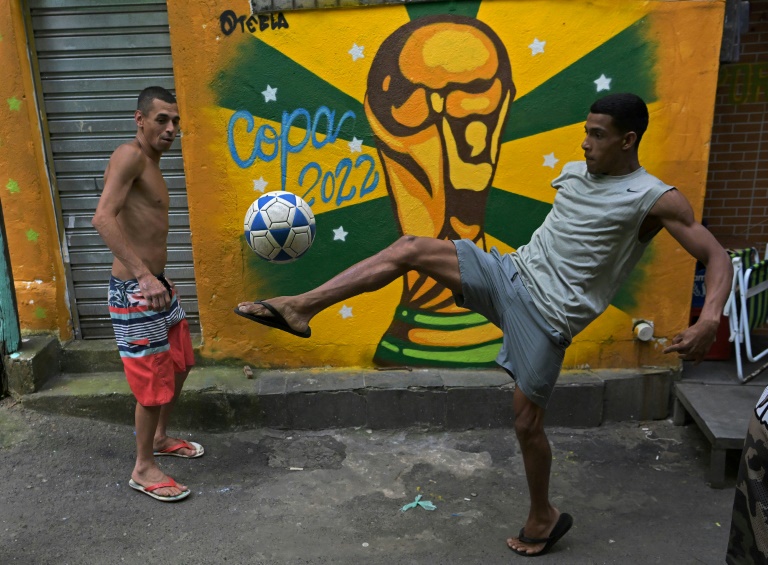
A sea of streamers and mini-Brazilian flags flutters over Freedom Alley, one of myriad narrow streets criss-crossing Rio de Janeiro’s biggest favela, Rocinha, which decks itself out in World Cup splendor every four years.

But residents vetoed a graffiti portrait of superstar Neymar — a supporter of outgoing President Jair Bolsonaro — and cut back on the usual green and yellow, after the national colors became associated with the far-right in a divisive election whose wounds many Brazilians hope the power of football will now help heal.

“The flag is ours. We’re cheering on our country. It has nothing to do with politics,” says Marcela Fadini Moreira, the 41-year-old teacher who organized Freedom Alley’s entry for Rocinha’s quadrennial World Cup street decoration contest.

Still, last month’s bitter election — in which Bolsonaro narrowly lost to veteran leftist Luiz Inacio Lula da Silva — had an impact on the look of her street’s decorations for Qatar-2022, where the country of Pele, Ronaldo and Ronaldinho is seeking a record-extending sixth title.

“People didn’t want us to paint Neymar, because he endorsed Bolsonaro” in the elections, Moreira says.

So she and her fellow volunteer decorators instead made a graffiti mural of hometown hero Pedro, a forward for the national team and local club Flamengo.

They also added blue and white streamers to the usual green and yellow, dialing down the colors embraced by Bolsonaro, who urged supporters to wear the Brazilian national team’s jersey to vote in October’s elections.

– Seeking to smile again –

Higher up the hillside covered by the sprawling slum, other murals depict the national team’s players and 2022 World Cup mascot La’eeb.

A group of youths juggle a football in a circle, showing off the prowess that has made Brazil famous for the “beautiful game.”

But World Cup enthusiasm is a bit diluted this year, says community leader Eliezer Oliveira, after the carnage of the coronavirus pandemic, an economic crisis and the polarizing election.

“Not many people were enthusiastic about decorating the streets this year,” says Oliveira, 57.

He is hoping that will change if Brazil dazzles in Qatar.

“After all the problems we’re going through… seeing Brazil crowned champions would put a smile on our faces again,” he says, proudly sporting the “Selecao” jersey.

– Less politics, more football –

Brazilians are increasingly catching World Cup fever as the five-time champions prepare to kick off their campaign Thursday against Serbia.

The usual explosion of flags, banners, balls and other national team-themed decorations has arrived, if a little late, in bars, restaurants, stores and streets across the country.

In the Sao Paulo neighborhood of Vila Medeiros, Jadson Paixao decided to keep alive the tradition of decorating his street with his childhood friends.

“It’s great if people can enjoy the World Cup and forget about the election,” says the 35-year-old Uber driver.

“Politics is politics. Football is football.”

Meanwhile, there is a movement to reclaim the colors of the flag as a national symbol, rather than that of the far-right.

Lula, who will be sworn in as president on January 1, has launched a campaign to do just that, saying, “Green and yellow are the colors of anyone who loves and supports the country.”

The Brazilian Football Confederation (CBF) has also jumped in, with an ad aimed at depoliticizing the national team’s jersey and “reconnecting” with fans.

“The World Cup is a time of unity,” said CBF president Ednaldo Rodrigues.

“Football can’t live without the fans. Our goal is to connect people of all ages, places, colors, races, ideologies and religions with football.”

How well that succeeds could depend on how well things go on the pitch.

“If Brazil win, I think everyone will want to wear the national team’s jersey again,” Sao Paulo businessman Fabio Vassalo Grande, 47, told AFP in Qatar.

“For Brazilians, football is happiness.”

Russia court extends Kremlin critic Yashin's detention by six months

A Russian court on Wednesday extended by six months the detention of opposition politician Ilya Yashin, who risks being jailed 10 years for denouncing President Vladimir Putin’s assault on Ukraine.

The 39-year-old Moscow city councillor is in the dock as part of an unprecedented crackdown on dissent in Russia, with most opposition activists either in jail or in exile.

He faces up to 10 years behind bars, if convicted.

Yashin refused to leave after Putin sent troops to Ukraine on February 24 and regularly took to his YouTube channel, which has 1.3 million subscribers, to condemn the Kremlin’s offensive.

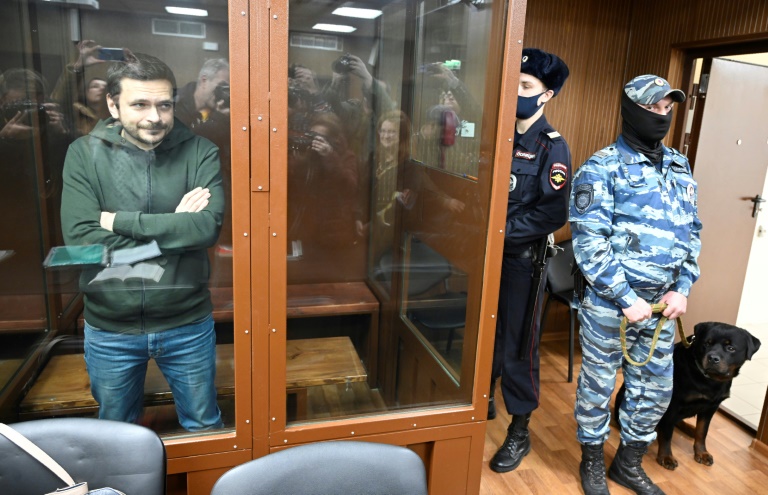
Standing in the defendant’s glass box at Moscow’s Meshchansky district court, Yashin smiled and flashed a peace sign at the end of the hearing as some of his supporters clapped.

– ‘ Russian patriot’ –

Yashin insisted in court that he would not flee the country, but the judge extended his detention by six months.

“I love my country and in order to live here I am ready to pay with my freedom,” he said. 

“I am a Russian patriot,” he said.

Prosecutors argued that Yashin should be kept in detention because he had “inflicted considerable damage to Russia” and “increased political tensions during the special military operation” — Moscow’s term for its Ukraine offensive.

One of the opposition activist’s lawyers, Vadim Prokhorov, said that extending Yashin’s detention until May 10 was against the law.

Yashin sought to put on a brave face during the hearing and looked relaxed. 

Wearing a dark green hoodie and jeans, he smiled to his parents in the front row. At one point he asked his father if he had watched the World Cup match between Argentina and Saudi Arabia on Tuesday night and they exchanged a laugh.

As the hearing ended and the audience was leaving the courtroom, a scuffle erupted between court employees and Yashin’s father, apparently after guards told his mother to stop talking to her son.

The men tussled in the corridor for several minutes, with Yashin’s father at one point held on the floor. He was taken to another room for some time before being released by the guards.

The next hearing is expected to take place on November 29.

Yashin is an ally of jailed opposition leader Alexei Navalny and was close to Boris Nemtsov, an opposition politician assassinated near the Kremlin in 2015.

– ‘Shut people up’ – 

Yashin was detained over the summer while walking through a Moscow park. 

He is accused of spreading “fake” information about the Russian army under legislation introduced after Putin launched the operation in Ukraine.

In an April YouTube stream Yashin spoke about the “murder of civilians” in the Kyiv suburb of Bucha where the Russian army has been accused of war crimes.

He called it a “massacre”.

His supporters at court said authorities were using the draconian legislation to muzzle critics of the military campaign in Ukraine.

“This law is absolutely anti-legal,” said Anastasia Leonova, 48.

“It’s just there to shut people up.”

Her 20-year-old daughter, Olga, said their family liked Yashin’s Youtube streams.

“We would gather in the kitchen every Thursday to watch them,” she said. “Me, mum and my 87-year-old grandmother.”

Since Moscow’s intervention began in Ukraine, independent media outlets have been shut down or their operations suspended in Russia. 

Tens of thousands of Russians — including many independent journalists — have left the country.

Another Moscow councillor, Alexei Gorinov, was in July sentenced to seven years in prison for denouncing the Ukraine offensive. 

The 61-year-old had questioned plans for an art competition for children in his constituency while “every day children are dying” in Ukraine. 

Almost all of Putin’s well-known political opponents have either fled the country or are in jail. 

Navalny, 46, is serving a nine-year sentence for embezzlement charges, which is widely seen as politically motivated. His political organisations have been outlawed.

New home sales in US post surprise jump in October

New home sales in the US defied expectations and rose in October, government data showed Wednesday, despite mortgage rates remaining high.

Although sales surged during the pandemic, the sector cooled with the central bank raising the benchmark lending rate multiple times this year to ease demand and tamp down soaring inflation.

But sales of new single-family houses picked up 7.5 percent to a seasonally adjusted annual rate of 632,000 in October, said the Commerce Department, despite analyst expectations of a dip as higher rates bite.

The median sales price for a new home in October rose to $493,000 as well, up from September’s revised figure of $455,700.

Monthly data can be volatile, and some observers have pointed to a rush to lock in mortgage deals before rates increased further as a reason that sales surged previously.

Another factor analysts have cited is a lack of existing inventory, nudging buyers into the market for new property, supporting sales.

In October, the sales pace remained below that of the same period in 2021.

The latest figures come as the US’s much bigger existing home sales market slipped for a record nine consecutive months.

“The increase in sales came despite a rise in new home prices,” said Nancy Vanden Houten of Oxford Economics in an analysis.

But she noted that this reflected a shift in composition of sales, towards homes priced above the median.

“We expect sales to remain under pressure going forward as the erosion in affordability this year keeps many buyers on the sidelines,” she said.

Home sales have eased “sharply” overall, added economist Rubeela Farooqi of High Frequency Economics.

“Pressure is likely to persist in the near term as low inventories, still-high prices and elevated mortgage rates weigh on activity,” she added in an analysis.

Vladimir Putin's critics: dead, jailed, exiled

Opposition politician Ilya Yashin, who went on trial in Moscow on Wednesday, risks becoming the latest in a long line of Kremlin critics slapped with heavy jail terms.

Others have been killed or narrowly escaped death while still others have gone into exile.

Here is a list of Putin’s best known critics. 

– Dead –

Boris Nemtsov, a Kremlin critic and a former deputy prime minister, was shot dead in 2015 as he walked home across a Moscow bridge near the Kremlin.

Five Chechen men were convicted of killing Nemtsov, but the mastermind of the murder was never found.

Nemtsov’s allies have pointed the finger of blame at the Kremlin as well as Chechen leader Ramzan Kadyrov, who has denied the accusation. 

The charismatic speaker had slammed Putin’s annexation of Crimea from Ukraine in 2014 and regularly taken part in opposition protests. 

He was 55 at the time of his death. 

In 2006, the killing of journalist Anna Politkovskaya outside her Moscow home had shocked the world. 

Politkovskaya, a reporter at Novaya Gazeta, Russia’s top independent newspaper, was a fierce critic of the Kremlin’s tactics in Chechnya. 

The newspaper’s editor Dmitry Muratov dedicated his Nobel Peace Prize this year to Politkovskaya and other Russian journalists killed for their work. 

Other Putin critics have narrowly escaped death. 

– Jailed –

Russia’s main opposition politician Alexei Navalny was poisoned with Novichok, a Soviet-made nerve agent, on a trip to Siberia in 2020. 

He underwent treatment in Germany and returned to Russia in January 2021, where he was arrested upon landing at a Moscow airport. 

The 46-year-old is serving a nine-year sentence on embezzlement charges his supporters call punishment for challenging the Kremlin.

Navalny has denounced Putin’s Ukraine offensive from prison, calling it a “tragedy” and a “crime against my country.” 

Vladimir Kara-Murza, an opposition politician, was arrested in April for spreading “fake” information about the Russian army. 

He was later charged with high treason and faces up to 20 years in prison. 

Kara-Murza, 41, says he has been poisoned twice.  

In August, Yevgeny Roizman, the former mayor of Yekaterinburg, was detained for his criticism of Russia’s assault on Ukraine. 

After his arrest sparked protests, the 60-year-old opposition politician was released from custody as he awaits trial on charges of “discrediting” the Russian army.


– Exiled –

Some of Putin’s high-profile critics have been based abroad for years, such as former oil tycoon Mikhail Khodorkovsky, who spent a decade in prison after challenging the Russian leader early in his rule. 

Khodorkovsky is based in London and has financed media projects critical of the Kremlin. 

Many of Navalny’s prominent allies fled Russia after his organisations were banned as “extremist” last year.

But the decision to send troops to Ukraine, which ushered in an unprecedented crackdown at home, proved to be a final nail in the coffin for Russia’s opposition movement. 

Russians opposed to Moscow’s attack on Ukraine are now scattered around the world, with many fleeing to Europe and Israel.

TV presenter and entertainer Maxim Galkin, the husband of Russian pop icon Alla Pugacheva, has become an unlikely leading voice against the Ukraine offensive on social media.

Based in Israel, the 46-year-old show star regularly denounces the Russian army’s offensive on Instagram.   

– Foreign agents –

Despite a rare intervention by Pugacheva — who is widely considered untouchable — Galkin has been branded a “foreign agent.” 

The label, which has Stalin-era connotations, has been used by authorities to mount pressure on critics. 

Putin has recently toughened the draconian 2012 “foreign agent” law. 

Many journalists and Russia’s main independent media outlets have been slapped with the label, making it much harder to operate.

All main independent media organisations in Russia have been shut down or suspended operations.

Other popular figures who have spoken out against Moscow’s Ukraine offensive — such as hugely popular rappers Oxxxymiron and Noize MC, as well as exiled science fiction writer Dmitry Glukhovsky — have also been labelled “foreign agents.”

Shine on: campaigners save London's historic gas lamps

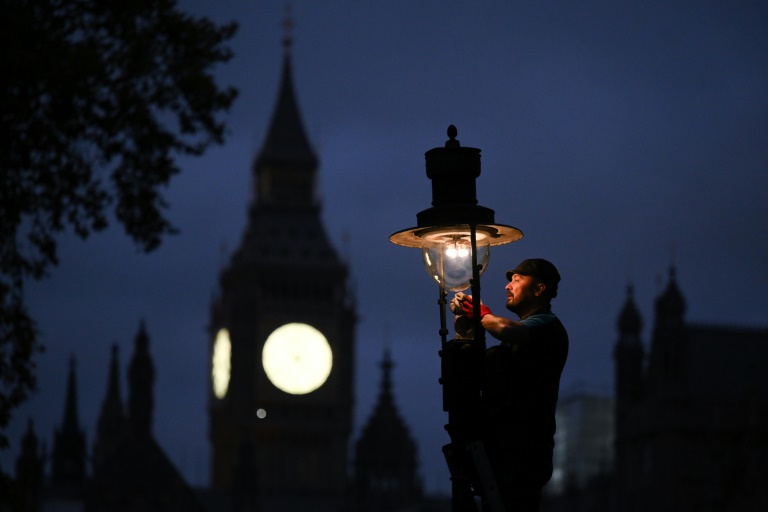
Intrigued tourists watch as Paul Doy climbs a ladder outside London’s Westminster Abbey and lifts the globe of a gas street lamp.

Winding its timer, he then ignites a small cloth mesh, creating a distinctive soft warm light that illuminates the darkness.

“I like the historical aspect of it,” said Doy, even if it means getting up at 5:00 am to tend to the lamps in the fashionable district of Covent Garden.

“It’s mainly winding the 100-year-old mechanical clocks” in the lamps “and setting the times for those, especially now as well, because we’re losing light much earlier,” he told AFP.

The 200-year-old nightly ritual nearly became history, however, over local authority plans to replace 174 gas-powered lamps protected by a heritage order with eco-friendly LED bulbs.

The plan by the City of Westminster council caused uproar among some residents and heritage lovers, and even sparked a question in parliament.

But on Tuesday, the council said it had decided to scrap the move. Instead, it will convert 94 other gas lamps which are not protected. 

Tim Bryars, who owns a small bookshop in Covent Garden, stumbled across the plan by chance just over a year ago.

“One morning, I went out of my shop, there are a couple of guys from the council digging a hole in front of my bookshop,” he said. 

“I said, ‘what are you doing?’ And they said, ‘Don’t worry, we’re just looking to see how easy it will be to convert your gas lamps to electricity’.

He fronted a campaign to save them and on Wednesday called the council’s U-turn “a good first step”.

“Basically they are admitting we were right but they have to do more,” he told AFP.

“We actually need a firm policy commitment to positively preserving the gas lamps, not just keeping a few until they become troublesome.”

– ‘London’s DNA’ –

London has more than 1,000 gas street lamps, which were installed at the beginning of the 19th century.

At the time, they were considered a major innovation in a city with dark, dirty and often dangerous streets.

In central London, they still light up parts of The Mall avenue leading to Buckingham Palace, the back streets of Covent Garden, and around Westminster Abbey.

The atmospheric light they give out is evocative of Charles Dickens novels, Mary Poppins and Sherlock Holmes.

“They are an incredibly important part of the fabric of London’s history. They are in London’s DNA,” said Luke Honey, an antiques writer who was also involved in the campaign. 

“They are just beautiful things. The quality of light is incredibly natural,” he said in Goodwin’s Court near Covent Garden, said to be the inspiration for Diagon Alley in J.K. Rowling’s Harry Potter series.

“I am afraid reproduction LEDs just don’t replicate the beauty of original lamps and also the quality of that particular gas light.”

Joe Fuller, head of the maintenance team for old street lamps at British Gas, accepted that some of the replacements “look very nice”.

“But they’re still different from the originals,” he said.

“I think it’s really key that we maintain that heritage and keep as many as we possibly can.”

– Consultation –

Previous attempts to replace the gas lamps caused a similar outcry and forced the council to abandon its plans.

But a change of leadership revived the project, as part of an overall aim to reduce carbon emissions — and improve public safety.

The council had been trying to convince naysayers in a public consultation exercise, which ended on Sunday.

Paul Dimoldenberg, the council’s cabinet member for city management and air quality, said the lamps were “increasingly difficult to maintain and repair”.

“In a street where gas lamps break down… the streets are in darkness for longer, and therefore they are not as safe as they should be for pedestrians or anybody using the streets in the dark,” he added.

But in abandoning the move, he said the council acknowledged “the strong heritage issues at stake”.

Close Bitnami banner
Bitnami