World

Twitter takeover raises fears of climate misinfo surge

Climate deniers looking to block action and “greenwashing” companies could have free rein on Twitter after Elon Musk’s takeover, analysts warned as leaders pursued anti-warming efforts at the COP27 summit.

The Tesla billionaire and self-declared free-speech absolutist has fired thousands of staff -– with sustainability executives Sean Boyle and Casey Junod among those signing off from the platform last week.

Musk has promised to reduce Twitter’s content restrictions and after the takeover announced plans to create a “content moderation council” to review policies.

“It’s not clear what Mr Musk really plans to do. However… if he removes all attempts at content moderation, we can expect a surge of disinformation, as well as increases in misleading and greenwashing advertisements,” said Naomi Oreskes, a professor of the history of science at Harvard University who has authored leading studies on climate misinformation.

“Greenwashing” means companies misleading the public about their impact on the planet through messages and token gestures.

“We may also see an increase in hateful comments directed towards climate scientists and advocates, particularly women,” Oreskes said.

Following the buyout, one climate journalist tweeted that he had received death threats on the platform. He did not immediately respond to a request for comment.

– Sustainability execs axed –

Researchers and campaigners say that despite measures announced by social platforms, climate misinformation is thriving, undermining belief in climate change and the action needed to tackle it.

Twitter and other tech giants such as Facebook and Google have said they are acting to make false claims less visible.

But the Institute for Strategic Dialogue think tank said in a detailed study this year that messages aiming to “deny, deceive and delay” regarding climate action were prevalent across social media.

Under Twitter’s policy before the takeover, it said “misleading advertisements on Twitter that contradict the scientific consensus on climate change are prohibited”.

“We believe that climate denialism shouldn’t be monetised on Twitter, and that misrepresentative ads shouldn’t detract from important conversations about the climate crisis,” Boyle and Junod wrote in an Earth Day post on Twitter’s blog.

Both posted messages on November 4 with the hashtag “LoveWhereYouWorked”, indicating they were among those laid off after Musk’s $44-million takeover. They did not immediately respond to requests for comment.

– Scientists at risk –

Beyond false information, some specialists warned that climate scientists themselves face threats if moderation falters.

A surge in hate speech drove Twitter’s head of safety and integrity Yoel Roth to respond, trying to calm concerns. He tweeted that the platform’s “core moderation capabilities remain in place”.

Musk wrote on November 4 that “Twitter’s strong commitment to content moderation remains absolutely unchanged.”

“I worry that scientific falsehoods will find a bigger platform on Twitter under Musk’s leadership,” said Genevieve Guenther, founder of the media activism group End Climate Silence.

“But I worry even more that the website will start deplatforming climate scientists and advocates who criticise right-wing views, preventing them from connecting to each other and to decision-makers in media and government.”

– Blue ticks at COP? –

Among Musk’s plans is an $8 monthly charge for users to have a blue tick by their name — currently a mark of authenticity for officials, celebrities, journalists and others.

“To me, this is opening the door to highly coordinated disinformation and manipulation,” said Melissa Aronczyk, an associate professor in communication and information at Rutgers University.

Musk said the move aims to reduce hate speech by making it too expensive for trolls to have multiple accounts.

Aronczyk argued the system would give a mark of authenticity to those willing to pay for a blue tick to push an agenda.

She pointed to the controversy around Hill+Knowlton Strategies — a PR company working for big fossil fuel companies -– reportedly hired by host Egypt to handle public relations for the COP27 summit.

“Picture every Hill+Knowlton staffer working for COP27 creating a network of blue-check accounts to promote the business-led initiatives at the summit. Or downplaying the conflicts. Or ignoring protests,” Aronczyk said.

“It’s basically letting corporate greenwashing become the default communication style around climate change.”
The weakest link? North Korea's crumbling air force

North Korea on Tuesday described its record-breaking blitz of missile launches last week as a “just counteraction” to the biggest-ever US-South Korea air exercises.

Pyongyang has long condemned joint military exercises by Seoul and Washington, calling them rehearsals for an invasion — but it has appeared especially sensitive to air force drills.

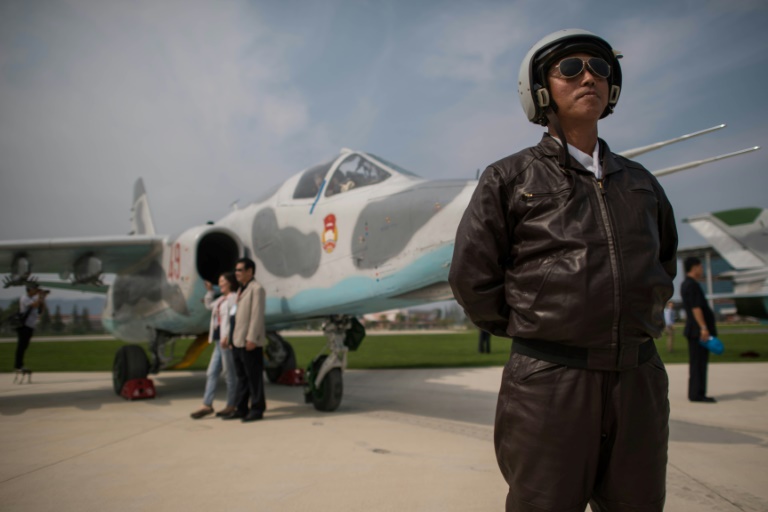
That is because North Korea’s air force is the weakest link in its military, experts say.

Here is a look at the service, officially known as the Korean People’s Army (KPA) Air and Anti-Air Force:

-How many planes does it have?-

The KPA air force has more than 900 combat aircraft, 300 transport planes and 300 helicopters, according to an assessment published last year by the Pentagon’s Defense Intelligence Agency.

But most of its fighters and bombers are either obsolete or near-obsolete, acquired decades ago mainly from the Soviet Union and China.

Even the most potent jets in its fleet, the Soviet-designed MiG-29s, were procured in the late 1980s.

The “on paper” estimates do not “represent the smaller ‘active’ fleet, with an unknown proportion in long-term storage or withdrawn, unlikely to ever fly again”, Joseph Dempsey, a researcher at the International Institute for Strategic Studies (IISS), told AFP.

North Korea is believed to be rotating its “ageing to obsolete” fleet in and out of storage “to keep them serviceable but also manage lifespan”, he added.

-What about its pilots?-

North Korea “does not have the capacity to pay for enough fuel, cover maintenance costs or adequately train its pilots,” according to a 2020 IISS report.

Without enough fuel and therefore enough flight time, its pilots cannot learn or even maintain combat readiness, analysts say.

North Korean combat pilots get as little as 15-25 hours in the air every year, the DIA estimated.

That is far lower than the reported average in the US and South Korean air forces.

The North Korean air force is so far behind that it is “simply incomparable” to other countries, North Korean studies scholar Ahn Chan-il told AFP.

“It is no exaggeration to say that the North’s air force is an ‘air force on the ground’ that almost never gets any proper training.”

-How did it become so weak?-

North Korea boasted about “twice the air power” of the South in the 1970s, according to a 2013 report by Seoul’s Institute for Military History.

The then-strong North Korean air force sent help to Hanoi in the Vietnam War and to Syria and Egypt during the 1973 Yom Kippur War, it said.

But the demise of the Soviet Union — a critical source of financial and military support — along with the deterioration of its own economy left North Korea deeply impoverished by the 1990s.

“Russia eventually established diplomatic ties with Seoul (in 1991) and partly because of it, Moscow decided not to provide the North the kind of military support the Soviets used to offer,” Chun In-bum, a retired South Korean army general, told AFP.

Pyongyang was also hit with crippling sanctions over its nuclear weapons and missile programmes, making it even more difficult to find the resources to build up and maintain modern conventional forces.

“North Korea eventually decided to fully focus on developing its nuclear programme instead,” Chun told AFP.

This was a “strategic” decision on Pyongyang’s part, added Yang Moo-jin, a professor at the University of North Korean Studies.

“The best card for North Korea to negotiate with the world is nuclear weapons.”

-How does it compare with US, S. Korean air forces?-

In the unlikely event of air combat with South Korea or the United States, the North Korean air force would be “severely overmatched”, said Daniel Pinkston, a senior lecturer at Troy University in Seoul.

“In an intense conflict with combined and joint South Korean and US forces… North Korea’s air power and air defences would be degraded very quickly.”

The difference in resources and technology was in sharp focus last week during the joint US-South Korean air drills, dubbed Vigilant Storm, which involved some of the most advanced aircraft in the world.

Unlike North Korea’s Soviet-era jets, US and South Korean pilots flew high-tech F-35 stealth fighters, B-1B long-range heavy bombers, electronic warfare jets and in-flight refuelling tankers.

Last week, many of North Korea’s missile launches were drills simulating the destruction of enemy air force bases.

“North Korea considers it important to strike and neutralise air bases first because their air power is weak,” said Cheong Seong-chang, a researcher at the Sejong Institute.

Renault to reorganise towards electric future

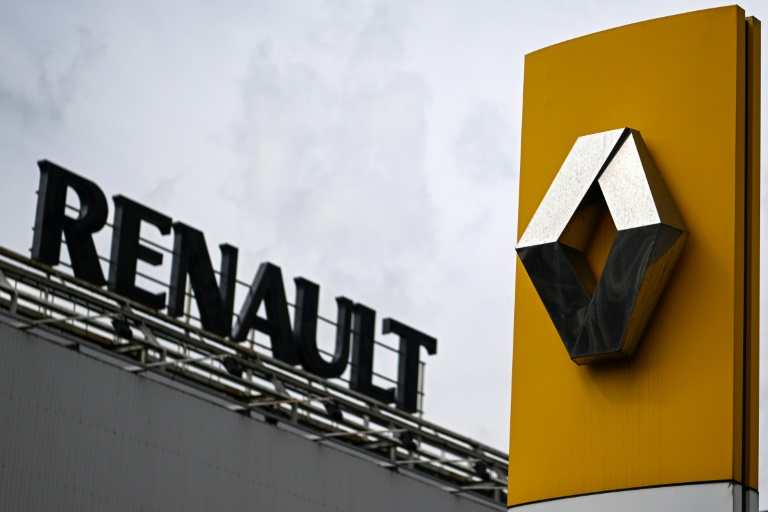
French automaker Renault will pitch investors Tuesday on its planned green revamp, with two spin-offs: a new electric-vehicle unit and a subsidiary for thermal and hybrid assets. 

The electric vehicle market is expected to grow rapidly in response to consumers’ worries about climate change, putting pressure on manufacturers to develop less polluting products.

The European Union last month agreed to phase out new CO2-emitting vehicles by 2035, a move set to turbo-charge the production of electric prototypes on the continent.

At an investor day in Paris on Tuesday, Renault is expected to outline its green transformation. 

The flagship division of the carmaker’s reorganisation is Ampere, a split-off expected to employ around 10,000 staff in France and produce electric vehicles in the north.

Renault plans to invite investment in Ampere but would remain the majority shareholder.

Renault also intends to combine its technological, manufacturing, and research and development activities for its hybrid and internal-combustion vehicles in a subsidiary called “Horse”.

The subsidiary is expected to employ an estimated 19,000 people across Europe, China and South America.

Chinese car manufacturer Geely is being considered for a stake in the company.

“We are designing an agile and innovative organisation to manage the volatility and accelerated technological evolution of our time,” said Renault CEO Luca de Meo.

Investors on Monday expressed their interest in Renault’s transformation, with the group’s shares climbing 3.77 percent on the Paris stock market.

The company suffered a historic loss in 2020 and its recovery was destabilised by its withdrawal from Russia following Moscow’s invasion of Ukraine.

The value of traditional car manufacturers pales in comparison to new players on the market specialising in electric vehicles such as Elon Musk’s Tesla or Chinese firm BYD.

Renault still needs large investment to accelerate its electric transformation, according to plans it presented in 2020.

US giant Ford has taken similar steps, announcing the creation of the “Ford Model E” earlier this year.

Renault’s sales of traditional internal-combustion vehicles are falling. In the first nine months of 2022, hybrid and electric vehicles represented 38 percent of the brand’s registrations in Europe, a year-on-year increase of 12 percent.

The planned separation of Renault’s electric and conventional production has concerned trade unions after several waves of job cuts.

Trump trails 2024 run on eve of US midterm election

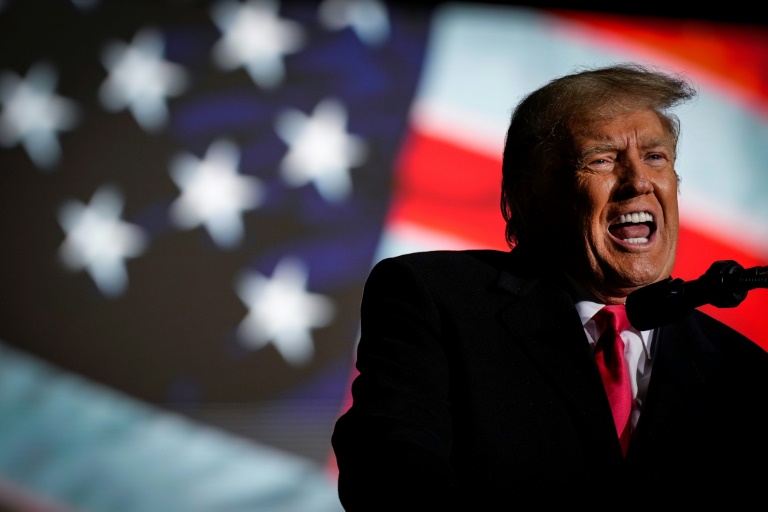
Donald Trump grabbed the election eve spotlight on Monday to flag an expected announcement on a new White House run, as America prepares to vote in midterms that polls show could land Congress back under Republican control.

The former president, who has never accepted the truth of his 2020 loss, ratcheted up the hints that he would be entering the fray for 2024.

“Not to detract from tomorrow’s very important, even critical election… I’m going to be making a very big announcement on Tuesday, November 15 at Mar-a-Lago in Palm Beach, Florida,” he told a cheering crowd in Ohio on the eve of polls that will determine control of the House of Representatives and the Senate.

The brief mention, at the tail end of a typically dark, rambling speech, came as President Joe Biden made a final appeal in an election in which Republicans are well placed to win at least partial control of the levers of government.

Even if Republicans win only the House of Representatives, that would scupper Biden’s legislative agenda for the last two years of his first term and potentially lead to a weakening of US support for Ukraine’s resistance against Russia.

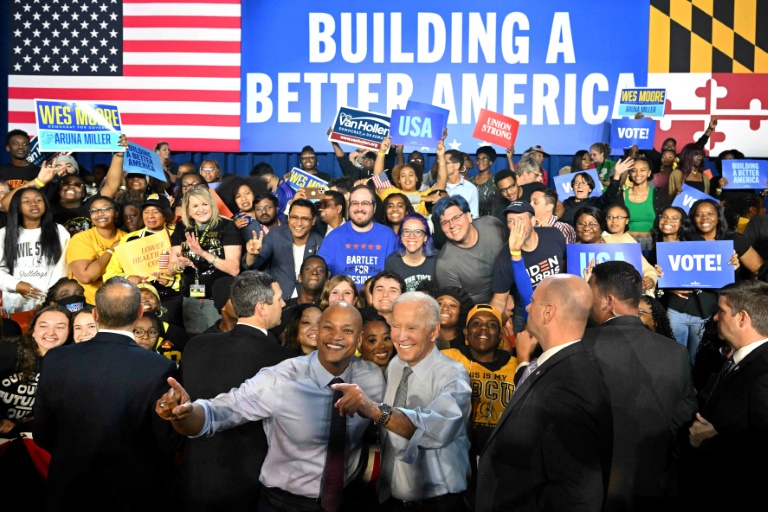
“Our lifetimes are going to be shaped by what happens,” Biden told an enthusiastic crowd at a historically Black university in Bowie, near Baltimore, late Monday. “We know in our bones that our democracy is at risk and we know that this is your moment to defend it.”

“The power’s in your hands,” he told Democrats. “So vote, get out the vote.”

An influx of far-right Trump backers in Congress would also accelerate the shift that has been taking place inside the Republican Party ever since the former real estate tycoon stunned the world by defeating Hillary Clinton for the presidency in 2016.

Despite facing criminal probes over taking top secret documents from the White House and trying to overturn the 2020 election, Trump is now using the midterms to cement his status as the de facto Republican leader and presumptive presidential nominee.

Monday night’s announcement was the closest the Republican has got to confirming his intention to run, building on his message last week that he “will very, very, very probably do it again.”

– Lame duck? –

More than 40 million ballots had been cast through early voting, meaning the outcome was already taking shape before polls opened nationwide Tuesday.

Biden tried to remain upbeat during his closing address in Baltimore, but in a call with party allies earlier Monday he conceded that his dreams of keeping Congress, which Democrats currently control by a thin margin, amounted to a “very high expectation.”

Trump Republicans are “some of the darkest forces we’ve ever seen in our history,” he said.

Biden’s speech laid out what he said was “a choice between two very different visions of America,” arguing that his administration has successfully steered the world’s largest economy out of the Covid pandemic, with unemployment at 3.75 percent and manufacturing industries on the rise.

Republicans, he said, would return to “trickle-down economics” that favor the rich.

Polls show that Republican messaging emphasizing four-decades-high inflation, crime and illegal immigration has left voters in an angry mood. As the party controlling the White House and — albeit barely — Congress, the Democrats are likely to get punished.

Returning to the White House on Monday night, Biden told reporters he believed Democrats would win the Senate — though he conceded “it’s going to be tough” to keep control of the House.

If Democrats can’t even hold the Senate, then Biden would find himself in a state of constant political warfare in Washington. There would also be immediate, harsh questions over whether the president, who turns 80 this month, should seek a second term or give way to a younger party member.

Biden’s entire agenda would go into deep freeze. That would raise questions over everything from climate crisis policies, which the president will be laying out at the COP27 conference in Egypt this week, to Ukraine, where Republicans are reluctant to maintain the current rate of US financial and military support.

While insisting he supports Ukraine’s struggle, Republican Minority Leader Kevin McCarthy told CNN there could be no “blank check” — a nod to the isolationist Trump wing of his party and a signal likely sending shivers through Kyiv.

Adding to tensions — and a reminder of Moscow’s murky role throughout Trump-era US politics — Kremlin-connected oligarch Yevgeny Prigozhin boasted that Russia was trying to tilt the outcome.

Australian insurer warns of 'distressing' data threat

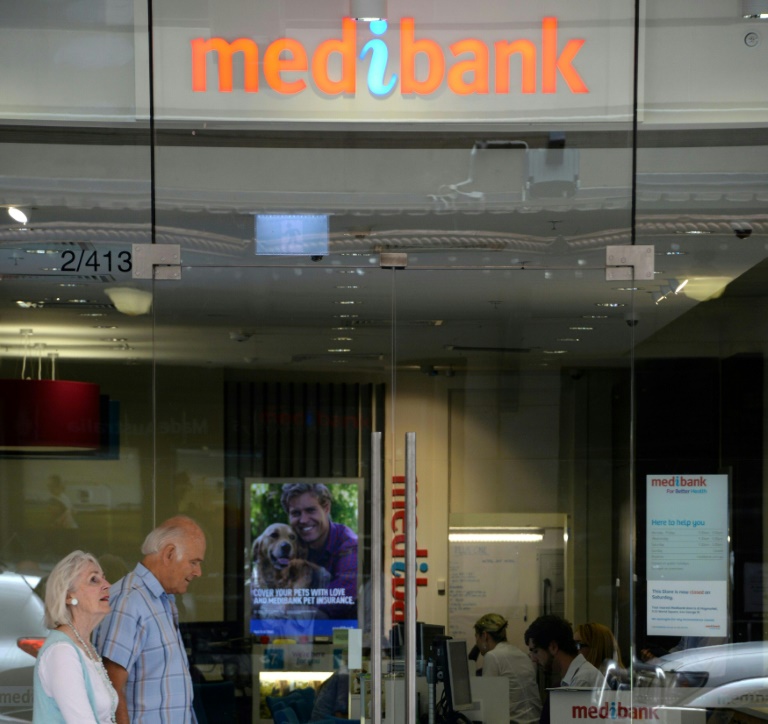
A major Australian health insurer warned Tuesday of a “distressing” threat by a purported hacker to release data within 24 hours from a hack affecting 10 million people.

Medibank Private, one of Australia’s largest insurers, told customers to be “vigilant” after the reported threat, issued a day after it had ruled out paying any ransom demand.

The warning came a day after a hack originally thought to have breached the data of 3.9 million customers had in fact given access to the names, birth dates, addresses, phone numbers and emails of about 9.7 million former and existing clients.

On Tuesday, an anonymous poster on a hacking blog — widely cited by Australian media — said “data will be publish in 24 hours”. 

It was not possible to confirm whether the poster was connected to the hack or had access to people’s stolen information.

“We knew the publication of data online by the criminal could be a possibility, but the criminal’s threat is still a distressing development for our customers,” Medibank chief executive David Koczkar said, calling for customers to be “vigilant”.

“We unreservedly apologise to our customers,” he added, describing the “weaponisation” of their data as malicious.

The hacker could also attempt to contact customers directly, the company warned.

The data breach of Medibank — one of Australia’s largest insurers — included 1.8 million international customers.

– ‘Betrayal’ –

The company had said in Monday’s announcement that they believe “all of the customer data accessed could have been taken by the criminal”, which contained people’s health claims along with codes exposing their diagnoses and medical procedures. 

Passport numbers and the visa details of international students were also part of the data hack. 

Medibank said it was working with the Australian government and with the police, who were trying to prevent the sharing and sale of the stolen data.

Cybercrime experts had advised that paying a ransom had only a “limited chance” of ensuring the return of the stolen data, Koczkar said, adding that it could encourage the direct extortion of its clients.

“It is for these reasons that we have decided we will not pay a ransom for this event,” he said. 

Two law firms said Tuesday they had joined forces to investigate a possible class action lawsuit against Medibank.

“We believe the data breach is a betrayal of Medibank Private’s customers and a breach of the Privacy Act,” said a joint statement by Bannister Law and Centennial Lawyers. “Medibank has a duty to keep this kind of information confidential.”

The Medibank hack followed an attack on telecom company Optus in September that exposed the personal information of some nine million Australians — almost a third of the population.

Australian insurer warns of 'distressing' data threat

A major Australian health insurer warned Tuesday of a “distressing” threat by a purported hacker to release data within 24 hours from a hack affecting 10 million people.

Medibank Private, one of Australia’s largest insurers, told customers to be “vigilant” after the reported threat, issued a day after it had ruled out paying any ransom demand.

The warning came a day after a hack originally thought to have breached the data of 3.9 million customers had in fact given access to the names, birth dates, addresses, phone numbers and emails of about 9.7 million former and existing clients.

On Tuesday, an anonymous poster on a hacking blog — widely cited by Australian media — said “data will be publish in 24 hours”. 

It was not possible to confirm whether the poster was connected to the hack or had access to people’s stolen information.

“We knew the publication of data online by the criminal could be a possibility, but the criminal’s threat is still a distressing development for our customers,” Medibank chief executive David Koczkar said, calling for customers to be “vigilant”.

“We unreservedly apologise to our customers,” he added, describing the “weaponisation” of their data as malicious.

The hacker could also attempt to contact customers directly, the company warned.

The data breach of Medibank — one of Australia’s largest insurers — included 1.8 million international customers.

– ‘Betrayal’ –

The company had said in Monday’s announcement that they believe “all of the customer data accessed could have been taken by the criminal”, which contained people’s health claims along with codes exposing their diagnoses and medical procedures. 

Passport numbers and the visa details of international students were also part of the data hack. 

Medibank said it was working with the Australian government and with the police, who were trying to prevent the sharing and sale of the stolen data.

Cybercrime experts had advised that paying a ransom had only a “limited chance” of ensuring the return of the stolen data, Koczkar said, adding that it could encourage the direct extortion of its clients.

“It is for these reasons that we have decided we will not pay a ransom for this event,” he said. 

Two law firms said Tuesday they had joined forces to investigate a possible class action lawsuit against Medibank.

“We believe the data breach is a betrayal of Medibank Private’s customers and a breach of the Privacy Act,” said a joint statement by Bannister Law and Centennial Lawyers. “Medibank has a duty to keep this kind of information confidential.”

The Medibank hack followed an attack on telecom company Optus in September that exposed the personal information of some nine million Australians — almost a third of the population.

Asian markets mixed ahead of US midterms

Asian markets were mixed on Tuesday following an upbeat session on Wall Street as investors look towards crucial midterm elections that polls show could upend power in Washington.

Shares fell in Hong Kong and Shanghai as speculation about a possible rollback of China’s strict zero-Covid policies fuelled volatility, even after the government vowed to stick with its harsh lockdowns and testing regimes.

But Tokyo stocks gained 1.3 percent at the break, extending rallies in New York, where stocks ended higher and the dollar retreated against both the pound and the euro.

Early voting has begun in many states and most US voters go to the polls on Tuesday, with a Republican takeover of Congress likely dooming President Joe Biden’s ambitious proposals.

Polls show Republicans are likely to win at least one house of Congress — and some see the prospect of further Washington gridlock as a scenario that could lessen the risk of policy uncertainty.

“This may very well be taken as a positive for equity markets over coming days,” Clifford Bennett, chief economist at ACY Securities, said in a note.

“The Biden administration, while welcomed to office by financial markets, has nonetheless delivered on being a very big spending government,” Bennett said.

“It is difficult to argue the extreme inflation and slowing economy are entirely the Biden administration’s fault, but voters will be very clear in their feelings on the matter just the same.”

On Monday, US stocks climbed, with the Dow Jones Industrial Average finishing up 1.3 percent and the broad-based S&P 500 rising 1.0 percent.

The next major data point that investors are watching is US inflation data due on Thursday.

Seoul gained 0.8 percent, Taipei jumped 1.0 percent and Sydney was up 0.3 percent in morning trade, with Singapore also rising 0.2 percent.

But Hong Kong was down 0.6 percent after jumping nearly three percent in the previous session as investors continued to hope for a relaxation of China’s strict Covid-19 rules.

“Speculation about reopening continues to add some market volatility,” Taylor Nugent, an economist at National Australia Bank, said in a commentary.

“In a timely reminder of the potential for Covid policy to hit output, Apple warned iPhone shipments will be lower than previously expected after China lockdowns affected operations at a supplier’s factory,” he noted.

Shanghai was down 0.6 percent, while Jakarta fell 0.3 percent, Bangkok retreated 0.2 percent and Wellington dropped 0.7 percent.

– Key figures around 0230 GMT –

Tokyo – Nikkei 225: UP 1.3 percent at 27,879.70 (break)

Hong Kong – Hang Seng Index: DOWN 0.6 percent at 16,491.63

Shanghai – Composite: DOWN 0.6 percent at 3,057.89

Pound/dollar: UP at $1.1517 from $1.1513 on Monday

Euro/dollar: DOWN at $1.0012 from $1.0023

Dollar/yen: DOWN at 146.59 from 146.68 yen

Euro/pound: DOWN at 86.97 pence from 87.03 pence

West Texas Intermediate: DOWN 1.1 percent at $91.63 per barrel

Brent North Sea crude: DOWN 0.8 percent at $97.80 per barrel

New York – Dow: UP 1.3 percent at 32,827.00 (close)

London – FTSE 100: DOWN 0.5 percent at 7,299.99 (close)

Cities under strain: India's predicted urban boom

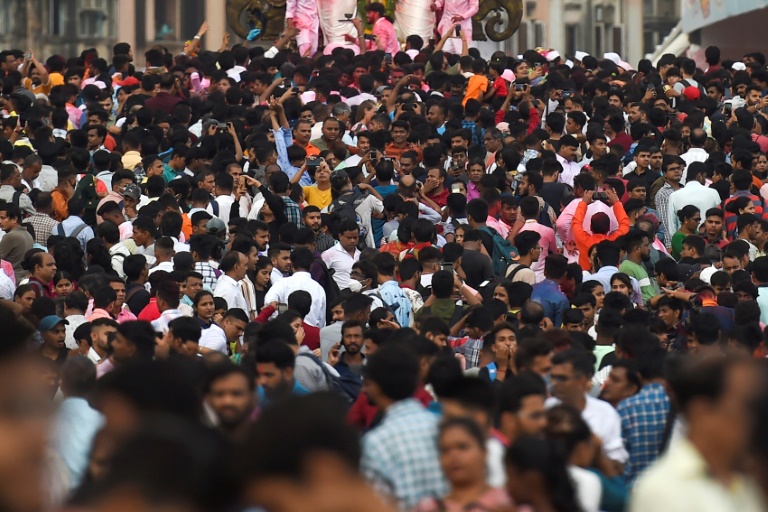
India is projected to see an explosion in its urban population in the coming decades, but its cities already cannot cope and climate change will make living conditions harsher still.

The metropolis of Mumbai, one of India’s biggest, grew by some eight million people in the past 30 years — the rough equivalent of the whole of New York City — to a population of 20 million, and is forecast to add another seven million by 2035.

Like other Indian megacities, Mumbai’s housing, transport, water and waste management infrastructure has not kept pace, with around 40 percent of people living in slums.

These crowded collections of ramshackle buildings, side by side with some of India’s richest neighbourhoods, often have no regular water, power supply or proper sanitation.

As the world’s population approaches eight billion, most of them in the developing world, it is a situation replicated globally.

Those living on the outskirts of Mumbai commute for hours to work, with many hanging out of doors on packed trains, and others travelling by car or motorbike on clogged, pothole-filled roads that flood during the monsoon.

In the biggest slum, Dharavi of “Slumdog Millionaire” fame, where a million people live, Mohammed Sartaj Khan arrived from rural Uttar Pradesh as a teenager and works in a tannery.

“My childhood was wonderful in the village. It has a peaceful environment unlike the crowd here,” Khan, now 35, told AFP in Dharavi’s warren of lanes.

“When I came here, I saw people running like ants,” he said. “The way ants keep walking in their lanes despite the crowd… Nobody cares about others.”

But in his village, he added, “people don’t have money”. 

At first, he earned 6,000 rupees ($70) a month in Mumbai but now operates a machine and makes four times that, most of which he sends back to his wife and children — whom he can seldom afford to visit.

– Premature deaths –

The UN projects that India’s population will rise from its current 1.4 billion to overtake China’s and peak at 1.7 billion in the 2060s, before dropping back to 1.5 billion by the start of the next century.

By 2040, 270 million more people will live in Indian cities, according to the International Energy Agency, driving carbon emissions higher from power generation and transport, and from the production of steel and concrete to house them.

Overcrowding, shoddy infrastructure and severe air, water and noise pollution are part of everyday life in India’s megacities.

About 70 percent of the billions of litres of sewage produced in urban centres every day goes untreated, a government report said last year.

Every winter, the capital New Delhi, home to 20 million people, is cloaked in toxic air pollution that, according to one Lancet study, caused almost 17,500 premature deaths in 2019.

– Droughts and floods –

Millions of people in Indian cities have no regular running water and rely on deliveries by truck or train. 

People in Delhi and elsewhere are digging ever-deeper wells as groundwater levels sink.

Chennai in southeastern India ran out of water in the summer of 2019, a crisis blamed on both insufficient rains and urban sprawl onto former wetlands.

At the same time, urban flooding is increasingly frequent.

The tech hub of Bengaluru — formerly Bangalore — has some of India’s worst traffic congestion and saw inundations in September blamed on unauthorised construction.

Natural catastrophes are forecast to cause more and more misery for India’s cities as the planet’s climate warms and makes weather more volatile.

Scientists believe the annual monsoon rainy season is becoming more erratic and more powerful, causing more flooding and also more droughts.

Rising temperatures are making Indian summers ever more scorching, particularly in urban areas full of concrete trapping the heat. This year, India saw its hottest March on record.

And while Covid-19 did not affect India’s slums as badly as some had feared, overcrowding puts them at risk in future epidemics.

Poonam Muttreja from the Population Foundation of India said more investment in the rural economy could stem migration to cities, while new incentives could encourage people to move to smaller urban centres.

“Poor people, especially migrants in cities, are at the worst risk of climate change, whether it is the changes in the weather or flooding, jobs, lack of infrastructure,” Muttreja told AFP.

“India has to have a paradigm shift. And instead of complaining, we need to start doing something.”

The one thing Americans agree on ahead of midterms: 'Vote, vote, vote'

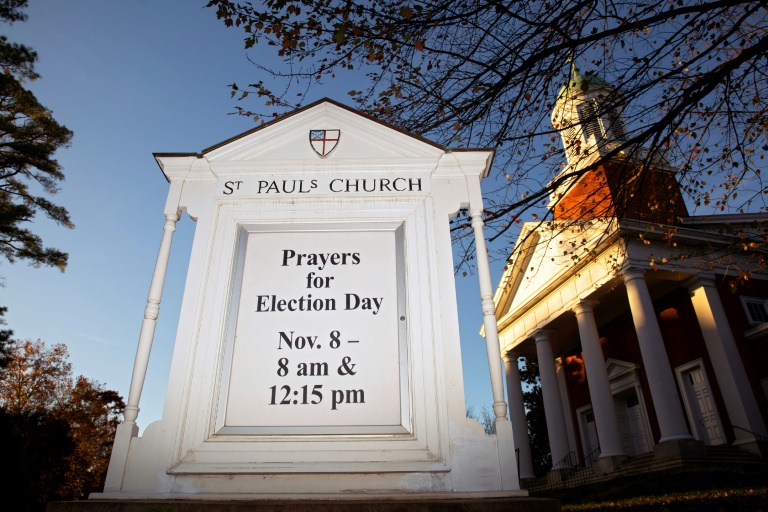
Less than 12 hours before polls open in US midterm elections, Americans remain deeply polarized on issues from immigration to abortion — though many were united in fears for their country’s democracy.

With control of the United States Congress at stake, citizens voiced concerns for the future, whether they were Republicans doubtful of the integrity of the vote, or Democrats concerned by election denialism.

Here’s what some American voters in cities around the country had to say about Tuesday’s polls.

– State of US democracy –

Across the country voters called on their fellow citizens to cast their ballot in the midterms, which  historically have low turnout.

“I would emphasize vote, vote, vote,” 24-year-old student Luke Osuagwu told AFP in Atlanta, Georgia.

Marisha Camp, a photographer from New York who spoke to AFP ahead of a rally with President Joe Biden at Bowie State University in Maryland, agreed. 

“Voter turnout concerns me,” she told AFP. “I think people should be more terrified.”

Many so-called election deniers — Republicans embracing defeated president Donald Trump’s false assertion that the 2020 election was stolen and that voter fraud is rife — are on the ballot in races across the country.

Analysts have also warned of the threat of violence around the elections. 

Social activist Guy Djoken, also at the Biden rally, told AFP that what resonates for him “is this democracy we are about to lose.”

“It’s really sad,” he said, describing emigrating to the US from Cameroon.

“I come from a place where I know what the absence of democracy will do … If we lose that, we have nothing left.”

In Arizona, 56-year-old Michelle Meglio said she cast her ballot last week and was “very worried about election integrity.”

“It’s a very important topic. I believe that we have a lot of irregular irregularities,” she said.

But Shana Ellis, a 51-year-old Arizona State University employee, said she has “complete faith” in the process, and condemned armed men who have been spotted patrolling drop boxes in Arizona.

“I think that’s an intimidation tactic, and everyone should be afforded the right to vote,” she told AFP.

Law student Benjamin Smart, in Phoenix, Arizona, was willing to go against his own beliefs in order to protect democracy. 

“I’m pro-life. But I think denying election is just too important of a thing to get wrong. And so I wouldn’t vote for them,” said the 23-year-old, referring to Republicans. 

Smart said he does not “think there’s much of a chance for actual violence, but the fact that we keep getting closer to it and people are threatening, it is quite concerning.

“I don’t want us to get to a place where I really do have to be concerned about that.”

– Abortion –

Reproductive rights are a banner issue for many voters, after the US Supreme Court overturned the right to abortion earlier this year and states began imposing restrictions or banning the procedure altogether.

Some saw that as a chance to act: “I feel like it’s a good opportunity now for Georgia to also put some restrictions on abortion,” said university student Meron Kiros in Atlanta.

Others were fearful. “Our bodily autonomy is under siege… especially here in Georgia,” said another student, Amy Winch. 

In Arizona, 19-year-old student Fallon Webb said she feared Republican Kari Lake could triumph there. 

“She’s trying to enforce and pursue the direction of zero tolerance for abortion,” Webb told AFP. “That’s something that kind of resolates with me as a woman… So that’s kind of what’s at jeopardy.”

– Immigration –

Democrats have “broken the immigration system,” says 71-year-old Francisco Cabral in McAllen, Texas, lamenting a “silent invasion” of undocumented people over the border with Mexico. 

“We have a huge border crisis here in Arizona,” agreed Michelle Meglio in Phoenix. 

But housewife Romelia Hinojosa, who also lives in McAllen, said migrants are welcome “as long as they do things correctly and abide by the laws of the country.”

– Trump –

Any Republican “red wave” could open the door to a comeback bid by former president Donald Trump, whose shadow has loomed large over the campaign but who has not yet announced that he is running in 2024.

“Trump for sure is running again. That’s not a question mark,” said Marisha Camp, the photographer at the Biden rally at Bowie State University.

“I would like for Donald Trump to run again. I think the Democrats are going to do everything they can to prevent him from running,” said Matthew Isaac, a 38-year-old administrative assistant in Phoenix, Arizona.

“The Democrats have become the elitist party… They represent the people in the big towers and the ivory towers, the people who will never see you, who really don’t care about the people at the bottom,” he said.

Debbie Brown, who spoke to AFP at a Trump rally in Dayton, Ohio, was unequivocal in her support.

“He was great, he made America great and everything was doing well with the economy and we just need him back,” she said.

'Nicaragua will end up alone' as migrants flee

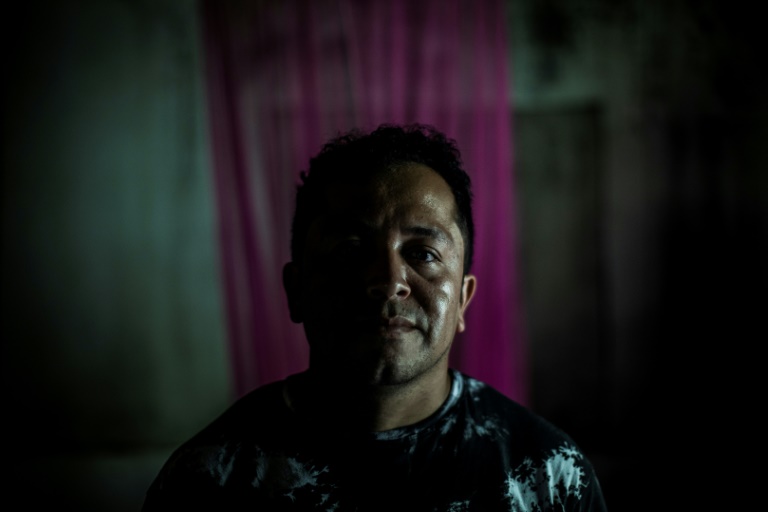
Jose Galeano is on the verge of embarking on the most important and frightening journey of his life. He took out a loan secured against his house and paid people smugglers to help him begin an odyssey he hopes will end in the United States.

Having worked as a farmhand, a gardener, and a laborer, this 35-year-old former veterinary medicine graduate is joining the thousands of Nicaraguans fleeing the second poorest country in Latin America.

There is “little work, pay is low, there are no opportunities,” lamented Galeano the day he left home.

Nicaraguan emigration has exploded over the last year due to the crippling cost of living, lack of work, and suppression of dissent.

Galeano plans to walk to the US with a brother and two cousins.

“We hope to get there and work,” he told AFP from his humble home in Managua, where he left behind a daughter, his mother, and his grandmother.

“We took a loan, secured against the land, the house, and with that, we are going … I’ve never been on such a long journey and I’m scared.”

Many migrants have lost their homes after being unable to pay back similar loans.

Galeano’s dream is to return home with enough money to open a bakery in Managua.

Tears flowed as his friends and family gathered in a somber atmosphere at his home to see him off.

– ‘Only us old people are left’ –

According to local media, quoting victims’ families, at least 40 Nicaraguan migrants died of asphyxiation, drowning, and traffic accidents in 2022.

Hundreds of people, including children, congregate at various points in Managua with nothing but a backpack, waiting to take buses offering tourism “excursions” to Guatemala.

It is the first stage of a journey that will see them forking out between $2,000 and $5,000 to a “coyote,” or people smuggler, to take them from Guatemala to the US.

At one point, they will have to cross the Bravo river, swimming or on a raft.

At least 60 people from Galeano’s area have embarked on that journey this year.

“They keep leaving. Only us old people are left. Nicaragua will end up alone,” moaned Roger Sanchez, a 60-year-old farmer.

Three of his four children migrated to the US, and the fourth plans on following them.

Some 57 percent of Nicaraguans are prepared to migrate, particularly to the US, according to a poll conducted by Costa Rican company Cid Gallup in September and October and published by the online newspaper Confidencial.

The three main reasons given were lack of employment, high cost of living, and government corruption.

– Sleeping in the streets –

The desire to leave has seen people from all over Nicaragua converge on the migration offices in Managua to request a passport.

Many sleep outside in the streets on mattresses or pieces of cardboard.

The number of emigrants is not officially recorded. but the migration office reported on its website that it had issued more than 20,000 passports, including 2,000 to children, between September 17 and October 7.

President Daniel Ortega, who has been in power since 2007, insisted last week that US sanctions imposed on the country were to blame for the mass exodus.

As well as the president himself, the US has sanctioned more than 30 family members, allies, and companies linked to the government.

Washington imposed sanctions following a brutal 2018 crackdown on anti-government protesters.

“Keep imposing sanctions and more immigrants will go to the United States no matter how much you want to close the doors to them,” said Ortega.

US statistics show that border guards turned away 164,000 undocumented Nicaraguans in 2022, three times as many as the previous year.

Almost a quarter of Nicaraguans live in poverty, according to official figures. Central America’s smallest economy has been stuck in a political and economic crisis since 2018 as Ortega has come under fire for increasing authoritarianism.

Manuel Orozco, from the Washington-based Inter-American Dialogue think tank, says politics is largely to blame for the migration.

“Persecution in Nicaragua is so beastly that people prefer to risk leaving than staying and exposing themselves to more repression,” he said.

Authorities have jailed more than 200 opposition figures and declared some 2,000 civil organizations illegal.

Close Bitnami banner
Bitnami