World

Southeast Asian ministers to hold emergency talks on Myanmar

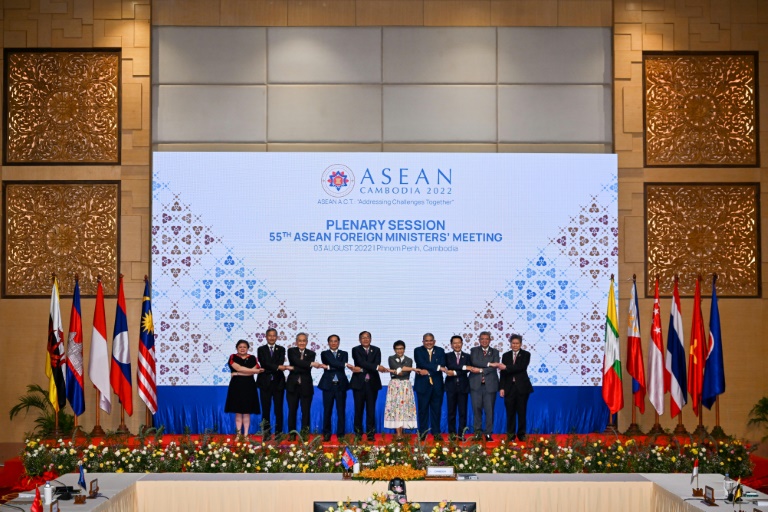
Southeast Asian foreign ministers will hold emergency talks in Jakarta next week to discuss strife-torn Myanmar ahead of November’s ASEAN leaders’ summit in Phnom Penh, diplomatic sources confirmed Friday.

Myanmar has been in chaos since a putsch in February last year, with more than 2,300 killed in the military’s brutal crackdown on dissent, according to a local monitoring group.

The Association of South East Asian Nations (ASEAN) has spearheaded so far fruitless efforts to resolve the crisis, and the bloc is frustrated by escalating human rights atrocities — including the execution of political prisoners and a recent airstrike on a school.

There has been little progress on a five-point plan nutted out in April last year, which called for an end to violence, increased humanitarian aid, as well as dialogue between the military and the anti-coup movement.

An Indonesian foreign ministry official confirmed a meeting is scheduled for Thursday at the ASEAN Secretariat in Jakarta.

The talks are expected to review progress on the plan.

“A special meeting is now needed as there are specific issues that will be looked into further before the leaders’ meeting,” the official told AFP.

“The Myanmar junta doesn’t show any desire or concrete steps for implementation (of the plan).”

The official noted that any potential suspension of Myanmar’s ASEAN membership would not be an easy process.

Another diplomatic source told AFP that article seven of the ASEAN charter, which allows the 10-country bloc’s leaders to address an emergency situation, would be the basis for action.

Cambodian foreign minister Prak Sokhonn — who is a special envoy to Myanmar as part of his country’s role as ASEAN host — will chair Thursday’s meeting.

Chum Sounry, Cambodia’s foreign ministry spokesman, told AFP a team had been sent to Myanmar to discuss concrete action and the envoy’s third visit to the country — originally slated for September.

“We are now waiting for a response from the Myanmar side,” he said.

Junta leader Min Aung Hlaing has not been invited to the ASEAN leaders’ summit — for the second year in a row — and Myanmar’s top diplomat Wunna Maung Lwin was excluded from ministerial talks in February and August.

Time of reckoning in Ukrainian monastery town

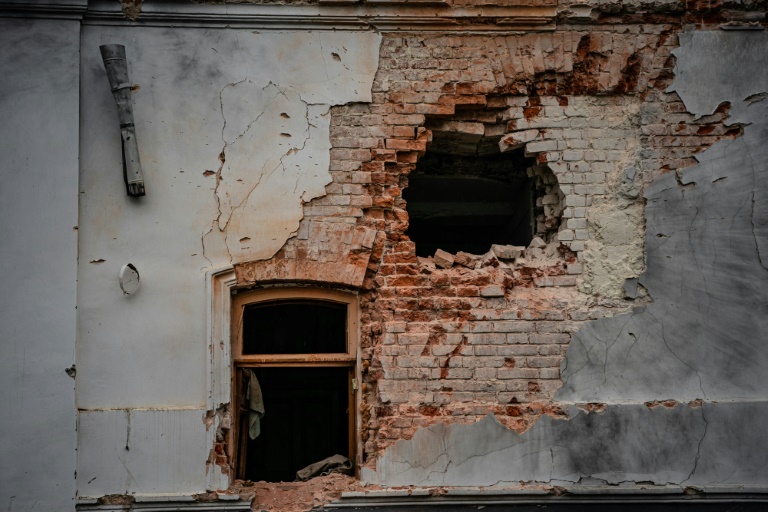
Two neighbours are desperately avoiding each other in a queue for food in the ruins of Svyatogirsk, a spa town whose monastery was recently re-captured by Ukrainian forces.

A tearful Lyudmila Orlova, 61, told AFP she was the victim of a dangerous betrayal of trust by 76-year-old Yevdokiya Yarovaya.

“Four days before the town was liberated, on September 7, she told Russian soldiers that I had a car that was used by Ukrainian troops.”

“They came in the evening with their guns. They were drunk and they questioned me for half an hour. They turned over everything in the house,” said Orlova, a Ukrainian-language teacher in this mostly Russian-speaking town.

Yarovaya denied the accusations, saying she had “no contact” with Russian forces and had only seen them a few times to receive aid.

“Food is more important than anything,” she insisted. But she did not answer the question if this aid was conditional on collaboration.

“There is a lot of anger and resentment. We still haven’t come to terms with what we lived through and I would like it not to happen again,” said Yarovaya.

She clutched two trays of seasoned pilau rice handed out to her by volunteers helping freezing inhabitants.

– ‘Liberators’ –

When Russian troops captured the town in June, its mayor, Volodymyr Bandura, celebrated them as “liberators”, holding a press conference under a Russian flag.

Bandura, a member of the pro-Russia party “For Life” elected in 2020, disappeared when Ukrainian troops took back the town in September and is now wanted for treason.

In his place the army has named Volodymyr Rybalki, who coordinated the town’s civil defence force, as head of the military administration for the re-captured area.

Rybalki said he is trying above all to ensure the welfare of residents as winter approaches and has no time now for any “hunt for collaborators”.

“Working out who collaborated or not is the work of the SBU (Ukrainian intelligence service) and the police. If there have been acts of treason, they will be handled according to the law,” he told AFP.

Ukraine’s law on treason has been amended since the Russian invasion to include a broader range of offences, including “denying that Ukraine suffered an armed aggression”.

People who collaborate with an occupying force risk between 15 years in prison and a life sentence in cases where their crime led to “death or a grave consequence”.

– ‘They support Russia’ –

In Svyatogirsk, the Holy Dormition Lavra monastery has become a focus for tensions.

Its abbot came out openly in favour of Russia-backed separatists in 2014 and Ukrainian authorities accused him of hiding fighters and weapons inside the monastery.

This time “the monastery tried to keep a position that it presented as neutral but we all know they support Russia”, said Oleksiy Kashporovskyi, a Ukrainian army press officer.

The 46-year-old pointed to the green domes of the sprawling religious site on a hillside.

At the entrance to the complex stands a statue of the Virgin Mary with only one hand left. The other was torn off by an explosion.

At the height of the fighting, 400 residents of Svyatogirsk sought refuge in the monastery alongside its 200 monks.

Despite orders for evacuation as Russian forces advanced, they stayed.

“This led to a lot of questions about their loyalties,” Kashporovskyi said.

In the monastery garden, Father Theophanus, 51, a former coal miner, pointed to the fresh graves of three monks killed by a mortar in May.

He said the “hostile” perception of the monastery is linked to questions about the allegiance of the Ukrainian Orthodox Church, which formally broke ties with Moscow in May.

“We mention Patriarch Kirill of Moscow in our services but we have never hosted terrorists, separatists or weapons,” he said, adding that he prayed daily “for the Ukrainian people”.

Russia says 'fortress' Kherson readying for Ukraine attack

Kremlin proxy officials said Friday they were building up defences and turning Ukraine’s southern city of Kherson into a “fortress” as Kyiv’s forces advance and Russia pulls residents from the region.

The claim came as Ukraine’s President Volodymyr Zelensky said Russian troops were preparing to destroy a hydroelectric dam in the southern Kherson region in what would amount to a “catastrophe on a grand scale”.

Ukrainian forces in recent weeks — aided by Western weapons — have been advancing along the west bank of the Dnieper river towards the region’s main city, also called Kherson.

Kherson was the first major city to fall to Moscow’s troops since the February invasion began and retaking it would be a crucial prize in Ukraine’s counter-offensive.

Moscow-installedauthorities in Kherson said Friday Kyiv forces killed four people when they shelled the Antonivskiy bridge over the Dnipro river that civilians have been urged to cross in advance of an anticipated Ukraine assault.

“Four people were killed,” pro-Moscow official Kirill Stremousov said on Telegram. “The city of Kherson, like a fortress, is preparing for its defence.”

A Ukrainian military spokeswoman Nataliya Gumenyuk denied Kyiv’s forces were responsible, saying its forces do not target local populations.

Russian state-run media in recent days had aired footage showing civilians with bags taking ferries across the river from Kherson.

– Risks of disasters –

Kyiv has branded the organised movement of Kherson residents to Russia and other Moscow-controlled regions as “deportations” of Ukrainian citizens.

Zelensky said late Thursday that Russian forces had mined the Kakhovka hydroelectric power plant with the intent of blowing it up.

Hundreds of thousands of people around the lower Dnipro River would be in danger of flash flooding if the dam was destroyed, Zelensky warned in a speech Thursday to European leaders.

He said cutting water supplies to the south could also impact the cooling systems of the Zaporizhzhia nuclear power plant, Europe’s largest.

The nuclear facility is a key concern of Russia’s eight-month invasion with both sides regularly accusing the other of shelling near it and endangering operations.

Ukraine’s push in the south comes after a sweeping counter-offensivein the northeast Kharkiv region that has badly impaired Russia’s supply routes and logistics corridors in the eastern Donbas region.

But Russian forces have continued shelling the region’s largest city, Kharkiv, and the presidency said Friday that “industrial infrastructure” was hit in the city, wounding six.

The attack in the latest in weeks-long barrage that has targeted infrastructure and particularly energy facilities.

Energy-saving measures were put in place across the country after Russian missile and drone strikes destroyed what Zelensky said was more than 30 percent of the country’s power stations in a week.

– Resilient Ukraine –

A 64-year-old Ukrainian, Vyacheslav, told AFP in Kyiv that the nation would make do, despite the restrictions.

“There are books to read. There battery-powered lights. I think we can hold out for a few hours. There are gas stoves so it will still be possible to cook,” he said, but declined to give his last name.

Kyrylo, a 27-year-old shop salesman, said that there had been a rush on power banks after Russian attacks began on the energy facilities in the capital.

“We don’t sell flashlights but regarding power banks, I can say that on the 10th, when the attack on Kyiv began, almost all available power banks were sold, and in general, the demand for power banks increased by 70 or 80 percent.

The Ukraine presidency said Friday that Russian forces were continuing to shell sections along the entire frontline of Donbas in east Ukraine and that two people were killed in the Donetsk region.

Far-right Meloni set to become Italy's first woman PM

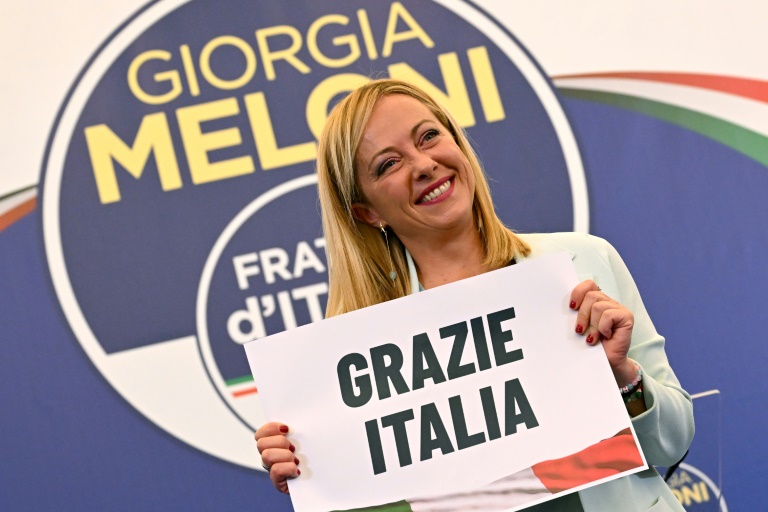
Far-right leader Giorgia Meloni was set to be named Italian prime minister on Friday after her party’s historic election win, becoming the first woman to head a government in Italy.

Her post-fascist Brothers of Italy party — Eurosceptic and anti-immigration — won September 25 legislative polls but needs outside support to form a government.

Meloni’s appointment would be an historic change for the eurozone’s third largest economy and for Brothers of Italy, which has never been in government.

Following two days of cross-party talks the 45-year-old from Rome is now all but certain to be asked to form a government and become the country’s first woman prime minister.

Her Brothers of Italy party won 26 percent of the vote last month, compared to eight and nine percent respectively for her allies Forza Italia and the far-right League.

Tradition dictates that President Sergio Mattarella will only name her after holding formal talks with all parties in parliament.

On Friday, Meloni joined representatives of her coalition to meet Mattarella, with speculation she could be asked to form a government as early as Friday afternoon.

“We are waiting for the decision of the president of the republic and we are already ready, we want to proceed as soon as possible,” she said after the meeting, calling it “an important moment for the nation”.

She could be sworn in with her ministers over the weekend, with a vote of confidence in parliament next week.

– Unity concerns –

The consultations to cobble a government have been overshadowed by disagreements over Meloni’s ardent support for Ukraine since the Russian invasion, with her two would-be coalition partners who are both considered close to Moscow.

A recording was leaked during the week in which Italy’s former prime minister Silvio Berlusconi — who heads Forza Italia — talks about his warm ties with Moscow and appeared to blame the war in Ukraine on Ukrainian President Volodymyr Zelensky.

Her other coalition partner, Matteo Salvini leader of the League party, is a long-time fan of Russian President Vladimir Putin and has criticised Western sanctions on Russia.

Despite her Eurosceptic stance, Meloni has been firm about her support for Ukraine, in line with the rest of the European Union and the United States.

“I intend to lead a government with a clear and unequivocal foreign policy line,” she has said. “Italy is fully, and with its head held high, part of Europe and the Atlantic Alliance.”

“Anyone who does not agree with this cornerstone will not be able to be part of the government, even at the cost of not forming a government,” Meloni has warned.

Berlusconi, 86, has said that his personal and political position “do not deviate from that of the Italian government (and) the European Union” on Ukraine.

But the tensions add to concerns that Meloni’s coalition, held together by the need for a parliamentary majority, will struggle to maintain unity.

Berlusconi’s allies insist his comments in the recording, from a meeting with lawmakers earlier this week, were taken out of context.

The billionaire media mogul described a rekindling of relations with long-time friend Putin, who he said sent him 20 bottles of vodka and a “very sweet letter” for his birthday.

– Challenges ahead –

Meloni’s coalition wants to renegotiate Italy’s part of the EU’s post-Covid recovery fund, arguing the almost 200 billion euros ($193 billion) it expects to receive should take into account the current energy crisis, exacerbated by Moscow’s invasion of Ukraine which has hit the supplies of Russian gas to Europe.

But the funds are tied to a series of reforms only just begun by outgoing Prime Minister Mario Draghi, and analysts say she has limited room for manoeuvre.

Meloni had campaigned on a platform of “God, country and family”, sparking fears of a regression on rights in the Catholic-majority country.

She has distanced herself from her party’s neo-fascist past — and her own, after praising dictator Benito Mussolini as a teenager — and presented herself as a straight-talking but unthreatening leader.

Inflation in Italy rose to 8.9 percent in September over the previous year threatening to put the country in recession next year. 

The margin for manoeuvre is limited given that its colossal debt represents 150 percent of Gross Domestic Product, the highest in the eurozone after Greece.

Draghi used his last day on the European stage Friday to warn both his fellow leaders and Meloni that a united Europe should remain their “guiding star”.

Draghi said everyone looked at “the EU as a source of security, stability and peace,” adding: “We have to keep this in mind as a guiding star for the future, especially in troubled times like these.”

Former Pakistan PM Khan barred from elections for five years

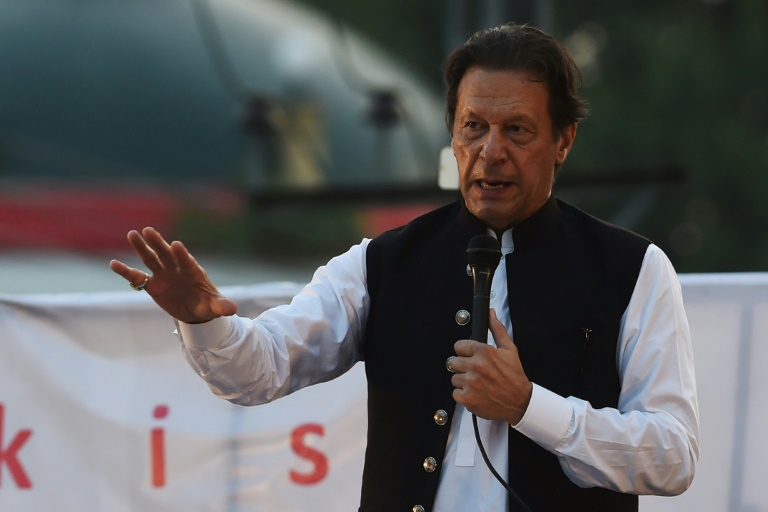
Former Pakistan prime minister Imran Khan was disqualified Friday from running for political office for five years, after the election commission ruled he misled officials about gifts he received from foreign leaders while in power.

The decision is the latest twist in political wrangling that began even before Khan’s April ouster, and is one of several legal battles being fought by the former international cricket star and his Pakistan Tehreek-e-Insaf (PTI) party.

Dozens of his supporters attacked vehicles as they left the Election Commission of Pakistan (ECP) headquarters after the ruling, and police detained one of Khan’s security guards after he fired a shot into the ground.

In the eastern city of Lahore, his supporters blocked some roads, while in Faisalabad, they used burning tyres to stop traffic.

On Twitter, Islamabad police said security in the capital was on “high alert”.

“The ECP has declared Imran Khan was involved in corrupt practices,” Gohar Khan, one of his lawyers, told AFP, adding he had been disqualified for five years.

“We are going to challenge it in the Islamabad High Court right now.”

Pakistan’s courts are often used to tie up lawmakers in lengthy proceedings that rights monitors criticise for stifling political opposition, but the commission’s involvement in this case stems from the obligation of elected officials to declare all their assets.

The case centres on a government department known as “Toshakhana”, which during the Mughal era referred to the “treasure houses” kept by the sub-continent’s princely rulers to store and display gifts lavished on them.

Government officials must declare all gifts, but are allowed to keep those below a certain value.

More expensive items must go to Toshakhana, but in some cases the recipient can buy them at around 50 percent of their value — a discount Khan raised from 20 percent while in office.

Pakistani newspapers have for months carried lurid stories alleging Khan and his wife received lavish gifts worth millions during trips abroad — including luxury watches, jewellery, designer handbags and perfumes.

Khan has said he did not register some gifts on national security grounds, but in a written submission admitted buying items worth nearly 22 million rupees ($100,000), and later selling them for more than twice that amount.

– Political disruptor –

Unless overturned by the courts, Khan’s ban will stymie one of his key tactics to disrupt the country’s political process as he presses for a general election ahead of the one scheduled for October next year.

All PTI lawmakers have quit the National Assembly — parliament’s lower house — forcing a series of by-elections.

In most of them so far, Khan has been his party’s only candidate.

This week he won six of eight National Assembly seats he stood for in a weekend by-election, a vote he called a referendum on his popularity.

Individuals can stand in multiple constituencies in Pakistani elections and choose which to forfeit if they win more than one.

Khan regularly holds rallies drawing tens of thousands of people across the country, giving fiery speeches criticising state institutions — including the powerful military — for allegedly conspiring to topple his government.

He has also vowed to soon announce the date of a “long march” of his supporters on the capital.

– Populist platform –

Khan rode to power in 2018 on a populist platform promising social reforms, religious conservatism and a fight against corruption, overturning decades of rule by two feuding political dynasties interspersed with military takeovers.

But under his tenure, the economy stagnated and he lost the support of the army, which was accused of helping to get him elected.

Khan’s opponents were delighted by the Election Commission’s ruling.

“He who would spread lies about alleged corruption of his political opponents has been caught red handed,” tweeted Foreign Minister Bilawal Bhutto Zardari.

Legal experts and analysts were more circumspect, however.

“The silver lining for Mr Khan is that… he hasn’t been disqualified by the apex court so he has a right of appeal,” independent lawyer Osama Malik told AFP.

“This decision will escalate the political tension in the country and the situation will deteriorate,” said analyst Hassan Askari Rizvi.

Pound sinks on UK political chaos

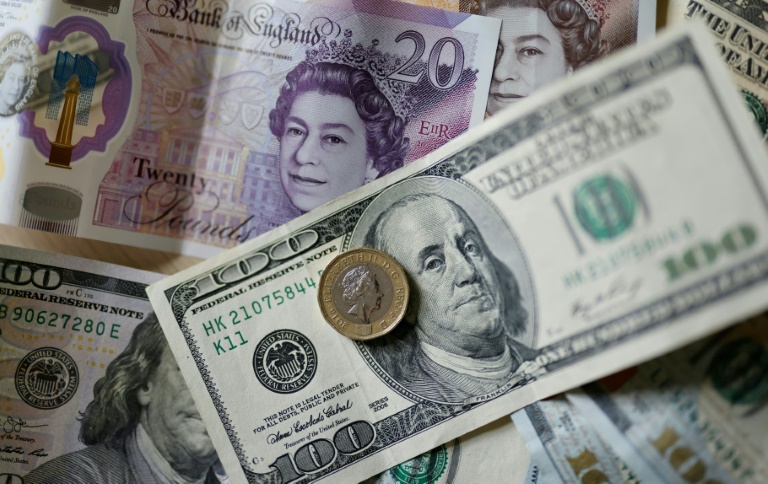
The British pound sank against the dollar Friday on political uncertainty after the resignation of UK Prime Minister Liz Truss, while weak economic data added to the turmoil.

The dollar strengthened also on expectations that the US Federal Reserve would press ahead with its programme of bumper interest rate hikes to target decades-high inflation.

European stock markets fell heavily, mirroring losses in Asia and on Wall Street, as investors fretted that rising global interest rates could tip the world economy into recession.

Sterling slid beneath $1.12, having bounced above $1.13 Thursday after Truss quit. 

The yield on the British government’s 30-year bond, or gilt, climbed back above four percent on Friday.

– ‘Seismic events’ –

“We are seeing retracement of these initial moves as markets realise that there’s still huge uncertainty,” noted Markets.com analyst Neil Wilson.

“The economic policies (of Truss) were already dead in the water so the market doesn’t have a huge amount of genuine new information to move on despite the seismic events of the last 24 hours.”

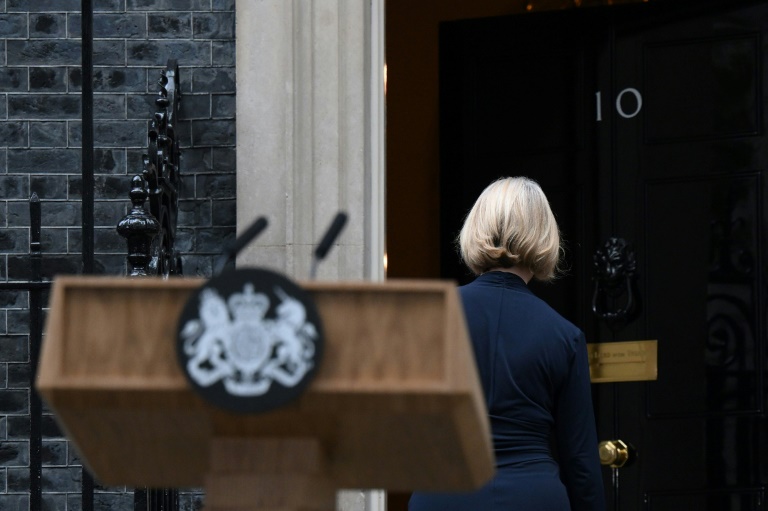
Truss resigned after 44 days in office, having triggered markets chaos over a tax-cutting budget due to have been funded by debt.

The pound was weighed down Friday additionally by official data showing that UK borrowing surged and retail sales slumped in September.

Elsewhere, traders were girding for another possible intervention by Tokyo after the dollar went above 150 yen.

The dollar burst to a 32-year high Thursday as investors bet the Fed would continue to aggressively ramp up borrowing costs.

In a sign of growing rate hike expectations, US 10-year Treasury yields rose to their highest level since the financial crisis in 2008, which in turn hit equities.

By contrast, the Bank of Japan refuses to raise interest rates despite the country’s sky-high inflation.

– Key figures around 1015 GMT –

Pound/dollar: DOWN at $1.1114 from $1.1235 on Thursday

Dollar/yen: UP at 150.98 yen from 150.15 yen

Euro/dollar: DOWN at $0.9735 from $0.9786

Euro/pound: UP at 87.62 pence from 87.11 pence

London – FTSE 100: DOWN 0.9 percent at 6,883.43 points

Frankfurt – DAX: DOWN 1.5 percent at 12,573.45

Paris – CAC 40: DOWN 1.7 percent at 5,986.60

EURO STOXX 50: DOWN 1.6 percent at 3,437.84

Tokyo – Nikkei 225: DOWN 0.4 percent at 26,890.58 (close)

Hong Kong – Hang Seng Index: DOWN 0.4 percent at 16,211.12 (close)

Shanghai – Composite: UP 0.1 percent at 3,038.93 (close)

New York – Dow: DOWN 0.3 percent at 30,333.59 (close)

Brent North Sea crude: DOWN 0.3 percent at $92.14 per barrel

West Texas Intermediate: DOWN 0.2 percent at $84.31 per barrel

burs-rfj/bcp/lth

UK reports further bleak economic data

UK government borrowing surged and retail sales slumped in September, official data showed Friday, dealing a further economic blow to a country in political crisis.

Public sector net borrowing stood at £20 billion ($22 billion), the second-largest September level on record, as decades-high inflation sees interest on debt repayments balloon.

Retail sales volumes tumbled 1.4 percent as sky-high prices curbed consumer purchasing. The figure was better, however, than the 1.7-percent slide in August.

The data comes one day after Prime Minister Liz Truss resigned in the wake of markets turmoil triggered by her budget of tax cuts funded by debt.

The public borrowing figure exceeded analysts’ consensus of £17.2 billion, which was already far above the government’s own prediction.

“The weakness in retail sales and further overshoot of the… (government) public borrowing forecast won’t make the next prime minister’s task any easier in navigating the economy through” various crises, concluded Ruth Gregory, senior UK economist at Capital Economics.

Interest payments on government debt surged to £7.7 billion in September, “largely reflecting the broader economic environment of soaring inflation”, noted CEBR economist Pushpin Singh.

Government borrowing is linked to the wider RPI measure of inflation, which stands at a huge 12.6 percent in Britain.

– Next PM –

Contenders bidding to succeed Truss on Friday opened a hectic weekend of campaigning, but opposition parties demanded that UK voters get their own say to end months of political chaos via a general election.

Truss succeeded Boris Johnson on September 6 after a weeks-long campaign against Tory rival Rishi Sunak, who is now a favourite to take over in the coming days.

Former finance minister Sunak had warned in the battle to succeed Johnson that tax cuts promised by Truss when government debt had already soared on Covid interventions was the wrong policy to pursue.

He was proved right as the budget sent the pound crashing to a record-low close to parity with the dollar and triggered yields on government bonds to soar.

That caused Truss to U-turn on most of her planned tax cuts, ultimately costing her the job of prime minister.

On Friday, sterling slid one percent against the dollar, before recovering slightly, while the yield on the British government’s 30-year bond climbed back above four percent.

“Uncertainty in British politics remains rife, which will do little to inspire confidence in UK assets,” said Matthew Ryan, head of market strategy at global financial services firm Ebury. 

Separate data Friday showed British consumer confidence stuck near historic lows despite a slight improvement this month.

GfK’s Consumer Confidence Index rose two points to minus 47.

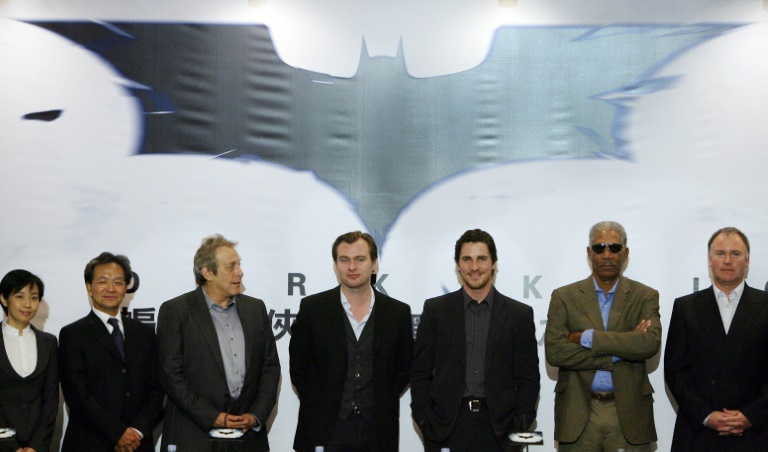
Batman screening scrapped by Hong Kong censors

A Hong Kong screening of Batman film “The Dark Knight” has been scrapped after government censors intervened, organisers said on Friday while denying that the cancellation was political.

The 2008 action blockbuster, parts of which were filmed in Hong Kong, was scheduled to be shown at an outdoor cinema on October 27 but has since been replaced by “Iron Man”, according to the organisers’ website.

The change was made after a recommendation from the city’s Office for Film, Newspaper and Article Administration (OFNAA) — a body that vets movies and has been awarded greater censorship powers in the last year.

OFNAA felt that for an outdoor screening, the level of violence was not appropriate,” a spokesperson for organiser The Grounds told AFP, saying the decision was “not unusual” and part of the licensing process.

The film’s storyline features a Chinese accountant working on behalf of Gotham’s criminal gangs who flees to Hong Kong, believing “the Chinese will not extradite one of their own”.

In Hong Kong, it was the highest-grossing movie of 2008.

But Warner Bros chose not to seek permission to screen “The Dark Knight” in mainland China due to “cultural sensitivities”, Variety reported at the time. China strictly vets which foreign movies can be shown.

Other movies rated by OFNAA with the same classification as “The Dark Knight” have not been pulled from the outdoor screening calendar.

Two other Batman movies from Nolan’s trilogy have been granted permission to screen because they “are much less violent”, The Grounds’ spokesperson said. 

The OFNAA declined to comment.

The intervention comes two days after city leader John Lee, a former security chief, said his administration wants “good stories” told about Hong Kong as he announced new funds for arts and culture.

But the city’s outspoken atmosphere, once prized by artists, has been drastically curtailed in the last three years as China cracks down on dissent following mass democracy protests.

Former Pakistan PM Khan barred from elections for five years

Former Pakistan prime minister Imran Khan was disqualified Friday from running for political office for five years, after the country’s election commission ruled he misled officials about gifts he received from foreign leaders while in power.

The decision is another twist in political wrangling that began even before Khan’s April ouster, and is one of several legal battles being fought by the former international cricket star and his Pakistan Tehreek-e-Insaf (PTI) party.

“The ECP (Election Commission of Pakistan) has declared Imran Khan was involved in corrupt practices,” Gohar Khan, one of his lawyers, told reporters, adding he had been disqualified for five years.

“We are going to challenge it in the Islamabad high court right now.”

Pakistan’s courts are often used to tie up lawmakers in lengthy proceedings that rights monitors criticise for stifling political opposition, but the commission’s involvement in this case stems from the obligation of elected officials to declare all their assets.

The case centres on a government department known as “Toshakhana”, which during the Mughal era referred to the “treasure houses” kept by the sub-continent’s princely rulers to store and display gifts lavished on them.

Government officials must declare all gifts, but are allowed to keep those below a certain value.

More expensive items must go to Toshakhana, but in some cases the recipient can buy them back at around 50 percent of their value — a discount Khan raised from 20 percent while in office.

Pakistan newspapers have for months carried lurid stories alleging Khan and his wife received lavish gifts worth millions during trips abroad.

They included luxury watches, jewellery, designer handbags and perfumes.

Khan is accused of failing to declare some gifts, or the profit made from selling them.

The complaint to the election commission was first brought when Khan was still in office by the Pakistan Democratic Movement, a coalition whose members now make up the government.

At the time, Khan said he had not made public some gifts on national security grounds, but in a written submission admitted buying items worth nearly 22 million rupees ($100,000), and later selling them for more than twice that amount.

He says the valuation was done through proper channels.

This week, Khan won six of eight national assembly seats he stood for in a weekend by-election, a vote he called a referendum on his popularity.

Individuals can stand in multiple constituencies in Pakistan elections and choose which to forfeit if they win more than one, but it is rare for a candidate to contest as many as Khan.

The 70-year-old has attempted to disrupt Pakistan’s political process since his April ouster when he ordered all his lawmakers to give up their seats, leaving no PTI members in the National Assembly.

He has also vowed to soon announce the date of a “long march” of his supporters on the capital to pressure the government to announce an earlier national election than that scheduled for October next year.

Khan regularly holds rallies drawing tens of thousands across the country, giving fiery speeches criticising state institutions — including the powerful military — for allegedly conspiring to topple his government.

He rode to power in 2018 on a populist platform promising social reforms, religious conservatism and a fight against corruption, overturning decades of rule by two feuding political dynasties interspersed with military takeovers.

But, under his tenure, the economy stagnated and he lost the support of the army, which was accused of helping to get him elected.

Ukraine war further divides Kosovo's rival communities

In the deeply divided Kosovo city of Mitrovica, the fighting in Ukraine has added another wedge between Serbs and ethnic Albanians, where the conflict has stirred bitter memories of their own war. 

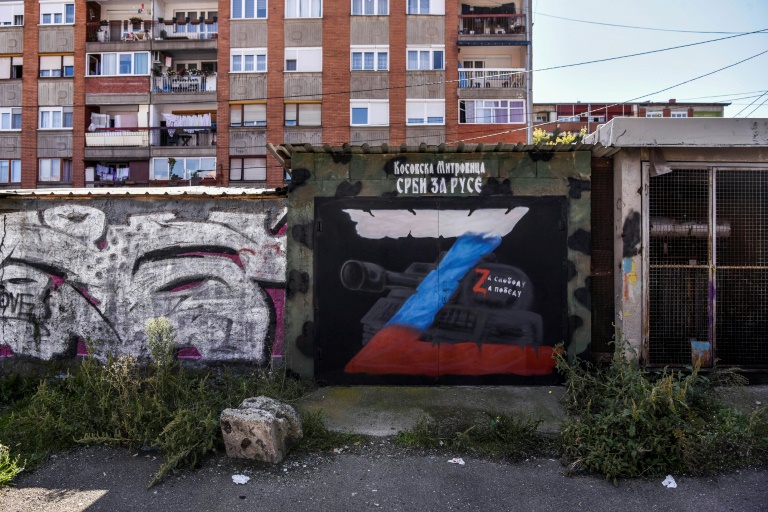
North of the Ibar River where the city’s 20,000 Serbs live, a smattering of pro-Russian murals have appeared in recent months, trumpeting the Kremlin’s invasion of Ukraine.  

“Serbs are for Russians, for freedom and victory,” reads the writing under a picture of a tank and the letter Z — the ubiquitous symbol of the Russian military since the war’s onset. 

For many Serbs, Russia has long been a close ally and friend, with their shared Orthodox faith and intertwined history considered a source of pride. 

That long history and the shared hatred of the NATO alliance — which bombed Serbian forces during the war in Kosovo in the late 1990s — has made the choice to side with Russia a natural one. 

“I support both Russia and Putin,” Branka Sofric, a 20-year-old literature student, told AFP, saying Russian President Vladimir Putin “is a man who fights for his people.” 

“You know, [Putin] is probably right because he did it,” pensioner Dragoljub Kovac, 75, said of the invasion. 

Murals often serve as public platforms for ultranationalists across much of the Balkans, where war veterans, political slogans and football clubs are glorified and threatening messages against perceived enemies are aired. 

For years, one mural in Mitrovica’s Serb enclave has proclaimed “Kosovo is Serbia, Crimea is Russia” — a common refrain now chanted at pro-Russia rallies held in Serbia since the outbreak of the war. 

– ‘A bloody letter’ –

But on the other side of the bridge over the Ibar where most of the 80,000-strong ethnic Albania community resides, there are no feelings of brotherly love for Russia.   

“Here you don’t see a ‘Z’,” Ekrem Vllahiu, a 24-year-old cigarette seller, told AFP. “Why? Because it is a bloody letter.”

The bridge that divides the communities has been the regular scene of clashes following the 1999 war between Serbian forces and Kosovo’s ethnic Albanian majority, which left 13,000 dead and ended after a NATO bombing campaign led by Washington. 

NATO troops are still stationed in Kosovo and continue to patrol the streets alongside local police in Mitrovica in a bid to head off any future unrest. 

On the city’s southern and Albanian side, the US flag is ubiquitous and official buildings often bear the symbols associated with NATO and the European Union. 

“Justice is on the side of Ukraine,” said Dan Syla, an 81-year-old retired fireman. “They suffer what we suffered ourselves,” he added, referring to the war with Serbia. 

Kyiv, however, has never officially recognised Kosovo’s independence from Serbia, which was declared in 2008 and is now accepted by more than 100 countries across the world.

But since the beginning of the war, the government in the capital in Pristina has joined sanctions against Russia, welcomed Ukranians fleeing the war, trained demining teams and even hosted a film festival usually held in the Black Sea port of Odessa. 

– ‘God first, America second’ –

At the heart of the latest spat, experts argue, is the starkly different feelings about the US and the role it plays in international affairs. 

“Support for Russia is a manifestation of anti-Americanism. The perception of the Serbs is that it was because of the United States that Kosovo was taken away from them,” said Nexhmedin Spahiu, a professor of political science in the Kosovan capital Pristina. 

“For Albanians, the United States represents freedom,” he added. 

Syla, the retired fireman in Mitrovica, agrees. 

“God first, America second,” he gushed.

Miodrag Milicevic — the director of Aktiv, a nonprofit in Serb north Mitrovica — believes that the current conflict has only further reinforced the “two very different realities” in the divided city that is a result of “the absence of any dialogue” between the communities.  

“In this kind of environment, frankly, our prospects, regardless of our community, are not very bright,” he added. 

For a 28-year-old Serb student called Uros, who identifies more as “anti-Western” than a “Russophile”, the choice in the latest war is simple. 

“As long as one nation is generally declared the bad guys, I am on their side,” he told AFP.

Close Bitnami banner
Bitnami