World

On Ukraine's southern front, soldiers hope to reach Kherson by winter

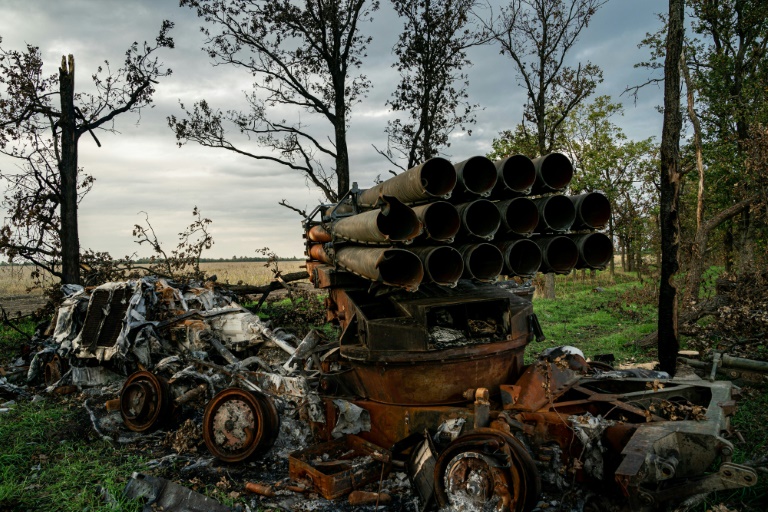
Charred, rusting skeletons are all that remain of three Russian rocket launchers that were left destroyed near the frontline in southern Ukraine, where Kyiv’s forces have been pushing back Moscow’s invading troops.

Uplifted by their recent successes in recapturing territory in the Kherson region, Ukrainian soldiers now hope that by winter they will reach the regional capital of the same name, a key city that had fallen into Russian hands shortly after the invasion began on February 24.

Nearly a week after the Soviet-designed BM-27 Uragan multiple rocket launchers were struck by Ukraine, the smell of smoke still lingers at the site.

Inside the barrels of one of the giant eight-wheeled machines, several rockets remain intact. 

“They were reloading when we hit them,” a Ukrainian soldier explained to AFP. 

One of the missile launcher’s trunks still holds a few tins of “Baltic fish”.

On the floor next to the machine lies a frying pan that miraculously escaped the flames. 

A short distance away, a truck is also left abandoned, its Russian registration plate lying on the grass nearby.

But its precious cargo is still in good shape: a dozen heavy Uragan rockets that Ukraine’s army needs. 

“They will soon be loaded and transported to us,” the soldier added. 

Another trophy snatched from the Russians, gunpowder barrels, have already been delivered to nearby Ukrainian troops. Other empty barrels are scattered on the ground.

– ‘Low’ morale among Russians –

“The Russians say they organised their withdrawal. But when someone organises their departure, they don’t leave weapons, underpants or pillows,” said a rescue services worker, who introduced himself as “Doc”. 

Another soldier says morale among Russian troops is “low”.

“The second army in the world is afraid of the 22nd,” he said, using his nom de guerre “Kappa”, meaning mouthguard. 

“We should increase our speed even more rather than reduce it, push them across the river,” said Kappa, referring to the Dnipro river.

In recent weeks, Ukraine’s army has made advances to the west of the Dnipro river, while Russians remain firmly in control of the opposite bank. 

But Moscow’s troops regrouped behind a new defensive line, strongly reinforced and even cemented in parts.

Many Russian soldiers were also brought in as reinforcements. 

Russians lost territory in northern Kherson in early September, when their troop numbers were low in this area with only a few villages, said George Barros of the Institute for the Study of War.

But now Russian lines are becoming “tighter”, facilitating their defences and complicating Ukraine’s advance, Barros added. 

Placing a sixth or more of Russia’s total forces, who are “among the best”, in southwestern Kherson will be “extremely dangerous” for Kyiv, according to French military expert Michel Goya. 

– Potential ‘disaster’ –

“The position is paradoxically solid but fragile, because it can explode under pressure,” which he said would constitute a “disaster perhaps decisive for the fate of the Russian expeditionary force in Ukraine”. 

A spokeswoman for Ukraine’s southern army command, Natalia Gumeniuk, said Ukraine’s chances are bolstered by Moscow’s soldiers “looking for ways to announce their desire to surrender” and that Russian logistics routes have been “significantly damaged”. 

For months, Kyiv’s forces have been striking Russian warehouses with ammunition and infrastructure that allows them to supply their troops, such as bridges.

The Crimea bridge, which according to Gumeniuk provided 75 percent of military supplies to the Kherson region, was hit by a large explosion over the weekend, which Moscow blamed on Kyiv. 

Ukraine has not claimed responsibility for the attack.

But “the Russians don’t have any supply problems yet,” said French expert Pierre Grasser.

If the situation were “critical” they would carry out “many more airborne deliveries”, he explained. 

For Ukraine, Kherson — a city with strategic and symbolic importance — is the long-term goal, he added, but it may not be achievable before winter or even during winter, he said. 

It remains to be seen what will become of Kherson next. Taking the city by force would mean casualties on both sides, and severe destruction.

Grasser suggests a possible “barter” between Kyiv and Moscow, with Ukraine abandoning its claims on the eastern Donbas region in exchange for Kherson returned in “good condition”.

But for Barros, the only possible outcome is a full Ukrainian victory. 

“The Russians lost the war back in March and we’ve been seeing the prolonged version of that now,” he said. 

NASA spaceship deflected asteroid in test to save Earth

NASA on Tuesday said it had succeeded in deflecting an asteroid in a historic test of humanity’s ability to stop an incoming cosmic object from devastating life on Earth.

The fridge-sized Double Asteroid Redirection Test (DART) impactor deliberately smashed into the moonlet asteroid Dimorphos on September 26, pushing it into a smaller, faster orbit around its big brother Didymos, said NASA chief Bill Nelson.

“DART shortened the 11 hour 55 minute orbit to 11 hours and 23 minutes,” he said. Speeding up Dimorphos’ orbital period by 32 minutes exceeded NASA’s own expectation of 10 minutes.

“We showed the world that NASA is serious as a defender of this planet,” added Nelson.

The asteroid pair loop together around our Sun every 2.1 years, and pose no threat to our planet.

But they are ideal for studying the “kinetic impact” method of planetary defense, in case an actual approaching object is ever detected.

DART’s success as a proof-of-concept has made a reality of science fiction — notably in films such as “Armageddon” and “Don’t Look Up.” 

Astronomers rejoiced in stunning images of matter spreading out thousands of miles in the wake of the impact — pictures collected by Earth and space telescopes, as well as a mini satellite that had traveled to the zone with DART.

– Pseudo-comet –

Thanks to its temporary new tail, Dimorphos, which is 530-foot (160-meter) in diameter or roughly the size of a big Egyptian pyramid, has turned into a manmade comet.

But quantifying just how well the test worked required an analysis of light patterns from ground telescopes, which took a few weeks to become apparent.

The binary asteroid system, which was around 6.8 million miles (11 million kilometers) from Earth at impact, is visible only as a single dot from the ground.

Ahead of the test, NASA scientists said the results of the experiment would reveal whether the asteroid is a solid rock, or more like a “rubbish pile” of boulders bound by mutual gravity.

If an asteroid is more solid, the momentum imparted by a spaceship will be limited. But if it is “fluffy” and significant mass is pushed at high velocity in the opposite direction to impact, there will be an additional boost.

Never actually photographed before, Dimorphos appeared as a speck of light around an hour before impact.

Its egg-like shape and craggy, boulder-dotted surface finally came into clear view in the last few moments, as DART raced toward it at roughly 14,500 miles (23,500 kilometers) per hour.

– Mass extinction –

Very few of the billions of asteroids and comets in our solar system are considered potentially hazardous to our planet, and none are expected in the next hundred years or so. 

But wait long enough, and it will happen.

The geological record shows, for example, that a six-mile wide asteroid struck Earth 66 million years ago, plunging the world into a long winter that led to the mass extinction of the dinosaurs along with 75 percent of all species.

An asteroid the size of Dimorphos, by contrast, would only cause a regional impact, such as devastating a city.

Kinetic impact with a spaceship is just one way to defend the planet, albeit the only method possible with current technology.

Should an approaching object be detected early, a spaceship could be sent to fly alongside it for long enough to divert its path via using the ship’s gravitational pull, creating a so-called gravity tractor.

Another option would be launching nuclear explosives to redirect or destroy an asteroid.

NASA believes the best way to deploy such weapons would be at a distance, to impart force without blowing the asteroid to smithereens, which could further imperil Earth.

NASA spaceship deflected asteroid in test to save Earth

NASA on Tuesday said it had succeeded in deflecting an asteroid in a historic test of humanity’s ability to stop an incoming cosmic object from devastating life on Earth.

The fridge-sized Double Asteroid Redirection Test (DART) impactor deliberately smashed into the moonlet asteroid Dimorphos on September 26, pushing it into a smaller, faster orbit around its big brother Didymos, said NASA chief Bill Nelson.

“DART shortened the 11 hour 55 minute orbit to 11 hours and 23 minutes,” he said. Speeding up Dimorphos’ orbital period by 32 minutes exceeded NASA’s own expectation of 10 minutes.

“We showed the world that NASA is serious as a defender of this planet,” added Nelson.

The asteroid pair loop together around our Sun every 2.1 years, and pose no threat to our planet.

But they are ideal for studying the “kinetic impact” method of planetary defense, in case an actual approaching object is ever detected.

DART’s success as a proof-of-concept has made a reality of science fiction — notably in films such as “Armageddon” and “Don’t Look Up.” 

Astronomers rejoiced in stunning images of matter spreading out thousands of miles in the wake of the impact — pictures collected by Earth and space telescopes, as well as a mini satellite that had traveled to the zone with DART.

– Pseudo-comet –

Thanks to its temporary new tail, Dimorphos, which is 530-foot (160-meter) in diameter or roughly the size of a big Egyptian pyramid, has turned into a manmade comet.

But quantifying just how well the test worked required an analysis of light patterns from ground telescopes, which took a few weeks to become apparent.

The binary asteroid system, which was around 6.8 million miles (11 million kilometers) from Earth at impact, is visible only as a single dot from the ground.

Ahead of the test, NASA scientists said the results of the experiment would reveal whether the asteroid is a solid rock, or more like a “rubbish pile” of boulders bound by mutual gravity.

If an asteroid is more solid, the momentum imparted by a spaceship will be limited. But if it is “fluffy” and significant mass is pushed at high velocity in the opposite direction to impact, there will be an additional boost.

Never actually photographed before, Dimorphos appeared as a speck of light around an hour before impact.

Its egg-like shape and craggy, boulder-dotted surface finally came into clear view in the last few moments, as DART raced toward it at roughly 14,500 miles (23,500 kilometers) per hour.

– Mass extinction –

Very few of the billions of asteroids and comets in our solar system are considered potentially hazardous to our planet, and none are expected in the next hundred years or so. 

But wait long enough, and it will happen.

The geological record shows, for example, that a six-mile wide asteroid struck Earth 66 million years ago, plunging the world into a long winter that led to the mass extinction of the dinosaurs along with 75 percent of all species.

An asteroid the size of Dimorphos, by contrast, would only cause a regional impact, such as devastating a city.

Kinetic impact with a spaceship is just one way to defend the planet, albeit the only method possible with current technology.

Should an approaching object be detected early, a spaceship could be sent to fly alongside it for long enough to divert its path via using the ship’s gravitational pull, creating a so-called gravity tractor.

Another option would be launching nuclear explosives to redirect or destroy an asteroid.

NASA believes the best way to deploy such weapons would be at a distance, to impart force without blowing the asteroid to smithereens, which could further imperil Earth.

BoE struggles to calm markets after latest intervention

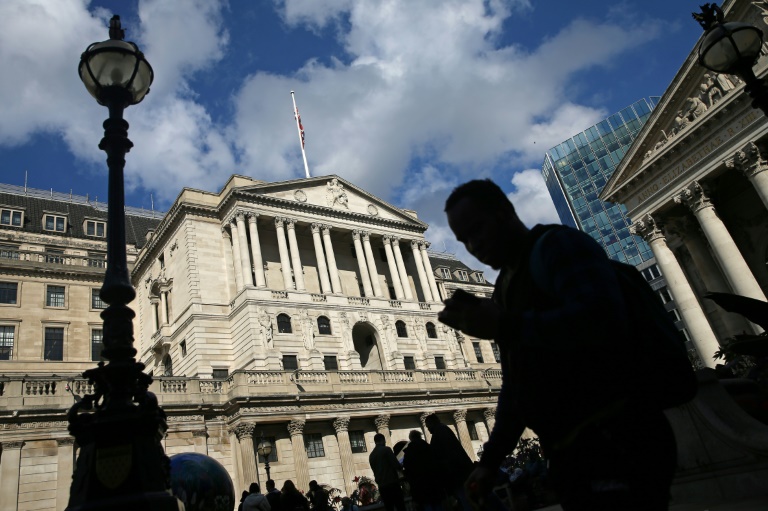
The Bank of England struggled Tuesday to reassure investors after unveiling yet more measures to calm markets rocked by the British government’s tax-cutting mini-budget, as the International Monetary Fund renewed warnings about their divergent policies.

The day after it launched a temporary facility aimed at easing liquidity pressures, the central bank said it was now widening the scope of its daily purchases of UK government bonds, or gilts, until Friday to include index-linked securities.

Comprising around a third of such bonds, they see their value and interest rates fluctuate with UK inflation and can have an outsized impact on pension funds which invest heavily in government bonds. 

This week’s actions are a fresh bid to soothe the bond markets in particular, as state borrowing — and its costs — soar following finance minister Kwasi Kwarteng’s debt-fuelled mini-budget last month.

The poor market response to it saw UK bond yields spike and the pound tumble to a record low against the dollar, prompting the BoE to step in over recent weeks vowing to protect the nation’s financial stability.

In a surprise September 28 move, it announced it was temporarily buying up tens of billions of pounds of long-dated UK government bonds “to restore orderly market conditions”.

Its latest action Tuesday would “act as a further backstop to restore orderly market conditions”, the central bank said.

– ‘Dysfunction’ –

It noted that “the beginning of this week has seen a further significant repricing of UK government debt, particularly index-linked gilts”, which it will now buy under its wider operation of bond purchases.

“Dysfunction in this market, and the prospect of self-reinforcing ‘fire sale’ dynamics pose a material risk to UK financial stability,” it added.

But in a sign that investors remained wary of the UK’s ability to repay long-term debts, the 30-year government borrowing rates have risen again in recent weeks and reached 4.73 percent early Tuesday afternoon.

AJ Bell investment director Russ Mould noted a key problem was that “the support measures are only scheduled to last until Friday”. 

“Extending it could go one of two ways — the market either applauds the move and breathes a sigh of relief or it gets even more worried, thinking the extra time suggests the crisis is more severe than originally thought.”

In some positive news, official data Tuesday revealed British unemployment fell to a near 50-year low at 3.5 percent.

Wages, however, continue to be eroded by decades-high inflation that threatens to send Britain into recession.

The British government on Monday brought forward key growth and inflation forecasts to Halloween, hoping not to spook markets further.

Finance minister Kwarteng will unveil debt-reduction plans and UK economic predictions on October 31 rather than in late November.

It comes after he was already forced to axe a tax cut for the richest earners, in the face of outrage as millions of Britons face a cost-of-living crisis with UK inflation around 10 percent.

– ‘Different direction’ –

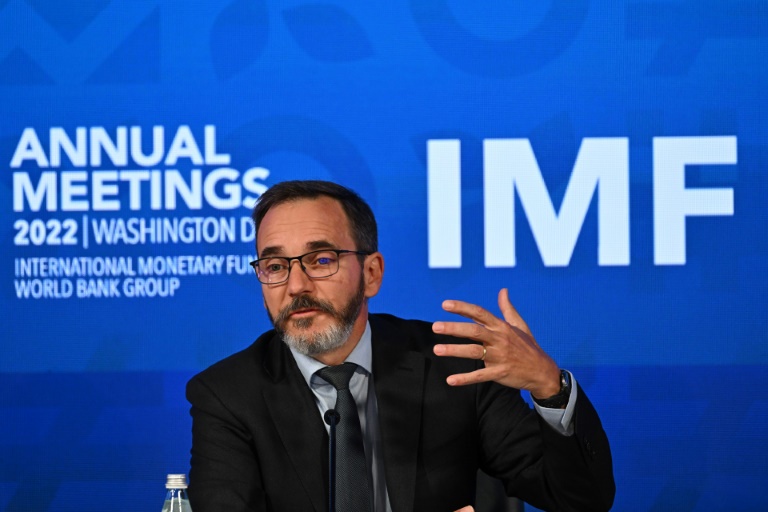
However, in Washington, IMF economic counsellor Pierre-Olivier Gourinchas said the divergence between BoE monetary policy and the UK government’s tax-slashing fiscal plans was “a little bit difficult”.

“It’s like having a car with two people in the front, and each of them is steering the wheel, and trying to steer the car in a different direction,” he told reporters. “That’s not going to work very well.”

The IMF, among others, has previously criticised the mini-budget over fears that government debt would balloon to pay for the tax cuts.

It added to the gloom Tuesday with a new forecast that UK economic growth would slow sharply to just 0.3 percent in 2023 — and warned the budget would “complicate” efforts to fight inflation.

Fitch last week lowered the outlook on its credit rating for British government debt to negative from stable.

The BoE has piled on further pressure by ramping up its main interest rate to a 14-year high of 2.25 percent in a bid to cool inflation — and is expected to hike even further next month.

This in turn has seen retail banks ramp up interest rates on mortgages, with analysts predicting heavy price falls for property.

Britain meanwhile faces “painful” cuts in public spending to fix state finances should it decide against more U-turns over tax cuts, a leading think tank warned.

“With a weaker economy, getting government finances on a sustainable path without cancelling tax cuts could force… big and painful spending cuts,” the Institute for Fiscal Studies said in a study.

UK court told of hospital baby attacks by 'killer' nurse

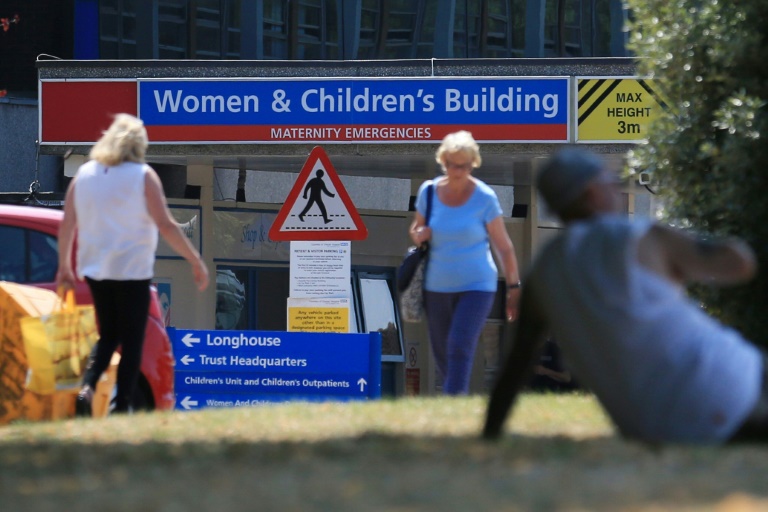
A nurse accused of murdering seven babies at the UK hospital where she worked was disturbed by the mother of one of her victims as she tried to kill him, a court heard on Tuesday.

The woman arrived in the neo-natal unit of the Countess of Chester Hospital in Chester, northwest England, on the evening of August 4, 2015, to find her son “distressed” and bleeding from the mouth.

But Lucy Letby said “trust me, I’m a nurse” and asked her to leave, prosecutor Nick Johnson told Manchester Crown Court.

The young boy died the following day, allegedly by an injection of air into the bloodstream.

Johnson told a jury that the unwitting mother was “fobbed off” by Letby, 32, who has pleaded not guilty to the murder charges, and attempting to kill 10 other babies, including some more than once.

The lawyer said Letby, originally from Hereford in western England, made “fraudulent” nursing notes after the event in an attempt to cover her tracks.

She also searched social media for the family of the boy, referred to in court as “Child E” in the days and months afterwards, including on Christmas Day.

Hours after “Child E” died on August 5, 2015, Letby allegedly tried to kill his twin brother “Child F” by injecting insulin into a bag of feeding fluids.

Johnson said negligence had been ruled out, as no other baby on the ward had been prescribed insulin and Letby hung up the bag and was in the room at the time the boy was poisoned.

“The only credible candidate” to be the poisoner was Letby, he said, “the same person who was present at all the unexplained collapses and deaths at the Countess of Chester Hospital on the neo-natal unit.”

The murders of five boys and two girls and attempted murders of five boys and five girls are alleged to have taken place between June 2015 and June 2016.

– ‘Deliberate’ –

The court was told that the first victim — “Child A” — was born prematurely and just one day old when he died on June 8, 2015, again following an injection of air into the bloodstream.

His twin sister — “Child B” — survived an attempt hours later, while “Child C” — a five-day-old baby boy — was killed six days later when air was injected into his stomach.

Letby was on shift on all three occasions.

Her next victim — a premature baby girl, “Child D” — died on June 22, 2015, again by the same method, it was alleged.

The prosecution said Letby sent messages to friends afterwards, explaining that the cases could be explained by natural causes.

She also again searched Facebook for the child’s parents.

In September that year, Letby allegedly tried three times to kill a baby girl who had been born four months previously weighing just over 500 grams (1.1 pounds).

The prosecution said the baby — referred to as “Child G” — was fed excessive amounts of milk and probably injected with air, causing her to vomit.

On the third occasion, she stopped breathing.

But Johnson said a monitor to measure oxygen saturation levels and heart rate levels had been switched off and Letby, who had “discovered” the unresponsive child, was trying to revive her.

The child had been left “severely disabled”, he added.

Johnson said all the deaths and collapses were “not naturally occurring or random events”.

“They were deliberate attempts to kill using slightly different methods by which Lucy Letby sought to give the appearance of chance events,” he added.

Trapped on the frontline in battle for Ukraine town

This week’s Russian missile attacks on power plants threaten cities across Ukraine with blackouts, but many frontline communities have been under shellfire and without power or water for months.

The wine-making and salt-mining down of Bakhmut, in the eastern region of Donetsk, is still grimly defended by Ukrainian forces, but its desperate residents have been within range of Russian guns since May. 

Once home to 70,000 people, Bakhmut’s tree-lined main streets are quiet and its concrete housing blocks are shell-scarred ruins. The residents on the east bank of the Bakhmutka river are increasingly isolated.

Ukrainian sappers demolished the bridge linking the exposed east bank to the town centre on the west side to stall any Russian advance.

But this has left civilians in the east side reliant on a muddy gangplank thrown down between murky waters and shattered concrete.

They cross to claim pensions or fetch water and basic foodstuffs, even as artillery fire erupts nearby.

The crossing is too daunting for Oleksandra Pylypenko, 67, who knows her husband Mykola — sick with cancer — can barely make it to their cellar to shelter from shelling, never mind cross the rickety bridge.

– Treacherous passage –

There are more sweet purple grapes than they will be able to eat hanging from the vines around their small bungalow, in the shadow of the blue-walled wooden Church of St Mykola. 

And they have buckets of walnuts.

But they lack basics like potatoes and onions — and services, like power and running water — even as winter and Ukraine’s rolling battle with Russian forces both creep inexorably towards the town.

“Firewood. How can I get it? There is no way to get it here. I don’t have money to pay for a delivery,” she told AFP, as she recounted her plight, haltingly at first and then in a flood of tears and emotion.

“No gas, no electricity for three months, no water. Rainwater. I collect rainwater and use it cook. How else can I get water?” 

There was no shortage of rain on Monday. 

The dirt roads plied by military convoys were turned to mud and the steep banks of the Bakhmutka that lead down to the makeshift pontoon more slick and treacherous than ever. 

The couple is trapped, their children and grandchildren have fled, and 66-year-old Mykola might not make it through the winter, even if the war spares him.

“They said to prepare myself, that’s it. What else could they say? I go outside and cry so that he doesn’t see me,” Oleksandra said.

“You see? Now it’s getting dark. What can we do? Nothing. We can’t do anything. And these explosions, we can’t stand them. When will it be over?”

Mykola, a former furniture factory worker stricken with lung cancer, said: “When the shelling starts, we run to the basement.” 

But Oleksandra looked on with pity: “And now he can’t even make it to the basement.”

The couple’s modest home, still warm but damp and leaking from the shrapnel damaged roof, is decorated with religious icons and stands by an impressive church.

But the even sacred has not been spared in the grinding battle for Bakhmut.

The water fountain before St Mykola’s door is padded and wrapped in polythene to protect it from blasts and the windows are boarded up, but the bell tower has been punctured by a shell and the walls scarred by cluster bombs.

Church housekeeper Valeriy, 69, takes off his felt hat to show the shrapnel hole that was pierced through it as it hung on a hook in his work area. 

Residents are cautious of complaining about the conduct of the war. Some would not give their full names to reporters, speaking of the fear of interrogation or arrest by agents of unnamed officialdom.  

– Heavy guns –

But, with a Russian force reputedly led by Wagner company mercenaries seizing villages near the southern approach to Bakhmut, the fighting is intensifying and exchanges of artillery fire erupt every day. 

“I have no idea who is shelling,” said 66-year-old Gennady, as he rode back from the broken bridge with a metal jerry can of drinking water strapped to the back of his bike.

“From here, from there, from over there. Automatic weapons, heavy machine guns. You never know what they’ll shoot next,” he told AFP, heading home to his adult son, his wife having fled town. 

“She was hysterical, she was trembling,” he explained. 

“Whatever happens, happens. I go to bed and I sleep. I don’t hide in the basement. My neighbour’s place was hit by shelling. The guest house, the closet, the terrace…” 

Israel-Lebanon sea border deal hailed as 'historic'

Israel said Tuesday it has reached a US-brokered agreement with Lebanon to settle their long-disputed maritime border, hailing a “historic agreement” that potentially unlocks significant offshore gas production for both countries.

Lebanon said the proposed final text was “satisfactory”, while US President Joe Biden praised the “breakthrough” and urged all parties to stick to the deal.

Negotiations between the neighbouring countries, which are still technically at war, had suffered repeated setbacks since their launch in 2020.

But they gained momentum in recent weeks with both sides eyeing revenue from potentially rich Mediterranean gas fields.

US envoy Amos Hochstein floated a proposed final agreement earlier this month that Israel welcomed, but Lebanon sought some adjustments. 

Israel said last week it intended to reject Lebanon’s requested changes, even if that made a deal impossible, but negotiations continued, culminating in what both sides described as acceptable final terms.

“Israel and Lebanon have reached an historic agreement settling the maritime dispute,” said a statement from Israeli Prime Minister Yair Lapid’s office, which said the deal was an “achievement that will strengthen Israel’s security”.

Lebanon’s presidency said the proposed final text submitted by Hochstein was “satisfactory to Lebanon” and voiced hope that “the agreement on the demarcation will be announced as soon as possible”.

Lebanese Prime Minister Najib Mikati, following a meeting with President Michel Aoun, said that there was “full agreement on the English draft of the agreement”.

Aoun will review the Arabic translation and is expected to make an official announcement by Wednesday, Mikati added.

Biden hailed the agreement as a “historic breakthrough”.

“The governments of Israel and Lebanon have agreed to formally end their maritime boundary dispute,” Biden said in a statement. “It is now critical that all parties uphold their commitments and work towards implementation.”

– ‘Positive for both sides’ –

Lebanon’s chief negotiator, Elias Bou Saab, said that Beirut had “come to a solution that satisfies both parties.”

A major source of friction was the Karish gas field, which Israel insisted fell entirely within its waters and was not a subject of negotiation.

Lebanon reportedly claimed part of the field and Hezbollah, the powerful Iran-backed militant group that holds huge sway in Lebanon, threatened attacks if Israel began production at Karish.

Israel has said production would begin at Karish as soon as possible, regardless of Lebanon’s demands.

Israel’s Defence Minister Benny Gantz commended the Lebanese presidency for backing the accord, which he described as “positive for both sides”.

Gantz criticised Hezbollah, which he said “attempted to destroy the process” with its threats.

Hezbollah chief Hassan Nasrallah was due to deliver a speech later Tuesday, during which he was expected to give his response to the border deal.

On Sunday, London-listed firm Energean began testing the pipeline linking Karish to the Israeli coast, a key step before production can begin.

The US text has not been made public but under terms leaked to the press all of the Karish field would fall under Israeli control, while another potential gas field, Qana, would be divided but its exploitation would be under Lebanon’s control.

French company Total would be licensed to search for gas in the Qana field, and Israel would receive a share of future revenues.

– Israeli election –

Bou Saab said Lebanon will “get its full rights from the Qana field”, and Israel might receive compensation through Total.

There will be no direct partnership in gas exploration or exploitation between the two enemy states, he said.

The Israeli premier has said his government is committed to exporting more gas to Europe to help replace Russian deliveries hit by the war in Ukraine. 

But Israel’s November 1 general election has overshadowed the recent phases of the negotiations. 

The country’s parliament will review the border deal but will not necessarily need to vote on it, as final approval lies with the cabinet, an Israeli official said.

Right-wing opposition leader Benjamin Netanyahu charged that Lapid had “capitulated” to Hezbollah by moving forward with an agreement. 

It was not clear if Netanyahu, who remains determined to reclaim the premiership he held from 2009-2021, had seen the deal’s proposed terms.

But he has vowed that the hawkish government he hopes to form next month with his far-right and religious allies will not be bound by any agreement with Lebanon.

France threatens to break refinery blockades in strike standoff

The French government warned Tuesday that it could move to break blockades of refineries and fuel depots paralysed by strikes, saying it would soon force some of the workers to return to their jobs.

Motorists again besieged petrol stations that are either low on fuel or completely dry as the labour protest at energy giant TotalEnergies and Esso-ExxonMobil entered its third week.

Government ministers have urged a negotiated resolution to the crisis, but have been threatening direct intervention to get supplies flowing again if agreements are not reached soon.

On Tuesday, Prime Minister Elisabeth Borne told parliament that workers would be requisitioned in particular at two depots owned by Esso-ExxonMobil, and face fines or jail time if they refuse.

Unions representing overall staff at the company accepted a pay deal Monday, but the hard-left CGT and FO unions at the depots rejected it and voted to extend their strike.

“Social dialogue means moving forward as soon as a majority agrees,” Borne told lawmakers. “I have asked officials to begin, as allowed by law, requisitions of essential staff for operating this company’s depots.”

Earlier, government spokesman Olivier Veran said striking workers at TotalEnergies could also be forced back, calling the strike “excessive and out of line”.

The company has said it is willing to advance annual pay negotiations to this month.

But Eric Sellini, coordinator for the CGT union at the oil major, said: “We are still waiting for details from management on what they want to negotiate on.”

His union demands a 10 percent pay hike for all of 2022, pointing to the company’s profit of $5.7 billion in the second quarter of the year, more than double the year-earlier figure.

– ‘They don’t respect us’ –

The stoppages have hit several key refineries, including France’s biggest near Le Havre in the north of the country, after strikers at TotalEnergies voted to extend their action.

The company runs a network of around 3,500 filling stations in France, nearly a third of the total.

At Fos-sur-Mer, in southern France, home to refineries run by TotalEnergies and Esso, strikers said their working conditions had been getting worse for years.

“For the past 10 years we have not been getting the slightest recognition for our work,” said one worker who joined Esso 24 years ago.

“Not only don’t they pay us enough, they also don’t respect us,” agreed CGT spokesman Fabien Cros at the neighbouring TotalEnergies installation.

Franck Tinel, the FO secretary for Esso at the site, said the threat of forcing workers back to work would have only a limited impact.

“They’re going to unblock internal depots for these refineries, but we’re not storage sites, so in fact these volumes will be used up quickly,” he said after Borne’s announcement.

But other workers acknowledged that tensions could rise further if the government began ordering refinery workers back.

– ‘We can’t work’ –

Motorists formed long queues outside petrol stations from dawn Tuesday, hoping to be served before the pumps closed.

Many used social media to exchange tips. One post in a Facebook group Monday said a local BP service station would be resupplied “at 2:30 pm”. Another replied: “It’s now 2:37 pm and they’re out of diesel.”

Jefferson Saint-Louis, a taxi driver, said “without fuel we can’t work. I’m just going to go home”.

The petrol crisis comes at a time of high energy prices and inflation that are sapping French households’ purchasing power.

The frustrations could add impetus to a “march against the high cost of living” in Paris and elsewhere on Sunday, called by the leftwing opposition coalition Nupes.

At the weekend, several prominent French people came out in support of the initiative, including this year’s winner of the Nobel Prize for Literature, Annie Ernaux.

“With this government, when dialogue stalls, it’s threats for the wage earners and caresses for the bosses,” tweeted Manuel Bompard, a deputy for the leftwing LFI party.

burs-jh/js/raz

France threatens to break refinery blockades in strike standoff

The French government warned Tuesday that it could move to break blockades of refineries and fuel depots paralysed by strikes, saying it would soon force some of the workers to return to their jobs.

Motorists again besieged petrol stations that are either low on fuel or completely dry as the labour protest at energy giant TotalEnergies and Esso-ExxonMobil entered its third week.

Government ministers have urged a negotiated resolution to the crisis, but have been threatening direct intervention to get supplies flowing again if agreements are not reached soon.

On Tuesday, Prime Minister Elisabeth Borne told parliament that workers would be requisitioned in particular at two depots owned by Esso-ExxonMobil, and face fines or jail time if they refuse.

Unions representing overall staff at the company accepted a pay deal Monday, but the hard-left CGT and FO unions at the depots rejected it and voted to extend their strike.

“Social dialogue means moving forward as soon as a majority agrees,” Borne told lawmakers. “I have asked officials to begin, as allowed by law, requisitions of essential staff for operating this company’s depots.”

Earlier, government spokesman Olivier Veran said striking workers at TotalEnergies could also be forced back, calling the strike “excessive and out of line”.

The company has said it is willing to advance annual pay negotiations to this month.

But Eric Sellini, coordinator for the CGT union at the oil major, said: “We are still waiting for details from management on what they want to negotiate on.”

His union demands a 10 percent pay hike for all of 2022, pointing to the company’s profit of $5.7 billion in the second quarter of the year, more than double the year-earlier figure.

– ‘They don’t respect us’ –

The stoppages have hit several key refineries, including France’s biggest near Le Havre in the north of the country, after strikers at TotalEnergies voted to extend their action.

The company runs a network of around 3,500 filling stations in France, nearly a third of the total.

At Fos-sur-Mer, in southern France, home to refineries run by TotalEnergies and Esso, strikers said their working conditions had been getting worse for years.

“For the past 10 years we have not been getting the slightest recognition for our work,” said one worker who joined Esso 24 years ago.

“Not only don’t they pay us enough, they also don’t respect us,” agreed CGT spokesman Fabien Cros at the neighbouring TotalEnergies installation.

Franck Tinel, the FO secretary for Esso at the site, said the threat of forcing workers back to work would have only a limited impact.

“They’re going to unblock internal depots for these refineries, but we’re not storage sites, so in fact these volumes will be used up quickly,” he said after Borne’s announcement.

But other workers acknowledged that tensions could rise further if the government began ordering refinery workers back.

– ‘We can’t work’ –

Motorists formed long queues outside petrol stations from dawn Tuesday, hoping to be served before the pumps closed.

Many used social media to exchange tips. One post in a Facebook group Monday said a local BP service station would be resupplied “at 2:30 pm”. Another replied: “It’s now 2:37 pm and they’re out of diesel.”

Jefferson Saint-Louis, a taxi driver, said “without fuel we can’t work. I’m just going to go home”.

The petrol crisis comes at a time of high energy prices and inflation that are sapping French households’ purchasing power.

The frustrations could add impetus to a “march against the high cost of living” in Paris and elsewhere on Sunday, called by the leftwing opposition coalition Nupes.

At the weekend, several prominent French people came out in support of the initiative, including this year’s winner of the Nobel Prize for Literature, Annie Ernaux.

“With this government, when dialogue stalls, it’s threats for the wage earners and caresses for the bosses,” tweeted Manuel Bompard, a deputy for the leftwing LFI party.

burs-jh/js/raz

IMF cuts 2023 global growth, warns major economies to stall

Global growth is expected to slow further next year, the IMF said Tuesday, downgrading its forecasts as countries grapple with the fallout from Russia’s invasion of Ukraine, spiraling cost-of-living and economic downturns.

The world economy has been dealt multiple blows, with the war in Ukraine driving up food and energy prices following the coronavirus outbreak, while soaring costs and rising interest rates threaten to reverberate around the globe.

“This year’s shocks will re-open economic wounds that were only partially healed post-pandemic,” said International Monetary Fund economic counsellor Pierre-Olivier Gourinchas in a blog post accompanying the fund’s latest World Economic Outlook.

More than a third of the global economy is headed for contraction this year or next, and the three biggest economies –- the United States, European Union and China –- will continue to stall, he warned.

“The worst is yet to come and, for many people 2023 will feel like a recession,” said Gourinchas.

In its report, the IMF trimmed its 2023 global GDP growth forecast to 2.7 percent, 0.2 point down from July expectations.

Its world growth forecast for this year remains unchanged at 3.2 percent.

The global growth profile is its weakest since 2001, apart from during the global financial crisis and the worst of the pandemic, the IMF said.

This reflects slowdowns for the biggest economies, including a US GDP contraction in the first half of 2022 and continued lockdowns in China as it faces a property market crisis.

– Laser focus –

A key factor behind the slowdown is a shift in policy as central banks try to bring down soaring inflation, with higher interest rates starting to take the heat out of domestic demand.

Growing price pressures are the most immediate threat to prosperity, said Gourinchas in the report, adding that central banks are now “laser-focused on restoring price stability”.

Global inflation is expected to peak at 9.5 percent this year before dropping to 4.1 percent by 2024.

Misjudging the persistence of inflation could prove detrimental to future macroeconomic stability, he warned, “by gravely undermining the hard-won credibility of central banks.”

Asked about the Federal Reserve’s rate hikes, Gourinchas told a press briefing on Tuesday that the IMF is not calling for an acceleration, but this “doesn’t mean that they should pause on the path… that we’ve seen” either. 

This is because banks were starting from a point where rates were historically low as countries emerged from the pandemic, he said.

Current challenges do not mean a large downturn is inevitable, but the fund also warned many low-income countries are either in, or close to debt distress.

While the G20 has agreed on a “common framework” for debt restructuring for the poorest countries, only three have qualified and “more progress is needed,” Gourinchas told reporters.

“Time may soon be running out,” he said.

– Slowdown in major economies –

The IMF has also cut forecasts for the world’s two biggest economies, the United States and China.

US economic growth for this year is now pegged at 1.6 percent, 0.7 point below the fund’s July forecast, due to an “unexpected real GDP contraction in the second quarter,” the IMF said.

“Declining real disposable income continues to eat into consumer demand, and higher interest rates are taking an important toll on spending,” the report added.

The Federal Reserve has been raising interest rates aggressively to tamp down surging inflation, which is slowing economic activity. And the central bank has said more increases are likely to come.

China’s economy is expected to grow at 3.2 percent this year — its lowest rate in decades, apart from the initial coronavirus outbreak.

The fund cautioned that a worsening of China’s property sector slump could spill over to the domestic banking sector and weigh heavily on growth.

A slowdown in the Euro area is also expected to deepen next year, the IMF projected, with the German and Italian economies tumbling into recession due to their exposure to Russian gas cuts.

The energy crisis provoked by Russia’s invasion of Ukraine “is not a transitory shock,” the IMF said, describing the global shift in energy trade as “broad and permanent.”

It warned that winter this year will be “challenging for Europe,” while “winter 2023 will likely be worse.”

Close Bitnami banner
Bitnami