World

Thai court to decide suspended prime minister's fate

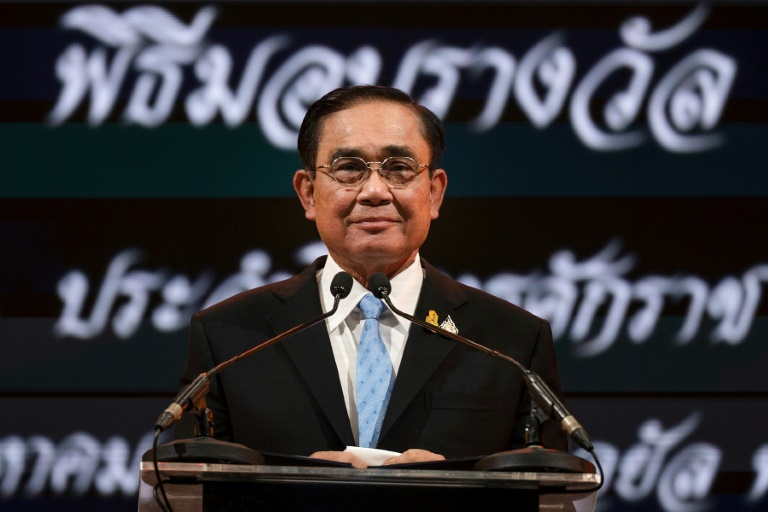
A Thai court is set to rule Friday on whether suspended prime minister Prayut Chan-O-Cha should be reinstated, or thrown out of office permanently, with a  verdict in his favour likely to trigger protests.

The former army chief, who came to power in a 2014 military coup, was suspended last month while the court examined a legal challenge mounted by opposition parties who argued he had reached his term limit in power.

Under the 2017 Thai constitution, a prime minister cannot serve more than eight years in office, but Prayut’s supporters and critics disagree as to when his term began.

The court ruling is expected to be announced at 3 pm (0800 GMT) Friday. 

His supporters argue the clock started when the 2017 constitution was enacted — or even after the 2019 general election, in which Prayut stayed in power thanks to the army-scripted constitutional provisions which critics say gave him an advantage.

If the court agrees, he could continue to serve until 2025 or 2027 — depending on an upcoming national poll, which must be held within months.

Naresuan University political scientist Napisa Waitoolkiat said she expected the ruling to go in Prayut’s favour.

“There is really a high, high chance he will survive,” she told AFP ahead of Friday’s ruling.

– ‘Lose face’ –

Following Prayut’s suspension in August, his deputy Prawit Wongsuwan took over as caretaker prime minister, while Prayut continued to serve as defence minister.

The suspension has been hugely damaging to Prayut, Napisa said, causing him to “lose face” in the eyes of voters.

The ruling comes ahead of the national elections, which must be called by March 2023.

Prayut and his Palang Pracharat Party are increasingly out of favour with voters, as an underperforming Thai economy hurts households.

A survey of 2,500 people earlier this month by the National Institute of Development Administration found that only 10.5 percent of respondents supported Prayut, who ranked a lowly fourth as a potential prime ministerial candidate.

If the court ruling goes in his favour the city could see protests, Napisa said.

“I think there will be protests in the street and demonstrations in Bangkok against the ruling,” Napisa said.

At least three protest groups — which came to prominence during 2020’s massive pro-democracy rallies — said Thursday they would demonstrate should Prayut carry the day. 

Deputy national police spokesman Kissana Phathanacharoen told AFP officers would be deployed to provide security near the court and in Bangkok’s shopping mall district, a popular location for previous protests.

Meanwhile, officials announced late Thursday there would be a restricted zone around the court.
Environmental bodies concerned by new UK government's climate comments

Initial comments by British Prime Minister Liz Truss’s conservative government have raised concerns about her climate policy in a country which is increasingly feeling the effects of global warming but is going through an unprecedented energy crisis.

Urged to act in the face of soaring energy prices, the new premier took office in early September and promptly announced a package of measures.

They included the acceleration of North Sea offshore oil and gas exploitation and the freezing of the moratorium on controversial gas fracking.

The UK had in 2019 called a halt to fracking — or hydraulic fracturing, used to release hydrocarbons locked deep underground — due to fears it could trigger earthquakes.

Truss has also refused to impose a windfall tax on oil companies, despite record profits they have been making in recent months.

For environmental campaigners, the introduction last week of a bill to amend or remove hundreds of environmental protection laws inherited from the European Union by the end of 2023 was the last straw.

“Nature is under attack from a raft of dangerous decisions by Government and we know people are furious at the new threats,” said Craig Bennett, chief executive of The Wildlife Trusts.

“Vital legal protections for wildlife are at risk, fossil fuel extraction is being favoured over renewables, and the government is going back on plans to reward farmers for managing land in a nature-friendly way.”

– Climate pioneer –

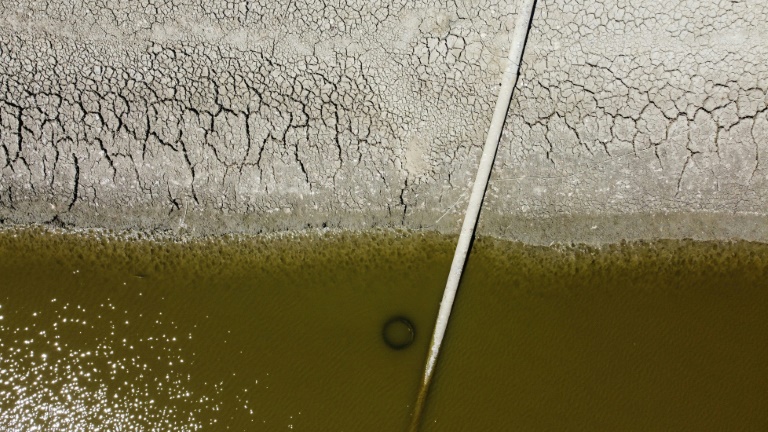
The months-long drought in parts of the UK, record high temperatures reached this summer and heat-induced fires have all brought home to many British people the future consequences of global warming.

The country is one of the pioneers in Europe in tackling climate change.

Britain became the first country to legally mandate reductions in greenhouse-gas emissions through its 2008 Climate Change Act.

It has also seen a rapid transformation in its energy model, with coal representing only three percent of energy consumed in 2020, compared to 20 percent in 2013.

At the COP26 climate conference last year in Scotland, former prime minister Boris Johnson promised to make the UK the Saudi Arabia of wind power and presented ambitious climate targets, including to phase out petrol and diesel vehicles.

Truss, who succeeded him, has never been perceived as particularly committed to the climate.

But her early decisions have confused even her own camp.

“The new government must not listen to siren calls to row back on environmental commitments when the solutions to the multiple crises we face, from climate to the cost of living, are complementary,” said Chris Skidmore, a Conservative member of parliament and former energy minister.

A cross-party group of pro-environment parliamentarians wrote to Truss in early September asking her to give a firm recommitment to the goal of reaching carbon neutrality.

After she became prime minister, Truss said she was “completely committed to achieving carbon neutrality by 2050”, but she also told parliament she had decided to “re-examine” this objective to ensure it was achieved in a way favourable to the economy and growth.

Doubts about the UK’s future climate policy have also been fuelled by Truss’s decision to appoint Jacob Rees-Mogg as her secretary of state for business, energy and industrial strategy.

– ‘Teetering on the brink’ –

An opponent of onshore wind power, Rees-Mogg has said he wants his constituents to have cheap energy “rather more than I would like them to have windmills”.

He has also warned against “climate alarmism” and recently accused Russian President Vladimir Putin of funding opponents of shale gas in the UK.

His comments have been branded a “a dangerous climate denial” by Ed Miliband, the main opposition Labour Party’s spokesperson on climate change and net zero.

“Putting someone who recently suggested ‘every last drop’ of oil should be extracted from the North Sea in charge of energy policy is deeply worrying for anyone concerned about the deepening climate emergency, solving the cost-of-living crisis and keeping our fuel bills down for good,” environmental pressure group Friends of the Earth said.

“Extracting more fossil fuels is a false solution to the energy crisis. It’s our failure to end our reliance on gas and oil that’s sent energy bills soaring and left us teetering on the brink of catastrophic climate change,” it said.

Rees-Mogg’s appointment “suggests that the Tories have learned nothing after years of incompetence in energy policy”, added Rebecca Newsom of Greenpeace.

The Labour Party, meanwhile, has made the issue of climate change one of its main lines of attack as it approaches the next general election, scheduled for 2025 at the latest.

UK's Royal Mint reveals coin portrait of King Charles III

Britain’s Royal Mint on Friday unveiled the official effigy of King Charles III that will appear on coins following his accession to the throne.

The effigy is the work of British sculptor Martin Jennings and was personally approved by the new king.

The first coins bearing the king’s portrait will be a special £5 coin and a 50 pence coin commemorating the life of Queen Elizabeth II. 

Jennings said his portrait was sculpted from a photograph of the Charles.

“It is the smallest work I have created, but it is humbling to know it will be seen and held by people around the world for centuries to come,” he said.

In line with royal tradition, Charles’s portrait faces to the left, the opposite direction to his late mother.

A Latin inscription surrounding the effigy translates as “King Charles III, by the Grace of God, Defender of the Faith”.

The image of Charles will begin to appear on coins in circulation and on commemorative pieces in the coming months, the Royal Mint said in a statement.

Two new portraits of Elizabeth will feature on the reverse of the commemorative five pound coin.

The Royal Mint has been responsible for depicting monarchs on coins for over 1,100 years since Alfred the Great. 

Elizabeth died on September 8 following a record-breaking 70 years on the throne.

Kevin Clancy, director of the Royal Mint Museum, said late queen had appeared on more coins than any other British monarch.

“Over the coming years it will become common for people to find coins bearing His Majesty and Queen Elizabeth II’s effigy in their change,” he said.

The Royal Mint said historically it had been commonplace for coins featuring the effigies of different monarchs to co-circulate.

“This ensures a smooth transition, with minimal environmental impact and cost.”

There are currently around 27 billion coins circulating in the UK bearing the effigy of Queen Elizabeth II.

“These will be replaced over time as they become damaged or worn and to meet demand for additional coins,” the Royal Mint added.

Meta to freeze hiring to tighten budget: report

Facebook-parent Meta put out word to employees on Thursday that it will freeze hiring to cut costs as it endures tough economic times, The Wall Street Journal reported.

Meta chief Mark Zuckerberg revealed a planned pause in hiring during a weekly all-hands meeting, the Journal reported, saying the move came as the social media titan planned to cut expenses by at least 10 percent.

Meta declined to comment on the report, instead referring AFP to remarks Zuckerberg made in July when the company reported its first quarterly revenue drop and a plunging profit.

Zuckerberg said during an earnings call that teams would shrink in order to “reallocate our energy” as it battled a turbulent economy and the rising phenomenon of TikTok.

Meta had long delivered seemingly endless upward growth, but reported early this year its first decline in global daily users.

“This is a period that demands more intensity, and I expect us to get more done with fewer resources,” Zuckerberg told analysts during an earnings call.

Big tech platforms have been suffering from the economic climate, which is forcing advertisers to cut back on marketing budgets, and Apple’s data privacy changes, which have reduced leeway for ad personalization.

Snap and e-commerce colossus Amazon are among tech firms that have announced workforce cuts this year.

NASA, SpaceX study boosting Hubble to extend its lifespan

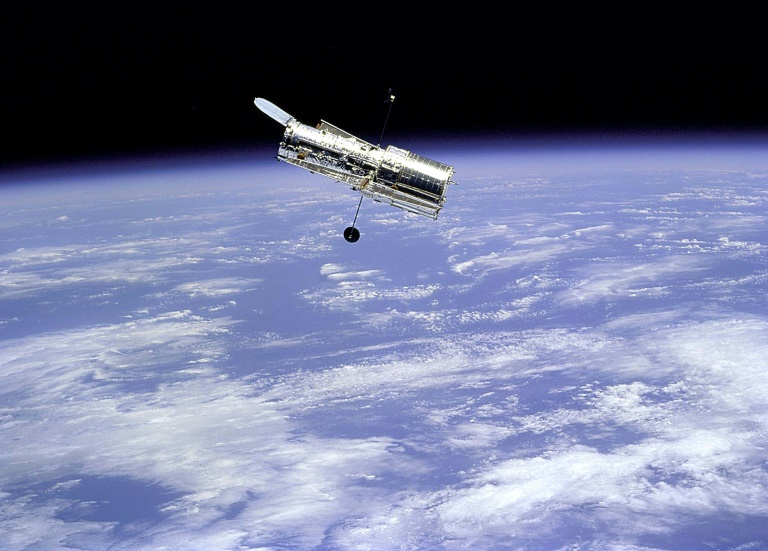
NASA and SpaceX have agreed to study the feasibility of awarding Elon Musk’s company a contract to boost the Hubble Space Telescope to a higher orbit, with a goal of extending its lifespan, the US space agency said Thursday.

The renowned observatory has been operating since 1990 about 335 miles (540 kilometers) above Earth, in an orbit that slowly decays over time.

Hubble has no on-board propulsion to counter the small but still present atmospheric drag in this region of space, and its altitude has previously been restored during Space Shuttle missions.

The proposed new effort would involve a SpaceX Dragon capsule.

“A few months ago, SpaceX approached NASA with the idea for a study whether a commercial crew could help reboost our Hubble spacecraft,” NASA’s chief scientist Thomas Zurbuchen told reporters, adding the agency had agreed to the study at no cost to itself.

He stressed there are no concrete plans at present to conduct or fund such a mission until the technical challenges are better understood.

One of the main obstacles would be that the Dragon spacecraft, unlike the Space Shuttles, does not have a robotic arm and would need modifications for such a mission.

SpaceX proposed the idea in partnership with the Polaris Program, a private human spaceflight venture led by payments billionaire Jared Isaacman, who last year chartered a SpaceX Crew Dragon to orbit the Earth with three other private astronauts.

“This would certainly fit within the parameters we established for the Polaris program,” Isaacman said in response to a question about whether reboosting Hubble could be the goal for a future Polaris mission.

Asked by a reporter whether there might be a perception that the mission was contrived in order to give wealthy people tasks to do in space, Zurbuchen said: “I think it’s only appropriate for us to look at this because of the tremendous value this research asset has for us.”

Arguably among the most valuable instruments in scientific history, Hubble continues to make important discoveries, including this year detecting the farthest individual star ever seen — Earendel, whose light took 12.9 billion years to reach us.

It is currently forecast to remain operational throughout this decade, with a 50 percent chance of de-orbiting in 2037, said Patrick Crouse, Hubble Space Telescope project manager.

Nike shares tumble as it reports lower profits

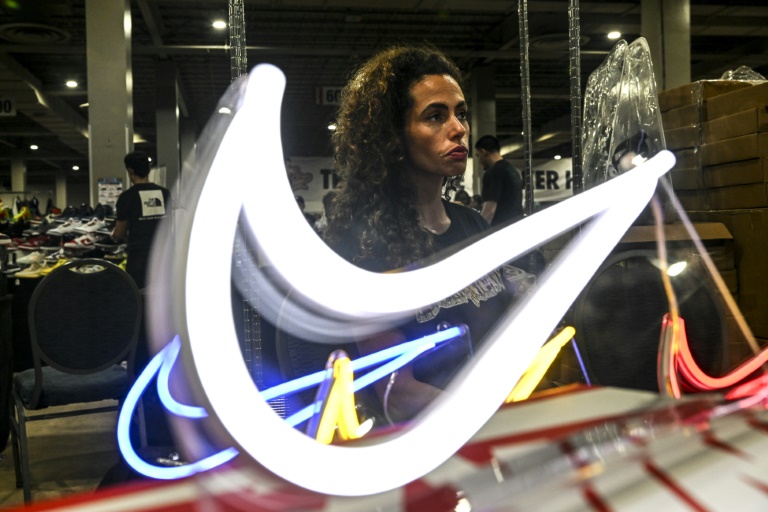
Nike reported lower quarterly profits Thursday on increased logistics spending and a hit from product markdowns, as it pivots in a fast-changing consumer market challenged by inflation.

The sports giant topped analyst estimates for both earnings per share and revenues, but shares fell sharply as it faced questions over excess inventory in North America and signaled the strengthening dollar would dent results.

Nike expects a $4 billion hit from the stronger dollar in its current fiscal year, said Chief Financial Officer Matthew Friend on a conference call over its fiscal 2023 first quarter results. 

Profit for the quarter ending August 31 was $1.5 billion, down 22 percent but translating into earnings per share that exceeded expectations. Revenues rose four percent to $12.7 billion.

While sales once again fell in Greater China, a market hard hit by Covid-19 restrictions, Nike notched higher sales in its other three regions, including North America, where revenues jumped 13 percent.

But the company is facing a much more promotional environment in its home market, where other retailers are offering deals as consumers respond to costlier gasoline, groceries and other household items.

At the same time, Nike has seen a 65 percent jump in inventories in North America, an increase that reflects an uptick in early orders from retailers concerned about supply chain delays, as well as improving delivery times.

Friend said Nike has continued to see strong consumer demand for choice products, but that it is working to offload a glut of older items that have generated less interest. 

“We’re focused on trying to clear through that late-season apparel inventory,” Friend told analysts on a conference call.

Neil Saunders, managing director of consultancy GlobalData, said Nike’s results were “relatively strong,” but warned it was not immune to macro challenges.

“At present, consumer sentiment and spending are holding up relatively well and we believe this bodes well for the upcoming quarter. However, as we move into 2023 and beyond the demand picture could soften,” Saunders said.

“Nike is in a better position than most brands, but it may find it harder to punch out such good numbers as it moves into the back end of its fiscal year.”

Shares fell 10.1 percent to $85.68 in after-hours trading.

European and US stocks tumble, pound rebounds

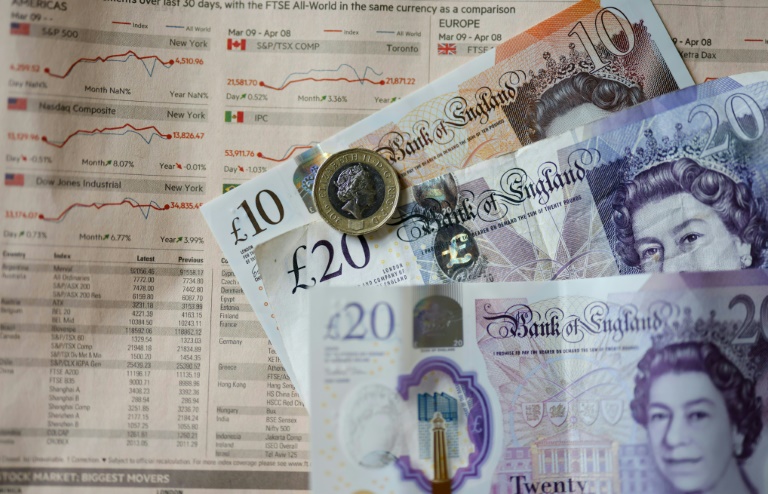
European and US equities sank Thursday on fears that rising interest rates will spark a global recession, while the pound clawed back ground one day after emergency bond-market intervention from the Bank of England.

“Higher US Treasury yields, inflation and rising recession fears are back in the driving seat,” said market analyst Fiona Cincotta at City Index.

German inflation accelerated sharply in September, official data showed Thursday, in the latest indication that Europe’s biggest economy is buckling under the pressure of soaring energy prices.

Consumer prices spiked 10 percent compared to the same month a year earlier.

German Chancellor Olaf Scholz announced that the nation would plough 200 billion euros into shielding households and businesses from skyrocketing energy costs in the wake of Russia’s invasion of Ukraine.

However, Frankfurt stocks slumped 1.7 percent, while Paris fell 1.5 percent.

London equities dropped 1.8 percent, as the pound rebounded somewhat from earlier falls, one day after the BoE snapped up UK bonds to avert a risk to British financial stability.

“The BoE rode to the rescue of the markets for one day, and the overall impact has been limited,” said Cincotta, though the pound bounced more than one percent higher to climb above $1.10.

The BoE, the European Central Bank, the US Federal Reserve and many other counterparts are ratcheting up interest rates to fight decades-high inflation.

Wall Street’s main stock indices slumped as US treasury yields continued to rise, and with the latest data showing a drop in first-time unemployment benefit claims falling under 200,000 for the first time since May.

The reading will be used by the Fed “as a basis to maintain an aggressive line with its rate hikes” because the bank sees a softening of the labor market as necessary to bring inflation back down to its two-percent target, said Patrick O’Hare, analyst at Briefing.com.

The broad-based S&P 500 dropped 2.1 percent to 3,640.47, its lowest close since November 2020.

– ‘Pessimistic’ investors –

“There’s a growing list of reasons why investors are pessimistic right now, with the prospect of an interest-rate recession being right up there,” Craig Erlam, analyst at trading platform OANDA, told AFP.

“But we are increasingly seeing pressures mounting and forcing responses from policymakers that are not normal. That started out as super-sized rate hikes, and now includes Japanese foreign-exchange interventions and the BoE intervening in bond markets.”

Stocks had also rallied Wednesday partly after the BoE’s surprise purchase, which came after Britain’s recent tax-cutting budget sparked soaring bond yields and sent the pound to a record dollar low on Monday. 

The BoE launched a two-week program to buy long-term UK bonds, capped initially at £65 billion ($71 billion), as UK pension funds scrambled to sell investments to remain solvent.

While the UK government’s 30-year sovereign bond yield retreated further to 3.97 percent, having briefly surged Wednesday to a 1998 peak at 5.14 percent, the yield on 10-year bonds began to march higher.

Meanwhile, sentiment was also dented this week by leaks from the undersea Nord Stream pipelines running from Russia to Europe.

That sparked accusations of sabotage amid strained relations between the West and sanctions-hit Russia over the latter’s war on Ukraine.

– Key figures around 2050 GMT –

New York – Dow: DOWN 1.5 percent at 29,225.61 (close)

New York – S&P 500: DOWN 2.1 percent at 3,640.47 (close)

New York – Nasdaq: DOWN 2.8 percent at 10,737.51 (close)

London – FTSE 100: DOWN 1.8 percent at 6,881.59 (close) 

Frankfurt – DAX: DOWN 1.7 percent at 11,975.55 (close) 

Paris – CAC 40: DOWN 1.5 percent at 5,676.87 (close)

EURO STOXX 50: DOWN 1.7 percent at 3,279.04 (close)

Tokyo – Nikkei 225: UP 1.0 percent at 26,422.05 (close)

Hong Kong – Hang Seng Index: DOWN 0.5 percent at 17,165.87

Shanghai – Composite: DOWN 0.1 percent at 3,041.20 (close)

Pound/dollar: UP at $1.1116 from $1.0689 on Wednesday

Euro/dollar: UP at $0.9818 from $0.9735

Euro/pound: DOWN at 88.28 pence from 89.40 pence

Dollar/yen: UP at 144.42 yen from 144.16 yen

Brent North Sea crude: DOWN 0.9 percent at $88.49 per barrel

West Texas Intermediate: DOWN 1.1 percent at $81.23 per barrel

burs-jmb/sw

Rescuing trapped grandkids via kayak — the aftermath of Hurricane Ian

Suzanne Clarke wades through waist-deep water, struggling to reach her daughter’s apartment as she drags a kayak behind her.

When she finally reaches the home, she loads her two small granddaughters into the boat and pushes them toward higher ground, where she has parked her car on a freeway.

The building where Clarke’s daughter lives, in McGregor, a small city in southwestern Florida, was flooded Wednesday as Hurricane Ian thrashed over the community, which is situated along the Caloosahatchee River. 

“I am very stressed, it’s been rough,” said 54-year-old Clarke. “I came early. The water was really, really high and I was scared.”

A day after Ian’s fury was unleashed, the inhabitants of Lee County — one of the areas most affected by the storm — are left to count the damage inflicted over the last several hours, now standing under a radiantly sunny sky. 

Some six miles (10 kilometers) away in Iona, only a few particularly large cars dare to navigate through a flooded street. 

Resident Ronnie Sutton spent the night with a friend in a town south of here called Cabo Coral. Even though he hasn’t been able to get to his house yet, he is sure the water has destroyed everything. 

“It’s terrible,” the 67-year-old said. “I guess this is the price you pay for being at sea level. Sometimes it comes back to bite you.”

– Boats in the street –

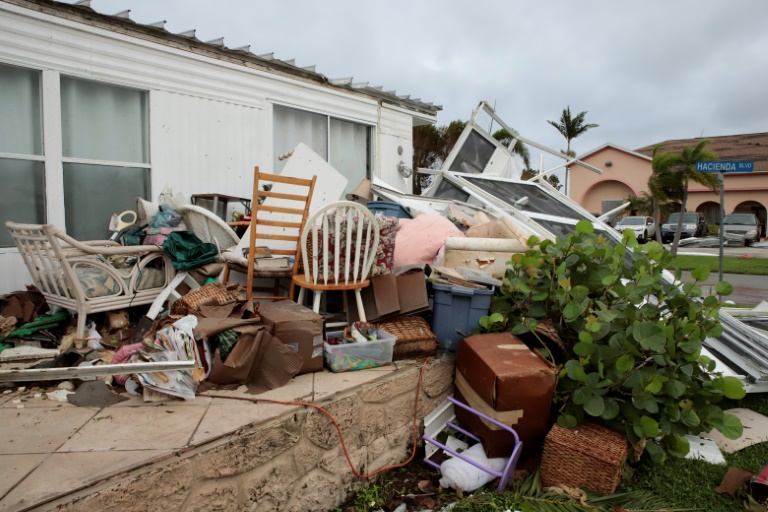
Ian battered this section of southwestern Florida for hours on Wednesday, leaving behind scenes of destruction, including splintered trees, felled traffic lights and shattered glass.

In Fort Myers, a quiet city of approximately 83,000 people, the rising Caloosahatchee River pushed dozens of small boats — usually anchored at the local marina — up into the streets of downtown, where they remained Thursday on the now-dry ground. 

Tom Johnson witnessed the flooding up close from his apartment on the second floor of a two-story building. 

Wednesday afternoon, he saw how the hurricane propelled two boats up into his complex’s courtyard in a matter of just five minutes. 

“I was scared because I’ve never been through that,” recalled 54-year-old Johnson, whose home was not damaged, gesturing to the crafts still laying there.

“It was just the most horrifying sounds, with debris flying everywhere, doors flying off.”

One of Johnson’s neighbors, Janelle Thil, was not as lucky. Her ground-floor apartment began to flood, but she was able to ask another resident for help to get out. 

“They got my dogs and then I jumped out of the window and swam over there,” Thil said, pointing to a vacant second-floor unit where she and others took refuge. 

The 42-year-old had finished clearing out the mud that found its way into her home, and began gathering her few possessions that were not lost in the flood. 

“I cried a little bit when I finally got to my apartment,” she said. “Opened the door and I had to wait about five minutes for all the floodwaters to come out.”

“I loved my home, but I’m alive and that’s what matters.”

No timeframe for fixing Nord Stream pipelines: operator

Nord Stream’s operator said Thursday it was unable to immediately assess damage to pipelines linking Russia to Europe, threatening an indeterminate outage — after Sweden detected a fourth leak and NATO decried “acts of sabotage”. 

The Swedish Coast Guard confirmed Thursday there were four leaks in total on the pipeline in the Baltic Sea — two on the Swedish side and two on the Danish side. Three leaks were previously reported.

The Nord Stream 1 and 2 pipelines have been at the centre of geopolitical tensions as Russia cut gas supplies to Europe in suspected retaliation against Western sanctions following Moscow’s invasion of Ukraine.

Nord Stream’s operator said it “intends to start assessing the damage to the pipeline as soon as it receives necessary official permits”.

It said access could be allowed “only after the pressure in the gas pipeline has stabilised and the gas leakage has stopped”. 

“Until the completion of the damage assessment, it is not possible to predict the timeframe for restoration of the gas transmission infrastructure”, the operator said.

NATO declared the damage was “the result of deliberate, reckless and irresponsible acts of sabotage” and said it supported investigations to determine the origin of the damage.

The Western alliance warned it was “committed to prepare for, deter and defend against the coercive use of energy and other hybrid tactics”.

“Any deliberate attack against Allies’ critical infrastructure would be met with a united and determined response,” it said, adding that the leaks present risks to shipping and would cause substantial environmental damage.

Russia has denied it was behind the explosions and said a foreign state was likely responsible.

President Vladimir Putin blamed the leaks on “international terrorism”.

He described them as “unprecedented sabotage” in a phone call with Turkish leader Recep Tayyip Erdogan on Thursday, according to a Kremlin readout.

Russia’s security service has also launched an “international terrorism” investigation into the gas leaks, saying it had caused “significant economic damage to the Russian Federation”.

Russia said Wednesday that Washington should answer if it was behind the leaks — an assertion rejected by the United States as “ridiculous”.

The UN Security Council will meet Friday to discuss the matter.

Finland, which borders Russia, moved to reinforce security around its critical infrastructure, with particular focus on the electricity network.

Sweden’s two main nuclear power plants stepped up their alert levels.

– ‘Constant’ gas flow –

Operated by a consortium majority-owned by Russian gas giant Gazprom, Nord Stream 1 and 2 run from Russia to Germany.

While the pipelines are not currently in operation, they both still contained gas.

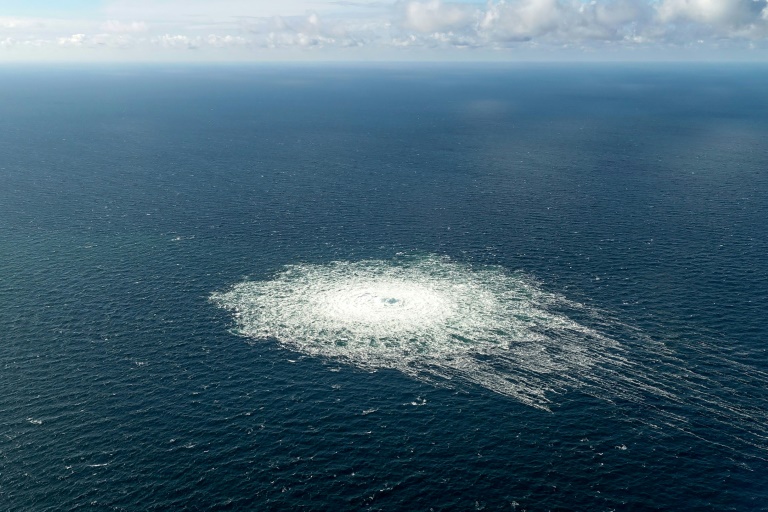
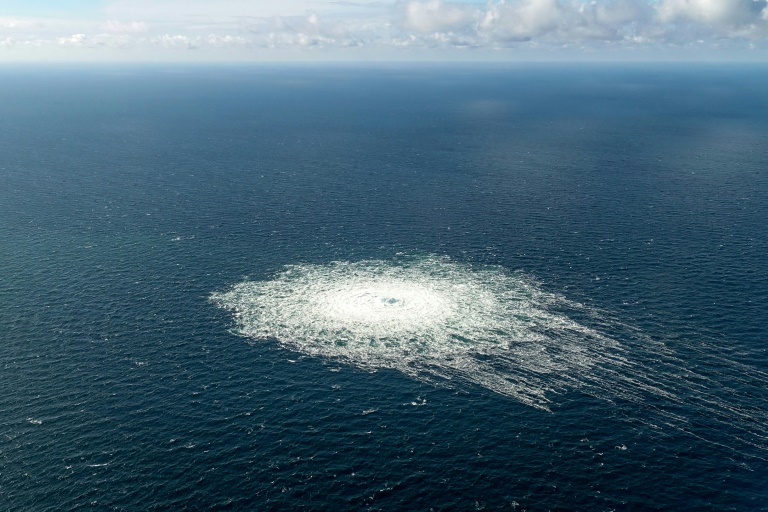
The vast leaks have caused underwater gas plumes, with significant bubbling at the surface of the sea several hundred metres wide, making it impossible to immediately inspect the structures. 

Seismic institutes on Tuesday reported they had recorded “in all likelihood” explosions in the area, prior to the leaks being detected.

A Swedish Coast Guard search and rescue vessel was patrolling the area.

“The crew reports that the flow of gas visible on the surface is constant,” the agency said in a statement. 

Danish authorities said the leaks will continue until the gas in the pipelines is exhausted, which is expected to occur on Sunday.

Fatih Birol, executive director of the International Energy Agency, said at a symposium in Paris that to him it was “very obvious” who was behind the leaks.

He said natural gas shortages in the wake of the war in Ukraine could make for a tough winter in Europe. 

“In the absence of a major negative surprise, I think Europe, in terms of natural gas, can survive this winter with a lot of bruises in our bodies in terms of prices, economy and social issues, but we can go through that,” Birol said. 

According to climate groups, Nord Stream 1 and 2 contained some 350,000 tonnes of natural gas — methane.

Greenpeace says the leaks could have the effect of almost 30 million tonnes of CO2, or more than two-thirds of the annual emissions of Denmark.

No timeframe for fixing Nord Stream pipelines: operator

Nord Stream’s operator said Thursday it was unable to immediately assess damage to pipelines linking Russia to Europe, threatening an indeterminate outage — after Sweden detected a fourth leak and NATO decried “acts of sabotage”. 

The Swedish Coast Guard confirmed Thursday there were four leaks in total on the pipeline in the Baltic Sea — two on the Swedish side and two on the Danish side. Three leaks were previously reported.

The Nord Stream 1 and 2 pipelines have been at the centre of geopolitical tensions as Russia cut gas supplies to Europe in suspected retaliation against Western sanctions following Moscow’s invasion of Ukraine.

Nord Stream’s operator said it “intends to start assessing the damage to the pipeline as soon as it receives necessary official permits”.

It said access could be allowed “only after the pressure in the gas pipeline has stabilised and the gas leakage has stopped”. 

“Until the completion of the damage assessment, it is not possible to predict the timeframe for restoration of the gas transmission infrastructure”, the operator said.

NATO declared the damage was “the result of deliberate, reckless and irresponsible acts of sabotage” and said it supported investigations to determine the origin of the damage.

The Western alliance warned it was “committed to prepare for, deter and defend against the coercive use of energy and other hybrid tactics”.

“Any deliberate attack against Allies’ critical infrastructure would be met with a united and determined response,” it said, adding that the leaks present risks to shipping and would cause substantial environmental damage.

Russia has denied it was behind the explosions and said a foreign state was likely responsible.

President Vladimir Putin blamed the leaks on “international terrorism”.

He described them as “unprecedented sabotage” in a phone call with Turkish leader Recep Tayyip Erdogan on Thursday, according to a Kremlin readout.

Russia’s security service has also launched an “international terrorism” investigation into the gas leaks, saying it had caused “significant economic damage to the Russian Federation”.

Russia said Wednesday that Washington should answer if it was behind the leaks — an assertion rejected by the United States as “ridiculous”.

The UN Security Council will meet Friday to discuss the matter.

Finland, which borders Russia, moved to reinforce security around its critical infrastructure, with particular focus on the electricity network.

Sweden’s two main nuclear power plants stepped up their alert levels.

– ‘Constant’ gas flow –

Operated by a consortium majority-owned by Russian gas giant Gazprom, Nord Stream 1 and 2 run from Russia to Germany.

While the pipelines are not currently in operation, they both still contained gas.

The vast leaks have caused underwater gas plumes, with significant bubbling at the surface of the sea several hundred metres wide, making it impossible to immediately inspect the structures. 

Seismic institutes on Tuesday reported they had recorded “in all likelihood” explosions in the area, prior to the leaks being detected.

A Swedish Coast Guard search and rescue vessel was patrolling the area.

“The crew reports that the flow of gas visible on the surface is constant,” the agency said in a statement. 

Danish authorities said the leaks will continue until the gas in the pipelines is exhausted, which is expected to occur on Sunday.

Fatih Birol, executive director of the International Energy Agency, said at a symposium in Paris that to him it was “very obvious” who was behind the leaks.

He said natural gas shortages in the wake of the war in Ukraine could make for a tough winter in Europe. 

“In the absence of a major negative surprise, I think Europe, in terms of natural gas, can survive this winter with a lot of bruises in our bodies in terms of prices, economy and social issues, but we can go through that,” Birol said. 

According to climate groups, Nord Stream 1 and 2 contained some 350,000 tonnes of natural gas — methane.

Greenpeace says the leaks could have the effect of almost 30 million tonnes of CO2, or more than two-thirds of the annual emissions of Denmark.

Close Bitnami banner
Bitnami