AFP

Asian markets fluctuate as oil, euro struggle on recession fears

Asian markets fought Wednesday to recover some of the losses suffered at the start of the week as recession alarms continue to ring loud and oil struggled to erase the previous day’s sharp drop owing to growing demand fears.

The euro clawed its way back slightly after hitting parity with the dollar for the first time in two decades, though it remains under pressure from growing concerns about an energy crisis across the eurozone and the European Central Bank’s slower pace of monetary tightening.

Traders are also awaiting the release of a series of key indicators this week, including the all-important consumer price index later Wednesday, with expectations for another increase to a fresh 41-year high.

Another big spike in prices will reinforce the Federal Reserve’s determination to lift interest rates 75 basis points for a second successive month in July, adding to concerns that officials could go too far and tip the economy into recession.

Still, Lauren Goodwin of New York Life Investments said policymakers were unlikely to shift from their hawkish tilt for now.

“This is widely expected to be a really strong print,” she told Bloomberg Television.

“Even if it is not, I don’t think that changes the Fed’s perspective in a couple of weeks. We won’t have enough evidence that inflation is convincingly turning over.”

In a further sign of the pressure being felt around the world from surging prices, the South Korean central bank lifted rates 0.5 percentage points Wednesday, the first such increase since 1999.

While European markets enjoyed a rare advance thanks to bargain-buying, all three main indexes on Wall Street dropped.

Asian equities fluctuated, with Tokyo, Hong Kong, Seoul, Wellington and Taipei slightly higher but Shanghai, Sydney, Singapore, Manila and Jakarta in the red.

– Europe gas crisis –

Stephen Innes at SPI Asset Management said equities could continue to struggle owing to a perfect storm of crises engulfing trading floors.

“Typically, equity markets can deal with one risk relatively well,” he said in a note. “But the current setup of sticky inflation, rapid Fed tightening, growth/recession risks and excessive rates volatility, to name a few, have at times left investors defenceless. 

“And with the market coalescing to a bearish consensus, stocks are having trouble sustaining a meaningful rally.”

Both main crude contracts were flat, staying below $100 and nowhere near recovering the more than seven percent drops suffered Tuesday, hit by bets on a drop in demand and fears of more Covid-19 lockdowns in Shanghai.

The commodity has lost a large chunk of the gains seen after Vladimir Putin’s invasion of Ukraine, despite bans on imports from Russia, with some analysts saying consumers were simply choosing not to buy fuel because of the high price.

Data from the American Petroleum Institute showed US stockpiles rose 4.76 million barrels last week, Bloomberg News reported citing people familiar with the figures, indicating demand slacking off even during the key summer driving season.

Joe Biden’s visit to Saudi Arabia on Friday will be followed intently as he tries to persuade the crude giant to pump more to help reduce prices.

On currency markets, the euro held just above $1.0 a day after hitting parity on Tuesday for the first time since late 2022, with a worsening energy crisis fanning expectations that the eurozone will plunge into recession.

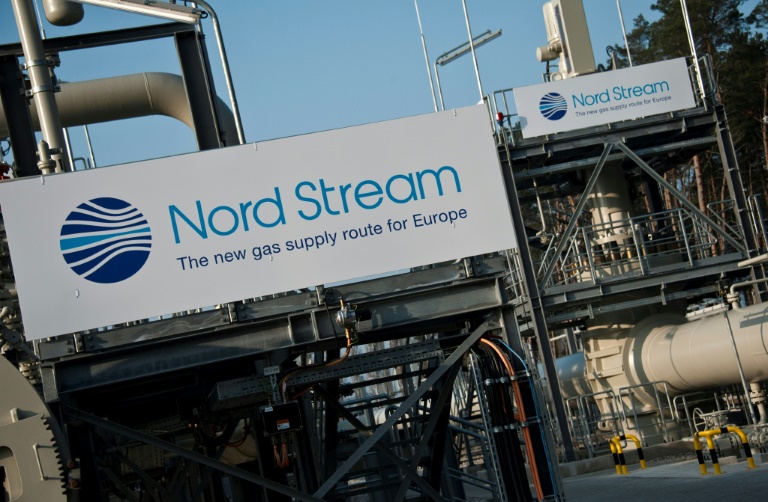
With Russian energy giant Gazprom starting 10 days of maintenance Monday on its Nord Stream 1 pipeline, the bloc — and particularly gas-reliant Germany — is waiting nervously to see if the taps are turned back on.

“A prolonged cut to the gas supply would halt a lot of economic activity, sending (Germany) deep into recession,” said Tapas Strickland at National Australia Bank.

He said July 21 — when the gas should be switched back on — will be a crucial date.

“That date also happens to be the day of the next ECB meeting,” he added. “Either of these events are key risk events. Russia playing gas politics by not switching on the gas supply would likely see the euro lurch much lower.”

– Key figures at around 0250 GMT –

Tokyo – Nikkei 225: UP 0.3 percent at 26,423.11 (break)

Hong Kong – Hang Seng Index: UP 0.6 percent at 20,963.55

Shanghai – Composite: DOWN 0.3 percent at 3,270.99

Euro/dollar: DOWN at $1.0032 from $1.0037 Tuesday

Pound/dollar: UP at $1.1893 from $1.1889 

Euro/pound: DOWN at 84.34 pence from 84.40 pence

Dollar/yen: UP at 137.14 yen from 136.84 yen

West Texas Intermediate: FLAT at $95.80 per barrel

Brent North Sea crude: FLAT at $99.52 per barrel

New York – Dow: DOWN 0.6 percent at 30,981.33 (close)

London – FTSE 100: UP 0.2 percent at 7,209.86 (close)
Biden heads to Middle East for first tour as president

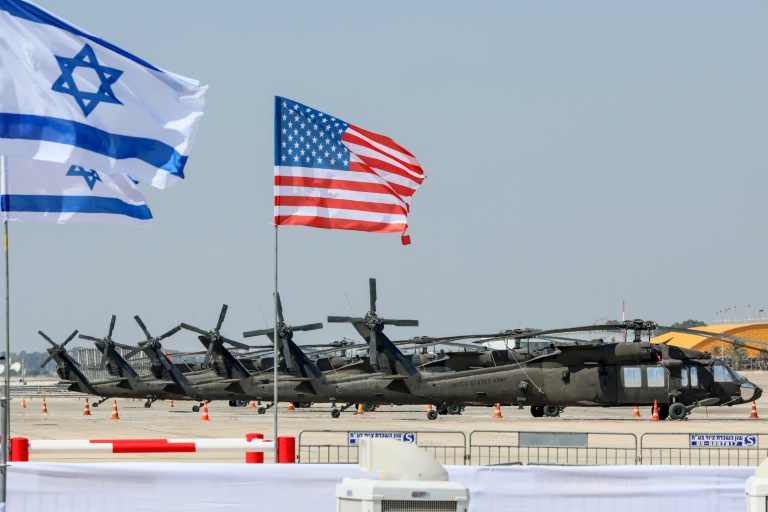
US President Joe Biden lands in the Middle East on Wednesday for a trip that will see Israeli leaders urge tougher action against Iran, before a delicate stop in Saudi Arabia.

The 79-year-old president’s visit to Jeddah on Friday will be the focus of the tour, after Biden branded Saudi Arabia a “pariah” over the 2018 murder of dissident Saudi journalist and US resident Jamal Khashoggi.

Air Force One will also make an unprecedented direct flight between the Jewish state and the conservative Gulf kingdom that does not recognise its existence.

Before that, Biden will meet Israeli leaders seeking to broaden cooperation against Iran, and Palestinian leaders frustrated by what they describe as Washington’s failure to curb Israeli aggression.

The persistent frustrations of Israeli-Palestinian diplomacy are nothing new for Biden, who first visited the region in 1973 after being elected to the Senate. 

Iran and Israel were allies then, but the Jewish state now considers Tehran its top threat.

Israel’s caretaker Prime Minister Yair Lapid, who took office less than two weeks ago, has said talks “will focus first and foremost on the issue of Iran.”

–  Jerusalem to Bethlehem –

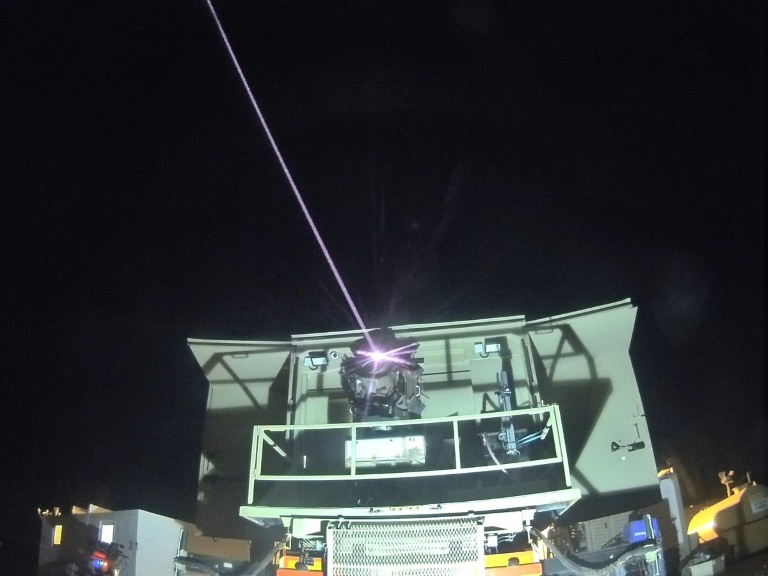
Moments after Biden touches down, Israel’s military will show him its new Iron Beam system, an anti-drone laser it claims is crucial to countering Iran’s UAV fleet. 

Israel insists it will do whatever is necessary to thwart Iran’s nuclear ambitions, and is staunchly opposed to a restoration of the 2015 deal that gave Tehran sanctions relief.

Israel says it is raising 1,000 flags across Jerusalem to welcome the US leader, who has not reversed former president Donald Trump’s controversial decision to recognise the city as the capital of the Jewish state.

Palestinians claim Israeli-annexed east Jerusalem as their capital and, ahead of the visit, have accused Biden of failing to make good on his pledge to restore the United States as an honest broker in the conflict.

“We only hear empty words and no results,” said Jibril Rajoub, a leader of the secular Fatah movement of Palestinian president Mahmud Abbas.

Biden will meet Abbas in the occupied West Bank city of Bethlehem on Friday, but there is no expectation of bold announcements towards a fresh peace process, meaning the visit may merely deepen Palestinian frustration.

Israel is also mired in political gridlock ahead of elections on November 1, the fifth vote in less than four years.

– Normalisation steps?  –

US-Palestinian ties have recently been strained by the May killing of prominent Al Jazeera reporter Shireen Abu Akleh while she was covering an Israeli army raid in the occupied West Bank.

The United Nations has concluded the Palestinian-American national was killed by Israeli fire, something Washington found was likely but said there was no evidence the killing was intentional.

Abu Akleh’s family has voiced “outrage” over the Biden administration’s “abject response” to her death, and the White House has not commented on their request to meet the president in Jerusalem.

Biden’s trip to Saudi Arabia is seen as part of efforts to stabilise oil markets rattled by the war in Ukraine, by re-engaging with a country that has been a key strategic ally of the United States for decades and a major supplier of oil.

But Israel hopes the visit will also signal the start of diplomatic ties between the country and Riyadh.

Israel expanded its regional reach with US backing in 2020, when it formalised ties with the United Arab Emirates, Bahrain and Morocco — breakthroughs that came after its peace accord with Jordan, in 1994, and Egypt in 1979.

While there is no expectation of Saudi Arabia recognising the Jewish state in the immediate future, a senior Israeli official said Tuesday that Biden’s visit marked an important step. 

Israel to laser in on Iranian drone threat as Biden visits

Moments after US President Joe Biden touches down in Tel Aviv on Wednesday, the Israeli military will show him new hardware it says is essential to confronting Iran: anti-drone lasers.

While Israel has long been known for its efforts to thwart Tehran’s nuclear ambitions, Israeli officials have increasingly been sounding the alarm over Iran’s fleet of unmanned aerial vehicles (UAVs).

This month, the Israeli military said it had intercepted a total of four unarmed drones headed for an offshore gas rig. It said the drones were Iranian-made and launched by the Lebanese group Hezbollah, which is backed by Tehran.

As concerns mount over drone warfare, Israel hopes the new “Iron Beam” system will secure its skies.

While not yet operational, the military hardware was described as a “game-changer” in April by then-prime minister Naftali Bennett. 

Presenting such technology to Biden is a strategic move for Israel, which saw Washington approve a billion-dollar package in September for Israel’s active Iron Dome system. 

The defence system has been used countless times to intercept rockets fired by militants from the Gaza Strip, which is controlled by Iran’s ally Hamas.

The Iron Dome costs roughly $50,000 per launch, while Bennett priced the Iron Beam at $3.50 per deployment.

He said the new defence system was “silent” and could “intercept incoming UAVs, mortars, rockets and anti-tank missiles.”

Uzi Rubin, a former Israeli defence ministry specialist in anti-missile systems, said intercepting drones was a significant challenge.

“The laser technology will have more capacity against drones than rockets and missiles,” said Rubin, who is based at the Jerusalem Institute for Strategy and Security.

“It is going to help if we get some American financing” for the Iron Beam, he added. 

– Rare regional talks –

For Israel, a priority of Biden’s Middle East tour is broadening US-backed security cooperation among regional countries with shared hostility towards Iran.

The US president will fly Friday to Saudi Arabia, Iran’s main regional rival, following meetings with Israeli and Palestinian officials. 

Saudi Arabia and its neighbour the United Arab Emirates have both come under drone attack by Yemen’s Iran-backed Huthi rebels since 2019.

The Wall Street Journal reported last month that senior Israeli and US military officials had visited Egypt to discuss Iranian drones.

Participants in the talks included the UAE and Bahrain, which both normalised ties with Israel in 2020, as well as Saudi Arabia and Qatar, which don’t recognise the Jewish state.

Israel’s Defence Minister Benny Gantz subsequently made comments which were widely interpreted as confirming the discussions.

“We are building our wide partnership with additional countries in the region to ensure a secure, stable and prosperous Middle East. Among other things, this also includes aerial defence,” Gantz said.

The race to develop arsenals of UAVs in the region has been described as a “drone revolution” by Washington’s Middle East Institute.

The normalisation of ties with the Jewish state has “opened new horizons” for Abu Dhabi’s tech sector, the institute said in March, as Israel has been “at the forefront of the drone industry since the 1980s”.

– ‘Significant platform’ –

According to Eyal Pinko, a former Israeli navy intelligence officer, Israel has been anticipating the rising threat of drones from Iran and its regional proxies.

“Since 2009, there was an understanding among Israeli naval intelligence that Hezbollah’s UAVs would be a threat to Israeli rigs,” said Pinko, a specialist at Tel Aviv’s Bar-Ilan University.

“Iran understood many years ago that drones were force multipliers, a significant platform and relatively cheap,” he told AFP.

Earlier this year, the Israeli military said that in March 2021 it had intercepted two Iranian drones laden with weapons for Gaza militants.

Tehran “is positioning itself as a major drone power in the region”, according to an article published by the European Council on Foreign Relations think tank.

“The country built up its vast drone fleet over many years mainly out of necessity, aiming to compensate for its old and decaying air force, which has been battered by decades of sanctions,” the May report said.

Its fleet includes the “Gaza” drone, which can fly for 35 hours, according to Iran’s Fars News Agency.

On Monday, the White House revealed intelligence that Tehran was “preparing to provide Russia with up to several hundred UAVs… on an expedited timeline” for use in the war in Ukraine.

While Israel aims to counter Iranian UAVs with new technology and regional alliances, it may also be going on the offensive.

In March, Israeli media said the army had launched an attack on an Iranian site storing dozens of armed drones.

But weeks later, Iranian state television broadcast footage of a facility hidden in the mountains: an underground base for scores of military UAVs.

Three men charged in plot to sell stolen Eagles notes

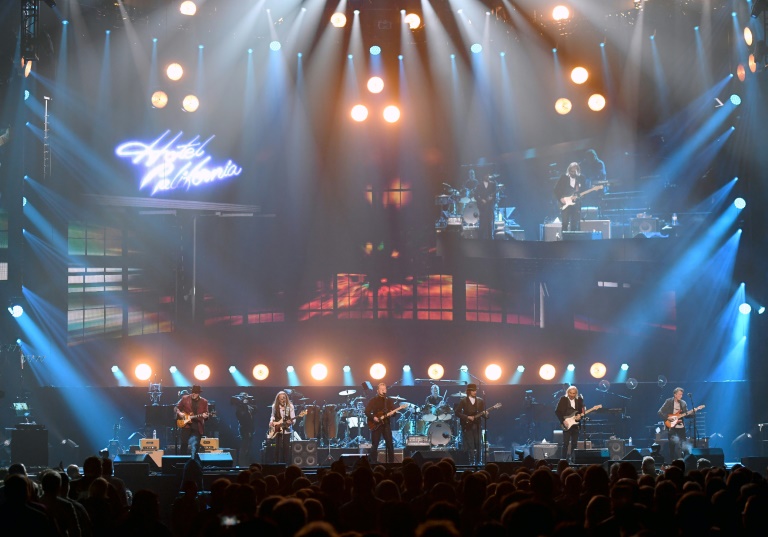
Manhattan’s district attorney on Tuesday charged three people with conspiring to illegally possess and sell some 100 pages of handwritten notes and lyrics for the Eagles album “Hotel California.”

Glenn Horowitz, Craig Inciardi and Edward Kosinski allegedly knew the documents — collectively valued at over $1 million — were stolen, but conspired to sell them anyway.

According to court documents, the men manufactured false provenance and lied to auction houses, potential buyers and law enforcement about how they acquired the notes by Don Henley, which included lyrics to the hits “Hotel California” and “Life in the Fast Lane.”

A biographer for the band originally stole the manuscripts in the late 1970s, according to the legal filing, eventually selling them to Horowitz, who in turn sold them to Inciardi and Kosinski.

Court documents say Eagles founding-member Henley filed police reports upon learning that Inciardi and Kosinski had the pages, allegations the duo fought for years.

“New York is a world-class hub for art and culture, and those who deal cultural artifacts must scrupulously follow the law,” said Manhattan prosecutor Alvin Bragg.

“These defendants attempted to keep and sell these unique and valuable manuscripts, despite knowing they had no right to do so. They made up stories about the origin of the documents and their right to possess them so they could turn a profit.”

Inciardi, 58, is an “employee with curator responsibilities” at the Rock and Roll Hall of Fame in Cleveland, Ohio, the museum confirmed to AFP.

“When we became aware of this matter, we suspended the employee and retained experienced outside counsel to conduct an internal investigation,” the Rock Hall said in a statement, insisting it was not named in the investigation.

Attorneys for the men vowed to “fight these unjustified charges vigorously.”

“The DA’s office alleges criminality where none exists and unfairly tarnishes the reputations of well-respected professionals,” they wrote in a statement given to AFP. 

The men pleaded not guilty and were released on their own recognizance.

Cosmic cliffs and dancing galaxies: Webb begins era of discovery

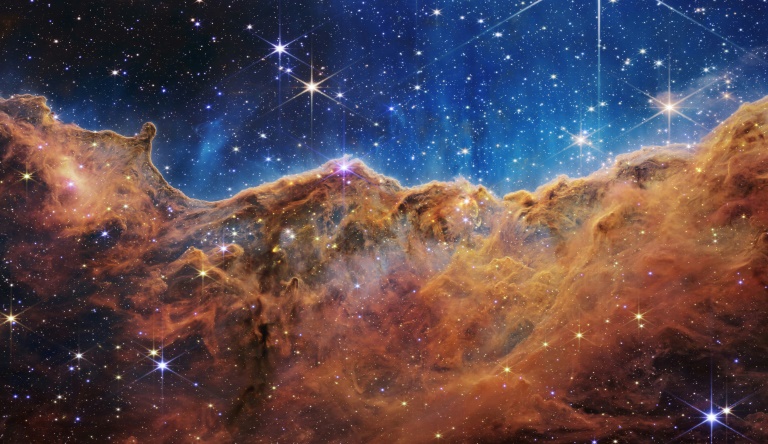
The cosmic cliffs of a stellar nursery and a quintet of galaxies bound in a celestial dance: NASA released the next wave of images from the James Webb Space Telescope Tuesday, heralding a new era of astronomy.

“Every image is a new discovery,” said NASA administrator Bill Nelson. “Each will give humanity a view of the universe that we’ve never seen before.”

Released one by one starting from 10:30 am Eastern (1430 GMT) at the Goddard Space Flight Center, the new images demonstrated the full power of the $10 billion observatory, which uses infrared cameras to gaze into the distant universe with unprecedented clarity.

“They’re beautiful and they’re full of wonderful discoveries and science, and lots of things we haven’t identified are in there,” Nobel-winning cosmologist and Webb senior project scientist John Mather told AFP.

On Monday, Webb revealed the sharpest image to date of the early universe, teeming with thousands of galaxies going back more than 13 billion years.

The latest tranche included the “mountains” and “valleys” of a star-forming region called NGC 3324 in the Carina Nebula, dubbed the “Cosmic Cliffs,” 7,600 light years away.

“For the first time we’re seeing brand new stars that were previously completely hidden from our view,” said NASA astrophysicist Amber Straughn.

– Stellar nurseries and graveyards –

Webb also revealed never-before-seen details of Stephan’s Quintet, a grouping of five galaxies including four that experience repeated close encounters, which provide insights into how early galaxies formed at the start of the universe.

At the center of the cluster is a black hole called an active galactic nucleus, “which means stuff is flowing in, it gets cooked to high temperatures, and some of it gets spit back out again,” explained Mather.

Studying the black hole will allow scientists to better understand the one at the center of our own Milky Way, called Sagittarius A*.

A dim star at the center of the Southern Ring Nebula was found for the first time to be cloaked in dust, as it spews out rings of gas and dust in its death throes.

Understanding the molecules present in such stellar graveyards can help scientists learn more about the process of stellar death.

The telescope also detailed water vapor in the atmosphere of a faraway giant gas planet. 

The spectroscopy — an analysis of light that reveals detailed information — was of planet WASP-96 b, which was discovered in 2014.

Scientists will next hope to train the spectrographic instruments on small rocky worlds such as our own, to search for signs of habitability.

– Fundamental discoveries expected –

Webb’s first images have set the space community alight, and will also be shown on giant screens in New York City’s Times Square and in London.

Launched in December 2021 from French Guiana on an Ariane 5 rocket, Webb is orbiting the Sun at a distance of a million miles (1.6 million kilometers) from Earth, in a region of space called the second Lagrange point.

It remains in a fixed position relative to the Earth and Sun, with minimal fuel required for course corrections and maneuvering its instruments.

A wonder of engineering, Webb is one of the most expensive scientific platforms to date, comparable to the Large Hadron Collider at CERN, and also among the most complex machines ever built.

Webb’s primary mirror is over 21 feet (6.5 meters) wide and is made up of 18 gold-coated mirror segments. Like a camera held in one’s hand, the structure has to remain very still for the best shots, with Webb’s engineers minimizing its wobble to just 17 millionths of a millimeter.

Its pointing accuracy is equivalent to firing a bullet from Washington and hitting a coin on top of a tower in Los Angeles, Charlie Atkinson, chief engineer for its main builder Northrop Grumman, told AFP.

After the first images, astronomers around the globe will get shares of time on the telescope, with projects selected competitively through a process in which applicants and selectors don’t know each other’s identities, to minimize bias.

Thanks to an efficient launch, NASA estimates Webb has enough propellant for a 20-year life, as it works in concert with the Hubble and Spitzer space telescopes to answer fundamental questions about the cosmos — including those scientists don’t yet know to ask.

“We don’t know what we don’t know yet,” said Straughn.  

Hubble played a key role in discovering that dark energy is causing the universe to expand at an ever-growing rate, “so it’s hard to imagine what we might learn with this 100 times more powerful instrument.”

Cosmic cliffs and dancing galaxies: Webb begins era of discovery

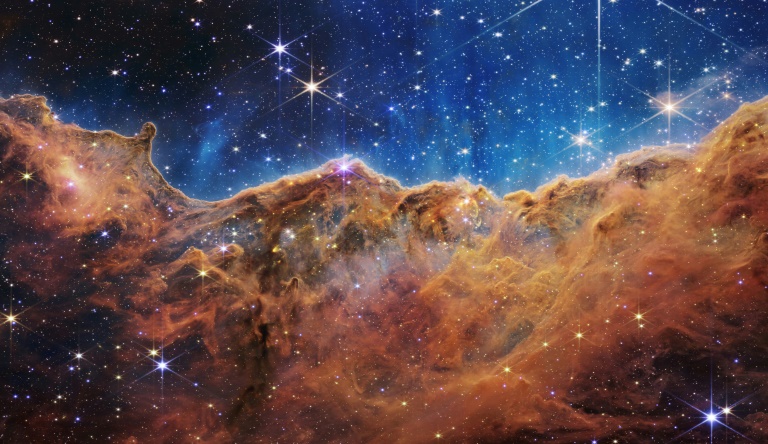
The cosmic cliffs of a stellar nursery and a quintet of galaxies bound in a celestial dance: NASA released the next wave of images from the James Webb Space Telescope Tuesday, heralding a new era of astronomy.

“Every image is a new discovery,” said NASA administrator Bill Nelson. “Each will give humanity a view of the universe that we’ve never seen before.”

Released one by one starting from 10:30 am Eastern (1430 GMT) at the Goddard Space Flight Center, the new images demonstrated the full power of the $10 billion observatory, which uses infrared cameras to gaze into the distant universe with unprecedented clarity.

“They’re beautiful and they’re full of wonderful discoveries and science, and lots of things we haven’t identified are in there,” Nobel-winning cosmologist and Webb senior project scientist John Mather told AFP.

On Monday, Webb revealed the sharpest image to date of the early universe, teeming with thousands of galaxies going back more than 13 billion years.

The latest tranche included the “mountains” and “valleys” of a star-forming region called NGC 3324 in the Carina Nebula, dubbed the “Cosmic Cliffs,” 7,600 light years away.

“For the first time we’re seeing brand new stars that were previously completely hidden from our view,” said NASA astrophysicist Amber Straughn.

– Stellar nurseries and graveyards –

Webb also revealed never-before-seen details of Stephan’s Quintet, a grouping of five galaxies including four that experience repeated close encounters, which provide insights into how early galaxies formed at the start of the universe.

At the center of the cluster is a black hole called an active galactic nucleus, “which means stuff is flowing in, it gets cooked to high temperatures, and some of it gets spit back out again,” explained Mather.

Studying the black hole will allow scientists to better understand the one at the center of our own Milky Way, called Sagittarius A*.

A dim star at the center of the Southern Ring Nebula was found for the first time to be cloaked in dust, as it spews out rings of gas and dust in its death throes.

Understanding the molecules present in such stellar graveyards can help scientists learn more about the process of stellar death.

The telescope also detailed water vapor in the atmosphere of a faraway giant gas planet. 

The spectroscopy — an analysis of light that reveals detailed information — was of planet WASP-96 b, which was discovered in 2014.

Scientists will next hope to train the spectrographic instruments on small rocky worlds such as our own, to search for signs of habitability.

– Fundamental discoveries expected –

Webb’s first images have set the space community alight, and will also be shown on giant screens in New York City’s Times Square and in London.

Launched in December 2021 from French Guiana on an Ariane 5 rocket, Webb is orbiting the Sun at a distance of a million miles (1.6 million kilometers) from Earth, in a region of space called the second Lagrange point.

It remains in a fixed position relative to the Earth and Sun, with minimal fuel required for course corrections and maneuvering its instruments.

A wonder of engineering, Webb is one of the most expensive scientific platforms to date, comparable to the Large Hadron Collider at CERN, and also among the most complex machines ever built.

Webb’s primary mirror is over 21 feet (6.5 meters) wide and is made up of 18 gold-coated mirror segments. Like a camera held in one’s hand, the structure has to remain very still for the best shots, with Webb’s engineers minimizing its wobble to just 17 millionths of a millimeter.

Its pointing accuracy is equivalent to firing a bullet from Washington and hitting a coin on top of a tower in Los Angeles, Charlie Atkinson, chief engineer for its main builder Northrop Grumman, told AFP.

After the first images, astronomers around the globe will get shares of time on the telescope, with projects selected competitively through a process in which applicants and selectors don’t know each other’s identities, to minimize bias.

Thanks to an efficient launch, NASA estimates Webb has enough propellant for a 20-year life, as it works in concert with the Hubble and Spitzer space telescopes to answer fundamental questions about the cosmos — including those scientists don’t yet know to ask.

“We don’t know what we don’t know yet,” said Straughn.  

Hubble played a key role in discovering that dark energy is causing the universe to expand at an ever-growing rate, “so it’s hard to imagine what we might learn with this 100 times more powerful instrument.”

Video shows hesitant police response to Uvalde school shooting

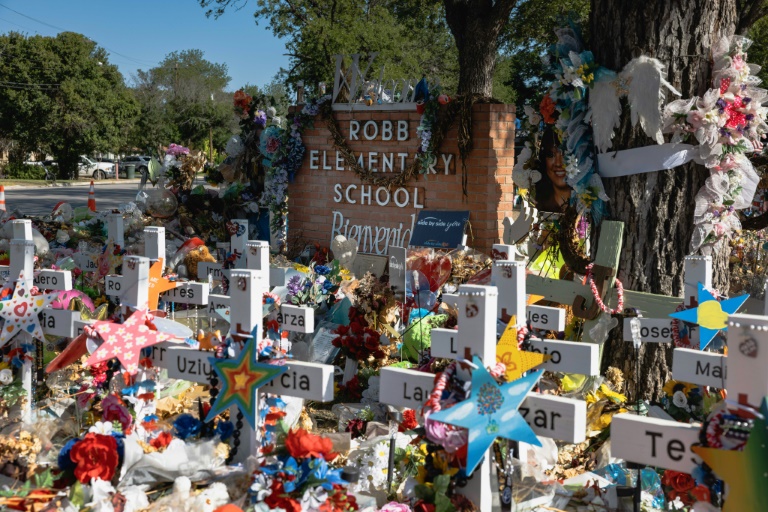
A video of the school shooting in Uvalde, Texas, published Tuesday showed police waiting for more than an hour before breaching a classroom where a gunman killed 19 children and two teachers.

Steve McCraw, Texas’s public safety chief, has described the police response to the May 24 attack as an “abject failure” and said officers wasted vital time looking for a classroom key that was “never needed.”

Surveillance camera video obtained by the Austin American-Statesman newspaper and local TV station KVUE shows the 18-year-old gunman crashing his truck outside Robb Elementary School and then entering the building at 11:33 am armed with a semi-automatic rifle. 

As he walks down an empty hallway, a young boy spots him from around a corner and rushes away as the gunman opens fire into a classroom.

The camera catches the gunman shooting dozens of rounds from the doorway before going inside. He steps out briefly into the view of the camera, reenters the classroom and is not seen again.

Several police officers armed with handguns are seen arriving in the school hallway within three minutes of the first shots being fired.

They go down the hallway where the shooting is taking place but retreat when the gunman opens fire from the classroom.

For the next hour the police are seen huddling at the end of the hallway while reinforcements arrive, including officers armed with semi-automatic weapons and ballistic shields.

At 12:21 pm, 45 minutes after the arrival of the first officers on the scene, shots could be heard from where the gunman was holed up.

The officers eventually stormed the classroom at 12:50 pm and killed the gunman — one hour and 14 minutes after their arrival.

The video does not show any children being shot and the Austin American-Statesman said it had removed audio of their screams.

Its public release was met with outrage by some in the community.

Uvalde Mayor Don McLaughlin, speaking at a town council meeting, called it “one of the most chicken things I’ve seen.”

He said that the video was not meant to be released until after victims’ families had a chance to view it, and that it was meant to be edited down.

“They didn’t need to see the gunman coming in and hear the gunshots. They don’t need to relive that, they’ve been through enough.”

– ‘Terrible decisions’ –

McCraw, Texas’s public safety chief, told a state senate hearing in June that police had enough officers to stop the shooter three minutes after he entered the school.

On-scene commander Pete Arredondo had “decided to place the lives of officers before the lives of children,” McCraw said.

“The officers had weapons, the children had none. The officers had body armor, the children had none. The officers had training, the subject had none,” he testified.

Arredondo had claimed that the classroom door was locked, delaying their move on the shooter, but McCraw told the inquiry that was not believed to be the case.

“He waited for a key that was never needed,” said the official.

McCraw told the inquiry that Arredondo, who has since been suspended, had made “terrible decisions.”

He said the response ran counter to lessons learned since the Columbine high school shooting that left 13 people dead in 1999. 

“There’s compelling evidence that the law enforcement response to the attack at Robb Elementary was an abject failure and antithetical to everything we’ve learned over the last two decades since the Columbine massacre,” said McCraw.

Shannon Watts, founder of gun control group Moms Demand Action, denounced the police response after viewing the video.

“Dozens of officers — local, state and federal — are heavily armed, wearing body armor and helmets, have protective shields. They walk around, point guns at the classroom, make calls, send texts, look at floor plans — but NEVER ATTEMPT TO ENTER A CLASSROOM,” Watts tweeted.

The Uvalde shooting, America’s worst school shooting in a decade, came 10 days after an 18-year-old used an AR-15-type assault rifle to kill 10 African Americans at a supermarket in Buffalo, New York.

Former US official John Bolton admits he 'helped plan coups'

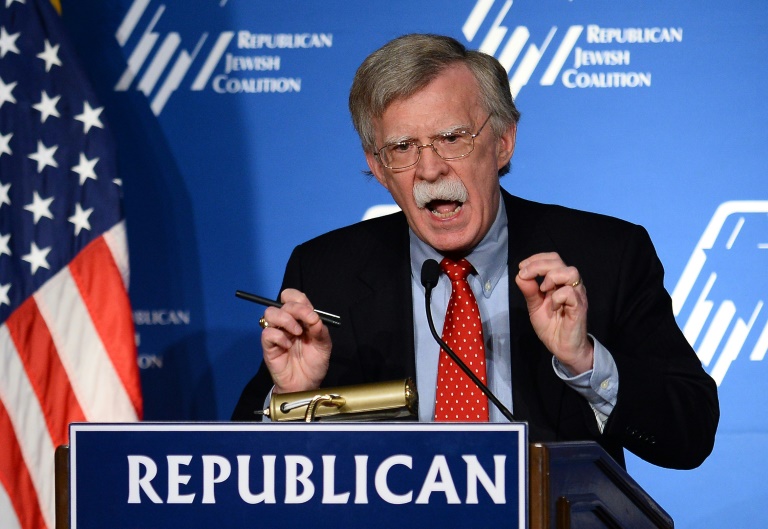
Former US national security advisor John Bolton admitted on television Tuesday that he has helped plan coups in other countries, while arguing that the January 6, 2021 riot in Washington fell short of such efforts.

The attack on the US Capitol was the result of then-president Donald Trump “just stumbling around from one idea to another,” Bolton told CNN’s Jake Tapper.

“As somebody who has helped plan coups d’etat, not here, but, you know, other places, it takes a lot of work,” he said.

Bolton — who served as Trump’s national security advisor from 2018 to 2019 — did not specify which governments he had helped to overthrow, but while in his post, he advocated for US military intervention in Venezuela.

January 6 was “not an attack on our democracy. It’s Donald Trump looking out for Donald Trump. It’s a once in a lifetime occurrence,” said Bolton.

“Ultimately, he did unleash the rioters at the Capitol. As to that, there’s no doubt. But not to overthrow the Constitution, to buy more time, to throw the matter back to the states, to try and redo the issue,” he added.

An unabashed hawk, Bolton served in the US Departments of Justice and State during three Republican administrations, starting with Ronald Reagan’s in the 1980s.

He served as the US ambassador to the United Nations under former president George W. Bush, and for decades has been recognizable by his large white mustache. 

Bolton unrepentantly pushed for the US invasion of Iraq and has voiced support for bombing Iran and North Korea — an interventionist approach to foreign policy that put him at odds with Trump, who fired him in 2019.

Bolton’s comments on the January 6 riots came as a congressional committee works to determine whether Trump or his associates had a role in planning or encouraging the violent insurrection that left at least five people dead and 140 police officers injured.

On Tuesday, lawmakers said a tweet by then-president Trump promising a “wild” January 6 rally was seen as a “call to arms” by members of right-wing militia groups and other supporters of the president who went on to assault the US Capitol.

US prosecutor says Polanski case transcripts can be unsealed

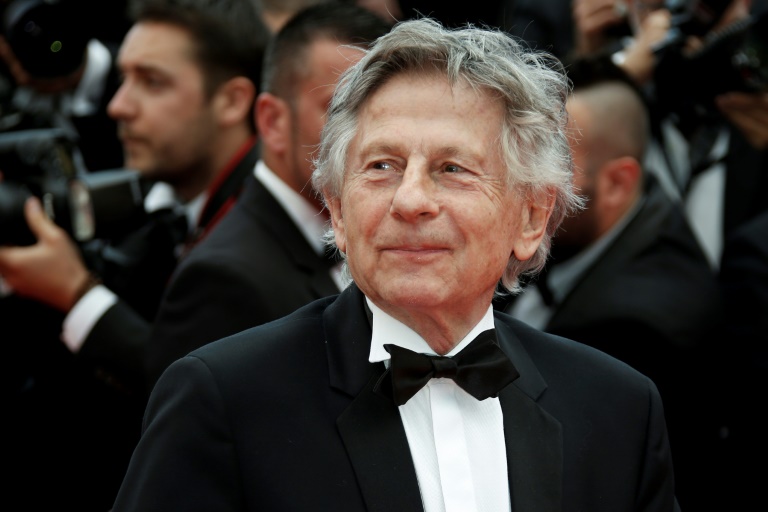
Los Angeles prosecutors said Tuesday they will no longer oppose the release of sealed transcripts in the statutory rape case against Roman Polanski — documents which the fugitive director has previously argued could reveal judicial misconduct.

George Gascon, the Los Angeles County district attorney, said his office had “determined it to be in the interest of justice to agree to the unsealing of these transcripts.”

“This case has been described by the courts as ‘one of the longest-running sagas in California criminal justice history,'” said Gascon in a statement. 

“For years, this office has fought the release of information that the victim and public have a right to know.”

While it is not known what exactly the transcripts contain, they include testimony by former Deputy District Attorney Roger Gunson, the first prosecutor to handle Polanski’s case.

In 1977, French-Polish director Polanski was arrested after 13-year-old Samantha Gailey accused him of plying her with drugs and champagne and forcibly sodomizing her.

Seeking to spare the child a trial, prosecutors dropped the most serious charges in a plea deal, with Polanski accepting guilt for unlawful sexual intercourse with a minor.

He served 42 days in prison while undergoing psychiatric evaluation.

When it appeared that the judge, Laurence Rittenband, was set to reconsider and hand down a much lengthier prison sentence, Polanski fled to France, where he still resides.

The “Rosemary’s Baby” and “Chinatown” director has not returned to the United States since, and has been engaged in a decades-long cat-and-mouse game with officials seeking his extradition, before a global audience split between continuing outrage and forgiveness for his acts.

According to Gascon’s statement, Polanski first requested the transcripts be unsealed “several years ago” in order to “conduct an investigation into alleged judicial misconduct.”

Gascon also described the circumstances in which Polanski was initially treated by prosecutors as “extraordinary” and added that his office was committed to “transparency and accountability for all in the justice system.”

The Hollywood Reporter said the new request to see the transcripts came not from Polanski, but from two journalists. 

Gailey publicly forgave Polanski in 1997, and said her treatment by the press and judicial system were worse than the original crime.

She has also previously called for the transcripts to be unsealed.

But Gascon’s statement concludes: “Polanski remains a fugitive from justice and should surrender himself to the Los Angeles County Superior Court to be sentenced.”

In more recent years, Polanski — now 88 — has also been accused of other historic sex crimes by different women.

He denies the allegations, for which the statute of limitations has expired.

Mattel unveils Jane Goodall Barbie, complete with chimp

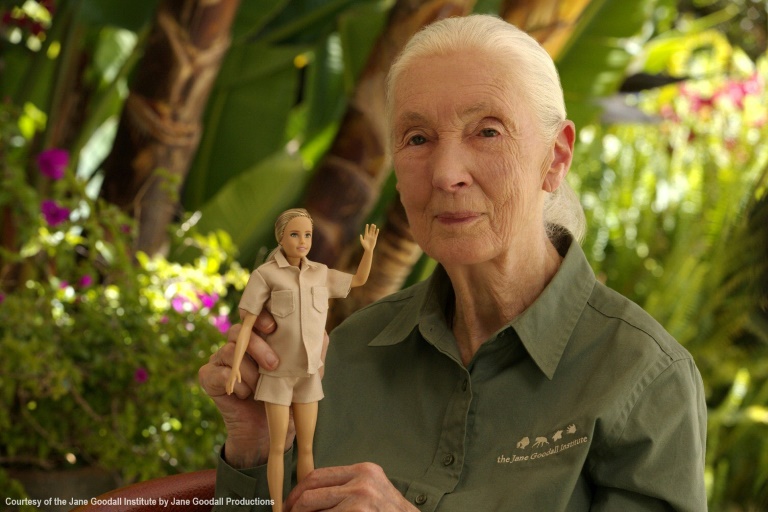
American toy manufacturer Mattel has unveiled new specialty Barbie dolls modeled after the famous English primatologist Jane Goodall and her beloved research specimen, a chimpanzee named David Greybeard.

The Goodall doll, which Mattel says will be partly made with recycled plastic, sports the researcher’s classic beige collared shirt and shorts, as well as a pair of binoculars and a blue notebook.

David Greybeard was the chimpanzee on whom Goodall wrote her initial research papers, which documented for the first time the species’ usage of tools. 

“I’d been suggesting it for a long time that girls don’t want just to be film stars and things like that,” said Goodall in a promotional video.

“Many of them, like me, want to be in the out in nature studying animals.”

The new Barbie is the latest in a series of dolls Mattel has dedicated to feminist or other inspirational icons.

Before Goodall, the toy-maker had produced dolls modeled off tennis star Naomi Osaka, the co-creator of AstraZeneca’s Covid vaccine, Sarah Gilbert, and an anonymous female “robotics engineer.”

“My heroes, my models were Tarzan, Dr. Dolittle,” said Goodall.

“There weren’t women doing the kind of things I wanted to do… so in all my dreams, I was a man.”

To all the little girls who like her would like to be changemakers, the primatologist recommends to “go for a walk in nature, learn to love it and then protect it.”

Close Bitnami banner
Bitnami