AFP

Supply risks still haunt market despite high oil prices: IEA

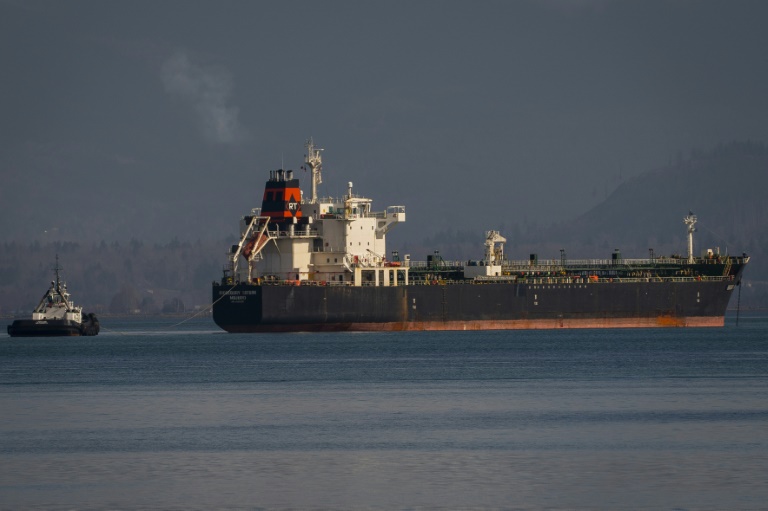
High oil prices have yet to dampen demand which is set to continue rising and may soon outstrip supply, the International Energy Agency warned Wednesday.

It cautioned that the global economic recovery could be derailed unless governments take measures to reduce consumption and fuel prices that pose a threat to stability in some nations.

“Without strong policy intervention on energy use, risks remain high that the world economy falls off-track for recovery,” the Paris-based agency that advises industrialised nations on energy policy said in its latest monthly report on oil markets.

Oil prices have surged from around $80 per barrel earlier this year to over $120 at times as Russia’s invasion of Ukraine has sparked supply concerns and the reopening of China’s economy from Covid lockdowns has boosted demand.

If high petrol prices have started to dent demand in industrialised nations, the IEA said this has been counterbalanced by larger-than-expected rebounds in demand by China and some emerging and developing nations.

The IEA now expects oil demand to rise this year to 99.2 million barrels per day (mbd) and to 101.3 mbd next year.

Meanwhile, supply climbs to 100.1 mbd this year. But even if it hits an expected record of 101.1 mbd next year, it will fall below demand.

The IEA noted that the world has little spare capacity to increase production, with the combined buffer of Saudi Arabia and the United Arab Emirates set to fall to just 2.2 mbd in August.

It said the production of OPEC+ nations could even fall next year if Russia’s supply is impacted as expected by tightening international sanctions.

Coupled with tight refinery margins causing imbalances in certain product markets and putting upward pressure on prices, “it may be up to demand side measures to bring down consumption and fuel costs that pose a threat to stability, most notably in emerging markets,” the IEA said.

It added the strengthening of the dollar versus other currencies as the US Federal Reserve hikes interest rates has compounded the pain of already rising import costs for food and oil for numerous developing and emerging nations, including Sri Lanka which has been gripped by social unrest.

Asian stocks, crude bounce from losses but recession fears linger

Asian stockswere mixed Wednesday as trader struggled to recover some of the losses suffered at the start of the week, while oil bounced from a rout, though recession alarms continue to ring loud.

The euro clawed its way back slightly after hitting parity with the dollar for the first time in two decades, though it remains under pressure from growing concerns about an energy crisis across the eurozone and the European Central Bank’s slower pace of monetary tightening.

Traders are also awaiting the release of a series of key indicators this week, including the all-important consumer price index later Wednesday, with expectations for another increase to a fresh 41-year high.

Another big spike in prices will reinforce the Federal Reserve’s determination to lift interest rates 75 basis points for a second successive month in July, adding to concerns that officials could go too far and tip the economy into recession.

Still, Lauren Goodwin of New York Life Investments said policymakers were unlikely to shift from their hawkish tilt for now.

“This is widely expected to be a really strong print,” she told Bloomberg Television.

“Even if it is not, I don’t think that changes the Fed’s perspective in a couple of weeks. We won’t have enough evidence that inflation is convincingly turning over.”

In a further sign of the pressure being felt around the world from surging prices, the New Zealand and South Korean central banks each lifted rates 0.5 percentage points Wednesday, the first such increase by Seoul since 1999. 

After losses on Wall Street, Asian equities were mixed. Shanghai edged up after data showed a forecast-beating jump in Chinese exports, while there were also gains in Tokyo, Sydney, Seoul, Wellington and Taipei.

However, Hong Kong was unable to hold earlier gains, while Singapore, Manila and Jakarta and Mumbai were in the red.

London fell despite data showing the UK economy unexpectedly saw growth last month. Paris and Frankfurt also fell. 

– Europe gas crisis –

Stephen Innes at SPI Asset Management said equities could continue to struggle owing to a perfect storm of crises engulfing trading floors.

“Typically, equity markets can deal with one risk relatively well,” he said in a note. “But the current setup of sticky inflation, rapid Fed tightening, growth/recession risks and excessive rates volatility, to name a few, have at times left investors defenceless. 

“And with the market coalescing to a bearish consensus, stocks are having trouble sustaining a meaningful rally.”

Both main crude contracts rose but were and nowhere near recovering the more than seven percent drops suffered Tuesday, hit by bets on a drop in demand and fears of more Covid-19 lockdowns in Shanghai.

The commodity has lost a large chunk of the gains seen after Vladimir Putin’s invasion of Ukraine, despite bans on imports from Russia, with some analysts saying consumers were simply choosing not to buy fuel because of the high price.

Data from the American Petroleum Institute showed US stockpiles rose 4.76 million barrels last week, Bloomberg News reported citing people familiar with the figures, indicating demand slacking off even during the key summer driving season.

Joe Biden’s visit to Saudi Arabia on Friday will be followed intently as he tries to persuade the crude giant to pump more to help reduce prices.

On currency markets, the euro held just above $1.0 a day after hitting parity on Tuesday for the first time since late 2022, with a worsening energy crisis fanning expectations that the eurozone will plunge into recession.

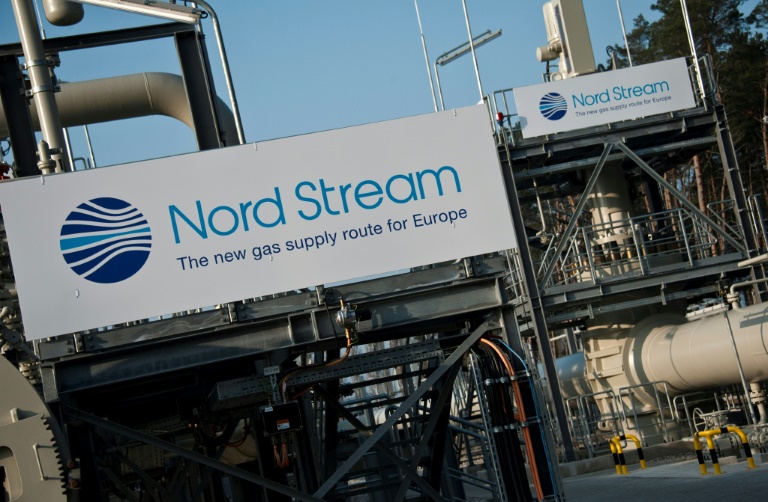
With Russian energy giant Gazprom starting 10 days of maintenance Monday on its Nord Stream 1 pipeline, the bloc — and particularly gas-reliant Germany — is waiting nervously to see if the taps are turned back on.

“A prolonged cut to the gas supply would halt a lot of economic activity, sending (Germany) deep into recession,” said Tapas Strickland at National Australia Bank.

He said July 21 — when the gas should be switched back on — will be a crucial date.

“That date also happens to be the day of the next ECB meeting,” he added. “Either of these events are key risk events. Russia playing gas politics by not switching on the gas supply would likely see the euro lurch much lower.”

– Key figures at around 0810 GMT –

Tokyo – Nikkei 225: UP 0.5 percent at 26,478.77 (close)

Hong Kong – Hang Seng Index: DOWN 0.2 percent at 20,797.95 (close)

Shanghai – Composite: UP 0.1 percent at 3,284.29 (close)

London – FTSE 100: DOWN 0.9 percent at 7,143.57

Euro/dollar: DOWN at $1.0035 from $1.0037 Tuesday

Pound/dollar: UP at $1.1912 from $1.1889 

Euro/pound: DOWN at 84.27 pence from 84.40 pence

Dollar/yen: UP at 137.07 yen from 136.84 yen

West Texas Intermediate: UP 0.9 percent at $96.74 per barrel

Brent North Sea crude: UP 1.0 at $100.51 per barrel

New York – Dow: DOWN 0.6 percent at 30,981.33 (close)

Fukushima operator ex-bosses ordered to pay $95 bn: media

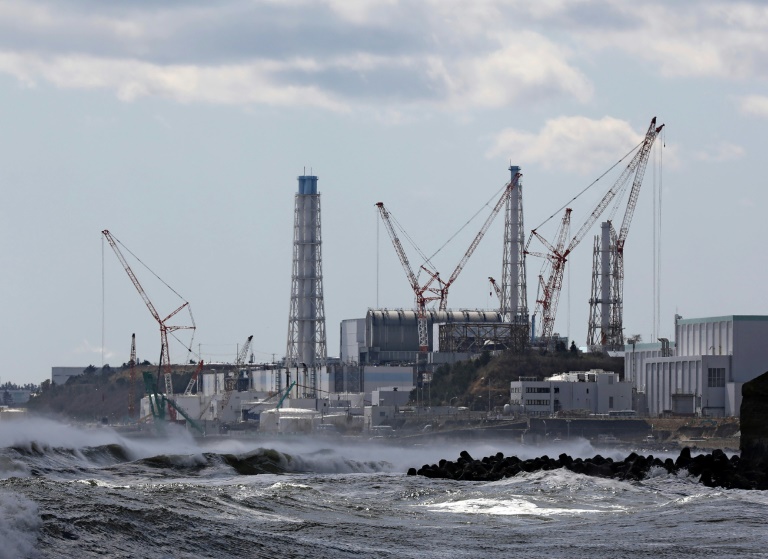
A Tokyo court Wednesday ordered former executives from the operator of the Fukushima nuclear plant involved in the 2011 disaster to pay around 13 trillion yen ($94.8 billion) in damages, local media said.

Four ex-bosses of Tokyo Electric Power Company (TEPCO) were ordered to pay the damages in a suit brought by shareholders over the nuclear disaster triggered by a massive tsunami.

Plaintiffs emerged from the Tokyo court holding banners reading “shareholders win” and “responsibility recognised.”

Hiroyuki Kawai, a lawyer representing shareholders, said when the suit was filed that senior managers at TEPCO must be made to pay.

“Warnings have to be issued that, if you make wrong decisions or do wrong, you must compensate with your own money,” he told a press conference in 2012.

“You may have to sell your house. You may have to spend your retirement years in misery. In Japan, nothing can be resolved and no progress can be made without assigning personal responsibility.”

The shareholders argued that the disaster could have been prevented if TEPCO bosses had listened to research and carried out preventative measures like placing an emergency power source on higher ground.

But officials argued the studies they were presented were not credible and risks could not have been predicted.

In a statement read to AFP by a TEPCO spokesman, the firm said: “we again express our heartfelt apology to people in Fukushima and members of the society broadly for causing trouble and worry” with the disaster.

But it declined to comment on the ruling, including whether there would be any appeal.

Three of the Fukushima Daiichi nuclear plant’s six reactors were operating when a massive undersea quake triggered a devastating tsunami on March 11, 2011.

They went into meltdown after their cooling systems failed when waves flooded backup generators.

The accident was the worst nuclear disaster since Chernobyl and prompted the declaration of an evacuation zone around the plant.

Tens of thousands of residents around the Fukushima plant were ordered to evacuate their homes, or chose to do so.

Around 12 percent of the Fukushima region was once declared unsafe but no-go zones now cover around two percent, although populations in many towns remain far lower than before.

TEPCO has been pursued in the courts by survivors of the disaster as well as shareholders, and six plaintiffs this year took the firm to court over claims they developed thyroid cancer because of radiation exposure.

In 2019, a court acquitted three former TEPCO officials in the only criminal trial to stem from the disaster.

They had faced up to five years in prison if convicted of professional negligence resulting in death and injury, but the court ruled that they could not have predicted the scale of the tsunami that triggered the disaster.

TEPCO is currently engaged in a decades-long effort to decommission the plant, a costly and difficult process.

No one was killed in the nuclear meltdown, but the tsunami left 18,500 dead or missing.

Western Europe wilts under second heatwave in weeks

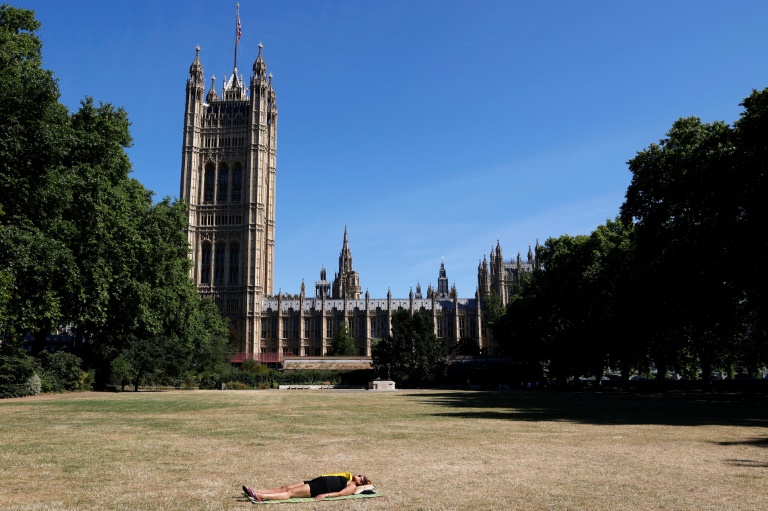
France and Britain were set to suffer soaring temperatures on Wednesday, with a heatwave in Western Europe fuelling wildfires across vast stretches of forestland.

Since Sunday, large parts of the Iberian Peninsula have seen temperatures surpassing 40 degrees Celsius (104 Fahrenheit) in Spain and Portugal, where firefighters have battled wildfires.

In southern France since Tuesday afternoon, a wildfire ripped through 800 hectares of pine trees just south of Bordeaux, pushing 150 residents to evacuate their homes, according to the local fire department.

And near the Dune of Pilat — Europe’s tallest sand dune — another fire consumed about 180 hectares of old pine trees, authorities said. 

About 6,000 campers near the dune were evacuated overnight as a precautionary measure, fire department official Lieutenant Colonel David Annotel told local news channel BFMTV.

Firefighters worked through the night on the sandy terrain to “cut the head off the fire”, an official told AFP, adding that the blaze had been contained. 

Prime Minister Elisabeth Borne has called on government ministers to be ready to deal with the consequences of the heatwave, which is forecast to last for up to 10 days.

“The heat affects people’s health very quickly, especially that of the most vulnerable,” her office said in a statement.

Heatwaves have become more frequent due to climate change, scientists say. As global temperatures rise over time, they are expected to become more intense.

The previous such phenomenon to blight France, Portugal and Spain occurred in mid-June.

“We do expect it to worsen,” World Meteorological Organization spokeswoman Clare Nullis told a briefing in Geneva on Tuesday.

“Accompanying this heat is drought. We’ve got very, very dry soils,” she said.

She added that despite being early in the summer, “it’s been a very bad season for the glaciers”. 

Last week an avalanche triggered by the collapse of the largest glacier in the Italian Alps — due to unusually warm temperatures — killed 11 people.

– ‘Oppressive’ temperatures –

The high temperatures are expected to spread to other parts of western and central Europe in the coming days.

Britain issued an “amber” alert — the second-highest of three levels — which indicates that the extreme heat will have a “high impact” on daily life and people. Temperatures are forecast to hit 35C in the southeast of the country in the coming days.

Britain’s highest recorded temperature was on July 25, 2019 — reaching 38.7C at Cambridge Botanic Garden, in eastern England — and a UK climate official said that the chances of a new UK record were increasing due to “strongly embedded warming”.

In Spain, temperatures are forecast to keep rising until Thursday, with highs of up to 44C expected in Guadalquivir valley in Seville in the south.

Spain’s health ministry warned the “intense heat” could affect people’s “vital functions” and provoke problems like heatstroke. It advised people to drink water frequently, wear light clothes and “remain as long as possible” in the shade or in air-conditioned places.

But for those who make a living working outdoors, it was a struggle.

“It’s hard because the temperature is a bit oppressive,” said Miguel Angel Nunez, a 54-year-old bricklayer at a construction site in central Madrid.

In its eastern region of Extremadura, some 300 firefighters backed by 17 planes and helicopters battled a wildfire Tuesday which ravaged 2,500 hectares (6,180 acres), local officials said.

The blaze began Monday due to a lightning strike and “will probably last several days”, the head of the regional government of Extremadura, Guillermo Fernandez Vara, told reporters.

Between January 1 and July 3, more than 70,300 hectares of forest went up in smoke in Spain, the government said — almost double the average of the last ten years.

– ‘A maximum of caution’ – 

Firefighters in neighbouring Portugal were combating a similar inferno, which torched some 2,000 hectares of land in the central municipality of Ourem since last week. 

The blaze was brought under control Monday but flared up again by Tuesday.

With temperatures set to climb past 40C, Portuguese Prime Minister Antonio Costa urged “a maximum of caution”.

“We have experienced situations like this in the past and we will certainly experience them in the future,” he said.

The whole country is under a “situation of alert” for wildfires until at least Friday, raising the readiness levels of firefighters, police and emergency medical services.

The current inferno is stirring memories of devastating wildfires in 2017, which claimed the lives of over 100 people in Portugal.

Officials in the town of Sintra near Lisbon closed a series of tourist attractions such as palaces and monuments in a verdant mountain range popular with visitors as a precaution.

burs-dhc/gw

Tour de France environment protest reaches global audience

When French environmental campaigners “Dernier Renovation” briefly halted the Tour de France in the Alps on Tuesday, they hooked into a global audience with sport becoming an increasingly popular medium for viral stunts by protestors.

Climate activists “Just stop Oil” garnered a great deal of publicity at the British Grand Prix Silverstone circuit in July while, others have also glued themselves to artistic treasures from the likes of Vincent van Gough.

But sports appears to reach more people and some estimates say the Tour de France, over the 21 stages, reaches up to 3.5 billion viewers across the 190 countries in which it is broadcast.

Broadcasters cut away to a view of the Alps where holiday crowds were enjoying a sunny day out in 24 degrees Celsius (75 degrees Fahrenheit) temperatures for the 15 minutes or so that the Tour de France stage 10 was held up.

But the protest has gone viral.

The same group members who sat on the road between the ski resort Les Ports du Soliel to the altiport of Megeve, recently interrupted the French tennis Open at Roland Garros in June.

“Alize”, as she was identified at the time of the May protest, chained her neck to the net and knelt on the iconic red clay, also reaching a huge audience.

With the group’s name written at neck level on her white T-shirt bearing the simple and powerful slogan written in English, not French “We have 1028 days left”, the images reached a global platform.

On Tuesday the same woman chained herself by the neck to a fellow protester, her T-shirt bearing the same slogan but this time adding a sense of the clock ticking — “We have 989 days left”.

Identified as “Alice, 32” on the group’s website, the protester explained her action, and her words have reached a global audience.

“I would prefer not to have had to do this,” she says, explaining she would rather have been with her grandfather watching the Tour on the television from his sofa.

– Emily Davidson to Colin Kaepernick –

She goes on to predict a dystopian future without a Tour de France before finishing her message by stating she “decided instead to react and help avoid human suffering and create a new world. Everything can change”.

There is consensus in France that by fighting against the Tour de France, publicity can be attained — but that it is so popular that movements risk damaging their reputations.

Green politics is growing fast and the narrative of a concerned young woman wanting to watch the Tour with her grandfather, likely bridged a generation gap.

The 23-year-old cyclist Fred Wright of the Bahrain Victorious team was part of the small escape group of riders that first encountered the clutch of youthful campaigners.

“You know that almost straight away. They’re protesting about a good thing,” he said, before adding: “But it’s not great when it’s in front of the Tour de France.”

The 2018 Tour champion Geraint Thomas said he’d seen the protesters “getting dragged away” in reference to a farmers protest during his title-winning campaign.

“At least we didn’t get pepper sprayed this time,” he said.

From the Black Power salute at the Mexico Olympics in 1968 to the NFL take a knee protest for Black Lives Matter in 2016 sports protests have an established legacy in the struggle against racism.

Gender equality campaigners have also successfully used sports to get their message across, with equal pay a topical issue. 

Historically, suffragette Emily Davison was trampled and killed at the English horse race the Derby way back in 1913, but gained lasting publicity for her movement.

Now environmentalists are following a well-established path in pursuit of change.

Panama protests continue despite fuel and food price cuts

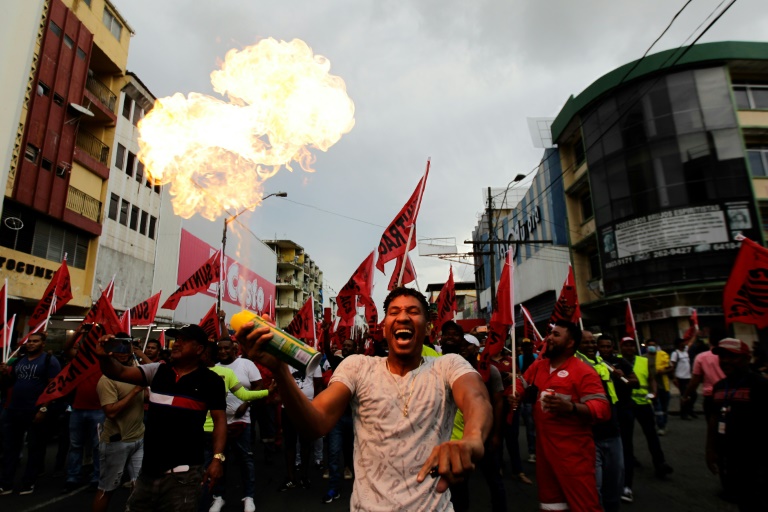
Thousands of Panamanians took to the street again on Tuesday to protest rising inflation and government corruption, despite the announcement of price cuts for fuel and some food products.

The demonstrations, called for by the Central American country’s numerous unions, have lasted for two weeks and resulted in some main highways being closed.

President Laurentino Cortizo announced Monday that the price of gasoline for private vehicles will be reduced to $3.95 per gallon from July 15, a drop of 24 percent from the price at the end of June.

He also announced that his government would draft a decree to freeze the prices of a dozen essential food products. 

But several unions say that protests will continue until there is a general reduction in prices and gasoline rates drop below $3 per gallon.

Protesters in Panama City marched Tuesday from the central Porras Park to the heavily guarded National Assembly building.

Many carried Panamanian flags and banners with messages such as “Corruption embezzled my nation”, “We want honest governors” or “Where is the money?”

“The cost of living is what has the people in the streets,” protester Sergio Gallegos, an Indigenous man from the Ngabe-Bugle region, told AFP.

In La Chorrera, a town west of the capital, protesters marched on the Inter-American Highway, the main artery linking Panama with the rest of Central America.

Security minister Juan Pino made a “call for sanity” on Tuesday, so that “social peace” prevails over “any differences.”

The protests have stoked fears in the government and business sector that the country could see a drop in economic activity, or impacts on the tourism industry.

In Ecuador, 18 days of mass protests against high fuel prices last month cost the country over $1 billion, according to its central bank.

China growth slumps on virus lockdowns, real estate woes: poll

China’s economic expansion slumped in the second quarter to levels not seen since early 2020, an AFP poll of analysts found, owing to painful Covid lockdowns and lingering weakness in the real estate sector.

Leaders of the world’s second-biggest economy remain firmly wedded to a zero-Covid approach of stamping out clusters as they emerge, but the fallout has sapped growth and is pushing policymakers’ annual target of around 5.5 percent out of reach.

The slowdown comes after the country’s biggest city Shanghai was sealed off for two months over a virus resurgence — snarling supply chains and causing factories to shut — while dozens of others grappled with tightened rules to fight local outbreaks.

Gross domestic product is estimated to have expanded 1.6 percent on-year in April-June, according to the AFP poll of experts from 12 financial institutions.

Several analysts expect the economy to shrink on a quarterly basis — a first since 2020 at the height of the pandemic.

According to key gauges, activity in both the services and manufacturing sectors contracted in April and May, said Rabobank senior macro strategist Teeuwe Mevissen.

China’s property sector, an important economic driver, was also “still in limbo”, while lockdowns have severely hit supply and demand, he told AFP.

New home sales for the top 100 developers was 43 percent down on-year in June, according to China Real Estate Information Corporation data, with Nomura analysts adding that metro passenger trips in major cities remained below 2021 levels.

China has only logged a GDP contraction once in recent decades, and analysts expect the latest reading will drag full-year growth to around four percent, slashing earlier estimates.

Economists have long questioned the accuracy of official Chinese data, suspecting that figures are massaged for political reasons. 

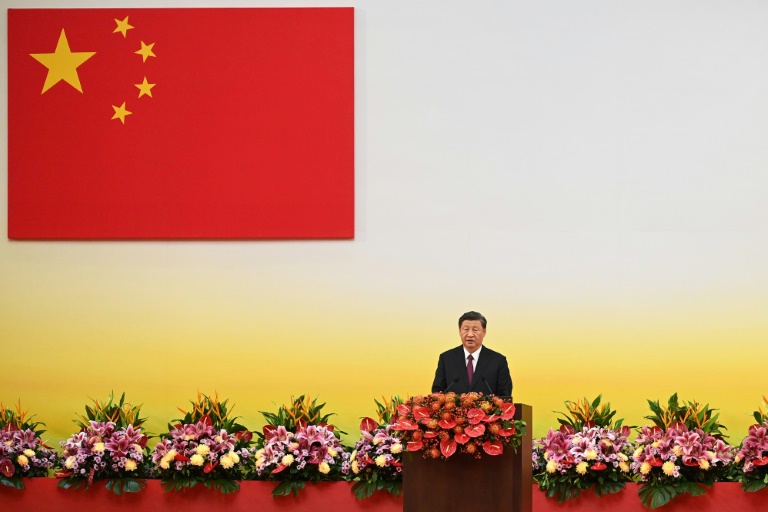
And Friday’s official release will be closely watched as the Communist Party gears up for its 20th Congress when Xi Jinping is expected to be given another five-year term as president.

– Zero-Covid vs growth –

China’s policymakers want both zero-Covid and growth, an aim made clear during April’s Politburo meeting, said Macquarie economist Larry Hu in a recent report.

Authorities have vowed efforts to meet this year’s target, a goal reiterated by Xi last month, and leaders will likely “decide whether to double down or back down” in July, Hu said.

“Rhetorically, policymakers are unlikely to drop the name of ‘zero-Covid’ any time soon. That said, they could still redefine ‘zero-Covid’ to make it less and less disruptive to the economy,” he added.

Last Thursday, Premier Li Keqiang said the foundations for China’s recovery are “still unstable” and called for more work to stabilise the economy.

And “multiple uncertainties” also surround the latest rebound, said ANZ Research in a report.

Besides unexpected Covid outbreaks which could trigger more restrictions on movement, “a slowdown in the US economy and the Fed’s hiking moves may cloud the outlook for China’s exports,” ANZ added.

Domestically, consumer inflation climbed in June to the highest in two years as pork prices spiked, official data showed Saturday, threatening relative stability from a global surge in food prices.

China’s economy has started to recover after lockdown restrictions were lifted in Shanghai from June 1, said Oxford Economics’ lead economist Tommy Wu.

But even if future outbreaks are less disruptive as authorities fine-tune their strategies, “pressure on consumption will likely persist”, he added.

This week, an auto industry association downgraded its 2022 sales forecast on weaker demand.

“Consumer sentiment is unlikely to turn sanguine as strict mobility restrictions will be imposed even when the number of Covid cases in a small neighbourhood is very low,” Wu added.

Biden heads to Middle East for first tour as president

US President Joe Biden lands in the Middle East on Wednesday for a trip that will see Israeli leaders urge tougher action against Iran, before a delicate stop in Saudi Arabia.

The 79-year-old president’s visit to Jeddah on Friday will be the focus of the tour, after Biden branded Saudi Arabia a “pariah” over the 2018 murder of dissident Saudi journalist and US resident Jamal Khashoggi.

Air Force One — which has left the United States and is expected to land at 1230 GMT in Tel Aviv — will also make an unprecedented direct flight between the Jewish state and the conservative Gulf kingdom that does not recognise its existence.

Before that, Biden will meet Israeli leaders seeking to broaden cooperation against Iran, and Palestinian leaders frustrated by what they describe as Washington’s failure to curb Israeli aggression.

The persistent frustrations of Israeli-Palestinian diplomacy are nothing new for Biden, who first visited the region in 1973 after being elected to the Senate. 

Iran and Israel were allies then, but the Jewish state now considers Tehran its top threat.

Israel’s caretaker Prime Minister Yair Lapid, who took office less than two weeks ago, has said talks “will focus first and foremost on the issue of Iran.”

–  Jerusalem to Bethlehem –

Moments after Biden touches down, Israel’s military will show him its new Iron Beam system, an anti-drone laser it claims is crucial to countering Iran’s UAV fleet. 

Israel insists it will do whatever is necessary to thwart Iran’s nuclear ambitions, and is staunchly opposed to a restoration of the 2015 deal that gave Tehran sanctions relief.

Israel says it is raising 1,000 flags across Jerusalem to welcome the US leader, who has not reversed former president Donald Trump’s controversial decision to recognise the city as the capital of the Jewish state.

Palestinians claim Israeli-annexed east Jerusalem as their capital and, ahead of the visit, have accused Biden of failing to make good on his pledge to restore the United States as an honest broker in the conflict.

“We only hear empty words and no results,” said Jibril Rajoub, a leader of the secular Fatah movement of Palestinian president Mahmud Abbas.

Biden will meet Abbas in the occupied West Bank city of Bethlehem on Friday, but there is no expectation of bold announcements towards a fresh peace process, meaning the visit may merely deepen Palestinian frustration.

Israel is also mired in political gridlock ahead of elections on November 1, the fifth vote in less than four years.

– Normalisation steps?  –

US-Palestinian ties have recently been strained by the May killing of prominent Al Jazeera reporter Shireen Abu Akleh while she was covering an Israeli army raid in the occupied West Bank.

The United Nations has concluded the Palestinian-American national was killed by Israeli fire, something Washington found was likely but said there was no evidence the killing was intentional.

Abu Akleh’s family has voiced “outrage” over the Biden administration’s “abject response” to her death, and the White House has not commented on their request to meet the president in Jerusalem.

Biden’s trip to Saudi Arabia is seen as part of efforts to stabilise oil markets rattled by the war in Ukraine, by re-engaging with a country that has been a key strategic ally of the United States for decades and a major supplier of the fuel.

But Israel hopes the visit will also signal the start of diplomatic ties between the country and Riyadh.

Israel expanded its regional reach with US backing in 2020, when it formalised ties with the United Arab Emirates, Bahrain and Morocco — breakthroughs that came after its peace accord with Jordan, in 1994, and Egypt in 1979.

While there is no expectation of Saudi Arabia recognising the Jewish state in the immediate future, a senior Israeli official said Tuesday that Biden’s visit marked an important step. 

Western Europe wilts under second heatwave in weeks

France and Britain were set to suffer soaring temperatures on Wednesday, with a heatwave in Western Europe fuelling wildfires across vast stretches of forestland.

Since Sunday, large parts of the Iberian Peninsula have seen temperatures surpassing 40 degrees Celsius (104 Fahrenheit) in Spain and Portugal, where firefighters have battled wildfires.

In southern France since Tuesday afternoon, a wildfire scorched through 800 hectares of pine trees just south of Bordeaux, pushing 150 residents to evacuate their homes, according to the local fire department.

And near the Dune of Pilat — Europe’s tallest sand dune — another fire consumed about 180 hectares of old pine trees, authorities said. 

Firefighters are working through the night on the sandy terrain to “cut the head off the fire”, an official told AFP, adding that the blaze has been contained. 

Prime Minister Elisabeth Borne has urged all government ministers to be ready to deal with the consequences of the heatwave, which is forecast to last for up to 10 days.

“The heat affects people’s health very quickly, especially that of the most vulnerable,” her office said in a statement.

Heatwaves have become more frequent due to climate change, scientists say. As global temperatures rise over time, they are expected to become more intense.

The previous such phenomenon to blight France, Portugal and Spain occurred in mid-June.

“We do expect it to worsen,” World Meteorological Organization spokeswoman Clare Nullis told a briefing in Geneva on Tuesday.

“Accompanying this heat is drought. We’ve got very, very dry soils,” she said.

She added that despite being early in the summer, “it’s been a very bad season for the glaciers”. 

Last week an avalanche triggered by the collapse of the largest glacier in the Italian Alps — due to unusually warm temperatures — killed 11 people.

– ‘Oppressive’ temperatures –

The high temperatures are expected to spread to other parts of western and central Europe in the coming days.

Britain issued an “amber” alert — the second-highest of three levels — which indicates that the extreme heat will have a “high impact” on daily life and people. Temperatures are forecast to hit 35C in the southeast of the country in the coming days.

So far its highest recorded temperature was on July 25, 2019 — reaching 38.7C at Cambridge Botanic Garden, in eastern England — and a UK climate official saying that the chances of a new UK record was increasing due to “strongly embedded warming”.

In Spain, temperatures are forecast to keep rising until Thursday, with highs of up to 44C expected in Guadalquivir valley in Seville in the south.

Spain’s health ministry warned the “intense heat” could affect people’s “vital functions” and provoke problems like heat stroke. It advised people to drink water frequently, wear light clothes and “remain as long as possible” in the shade or in air-conditioned places.

But for those who make a living working outdoors, it was a struggle.

“It’s hard because the temperature is a bit oppressive,” said Miguel Angel Nunez, a 54-year-old bricklayer at a construction site in central Madrid.

In its eastern region of Extremadura, some 300 firefighters backed by 17 planes and helicopters battled a wildfire Tuesday which ravaged 2,500 hectares (6,180 acres), local officials said.

The blaze began Monday due to a lightning strike and “will probably last several days”, the head of the regional government of Extremadura, Guillermo Fernandez Vara, told reporters.

Between January 1 and July 3, more than 70,300 hectares of forest went up in smoke in Spain, the government said — almost double the average of the last ten years.

– ‘A maximum of caution’ – 

Firefighters in neighbouring Portugal were combating a similar inferno, which torched some 2,000 hectares of land in the central municipality of Ourem since last week. 

The blaze was brought under control Monday but flared up again by Tuesday.

With temperatures set to climb past 40C, Portuguese Prime Minister Antonio Costa urged “a maximum of caution”.

“We have experienced situations like this in the past and we will certainly experience them in the future,” he said.

The whole country is under a “situation of alert” for wildfires until at least Friday, raising the readiness levels of firefighters, police and emergency medical services.

The current inferno is stirring memories of devastating wildfires in 2017, which claimed the lives of over 100 people in Portugal.

Officials in the town of Sintra near Lisbon closed a series of tourist attractions such as palaces and monuments in a verdant mountain range popular with visitors as a precaution.

burs-dhc/je

China growth slumps on virus lockdowns, real estate woes: poll

China’s economic expansion slumped in the second quarter to levels not seen since early 2020, an AFP poll of analysts found, owing to painful Covid lockdowns and lingering weakness in the real estate sector.

Leaders of the world’s second-biggest economy remain firmly wedded to a zero-Covid approach of stamping out clusters as they emerge, but the fallout has sapped growth and is pushing policymakers’ annual target of around 5.5 percent out of reach.

The slowdown comes after the country’s biggest city Shanghai was sealed off for two months over a virus resurgence — snarling supply chains and causing factories to shut — while dozens of others grappled with tightened rules to fight local outbreaks.

Gross domestic product is estimated to have expanded 1.6 percent on-year in April-June, according to the AFP poll of experts from 12 financial institutions.

Several analysts expect the economy to shrink on a quarterly basis — a first since 2020 at the height of the pandemic.

According to key gauges, activity in both the services and manufacturing sectors contracted in April and May, said Rabobank senior macro strategist Teeuwe Mevissen.

China’s property sector, an important economic driver, was also “still in limbo”, while lockdowns have severely hit supply and demand, he told AFP.

New home sales for the top 100 developers was 43 percent down on-year in June, according to China Real Estate Information Corporation data, with Nomura analysts adding that metro passenger trips in major cities remained below 2021 levels.

China has only logged a GDP contraction once in recent decades, and analysts expect the latest reading will drag full-year growth to around four percent, slashing earlier estimates.

Economists have long questioned the accuracy of official Chinese data, suspecting that figures are massaged for political reasons. 

And Friday’s official release will be closely watched as the Communist Party gears up for its 20th Congress when Xi Jinping is expected to be given another five-year term as president.

– Zero-Covid vs growth –

China’s policymakers want both zero-Covid and growth, an aim made clear during April’s Politburo meeting, said Macquarie economist Larry Hu in a recent report.

Authorities have vowed efforts to meet this year’s target, a goal reiterated by Xi last month, and leaders will likely “decide whether to double down or back down” in July, Hu said.

“Rhetorically, policymakers are unlikely to drop the name of ‘zero-Covid’ any time soon. That said, they could still redefine ‘zero-Covid’ to make it less and less disruptive to the economy,” he added.

Last Thursday, Premier Li Keqiang said the foundations for China’s recovery are “still unstable” and called for more work to stabilise the economy.

And “multiple uncertainties” also surround the latest rebound, said ANZ Research in a report.

Besides unexpected Covid outbreaks which could trigger more restrictions on movement, “a slowdown in the US economy and the Fed’s hiking moves may cloud the outlook for China’s exports,” ANZ added.

Domestically, consumer inflation climbed in June to the highest in two years as pork prices spiked, official data showed Saturday, threatening relative stability from a global surge in food prices.

China’s economy has started to recover after lockdown restrictions were lifted in Shanghai from June 1, said Oxford Economics’ lead economist Tommy Wu.

But even if future outbreaks are less disruptive as authorities fine-tune their strategies, “pressure on consumption will likely persist”, he added.

This week, an auto industry association downgraded its 2022 sales forecast on weaker demand.

“Consumer sentiment is unlikely to turn sanguine as strict mobility restrictions will be imposed even when the number of Covid cases in a small neighbourhood is very low,” Wu added.

Close Bitnami banner
Bitnami