AFP

Western Europe wilts under fresh heatwave

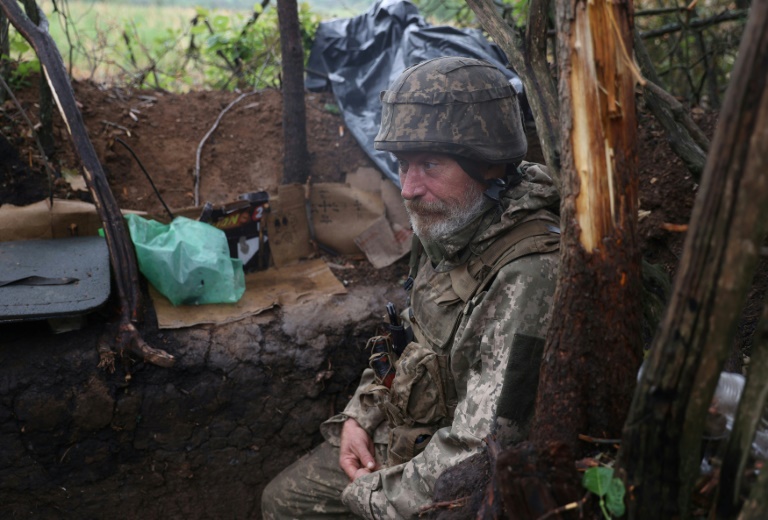
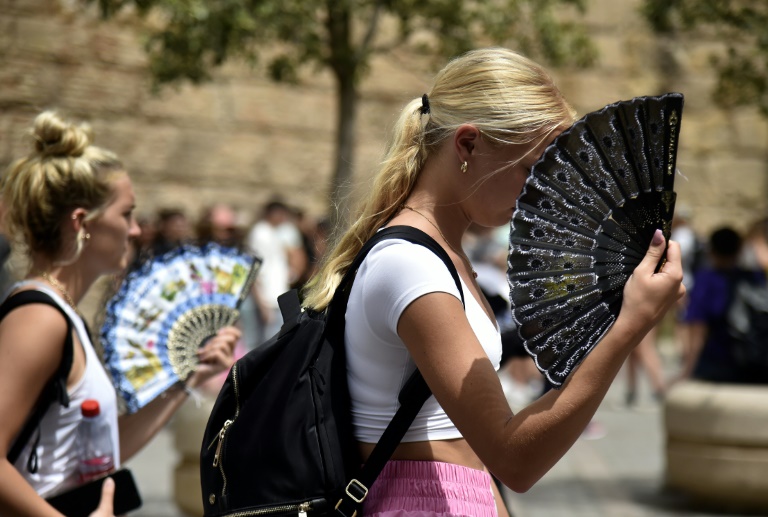
Firefighters battled wildfires in Spain and Portugal Tuesday as Western Europe faced its second heatwave in less than a month which threatened glaciers in the Alps and worsened drought conditions.

The mass of hot air which pushed temperatures above 40 degrees Celsius (104 Fahrenheit) in large parts of the Iberian Peninsula since Sunday was set to spread to the north and east in the coming days.

“We do expect it to worsen,” World Meteorological Organization spokeswoman Clare Nullis told a briefing in Geneva on Tuesday.

“Accompanying this heat is drought. We’ve got very, very dry soils at the moment,” she said.

“The glaciers in the Alps, are really being punished at the moment. It’s been a very bad season for the glaciers. And we’re still relatively early in the summer.”

Last week an avalanche set off by the collapse of the largest glacier in the Italian Alps amid unusually warm temperatures killed 11 people.

Heatwaves have become more frequent due to climate change, scientists say. As global temperatures rise over time, heatwaves are expected to become more intense.

In Spain, some 300 firefighters backed by 17 planes and helicopters were battling a wildfire in the eastern region of Extremadura which has ravaged 2,500 hectares of land, local officials said.

Speaking in parliament, Spanish Prime Minister Pedro Sanchez promised “more resources” for the fight against forest fires that are being fanned by “the climate emergency the planet is going through”.

– ‘It’s hell’ –

Temperatures are forecast to keep rising in Spain until Thursday, with highs of up to 44 Celsius expected in Guadalquivir valley in Seville in the south.

Spain’s health ministry warned the “intense heat” could affect people’s “vital functions” and provoke problems like heat stroke.

It advised people to drink water frequently, wear light clothes and “remain as long as possible” in the shade or in air-conditioned places.

“It’s hell,” said Dania Arteaga, a 43-year-old cleaner in a shop in central Madrid, her forehead covered in sweat.

In neighbouring Portugal, firefighters were battling a blaze which has ravaged some 2,000 hectares (4,900 acres) of land in the central municipality of Ourem since Thursday. 

The blaze has been brought under control on Monday but it flared up again on Tuesday morning.

With temperatures set to surpass 40 Celsius on Tuesday in much of the country, Portuguese Prime Minster Antonio Costa urged “a maximum of caution”.

The government has issued a “situation of alert” for wildfires for the whole country until at least Friday, raising the readiness levels of firefighters, police and emergency medical services.

– ‘Vulnerable people’ –

The current situation is stirring memories of devastating wildfires in 2017 which claimed the lives of over 100 people in Portugal.

Local officials in the town of Sintra near Lisbon closed a series of tourist attractions such as palaces and monuments in a verdant mountain range popular with visitors as a precaution.

In France, temperatures — which reached 30 Celsius in much of the country Monday — could spike to 39 Celsius in some areas Tuesday, the national weather service Meteo France predicted.

Prime Minister Elisabeth Borne urged all government ministers to be ready to deal with the consequences of the heatwave which is forecast to last for up to 10 days.

“The heat affects people’s health very quickly, especially that of the most vulnerable,” her office said in a statement.

Britain issued an extreme heat warning, with temperatures forecast to hit 35 Celsius in the southeast of the country in the coming days.

The extreme heat warning was classified as “amber”, the second-highest alert level, indicating a “high impact” on daily life and people.
Heavy rains flood villages in Russia's climate-hit Far East

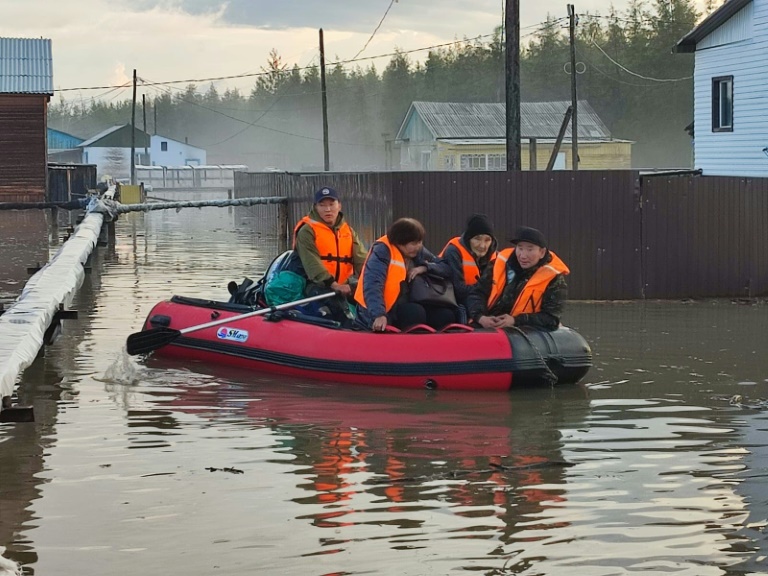
Heavy rainfall has flooded several villages in Yakutia, in Russia’s Far East region, authorities said on Tuesday.

Yakutia has been badly affected in recent summers by extreme weather — including wildfires and floods — that scientists say is linked to climate change.

Such extreme weather events are expected to become even more frequent, more prolonged and more intense in the future.

The government of Yakutia said the rains had broken structures around a dam and left a remote village in Siberia “almost entirely” flooded.

Dozens of people have had to leave their homes, it said. 

“Due to heavy rains on July 11, despite the installation of protective structures, a dam broke and flooded the village of Betenkes almost entirely,” the Yakutia government wrote on the Telegram messaging app.   

The small village lies on the banks of the Adycha River in northeastern Siberia. 

“At 7:00 am this morning, the water level reached a critical 1,000 centimetres (33 feet),” the local government said. 

It said 36 homes had been flooded and more than 100 plots of lands. 

A dozen people were in temporary accommodation, while 72 others were staying with relatives, it added. 

The local government published photos of rescuers on a small boat leading horses through the flooded village, surrounded by wooden houses deep in water.

It also said authorities were working to bring supplies to other flooded villages.  

On Telegram it published a video of a propeller plane being loaded with more than two tonnes of food for flood victims in the remote village of Suordakh, in the western part of Yakutia. 

The plane will then ferry elderly people and children from the village to the regional capital, Yakutsk.

Flooding in recent days has damaged 85 houses in Suordakh, where 317 people live, the authorities said. 

Russian President Vladimir Putin made comments earlier in his rule suggesting scepticism about climate change but has in recent years ordered his government to protect Russia from the effects of changing weather.

Kyiv says hits Russian arms depot, Istanbul announces grain talks

Kyiv said Tuesday it had launched artillery barrages that a destroyed a Russian arms depot and carried out a “special operation” to free military captives in the Moscow-controlled Kherson region.

The bombardments in the south came as the EU green-lit one billion euros in aid for Ukraine and Turkey announced that delegations from Moscow and Kyiv would meet in Istanbul on Wednesday to discuss the resumption of stalled grain deliveries across the Black Sea.

The bombardment overnight in the Kherson region, which Russian forces captured soon after they invaded in late February, were reported as Kyiv tries to claw back territory in the south.

Ukrainian military officials said the strikes had destroyed artillery, armoured vehicles “and a warehouse with ammunition” in Nova Kakhovka.

Russian-backed authorities, however, accused the Ukrainians of damaging civilian infrastructure and killing at least seven people, a toll that could not be independently verified.

“There are no military targets here,” the head of the city’s Moscow-backed administration, Vladimir Leontiev, said on social media.

“Warehouses were hit, as were shops, a pharmacy, petrol stations and even a church,” he added.

Ukrainian military intelligence said separately that its troops had rescued five people in a “special operation” in Kherson, including a military serviceman and former police officer, without specifying when.

– EU financial aid –

The Ukrainian army has for several weeks been waging a counter-offensive designed to recapture Kherson, while Russian troops have focused on trying to capture the entire eastern Donbas region.

The deputy head of the pro-Russian authorities in Kherson, Ekaterina Gubareva, accused Ukraine of having used long-range, precision artillery systems supplied by the United States in the strikes in Nova Kakhovka.

Military analysts are crediting newly arrived systems from the West — including HIMARS from the United States — with attacks deeper in Russian-controlled territory in Ukraine, including on ammunition depots.

EU member states, which have been supplying Ukraine with military support, on Tuesday also approved one billion euros in financial support for Kyiv.

“This will give Ukraine the necessary funds to cover urgent needs and ensure the operation of critical infrastructure,” said Zbynek Stanjura, the finance minister of the Czech Republic, which holds the EU’s rotating presidency.

The United States, however, cautioned Monday that Iran was planning to supply drones with combat weapon capabilities to Russia for use in Ukraine.

Russian forces early Tuesday launched “massive” strikes on the southern Ukrainian city of Mykolaiv, with missiles hitting two medical facilities and residential buildings, the city’s mayor Oleksandr Sienkevych said.

The regional head, Vitaliy Kim, said 12 people were wounded.

– ‘Front getting closer’ –

The heaviest fighting in recent weeks has centred on the industrial east in the Donbas where Moscow’s forces have slowly advanced despite fierce resistance since failing to capture Kyiv after its February 24 invasion.

Ukrainian emergency services said the death toll had risen to 35, two days after Russian bombardment flattened a residential building in the eastern town of Chasiv Yar, in the Donetsk region of the Donbas.

In Bakhmut — one of the few remaining cities under Ukrainian control in the eastern region — AFP journalists could hear nearby artillery fire.

“I’d like to evacuate too but my parents don’t want to. Everyone has gone. I only have one friend left here,” said eight-year-old Sofia, watching around two dozen people gather near the town hall to evacuate further west.

“The front is getting closer,” said municipal offical, Dmytro Podkuyidko, estimating the more than one-third of the town’s esimtated population of 73,000 have fled.

“If it gets worse, I’ll end up leaving too,” Podkuyidko said.

The Kremlin has been working to consolidate its hold over territories it controls like Kherson, both militarily and bureaucratically since the beginning of the conflict.

After Russian President Vladimir Putin on Monday passed a decree fast-tracking Russian passports for all Ukrainians, Foreign Minister Sergei Lavrov was expected Tuesday to open a representative office for separatist authorities in Moscow.

burs-jbr/jm

Iran to supply Russians with UAVs for Ukraine: White House

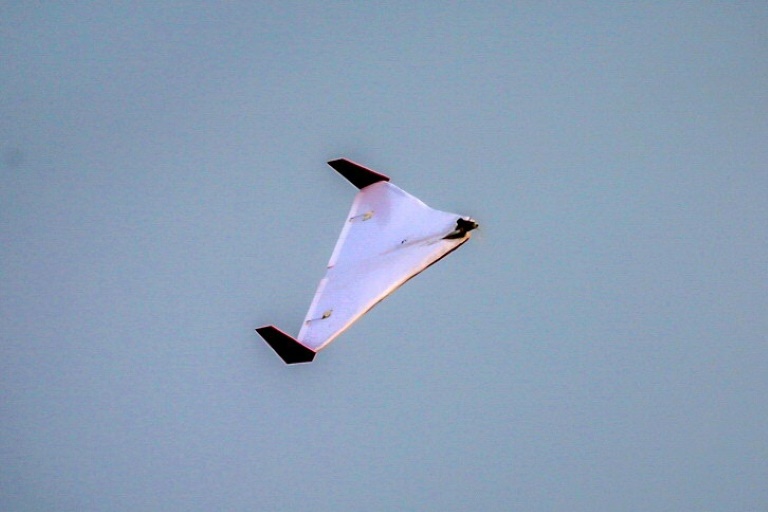
Iran is planning to supply hundreds of drones with combat weapon capabilities to Russia for use in Ukraine, a top US official said Monday.

Jake Sullivan, the White House national security advisor, said the information received by the United States supported views that the Russian military is facing challenges sustaining its weaponry after significant losses in Ukraine.

“The Iranian government is preparing to provide Russia with up to several hundred UAVs (unmanned aerial vehicles), including weapons-capable UAVs, on an expedited timeline,” Sullivan told reporters.

“Our information further indicates that Iran is preparing to train Russian forces to use these UAVs, with initial training sessions slated to begin as soon as early July,” he said.

Iran responded on Tuesday by saying that “no special development” had taken place in technological cooperation with Russia following its invasion of Ukraine in February.

Without specifically mentioning drones, Iran’s foreign ministry spokesman Nasser Kanani said cooperation with Russia “in the field of some modern technologies predates the war in Ukraine, and there has been no special development in that regard recently.”

Tehran’s position regarding the war “is quite clear and has been officially announced many times,” he added.

Iran has maintained that it is against the war in Ukraine and called for a political solution, while blaming the roots of the crisis on the United States and NATO’s expansion.

“The claim of the American official (Sullivan) comes as the US and the Europeans have for years turned the occupying and aggressor countries, including in the West Asia region, into a storehouse of their various deadly weapons,” Kanani added.

Sullivan said it was not clear whether Iran had delivered any of the drones to Russia yet.

He noted that Iran’s drones have been used by the Huthi rebels in Yemen to attack Saudi Arabia.

Drones have played a crucial role on both sides of the war in Ukraine, for everything from firing missiles from a distance, to dropping small bombs on targets, to conducting reconnaissance for artillery forces and ground troops.

Ukraine’s forces have had particular success in using Turkish-made Bayraktar armed combat UAVs, and the United States and other allies have supplied Kyiv with many types of smaller drones.

“From our perspective, we will continue to do our part to help sustain the effective defense of Ukraine and to help the Ukrainians show that the Russian effort to try to wipe Ukraine off the map cannot succeed,” Sullivan said.

James Webb Telescope to release more breathtaking cosmic views

After unveiling the clearest view yet of the distant cosmos, the James Webb Space Telescope has more to come. 

The next wave of images on Tuesday will reveal details about the atmosphere of a faraway gas planet, a “stellar nursery” where stars form, a “quintet” of galaxies locked in a dance of close encounters, and the cloud of gas around a dying star.

They will be published starting from 10:30 am Eastern Time (1430 GMT), in an event live streamed from the NASA Goddard Space Flight Center, just outside Washington.

Targets include Carina Nebula, a stellar nursery, famous for its towering pillars that include “Mystic Mountain,” a three-light-year-tall cosmic pinnacle captured in an iconic image by Hubble.

Webb has also carried out a spectroscopy — an analysis of light that reveals detailed information — on a gas giant planet called WASP-96 b, which was discovered in 2014.

Nearly 1,150 light-years from Earth, WASP-96 b is about half the mass of Jupiter and zips around its star in just 3.4 days.

On Monday, Webb revealed the clearest image to date of the early universe, going back 13 billion years, NASA said Monday.

The stunning shot, released in a White House briefing by President Joe Biden, is overflowing with thousands of galaxies and features some of the faintest objects observed.

Known as Webb’s First Deep Field, it shows the galaxy cluster SMACS 0723, which acts as a gravitational lens, bending light from more distant galaxies behind it towards the observatory, in a cosmic magnification effect.

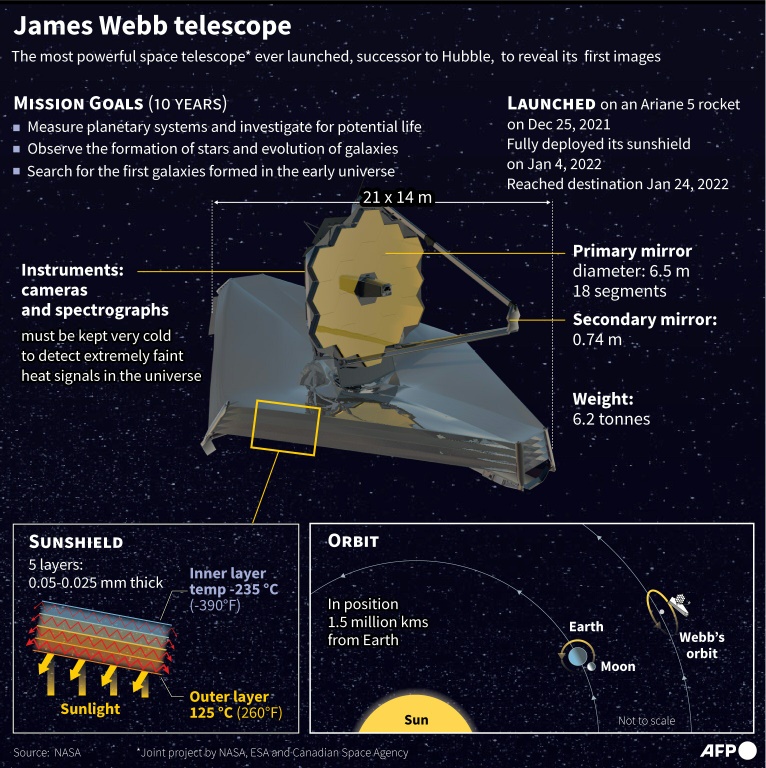
Launched in December 2021 from French Guiana on an Ariane 5 rocket, Webb is orbiting the Sun at a distance of a million miles (1.6 million kilometers) from Earth, in a region of space called the second Lagrange point.

Here, it remains in a fixed position relative to the Earth and Sun, with minimal fuel required for course corrections. 

A wonder of engineering, the total project cost is estimated at $10 billion, making it one of the most expensive scientific platforms ever built, comparable to the Large Hadron Collider at CERN.

Webb’s primary mirror is over 21 feet (6.5 meters) wide and is made up of 18 gold-coated mirror segments. Like a camera held in one’s hand, the structure must remain as stable as possible to achieve the best shots.

After the first images, astronomers around the globe will get shares of time on the telescope, with projects selected competitively through a process in which applicants and selectors don’t know each other’s identities, to minimize bias.

Thanks to an efficient launch, NASA estimates Webb has enough propellant for a 20-year life, as it works in concert with the Hubble and Spitzer space telescopes to answer fundamental questions about the cosmos.

James Webb Telescope to release more breathtaking cosmic views

After unveiling the clearest view yet of the distant cosmos, the James Webb Space Telescope has more to come. 

The next wave of images on Tuesday will reveal details about the atmosphere of a faraway gas planet, a “stellar nursery” where stars form, a “quintet” of galaxies locked in a dance of close encounters, and the cloud of gas around a dying star.

They will be published starting from 10:30 am Eastern Time (1430 GMT), in an event live streamed from the NASA Goddard Space Flight Center, just outside Washington.

Targets include Carina Nebula, a stellar nursery, famous for its towering pillars that include “Mystic Mountain,” a three-light-year-tall cosmic pinnacle captured in an iconic image by Hubble.

Webb has also carried out a spectroscopy — an analysis of light that reveals detailed information — on a gas giant planet called WASP-96 b, which was discovered in 2014.

Nearly 1,150 light-years from Earth, WASP-96 b is about half the mass of Jupiter and zips around its star in just 3.4 days.

On Monday, Webb revealed the clearest image to date of the early universe, going back 13 billion years, NASA said Monday.

The stunning shot, released in a White House briefing by President Joe Biden, is overflowing with thousands of galaxies and features some of the faintest objects observed.

Known as Webb’s First Deep Field, it shows the galaxy cluster SMACS 0723, which acts as a gravitational lens, bending light from more distant galaxies behind it towards the observatory, in a cosmic magnification effect.

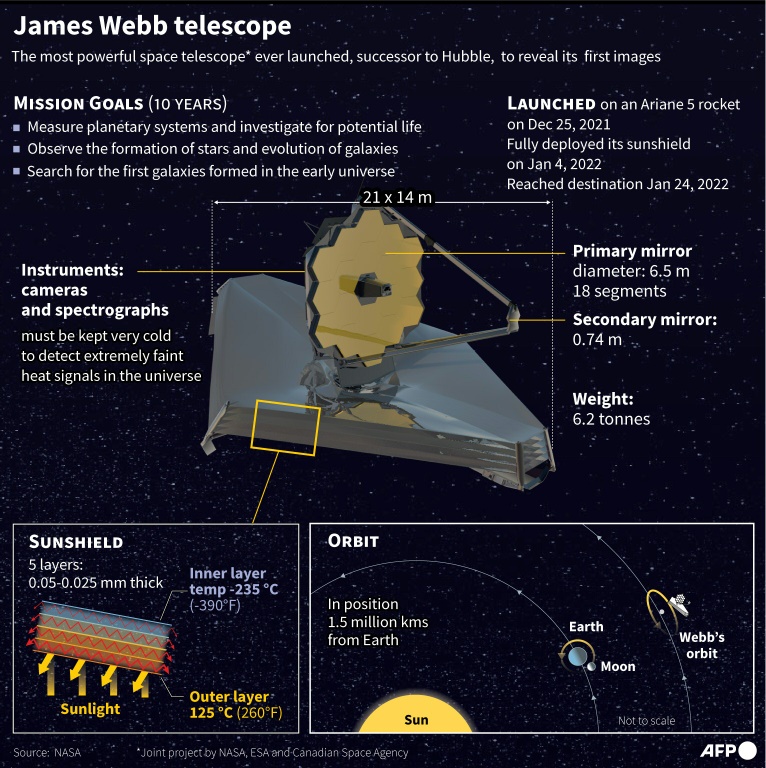
Launched in December 2021 from French Guiana on an Ariane 5 rocket, Webb is orbiting the Sun at a distance of a million miles (1.6 million kilometers) from Earth, in a region of space called the second Lagrange point.

Here, it remains in a fixed position relative to the Earth and Sun, with minimal fuel required for course corrections. 

A wonder of engineering, the total project cost is estimated at $10 billion, making it one of the most expensive scientific platforms ever built, comparable to the Large Hadron Collider at CERN.

Webb’s primary mirror is over 21 feet (6.5 meters) wide and is made up of 18 gold-coated mirror segments. Like a camera held in one’s hand, the structure must remain as stable as possible to achieve the best shots.

After the first images, astronomers around the globe will get shares of time on the telescope, with projects selected competitively through a process in which applicants and selectors don’t know each other’s identities, to minimize bias.

Thanks to an efficient launch, NASA estimates Webb has enough propellant for a 20-year life, as it works in concert with the Hubble and Spitzer space telescopes to answer fundamental questions about the cosmos.

James Webb Telescope to release more breathtaking cosmic views

After unveiling the clearest view yet of the distant cosmos, the James Webb Space Telescope has more to come. 

The next wave of images on Tuesday will reveal details about the atmosphere of a faraway gas planet, a “stellar nursery” where stars form, a “quintet” of galaxies locked in a dance of close encounters, and the cloud of gas around a dying star.

They will be published starting from 10:30 am Eastern Time (1430 GMT), in an event live streamed from the NASA Goddard Space Flight Center, just outside Washington.

Targets include Carina Nebula, a stellar nursery, famous for its towering pillars that include “Mystic Mountain,” a three-light-year-tall cosmic pinnacle captured in an iconic image by Hubble.

Webb has also carried out a spectroscopy — an analysis of light that reveals detailed information — on a gas giant planet called WASP-96 b, which was discovered in 2014.

Nearly 1,150 light-years from Earth, WASP-96 b is about half the mass of Jupiter and zips around its star in just 3.4 days.

On Monday, Webb revealed the clearest image to date of the early universe, going back 13 billion years, NASA said Monday.

The stunning shot, released in a White House briefing by President Joe Biden, is overflowing with thousands of galaxies and features some of the faintest objects observed.

Known as Webb’s First Deep Field, it shows the galaxy cluster SMACS 0723, which acts as a gravitational lens, bending light from more distant galaxies behind it towards the observatory, in a cosmic magnification effect.

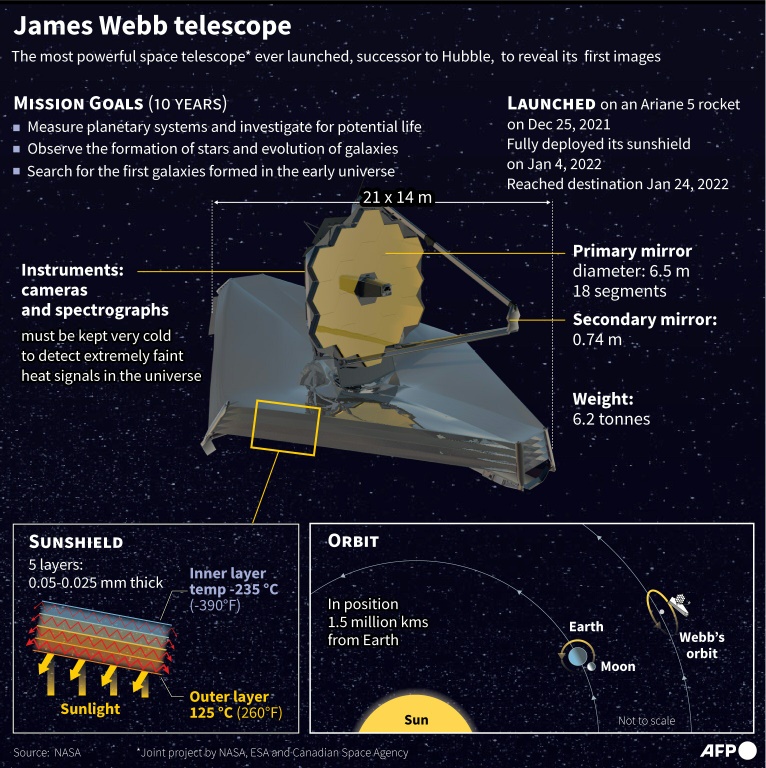
Launched in December 2021 from French Guiana on an Ariane 5 rocket, Webb is orbiting the Sun at a distance of a million miles (1.6 million kilometers) from Earth, in a region of space called the second Lagrange point.

Here, it remains in a fixed position relative to the Earth and Sun, with minimal fuel required for course corrections. 

A wonder of engineering, the total project cost is estimated at $10 billion, making it one of the most expensive scientific platforms ever built, comparable to the Large Hadron Collider at CERN.

Webb’s primary mirror is over 21 feet (6.5 meters) wide and is made up of 18 gold-coated mirror segments. Like a camera held in one’s hand, the structure must remain as stable as possible to achieve the best shots.

After the first images, astronomers around the globe will get shares of time on the telescope, with projects selected competitively through a process in which applicants and selectors don’t know each other’s identities, to minimize bias.

Thanks to an efficient launch, NASA estimates Webb has enough propellant for a 20-year life, as it works in concert with the Hubble and Spitzer space telescopes to answer fundamental questions about the cosmos.

Euro strikes dollar parity as eurozone recession fears mount

The euro struck parity with the dollar Tuesday for the first time in nearly 20 years as a cut in Russian gas supplies to Europe heightened fears of a recession in the eurozone. 

The European single currency hit exactly one dollar — its lowest level since December 2002 — before rising to $1.0023.

Oil prices meanwhile fell heavily on concerns of a wider recession as central banks hike interest rates to fight decades-high inflation.

European stock markets fell approaching the half-way mark and in the wake of overnight losses in Asia and on Wall Street.

“The gas crisis has really spooked markets over the eurozone economy,” Markets.com analyst Neil Wilson told AFP.

Russian energy giant Gazprom on Monday began 10 days of maintenance on its Nord Stream 1 pipeline — with Germany and other European countries watching anxiously to see if the gas comes back on.

With relations between Russia and the West at their lowest in years because of the invasion of Ukraine, Gazprom may not reopen the valves, according to analysts.

“The next few weeks could be challenging for Europe, with possibly maximum uncertainty stretching into August,” said SPI Asset Management’s Stephen Innes.

“Investors increasingly believe that gas may not start to flow through Nord Stream 1 again following the scheduled maintenance on July 11-21, with further ‘temporary’ interruptions seen as likely.”

Worries about a Covid flare-up in China — fuelling fears of more lockdowns — added to the downbeat mood, just as investors prepared for a week of economic data and corporate earnings that could have huge implications for markets.

A forecast-beating US jobs report last week suggested the world’s top economy was coping with higher Federal Reserve rates, but it also gave the central bank more room to continue tightening — leading to concerns it could go too far and cause a contraction.

The European single currency is also under pressure from the Federal Reserve hiking US interest rates more aggressively than the European Central Bank.

The dollar has jumped 14 percent against the euro since the start of the year.

Central banks are increasing borrowing costs in a bid to tame inflation, which has been fuelled by soaring energy prices.

Oil and gas prices have rocketed this year after economies reopened from Covid lockdowns and following the invasion of Ukraine by major energy producer Russia.

– Key figures at around 1015 GMT –

Euro/dollar: DOWN at $1.0023 from $1.0041 Monday

Pound/dollar: DOWN at $1.1847 from $1.1892 

Euro/pound: UP at 84.60 pence from 84.38 pence

Dollar/yen: DOWN at 136.91 yen from 137.41 yen

West Texas Intermediate: DOWN 2.4 percent at $101.55 per barrel

Brent North Sea crude: DOWN 2.5 percent at $104.47 per barrel

London – FTSE 100: DOWN 0.4 percent at 7,170.27 points

Frankfurt – DAX: DOWN 0.8 percent at 12,724.46

Paris – CAC 40: DOWN 0.4 percent at 5,972.14

EURO STOXX 50: DOWN 0.7 percent at 3,447.68

Tokyo – Nikkei 225: DOWN 1.8 percent at 26,336.66 (close)

Hong Kong – Hang Seng Index: DOWN 1.3 percent at 20,844.74 (close)

Shanghai – Composite: DOWN 1.0 percent at 3,281.47 (close)

New York – Dow: DOWN 0.5 percent at 31,173.84 (close)

Kyiv says hits Russian arms depot in south Ukraine

Kyiv said Tuesday it had launched a barrage of rockets and missiles on Russian military targets in southern Ukraine and destroyed an arms depot, in attacks that Moscow-backed authorities said had damaged homes.

The bombardment overnight in the Kherson region — which Russian forces captured soon after they invaded in late February — come as Kyiv’s army tries to claw back territory in the south of the country.

Ukrainian military officials said the strikes had destroyed artillery, armoured vehicles “and a warehouse with ammunition in Nova Kakhovka”.

Russian-backed authorities in the city however said Ukrainian strikes had damaged civilian infrastructure and left at least seven people dead, a toll that could not be independently verified.

“There are no military targets here… warehouses were hit, as were shops, a pharmacy, petrol stations and even a church,” the head of the city’s Moscow-backed administration, Vladimir Leontiev, said on social media.

Images published by the Moscow-backed authorities showed several buildings reduced to ash.

The Ukrainian army has for several weeks been waging a counter-offensive on the southern Kherson front, while Russian troops have been focusing on the country’s east.

The deputy head of the pro-Russian authorities in Kherson, Ekaterina Gubareva, accused Ukraine of having used long-range, precision artillery systems supplied by the United States in the strikes in Nova Kakhovka.

– Strikes on medical facilities –

Ukraine has pleaded for sophisticated artillery systems from Western allies to fend of Russian forces, arguing only these weapons could turn the tide of the fighting.

Now military analysts are crediting the newly arrived systems — including Caesars from France and HIMARS from the United States — with attacks deeper in Russian-controlled territory in Ukraine, including on ammunition depots.

During a visit to Kyiv on Monday, Dutch prime minister Mark Rutte said that the Netherlands too would sent more advanced artillery to the front lines.

The United States however cautioned that Moscow was also receiving a weapons boost, with Iran planning to supply hundreds of drones with combat weapon capabilities to Russia for use in Ukraine, a top US official said Monday.

Russian forces early Tuesday launched “massive” strikes on the southern Ukrainian city of Mykolaiv, with missiles hitting two medical facilities and residential buildings, the city’s mayor Oleksandr Sienkevych said.

The regional head, Vitaliy Kim, said 12 people were wounded in those attacks.

– Russian passports –

The epicentre of fighting in Ukraine in recent weeks has however been the industrial east of the country, known as the Donbas, where Moscow’s forces have slowly advanced despite fierce resistance and recent Russian strikes have left dozens dead.

Moscow has concentrated its efforts on the region since failing to capture Kyiv after its February 24 invasion.

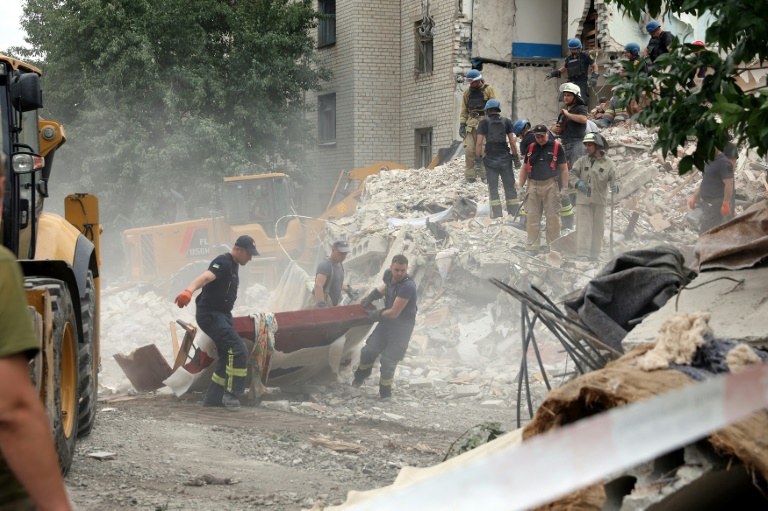
Two days after Russian bombardment reduced a residential building in the eastern town of Chasiv Yar to rubble, rescue workers were still clearing the debris and retrieving bodies from the wreckage Tuesday.

The head of the Donetsk region, which has been partially controlled by Moscow-backed separatists since 2014, said that 34 people had so far been confirmed killed by the attack on Sunday.

Nine people were recovered alive, Pavlo Kyrylenko said.

The Kremlin has been working to consolidate its hold over territories it controls like Kherson, both militarily and bureaucratically since the beginning of the conflict.

After Russian President Vladimir Putin on Monday passed a decree fast-tracking Russian passports for all Ukrainians, Foreign Minister Sergei Lavrov was expected Tuesday to open a representative office for separatist authorities in Moscow.

burs-jbr/ah

Pacific leaders struggle to keep focus on climate at key summit

US-China rivalry and an inter-island rift overshadowed the start of a landmark Pacific summit Tuesday, hampering efforts to focus world attention on the islands’ dire climate crisis.

This year’s Pacific Islands Forum is the region’s most important meeting in years, coming after a Covid-enforced hiatus and as low-lying tropical isles run out of time for climate action.

Fiji president and forum chair Voreqe Bainimarama opened Tuesday’s first meeting with a warning that the “runaway climate change crisis” threatened the security and sovereignty of many Pacific nations.

But instead of a singular focus on the threat of rising sea levels and ever-more-powerful storms, a shock decision by Beijing-allied leaders in Kiribati to quit the forum altogether, revealed on the eve of the summit, loomed over proceedings.

Geopolitical jostling between the United States and China has been building since Solomon Islands controversial signed a security pact with Beijing in April. 

United States Vice President Kamala Harris announced Tuesday that she would make an unprecedented video appearance at the summit — usually restricted to Pacific nations, Australia and New Zealand.

– ‘Fight this emergency’ –

Leaders gathered at Suva’s luxurious Grand Pacific Hotel will discuss a strategy to guide the Pacific through to 2050, keenly focused on the existential threat posed by climate change.

They will also debate announcing a climate emergency in the Pacific and whether to endorse a push, spearheaded by Vanuatu, to ask the International Court of Justice to weigh in on nations’ climate obligations.

Vanuatuan prime minister Bob Loughman said Tuesday that the people of the region “are calling on us, Pacific leaders, to take action to fight this emergency”.

But Kiribati’s exit from the forum has sparked concerns about a fracturing of the Pacific’s closely held unity, which gives the region of small island states heft in global climate negotiations.

Tuvaluan foreign minister Simon Kofe told AFP he was “surprised and saddened” by Kiribati’s departure, but was optimistic the nation could be enticed to rejoin.

Last year, Kofe made headlines when he addressed the COP summit standing knee-deep in water to draw attention to the threat climate change poses to his low-lying nation, which may disappear below rising seas in the next 50 years.

Faced with such a threat, his priority at the summit is climate change — Tuvalu will be pushing for a focus on statehood and climate financing. 

Concerns about regional security — brought to the fore by the Solomons-China pact — “draw a bit of attention away from climate change”, Kofe said.

– Security versus climate –

The summit will be a test of Australia’s newly elected Prime Minister Anthony Albanese, who has pledged to do more on climate and to heal his country’s fractured relationship with the Pacific.

At the last Pacific Islands Forum leaders’ meeting, held in 2019, negotiations descended into shouting and tears as Australia’s former government attempted to muzzle leaders who wanted to issue a global call for climate action.

But Albanese also wants to use the summit to raise his concerns about security developments in the region in the wake of the Solomons-China deal.

Speaking to media Tuesday, the leader sought to knit the issues of climate and security together.

“Our neighbours in the Pacific understand that climate change is a national security issue,” he told a press conference in Sydney.

Close Bitnami banner
Bitnami